


R
Species Profile

Roadrunners

Geococcyx

Desert cuckoos built for the fast lane
Dennis W Donohue/Shutterstock.com
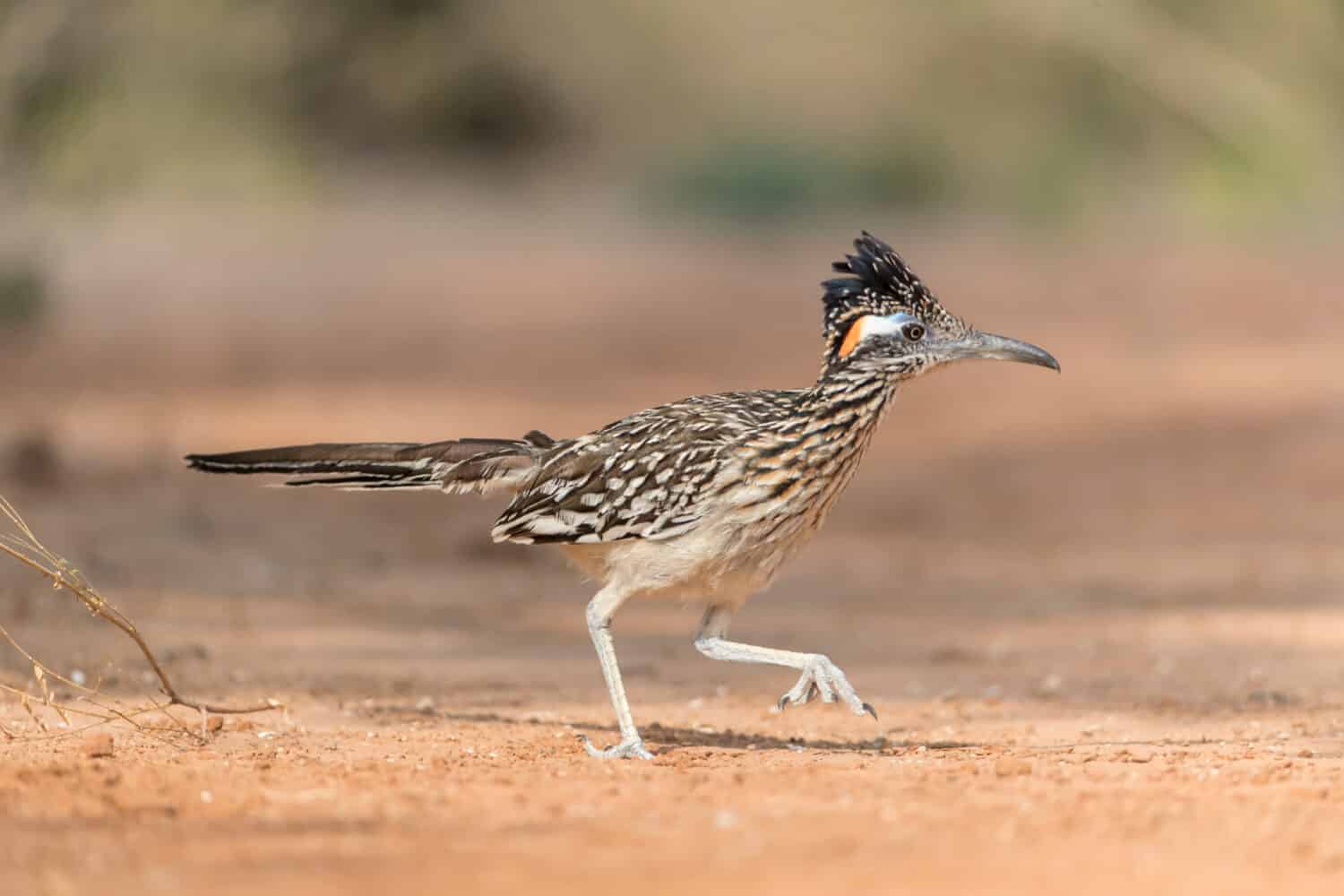
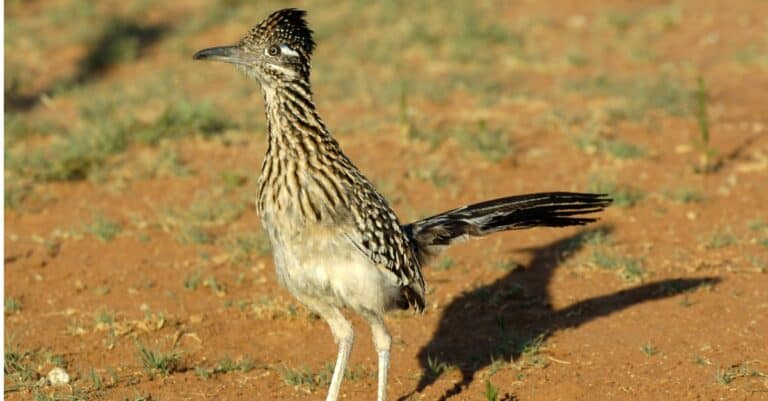
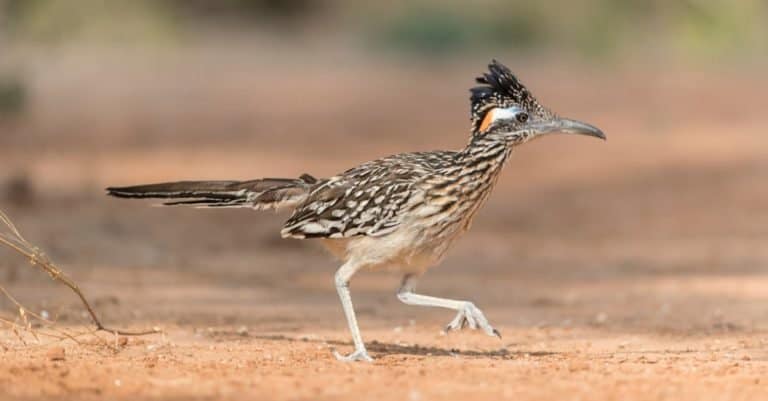
Greater Roadrunner in Texas Desert

At a Glance

Genus Overview This page covers the Roadrunners genus as a group. Stats below are general traits shared across the genus.
Also Known As Greater roadrunner, Lesser roadrunner, Paisano, Chaparral cock, Ground cuckoo
Diet Omnivore
Activity Diurnal+
Weight 0.43 lbs
Status Least Concern
Did You Know?

Across Geococcyx, adults run about 46-62 cm long and roughly 190-540 g.

Scientific Classification

Genus Overview "Roadrunners" is not a single species but represents an entire genus containing multiple species.

Roadrunners are terrestrial cuckoos in the genus Geococcyx, adapted for fast running and hunting on the ground. The genus contains two species (Greater and Lesser roadrunner) that inhabit arid and semi-arid landscapes of North and Central America.

Kingdom
Animalia
Phylum
Chordata
Class
Aves
Order
Cuculiformes
Family
Cuculidae
Genus
Geococcyx

Distinguishing Features

  • Long legs built for running
  • Long tail used for balance
  • Zygodactyl feet (two toes forward, two back)
  • Predatory diet including insects and small vertebrates

Physical Measurements

Length
1 ft 10 in (1 ft 6 in – 2 ft)
Weight
1 lbs (0 lbs – 1 lbs)
Tail Length
9 in (7 in – 11 in)
Top Speed
25 mph
running

Appearance

Primary Colors
Secondary Colors
Skin Type Feathers
Distinctive Features
  • Long, graduated tail used for balance while sprinting.
  • Shaggy erectile crest, raised during display or alarm.
  • Long, sturdy legs and large feet adapted for rapid running.
  • Zygodactyl toes typical of cuckoos; strong ground grip.
  • Slightly decurved, robust bill suited for seizing prey.
  • Pale underparts with darker, streaked upperparts for camouflage.
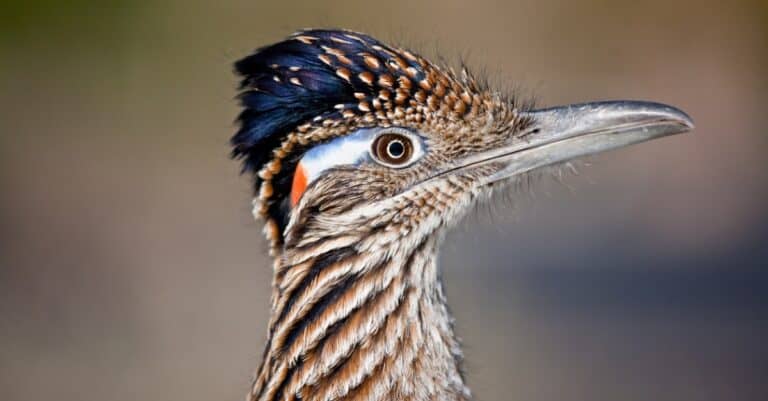
  • Bare facial skin around eye; contrasts with feathered head.
  • Genus size range about 46-61 cm total length.
  • Typical lifespan roughly 6-14 years across wild-to-captivity reports.
  • Diurnal ground-hunting in arid scrub; diet varies from insects to reptiles.
  • Greater generally larger and heavier; Lesser typically smaller and paler.
  • Both species favor open habitats; Lesser more tropical thorn-scrub influence.

Sexual Dimorphism

Sexes are very similar in plumage and patterning across both species; differences are subtle. Males average slightly larger and may show slightly more pronounced display posture/crest use, but field separation by sex is unreliable.

  • Average slightly larger body size and bill dimensions.
  • Average slightly smaller body size; plumage typically indistinguishable.

Did You Know?

Across Geococcyx, adults run about 46-62 cm long and roughly 190-540 g.

The genus has only two species: larger, more northern Greater; smaller, more tropical Lesser roadrunner.

Both are ground-hunting cuckoos that eat insects, lizards, rodents, and sometimes small snakes.

Zygodactyl feet leave distinctive X-shaped tracks, inspiring protective track symbols in Southwestern Indigenous art.

Roadrunners can tackle venomous prey by rapid strikes and repeated beating against the ground.

Lifespan varies with conditions: often about 7-8 years in the wild, longer in captivity.

They favor arid and semi-arid scrub, from U.S. deserts to thornscrub in Mexico and Central America.

Unique Adaptations

  • Long, powerful legs and a balancing tail enable fast running and sharp turns in open desert terrain.
  • Zygodactyl toes improve grip on loose ground and branches, useful for both sprinting and nesting.
  • Omnivorous digestion lets them switch between insects, fruit, and vertebrates as seasonal food pulses change.
  • They can meet much of their water needs from prey, an advantage in dry landscapes with few pools.
  • Bright bare skin patches near the eye are used in courtship and threat displays, flashing color at close range.

Interesting Behaviors

  • They hunt by walking, then sprinting in bursts, grabbing prey with the bill and pummeling it.
  • Territorial adults use low coos, bill clacks, and raised crest-and-tail displays to warn rivals.
  • Both species perch to scan, but spend most time on the ground, flying mainly to reach nests.
  • Greater Roadrunners often exploit roadsides and suburbs; Lesser Roadrunners more often keep to thornscrub and savanna edges.
  • During cool mornings they sun-bathe with feathers drooped; in heat they shade-seek and pant.

Cultural Significance

The Greater Roadrunner is New Mexico's state bird; across the U.S.-Mexico borderlands, roadrunners appear in Indigenous designs, tourism, and sports branding, and in cartoons as icons of speed.

Myths & Legends

Among several Pueblo peoples, the roadrunner's X-shaped tracks were drawn near homes to confuse or ward off harmful spirits.

Traditional Southwestern stories sometimes cast Roadrunner as a clever, fast figure who outwits predators and rivals through speed and alertness.

Spanish-speaking settlers nicknamed the bird "paisano," a 'countryman,' and the term became a regional emblem in desert communities.

In 20th-century American pop culture, Warner Bros.' Road Runner became a modern folk icon, turning the real bird into a symbol of unstoppable speed.

Conservation Status

LC Least Concern (genus-wide: both species are currently assessed as LC, though some regions show local declines and edge-of-range contractions)

Widespread and abundant in the wild.

Population Decreasing

Protected Under

  • Migratory Bird Treaty Act
  • Mexican wildlife law

You might be looking for:

Greater roadrunner

55%

Geococcyx californianus

The best-known roadrunner species; widespread in the southwestern U.S. and Mexico, often associated with desert and scrub habitats.

View Profile

Lesser roadrunner

45%

Geococcyx velox

A more southern, generally smaller roadrunner species found mainly in Mexico and parts of Central America in thorn scrub and dry forest.

View Profile

Life Cycle

Birth 4 chicks

Lifespan

In the Wild
0 years
In Captivity
10–15 years

Reproduction

Mating System Monogamy
Social Structure Socially Monogamous
Breeding Season late winter through midsummer; varies by rainfall
Breeding Pattern Long Term
Fertilization Internal Fertilization
Birth Type Internal_fertilization

Across Geococcyx, adults typically form territorial male-female pairs; both sexes court, defend a home range, and share incubation and chick-feeding. Pair bonds often persist across breeding seasons, though mate switching and occasional extra-pair mating may occur.

Behavior & Ecology

Social Family Group: 2
Activity Diurnal, Crepuscular
Diet Omnivore lizards

Temperament

Territorial
Wary
Opportunistic
Bold
Aggressive

Communication

low coos
cooing series
rattles
chattering notes
bill clatter
crest and tail displays
wing-droop threat display
posture and head-bobbing
chases and countersinging

Habitat

Biomes:
Desert Hot Desert Cold Mediterranean Temperate Grassland Savanna Tropical Dry Forest Temperate Forest Wetland Freshwater +3
Terrain:
Plains Plateau Valley Hilly Mountainous Rocky Sandy Coastal +2
Elevation: Up to 8530 ft 2 in

Ecological Role

Mesopredators controlling desert arthropods and small vertebrates

pest control trophic regulation seed dispersal

Diet Details

Main Prey:
Other Foods:
Cactus fruits (prickly pear) Berries Seeds and grain

Human Interaction

Domestication Status

Wild

Geococcyx roadrunners (2 wild species) have no domestication history. They have been interacted with mainly through cultural symbolism, incidental coexistence in arid settlements, and occasional (generally illegal) capture; they were never selectively bred for food, labor, or companionship.

Danger Level

Low
  • Painful pecks or scratches if handled
  • Rare defensive bites when cornered
  • Minor zoonotic disease risk from feces
  • Traffic collisions from roadside foraging

As a Pet

Not Suitable as Pet

Legality: Generally illegal: native wildlife protected; permits only.

Care Level: Expert Only

Purchase Cost:
Lifetime Cost: $5,000 - $30,000

Economic Value

Uses:
Tourism Education Research Culture

Relationships

Related Species 4

Yellow-billed cuckoo Coccyzus americanus Shared Family
Common cuckoo Cuculus canorus Shared Family
Guira cuckoo Guira guira Shared Family
Greater ani Crotophaga major Shared Family

Types of Roadrunners

2

Explore 2 recognized types of roadrunners

Quick Take

  • Everything you think you know about roadrunners from cartoons is wrong, and the reality is far stranger. See how reality differs →
  • Roadrunners have a method for taking down rattlesnakes that requires a partner, and the strategy is surprisingly calculated. Explore the rattlesnake tactic →
  • The materials roadrunners weave into their nests include something most birds would never go near. Discover the nest materials →
  • Roadrunners share an ancient lineage with something that walked the earth 150 million years ago, a connection supported by fossil evidence that turned up in a famous California landmark. Trace the ancient lineage →

The roadrunner is a large ground bird in the cuckoo family (Cuculidae), native to North and Central America. It is known for its remarkable running speed and adaptability to desert environments. Roadrunners are recognized for their distinctive crests and hunting abilities. However, unlike their well-known cartoon portrayal, real roadrunners cannot keep up with a coyote.

An educational infographic about roadrunners with maps, bird anatomy diagrams, and facts about their 20 MPH top speed and rattlesnake-hunting techniques.
Think you know the Roadrunner? From cooperative rattlesnake hunting to the truth about their 'meep-meep' sounds, the reality of this desert survivor is even wilder than the cartoon. © A-Z Animals

Species

The Geococcyx genus comprises two roadrunner species:

  • The Greater Roadrunner (Geococcyx californianus) — Can be found in Mexico and the southwestern and southcentral United States.
  • The Lesser Roadrunner (G. velox) — Native to Mexico and Central America. The Lesser Roadrunner is slightly smaller than the Greater and has a smaller bill and fewer streaks.

Where to Find Roadrunners

Roadrunners live in North and Central American countries, including Mexico, the United States, El Salvador, Guatemala, Honduras, and Nicaragua. The greater roadrunner resides in Mexico and the Southwestern and South-Central United States, and the lesser roadrunner lives in Mexico and Central America. They inhabit chaparrals — regions of dense, shrubby plants that have adapted to dry, hot summers and rainy, mild winters. Roadrunners do not migrate, staying in their environments year-round. Look for these birds on the ground, walking or running as they search for food.

Evolution

Like all modern birds, roadrunners evolved from theropod dinosaurs, with avian origins dating back about 150 million years to Archaeopteryx. The cuckoo lineage likely diverged tens of millions of years later. A range of birds with more “bird-like” features appeared after Archaeopteryx and gave rise to modern birds in the Late Cretaceous. Bird-like dinosaurs, primitive birds, and early modern birds all co-existed for a time. Fossils of modern roadrunners from the Late Pleistocene (about 30,000 to 40,000 years ago) have been discovered in California’s La Brea Tar Pits.
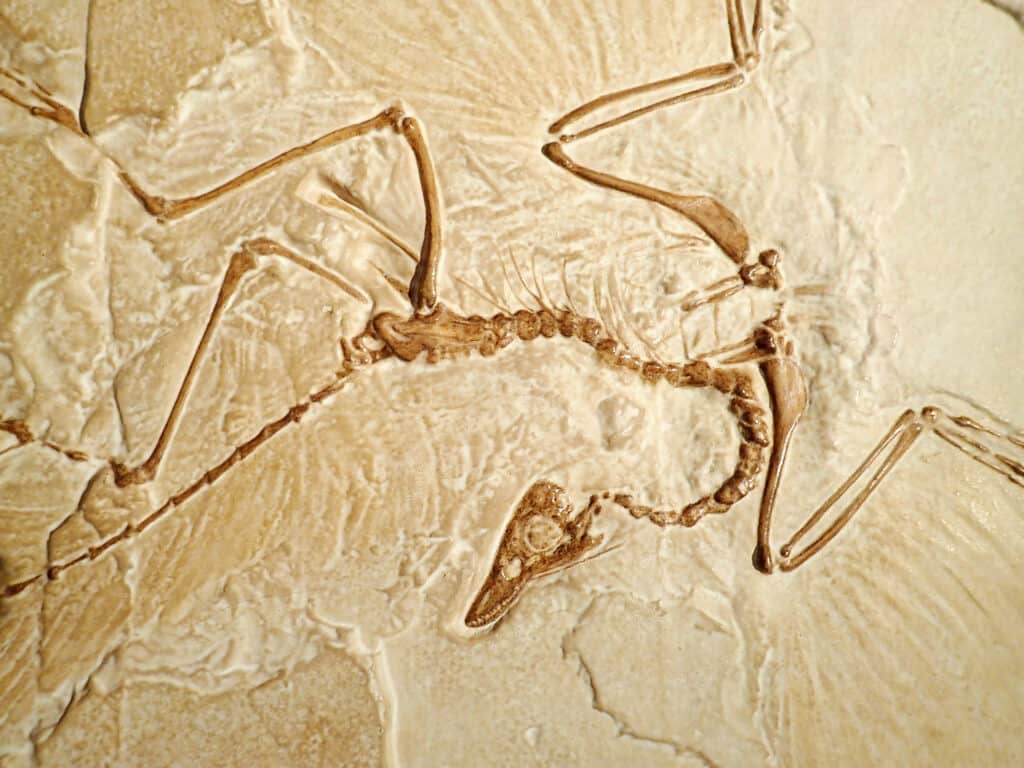
Fossilized Archaeopteryx, a transitional fossil between dinosaur and modern birds remains in stone.

Archaeopteryx is a transitional fossil between dinosaurs and modern birds, dating 150 million years ago.

Size, Appearance, & Behavior

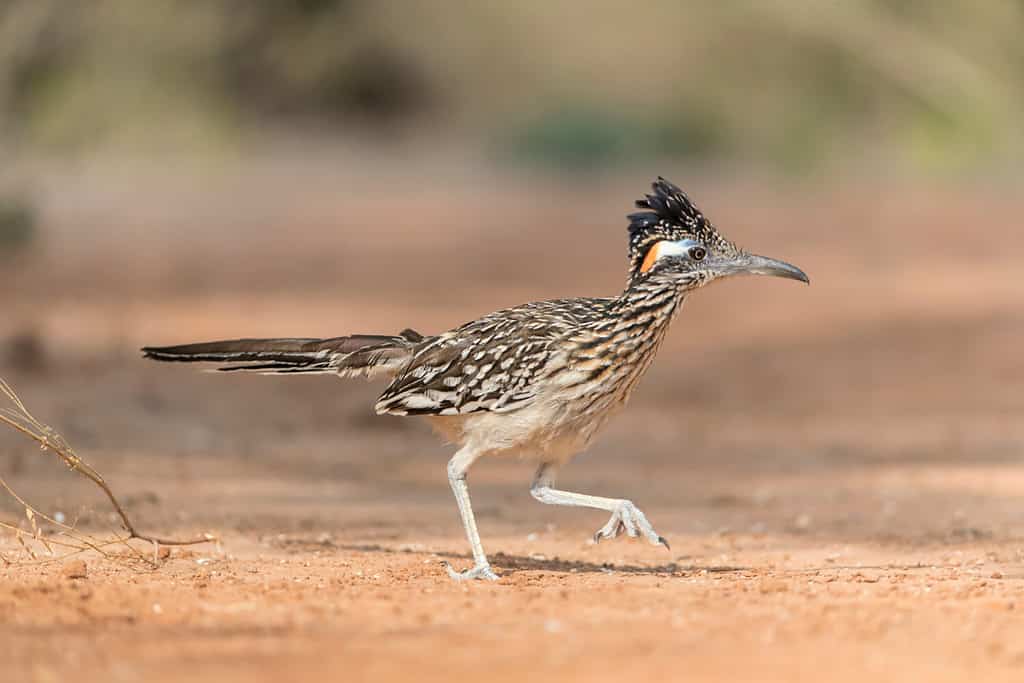
Roadrunners are large ground cuckoos, measuring 20 to 24 inches and weighing about 7.8 to 19 ounces, with a 17- to 24-inch wingspan. These birds feature slender bodies, long legs, broad tails, and large bills. They are black and brown with white streaks and feature a distinctive head crest. Roadrunners also have bare skin patches behind each eye in shades of blue and red.

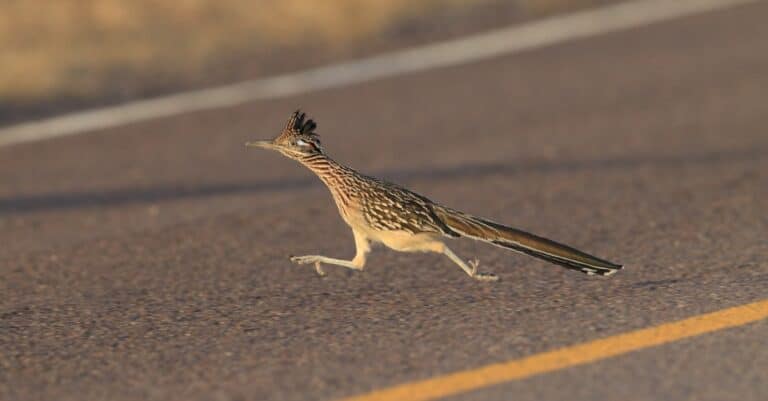
The roadrunner’s lightweight, streamlined body reduces air resistance during fast sprints, enhancing its ability to maintain high speeds. These birds and other cuckoos have zygodactyl feet (two toes forward, two backward) that aid in gripping and maneuverability; they leave distinctive X-shaped tracks and helping them maneuver quickly on rough terrain. Roadrunners’ speed primarily comes from their long, strong legs and digitigrade posture.
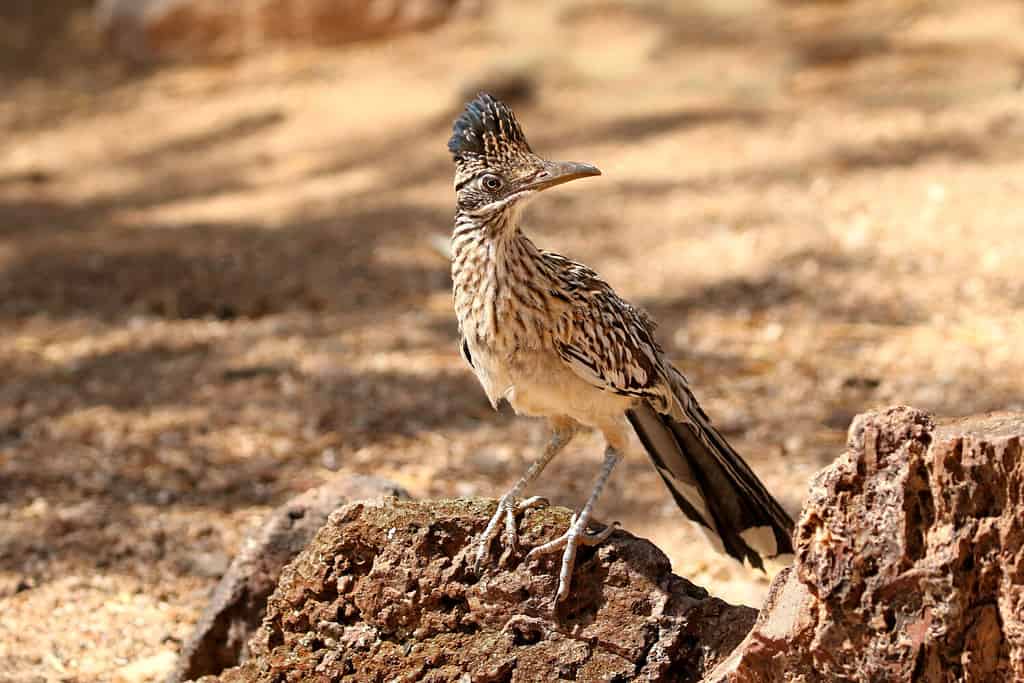
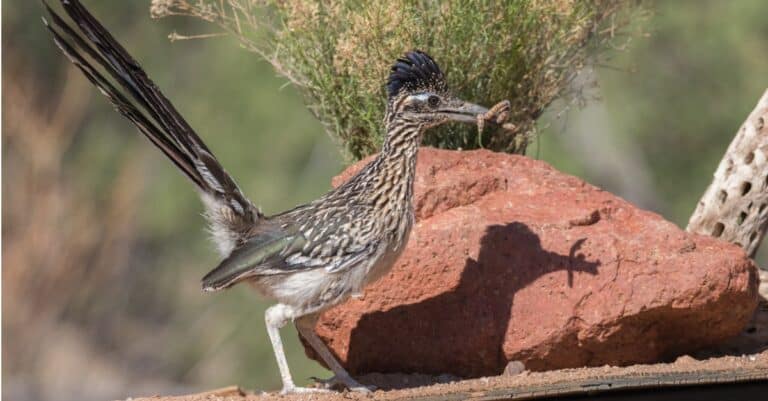
Greater Roadrunner on rocks looking for next meal

Roadrunners inhabit arid chaparral environments.

Roadrunners are relatively solitary and prefer to be alone or in pairs. A group of roadrunners is playfully called a “marathon,” though the term isn’t officially recognized. These birds make a slow, downward-slurring dove-like coo (not “meep meep”). They can also make rapid clattering sounds with their beaks. Roadrunners are capable fliers but prefer to spend most of their time running on the ground. The roadrunner can reach speeds of up to 20 mph.

Diet

The roadrunner is an opportunistic omnivore that primarily eats insects and small reptiles. 

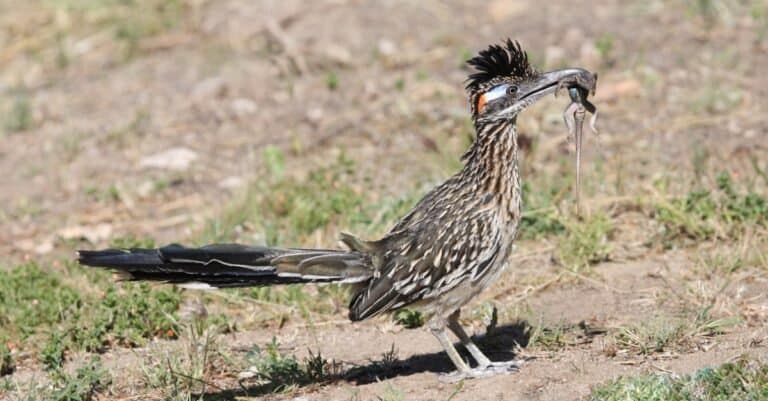
The roadrunner’s diet consists of crickets, grasshoppers, caterpillars, beetles, lizards, snakes, rodents, spiders, scorpions, centipedes, snails, small birds, eggs, fruits, and seeds. They occasionally take dangerous prey such as small rattlesnakes or even tarantula hawk wasps.
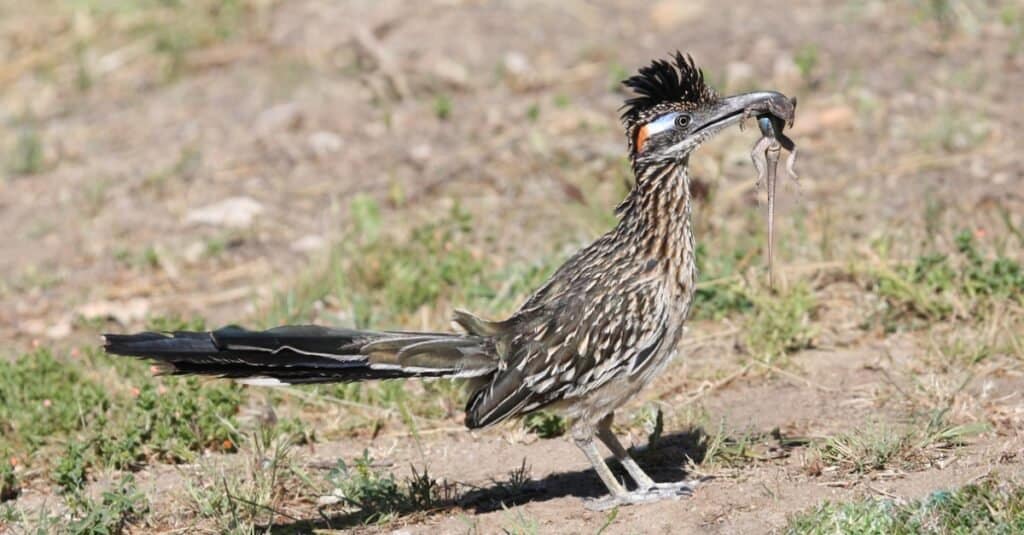
What Do Roadrunners Eat?

Roadrunners are omnivores that eat small mammals, lizards, and snakes.

The roadrunner hunts on the ground, hiding under cover and running after prey. It will leap into the air to catch insects and then smash them against the ground. A pair of roadrunners will sometimes work together to take down a rattlesnake. While one bird focuses on keeping the snake’s attention by jumping up and down and flapping its wings, the other bird circles around to attack from behind. Roadrunners rely on their agility and speed to avoid strikes while repeatedly pecking the snake or using their strong beaks to grab and kill it.

Predators

Roadrunner predators include coyotes, raccoons, skunks, domestic cats, hawks, and other birds of prey. Although roadrunners are known for their speedy sprints, they often fly away from predators. Unlike in the cartoon, roadrunners are no match for the Wile E. Coyote, which can run over 40 mph.
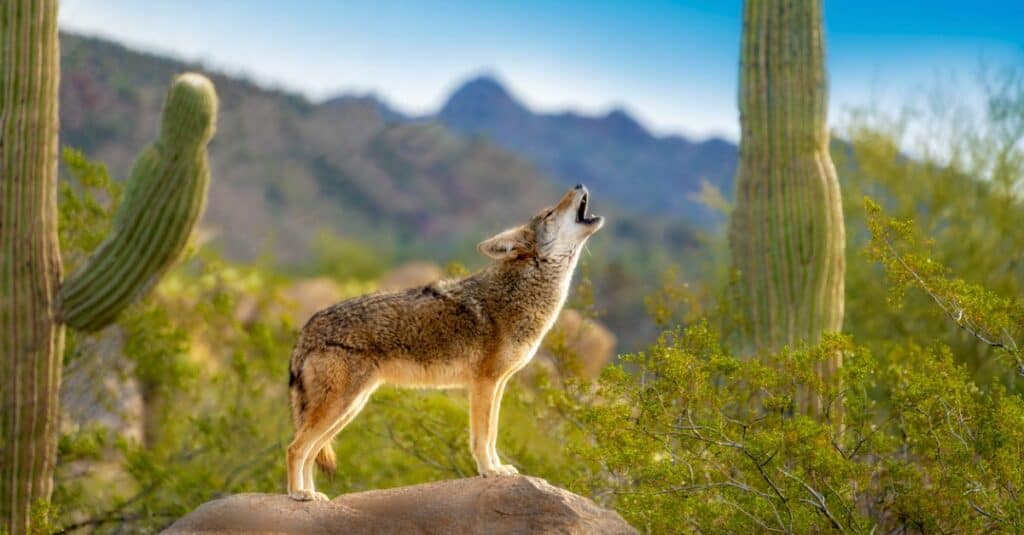
coyote howling from on top of a rock

Unlike their cartoon counterpart, Coyotes can outrun roadrunners and are major predators.

Reproduction, Maturation, and Lifespan

Roadrunner pairs are monogamous and mate for life, defending their territories together all year. During courtship, males perform displays and dangle food from their bills to entice the females. Once pairs form, their reproductive season lasts from spring to mid-summer. Females lay two to six white eggs, and both parents take turns incubating for 19 to 20 days. Their young fledge the nest two to three weeks after hatching but continue to forage with their parents for a few more days. They become sexually mature around two to three years old. Roadrunners have an average lifespan of 3.5 years, though some live up to seven or eight years.

Nesting
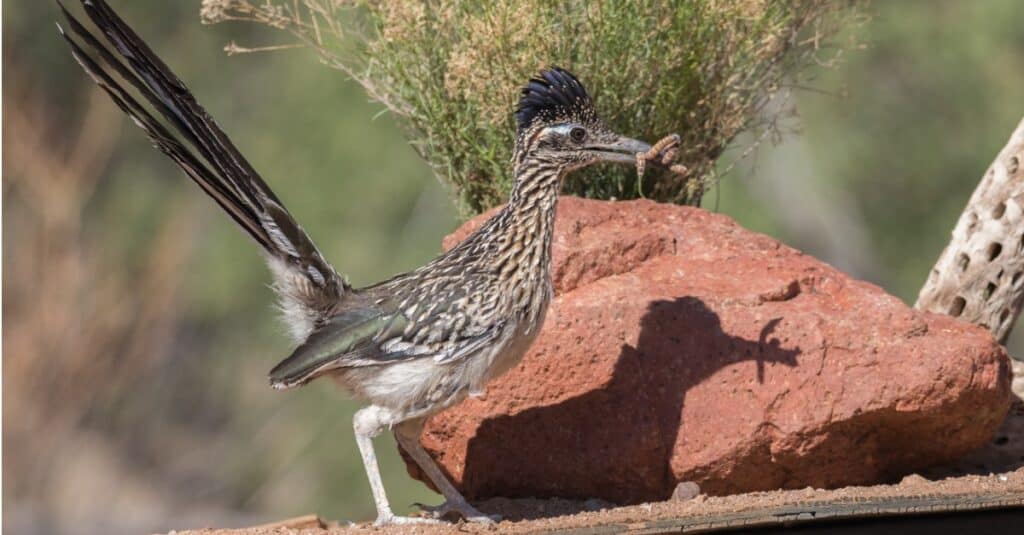
What Do Roadrunners Eat?

During courtship, male roadrunners dangle food from their bills to entice females.

Roadrunners build their bowl-shaped nests with sticks, leaves, feathers, snakeskins, and dung. They place the nests in a tree, shrub, or cactus three to ten feet above the ground. Both males and females participate in nest-building, with males typically gathering materials while females arrange them.

Population

The total global roadrunner population is unknown, but the lesser roadrunner alone has an estimated 500,000 to 5 million mature individuals. Data trends show both species have stable populations with no extreme fluctuations or fragmentation.
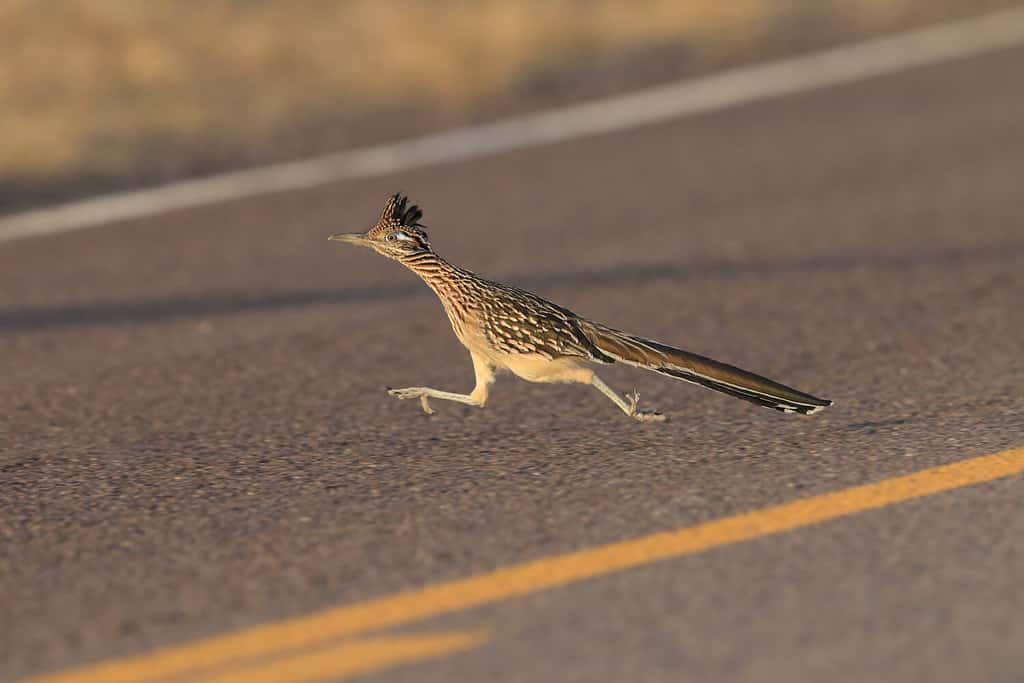
Roadrunner Bosque del Apache wildlife refuge in New Mexico.

Roadrunners are speedy members of the cuckoo family.

Threats and Conservation Status

The IUCN lists both species of roadrunner as LC or “least concern.” Due to their extensive range and large, stable population, these species do not meet the “threatened” status thresholds. Their biggest threats include illegal shooting, habitat loss, and habitat fragmentation from urbanization (development and traffic).

View all 183 animals that start with R

Sources

  1. International Union for Conservation of Nature Red List / Accessed November 1, 2022
  2. International Union for Conservation of Nature Red List / Accessed November 1, 2022
  3. Maxon, Martha Anne (2005) The Real Roadrunner. Vol. 9. University of Oklahoma Press, 2005. / Accessed November 1, 2022
  4. National Wildlife Federation / Accessed November 1, 2022
Abby Parks

About the Author

Abby Parks

Abby Parks has authored a fiction novel, theatrical plays, short stories, poems, and song lyrics. She's recorded two albums of her original songs, and is a multi-instrumentalist. She has managed a website for folk music and written articles on singer-songwriters, folk bands, and other things music-oriented. She's also a radio DJ for a folk music show. As well as having been a pet parent to rabbits, birds, dogs, and cats, Abby loves seeking sightings of animals in the wild and has witnessed some more exotic ones such as Puffins in the Farne Islands, Southern Pudu on the island of Chiloe (Chile), Penguins in the wild, and countless wild animals in the Rocky Mountains (Big Horn Sheep, Mountain Goats, Moose, Elk, Marmots, Beavers).
Connect:

Thank you for reading! Have some feedback for us?


Roadrunners FAQs (Frequently Asked Questions)

Roadrunners live in North America in six countries, including Mexico, the United States, El Salvador, Guatemala, Honduras, and Nicaragua. They inhabit arid lowland and mountain shrublands and woodlands.