C
Species Profile

Crabeater Seal

Lobodon carcinophaga

The krill-sieving seal of the pack ice
Anton Rodionov/Shutterstock.com

Crabeater Seal Distribution

Click a location to explore more animals from that region

Endemic Species

This map shows coastal regions where Crabeater Seal are found.

Loading map...
crabeater seal laying on ice

At a Glance

Wild Species
Diet Carnivore
Activity Cathemeral
Lifespan 25 years
Weight 300 lbs
Status Least Concern
Did You Know?

Despite the name, its diet is dominated by Antarctic krill, often reported as >90% of prey by mass in stomach-content studies (e.g., Laws 1977).

Scientific Classification

The crabeater seal is an Antarctic true seal best known for its highly specialized teeth used to strain krill from the water; despite its name, it primarily eats Antarctic krill rather than crabs.

Kingdom
Animalia
Phylum
Chordata
Class
Mammalia
Order
Carnivora
Family
Phocidae
Genus
Lobodon
Species
Lobodon carcinophaga

Distinguishing Features

  • Sieve-like, multi-cusped cheek teeth adapted for filtering krill
  • Slender head and long muzzle relative to many other phocids
  • Pale to silvery coat often with scars (commonly from leopard seal encounters)
  • Strong association with pack ice; often seen in groups on ice floes

Physical Measurements

Males and females differ in size

Length
♂ 7 ft 10 in (6 ft 11 in – 8 ft 6 in)
♀ 7 ft 10 in (7 ft 3 in – 8 ft 6 in)
Weight
♂ 507 lbs (375 lbs – 661 lbs)
♀ 551 lbs (441 lbs – 661 lbs)
Top Speed
16 mph
Crabeater seal: ~25 km/h

Appearance

Primary Colors
Secondary Colors
Skin Type Fur-bearing marine mammal skin (short, dense coat over a thick blubber layer); prominent vibrissae (whiskers) on the muzzle for tactile sensing under ice and in the water.
Distinctive Features
  • Highly specialized post-canine teeth with multiple cusps that interlock to form a sieve for filtering Antarctic krill; teeth adapted for krill-filter feeding rather than tearing large prey.
  • Long, relatively narrow head and muzzle compared with many other phocids; large, dark eyes adapted to Antarctic light conditions and under-ice foraging.
  • Streamlined true-seal body with small external ear openings (no pinnae) and strong hind flippers used as the main propulsive surface in swimming; foreflippers shorter with claws used on ice.
  • Frequent visible scars, rake marks, and healed wounds are common in adults-often attributed to attempted predation by leopard seals; scarring can be a key field cue in pack-ice areas.
  • Adult size (appearance-relevant): typically ~2.2-2.6 m total length and ~200-300 kg body mass (reported in field guides and pinniped references such as King 1983; variability by region/season).
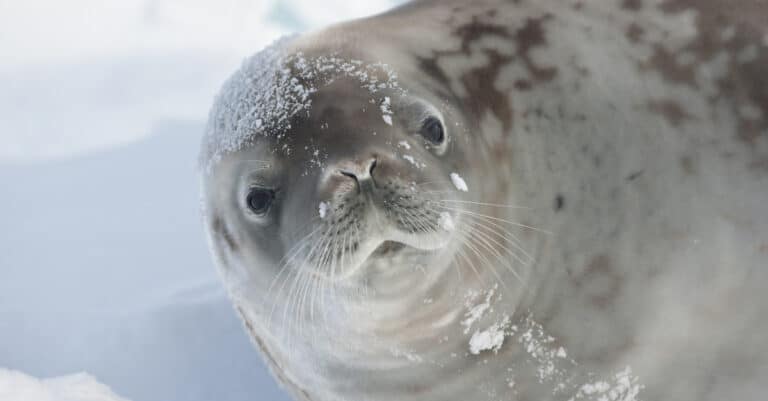
  • Pack-ice ecology reflected in appearance/condition: individuals hauled out on sea ice often show frost/snow on fur; body condition and molting state vary seasonally with Antarctic ice dynamics.
  • Seasonal molt: like other phocids, undergoes an annual molt; freshly molted animals look cleaner and more 'silver,' while later-stage coats can appear duller or stained.

Sexual Dimorphism

Sexual dimorphism is subtle in crabeater seals; sexes look very similar in coloration and pattern, with differences expressed mainly as slight average size differences rather than distinct markings.

♂
  • Slightly larger/heavier on average in some datasets, but overlap is extensive; no consistent, diagnostic male-only color pattern.
  • May appear marginally more robust in the neck/shoulder region during the breeding season, though this is not a strong visual trait compared with many other pinnipeds.
♀
  • Often reported as similar in length and mass to males (or slightly larger in some populations), with substantial overlap; no female-specific coloration.
  • Females may appear fuller-bodied when pregnant late in the austral spring/early summer around pupping on sea ice (a seasonal condition effect rather than a permanent dimorphic trait).

Did You Know?

Despite the name, its diet is dominated by Antarctic krill, often reported as >90% of prey by mass in stomach-content studies (e.g., Laws 1977).

Its cheek teeth have multiple cusps that interlock into a "sieve," functioning like a filter to strain krill from seawater-unique among true seals.

Adults are typically ~2.2-2.6 m long and about ~200-300 kg (sexes broadly overlapping; values commonly reported in field guides and pinniped syntheses).

Many adults carry pale, looping scars ("caterpillar" patterns) from leopard seal attacks-evidence that they frequently escape predation attempts.

Pupping is strongly tied to seasonal sea ice: births peak in the austral spring (often Sep-Oct), with mothers nursing on ice for roughly ~2-3 weeks before weaning.

One classic ecosystem estimate suggested crabeater seals may consume on the order of ~60+ million tonnes of krill per year (Laws 1977), making them a major krill predator in the Southern Ocean food web.

They can move surprisingly fast on ice by undulating/"inchworming," a distinctive haul-out locomotion for escaping predators or reaching breathing cracks.

Unique Adaptations

  • Krill-filtering dentition: multi-cusped postcanine teeth interlock to form a strainer, allowing efficient filter feeding while still classed in Carnivora.
  • Streamlined, ice-edge hunting design: a body shape and swimming style suited to repeated short dives and rapid accelerations near floe edges where krill concentrate.
  • High-density whiskers: sensitive tactile system for detecting prey and water movement in turbid, icy conditions (a shared pinniped trait, heavily relied upon in polar seas).
  • Thick blubber layer: insulation and energy storage for living in near-freezing waters and coping with fasting/low feeding during molt and breeding.
  • Physiological dive capacity typical of phocids: oxygen stores and bradycardia support repeated foraging dives (commonly short, shallow dives; maximum depths reported in telemetry studies reach hundreds of meters).
  • Pack-ice specialization: behaviorally adapted to living on mobile sea ice-resting, birthing, and molting on floes rather than land.

Interesting Behaviors

  • Pack-ice foraging synchronized with krill vertical migration: many feeding dives are shallow and timed to periods when krill rise toward the surface, especially at night.
  • Seasonal life cycle on drifting sea ice: individuals track the expanding/retreating ice edge for access to both haul-out platforms and productive krill habitat.
  • Pupping and nursing on sea ice: a single pup is born on the ice; the mother remains closely attendant during a short, intense lactation period (~2-3 weeks), then weans abruptly.
  • Social haul-outs: often seen resting in loose groups on floes; group presence may reduce individual predation risk via collective vigilance.
  • Predator avoidance: rapid, twisting underwater escape from leopard seals near floe edges; on-ice undulating locomotion helps reach safer interior ice when threatened.
  • Risky edge behavior: frequently enter/exit at floe margins and leads-high-reward feeding zones that are also prime ambush sites for leopard seals and for killer whale (orca) hunting in open leads.
  • Post-molt/seasonal condition shifts: body condition, hauling frequency, and movement patterns change markedly around the annual molt (typically in austral summer on the ice).

Cultural Significance

Crabeater Seal (Lobodon carcinophaga) is a key Antarctic pack-ice species. It shows krill and sea-ice changes, is one of the region’s many large predators, is protected by CCAMLR and the Antarctic Treaty, and is shown in museums for its lobe-shaped teeth.

Myths & Legends

Naming origin rather than folklore: the species name means "crab-eater" and reflects early assumptions from superficial observation and broad use of "crab" for small crustaceans; later diet studies showed Antarctic krill dominate.

Taxonomic story: its genus name means "lobe-tooth," referring to the unusual, lobed tooth cusps that interlock to form a sieve-like structure used for filtering prey such as krill.

Early voyage journals said crabeater seals were common on drifting pack ice, often compared with the more solitary Weddell seal on fast ice and the fierce leopard seal at floe edges.

Modern Antarctic cultural association: in polar field camps and research-station storytelling, the crabeater seal's pale scars are commonly recounted as 'survivor marks' from leopard-seal encounters-an informal but persistent narrative motif in Antarctic human lore.

Conservation Status

LC Least Concern

Widespread and abundant in the wild.

Population Unknown

Protected Under

  • Convention for the Conservation of Antarctic Seals (CCAS, 1972) - regulates any taking of Antarctic seals, including Lobodon carcinophaga.
  • Antarctic Treaty System (Antarctic Treaty 1959; Protocol on Environmental Protection/Madrid Protocol 1991) - environmental safeguards and impact assessment requirements that reduce unmanaged harm to Antarctic wildlife and habitats.
  • CCAMLR (Convention on the Conservation of Antarctic Marine Living Resources, 1980) - ecosystem-based management of the Southern Ocean, including krill fishery controls relevant to crabeater seal prey.

Life Cycle

Birth 1 pup
Lifespan 25 years

Lifespan

In the Wild
20–39 years
In Captivity
20–30 years

Reproduction

Mating System Monogamy
Social Structure Transient
Breeding Pattern Transient
Fertilization Internal Fertilization
Birth Type Internal_fertilization

Behavior & Ecology

Social Haul-out aggregation Group: 6
Activity Cathemeral
Diet Carnivore Antarctic krill (Euphausia superba)
Seasonal Migratory 932 mi

Temperament

Generally gregarious and tolerant of conspecifics at haul-outs; aggression is usually low outside breeding contexts (Laws 1984).
Breeding season increases local aggression/defensiveness: adult males can be persistent and combative in mate-guarding/tending interactions; mothers are defensive near pups (Siniff et al. 1979; Bonner 1990).
Strong flight response to disturbance (humans/predators) is common; they may rapidly enter the water or move across ice when approached (documented broadly for pack-ice seals in Antarctic observational studies/reviews such as Laws 1984).

Communication

Underwater calls Variously described as moans, groans, trills/chirps, and pulsed sounds) used in social/sexual contexts and possibly spacing; pack-ice phocids, including crabeater seals, are noted for underwater vocal activity (Stirling & Siniff 1979; Thomas & Kuechle 1982
On-ice vocalizations such as grunts/growls/snorts during close encounters and threat/defense; pups produce bleat-like calls to maintain contact with mothers Laws 1984; Bonner 1990
Visual postures and threat displays Head raised, open-mouth display, lunging) during close-range interactions, especially around breeding units (Siniff et al. 1979; Laws 1984
Tactile interactions Nuzzling/contact between mother and pup; physical pushing/bites during male-male conflicts) (Bonner 1990
Acoustic signaling enhanced by the ice/water environment: splashing and movement on ice can function as short-range cues during disturbance or conflict General pack-ice seal behavioral accounts in Laws 1984

Habitat

Open Ocean Coastal Beach
Biomes:
Terrain:
Coastal Island Rocky Sandy
Elevation: Up to 164 ft 1 in

Ecological Role

Antarctic mid-trophic marine predator and one of the principal consumers of Antarctic krill, coupling krill production to higher trophic levels.

Top-down regulation of local krill swarms (predation pressure on euphausiids) Energy and nutrient transfer from pelagic/ice-edge krill layers to higher trophic levels via seal biomass and excretion Prey base support for apex predators (notably leopard seals and killer whales) through serving as a common pinniped prey species Indicator value for Antarctic ecosystem change because feeding success is tightly linked to krill distribution and sea-ice conditions

Diet Details

Main Prey:
Antarctic krill Ice krill Small Antarctic fishes Cephalopods

Human Interaction

Domestication Status

Wild

Crabeater Seal (Lobodon carcinophaga) is not domesticated and has no domestication history. This wild Antarctic pack-ice phocid eats mostly Antarctic krill (Euphausia superba) using lobed, sieve-like teeth. Adults ~2.2–2.6 m and 200–300 kg, live ~30–40 years. Human contact has been limited: past sealing, now mainly research, tagging, tourism, and disturbance.

Danger Level

Low
  • Bites and lacerations if approached/handled (wild pinnipeds can bite when threatened)
  • Zoonotic and wound-infection risk from marine mammal oral flora (any bite should be treated as medically significant)
  • Operational hazards to humans working on sea ice near seals (ice break-through, weather exposure), rather than predation risk
  • Aggressive defensive behavior possible at close range, especially around pups or when cornered

As a Pet

Not Suitable as Pet

Legality: Crabeater seal (Lobodon carcinophaga) is not legal as a private pet in most places. In the US, the Marine Mammal Protection Act bans having them except with narrow permits for research, public display, or rehab. Antarctica is tightly regulated.

Care Level: Expert Only

Purchase Cost:
Lifetime Cost: $500,000 - $3,000,000

Economic Value

Uses:
Scientific research value (sentinel of Antarctic ecosystem and sea-ice change) Ecotourism/wildlife viewing (non-consumptive) Indirect ecosystem services (krill predator; role in Antarctic food web) Historical limited consumptive use (minor sealing compared with other species)
Products:
  • Non-consumptive: research data (diet, sea-ice habitat use, telemetry), educational/public outreach value
  • No established legal commercial pet/animal trade
  • Historically (limited/locale-dependent): seal oil and skins in early Antarctic sealing contexts (not a major target relative to other seals)

Relationships

Related Species 6

Leopard seal
Leopard seal Hydrurga leptonyx Shared Family
Weddell seal Leptonychotes weddellii Shared Family
Ross seal Ommatophoca rossii Shared Family
Southern elephant seal Mirounga leonina Shared Family
Harbor seal
Harbor seal Phoca vitulina Shared Family
Gray seal
Gray seal Halichoerus grypus Shared Family

Ecological Equivalents 4

Animals that fill a similar ecological role in their ecosystem

Antarctic minke whale Balaenoptera bonaerensis Both eat mainly Antarctic krill (Euphausia superba) in the Southern Ocean pack-ice zone. Crabeater seals are krill specialists with sieve-like, lobed teeth for filter-feeding and reach about 2.3–2.6 m in length and 200–300 kg in mass.
Antarctic fur seal Arctocephalus gazella Functional niche overlap as a krill-consuming pinniped in Antarctic and subantarctic waters. Both can feed heavily on Euphausia superba when available, though fur seals generally have a broader diet and are less ice-dependent than crabeater seals.
Chinstrap Penguin
Chinstrap Penguin Pygoscelis antarcticus Direct trophic overlap: chinstrap penguins are among the most krill-dependent seabirds and forage in similar regions and seasons. Crabeater seals and chinstrap penguins can compete for dense krill swarms, especially near the pack ice edge.
Adélie penguin
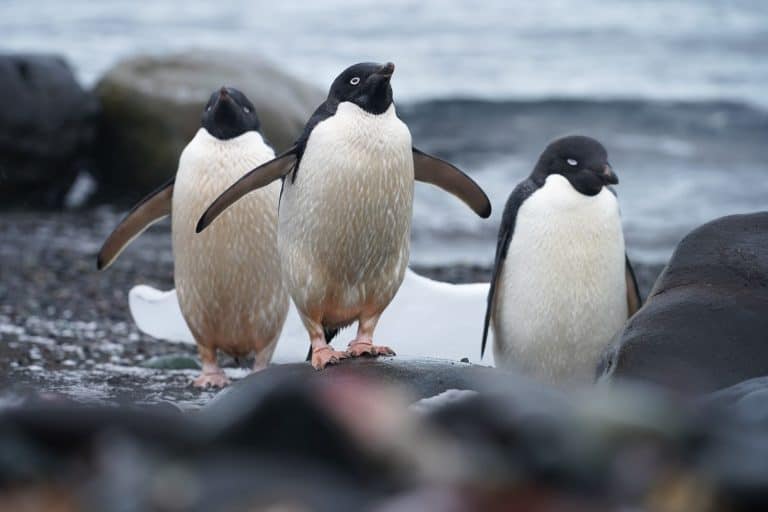
Adélie penguin Pygoscelis adeliae Shares pack-ice-associated foraging ecology, with heavy reliance on Antarctic krill in many areas and years; both track sea-ice dynamics that concentrate krill and influence access to feeding grounds.

The crabeater seal has carved out a very successful life in one of the most inhospitable places on the planet.

Found almost everywhere around the Antarctic seas, it is believed to be one of the most abundant and populous of carnivorous mammals. However, the crabeater probably suffers from the biggest case of misnaming in the entire animal kingdom. They do not eat crab at all (few of which even live in the Antarctic); instead, they eat tiny crustaceans called krill that live relatively close to the surface. A better name would be the krill-eating seal. Unfortunately, because of their isolated environment, there are still some facts about them that we don’t understand.

4 Incredible Crabeater Seal Facts!

  • Crabeaters actually compete with baleen whales for access to krill food resources. When the baleen whale’s population fell, the crabeater’s population actually increased.
  • One of the most interesting facts is that the seal pups gain weight at an astonishing rate of around ten pounds per day, perhaps as a result of the need to pack on insulation in the cold Antarctic winters.
  • The crabeater’s skull may have the most complex teeth of any carnivore in the world. The teeth help them filter out krill from the water. They have an unusually intricate, almost decorative appearance.
  • Scientists have found mummified remains of crabeater seals toward the interior of Antarctica, perhaps the result of one getting lost. Their bodies are preserved remarkably well in the cold, dry habitat of Antarctica.

Scientific Name

The scientific name of the crabeater seal is Lobodon carcinophaga. Lobodon comes from a Greek term meaning lobe-toothed, whereas carcinophaga roughly translates to mean crab eater. This species is the only currently living member of its genus, but it does share common ancestry with the leopard seal, Ross seal, and other Antarctic seals. The crabeater belongs to a family known as the true seals, which are characterized by the lack of external ear flaps and an inability to rotate their hind flippers under their body.

Appearance

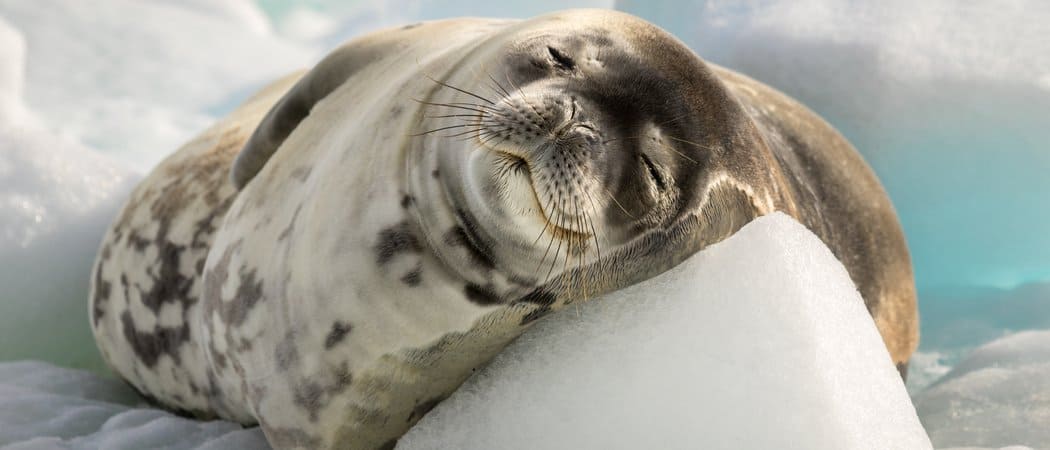
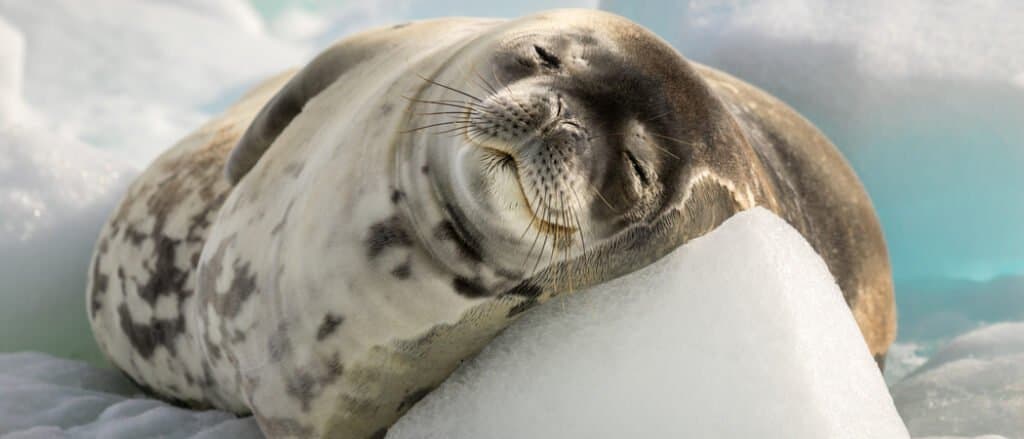
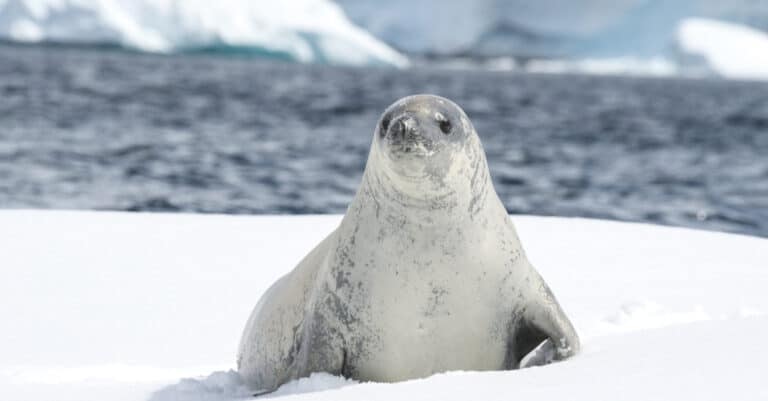
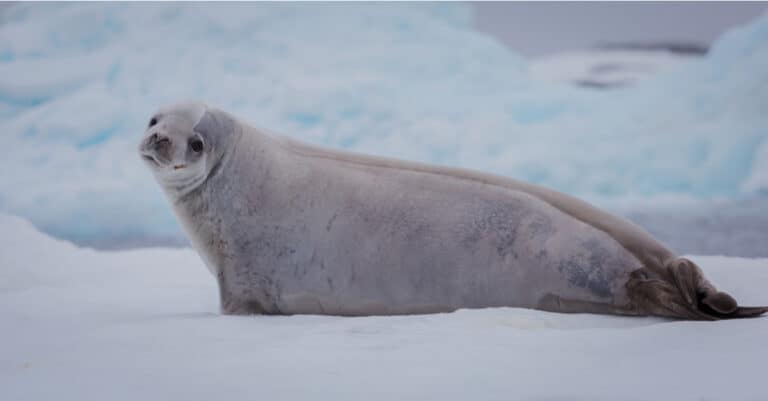
The crabeater seal is characterized by a long body and big skull and snout compared to other seal species. The coat is blotched gray-brown during the summer and then transforms into white or blonde following the late summer molt. It normally measures somewhere between 6.6 and 8.2 feet and weighs up to an astonishing 500 or 600 pounds. Females are slightly larger, on average than males, but their body weight fluctuates substantially throughout the year.

They lose nearly half their weight while nursing the baby pup on their nutrient-rich milk. The thick layers of blubber help them remain insulated in the frigid Antarctic waters.
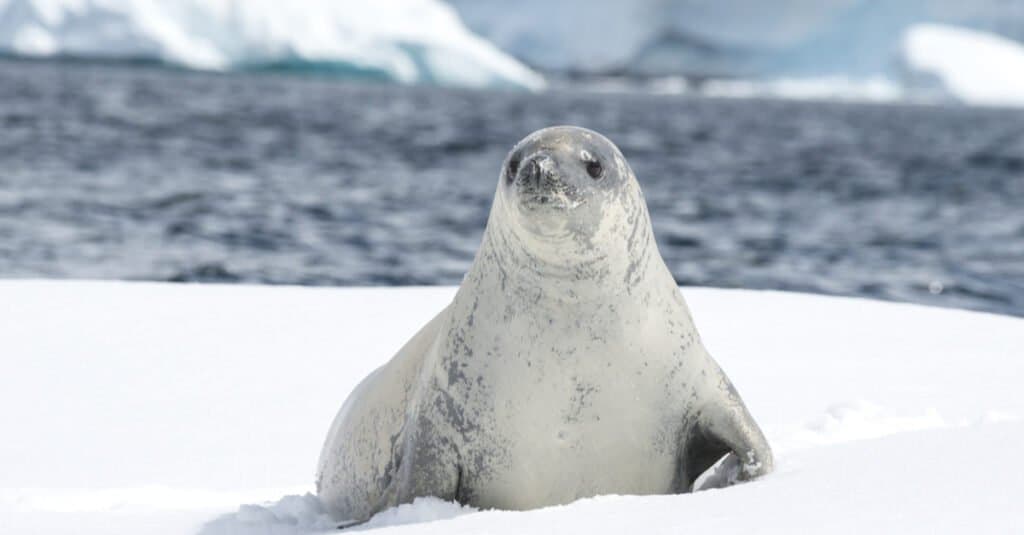
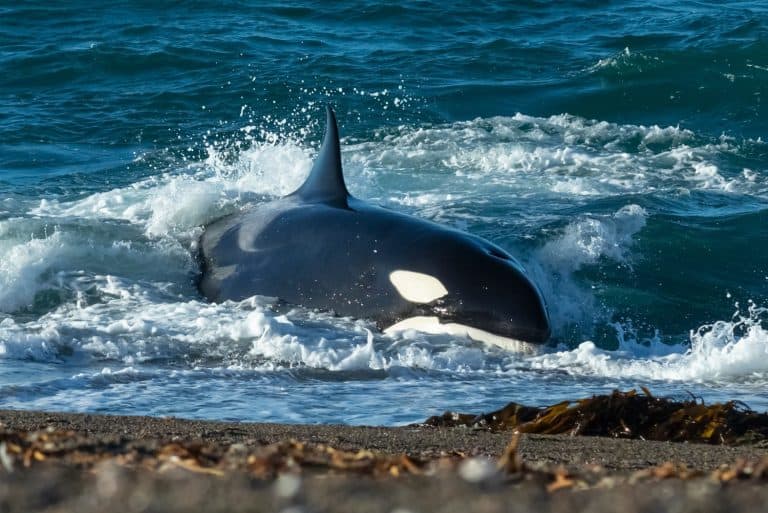
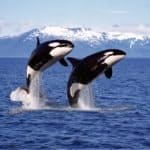
Killer whales are one of the only species big enough to hunt a crabeater seal.

Behavior

The crabeater seal sometimes gathers together in large groups for protection. Young pups in particular will congregate in groups of up to a thousand individuals. As they age, the seals may become solitary or live in small groups of only three or four. Their behavior is largely associated with fluctuations in the ice packs. When ice packs start to melt, they may travel long distances to seek refuge elsewhere.

While adults tend not to be too vocal, the crabeater has several ways to communicate. Males in particular will produce a few types of mating calls, including both a low and a high moan. If it feels threatened, then the seal may hiss, snort, bare its teeth, and roll over. This may help it to get away from potential threats.

Despite how much time they spend on ice packs, crabeater seals are mostly adapted for the water. Because their hind flippers are fused to the pelvis, these seals cannot bring the legs under their body to walk on them. To move on land, they curve their body back and forth in a snake-like motion. This enables them to reach speeds of up to 15 miles per hour in short bursts, the fastest of any seals in the world. When it’s in the water, the crabeater uses a combination of its hind flippers to propel forward and its front flippers to steer. They can reach speeds of around eight miles per hour consistently in the water.

Many people often wonder whether seals can breathe underwater. The answer is no, they cannot. Seals need to breathe air just like any other mammal. But they do have the remarkable ability to remain underwater for up to 11 minutes at a time, thanks to particularly rich oxygen stores and the ability to seal their nostrils shut.

Most seals forage at depths of around 100 feet, but the maximum possible depth they can dive is thought to be around 1,400 feet. Eventually, though, crabeaters are forced back to the surface to breathe. When the water is frozen over with ice, they will use the breathing holes created by Weddell seals, even chasing the smaller seals away.

Habitat

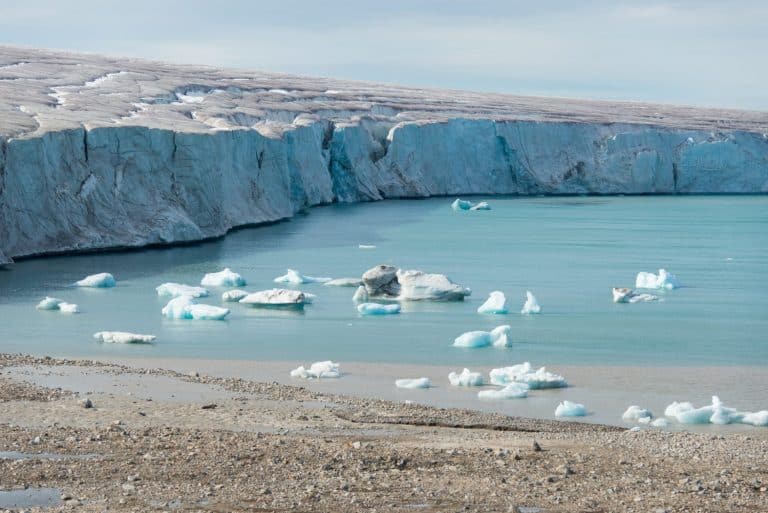
For much of the year, the crabeater seal can be found around the coasts and ice packs of Antarctica. During the winter, it travels farther north with the expansion of ice packs. Some seals have even appeared as far away as Australia, New Zealand, South Africa, and the southern tip of South America, though this is uncommon behavior. Sometimes, a seal will lose its bearing and end up well off course, toward the interior of Antarctica.

Predators and Threats

Isolated in the extreme south, the crabeater faces few threats from humans. Predators seem to be the most pressing problem daily. However, climate change may prove to be a massive threat in the future. Dissipating ice packs will expose the seal to predators and reduce its natural birthing grounds.

What eats the crabeater seal?

Because of its sheer size and ferocity, an adult crabeater seal is a formidable foe. The killer whale is one of the few species large enough to hunt them. Seals are quite exposed in the water and risk being eaten. If the seal manages to escape from their grasp by climbing on ice, then packs of orcas may attempt to tip over the ice by creating waves in the water. Juvenile crabeaters also face significant predation from leopard seals. It’s estimated that as many as 80% of all immature crabeaters are killed in this manner. Many adults still carry scars that testify to the seriousness of these attacks.

What does the crabeater seal eat?

The crabeater seal is specialized for consuming Antarctic krill. The teeth have complex and jagged cusps (the points at the ends) to filter out krill from the water. The seal will swim through a group of krill and suck up whatever it can into its mouth. Small fish and squid also make up around 5% of its diet.

Reproduction and Life Cycle

Crabeaters reproduce and then give birth directly on the pack ice. The reproductive season takes place at some point between October and December. Following an 11-month gestation period (in which the female may have the ability to temporarily suspend the development of her newly fertilized egg), the mother will give birth to a single baby, which weighs about 44 pounds and is otherwise helpless. While she’s nursing the baby on her milk, a random male who’s almost certainly not the father will join them on the ice and protect them from predators and other males. His intention seems to be entirely selfish. He is waiting for the female to become sexually receptive again so he can mate with her. This protective gesture simply seems to be his way of establishing his mating rights over other males.

Since they are born so close to the next mating season, pups grow at an astonishing rate. They gain nearly ten pounds a day until they’re fully weaned at around three weeks of age. There appears to be little parental involvement from this point forward. However, even after gaining independence, the seals still have a lot of growing to do. They reach sexual maturity at around three or four years. Many females can successfully reproduce until around 25 years or so. They are thought to live around 40 years in the wild.

Population

According to the IUCN Red List, the crabeater seal is a species of least concern. It is thought to be the most common species of Pinnipeds (seals and sea lions) in the world, with an estimated population of somewhere between 7 million and 70 million. More likely, population numbers probably fall within the range of 20 to 40 million. The numbers can be difficult to estimate because some parts of Antarctica are a challenge to access during parts of the year.

View all 395 animals that start with C

Sources

  1. Britannica / Accessed September 30, 2021
  2. Animal Diversity Web / Accessed September 30, 2021
  3. Oceanwide Expeditions https://oceanwide-expeditions.com/to-do/wildlife/crabeater-seal Jump to top / Accessed September 30, 2021
A-Z Animals Staff

About the Author

A-Z Animals Staff

AZ Animals is a growing team of animals experts, researchers, farmers, conservationists, writers, editors, and -- of course -- pet owners who have come together to help you better understand the animal kingdom and how we interact.
Connect:

Thank you for reading! Have some feedback for us?


Crabeater Seal FAQs (Frequently Asked Questions)

The crabeater is a semi-aquatic member of the true seal family. It’s one of only a handful of seals (along with leopard and Ross seals) that hails from Antarctica. It is mostly distinguished by the elongated body, big skull, and gray-brown coat of fur that becomes white in the fall and winter. It spends all of its time either swimming in the water or hauling out onto ice packs.