





Quick Take
- One body part makes this lizard unique among monitors, and it guards it like treasure.
- Its nursery is borrowed from an unlikely architect, and the hatchlings' first meal comes with the house.
- Its hunting tactics are surprisingly brutal for such a graceful climber.
- This apex predator has no natural enemies, yet something still threatens it.
The emerald tree monitor is a beautiful lizard that lives in the tropical rainforests of Indonesia and Papua New Guinea. It is also found on the islands of the Torres Strait near Australia. Its bright green color, slender body, and long tail make it one of the most striking members of the monitor family. This intelligent reptile is known for its social behavior and fierce hunting skills.

4 Incredible Emerald Tree Monitor Facts
- It is one of a small group of tree monitor lizards with a prehensile tail.
- It spends most of its life in tree branches.
- Females lay their eggs in termite nests.
- It’s one of the most popular reptiles for zoo displays.
Classification and Scientific Name
Its scientific name is Varanus prasinus. The word varanus comes from the Arabic word for a monitor, and prasinus is Latin for green. It is a member of the subgenus Hapturosaurus. It is closely related to other tree monitors that live in different parts of the world.
Appearance
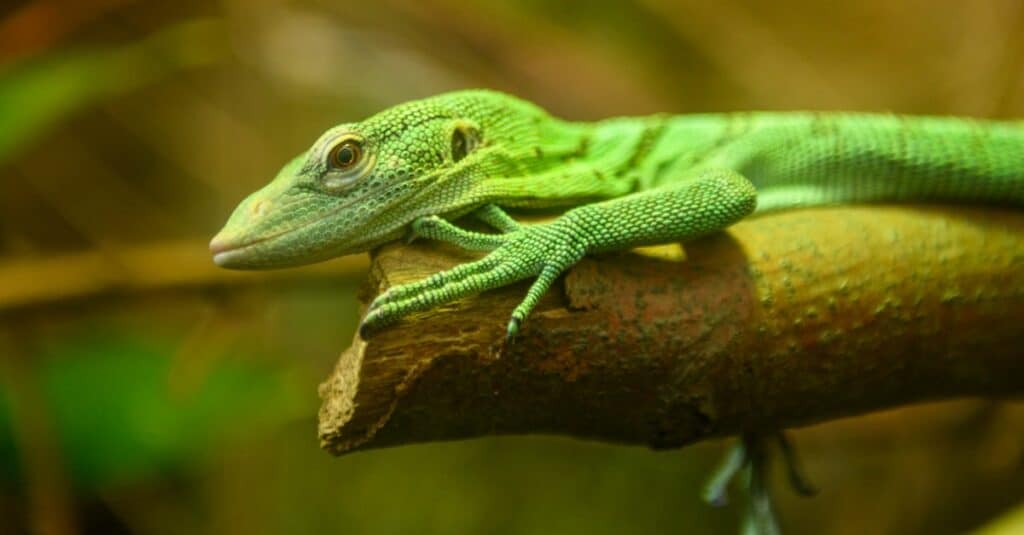
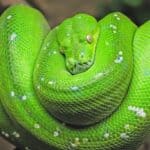
Identification of this lizard is simple. The emerald tree monitor, also known as the green tree monitor, is one of the most beautiful members of the reptile family. This elegant, slender lizard gets its name from its colors, which can range from pale green to deep turquoise.
It has a long body and long, slender limbs ending in sharp claws. The emerald tree monitor has dark blue or green spots on its back. It has scales in different colors that give it a textured look.
The average emerald tree monitor is three feet long with a tail twice as long as its body. Unlike other members of the monitor family, it keeps its slim shape as it ages.

The emerald tree monitor’s tail is twice as long as its body.
©iStock.com/DK Media
Behavior
They are one of the few monitor species known to show social behavior. Emerald tree monitors live in small groups that include a dominant male, several females, some young males, and baby monitors.
They have many adaptations that allow them to live in their preferred environments. As one of the few monitor species with a prehensile tail, they can live most of their lives in tree branches. They are excellent climbers who can leap from one branch to another in search of prey. They are capable of advanced behavior when hunting their prey. For instance, they will sometimes pick up small animals and hit them against hard objects to kill them.
They also differ from other lizards in their defensive behavior. While other monitors use their tails as weapons, the emerald tree monitor protects its tail rather than wielding it. It depends on its tail to move quickly through tree branches, so it will always protect this part of its body.
Habitat
Emerald tree monitors prefer humid climates. They live in palm trees, rainforests, mangroves, and cocoa plantations. They prefer forested areas where they can climb and hide. Their color makes it easy for them to camouflage themselves in the thick leaves. High humidity is important because they get most of their water from the air around them.
Emerald Tree Monitors in Zoos
Because of their beauty, these reptiles are highly prized by zoos and aquariums. Here are a few places you can see them:
- Smithsonian Institution
- Bristol Zoo
- Tennessee Aquarium
- Lehigh Valley Zoo
- Cincinnati Zoo & Botanical Garden
Diet
These lizards are carnivores. They eat insects, geckos, small mammals, and birds. They mostly feed on katydids, termites, and grasshoppers, but they will also eat spiders and small crabs. Occasionally, they eat small rodents. When they hunt rodents, they use their sharp claws to kill and disembowel the animals after biting them on the neck.
Emerald tree monitors in captivity eat mice, crickets, and cockroaches.
Predators and Threats
They are considered the apex predators in their habitats, and no species preys on the adults. However, snakes and birds will eat their eggs and hatchlings. Prized for their looks, they are sometimes victims of illegal poaching for the zoo and pet trades. Currently, the biggest threat to these lizards is collection for the pet trade, though even this is not considered a significant threat to the species.
Reproduction and Life Cycle
Emerald tree monitors can mate and reproduce three times a year. After mating, the female monitor incubates the eggs for around 165 days.
The females often use termite mounds to build their nests. The temperature and humidity levels of these nests are perfect for incubating monitor eggs. Typically, they have three to seven eggs in a clutch. When the eggs hatch, the baby monitors eat the termites and termite eggs.
Hatchlings grow quickly. They quadruple in size in the first three months of life.
Monitors reach sexual maturity at two years old. They have a lifespan of about 15 years in captivity, but their lifespan in the wild is unknown.
Population
The exact population size of these lizards is unknown, but the population is believed to be stable.
Conservation Status
The emerald tree monitor is listed as least concern by the International Union for the Conservation of Nature (IUCN). In Europe, they are included in the European Association of Zoos and Aquariums (EAZA) Studbook, which works to breed endangered and otherwise valuable species in captivity.
Emerald Tree Monitor Pictures
View all of our Emerald Tree Monitor pictures in the gallery.

iStock.com/Gyrohype
Sources
- Smithsonian's National Zoo & Conservation Biology Institute / Accessed January 26, 2022
- Animal Diversity Web / Accessed January 26, 2022
- Reptile Direct / Accessed January 26, 2022