N
Species Profile

Nicobar pigeon

Caloenas nicobarica

The rainbow pigeon with a white flag tail
iStock.com/Rixipix

Nicobar pigeon Distribution

Click a location to explore more animals from that region

Loading map...
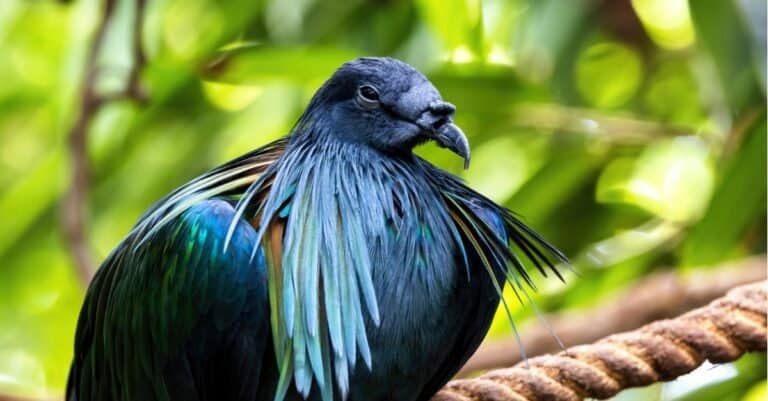
Nicobar pigeon, Caloenas nicobarica, the only living member of the genus Caloenas, and may be the closest living relative of the extinct dodo

At a Glance

Wild Species
Diet Omnivore
Activity Diurnal+
Lifespan 7 years
Weight 0.6 lbs
Did You Know?

Adult size is about 40 cm long and typically ~460-600 g in mass (BirdLife/HBW species accounts).

Scientific Classification

The Nicobar pigeon is a large, primarily ground-foraging island pigeon notable for its iridescent green and copper plumage, white tail, and shaggy hackles on the neck. It is the only living species in the genus Caloenas and is closely associated with small islands across the eastern Indian Ocean and western Pacific.

Kingdom
Animalia
Phylum
Chordata
Class
Aves
Order
Columbiformes
Family
Columbidae
Genus
Caloenas
Species
Caloenas nicobarica

Distinguishing Features

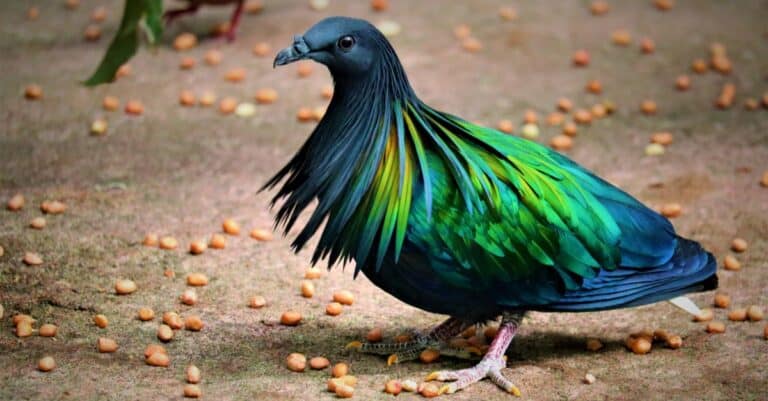
  • Iridescent green/bronze body plumage with a ‘metallic’ sheen
  • Prominent elongated neck hackles (shaggy collar appearance)
  • White tail and white tail coverts contrasting with darker body
  • Robust build with relatively long legs for a pigeon; often terrestrial on predator-free islands

Physical Measurements

Length
1 ft 4 in (1 ft 3 in – 1 ft 5 in)
Weight
1 lbs
Top Speed
43 mph
flying

Appearance

Primary Colors
Secondary Colors
Skin Type Feathered body plumage with iridescent structural coloration; legs and feet covered in scaly skin.
Distinctive Features
  • Only living species in genus Caloenas; restricted to small Indo-Pacific islands (not mainland).
  • Adult size: ~40 cm total length; typically robust, large-bodied island pigeon.
  • Conspicuous elongated neck hackles forming a shaggy mane around the neck.
  • Brilliant iridescent green and bronze/copper upperparts; slate-gray head and underparts.
  • Bright white tail stands out strongly during flight and when perched.
  • Mostly ground-foraging and often walks on beaches/forest floor, increasing predator vulnerability.
  • High vulnerability to introduced predators on islands (rats, cats, dogs) due to ground use.
  • Red legs/feet and dark bill aid identification at close range.

Did You Know?

Adult size is about 40 cm long and typically ~460-600 g in mass (BirdLife/HBW species accounts).

It's the only extant species in the genus Caloenas-its closest relatives are extinct island pigeons like the dodo lineage (molecular phylogenies: Shapiro et al., 2002; Pereira et al., 2007).

Unlike many tree-perching pigeons, it does much of its feeding on the ground, often on remote predator-free islets.

Breeding is slow: it usually lays a single egg per clutch (typical of many large island pigeons; HBW).

The white tail is a key field mark and can act as a conspicuous "follow-me" signal when flocks move through dim coastal forest.

It can commute between islands, roosting in trees but traveling to different islets to forage-an important strategy in patchy island habitats (BirdLife/HBW).

Unique Adaptations

  • Iridescent "hackles" (elongated neck feathers) that reflect green-to-copper tones-high-contrast signaling in low-light coastal forest understories.
  • Conspicuous white tail patch that remains highly visible during flight, aiding group coordination across cluttered vegetation and over surf-dark shorelines.
  • Strong, sustained flight for a heavy pigeon, enabling regular crossings between small islands-crucial in archipelagos where food resources are seasonally patchy.
  • Island-specialist ecology: thrives on small, forested, often predator-free islands, but is unusually vulnerable when invasive rats/cats arrive (IUCN notes introduced predators as a key threat).
  • Like other pigeons, produces nutrient-rich "crop milk" to feed the chick-supporting rapid early growth even when protein-rich prey is scarce (Columbidae trait; avian physiology literature summarized in HBW).

Interesting Behaviors

  • Ground-foraging: walks and probes among leaf litter and beach-edge vegetation for fallen fruits, seeds, and invertebrates; uses grit to help grind hard foods in the gizzard (general Columbidae physiology; HBW).
  • Island-hopping routine: commonly roosts or nests in trees, then flies to feeding sites, including small offshore islets, sometimes in groups (BirdLife/HBW).
  • Single-chick investment: pairs typically raise one nestling at a time, reflecting a slow life-history strategy common in larger pigeons on islands (HBW).
  • Vigilance and flock cohesion: tends to be wary on the ground; the bright white tail remains visible when birds lift off together, helping maintain contact in shaded forest.
  • Site sensitivity: colonies and feeding grounds can shift quickly when hunting pressure or predators increase, leading to local disappearances on disturbed islands (IUCN/BirdLife assessments).

Cultural Significance

The Nicobar pigeon (Caloenas nicobarica) lives on remote Indian Ocean and western Pacific islands. Sailors noted its bright colors. It is seen as the closest living relative of the dodo and a symbol for protecting island forests and removing rats and cats.

Myths & Legends

Since early 2000s genetic studies, scientists linked the Nicobar pigeon to the dodo and solitaire group. Science books and museums call it a 'living window' into dodo relatives.

The Nicobar pigeon (Caloenas nicobarica) is named for the Nicobar Islands. Explorers' stories and collected specimens during the age of exploration made it known as a special island bird, historical, not a folk myth.

Conservation Status

NT Near Threatened

Likely to qualify for a threatened category in the near future.

Population Decreasing

Protected Under

  • CITES Appendix I (international trade controlled/primarily prohibited except under strict permitting)
  • Protected under various national wildlife laws across range states (e.g., India's Wildlife (Protection) Act in the Andaman & Nicobar Islands; protections and harvest controls in parts of Indonesia and other Southeast Asian jurisdictions)

Life Cycle

Birth 1 chick
Lifespan 7 years

Lifespan

In the Wild
4–12 years
In Captivity
10–20 years

Reproduction

Mating System Monogamy
Social Structure Socially Monogamous
Breeding Pattern Long Term
Fertilization Internal Fertilization
Birth Type Internal_fertilization

Nicobar pigeons form monogamous pairs within breeding colonies on small islands. They typically lay a single egg, with both sexes participating in incubation and chick rearing (including crop-milk feeding), consistent with socially monogamous Columbidae.

Behavior & Ecology

Social Flock Group: 20
Activity Diurnal, Crepuscular
Diet Omnivore Fallen fruits and seeds collected on the forest floor (reported as the predominant foods across its island range; e.g., BirdLife International/HBW accounts).

Temperament

Gregarious outside breeding; individuals often keep close spacing in feeding/roosting flocks (Gibbs et al., 2001).
Wary and readily flushed where hunted; more confiding on remote, predator-free islets (BirdLife International species account).
Strong site use of small offshore islands for roosting/breeding; commutes to forage on larger islands (HBW/ del Hoyo et al.).
Breeding pairs can be locally territorial at nest sites, but tolerate near neighbors in dense colonies (HBW/ del Hoyo et al.).
Longevity: up to 20.3 years recorded in captivity; wild longevity not well quantified (AnAge database).

Communication

Low, resonant cooing/hooting used in contact and courtship HBW/ del Hoyo et al.
Short grunts or growls at close range during aggression near food or nest sites Gibbs et al., 2001
Abrupt alarm notes on disturbance, often followed by immediate flock takeoff BirdLife International
Visual courtship: strutting, head-bobbing, and neck-hackle erection to emphasize iridescent plumage HBW
Allopreening within pairs reinforces bonds and coordinates nesting duties Gibbs et al., 2001
Wing-noise/flush displays during rapid flock departure can function as group alarm coordination General Columbidae; HBW

Habitat

Biomes:
Tropical Rainforest Tropical Dry Forest Wetland Marine
Terrain:
Island Coastal Plains Sandy Rocky
Elevation: Up to 1640 ft 5 in

Ecological Role

Omnivorous island ground-forager; primarily a frugivore/granivore that also takes invertebrates opportunistically.

Seed dispersal (endozoochory) for island plants via fruit consumption and movement among islets Seed predation/processing (reducing some seed survival while aiding others through dispersal) Nutrient cycling by moving and depositing organic material (feces) across roosting/foraging sites Minor regulation of invertebrate populations through opportunistic predation

Diet Details

Main Prey:
Insects Small terrestrial invertebrates
Other Foods:
Fallen fruits Seeds Nuts Plant buds and young shoots

Human Interaction

Domestication Status

Wild

Nicobar pigeon (Caloenas nicobarica) is not domesticated; all populations are wild, though some are in zoos from captive breeding. People hunt them and collect eggs on small islands, and run conservation because island colonies face habitat loss and introduced predators. Adults are about 40 cm, feed on the ground, roost and breed on islets, and lay one egg.

Danger Level

Low
  • Minor injury risk (pecks/scratches) if handled or cornered; generally shy and non-aggressive.
  • Zoonotic disease potential typical of pigeons/doves in captive settings (e.g., psittacosis/Chlamydia psittaci risk) if hygiene and veterinary screening are poor.
  • Biosecurity risk to poultry/other birds if moved between collections without quarantine (pathogen transmission).

As a Pet

Not Suitable as Pet

Legality: Nicobar pigeon (Caloenas nicobarica): laws change by country/state. Not a usual pet; usually kept only in licensed aviaries or zoos. Keeping, importing, or exporting often needs wildlife permits and paperwork—check laws first.

Care Level: Expert Only

Purchase Cost: $2,000 - $6,000
Lifetime Cost: $20,000 - $60,000

Economic Value

Uses:
Subsistence food (local hunting/eggs) Conservation/ecotourism value on remote islands Zoo/aviary display and education Scientific value (phylogenetic importance as the only living Caloenas)
Products:
  • meat and eggs (localized, generally discouraged/illegal in protected areas)
  • live-animal value for accredited collections (display/education)
  • non-consumptive value via wildlife tourism and conservation funding

Relationships

Related Species 5

Kanaka pigeon Caloenas canacorum Shared Genus
Spotted green pigeon Caloenas maculata Shared Genus
Pied imperial-pigeon Ducula bicolor Shared Family
Rock pigeon Columba livia Shared Family
Metallic pigeon Columba vitiensis Shared Family

Ecological Equivalents 3

Animals that fill a similar ecological role in their ecosystem

Crowned pigeon Goura spp. Large, mainly ground-foraging island pigeons. Like the Nicobar pigeon, they spend substantial time walking and feeding on fallen fruits and seeds on forest floors, and are vulnerable to introduced mammalian predators on islands.
Pied imperial-pigeon Ducula bicolor Island-associated pigeon in the eastern Indian Ocean-western Pacific region; overlaps in small-island use and in frugivory/seed consumption, and can be part of similar island-forest food webs (seed dispersal), though it is more arboreal than Caloenas nicobarica.
Megapodes Megapodius spp. Ground-oriented island birds that forage in leaf litter for seeds, fruits, and invertebrates. They face similar predator pressures on small islands (rats, cats, monitor lizards) and rely on intact island forest and strand habitats.

The Nicobar pigeon is the only member of the Caloenas genus and is believed to be the only living relative of the poor dodo, as well as a creature called the Rodrigues solitaire. It’s famous for its amazing, glittery feathers, but unfortunately hunted for food and its gem-quality gizzard stone.

4 Amazing Nicobar Pigeon Facts

  • The bird’s gizzard stone is so hard that it can grind nuts that humans need a hammer to crack, and it’s made into jewelry. The gizzard is one of the adaptations the bird has for grinding down seeds and nuts that might otherwise be too hard to eat.
  • It is the world’s largest pigeon.
  • When the Nicobar pigeon wants to startle predators, it makes a sound like a pig grunting.
  • Both parents feed their squab with “pigeon milk.”

What Does the Nicobar Pigeon Have to Do with the Dodo Bird?

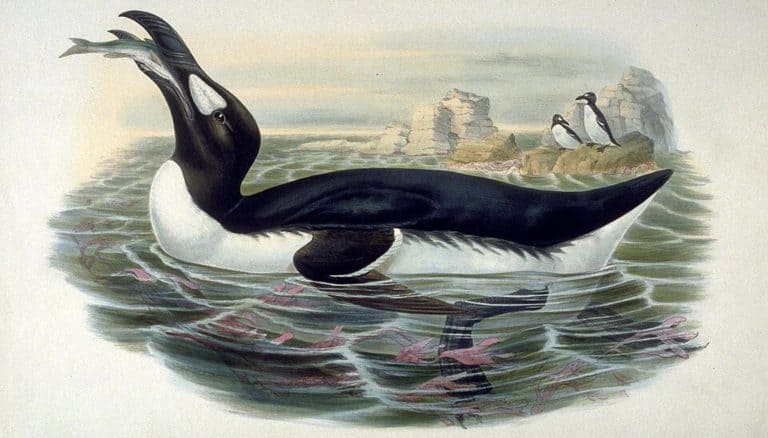
The Nicobar pigeon is the extinct dodo’s closest living relative. Both of them are/were members of the Columbidae family. Many people are surprised that the ugly, flightless, turkey-sized dodo was a type of dove, but it was!

Where To Find the Nicobar Pigeon

The Nicobar pigeon can be found in the lowland rainforests, dry forests, shrublands, and mangroves on the islands in the Malay Archipelago, in Palau, and the Andaman and Nicobar Islands, among others. An especially large colony was found in a wildlife sanctuary on Battimalv, one of the Nicobar Islands. There are also populations in the south of Vietnam and Cambodia. There have been rare vagrant sightings of Nicobar pigeons in Western Australia, but no established populations exist there.

Nicobar Pigeon Nests

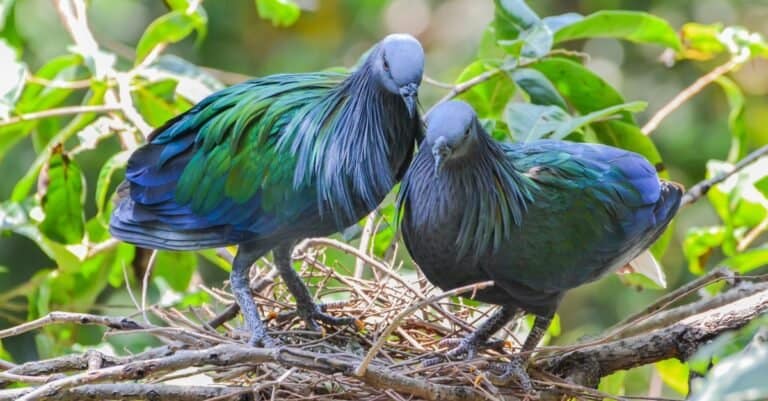
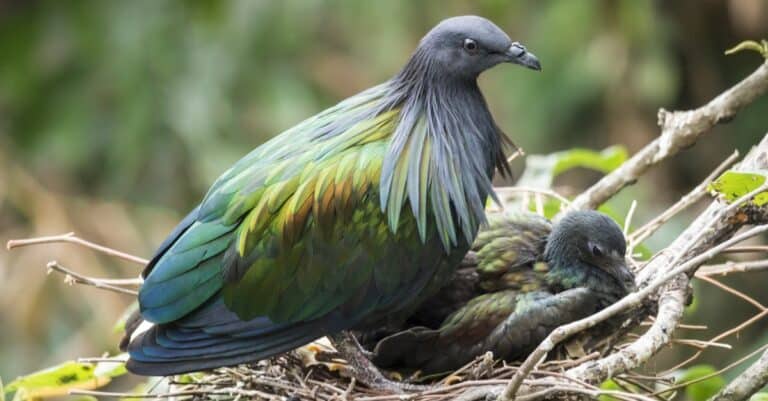
Nicobar pigeon nests are made of twigs and built high in the trees. They are just sturdy enough to keep the egg from falling out and bear the weight of the parents as they incubate it.
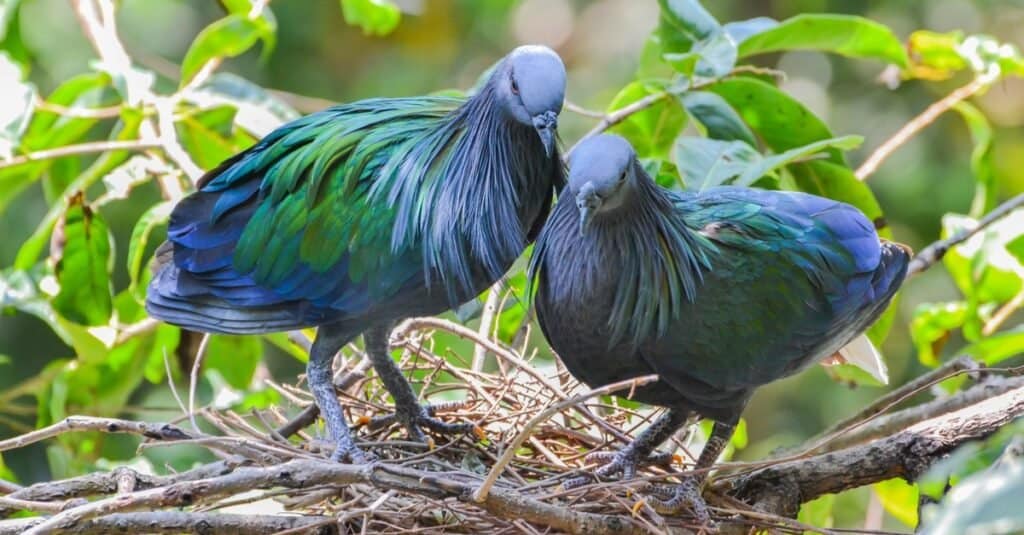
A pair of Nicobar pigeon in nest (Caloenas nicobarica).

A pair of Nicobar pigeons in the nest (Caloenas nicobarica).

Nicobar Pigeon Scientific Name

The pigeon’s scientific name is Caloenas nicobarica. Caloenas comes from the Greek words kalos, which means “beautiful,” and oinas, which means “dove,” and it is indeed a beautiful dove. Nicobarica means that it’s from the Andaman and Nicobar Islands. One subspecies, Caloenas nicobarica pelewensis, gets its name because it’s found on the island of Palau. Another subspecies is C.n. nicobarica.

Nicobar Pigeon Appearance

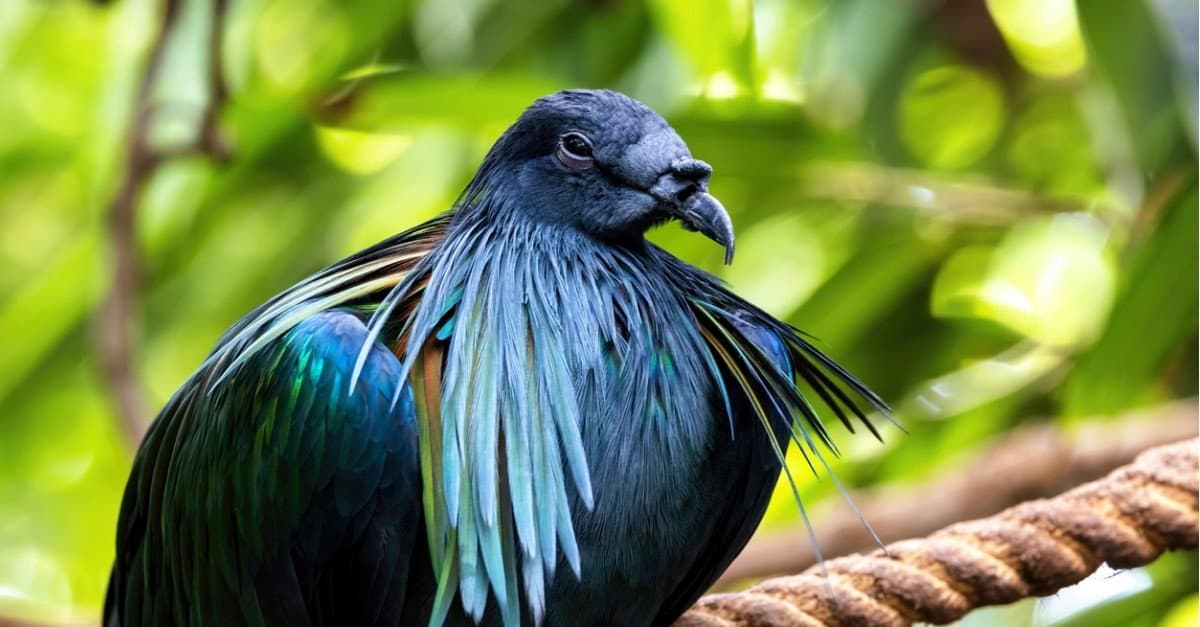
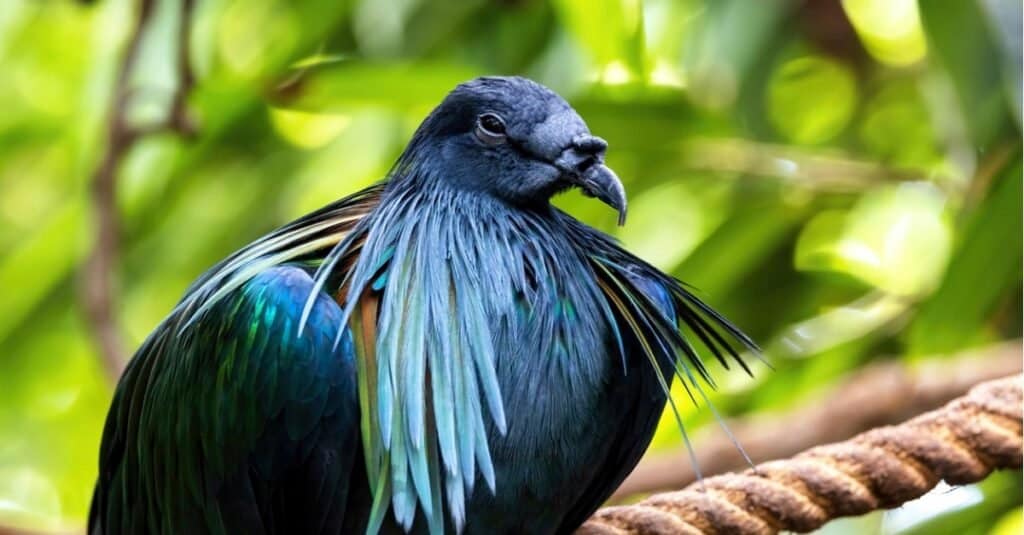
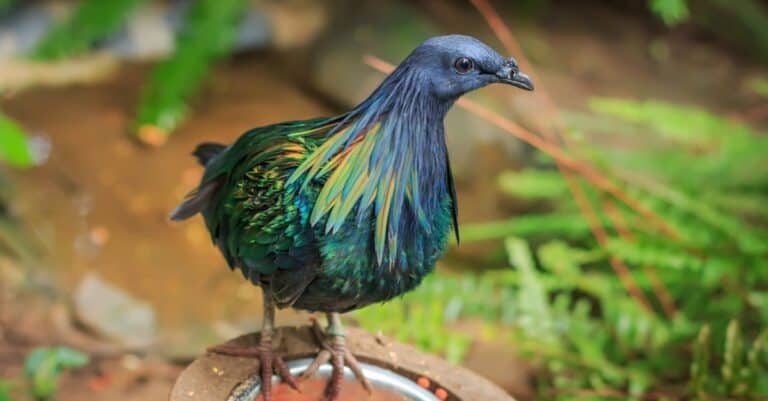
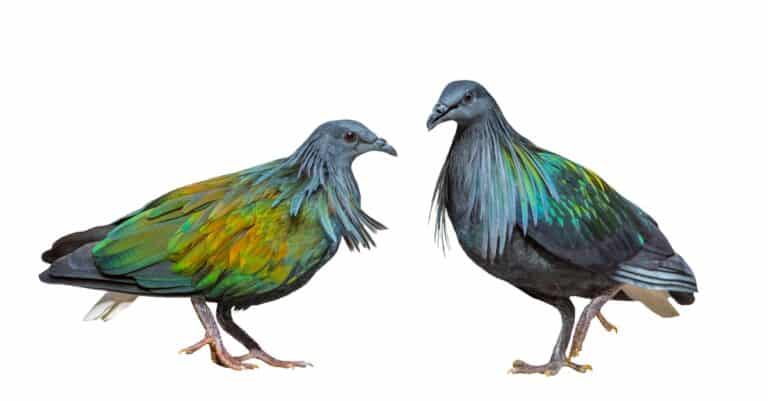
One of the most beautiful characteristics of the Nicobar pigeon is the beautiful, iridescent feathers on its wings and body. Other characteristics are its long hackles, which are sometimes kept permanently erected, and its short, pure white tail. Besides that, it is the largest extant pigeon and can grow to nearly 16 inches in length and weigh over a pound, with a wingspan of 21 to 23 inches.

The pigeon has a long, thin neck and a slender head, and its bill is ornamented with a knob or an upright wattle that’s especially prominent in males. Its long, strong feet and legs are reddish. The tail is short and pure white and is only seen in adults. Scientists believe that this white tail is one of the adaptations that foster flock cohesiveness. It serves as a guiding light when the birds are flying and lets members of the flock know that the bird is an adult and should not be courted or followed.

Nicobar Pigeon Behavior

The pigeon flies from island to island in search of food. Though it’s a strong flyer, it forages nuts, seeds, and fallen fruit on the forest floor from sunup till sundown. Foraging on the ground is one of the adaptations that make the bird hard to see, for the shade thrown by the trees dulls the colors of its feathers. It builds its nest high in the trees, and unlike some birds, a mated pair doesn’t mind if another pair builds its nest in the same tree. Eventually, there can be large colonies of these birds nesting close together.

What Does the Nicobar Pigeon Eat?

The diet of this pigeon is made up of grains, seeds, nuts, buds, berries, and invertebrates.

Nicobar Pigeon Predators and Threats

Humans are the main predators of Nicobar pigeons. They are hunted for their meat and their gizzard stones and trapped for the illegal pet trade. They are preyed upon by rats and pets such as cats.

The destruction of its habitat is also blamed for the decline in the pigeon’s numbers. This includes clearing the land for plantations and pollution caused by industry.
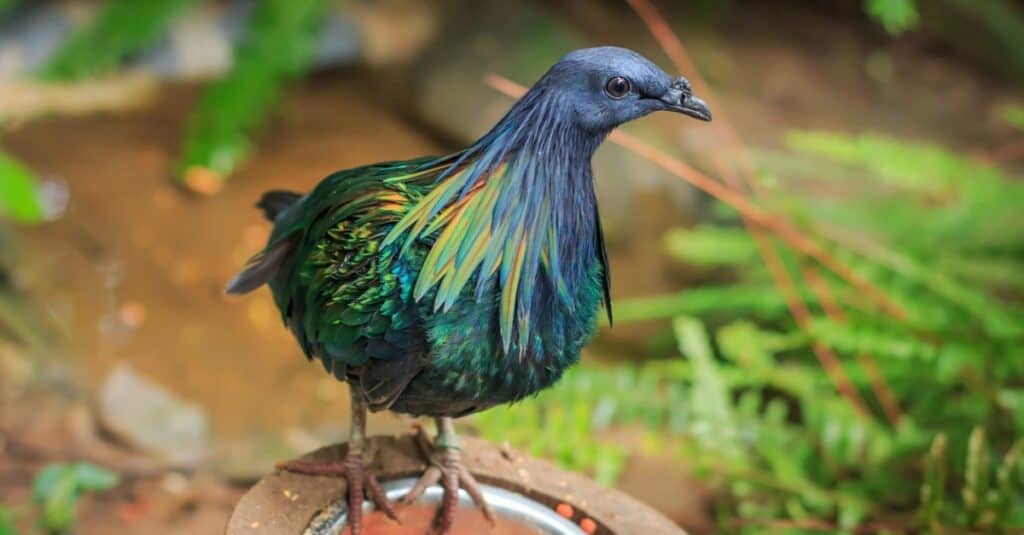
Nicobar pigeon (Caloenas nicobarica) in the forest.

Nicobar pigeon, Caloenas nicobarica, the only living member of the genus Caloenas, and may be the closest living relative of the extinct dodo.

Nicobar Pigeon Reproduction, Babies, and Lifespan

Nicobar pigeons usually breed from January to March. The male struts before the female and puffs out his feathers to impress her. He might need to do this for some days before she accepts him, but if she does, they are mated for life, as Nicobar pigeons are monogamous. He then chooses the site of the nest, which is between 6.5 and 39 feet off the ground, and she builds a rather haphazard nest of twigs. There she will lay a single, blue-tinted egg that both parents incubate for about a month.

Nicobar squabs are helpless when they are born and are fed crop milk until they can take seeds and fruit. Their feathers start to come in when they’re about 10 days old, and they can feed themselves when they’re about a month old. The lifespan of a Nicobar pigeon is about 8 to 12 years in the wild, but they can live as long as 15 years in captivity if they’re given good care.

Nicobar Pigeon Population

The total population of the species and subspecies hasn’t been determined, but past estimates suggested up to 1,000 individuals of C.n. pelewensis on Palau, though current numbers may be lower due to ongoing threats. The Nicobar pigeon is classified as Near Threatened by the IUCN.

View all 98 animals that start with N

Sources

  1. Tulsa Zoo / Accessed December 28, 2021
  2. Pigeonpedia / Accessed December 28, 2021
  3. Fresno Chaffee Zoo / Accessed December 28, 2021
  4. ITIS / Accessed December 28, 2021
  5. Wikipedia / Accessed December 28, 2021
  6. Rosamond Gifford Zoo / Accessed December 28, 2021
  7. Britannica / Accessed December 28, 2021
  8. Datazone / Accessed December 28, 2021

A-Z Animals Staff

About the Author

A-Z Animals Staff

AZ Animals is a growing team of animals experts, researchers, farmers, conservationists, writers, editors, and -- of course -- pet owners who have come together to help you better understand the animal kingdom and how we interact.
Connect:

Thank you for reading! Have some feedback for us?


Nicobar pigeon FAQs (Frequently Asked Questions)

The pigeon doesn’t migrate but is nomadic. That means it flies long distances within its range to find food.