B
Species Profile

Bornean Orangutan

Pongo pygmaeus

Borneo's forest genius in the canopy
Millie Bond - Copyright A-Z Animals

Bornean Orangutan Distribution

Click a location to explore more animals from that region

Endemic Species
Loading map...

Size Comparison

Human 5'8"
Bornean Orangutan 4 ft 1 in

Bornean Orangutan stands at 72% of average human height.

At a Glance

Wild Species
Also Known As orangutan, orang-utan, orang utan, orang hutan, red ape, man of the forest, old man of the forest
Diet Omnivore
Activity Diurnal
Lifespan 40 years
Weight 100 lbs
Did You Know?

Adults are strongly dimorphic: males typically ~50-90 kg, females ~30-50 kg (field-based ranges reported across Borneo populations).

Scientific Classification

The Bornean orangutan is a large-bodied great ape and one of three extant orangutan species. It is a primarily arboreal, fruit-eating primate known for high intelligence, solitary tendencies compared with other apes, and strong maternal care.

Kingdom
Animalia
Phylum
Chordata
Class
Mammalia
Order
Primates
Family
Hominidae
Genus
Pongo
Species
Pongo pygmaeus

Distinguishing Features

  • Reddish-brown shaggy coat
  • Very long arms adapted for climbing and suspension
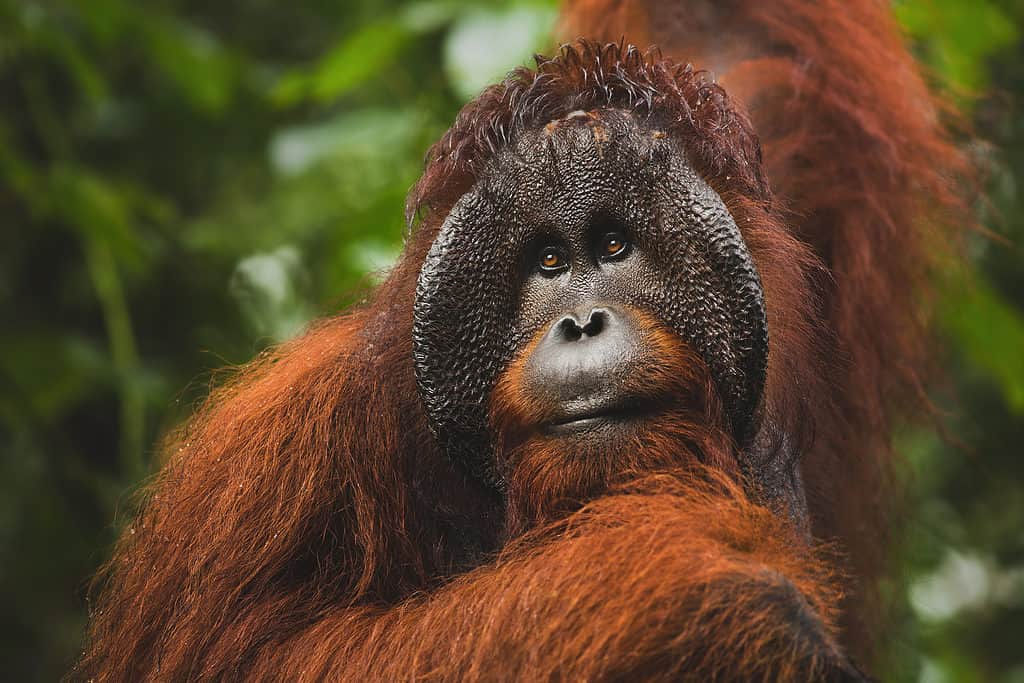
  • Adult males may develop prominent cheek pads (flanges) and a throat sac used for long calls
  • Mostly solitary social structure with strong mother–infant bond
  • Primarily frugivorous diet but flexible (includes leaves, bark, insects)

Physical Measurements

Males and females differ in size

Height
♂ 4 ft 5 in (3 ft 11 in – 4 ft 11 in)
♀ 3 ft 7 in (3 ft 3 in – 3 ft 11 in)
Weight
♂ 154 lbs (110 lbs – 198 lbs)
♀ 84 lbs (66 lbs – 110 lbs)
Top Speed
2 mph
Measured ground speed ~1 m/s

Appearance

Primary Colors
Secondary Colors
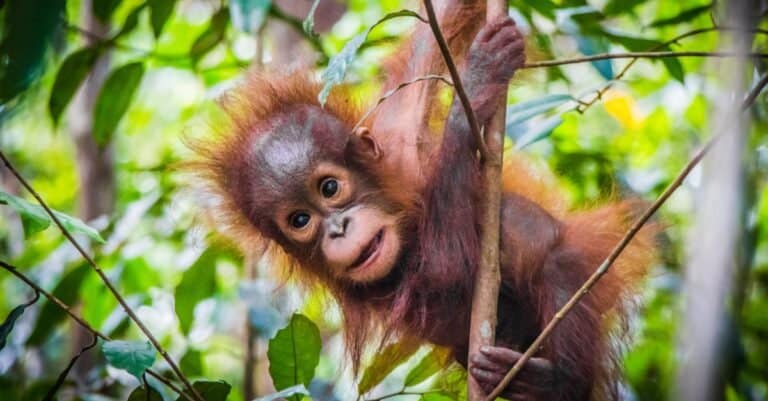
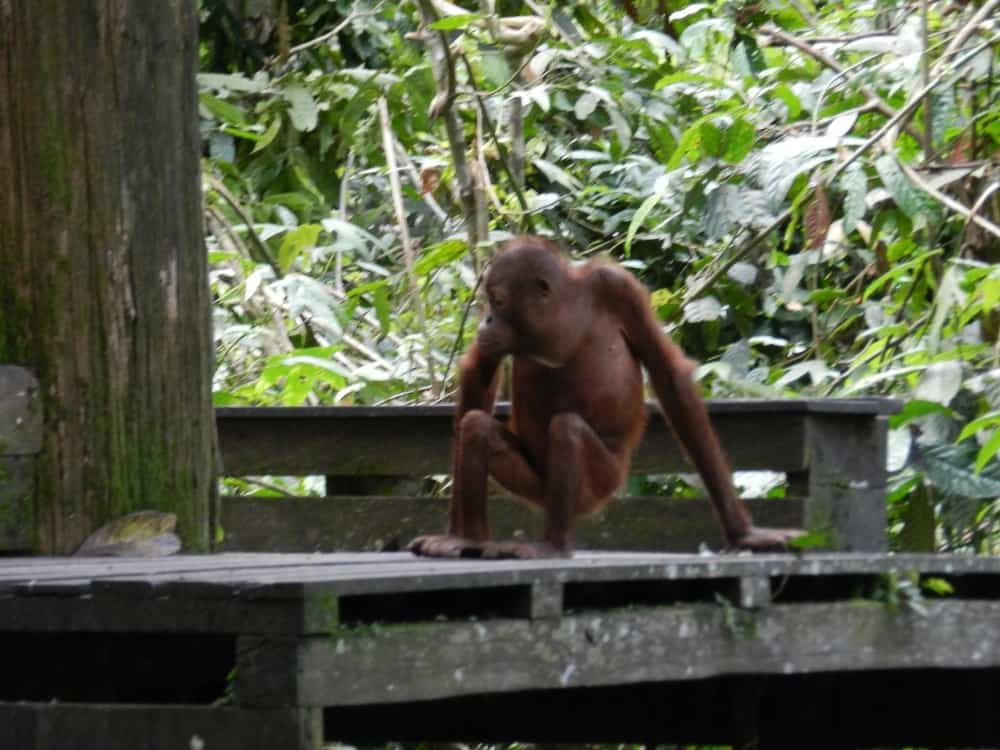
Skin Type Bornean orangutan (Pongo pygmaeus) has mammal skin with long, coarse, shaggy hair and sparse face hair; palms and soles are thick and callused for climbing, with long arm and shoulder hair forming a cape.
Distinctive Features
  • Large-bodied great ape endemic to Borneo; adapted for rainforest and peat-swamp forest canopies (primarily arboreal, using cautious climbing and 'quadrumanous' grasping with hands and feet).
  • Very long arms relative to body; arm span commonly reported around ~2.0 m and can reach ~2.2 m in large adults (reported in primatology references and zoo morphometrics).
  • Head-body length typically ~0.97-1.37 m (males generally larger than females).
  • Adult weight differs by sex: females about 30–50 kg, males about 50–90 kg, with some large males near 100 kg. Weight varies by age, habitat, and condition.
  • Dark, hairless facial skin framed by long facial hair; prominent brow ridge; small external ears with sparse hair.
  • Hands and feet with long, curved digits for grasping branches; reduced thumb compared with many other primates; nails (not claws).
  • Behavior-linked appearance cues: individuals often show mud/peat staining on pelage in swamp forests; visible calluses and worn hair on knuckles/forearms from climbing and resting postures.
  • Like other great apes, Bornean orangutans grow very slowly, with long care from mothers and dependence of young (about 7–8+ years between births); offspring are smaller, paler, and ride with mothers.
  • Longevity: commonly cited ~30-40+ years in the wild, and ~50+ years in human care for orangutans (species-level values vary by dataset; orangutans are among the longest-lived nonhuman primates).
  • Conservation-related external condition notes (field observations): injuries/scars and missing digits can occur from snares, conflict, or other human-caused trauma; smoke/fire exposure can leave coat duller or sooty in burned landscapes.

Sexual Dimorphism

Strong sexual dimorphism in size and secondary sexual traits. Adult males may be 'flanged' (fully developed cheek pads and throat sac) or 'unflanged' (lacking large cheek pads). This bimaturism is characteristic of orangutans and is associated with different mating strategies and signaling (e.g., long calls in flanged males).

♂
  • Larger body size than females (commonly ~50-90 kg; some males reported near ~100 kg).
  • Flanged males: very large lateral cheek pads (flanges) composed of fibrous/fatty tissue, giving a broad, dish-like facial outline; thicker neck and shoulders.
  • Prominent throat sac in flanged males (gular air sac) that can inflate; associated with powerful 'long calls' used for spacing/advertising.
  • More robust cranial features (heavier brow ridges), thicker facial skin, and often darker overall facial appearance.
  • Longer, heavier hair over shoulders/upper arms; overall more massive silhouette.
♀
  • Smaller body size (commonly ~30-50 kg) and more gracile build.
  • No cheek flanges; face appears narrower with less pronounced secondary sexual ornamentation.
  • Less-developed throat sac and no male-typical long-call display apparatus; generally subtler neck/throat profile.
  • Often retain a softer facial outline with more visible light hair framing the face compared with flanged males.

Did You Know?

Adults are strongly dimorphic: males typically ~50-90 kg, females ~30-50 kg (field-based ranges reported across Borneo populations).

Head-body length is about 0.97-1.30 m; arm span can exceed ~2 m, enabling "quadrumanous" (four-limbed) climbing and suspension.

Gestation averages ~245 days (~8.5 months), followed by the longest routine interbirth interval among mammals: commonly ~7-9 years in the wild.

Infants nurse for years; weaning commonly occurs around ~6-7 years, with mothers providing prolonged learning/skills transfer.

They build a new sleeping nest almost every night-often adding a leaf "pillow" or rain cover when needed.

Adult flanged males produce far-carrying "long calls" (aided by a throat sac) that can travel roughly ~1 km through forest to advertise status and attract females.

Conservation status is Critically Endangered (IUCN): major drivers include lowland/peat-swamp deforestation, fire, hunting, and the pet trade.

Unique Adaptations

  • Extreme arboreal anatomy: very long forelimbs, highly mobile shoulders/hips, and long, curved fingers/toes for powerful grasping and suspension.
  • Low-energy lifestyle: slow movement and energy-conserving behavior that suits forests with highly seasonal fruit availability.
  • Sexual dimorphism with secondary traits: flanged males develop large cheek pads (flanges) and a throat sac that amplifies long calls-traits linked to dominance and mate attraction.
  • Advanced cognition for a non-group-living ape: strong spatial memory for fruiting trees and flexible tool/leaf use for feeding and comfort.
  • Thick hair and robust skin help navigate thorny, wet vegetation; leaf "umbrellas" and nest roofs reduce exposure during heavy tropical rains.
  • Slow life history (late maturity, long dependency, long birth intervals) increases vulnerability to rapid habitat loss but supports extensive skill learning in complex forests.

Interesting Behaviors

  • Nightly nest construction: selecting a stable fork, bending/"weaving" branches into a platform, then lining it with leafy branches; day nests are also made for resting.
  • Tool use and problem-solving: using sticks to probe holes or extract seeds/insects; using leaves as "gloves"/"napkins" or as improvised rain protection.
  • Foraging strategy tuned to boom-bust fruiting: tracking seasonal fruit, then switching to fallback foods (bark, leaves, pith) when fruit is scarce-especially in peat-swamp and dipterocarp forests.
  • Mostly solitary spacing with flexible social tolerance: adults often travel alone, but temporary associations form around abundant fruit trees; females maintain overlapping ranges with offspring.
  • Male alternative strategies: flanged males (with cheek pads) often advertise with long calls; unflanged males may range more widely and can attempt opportunistic mating.
  • Strong maternal teaching: youngsters learn nest-building, food recognition, and safe travel routes by years of close following and observation.
  • Arboreal locomotion repertoire: careful climbing, cautious bridging between branches, and occasional terrestrial travel where canopy is broken (often increasing risk near roads/plantations).

Cultural Significance

Bornean orangutan (Pongo pygmaeus) is called "person of the forest" in Malay and Indonesian. Many Dayak stories treat them as almost human. They are a flagship species for rainforest and peat-swamp protection, education, ecotourism, and anti-pet-trade work.

Myths & Legends

"People of the forest" tales (Malay/Dayak oral tradition): orangutans are described as forest-people-human-like beings living apart in the canopy, reinforcing taboos against harming them in some communities.

The "silent talker" motif (reported in multiple Bornean folktales): orangutans are said to understand or speak human language but choose silence so people won't force them to work or live in villages.

Transformation stories from Dayak oral traditions: accounts in which a person (often one who broke a social rule, was cursed, or fled society) becomes an orangutan and retreats to the forest.

Naming-as-kin traditions: local names in parts of Borneo are used in stories that frame orangutans as near-relatives rather than ordinary animals, emphasizing respect and caution when encountered.

Conservation Status

CR Critically Endangered

Facing an extremely high risk of extinction in the wild.

Population Decreasing

Protected Under

  • CITES Appendix I (international commercial trade prohibited, with limited exceptions).
  • Indonesia: protected species under national biodiversity/wildlife frameworks (e.g., Law No. 5/1990 on Conservation of Living Natural Resources and Ecosystems; and subsequent protected-species regulations such as Ministerial Regulation P.106/2018).
  • Malaysia (Borneo states): protected under state wildlife laws (e.g., Sabah Wildlife Conservation Enactment 1997; Sarawak Wildlife Protection Ordinance 1998), with strong legal penalties for hunting/capture/trade.
  • HUBS (orangutans, genus Pongo) conservation landscape: all three extant orangutan species are threatened-Bornean (CR), Sumatran (CR), and Tapanuli (CR). Common cross-cutting threats are habitat loss/fragmentation from agricultural expansion (notably oil palm), logging and other forest degradation, hunting/retaliatory killing, and illegal capture/trade; infrastructure expansion and fire risk (increasing with drought and peatland drainage) frequently compound these pressures. Notable at-risk species: Tapanuli orangutan (Pongo tapanuliensis) is widely regarded as the most imperiled due to a very small, highly fragmented range and low population size relative to the other species.

Life Cycle

Birth 1 infant
Lifespan 40 years

Lifespan

In the Wild
30–50 years
In Captivity
40–60 years

Reproduction

Mating System Polygynandry
Social Structure Solitary
Breeding Season Non-seasonal; mating and births occur year-round (no fixed breeding season).
Breeding Pattern Transient
Fertilization Internal Fertilization
Birth Type Internal_fertilization

Bornean orangutan (Pongo pygmaeus) mating is promiscuous. Solitary females overlap ranges and mate during short visits or by chance. Males may be flanged or unflanged; females mate with many males. No pair bonds or male care; time between births about 7–9 years.

Behavior & Ecology

Social Party (temporary association) Group: 1
Activity Diurnal
Diet Omnivore Ripe, sugar-rich fruits-especially figs (Ficus spp.) and mast-fruiting tree fruits such as durian (Durio spp.) and Artocarpus spp. when available.

Temperament

Generally tolerant at close range when feeding opportunities are high, but not strongly affiliative; social contact is typically brief and context-dependent (van Schaik 1999; Wich et al. 2009).
Adult flanged males can be aggressively competitive (especially around receptive females); female-female interactions are often characterized by avoidance/low tolerance when resources are limiting (van Schaik 1999).
Strong maternal care and high learning dependence in young; mother-infant bonding is central, with extensive social learning of diet and nesting/route knowledge (Knott 2001; Wich et al. 2009).
Behavioral variation across Bornean populations: more frequent associations and higher local tolerance where fruit productivity is higher and more predictable; more solitary spacing where food is sparse/patchy (van Schaik 1999; Wich et al. 2009).

Communication

Male long call Far-carrying advertisement used in spacing and mate attraction; characteristic of flanged males) (Wich et al. 2009
Kiss-squeak Often an alarm/anti-predator signal; can be modified with leaves/hands to alter acoustics) (Wich et al. 2009
Grumphs/soft contact vocalizations between nearby individuals Commonly in mother-infant context) (Wich et al. 2009
Distress screams/whimpers by infants and juveniles Wich et al. 2009
Visual gestures and facial expressions during close-range interactions E.g., solicitation, avoidance, play in immatures) (Wich et al. 2009
Mechanical signals: branch shaking, canopy movement, and occasional drumming/slapping vegetation during displays Especially by males) (van Schaik 1999; Wich et al. 2009
Olfactory cues: scent/chemical cues likely contribute to spacing and reproductive information E.g., male condition and female reproductive state), though less conspicuous than in many mammals (Wich et al. 2009
Spatial communication via nest building: daily construction of night nests And occasional day nests) provides indirect cues of presence and recent use of an area; orangutans typically build a new night nest each evening (Wich et al. 2009

Habitat

Biomes:
Tropical Rainforest Wetland
Terrain:
Island Plains Hilly Mountainous Valley Riverine Coastal Muddy +2
Elevation: Up to 4921 ft 3 in

Ecological Role

Key canopy frugivore and major seed-dispersal agent in Bornean lowland and peat-swamp forests; also a conditional seed predator and an important consumer of fallback plant tissues during lean seasons.

Seed dispersal (moving viable seeds away from parent trees; promotes forest regeneration and plant gene flow) Forest composition effects (diet selectivity can favor certain fruiting taxa; occasional seed predation can reduce recruitment of some species) Nutrient cycling (via fruit processing, fecal deposition, and redistribution of nutrients across large home ranges) Trophic linkage (connects mast-fruiting phenology to animal communities; provides indirect support for forest food webs)

Diet Details

Main Prey:
Ant Termites Beetle larvae Small arthropods Bird eggs
Other Foods:
Forest fruits Unripe fruits and seeds Young leaves and leaf shoots Flowers and nectar Inner bark and cambium Pith Honey Fungi +2

Human Interaction

Domestication Status

Wild

Pongo pygmaeus (Bornean orangutan) is not domesticated; no history of domestication — all are wild, though some live in rehabs after illegal trade. They reproduce slowly (gestation ~245 days; 6–8 year gap between births) and have long mother care (~7–8+ years), so domestication is not possible. Human threats: habitat loss, illegal pet trade, hunting, conflict, rescue, research, tourism.

Danger Level

Moderate
  • Severe bite and laceration risk if an orangutan is threatened, cornered, handled, or kept in captivity (large canines, very strong upper-body strength); injuries can be serious even though unprovoked attacks in the wild are uncommon.
  • Scratch/bite wound infection risk (secondary bacterial infection).
  • Zoonotic disease transmission risk in both directions (e.g., human respiratory pathogens to orangutans; potential exposure to primate-associated pathogens for humans), especially in close-contact settings such as illegal pet keeping, tourism, and rehabilitation handling.
  • Behavioral unpredictability increases with puberty/sexual maturity in captive-raised individuals; risk escalates with improper housing, lack of enrichment, and attempts at physical control.

As a Pet

Not Suitable as Pet

Legality: Not legal as a pet: Bornean orangutan, Pongo pygmaeus, is listed on CITES Appendix I and protected by laws in Indonesia and Malaysia; bringing in, keeping, or trade is banned except for licensed zoos, sanctuaries, or research.

Care Level: Expert Only

Purchase Cost: $1,000 - $10,000
Lifetime Cost: $1,000,000 - $3,000,000

Economic Value

Uses:
Ecotourism and wildlife-viewing revenue (when responsibly managed) Scientific research value (cognition, behavior, ecology, evolution, conservation science) Ecosystem services (seed dispersal and forest regeneration support via frugivory) Conservation funding and NGO/government employment (rangers, monitoring, rehabilitation centers) Negative economic impacts via human-orangutan conflict (crop damage in fragmented landscapes) Illegal wildlife trade (high conservation cost; black-market 'pet' demand)
Products:
  • Guided ecotourism experiences and park entry fees
  • Educational programming/media content (documentaries, outreach materials)
  • Research outputs (datasets, publications, conservation planning tools)
  • Illicit products/services: live infant sales for the pet trade (illegal), trafficking-related 'brokerage'

Relationships

Predators 5

Sunda clouded leopard Neofelis diardi
Saltwater crocodile Crocodylus porosus
False gharial Tomistoma schlegelii
Reticulated python
Reticulated python Malayopython reticulatus
Human
Human Homo sapiens

Ecological Equivalents 5

Animals that fill a similar ecological role in their ecosystem

Muller's Bornean gibbon Hylobates muelleri Shares Bornean lowland, peat-swamp, and mixed dipterocarp forest canopy; is strongly arboreal and largely frugivorous. Niche overlap occurs through reliance on seasonal fruit pulses and canopy travel, although gibbons are pair-living and territorial while orangutans are more semi-solitary.
Proboscis monkey
Proboscis monkey Nasalis larvatus Co-occurs in Borneo and uses riverine and peat-swamp forests. Both are predominantly arboreal and important seed dispersers. Diet differs (proboscis monkeys are more folivorous), but both species track habitat quality and forest connectivity.
Pig-tailed macaque Macaca nemestrina Sympatric in parts of Borneo; uses overlapping forest types and consumes substantial amounts of fruit and invertebrates. Experiences similar pressures from habitat fragmentation and hunting, and can compete for fruiting trees during mast fruiting events.
Bearded pig Sus barbatus Major frugivore in Bornean forests that tracks mast fruiting of dipterocarps. It overlaps temporally and spatially with orangutans at fruiting trees and contributes to seed predation and dispersal dynamics that affect orangutan foraging efficiency.
Rhinoceros hornbill Buceros rhinoceros Large-bodied canopy frugivore in Sundaland forests; overlaps at fruiting trees (notably figs) and functions as a long-distance seed disperser, an ecological role broadly analogous to orangutans' contribution to forest regeneration.
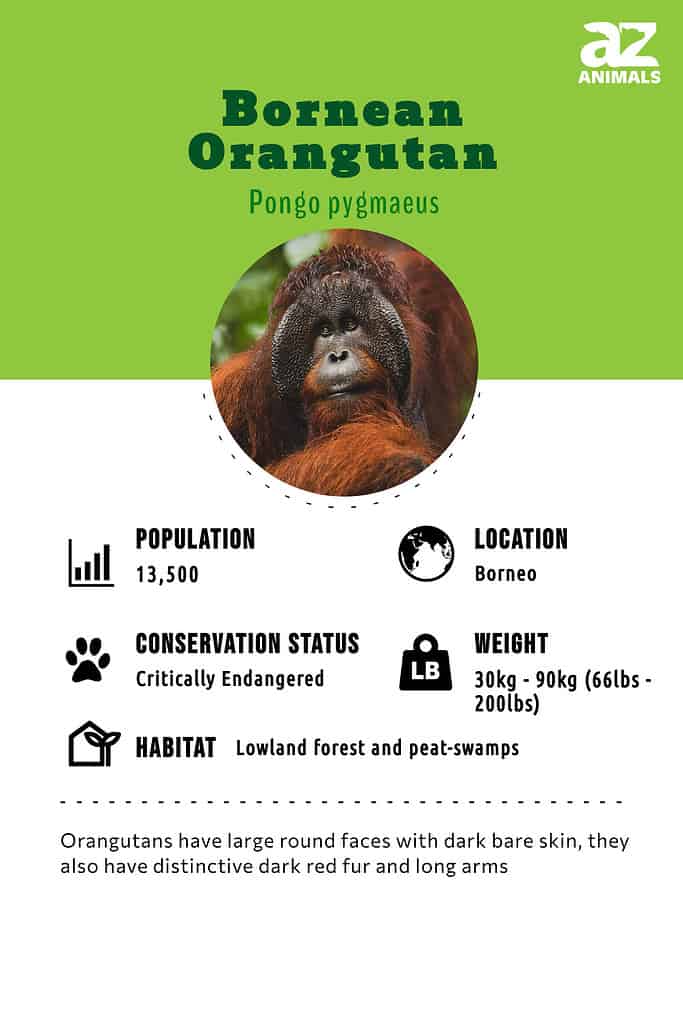
Pictorial summary of the Bornean Orangutan

Classification and Evolution
Orangutan, bornean

The Bornean Orangutan is one of three species including the Sumatran and the Tapanuli

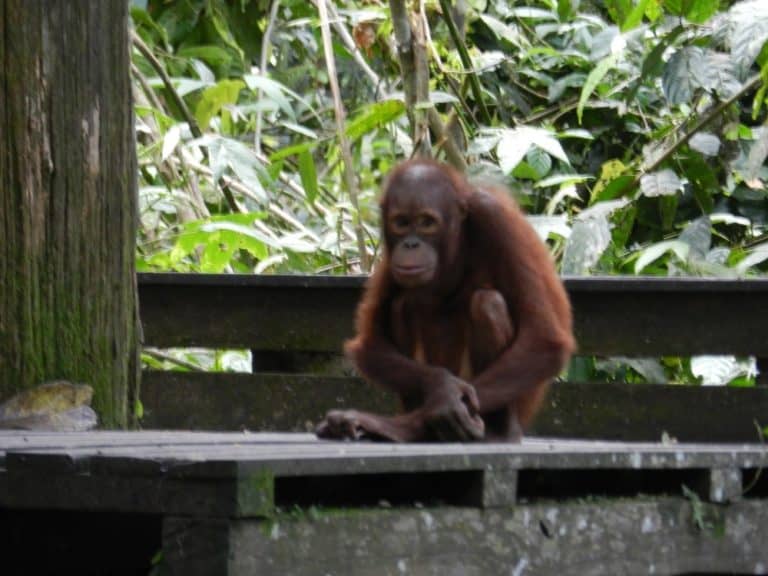
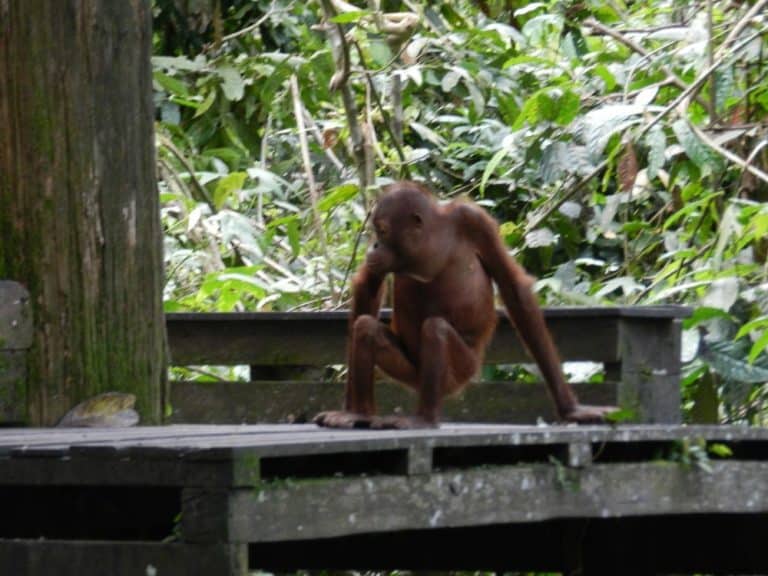
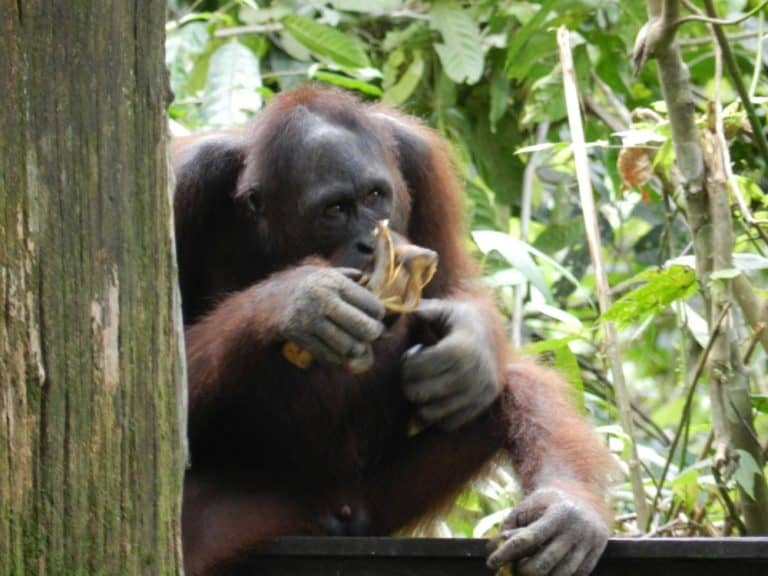
The Bornean orangutan is a large primate species that is found inhabiting the humid tropical jungles of Borneo. Also known as the Red Ape, the Bornean orangutan is the second largest ape species in the world (after the gorilla) and is the largest tree-dwelling animal on the planet. Although the Bornean orangutan is closely related to the great apes found in Africa, they differ greatly in their behavior with the biggest difference being that the Bornean orangutan is largely solitary where other ape species tend to adopt complex social hierarchies. Until recently there was thought to only be one orangutan species but recent genetic research has shown that there are in fact three species of orangutan which are the Bornean orangutan, the Sumatran orangutan, and the Tapanuli orangutan, which are slightly smaller in size and tend to be more sociable than their larger cousin. There are considered to be three different sub-species of the Bornean orangutan, which although they are similar in appearance, are differentiated by the areas of the island that they occupy. They are the Northwest Bornean orangutan, the Central Bornean orangutan and the Northeast Bornean orangutan.

Anatomy and Appearance

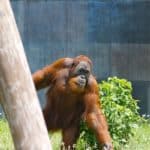
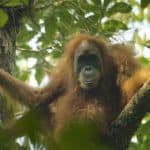
The Bornean orangutan is covered in patchy red or orange hair with its coarse grey skin being visible in some places. As they are largely arboreal mammals, the Bornean orangutan has a number of adaptations that help it when in the canopy including having feet that can grip as effectively as its hands, and arms that can grow to a span of more than two meters and are actually 30% longer than their legs. The face of the Bornean orangutan is bare and displays the grey or black color of its skin. Mature males also develop fleshy cheek pouches which are made up of fat deposits under the skin, along with throat poaches that are able to produce a deep, resonating sound through the forest. Both male and female Bornean orangutans are specially designed for opening and eating fruits with dexterous hands and feet for peeling and large flat teeth that help to grind down harder seeds and tree bark.

Distribution and Habitat

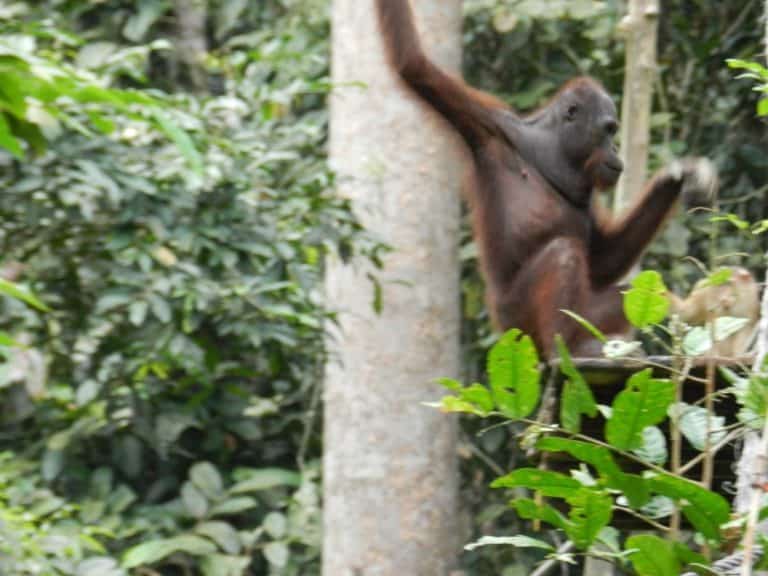
The Bornean orangutan is natively found on the island of Borneo where it inhabits areas of dense primary forest, mainly in the lowlands and valleys. Although they can be found at elevations of up to 1,500 meters they tend to prefer the lush slopes further down due to the higher abundance and variety of food. Although the Bornean orangutan (and indeed the Sumatran orangutan) were once widespread throughout south-east Asia, they are today confined to the two islands which they named after but are seriously vulnerable in their natural surroundings due to logging and forest fires which have decimated much of their once vast native regions. Due to the fact that the Bornean orangutan spends nearly all of its life high in the tree canopy, they rely on these dense and rich jungles to survive, and with less and less of their natural habitats remaining, they are being forced into smaller and more isolated regions away from the increasing levels of human activity.

Behavior and Lifestyle

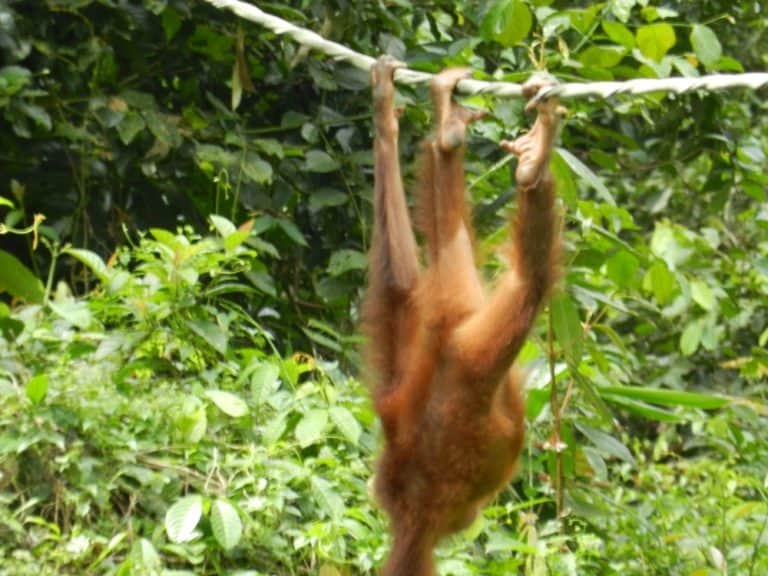
Unlike the other great ape species, the Bornean orangutan is largely solitary with the exception of mother and infant pairs and the gathering of a number of individuals around heavily laden fruit trees. Bornean orangutans spend much of their days sitting and eating in the canopy before constructing a nest by folding leafy branches over, where they sleep at night. Bornean orangutans move slowly through the steamy forests and as they are too heavy to jump, they rely on swinging tree branches back and forth until they can get close enough to grab onto the next one. Despite only traveling just over half a mile a day, Bornean orangutans can occupy vast home ranges that are loosely shared with other individuals with males having breeding rights with any female that enters their patch, marking their presence with deep, loud calls which echo through the trees.

Reproduction and Life Cycle

The Bornean orangutan is known to breed year-round but these slow-developing and maturing animals are not able to reproduce until they are often nearly 15 years old. After a gestation period that lasts for up to nine months, the female Bornean orangutan gives birth to a single infant which clings to its mother’s fur and is completely dependent on her for up to 10 years. Despite the young Bornean orangutans being weaned when they are around three years old, offspring continue to shadow their mother so as to learn about what to eat and where to find it and also for safety. Eventually leaving her to establish their own territory when they are at least eight years old, young females tend to remain close to their mother whereas young males can roam the forest for a long time before they finally find a patch of their own. Bornean orangutans tend to live for up to 35 years in the wild but can reach almost double that age in captivity.

Diet and Prey

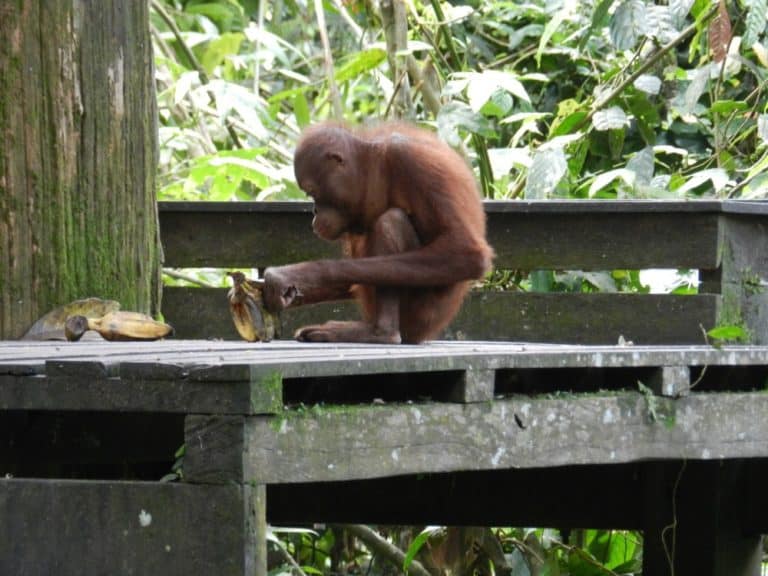
The Bornean orangutan is technically an omnivorous animal which means that they find and eat a variety of both plant and animal matter. Despite this, Bornean orangutans love fruit with around 60% of their diet being comprised of a wide variety of both ripe and unripe fruits including mangoes, durian, figs, and lychees. In the tropics though, different trees bare their fruits at different times of the year so Bornean orangutans must make a mental note of where the fruit trees are and when their fruits ripen. In order to supplement their diet though, Bornean orangutans also eat a range of plant matter including young shoots and leaves along with insects, eggs, and small vertebrates such as lizards on occasion. Although in areas where there is a rich and abundant supply of food Bornean orangutans are known to congregate together to feed, one of the reasons why they are so solitary is that if they lived together in a group in one area, there simply would not be enough food to go around.

Predators and Threats

Historically Bornean orangutans would hardly ever come down to the ground in fear of being preyed upon by large carnivores like tigers, bears, and clouded leopards but with the extinction of the tiger particularly throughout much of the island males are known to spend around 5% of their time on the forest floor. However, 40,000 years ago a new threat emerged in the form of modern humans that hunted the Bornean orangutan to extinction in numerous parts of their once vast natural range. Today they are protected by law but infants are still captured for the exotic pet trade and the mothers are often killed in the process. The biggest threat though to Borneo’s remaining orangutan populations is habitat loss in the form of deforestation for logging or to clear land for farming and agriculture, primarily to make way for palm oil plantations.

Interesting Facts and Features

The sound that male Bornean orangutans make to mark their territories comes from their developing throat pouch and is so booming that it can travel for more than a mile throughout the forest, to not only attract females but also to intimidate rival males. Bornean orangutans are unique amongst great apes as their arboreal lifestyle has led to their limbs having more mobility than other species, allowing them to negotiate around tricky branches more easily. In the same way however to other great ape species, Bornean orangutans have been observed using tools to help them in their daily lives. Seemingly dependent on where the individual lives, skills are passed onto infants from their mothers with sticks being used to extract termites and honey and even large leaves are used as a form of umbrella to keep the Bornean orangutan dry.

Relationship with Humans

Since their arrival in south-east Asia modern humans have been fascinated by this slow-moving and majestic mammal with their name in the native Malay language meaning “man of the forest” or “forest people”. Bornean orangutans are remarkably similar to us both in their appearance and behavior with these highly intelligent creatures having evolved perfectly to their tropical, tree-dwelling lives. However, the hunting of the Bornean orangutan and the deforestation of its once vast natural habitat has led to drastic declines in their population numbers particularly over the past century. Adults are often killed if they are seen in or close to plantations when looking for food and their young are captured to be sold into the exotic pet trade, despite their heavy legal protection.

Conservation Status and Life Today

Today, the Bornean orangutan is listed by the IUCN as a species that is Critically Endangered in its natural environment and is therefore severely threatened by extinction in the near future. The loss of their historic, unique, and incredibly bio-diverse habitats has led to a 92% drop in their population numbers in the past 100 years and if things continue the way they are going, it will not be long before they have disappeared from the wild forever. Rehabilitation programs exist throughout the island and so far seem to be having relative success but with deforestation (now even in protected areas) for logging and clearing land to make way for palm oil plantations, population numbers can only be expected to continue to fall.

View all 453 animals that start with B
How to say Bornean Orangutan in ...
German
Borneo-Orang-Utan
English
Bornean Orangutan
Spanish
Pongo pygmaeus
Indonesian
Orangutan Kalimantan
Italian
Pongo pygmaeus
Dutch
Borneose orang-oetan
Finnish
Borneonoranki
Chinese
婆罗洲猩猩

Sources

  1. David Burnie, Dorling Kindersley (2011) Animal, The Definitive Visual Guide To The World's Wildlife / Accessed July 13, 2010
  2. Tom Jackson, Lorenz Books (2007) The World Encyclopedia Of Animals / Accessed July 13, 2010
  3. David Burnie, Kingfisher (2011) The Kingfisher Animal Encyclopedia / Accessed July 13, 2010
  4. Richard Mackay, University of California Press (2009) The Atlas Of Endangered Species / Accessed July 13, 2010
  5. David Burnie, Dorling Kindersley (2008) Illustrated Encyclopedia Of Animals / Accessed July 13, 2010
  6. Dorling Kindersley (2006) Dorling Kindersley Encyclopedia Of Animals / Accessed July 13, 2010
  7. David W. Macdonald, Oxford University Press (2010) The Encyclopedia Of Mammals / Accessed July 13, 2010
  8. Bornean Orang-utan Facts / Accessed July 13, 2010
  9. Bornean Orang-utan Information / Accessed July 13, 2010
  10. Bornean Orang-utan Conservation / Accessed July 13, 2010
Dana Mayor

About the Author

Dana Mayor

I love good books and the occasional cartoon. I am also endlessly intrigued with the beauty of nature and find hummingbirds, puppies, and marine wildlife to be the most magical creatures of all.
Connect:

Thank you for reading! Have some feedback for us?


Bornean Orangutan FAQs (Frequently Asked Questions)

Bornean Orang-utans are Omnivores, meaning they eat both plants and other animals.