C
Species Profile

Cubera Snapper

Lutjanus cyanopterus

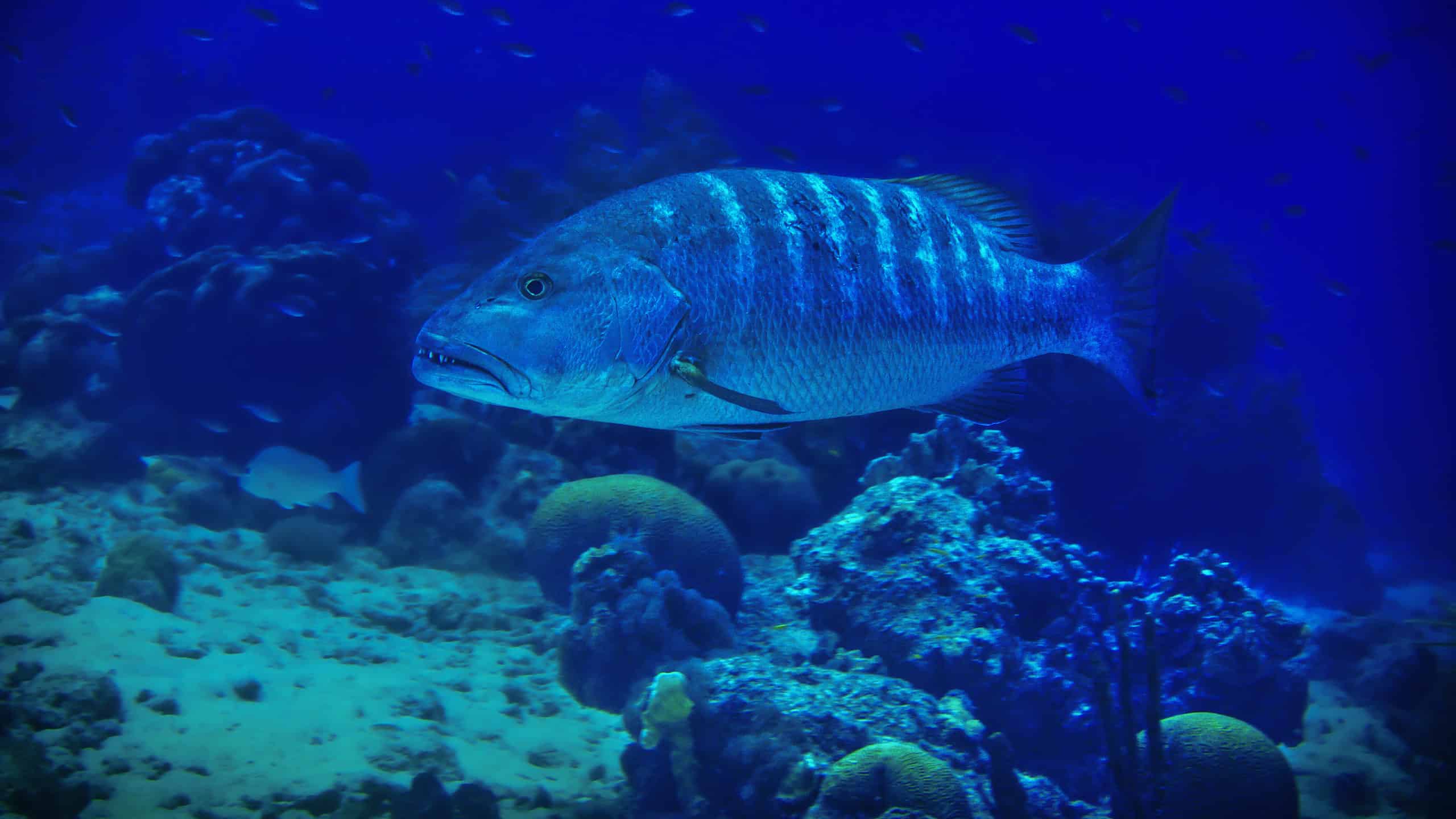
Big jaws. Bigger snapper.
Lynn Archer/Shutterstock.com

Cubera Snapper Distribution

Click a location to explore more animals from that region

This map shows coastal regions where Cubera Snapper are found.

Loading map...
Cubera Snapper

At a Glance

Wild Species
Diet Carnivore
Activity Nocturnal+
Lifespan 25 years
Weight 57 lbs
Status Vulnerable
Did You Know?

Record size is huge: up to 160 cm total length and ~57 kg reported (FishBase; Froese & Pauly, eds.).

Scientific Classification

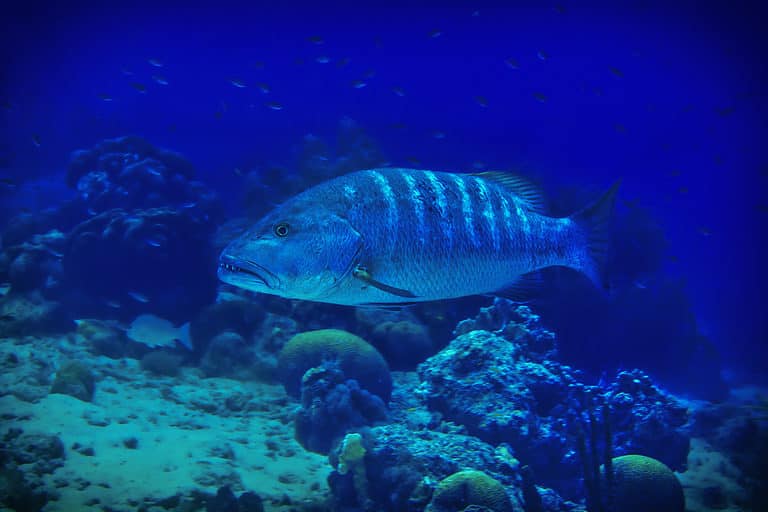
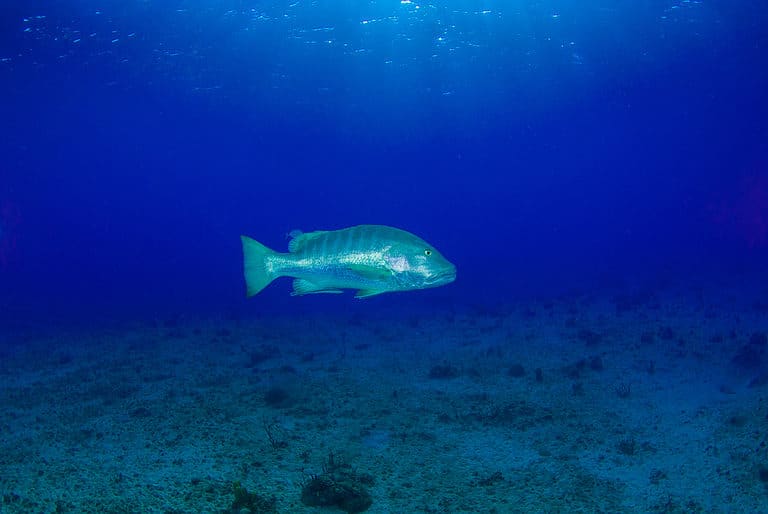
The cubera snapper is a very large, robust snapper (family Lutjanidae) of the western Atlantic, known for powerful jaws/canine teeth and a preference for reefs and rocky structure. It is an important sport and commercial fish and is long-lived and slow to mature compared with many reef fishes.

Kingdom
Animalia
Phylum
Chordata
Class
Actinopterygii
Order
Perciformes
Family
Lutjanidae
Genus
Lutjanus
Species
Lutjanus cyanopterus

Distinguishing Features

  • Very large snapper with a deep, robust body and massive head/jaws
  • Prominent canine teeth (especially anterior), suited for taking large prey
  • Generally gray to dark brown/bronze coloration; lacks the strong stripes typical of some other Lutjanus species
  • Typically tied closely to reefs/wrecks/rocky structure in the western Atlantic

Physical Measurements

Length
2 ft 11 in (1 ft 4 in – 5 ft 3 in)
Weight
33 lbs (4 lbs – 126 lbs)
Top Speed
36 mph
Estimated top speed ~57.6 km/h

Appearance

Primary Colors
Secondary Colors
Skin Type Bony fish with large, rough (ctenoid) scales and a thick, robust body; skin surface typically coated in mucus. Operculum and preopercle edges are firm/serrated as in snappers (Lutjanidae).
Distinctive Features
  • Very large, heavy-bodied snapper with a blunt, massive head and thick lips; adults develop a notably deep, robust profile compared with many Lutjanus species.
  • Powerful jaws with prominent canine teeth (especially anterior canines), giving a "bulldog" look; adapted for seizing large prey and crushing hard-bodied items.
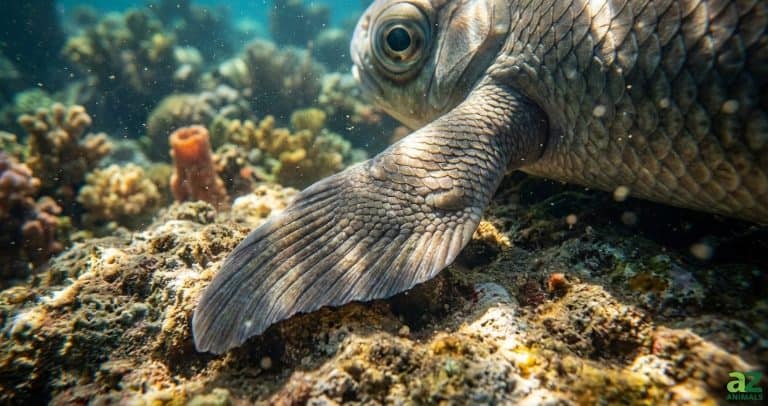
  • Caudal fin typically truncate to slightly emarginate (not deeply forked), contributing to a stocky silhouette.
  • Documented maximum size: 160 cm total length and ~57.0 kg maximum reported weight (commonly cited in FishBase; Froese & Pauly, eds.).
  • Long-lived, slow-growing snapper: maximum reported age up to 55 years from ageing studies on western Atlantic/Florida populations (e.g., Burton, 2001/2002 age-and-growth work on Lutjanus cyanopterus).
  • Behavioral appearance context: commonly associated with reefs, rocky bottoms, and wrecks in the western Atlantic (Caribbean and Gulf of Mexico); often seen as solitary or in small groups outside spawning periods.
  • Forms predictable spawning aggregations (seasonal, often around full moons) at specific reef promontories/shelf-edge sites-an important ecological and fisheries-relevant behavior for the species' life history.

Did You Know?

Record size is huge: up to 160 cm total length and ~57 kg reported (FishBase; Froese & Pauly, eds.).

It's one of the longest-lived snappers: maximum reported age ~55 years (FishBase; Froese & Pauly, eds.).

Adults have prominent canine teeth-built to seize fish and crack hard-shelled prey like crabs and lobsters.

Juveniles often use mangroves/estuaries as nurseries, then shift to reefs, rocky ledges, and shipwrecks as they grow.

Large adults are frequently solitary "structure fish," holding tight to caves, ledges, and wreck openings.

Spawning often happens in aggregations at predictable reef/edge sites-making the species easy to overfish when targeted at those times.

Anglers commonly call big ones "wreck hogs" for their habit of living deep in wrecks and surging back into cover when hooked.

Unique Adaptations

  • Massive head and robust jaw musculature with strong canines-adapted for gripping slippery fish and handling hard, struggling prey.
  • Heavy-bodied, deep profile and strong caudal propulsion-helps in short, explosive bursts and in resisting currents around reef drop-offs and wrecks.
  • Color pattern shifts with age: younger fish show more contrasting tones/barring that can aid camouflage in shallow nurseries; adults become darker and more uniform, blending into deeper reef shadows.
  • Wide habitat tolerance across life stages (nurseries to offshore reefs) increases survival-when nursery habitats like mangroves remain intact.
  • Site fidelity to structure (often returning to the same reefs/wrecks) can be advantageous for feeding efficiency, though it also increases vulnerability to localized fishing pressure.

Interesting Behaviors

  • Structure-hugging ambush predator: adults patrol reef faces, caves, and wreck corridors, then lunge from cover to grab prey.
  • Ontogenetic habitat shift: juveniles occur in sheltered coastal habitats (mangroves/estuaries), while adults concentrate on offshore hardbottom, reefs, and wrecks.
  • Spawning aggregations: adults travel to specific sites and gather to reproduce, often seasonally and with lunar timing reported in multiple regions (a key management concern for the species).
  • Powerful "dive-for-cover" response when hooked: large individuals frequently attempt to reach holes/structure immediately, leveraging their mass and tail beats.
  • Opportunistic feeding: takes both fishes and large crustaceans; individuals may become locally dominant predators on a given piece of structure.

Cultural Significance

The cubera snapper (Lutjanus cyanopterus) is a prized food and sport fish in the western Atlantic, especially the Caribbean and Gulf of Mexico. Sold at local docks, called a 'reef bull' for fierce fights, it gathers to spawn and drives seasonal fishing.

Myths & Legends

Gulf and Caribbean anglers call giant cubera snapper (Lutjanus cyanopterus) "ghosts of the wreck"—said to live for decades on one shipwreck and become nearly uncatchable after learning its tricks.

In parts of the Caribbean, some fishing communities share stories that the largest cubera snappers come from specific revered reefs and headlands believed to produce unusually large fish year after year.

No myths specific to the cubera snapper (Lutjanus cyanopterus) are found in references; large, solitary reef fish hide near caves, ledges, and wrecks and can be territorial, feeding local dockside tales.

Conservation Status

VU Vulnerable

Facing a high risk of extinction in the wild.

Population Decreasing

Protected Under

  • IUCN Red List: Lutjanus cyanopterus is assessed as Vulnerable (VU) with a decreasing population trend.
  • United States (example of range-state management): Managed under federal and state fisheries regulations (e.g., Magnuson-Stevens Fishery Conservation and Management Act framework; state rules such as Florida FWC regulations) that include gear/bag/size and seasonal measures in parts of its range; protections vary widely by jurisdiction.
  • Spatial protection: Occurs in multiple marine protected areas across the wider Caribbean/Western Atlantic; effectiveness depends on enforcement and whether key spawning aggregation sites are included.
  • HUBS (Lutjanidae / large Western Atlantic snappers) summary: Conservation status across the group ranges from Least Concern to Vulnerable (and in some cases Near Threatened) depending on region and fishing pressure. The most common threats are overfishing (especially aggregation fishing), habitat degradation (reef/nursery loss), and climate-driven reef decline. Notable at-risk taxa tend to be the largest, longest-lived, late-maturing snappers associated with spawning aggregations (cubera snapper is among these).

Life Cycle

Lifespan 25 years

Lifespan

In the Wild
1–55 years
In Captivity
5–30 years

Reproduction

Mating System Polygynandry
Social Structure Aggregation Group
Breeding Pattern Transient
Fertilization Broadcast Spawning
Birth Type Broadcast_spawning

Cubera snapper (Lutjanus cyanopterus) are separate male and female fish that spawn by external fertilization in short-lived, crowded offshore groups of many males and females. Spawning is seasonal and linked to the moon; eggs and larvae are pelagic. The species is very large and long-lived.

Behavior & Ecology

Social School Group: 1
Activity Nocturnal, Crepuscular
Diet Carnivore Reef fishes (commonly reported as the dominant prey of large adults in stomach-content summaries; FishBase species account for Lutjanus cyanopterus)

Temperament

Wary/avoidant toward large approaching animals (commonly described as difficult to approach by divers and fishers), consistent with heavily targeted reef predators.
Strongly predatory; uses ambush and short pursuit strikes; large adults can be locally dominant around structure.
Can be territorial around shelter sites (day refuges) and aggressive toward intruders/competitors at close range, as reported for large lutjanids and in field descriptions of this species (Claro & Lindeman 2003).

Communication

Low-frequency 'grunt/thump' sounds consistent with lutjanid swimbladder-associated sound production; reported generally for snappers and used in social/aggressive and reproductive contexts, but species-specific call structure for Lutjanus cyanopterus is not well characterized in peer-reviewed acoustic datasets.
Body posture/orientation displays (lateral presentations, rapid turns) during close interactions near structure.
Color pattern modulation (darkening/paling) associated with arousal/stress and social context-reported broadly in reef snappers; detailed ethograms for L. cyanopterus are limited.
Hydrodynamic cues within groups/aggregations Tail beats/rapid accelerations) aiding coordination during departures/ascents at spawning sites; described for reef-fish aggregations including lutjanids (Claro & Lindeman 2003

Habitat

Mangrove Estuary Coastal Coral Reef Rocky Shore Cave Seabed/Benthic +1
Biomes:
Terrain:
Coastal Island Rocky Sandy Muddy
Elevation: 6 ft 7 in – 180 ft 5 in

Ecological Role

Large reef mesopredator/top predator on western Atlantic reef and hard-bottom communities; links coastal nursery habitats to offshore reef trophic webs through ontogenetic habitat and diet shifts.

Regulates prey populations of smaller reef fishes and large mobile invertebrates (top-down control) Transfers energy from coastal nurseries (juveniles) to offshore reef systems (adults) Supports reef community balance by predation on mid-level consumers (helping prevent prey population booms)

Diet Details

Main Prey:
Reef and demersal fishes Crustaceans Cephalopods

Human Interaction

Domestication Status

Wild

Cubera snapper (Lutjanus cyanopterus) has no domestication history and is taken from the wild for food and sport. It is not commercially farmed. Cubera snapper can reach about 160 cm and 57 kg and live up to about 55 years. It grows slowly and matures late, making it very vulnerable to overfishing. Some related snappers are farmed.

Danger Level

Moderate
  • Bite/laceration risk: large adults have very strong jaws and canine teeth; handling on deck or at the spear can cause serious puncture wounds.
  • Ciguatera fish poisoning risk: as a large reef predator in tropical western Atlantic/Caribbean food webs, it can bioaccumulate ciguatoxins; human illness risk is via consumption (risk varies by location/size).
  • Fishing/boating injury risk: powerful fish can cause injuries during landing (hooks, gaffs, line burns) due to strong runs and headshakes near structure.

As a Pet

Not Suitable as Pet

Legality: Not usually banned as an aquarium fish, but getting Cubera snapper (Lutjanus cyanopterus) is limited by fishing rules (size, bag, season, gear) and may need licenses; taking from reefs or protected areas is illegal. Not CITES-listed.

Care Level: Expert Only

Purchase Cost: $50 - $300
Lifetime Cost: $20,000 - $100,000

Economic Value

Uses:
Commercial food fish (wild-caught) Recreational/sport fish (trophy species) Seafood supply chain (fresh/iced fillets, whole fish) Tourism value tied to sportfishing and dive-based reef ecotourism Fisheries management focus species (slow growth, long life, aggregation spawning)
Products:
  • fresh whole fish
  • fresh/chilled fillets
  • restaurant seafood
  • sportfishing charter value/trophy catch value

Relationships

Related Species 9

Dog snapper Lutjanus jocu Shared Genus
Mangrove snapper
Mangrove snapper Lutjanus griseus Shared Genus
Mutton snapper Lutjanus analis Shared Genus
Lane snapper Lutjanus synagris Shared Genus
Schoolmaster snapper Lutjanus apodus Shared Genus
Red snapper Lutjanus campechanus Shared Genus
Yellowtail snapper
Yellowtail snapper Ocyurus chrysurus Shared Family
Silk snapper Lutjanus vivanus Shared Genus
Queen snapper Etelis oculatus Shared Family

Ecological Equivalents 5

Animals that fill a similar ecological role in their ecosystem

Nassau grouper Epinephelus striatus Large, reef-structure-associated ambush predator that, like cubera snapper, is long-lived and forms spawning aggregations. Overlaps strongly on Caribbean reefs with cubera snapper in prey base (reef fishes and large crustaceans) and in use of caves and ledge habitat.
Goliath grouper
Goliath grouper Epinephelus itajara Very large, slow-growing reef and wreck predator that occupies a similar high-trophic-level role on rocky structures and artificial reefs. Both consume large crustaceans and fishes and are vulnerable to overfishing due to late maturity and aggregation spawning.
Great barracuda Sphyraena barracuda Reef-edge predator in the western Atlantic with overlapping habitat (reefs, wrecks, and rocky structure) and a similar adult diet emphasizing fishes. Often co-occurs around structure where cubera snapper patrols.
Caribbean spiny lobster Panulirus argus Not a taxonomic relative but a key shared-resource link. Large adult cubera snapper are well-known predators of large decapod crustaceans, including spiny lobsters on reefs and rocky bottoms. Both species are associated with crevices and holes for shelter, and their nocturnal activity increases encounter rates.
Dog snapper Lutjanus jocu Closest niche analogue among common western Atlantic snappers: a robust, reef-associated, large-bodied predator with strong canine teeth. Both often shift from juvenile mangrove and seagrass habitats to adult reef and wreck structure, and are commonly taken in the same fisheries.

The cubera snapper is game fish native to the West Atlantic Ocean. There are several species of snappers, including the mangrove snapper, mutton snapper, lane snapper, red snapper, cubera snapper, and yellowtail snapper. However, the cubera snapper is the largest of the Lutjanidae family and occurs across Nova Scotia, Florida, Cuba, and all the way across the South Atlantic to Brazil. While they are found in Florida’s northern oceans, they are very rare, as seen throughout the range. This massive snapper is often confused with the mangrove snapper but can be distinguished by its tooth patch and gill rakers.

Additionally, they are very aggressive predators, and prey on sea creatures like crabs and other large crustaceans, due to their powerful bite and strong teeth. But unfortunately, they also fall prey to whale sharks. Finally, Cubera snapper is delicious but hard to get because people can get ciguatera poisoning from them.

Three Amazing Cubera Snapper  Facts!

  • While very rare, the cubera snapper can cause ciguatera poisoning in humans
  • These snappers are the largest of their family, weighing approximately 40 pounds and measuring around 3 feet in length. However, some weigh up to 125 pounds and grow to 5 feet in length.
  • Cubera snappers have long lifespans and can live up to 55 years

Cubera Snapper Scientific Name

The cubera snapper’s scientific name is Lutjanus cyanopterus, and they belong to the order Perciformes. This order is the most diverse of ray-finned fish and consists of around 40% of all bony fish species, resulting in the largest order of vertebrates. For example, there are over 10,000 known species in this order, 1,500 genera, and 160 families. In addition, they are also dominant in many freshwater bodies.

These large snappers are members of the family Lutjanidae, which is a group of perciform fish that occur mainly in marine water. However, some members inhabit estuaries or feed in fresh water. In addition, there are around 113 species in this family, and some are important to human consumption. The best-tasting snapper is the red snapper.

Cubera Snapper Appearance

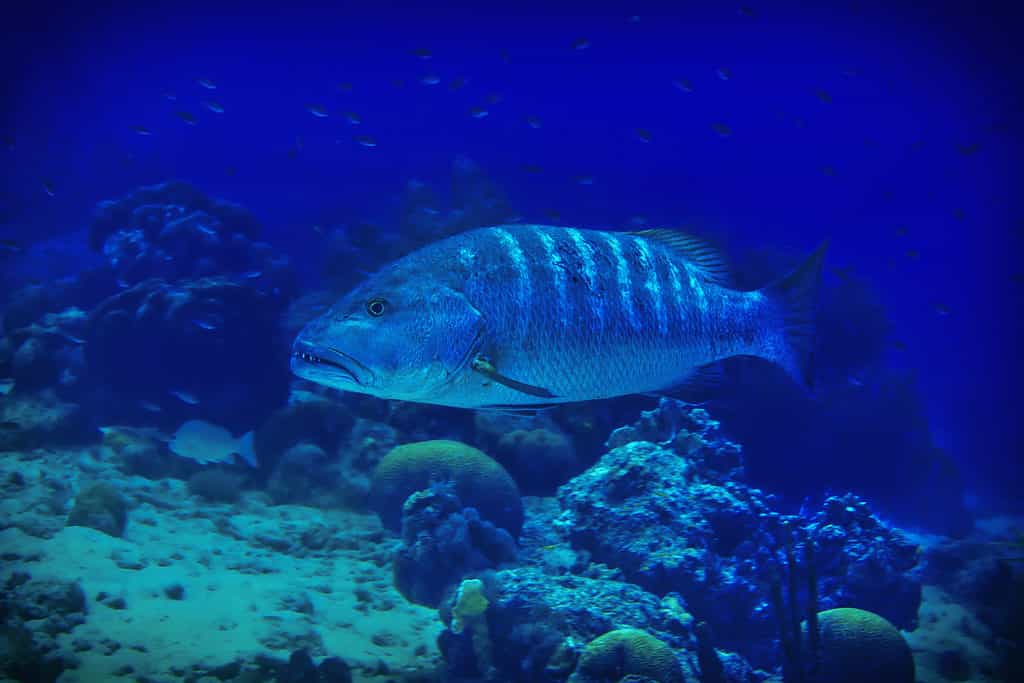
There is a distinctive difference between the cubera snapper and other members of the Lutjanidae family because they have a slender, elongated body that is not very deep. However, they have many similarities, like their continuous dorsal fin and longish pectoral fin. Additionally, their caudal fin is truncate-shaped, and they have large teeth and thick lips.

The coloration of the cubera snapper is generally dark brown or gray with pale or dark gray sides. Furthermore, they may have a reddish tint. In addition, they have a bluish tinge on their ventral and anal fins. These intimidating snappers also have light gray caudal fins and translucent or gray pectoral fins. Lastly, juveniles have a barred pattern on each side of their bodies that fades away as they age.

Cubera snappers are the biggest species in their family, often weighing around 40 pounds and growing to 3 feet long. However, they have been known to reach a weight of 125 pounds and measure 5 feet in length.
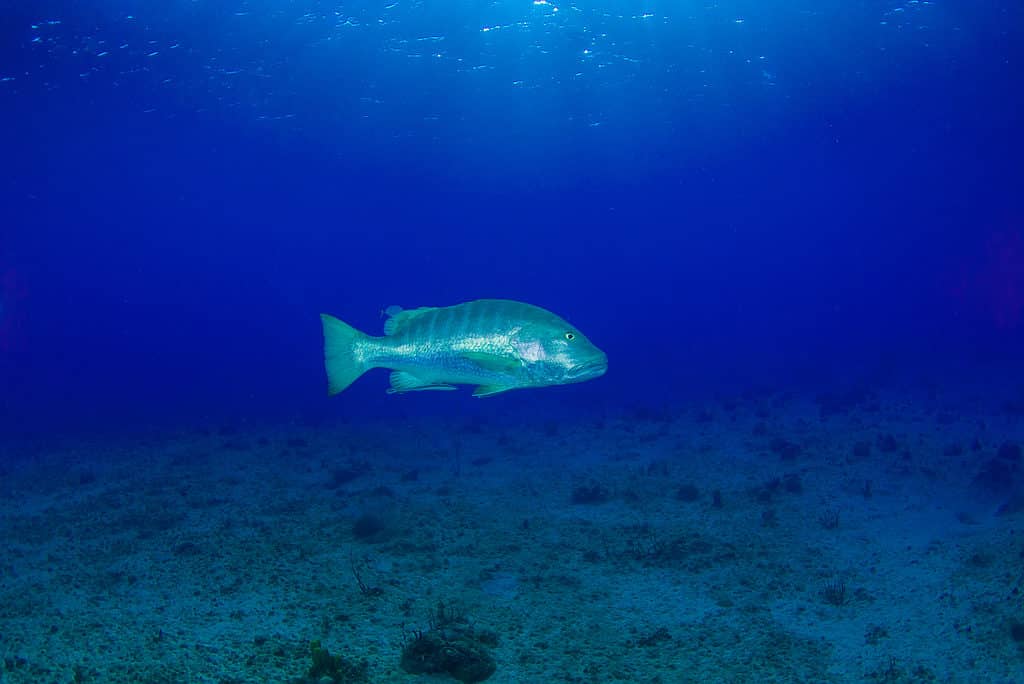
Cubera snapper isolated

Cubera snappers feed on crabs and other crustaceans and are very aggressive hunters.

Cubera Snapper Behavior

These massive snappers are solitary fish, generally found in depths of 3 to 278 feet. It is very rare to see them together unless it’s spawning season. However, there is incredibly little information available regarding how they communicate with each other. But one thing’s for sure; they are powerful fish, notorious for their aggressive behavior.

Cubera Snapper Habitat

Cubera snappers are native to the western Atlantic Ocean and inhabit areas as far north as Nova Scotia all the way south to Brazil’s Santa Catarina. Additionally, they occur in the Caribbean Sea, the Gulf of Mexico, and around Bermuda. Their depth preference differs, but they are generally found in waters 3 to 278 feet deep. However, juveniles are often found seeking shelter in seagrass beds amongst the mangroves and have been sighted entering freshwater. But adults swim offshore, where they live in rocky ledges and reef habitats.

Cubera Snapper Diet

The cubera snapper is a feared, carnivorous fish known for its aggressive behavior. They mainly feed on crabs and other fish species. In addition, their powerful canines allow them to feed on larger prey like lobsters and other crustaceans. Furthermore, their preferred feeding grounds are generally located near the bottom of rocky reefs.

Cubera Snapper Predators and Threats

While very intimidating, the cubera snapper also falls prey to other marine animals like barracudas, whale sharks, and moray eels. However, there is a likelihood these predators fall victim to ciguatera poisoning caused by certain algae the snapper ingested.

The cubera snapper’s biggest threats include:

  • Pollution
  • Commercial and residential development
  • Climate change
  • Overfishing

Cubera Snapper Reproduction, Babies, and Lifespan

The cubera snapper is an oviparous breeder who releases pelagic eggs into offshore waters. Their breeding season takes place in the Caribbean from June to August. As a result, it is not unusual to see hundreds of individuals congregating over deep areas during this time. Their eggs hatch 24 hours after being fertilized, resulting in pelagic larvae dispersed by the strong currents. However, not much is known about their lifecycle and development.

Lifespan/Longevity

Cubera snappers have a long lifespan and can live up to 55 years.

Cubera Snapper Population

There is no concrete evidence of the cubera snapper’s population size. However, their numbers are declining each year, and they are listed as Vulnerable on ICUN’s Redlist.

Other Snapper Species

There are over 113 species of snapper fish. Here are four of the most popular specimens:

Northern Red Snapper

The northern red snapper’s scientific name is Lutjanus campechanus, and they have large populations in their natural range of the Caribbean Sea, Atlantic Ocean, and Gulf of Mexico. Furthermore, they are one of the most sought-after game fish, notorious for their tasty flesh.

Their most distinguishing feature is their red coloration. However, red snappers occurring in deeper waters generally have a more intense red coloration compared to the ones inhabiting shallow waters. Red snappers are one of the top hunters in their habitat and prefer to stay on the hard bottoms of rocky reefs. However, their threats include humans and bigger carnivores like barracudas, sharks, morays, turtles, and other marine creatures.

Mangrove Red Snapper

The mangrove red snapper’s scientific name is Lutjanus argentimaculatus, and they belong to the class of ray-finned fishes. They, too, belong to the family Lutjanidae. These snappers go by many names, including:

  • Mangrove Jack
  • River snapper
  • Red perch
  • Red reef bream
  • Purple sea perch
  • Red beam
  • Gray snapper
  • Creek red bream
  • Stuart evader
  • Dog bream
  • Rock barramundi
  • River roman

These snappers are native to the Indo-Pacific range and have only recently been discovered in the Mediterranean Sea. The mangrove snapper is mainly a marine fish but can also occur in freshwater. As their namesake suggests, these fish occur primarily in mangrove estuaries. Additionally, adults and juveniles also inhabit lower areas of freshwater systems but eventually migrate to spawn in deeper offshore reefs.

Yellowtail Snapper

The yellowtail snapper is a broad fish with a yellow stripe running from its nose down its whole body. They are swift-moving fish that occupy the Atlantic Ocean. However, their biggest populations inhabit outside reefs in the Bahamas off the South Florida coast at depths of 30 to 250 feet. These snappers are highly prized for their light and flaky meat, which makes them very expensive all over the world, even in their native regions.

Compared to other snappers, the yellowtail snapper has a much smaller head and mouth. The clear yellow stripe that runs down their bodies narrows when approaching their eyes. In addition, they have several olive, bluish-black, or yellow spots on the upper half of their bodies. Furthermore, their lower sides and bellies have longitudinal, narrow, yellow, and pink stripes. Lastly, they have deeply-forked caudal balance with the lower projection shorter than the upper one.

Lane Snapper

The lane snapper is often referred to as:

  • Mexican snapper
  • Rainbow snapper
  • Candy snapper

This fish is a delicacy, making it a popular game catch. They occur in the western Atlantic Ocean, spanning from North Carolina to southern Brazil. In addition, they are found in large numbers just off Panama in the Antilles and along South America’s northern coast. Furthermore, they can also be found around Bermuda in the Gulf of Mexico.

Lane snappers have pointed snouts and deep bodies with double dorsal fins, rounded anal fins, and short pectoral fins. In addition, they have slightly forked caudal fins, and their dorsal fins are located above the lateral line on their bodies.

These snappers are generally found in deep waters, and their dark complexion is more pronounced than the shallow water fish, with resting phase coloration. Lastly, their uppersides are pinkish-red, and their backs have a green tint.

Mutton Snapper

The mutton snapper’s scientific name is Lutjanus analis. They inhabit the Atlantic coastal waters from Massachusetts in the USA to southern Brazil, specifically the Gulf of Mexico and the Caribbean Sea. Adults generally occur in coral reefs or rocky regions underwater. However, juveniles prefer sandy areas with an abundance of plankton to feed on. But, on average, they are found at depths of 82 to 295 feet.

These snappers have olive-tinted backs and reddish sides. They also have blue stripes on their heads and prominent black spots between their dorsal fin and lateral line.

Mutton snappers are important commercial fish. They are especially popular in the aquarium trade and amongst sports fishermen. In fact, they are extremely prized by saltwater anglers, who use cut squid, smaller baitfish, frozen or live shrimp, live pinfish, or minnows as bait to catch them. However, mutton snappers prefer live bait to artificial bait.

Adults are typically found in deep water, while juveniles prefer shallow water. These fish are notorious fighters and give anglers a run for their money, which makes them even more desirable. Lastly, they are also caught commercially because their meat is a delicacy. People rave about their light, flaky, and white flesh, which can be cooked in various ways.

Up Next?

View all 392 animals that start with C

Sources

  1. Wikipedia / Accessed January 30, 2023
  2. Gulf Council / Accessed January 30, 2023
  3. Florida Museum / Accessed January 30, 2023
  4. IUCN Redlist / Accessed January 30, 2023
Chanel Coetzee

About the Author

Chanel Coetzee

Chanel Coetzee is a writer at A-Z Animals, primarily focusing on big cats, dogs, and travel. Chanel has been writing and researching about animals for over 10 years. She has also worked closely with big cats like lions, cheetahs, leopards, and tigers at a rescue and rehabilitation center in South Africa since 2009. As a resident of Cape Town, South Africa, Chanel enjoys beach walks with her Stafford bull terrier and traveling off the beaten path.
Connect:

Thank you for reading! Have some feedback for us?


Cubera Snapper FAQs (Frequently Asked Questions)

The cubera snapper is the largest of this family and occurs across Nova Scotia, Florida, Cuba, and all the way across the South Atlantic to Brazil.