




P
Species Profile

Pink Salmon

Oncorhynchus gorbuscha

Two years. One run. Big impact.
CSNafzger/Shutterstock.com

Pink Salmon Distribution

Click a location to explore more animals from that region

Invasive Species

This map shows coastal regions where Pink Salmon are found.

Loading map...
pink salmon

At a Glance

Wild Species
Also Known As Humpback salmon, Humpy, Humpie, Pinks, Humpies
Diet Carnivore
Activity Cathemeral
Lifespan 2 years
Weight 6.8 lbs
Status Least Concern
Did You Know?

They almost always mature at age 2 and die after spawning-so generations are largely separated into odd- and even-year runs (ADF&G; NOAA Fisheries).

Scientific Classification

Pink salmon (Oncorhynchus gorbuscha) is the smallest and most abundant of the Pacific salmon species. It is an anadromous ray-finned fish: adults migrate from the ocean to freshwater to spawn, after which they die.

Kingdom
Animalia
Phylum
Chordata
Class
Actinopterygii
Order
Salmoniformes
Family
Salmonidae
Genus
Oncorhynchus
Species
gorbuscha

Distinguishing Features

  • Smallest of the Pacific salmon; typically 1.2–2.5 kg as adults (variable by region).
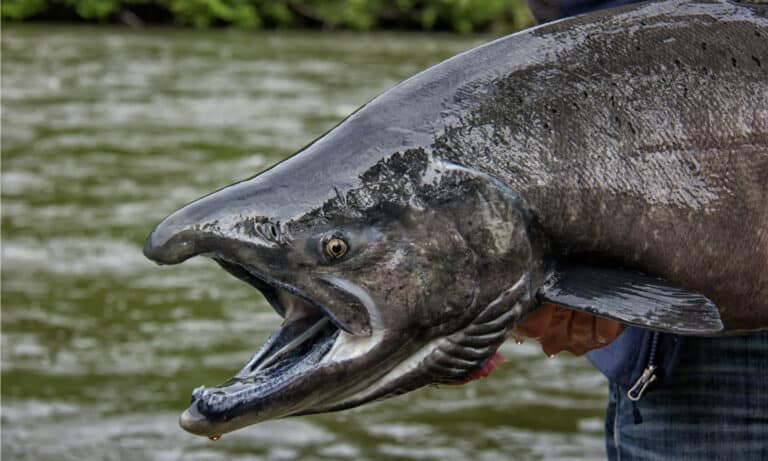
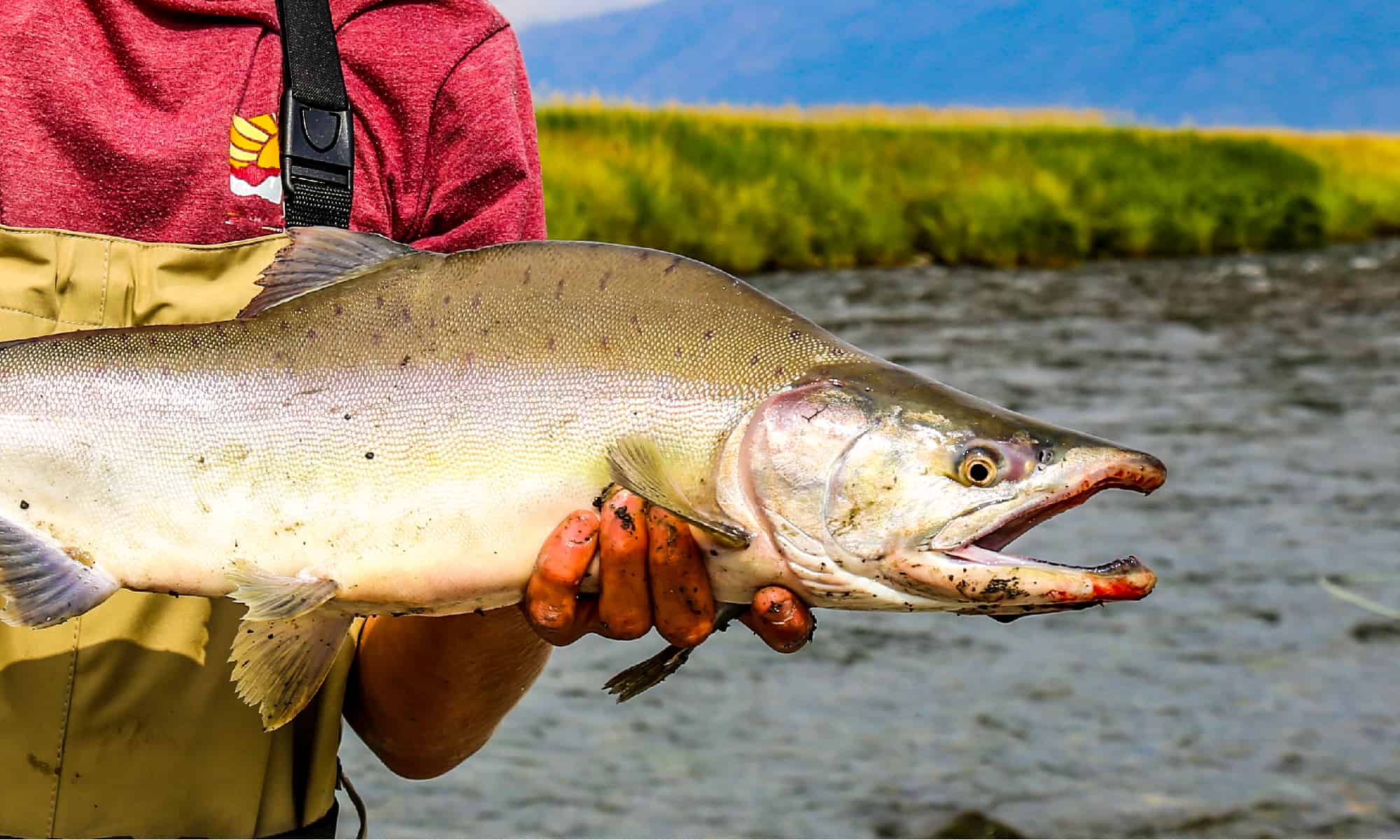
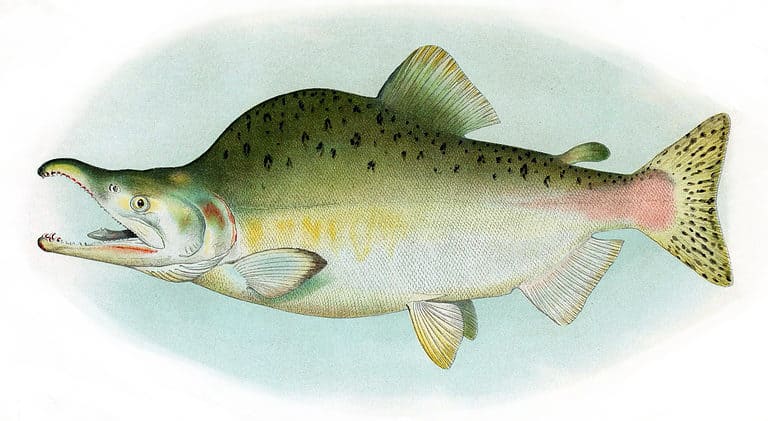
  • Males develop a pronounced dorsal hump and hooked jaw during spawning (source of the name 'humpback salmon').
  • Spawning adults often show dark blotches on the back and tail; tail typically has large oval spots.
  • Strict two-year life cycle in many regions, producing strong odd-year/even-year runs.

Physical Measurements

Length
1 ft 8 in (1 ft 4 in – 2 ft 6 in)
Weight
4 lbs (3 lbs – 15 lbs)
Top Speed
11 mph
swimming

Appearance

Primary Colors
Secondary Colors
Skin Type Thin cycloid scales with mucus-coated skin; smooth, streamlined body typical of anadromous salmonids.
Distinctive Features
  • Smallest Pacific salmon; typical adult fork length ~40-60 cm and ~1.2-2.3 kg (NOAA Fisheries).
  • Large scales relative to other Pacific salmon; overall sleek, torpedo-shaped profile.
  • Back and caudal fin marked with distinct black oval spots; few/none on lower sides (regional variation).
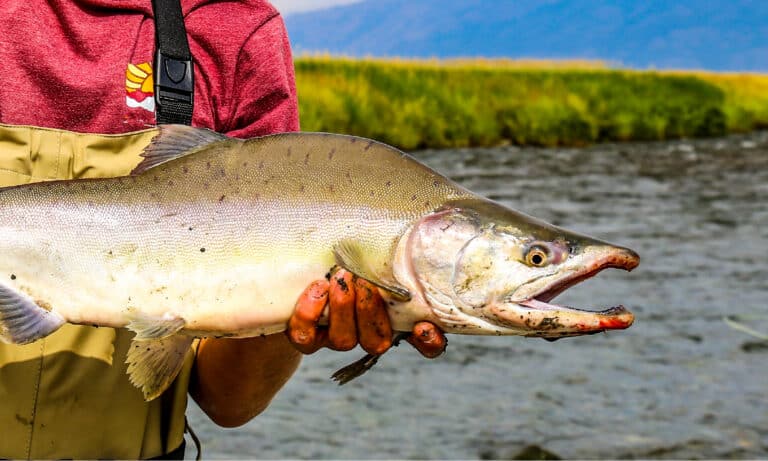
  • Mouth generally pale with dark gumline at tooth bases; breeding males develop pronounced kype.
  • Anadromous: juveniles emerge in freshwater, migrate to sea quickly, then return to spawn and die (semelparous).
  • Strong two-year life cycle with odd- and even-year lineages; run timing varies by region across the North Pacific (ADF&G/NOAA).
  • Spawning transfers marine-derived nutrients to freshwater ecosystems after post-spawn mortality; major commercial fishery species in the North Pacific.

Sexual Dimorphism

During spawning migration, males develop a pronounced dorsal hump and hooked jaws with deeper body shape and darker/rosier coloration. Females remain more streamlined with reduced jaw curvature and generally less intense breeding colors.

  • Distinctive breeding 'hump' behind the head (strongly developed at spawning).
  • More pronounced kype (hooked upper jaw) and enlarged teeth.
  • Often darker overall with stronger pink/red flushing and blotchier breeding tones.
  • No or minimal hump; body remains more evenly tapered.
  • Less pronounced kype; smaller head and jaw modifications.
  • Typically subtler pink/red breeding coloration and less extreme body depth.

Did You Know?

They almost always mature at age 2 and die after spawning-so generations are largely separated into odd- and even-year runs (ADF&G; NOAA Fisheries).

Typical adults are ~50 cm long; maximum reported length is 76 cm (FishBase).

Typical weight is ~1.2-2.5 kg; maximum reported weight is 6.8 kg (FishBase).

Spawning males develop the famous humped back and hooked jaws-hence the nickname "humpy."

Unlike some Pacific salmon (e.g., coho, Chinook) that may rear in freshwater for months to years, pink salmon juveniles head to sea soon after emerging from the gravel (NOAA Fisheries).

Pink salmon are the most abundant Pacific salmon species in many North Pacific regions and support major commercial fisheries, especially for canned and frozen products (NOAA Fisheries).

Their carcasses and eggs deliver marine nutrients to rivers and forests, feeding insects, birds, bears, and riparian plants-an ecosystem "nutrient pump."

Unique Adaptations

  • Fast, compressed life history: rapid growth and a near-universal 2-year lifespan/maturity schedule enables population "pulses" and quick turnover (NOAA Fisheries; ADF&G).
  • Male breeding morphology: the dorsal hump and hooked jaw are temporary sexual traits that improve leverage and fighting/positioning during spawning competition.
  • Early seaward migration: juveniles are adapted for immediate transition to marine feeding, reducing time in freshwater compared with other Oncorhynchus species that rear longer.
  • High ecological subsidy: post-spawn die-off is an adaptation shared across Pacific salmon that moves marine-derived nitrogen and phosphorus into freshwater and riparian ecosystems.
  • Cold-water tolerance and broad North Pacific range: pink salmon occupy subarctic to temperate coasts around the North Pacific, reflecting physiological tolerance for cold marine conditions.

Interesting Behaviors

  • Anadromous migration: hatch in freshwater, migrate to the ocean to grow, then return to freshwater to spawn and die (semelparity).
  • Strict two-year run timing: in many areas, odd-year and even-year lineages are temporally isolated, creating alternating "big" and "small" run years (ADF&G/NOAA Fisheries).
  • Redd building: females dig gravel nests (redds), deposit eggs, and cover them; males compete for access to spawning females.
  • Spawning color shift: both sexes darken and change coloration in freshwater; males exaggerate traits (hump, kype) during breeding.
  • Nearshore early marine life: juveniles quickly enter saltwater and often use coastal habitats soon after leaving streams, forming schools as they feed and grow.
  • Strong homing tendency (common to Pacific salmon): adults return to natal waters to spawn, reinforcing local population structure.

Cultural Significance

Across Alaska, British Columbia, and the North Pacific Rim, pink salmon (Oncorhynchus gorbuscha), or “humpies,” are a key food and cultural species. They support canning and roe fisheries, shape seasonal work and sharing, and their runs and carcasses feed wildlife and fertilize streams and forests.

Myths & Legends

Tlingit and other Northwest Coast tellings of "Salmon Boy": a boy who mistreats salmon is taken to live with Salmon People under the sea, learns respect, then returns to teach salmon rituals and care.

First Salmon ceremonies by Coast Salish and other Pacific Northwest peoples welcome the season's first salmon with songs, careful cooking, and returning bones to the river so salmon will come back.

In Northwest Coast Raven stories (Tlingit, Haida, Tsimshian and others), Raven the trickster brings or frees important foods; salmon — including Pink Salmon (Oncorhynchus gorbuscha) — are gifts that make human life in the new world possible.

Ainu traditions (Hokkaido and Sakhalin): salmon are honored as spirit beings who visit humans in fish form; rituals express gratitude and help maintain their return each year.

Conservation Status

LC Least Concern

Widespread and abundant in the wild.

Population Unknown

Protected Under

  • Magnuson-Stevens Fishery Conservation and Management Act (United States)
  • Fisheries Act (Canada)
  • Pacific Salmon Treaty (United States-Canada)

Life Cycle

Birth 1500 frys
Lifespan 2 years

Lifespan

In the Wild
1–3 years
In Captivity
2 years

Reproduction

Mating System Polygynandry
Social Structure Aggregation Group
Breeding Pattern Transient
Fertilization Substrate Spawning
Birth Type Substrate_spawning

Pink salmon mature at ~2 years, aggregate on spawning grounds, and are semelparous (die after spawning). Females build gravel redds and release eggs; multiple males (including dominant and sneaker males) compete and can fertilize a single female's clutch.

Behavior & Ecology

Social School Group: 100
Activity Cathemeral
Diet Carnivore Euphausiids (krill; especially Thysanoessa spp.)
Seasonal Migratory 31 mi

Temperament

Strongly social (schooling) in marine phase; generally non-aggressive while feeding (Quinn 2005).
During spawning, males show brief competitive aggression (chasing/biting) near females; contests are short (Quinn 2005).
Semelparous, ~2-year life cycle; adults stop feeding during spawning migration and die post-spawn (Groot & Margolis 1991).
Most individuals school in the open ocean.

Communication

none documented; no specialized acoustic signaling reported for pink salmon Hawkins 1981
Olfactory homing to natal waters via juvenile imprinting and adult odor discrimination Hasler & Scholz 1983; Dittman & Quinn 1996
Chemical cues/pheromones contribute to orientation and conspecific detection in freshwater Quinn 2005
Visual courtship signals Parallel swimming, quivering) coordinate spawning at the redd (Quinn 2005
Mechanosensory Lateral line) cues maintain spacing and alignment in schools (Pitcher & Parrish 1993
Tactile contact during spawning Body contact, nudging) helps synchronize gamete release (Quinn 2005

Habitat

River/Stream Estuary Coastal Kelp Forest Open Ocean Seabed/Benthic Rocky Shore Beach +2
Biomes:
Marine Freshwater Wetland Temperate Rainforest Temperate Forest Boreal Forest (Taiga) Tundra +1
Terrain:
Coastal Riverine Island
Elevation: Up to 984 ft 3 in

Ecological Role

Mid-trophic pelagic planktivore/forage fish and major nutrient vector between marine and freshwater ecosystems (anadromous, semelparous spawner).

Transfers marine-derived nutrients (N, P, C) to spawning streams via adult carcasses, eggs, and excretion, subsidizing stream and riparian food webs Provides substantial prey biomass for marine predators (e.g., salmon sharks, marine mammals, seabirds, larger fishes) and freshwater/terrestrial scavengers and predators during spawning runs Consumes large quantities of zooplankton (copepods/euphausiids), influencing pelagic plankton community structure and energy flow in subarctic North Pacific ecosystems Supports commercial, subsistence, and recreational fisheries, linking ecosystem production to human food systems

Diet Details

Main Prey:
Copepods Krill Amphipods Pteropods Larvaceans Decapod larvae Aquatic insect larvae Fish larvae and small pelagic fishes +2

Human Interaction

Domestication Status

Wild

Pink salmon (Oncorhynchus gorbuscha) is not domesticated; it is a wild anadromous salmon with a two-year, single-spawn life and odd- and even-year lineages. Humans raise it in hatcheries to support stocks and fisheries, but without long-term selection or farm strains. People also fish it commercially, for subsistence and sport, alter habitat, and run conservation programs.

Danger Level

Low
  • Handling/processing injuries (fish spines, knives, hooks; punctures and lacerations)
  • Slips/falls during fishing on wet rocks/boats
  • Foodborne illness risk if improperly handled (raw/undercooked fish; general seafood safety)
  • Allergic reactions in sensitive individuals to fish proteins
  • Possible exposure to parasites if consuming raw/undercooked fish (risk reduced by proper cooking/freezing protocols)

As a Pet

Not Suitable as Pet

Legality: Pink Salmon (Oncorhynchus gorbuscha) are not legal or practical pets. They are regulated as wildlife; keeping, moving, or holding them usually needs permits, and rules vary by place and origin.

Care Level: Expert Only

Purchase Cost: Up to $200
Lifetime Cost: $5,000 - $40,000

Economic Value

Uses:
Commercial marine fisheries (food fish) Subsistence/personal-use harvest (food security/cultural value) Recreational angling (regionally important, especially during runs) Hatchery production/stock enhancement and mixed-stock management Ecosystem services (nutrient transfer from ocean to rivers; carcass subsidies for wildlife)
Products:
  • Fresh/frozen fillets and whole fish
  • Canned salmon
  • Roe (salmon roe products; value varies by market)
  • Fish meal/oil and bait in some supply chains
  • Employment and regional economic activity tied to salmon runs and processing

Relationships

Ecological Equivalents 5

Animals that fill a similar ecological role in their ecosystem

The pink salmon (Oncorhynchus gorbuscha) is an anadromous fish that thrives in the cold waters of the North Pacific and Arctic Oceans. Alternate names for this species include humpback salmon, humpy, gorbusch, haddo, and holia. Its defining characteristic is its ability to swim for many miles upstream to spawn, after which it dies. Though these fish are carnivores, they are small enough that they have a number of predators. They are popular with both recreational fishermen and commercial fisheries. Despite this, however, their North Pacific populations are so large that they pose a threat to similar, competing species.

3 Pink Salmon Facts

  • Pink salmon don’t look predominantly pink: Though breeding members of this species have red sides, these fish are mostly silver with bluish or greenish tones. Their name comes from the pink color of their flesh, not their scales. Salmon get their pink color from the crustaceans in their diet, like shrimp and krill. The more crustaceans they eat, the pinker the salmon.
  • Pink salmon die after they spawn: These fish use up all their energy reserves to swim upriver and build nests. They stop eating after entering fresh water, leaving themselves with no fuel for the return journey. Eventually, they waste away.
  • The smallest of the North American Pacific salmon: Despite their amazing ability to swim miles upstream to spawn, these fish are not large. The biggest individuals only measure 30 inches and weigh no more than 15 pounds.
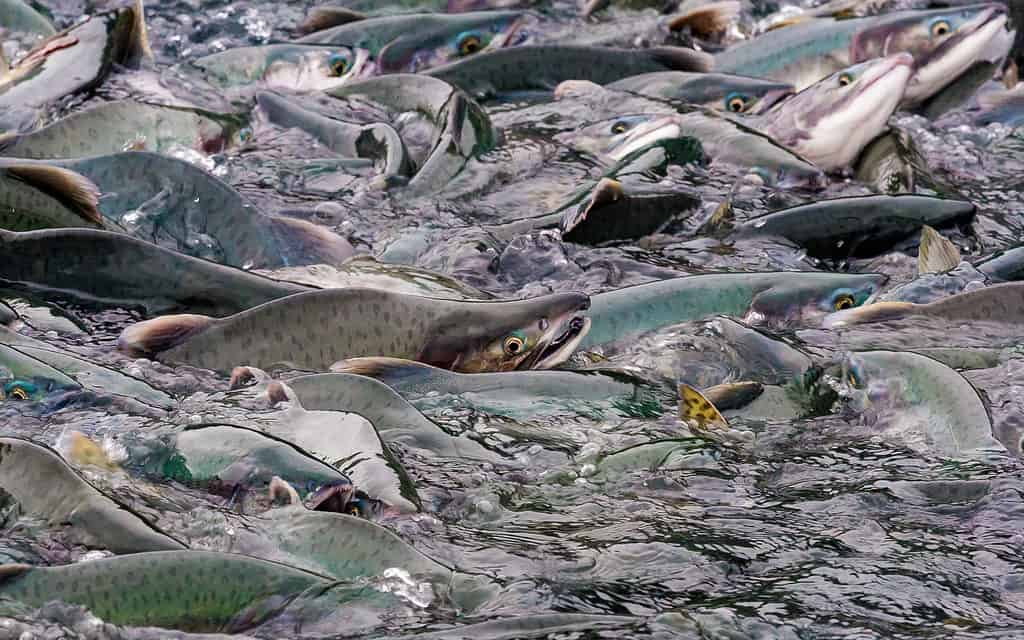
Pink salmon get their name from their scales

Pink salmon get their name from the pink color of their flesh, not their scales.

Pink Salmon Classification and Scientific Name

Pink salmon’s scientific name is Oncorhynchus gorbuscha. Oncorhynchus comes from the Greek words for “nail” and “snout”. Gorbuscha is the Russian name for this fish, which belongs to the superclass Osteichthyes (the bony fishes) and the class Actinopterygii. Within this class, it falls into the order Salmoniformes. Its family, Salmonidae, contains 66 species in 11 genera. The genus Oncorhynchus comprises all species of Pacific salmon and Pacific trout.

Pink Salmon Appearance

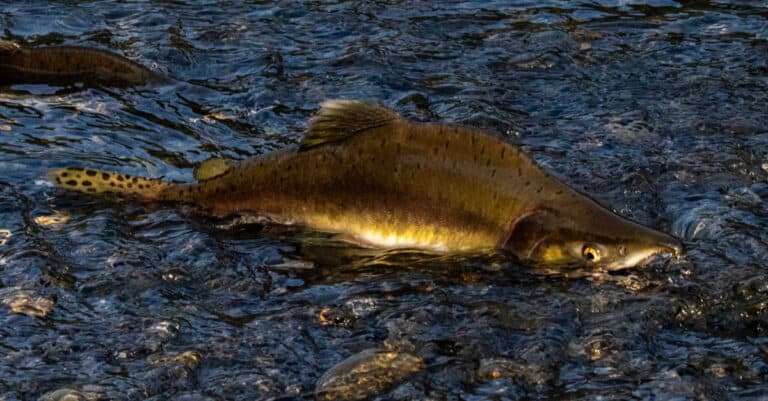
Despite their name, wild pink salmon do not have predominantly pink scales; rather, the flesh underneath is pink. Breeding males have red sides with greenish-brown blotches and dark backs. Breeding females appear similar; however, their coloration is duller than that of males. Both sexes feature a steel blue or blue-green dorsum with silver sides and a white belly, though their color fades to a pale grey during spawning.

These fish have six types of fins: an adipose fin, a dorsal fin, a caudal fin, pelvic fins, an anal fin, and pectoral fins. The adipose and dorsal fins, as well as the dorsal region, sport oval spots. During spawning, males develop a hump on their backs, earning the species the nickname “humpback salmon” or “humpies.”

This species is the smallest of the North American Pacific salmon. Individuals typically weigh between 3.5 and five pounds and measure 20-25 inches long. The biggest individual on record weighed 15 pounds and measured 30 inches in length.
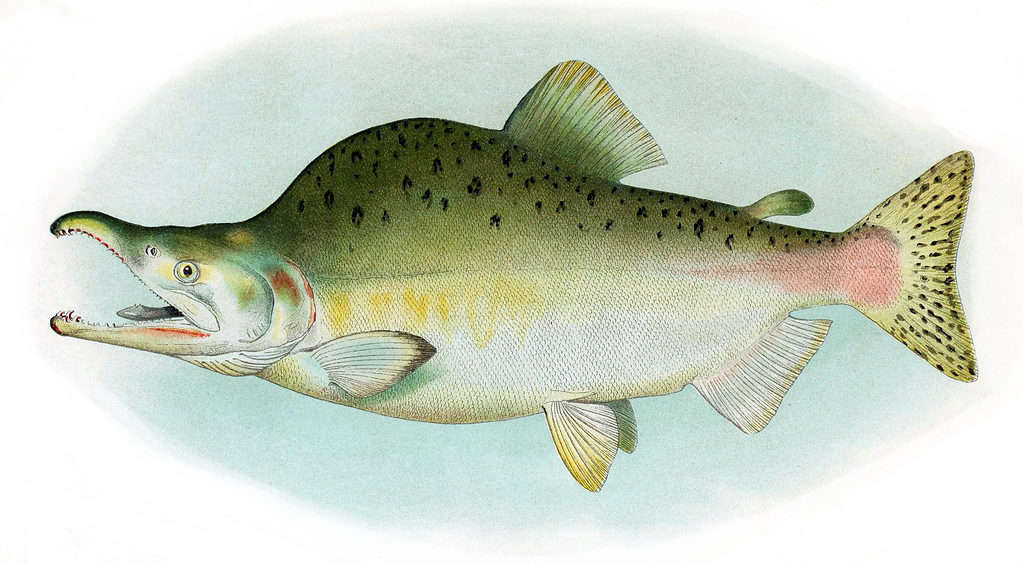
Pink salmon, humpback salmon, breeding male

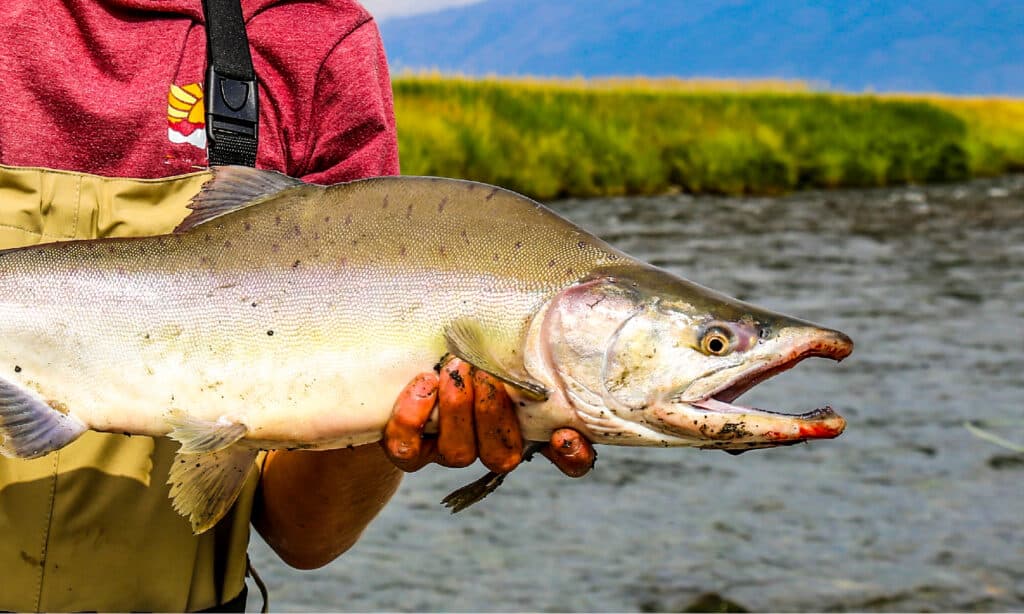
Breeding males have greenish-brown blotches and dark backs, and during spawning develop a hump, earning the nickname “humpback salmon”.

Pink Salmon Distribution, Population, and Habitat

In North America, pink salmon inhabit the North Pacific and Arctic Oceans as well as nearby seas like the Bering Sea. They are native to the United States (including Alaska), Canada, Russia, China, Japan, North Korea, and the Kuril Islands. Humans have introduced them to several areas, including Greenland, Iceland, the United Kingdom, Sweden, Poland, Norway, Latvia, Finland, and Iran. Within North America, this species ranges from the Mackenzie River delta in Canada’s Northwest Territories to Washington, Oregon, and California’s Sacramento River drainage and La Jolla coast.

These fish are anadromous, moving inland from the ocean to spawn in rivers and streams. As such, they thrive in both saltwater and freshwater environments. These fish prefer the cold temperatures of northern waters, living at depths of up to 820 feet.

Though scientists have not evaluated the total population of this species worldwide, a 2018 study found that there are excessive numbers in the North Pacific, up to 665 million adults. Evidence suggests that this is interfering with other species’ ability to thrive. As of 2022, the IUCN has not evaluated the pink salmon to determine its conservation status. NOAA features a 2021 report indicating that coho salmon stocks in Alaska (which include pink salmon) are not in danger of overfishing, though they have no data for stocks along the West Coast. According to the WWF, potential threats to this species include poaching, habitat destruction, river blockages, overharvesting, and climate change.

Pink Salmon Evolution and History

Scientists are unsure whether the ancient ancestors of pink salmon lived in saltwater or freshwater. However, between 95 and 65 million years ago (middle to late Cretaceous Period), members of Salmonidae became autotetraploids with twice the chromosome arms and twice the DNA as related species. This may have resulted in accelerated evolution.

By the early Miocene (15 to 20 million years ago), the genus Oncorhynchus (Pacific salmon) split from Salmo (Atlantic salmon) within the family Salmonidae. The cooling Arctic Ocean may have driven this adaptation. As the Miocene progressed, Oncorhynchus continued to speciate. By 6 MA, all extant species existed in some form. The greater diversity of Oncorhynchus, as opposed to Salmo, may be due to the more active geologic history in northwestern North America, which produced more diverse habitats.

Although there are relatively few fossils of Pacific salmon from the Pleistocene (11,700 to 2.5 million years ago), it is likely that the glacial disruptions and landscape alterations inspired more evolutionary changes within the genus and within individual species. Repeated glaciation, megafloods, annual floods, volcanic activity, and landslides all caused salmon species to either adapt or die out across the Pacific Northwest. Within the Holocene (the current epoch), smaller but frequent events like floods and erosion continue to force species like pink salmon to adapt.

Of all the extant species within Salmonidae, pink and coho salmon have the least genetic or evolutionary flexibility. In the future, it is possible that nonmigratory subspecies of salmon will fare better than migratory types due to increasing manmade barriers in rivers and streams.

Pink Salmon Predators and Prey

Pink salmon may be carnivores, but they are far from the top of the food chain. Their prey tends to be small while they themselves face threats from a number of larger predators.

What Do Pink Salmon Eat?

These fish feed exclusively on animal matter. They eat small fish, crustaceans, squid, and zooplankton. They also occasionally prey on aquatic insects.

What Eats Pink Salmon?

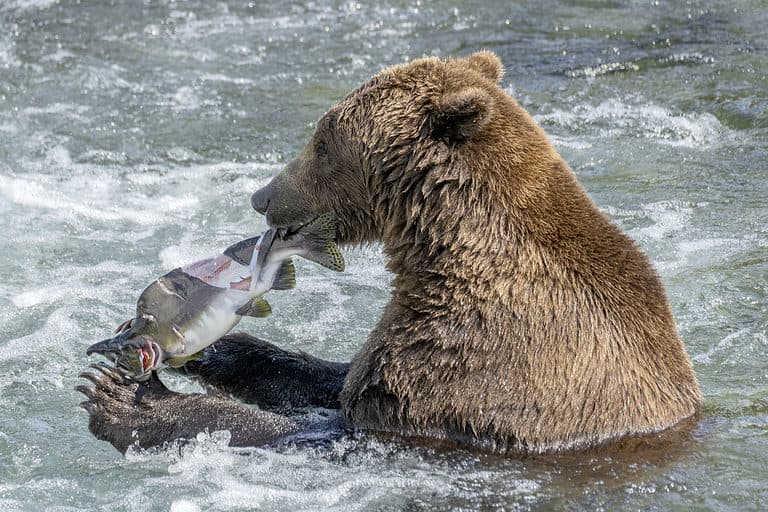
This species’ predators vary according to their environment and the age of the fish. In freshwater, eggs, alevins, and fry are at risk from fish, birds, and small mammals. Adults face predation from bears, wolves, river otters, and bald eagles, as well as other fish (including Pacific salmon) and coastal seabirds that hunt juveniles. Sharks, fish like Pacific halibut, and marine mammals like humpback whales prey on adults. Humans remain a major source of predation.
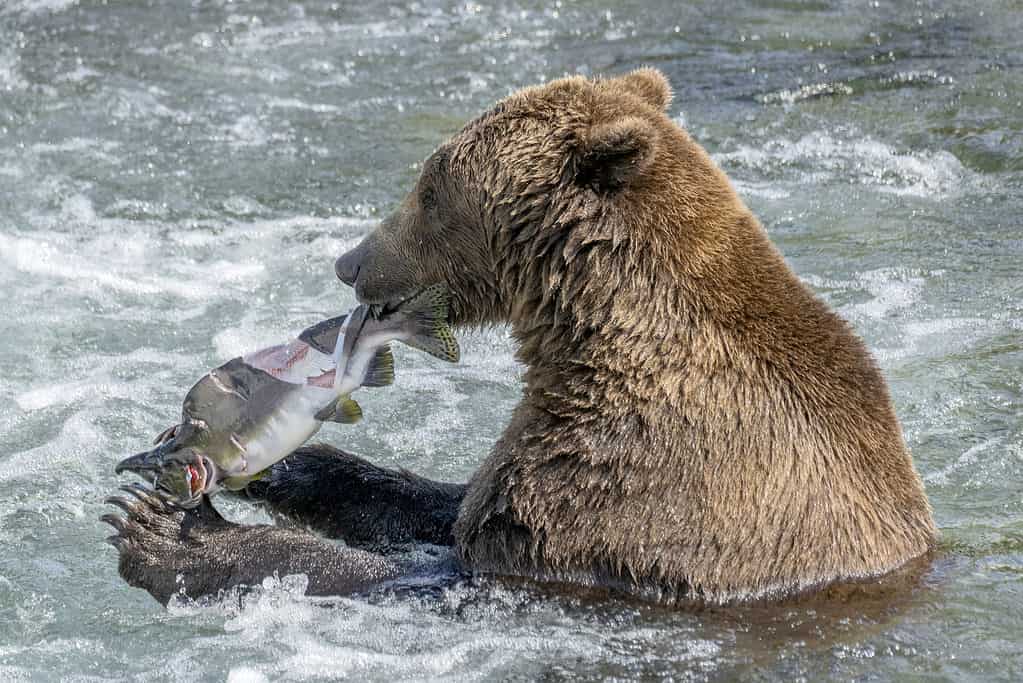
Brown bear eating a pink salmon

Pink salmon adults face predation from a variety of animals, such as bears.

Pink Salmon Reproduction and Lifespan

Though they begin life in fresh water, pink salmon fry quickly migrate to the ocean, where they live most of their lives. With an intense feeding schedule, they grow more rapidly than most Pacific salmon species. They only leave their marine environment in their second year of life to spawn. When the time comes, they return to the same river or stream where they were born, typically within 30 miles of the river estuary. Spawning occurs any time from June to October.

In preparation for spawning, males develop a hump on their backs and large, hooked teeth on both jaws. Females lie on their sides and use their tails to dig a redd (depression) while the male fends off competitors. Then both the male and the female descend into the redd. After opening their mouths and vibrating, the female releases eggs while the male releases milt (sperm). Being polyandrous, females may mate with several males. They then lay between 1,200 and 1,800 eggs.

The female stays and defends the redd until she dies, typically within two weeks. The eggs hatch within five to eight months after incubating during the winter and make their way downstream to the ocean. They remain there for 16-18 months until they are mature enough to return and spawn.

All pink salmon die after they spawn. This is because they use up all their energy swimming upstream and mating. After they enter fresh water, they generally stop eating, which means they lack the fuel to make it back to the ocean. They eventually waste away and die. Given their spawning habits, most individuals live only two years. However, the oldest recorded individual lived to be three years old.
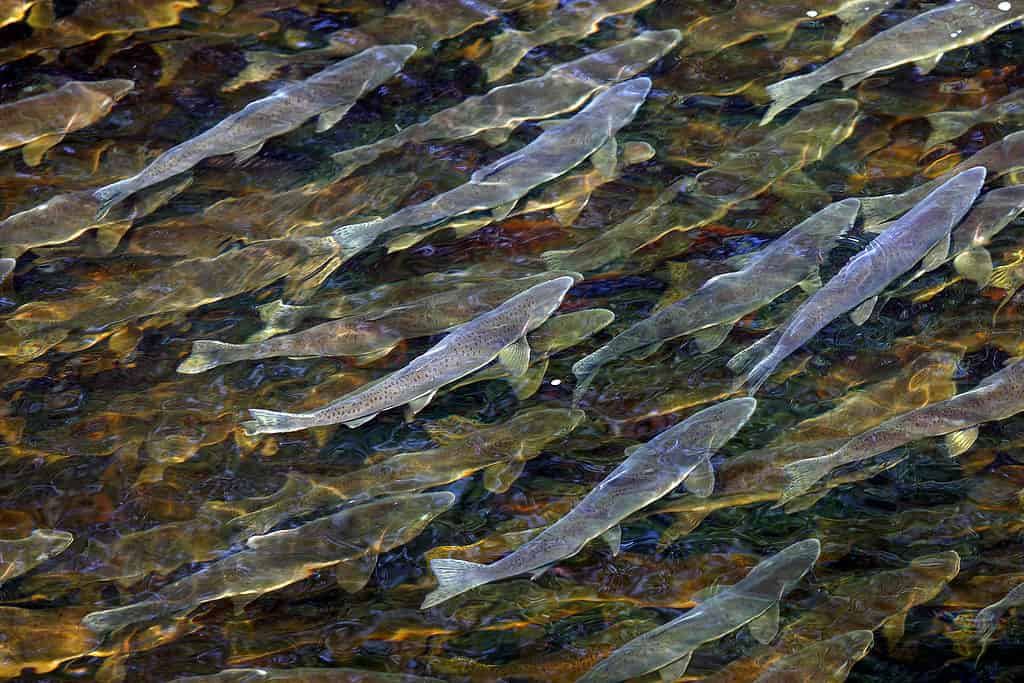
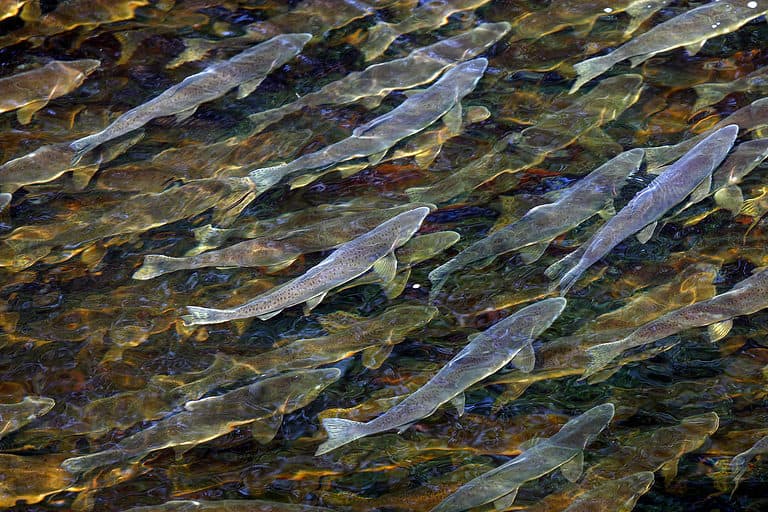
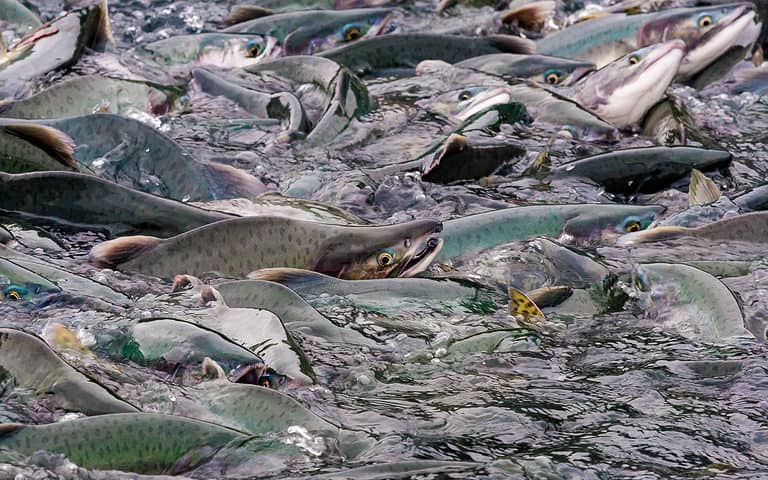
Migration of pink salmon

All pink salmon die after they spawn because they use up all their energy swimming upstream and mating.

Pink Salmon in Fishing and Cooking

Pink salmon are popular fish in both recreational and commercial fishing. According to NOAA, the worldwide commercial harvest in 2021 came to 453.6 million pounds valued at $173.4 million. Alaska fisheries yield most of the harvest in the United States. The West Coast, primarily Washington, yields a small portion of the annual harvest. Fisheries use gillnets, reef nets, as well as purse seines to catch this species with little bycatch or impact on the ocean floor.

Though this species is too small to draw the attention of most sport fishermen, recreational anglers like it for its mild flavor and aggression. It is legal to catch these fish in most areas; however, both Alaska and the West Coast have varying regulations. When it comes to bait, pink lures have the best chance of success.

There are several ways to prepare this fish, including baking, grilling, roasting, steaming, frying, or poaching. This garlic butter baked salmon recipe received high reviews; you can also check out this guide for five ways to prepare pink salmon. Alternatively, see this Global News article for expert marinades, rubs, and sauces.

The flesh of this species is pink and lean. A 100-gram serving has approximately 116 calories, 3.5 grams of fat, and 19.9 grams of protein.

View all 246 animals that start with P

Sources

  1. Fish Base / Accessed December 13, 2022
  2. California Academy of Sciences / Accessed December 13, 2022
  3. NOAA Fisheries / Accessed December 13, 2022
  4. Alaska Department of Fish and Game / Accessed December 13, 2022
  5. Phys / Accessed December 13, 2022
  6. WWF / Accessed December 13, 2022
  7. National Library of Medicine / Accessed December 13, 2022
  8. Seafood Source / Accessed December 13, 2022
  9. Little Spice Jar / Accessed December 13, 2022
  10. Global News / Accessed December 13, 2022
  11. Kitsilano / Accessed December 13, 2022
Kathryn Dueck

About the Author

Kathryn Dueck

Kathryn Dueck is a writer at A-Z Animals where her primary focus is on wildlife, dogs, and geography. Kathryn holds a Bachelor’s Degree in Biblical and Theological Studies, which she earned in 2023. In addition to volunteering at an animal shelter, Kathryn has worked for several months as a trainee dog groomer. A resident of Manitoba, Canada, Kathryn loves playing with her dog, writing fiction, and hiking.

Thank you for reading! Have some feedback for us?


Pink Salmon FAQs (Frequently Asked Questions)

Pink salmon are mostly silver with bluish or greenish tints, though breeding individuals have red sides.