A
Species Profile

Assassin Snail

Anentome helena

Banded burrower, snail-eating sniper
M-Production/Shutterstock.com

Assassin Snail Distribution

Click a location to explore more animals from that region

Loading map...
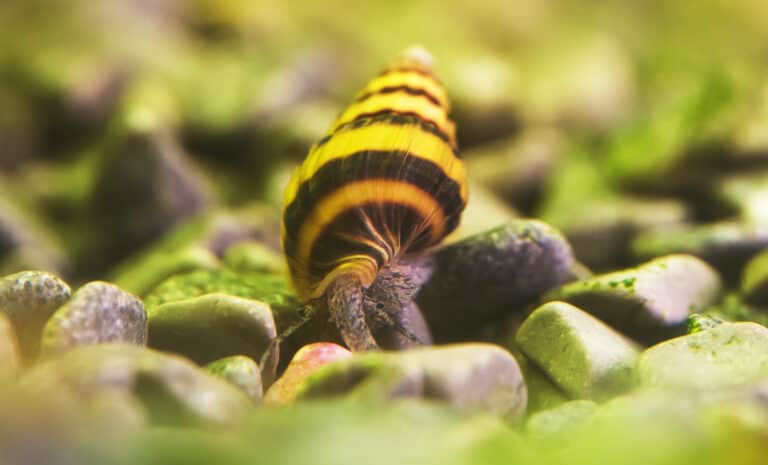
Assassin snail in aquarium

At a Glance

Wild Species
Also Known As Helena snail, Helena's snail, Snail-eating snail, Snail-killing snail, Killer snail
Diet Carnivore
Activity Crepuscular+
Lifespan 2 years
Status Not Evaluated
Did You Know?

Synonym alert: Anentome helena is widely sold as Clea helena in the aquarium trade.

Scientific Classification

A small predatory freshwater snail widely kept in aquaria for controlling pest snails; it hunts other snails and scavenges meaty foods. Adults are typically recognized by a yellow-and-brown banded cone-shaped shell and a long siphon.

Kingdom
Animalia
Phylum
Mollusca
Class
Gastropoda
Order
Neogastropoda
Family
Nassariidae
Genus
Anentome
Species
helena

Distinguishing Features

  • Conical, turreted shell with alternating yellow and dark brown bands (often called “bumblebee” pattern in freshwater context)
  • Carnivorous/predatory behavior toward other snails; uses a proboscis to feed
  • Burrowing/ambush habit in sand or fine gravel; extends a noticeable siphon while hunting
  • Separate sexes (not a self-fertilizing hermaphrodite); lays single eggs in small capsules on hard surfaces

Physical Measurements

Length
1 in (1 in – 1 in)
Top Speed
0 mph
About 1 mm/s (unconfirmed)

Appearance

Primary Colors
Secondary Colors
Skin Type Soft-bodied freshwater gastropod with a muscular foot and a distinct, protrusible siphon; possesses a hard calcareous shell and a horny operculum used to close the aperture. Body surface is smooth, moist, and non-scaled.
Distinctive Features
  • Species identity/synonymy: commonly sold as 'assassin snail'; valid name Anentome helena (often listed historically/colloquially as Clea helena in aquarium trade and some references).
  • Adult shell shape: elongate conical (turreted) neogastropod shell with multiple whorls and a pointed apex.
  • Adult size: shell height commonly about 1.8-2.0 cm in aquaria; reported maximum about 2.5 cm (maximum size is widely cited in standard species accounts/databases such as MolluscaBase/WoRMS).
  • Banded shell: alternating dark brown and yellow/cream spiral bands; pattern remains visible even in older individuals, aiding quick visual identification.
  • Long siphon: conspicuous, extendable siphon used while moving or when partially buried; often visible as the animal 'snorkels' from the substrate.
  • Burrowing/ambush behavior: frequently buries in sand/gravel with siphon protruding, then emerges to hunt-an appearance/pose characteristic in aquaria.
  • Predatory feeding adaptations: elongated proboscis and drilling/tearing radula typical of neogastropod predators; in aquaria it actively hunts other snails and also scavenges meaty foods (behavioral hallmark tied to its morphology).

Did You Know?

Synonym alert: Anentome helena is widely sold as Clea helena in the aquarium trade.

Adults are typically ~1.8-2.5 cm shell height; unusually large individuals up to ~3 cm are reported.

It has a long siphon (a snorkel-like tube) used to draw water to the gill while buried.

Unlike many "pest" snails, it has separate sexes (male/female), not a self-fertilizing hermaphrodite.

It lays eggs singly in small, square-ish clear capsules on hard surfaces-each capsule usually yields one juvenile.

In captivity it's commonly kept for biological control of nuisance snails, but it will also take meaty foods (worms, shrimp, fish food).

Unique Adaptations

  • Elongated siphon for respiration while buried-supports a sit-and-wait hunting strategy in low-flow substrates.
  • Neogastropod proboscis and radula adapted for predation/scavenging (typical of Neogastropoda), allowing it to feed on animal tissue rather than algae.
  • Compact, conical shell with a narrowed aperture that helps resist predation and abrasion while moving through sand and gravel.
  • Behavioral flexibility: switches between active predation and opportunistic scavenging, helping it persist when snail prey is scarce.

Interesting Behaviors

  • Burrowing ambush hunting: often hides under sand/gravel with only the siphon protruding, waiting for prey to pass.
  • Active tracking: can follow chemical cues from injured prey/snail mucus and move directly toward food sources.
  • Predatory feeding on other gastropods: attacks smaller snails and consumes soft tissues; will also scavenge carrion and leftover protein-rich foods.
  • Nocturnal/crepuscular tendency in aquaria: many individuals become more active at low light, emerging from substrate to hunt.
  • Egg placement behavior: females attach single egg capsules to hard décor (glass, rocks, wood), spacing them out rather than laying gelatinous clutches.

Cultural Significance

Anentome helena, called the "assassin snail", is used worldwide in freshwater aquariums to control pest snails like Physa, ramshorns, and Malaysian trumpet snails. Its yellow-brown banded shell and visible siphon make it a well-known tank helper. Older sources use the name Clea helena.

Myths & Legends

There is no old folklore about Anentome helena. In aquariums, its nickname "assassin snail" makes a modern legend of a stealthy hitman that burrows to kill pest snails, noted for banded warning colors.

Conservation Status

NE Not Evaluated

Has not yet been evaluated against the criteria.

Population Unknown

Life Cycle

Birth 1 hatchling
Lifespan 2 years

Lifespan

In the Wild
1–3 years
In Captivity
2–5 years

Reproduction

Mating System Promiscuity
Social Structure Solitary
Breeding Pattern Transient
Fertilization Internal Fertilization
Birth Type Internal_fertilization

Anentome helena (assassin snail) is gonochoric—separate males and females. Solitary, they meet briefly and mate with multiple partners. Fertilization is internal; females lay single eggs in firm capsules on hard surfaces. Hatchlings crawl away; no care.

Behavior & Ecology

Social Aggregation Group: 5
Activity Crepuscular, Nocturnal
Diet Carnivore Live small freshwater snails (soft-bodied prey that can be subdued and consumed via the proboscis/radula).
Seasonal Hibernates

Temperament

Predatory toward other snails (actively attacks live gastropods and also scavenges carrion/meaty foods); generally ignores fish and most non-molluscan tankmates unless already dead/immobile.
Intraspecific temperament is usually tolerant: conspecifics commonly co-occur without persistent aggression, though competition at food hubs can cause shoving/stacking and displacement.
Risk-avoidant/cryptic: frequently buries in sand/gravel and remains motionless when disturbed; emergence increases when chemical cues from prey/food are present.
Not territorial in the vertebrate sense; space use is driven by substrate cover and prey availability rather than defended home ranges (quantitative field territory data not well established).

Communication

Chemoreception in the water column and on surfaces (detects dissolved cues from prey/carrion); uses the siphon/osphradium-associated sensory sampling typical of many neogastropods.
Contact chemoreception and trail-following via mucus tracks Can home in on prey/food patches and follow conspecific or prey trails
Tactile communication during mating Physical contact/crawling alignment) and during feeding aggregations (pushing/overlapping to access the resource
Substrate-borne cues: vibration/touch sensitivity influences withdrawal and burying behavior; responses vary with disturbance intensity.

Habitat

Terrain:
Plains Valley Riverine Muddy Sandy
Elevation: Up to 1640 ft 5 in

Ecological Role

Benthic mesopredator of freshwater snail assemblages (and opportunistic scavenger of animal tissue).

Top-down control of small gastropod populations (including nuisance/pest snails in aquaria) Potential indirect reduction of snail-borne parasite transmission by lowering densities of intermediate-host snails (context-dependent) Contributes to benthic nutrient recycling when scavenging animal carrion

Diet Details

Human Interaction

Domestication Status

Semi domesticated

Anentome helena is a wild snail from Southeast Asia now common in the aquarium trade. It is not truly domesticated but is often kept and bred in tanks. People buy and sell it to eat pest snails, watch its hunting, and sometimes worry that releases could make it an unwanted wild species.

Danger Level

Low
  • No venom known to affect humans; not considered dangerous through normal handling.
  • Potential (general mollusk-handling risk): aquarium snails can carry microorganisms/parasites in some contexts; basic hygiene (handwashing, avoiding contact with mucous and then eyes/mouth) is prudent.
  • Indirect risk: can reduce or eliminate desirable/valuable snail species in an aquarium (harm to other livestock rather than to humans).

As a Pet

Suitable as Pet

Legality: Assassin snail (Anentome helena) is usually legal to own and sell in many places, but local rules may ban non-native snails; releasing them into the wild is usually illegal.

Care Level: Moderate

Purchase Cost: $2 - $8
Lifetime Cost: $20 - $120

Economic Value

Uses:
Ornamental aquaculture (aquarium trade) Biological control in aquaria (pest snail reduction) Education/hobbyist interest (behavioral observation)
Products:
  • live aquarium specimens (wild-collected and captive-bred individuals)
  • clean-up/predator service in mixed-species aquaria (non-material utility)

Relationships

Predators 7

Clown loach Chromobotia macracanthus
Yo-yo loach Botia almorhae
Pea puffer
Pea puffer Carinotetraodon travancoricus
Crayfish
Crayfish Cambarellus
Freshwater crab Potamidae
Snail-eating cichlids Trematocranus placodon
Wading birds
Wading birds Ardeidae

Related Species 5

Assassin snails Anentome spp. Shared Genus
Eastern mudsnail Tritia obsoleta Shared Family
Common nassa Tritia reticulata Shared Family
Vibex nassa Nassarius vibex Shared Family
Crowned nassa Nassarius coronatus Shared Family

Ecological Equivalents 5

Animals that fill a similar ecological role in their ecosystem

Bumblebee snail Engina mendicaria Often resembles pest-control snails with bold bands and similar hunting/scavenging behavior, but it is marine rather than freshwater and is not used to control pest snails — treated as a look-alike ecological analogue, not a close taxonomic relative.
Pea puffer
Pea puffer Carinotetraodon travancoricus Fills a similar aquarium role as a specialist snail predator—both eat small pulmonate or juvenile snails. Anentome helena is a benthic gastropod that burrows and uses a proboscis and a long siphon.
Yo-yo loach Botia almorhae Aquarists use the assassin snail (Anentome helena) to control pest snails. A. helena is a small snail eater (about 18–25 mm) and will also eat meaty leftovers; yo-yo loaches crush snail shells.
Clown loach Chromobotia macracanthus Anentome helena reduces pest snails but is much smaller and is usually kept with other invertebrates; it can be eaten by larger snail-eating fish, whereas clown loaches hunt and crush snails.
Mexican dwarf crayfish Cambarellus patzcuarensis Overlaps as a benthic invertebrate that preys on small snails and scavenges carrion and other meaty leftovers. Both can impact snail populations; the crayfish may also prey on Anentome helena (assassin snail) directly in confined aquarium settings.

The name “assassin” is enough to strike fear into the hearts of all who hear it, but in reality, assassin snails are not scary at all. Assassin snails are highly sought after by owners of household marine habitats because of their predilection for snail meat. While they are the bane of other snail species everywhere, they get along quite swimmingly with each other and work together to take down bigger snails.

Quick Facts on the Assassin Snail

  • Carnivore snails: Assassin snails are carnivores. They belong to a carnivorous order of snails and are also scavengers.
  • Male and female: Assassin snails are not hermaphrodites like a lot of other types of snails. They have distinct male and female sexes. However, it is impossible to tell them apart because they look exactly the same. Breeding assassin snails involves leaving a bunch of them to go at it.
  • The Terminator snails: Assassin snails eat other snails. Because of this, they are becoming popular for people whose aquariums have been infiltrated by pest snails that eat up all their plants.
  • Ideal exterminator: What makes assassin snails the ideal exterminator for pest snails is that they don’t eat aquatic plants, and they are slow breeders so they don’t become pests themselves. They can be quite tasking to get rid of due to their burrowing habits.
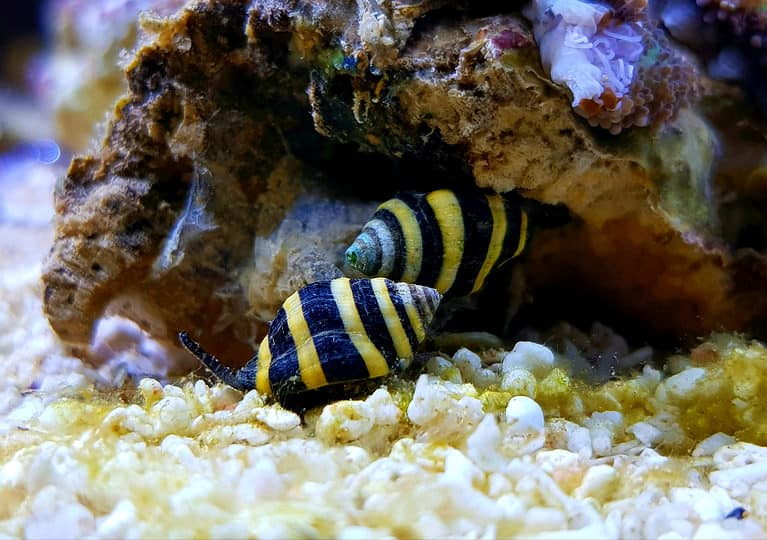
  • Bumblebees of the sea: Assassin snails are called bumblebee snails because of the color pattern of their shells. While some of them are solid brown, most of them have brown and yellow stripes, resembling a bumblebee.
  • Teamwork makes the dream work: Assassin snails usually band together to take down larger prey. If your tank is riddled with a ton of pest snails, it is best to introduce enough assassins to get the job done because they are slow eaters.
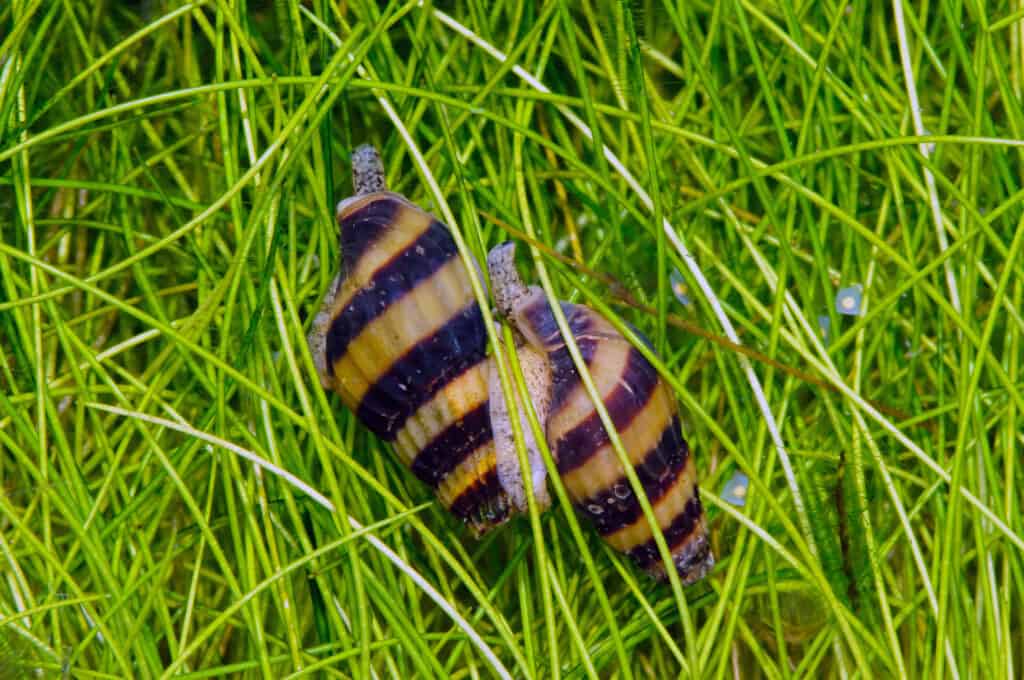
Assassin Snail

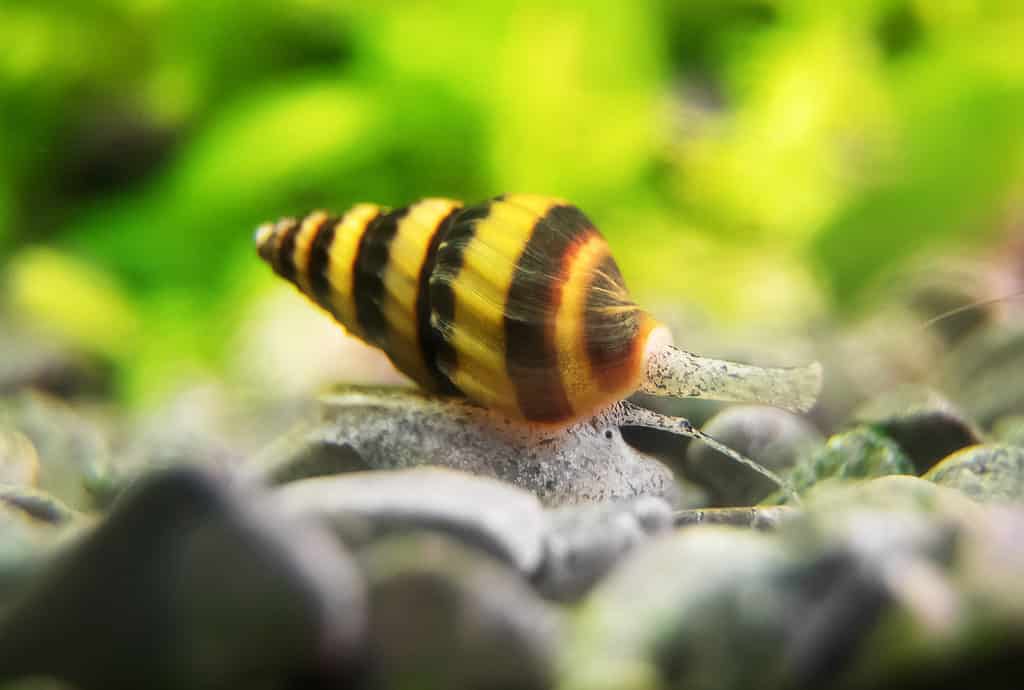
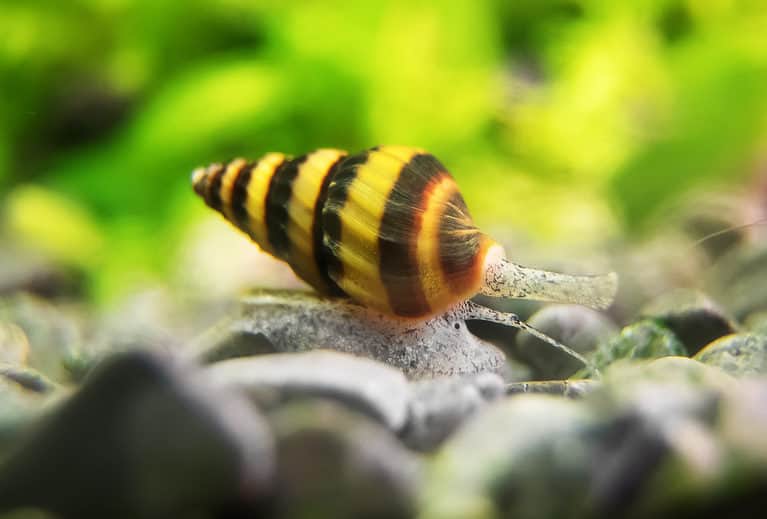
Assassin snails are also called bumblebee snails because of the brown and yellow stripe color pattern of their shells.

Assassin Snail Scientific Name

Assassin snails are named after their predilection for other snails. They are often used to get rid of pest snails in aquariums. Assassin snails are freshwater snails that belong to the genus Clea, a group of freshwater snails that comprises of ten species. They also belong to the family Nassariidae, also known as Nassa mud snails or dog whelks, and is made up of sea snails and some marine mollusks.

The proper classification for the assassin snail is Clea helena, but a lot of authors prefer to use the original genus Anentome to classify the snail instead (Anentome helena). In order to differentiate between the African and Asian species, some zoologists named the Asian subgenus Anentome, and the African subgenus Afrocanidia. The genera Clea and Anentome are still used interchangeably.

Assassin snails are also likely to be called bumblebee snails because of their typical brown and yellow shell pattern.

Evolution and History

Assassin snails belong to the order Neogastropoda which is composed of about 16,000 species of gastropods, including mollusks, clams, oysters, sea and marine snails. The fossil record of Neogastropoda is considered almost completed and traces the evolutionary history of the order.

Neogastropoda is believed to have originated in the Early Cretaceous Epoch 145 million to 100.5 million years ago. They diversified twice during the late Cretaceous Period which lasted 100.5 million years to 66 million years ago and the Paleocene Period 66 million to 23.03 million years ago.

The members of Neogastropoda evolved to have shells with elongated siphonal canals and siphons that suck water into the mantle cavity. They also developed an advanced proboscis used to scrape out flesh remnants from inside the shells of their prey. During their evolutionary process, Neogastropoda species experienced another physiological change wherein the mouth moved to a terminal position on its head.

Assassin Snail Appearance

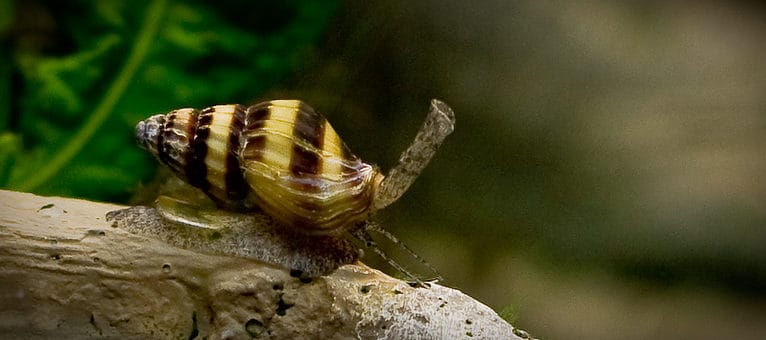
Assassin snails are tiny snails compared to the damage they can inflict on their snail prey. They grow to be 0.7 to 1.25 inches in size in the wild, but they tend to be smaller when raised in captivity. If given an insufficient amount of food, they will suffer from malnutrition and stunted growth. Also called bumblebee snails, the assassin snail has a conical shell with dark brown and yellow alternating stripes that resemble the hair on a bumblebee. Although their color pattern is a unique way of identifying them, not all assassin snails have this pattern. Some snails are just brown without the yellow stripes.

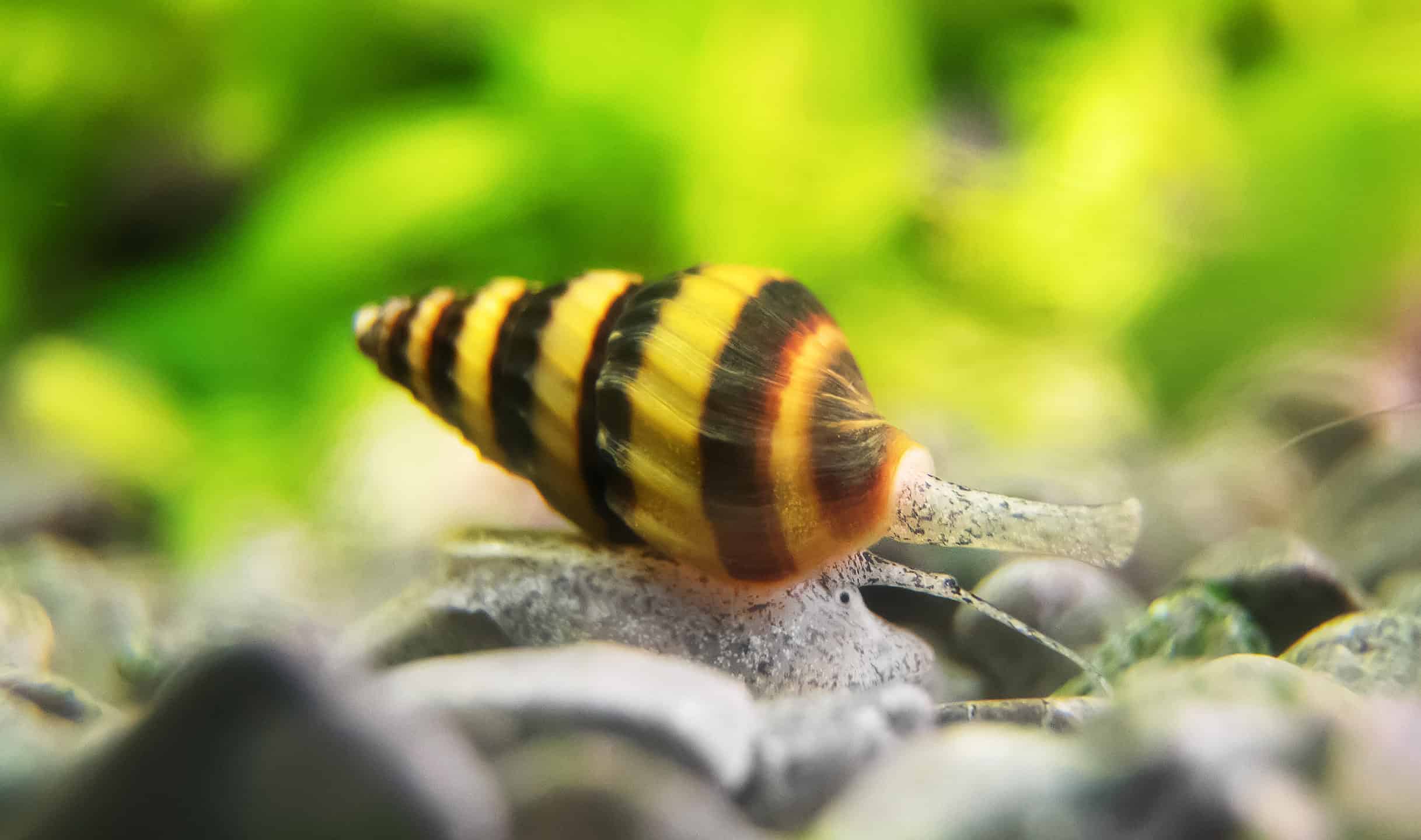
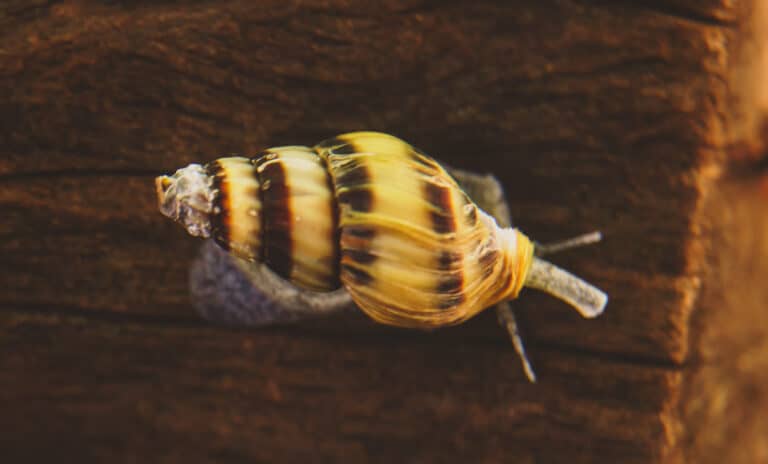
The assassin snail has a siphon, which is a long tube-like structure used to breathe, sense its surroundings and find prey. The snail also possesses a translucent, muscular foot, a pair of tentacles, as well as a proboscis which it uses to comb inside the shell of its prey for meat remnants.

Assassin snails have males and females, unlike a lot of other snail species who are hermaphroditic. However, the sexual dimorphism in assassins is nonexistent. There is no way to tell the males and females apart because they all look exactly alike.
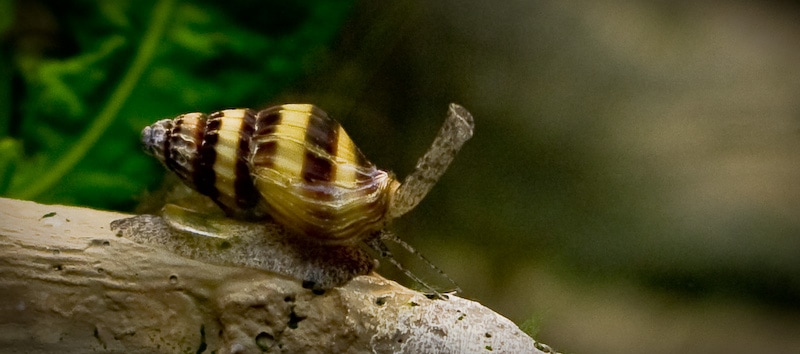
Assassin (bumblebee) snail showing siphon.

The assassin snail has a siphon, which is a long tube-like structure used to breathe, sense its surroundings and find prey.

Behavior

Bumblebee snails are usually inactive during the day. They are burrowing animals and spend most of their time buried in the substrate at the bottom of the aquarium. They come alive at night, hunting for their prey, which makes them nocturnal animals.

Assassin snails tend to be very sluggish in general, but mostly during the day. They are kept for their predatory nature toward other snails which is used to control and regulate the population of these snails in an aquarium. Assassin snails are not herbivorous animals and as such don’t have any interest in eating or uprooting plants. They are the perfect exterminators for people who have plant aquariums and invasive snail species who consume these plants.

Assassin snails don’t mind living the solitary life. However, if your aquarium has a lot of pest snails to get rid of, you might want to add more assassins to the mix. One assassin snail is not enough to control a large population of pest snails because they are such slow eaters. Also, a group of assassin snails has a better chance of taking down much larger snails.

Although the bumblebee snail is a carnivore, they don’t hurt live fish or larger invertebrates. They also don’t cannibalize themselves and actually get along quite well with each other.

Assassin snails usually stay burrowed at the bottom of tanks so if you notice your snails moving to the top of the tank, that might be a sign to clean it.
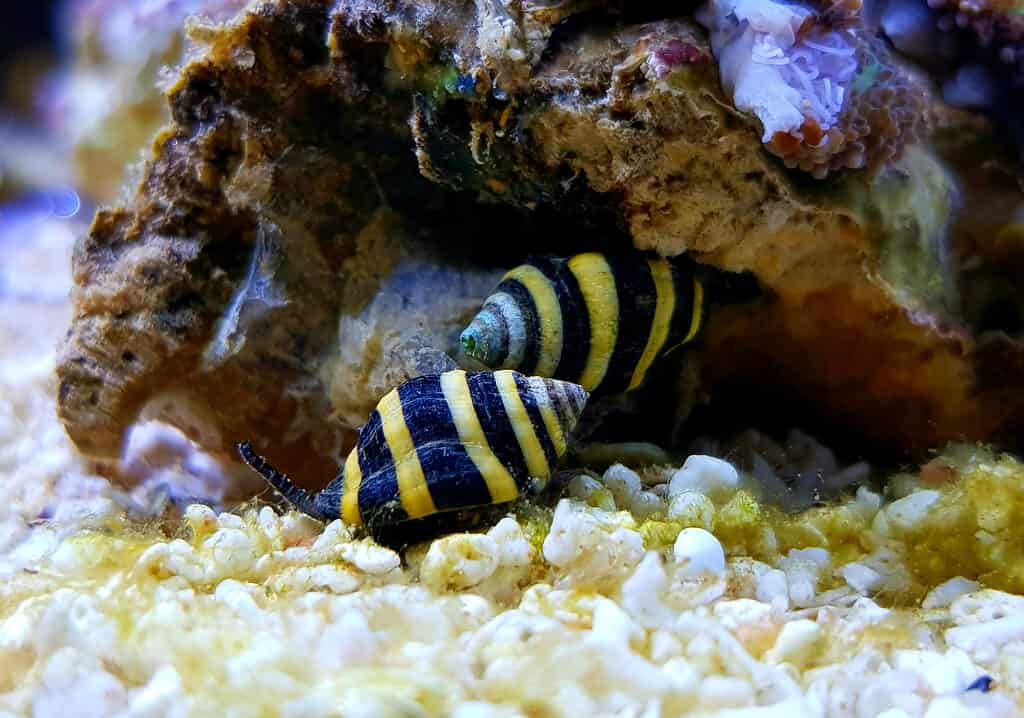
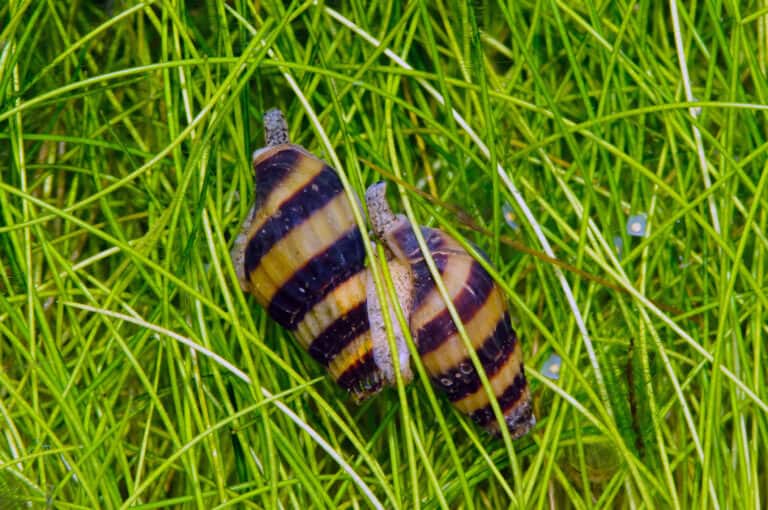
Assassin (bumblebee) snails in aquarium

Although the bumblebee snail is a carnivore, they don’t hurt live fish or larger invertebrates and get along quite well with each other.

Diet

Assassin snails are opportunistic carnivorous, a trait they share with all the other snails in the order Neogastropoda. They do not eat plants, but rather prefer to feed on other snails and worms alike. This trait of theirs is the reason why they are popular amongst pet owners who find invasive snails in their aquariums. Assassin snails will ambush snails bigger than themselves, often in a group if the snail is too large to be taken down by just one of them. This regulates the population of invasive snail species such as the Malaysian trumpet snail and the Ramshorn snails which harm aquatic plants.

Assassin snails ambush their prey in two ways. They bury themselves in the substrate at the bottom of the tank and patrol the environment with their siphon sticking out. When an unsuspecting snail moves by, the assassin detects and grabs it. The second way assassins hunt prey is simply by chasing them down.

Bumblebee snails don’t eat aquatic vegetation like the invasive snails do, so they are ideal for keeping in aquariums without worrying about plant destruction. They are also scavengers and eat decaying fish and other animals in their habitat.

Assassin snails have also been observed eating fish eggs. For owners who are fish breeders, this would pose a serious problem and it would be best to keep these snails as far away from the breeding tank as possible.

Bumblebee snails in captivity often do not need to be fed as long as there is a sufficient amount of snails in their habitat. If not, then their diet will need to be supplemented with food such as worms or any sinking food. The best time to feed these snails is at night when they are most active.

Habitat and Population of the Assassin Snail

Assassin snails are native to Southeastern Asian countries, namely, Thailand, Malaysia, and Indonesia. Their preferred habitats are tropical freshwater bodies such as canals, streams, lakes, and rivers. They are growing increasingly popular as pets due to the fact that they eat pest snails. They are introduced into aquariums to control the activity of pest snails that destroy the plants in the tank.

The assassin snail is not listed on the IUCN Red List of Threatened Species.
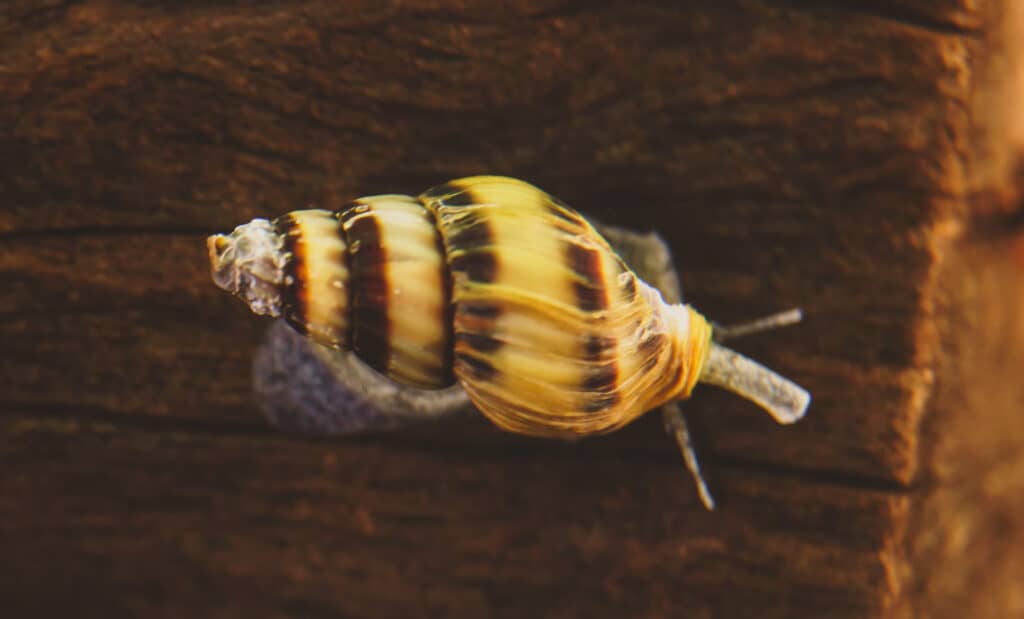
Assassin snails are carnivores

Assassin snails are carnivores often used to get rid of pest snails in aquariums.

Reproduction and Lifespan

Unlike many other snail species that reproduce asexually, assassin snails actually have separate male and female sexes. However, distinguishing between the sexes is impossible because of the lack of sexual dimorphism in the species. The males and females are the same size and shape.

The breeding behavior of Clea (Anentome) helena has been observed mostly in captivity. The mating snails lock on to one another and stay that way for about 12 hours. When they are done, the female will then lay several single, clear, square-shaped eggs. The eggs are usually laid on plants or any hard surface, even the tank glass.

The eggs hatch in about three to eight weeks, after which, the young snails will burrow into the substrate and stay there for about six months until they reach sexual maturity.

Because of its extensive breeding time, these snails seldom become pests themselves. Assassin snails typically live about two years in the wild but can live up to five years in captivity if they are handled properly.

Predators and Threats

Assassin snails are dedicated predators, but they get preyed on by larger carnivores, too. Their predators include larger cichlids, and fish that eat snails such as loaches. Although the snails have an operculum which acts as a trap door to protect the shelled creature, consistent attacks by snail-eating fish could injure the snail or even kill it.

Assassin snails also face various health problems, some of which are listed below.

  • Parasitic Infection: Parasitic infections are the most common health problems that assassin snails face. They are susceptible to trematode parasites. This infection results in white spots on the snail’s shell and fatigue.
  • Malnutrition: This occurs when there is a lack of adequate food in the snail’s living area. It mostly happens to assassin snails in captivity.
  • Stunted growth: This can be as a result of malnutrition, as well as a lack of abundant living space.
  • Brittle shell: This health issue can be caused by a calcium deficiency in the snail’s diet, or poor water conditions.

If you suspect your assassin snail might not be feeling too well, you can look out for some warning signs such as shell discoloration and inactivity.

Up Next

View all 326 animals that start with A

Sources

  1. Aqua Info / Accessed December 8, 2022
  2. Wikipedia / Accessed December 8, 2022
  3. Wikipedia / Accessed December 8, 2022
  4. Wikipedia / Accessed December 8, 2022
  5. Wikipedia / Accessed December 8, 2022
  6. PLOS Journals / Accessed December 8, 2022
Rose Okeke

About the Author

Rose Okeke

Hi! I am a writer, actor, and filmmaker. Reading is my favorite hobby. Watching old movies and taking short naps are a close second and third. I have been writing since childhood, with a vast collection of handwritten books sealed away in a duffel bag somewhere in my room. I love fiction, especially fantasy and adventure. I recently won the James Currey Prize 2022, so now, naturally, I feel like I own words. When I was 11, I wanted to be a marine biologist because I love animals, particularly dogs, cats, and owls. I also enjoy potatoes and chocolate in all their glorious forms.
Connect:

Thank you for reading! Have some feedback for us?


Assassin Snail FAQs (Frequently Asked Questions)

Assassin snails are native to the Southeastern Asian countries Thailand, Malaysia, and Indonesia.