



H
Species Profile

Hooded Oriole

Icterus cucullatus

Palm-frond weaver of the Southwest
Andrej Chudy/Shutterstock.com

Hooded Oriole Distribution

Click a location to explore more animals from that region

Loading map...
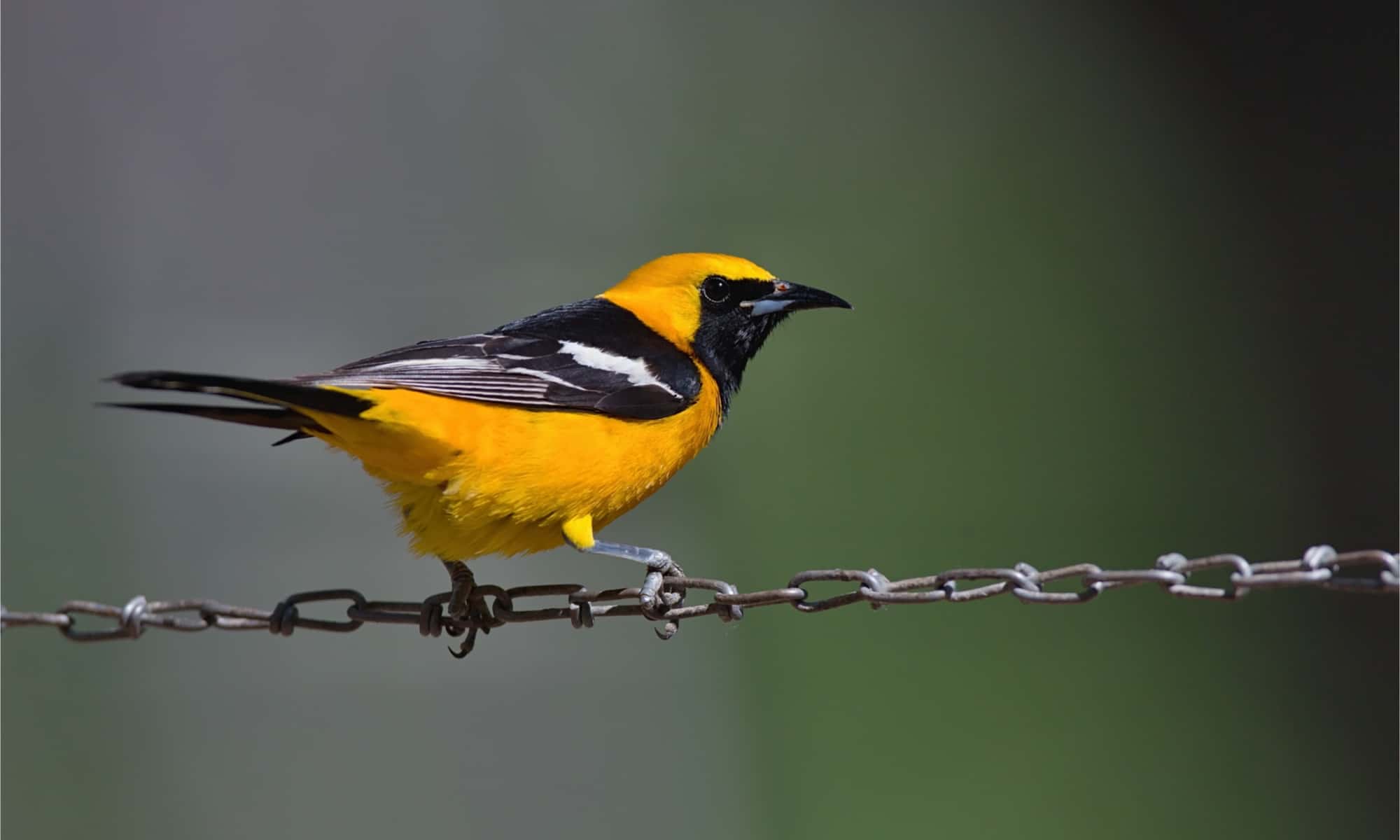
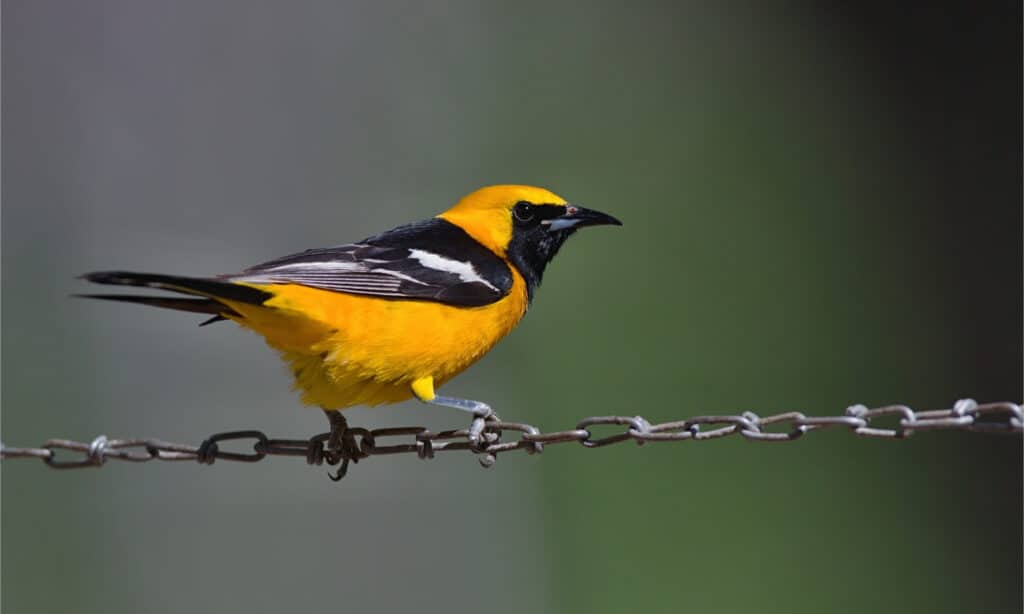
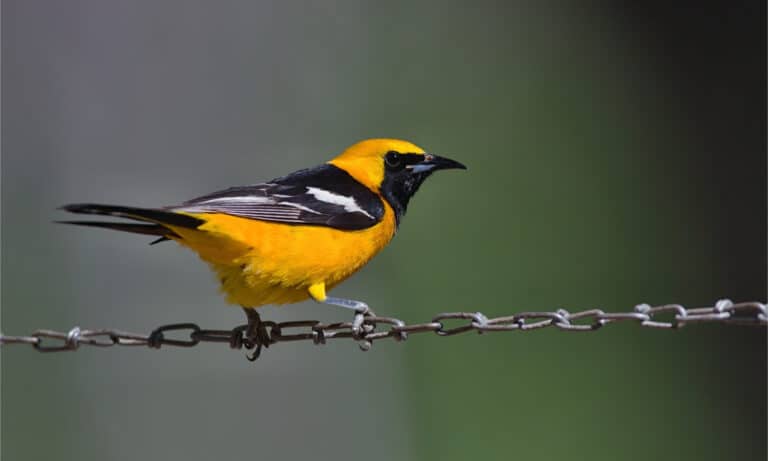
Male hooded oriole sitting on a chain

At a Glance

Wild Species
Activity Diurnal+
Lifespan 3 years
Weight 0.036 lbs
Status Least Concern
Did You Know?

Size (adult): 18-20 cm long; 24-31 g; wingspan 25-30 cm (Cornell Lab of Ornithology, All About Birds).

Scientific Classification

The Hooded Oriole is a slender, orange-and-black songbird (a true oriole of genus Icterus) known for its hanging, pouch-like nest and association with palms and open woodland edges in the southwestern United States and Mexico.

Kingdom
Animalia
Phylum
Chordata
Class
Aves
Order
Passeriformes
Family
Icteridae
Genus
Icterus
Species
Icterus cucullatus

Distinguishing Features

  • Adult male with a bright orange hood and underparts contrasted with a black back/throat area and black tail
  • Slender, slightly decurved bill typical of orioles
  • Often builds a deep, pendulous woven nest, frequently attached to palm fronds or the tips of branches
  • Song is rich and whistled; calls can be sharp and scolding

Physical Measurements

Length
8 in (7 in – 9 in)
Weight
0 lbs (0 lbs – 0 lbs)
Tail Length
3 in (3 in – 3 in)

Appearance

Primary Colors
Secondary Colors
Skin Type Feathered plumage; keratinous, slightly decurved bill; scaly (keratinized) gray-brown tarsi and toes typical of passerines.
Distinctive Features
  • Slender, medium-sized Icterus with a slightly downcurved, pointed bill suited to insects, nectar, and fruit feeding.
  • Typical size metrics reported for the species: total length about 18-20 cm; wingspan about 25-30 cm; mass about 0.022-0.032 kg (Cornell Lab of Ornithology, All About Birds: Hooded Oriole).
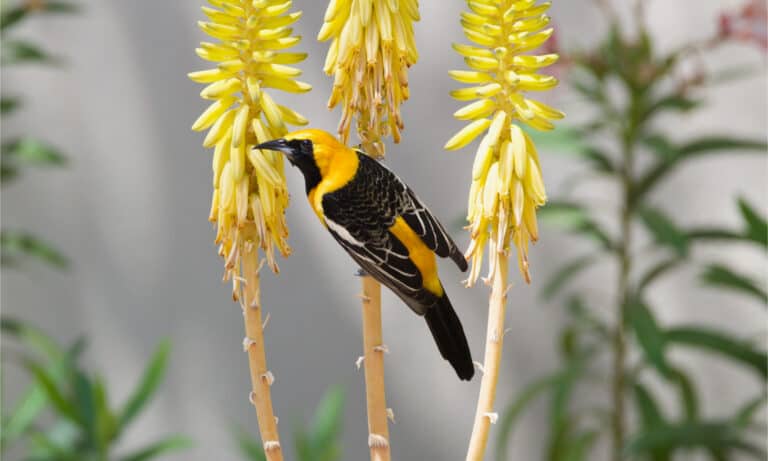
  • Adult male shows a bright orange hood (head/neck) surrounding a black throat/bib; black wings and tail with pale wing bars give a crisp, high-contrast look.
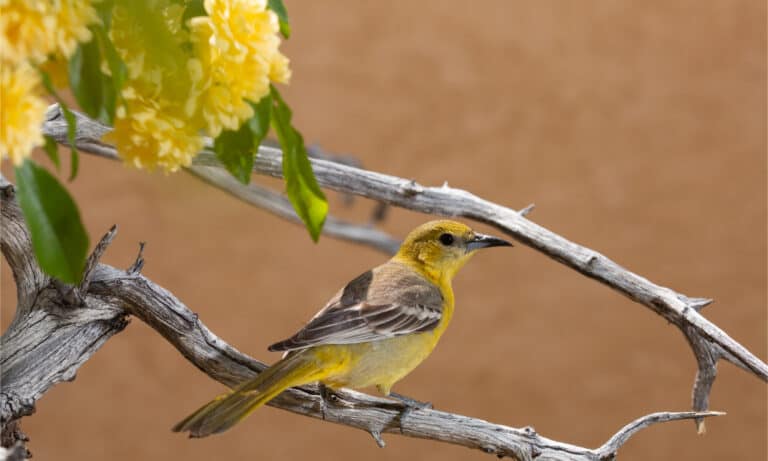
  • Adult female/immature is much duller: yellow to yellow-green underparts with grayish-olive upperparts and little to no solid black bib; often retains wing bars.
  • Builds long, hanging pouch nests woven from plant fibers (often palm fibers), hung under palm fronds or drooping plants; closely tied to palms and river or open woodland edges in the southwestern U.S. and Mexico.
  • Often forages actively in canopy and along edges; also visits flowers for nectar and takes insects/fruit seasonally (commonly reported diet for the species in the Southwest and Mexico).

Sexual Dimorphism

Strong sexual dimorphism in plumage: males are brightly colored with extensive black; females/immatures are duller yellow-olive/gray with markedly reduced black.

  • Vivid orange/yellow-orange hood and underparts.
  • Distinct black throat/bib and black wings/tail.
  • High-contrast overall appearance with visible pale/white wing bars.
  • Yellow to yellow-green underparts; grayish-olive/gray upperparts.
  • Little to no solid black bib (may show dusky throat/face rather than a full black patch).
  • Overall lower-contrast appearance; wing bars present but less striking than in males.

Did You Know?

Size (adult): 18-20 cm long; 24-31 g; wingspan 25-30 cm (Cornell Lab of Ornithology, All About Birds).

They often take nectar from flowers-and will readily visit hummingbird feeders, using their long, pointed bill to sip.

Females do most of the nest-building, weaving a deep, pouch-like "bag" that can hang from palm fronds and other drooping vegetation.

Hooded Orioles can hybridize with Bullock's Oriole (Icterus bullockii) where their ranges overlap in the Southwest.

Reproductive timing is fast: typical clutch 3-5 eggs; incubation about 12-14 days; young fledge about 11-14 days after hatching (Cornell Lab of Ornithology).

The species' Latin name fits: cucullatus means "hooded," describing the male's black face/throat pattern under the orange hood.

Unique Adaptations

  • Slender, slightly decurved bill suited to both insect capture and nectar feeding-an effective multi-purpose tool in seasonal desert-edge habitats.
  • Strong, precise weaving behavior (typical of genus Icterus): ability to tie fibers into a durable, pendulous nest that withstands wind and heat exposure.
  • Tolerance of hot, open habitats when paired with "resource ribbons" (riparian strips/palm stands): behaviorally adapted to concentrate activity where water-linked insects, flowers, and fruit are reliable.
  • Opportunistic use of novel resources: readily uses ornamental palms and backyard nectar sources, which can support breeding in human-altered landscapes.

Interesting Behaviors

  • Hanging pouch-nest construction: the female knots and stitches plant fibers (often palm fiber/grass) to form a deep, swinging nest suspended from the tips/undersides of drooping leaves-reducing access for many predators.
  • Riparian-and-palm corridor use: in arid landscapes they concentrate along streamside trees, desert oases, and ornamental palms in towns, tracking shade and food.
  • Flexible foraging: hawks and gleans caterpillars and other insects from foliage, probes blossoms for nectar, and switches to fruit as it ripens seasonally.
  • Oriole "gaping" (shared across many Icterus species): they can forcefully open the bill to pry into soft fruits or probe clusters of flowers/leaf bases.
  • Territorial singing and display: breeding males sing persistently from exposed perches near the nest area and chase intruding orioles or similar-sized nectar/insect competitors.

Cultural Significance

Hooded Oriole (Icterus cucullatus) is a standout bird of U.S. Southwest and Mexico riparian corridors and palm oases. Bright orange-and-black males and woven hanging nests make it a favorite in nature education, backyard birding, and yards with ornamental palms or nectar feeders.

Myths & Legends

The species name Icterus cucullatus ("hooded") follows a long tradition of naming birds after a key feature — here the male's dark face and throat under an orange hood.

In many desert towns, the Hooded Oriole (Icterus cucullatus) is tied to planted fan and tall ornamental palms. Their hanging nests are easy to see there, noted in local nature writings and bird lore.

In parts of North America, bright orange-and-black orioles (Icterus species, including I. cucullatus) are called 'spring-bringers'; their return and song mean warmer weather and blooming trees.

Conservation Status

LC Least Concern

Widespread and abundant in the wild.

Population Increasing

Protected Under

  • United States: protected under the Migratory Bird Treaty Act (MBTA; 16 U.S.C. §§ 703-712), which prohibits take, possession, and sale of native migratory birds, their nests, and eggs except as permitted.
  • Mexico: occurs under national wildlife protection frameworks (e.g., Ley General de Vida Silvestre) and is present in multiple protected areas within its range; specific local protections vary by state/management unit.
  • HUBS (Icterus orioles conservation landscape): Most Icterus species are Least Concern, but the group spans from LC to Critically Endangered (e.g., Bahama Oriole, Icterus northropi, CR). Common cross-taxon threats include habitat loss and degradation (especially island endemics and riparian/woodland specialists), climate-change-amplified extreme weather (hurricanes/drought), pollution (including pesticides), and-in some regions-capture for the cage-bird trade. Notable higher-risk Icterus species include Bahama Oriole (CR) and other range-restricted Caribbean orioles that are vulnerable to rapid habitat conversion and storm impacts.

Life Cycle

Birth 4 chicks
Lifespan 3 years

Lifespan

In the Wild
1–11.1 years
In Captivity
5–15 years

Reproduction

Mating System Monogamy
Social Structure Socially Monogamous
Breeding Pattern Seasonal
Fertilization Internal Fertilization
Birth Type Internal_fertilization

Behavior & Ecology

Social Flock Group: 2
Activity Diurnal, Matutinal, Vespertine
Diet Insectivore Nectar (including from tubular flowers and hummingbird feeders).
Seasonal Migratory 1,087 mi

Temperament

Breeding-season territoriality: males are notably defensive of nesting areas and can be aggressive in chases of intruding conspecifics (Birds of the World: Hooded Oriole, Cornell Lab of Ornithology).
Generally wary and canopy-oriented while foraging; often remains in cover in palms/trees, reducing close approach tolerance compared with more ground-foraging passerines (Birds of the World: Hooded Oriole, Cornell Lab of Ornithology).
Outside nesting, Hooded Orioles are less aggressive and often feed near each other at rich food sources (flowering or fruiting trees, feeders); occasional small fights over access happen but are not constant.
Hooded Oriole social life changes with seasons: lone pairs defend territories to breed, but form loose flocks and join other species during migration or winter, especially where food is patchy.

Communication

Primary song: a rich, whistled series Male song used for mate attraction and territory advertisement); song output commonly peaks in early morning and late afternoon consistent with matutinal/vespertine activity (Birds of the World: Hooded Oriole, Cornell Lab of Ornithology
Contact calls: short whistles/chips used between mates and nearby individuals while foraging Birds of the World: Hooded Oriole, Cornell Lab of Ornithology
Alarm/scold calls: sharper notes and chattering given during nest defense or predator encounters Birds of the World: Hooded Oriole, Cornell Lab of Ornithology
Visual displays: conspicuous male plumage and posture/flight displays function in sexual signaling and territorial encounters General Icterus courtship/territorial display patterns described for Hooded Oriole in Birds of the World, Cornell Lab of Ornithology
Pursuit/chase behavior: direct flight chases are a common non-vocal mechanism of territorial enforcement around breeding sites Birds of the World: Hooded Oriole, Cornell Lab of Ornithology
Nest-centered signaling: repeated approaches, material carrying, and movements near the nest act as cues between pair members during nest building and provisioning Birds of the World: Hooded Oriole, Cornell Lab of Ornithology

Habitat

Biomes:
Desert Hot Mediterranean Temperate Forest Tropical Dry Forest Wetland
Terrain:
Plains Valley Hilly Coastal Riverine
Elevation: Up to 8530 ft 2 in

Ecological Role

Arthropod predator with secondary nectar- and fruit-feeding that links canopy/palm habitats to pollination and seed dispersal processes.

predation on herbivorous and nuisance insects in riparian woodland edges and suburban plantings incidental pollination while nectar-feeding at flowers seed dispersal via fruit consumption supports higher trophic levels as prey for avian predators

Diet Details

Other Foods:
Nectar Fruit and berries palm fruits

Human Interaction

Domestication Status

Wild

Hooded Oriole (Icterus cucullatus) is a wild, not domesticated passerine (a New World oriole, genus Icterus, family Icteridae). There is no history of being bred or tamed. Some birds are taken illegally as cagebirds, but people mostly affect them indirectly by changing habitat, planting palms for nests, and backyard feeding or nectar.

Danger Level

Low
  • Minimal direct physical risk; may peck if handled (rare outside rehabilitation/banding contexts)
  • Potential (low) zoonotic/health considerations common to wild birds: Salmonella exposure from feces/contaminated feeders; ectoparasites (mites) in nests; general hygiene risks when handling injured birds
  • Collision/strike risk is negligible (small bird); primary human safety issues are indirect (e.g., ladder falls while checking nests/feeding stations)

As a Pet

Not Suitable as Pet

Legality: Hooded Oriole (Icterus cucullatus) is generally illegal to keep as a pet in the United States without federal MBTA permits. State and Mexican rules often ban capture, sale, transport, nests or eggs.

Care Level: Expert Only

Purchase Cost:
Lifetime Cost:

Economic Value

Uses:
Birdwatching / ecotourism Ecosystem services (insect predation) Environmental education Horticultural/urban-wildlife value (use of ornamental palms; backyard nectar feeding)
Products:
  • Non-consumptive value: contributes to wildlife viewing economies (guided birding, park visitation) rather than traded products
  • Indirect pest control services via consumption of insects during breeding season

Relationships

Related Species 10

Bullock's Oriole Icterus bullockii Shared Genus
Audubon's Oriole Icterus graduacauda Shared Genus
Baltimore Oriole Icterus galbula Shared Genus
Scott's Oriole Icterus parisorum Shared Genus
Orchard Oriole
Orchard Oriole Icterus spurius Shared Genus
Altamira Oriole Icterus gularis Shared Genus
Streak-backed Oriole Icterus pustulatus Shared Genus
Black-vented Oriole Icterus wagleri Shared Genus
Red-winged Blackbird
Red-winged Blackbird Agelaius phoeniceus Shared Family
Great-tailed Grackle Quiscalus mexicanus Shared Family

The hooded oriole is a medium-sized songbird known for its bright orange coloring. It belongs to the family Icteridae, which is the family of blackbirds, meadowlarks, cowbirds, and orioles. Native to the southern and southwestern parts of the United States, it is a migratory bird that is extremely popular with backyard birders. This bird has a strong sweet tooth that makes nectar and jelly among its favorite foods.

4 Amazing Facts About the Hooded Oriole

  • In California, the hooded oriole is known as the palm-leaf oriole because of its fondness for palm trees.
  • Hooded orioles will eat grape jelly from a feeder.
  • The hooded oriole is one of the few songbirds whose population is increasing.
  • Hooded orioles vary in color depending on their geographic location.

Where to Find Hooded Orioles

Hooded orioles inhabit trees with wide leaves, and they are especially fond of palm trees. They also nest in shade trees, including cottonwood, sycamore, walnut, and large shrubs. They prefer to build their nests close to bodies of water. They are a common visitor to backyard feeders, and you can spot them in most city parks. Some people who put out hummingbird feeders find these feeders also attract hooded orioles.

This oriole has a pointed, downturned bill that makes it distinct from other orioles.

This bird lives in small regions of the southern and southwestern parts of the United States. Its range extends into northern Mexico.

How to Attract Hooded Orioles

Are you interested in attracting hooded orioles to your yard? These birds are very fond of sweets and fruits. Try hanging sliced oranges on posts or other platforms. Hang a feeder filled with sugar water that has slightly larger holes than a hummingbird feeder.

Birding experts also recommend containers holding mealworms and small containers of grape jelly. You can feed the jelly in a jar lid or a small can, but be sure to fasten it to the post or feeder. For the best results, use jelly that doesn’t have artificial sweeteners or colors. Orioles don’t eat birdseed.

Classification and Scientific Name

The hooded oriole’s scientific name is Icterus cucullatus. The first part of the name comes from the Latin word icterus, which is a Latinized form of the Greek word ikteros, meaning “yellow bird.” The word cucullatus is a Latin word meaning “hooded.”

There are five subspecies of hooded oriole, divided into two groups: those found in the eastern part of Texas and those that live in New Mexico and further south. They are:

  • I.c. cucullatus
  • I.c. sennetti
  • I.c. igneus
  • I.c. nelsoni
  • I.c. trochiloides

There are color differences among these birds. Hooded orioles in Texas and eastern Mexico are bright orange, but those in the southwestern U.S. and western Mexico are bright yellow.

The hooded oriole is one of the four types of orioles found in the southern states and Mexico. The others are the Altamira oriole, Audubon oriole, and streak-backed oriole.

Appearance

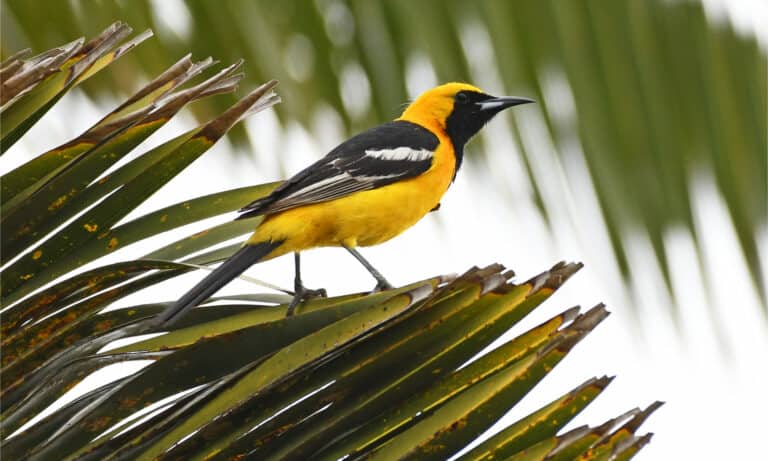
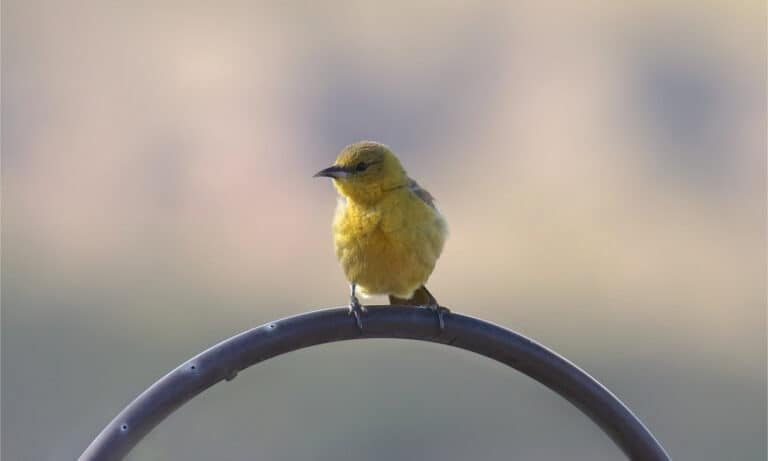
Like other orioles, the hooded oriole has distinctive black, yellow, and white coloring. It is about 8 inches long with a long tail and a pointed bill. The male is more darkly colored with a deep orange head and chest, black-and-white striped wings, and long black tail feathers. The male also has a dark chest and bill. The female is bright yellow with a green back and white-striped wings.

Males in northwestern Mexico and the southwestern United States tend to be more yellow, while males in south Texas and eastern Mexico are more orange.

The average hooded oriole is 7 to 8 inches long and weighs 0.8 of an ounce. It has a wingspan of 9 to 11 inches.
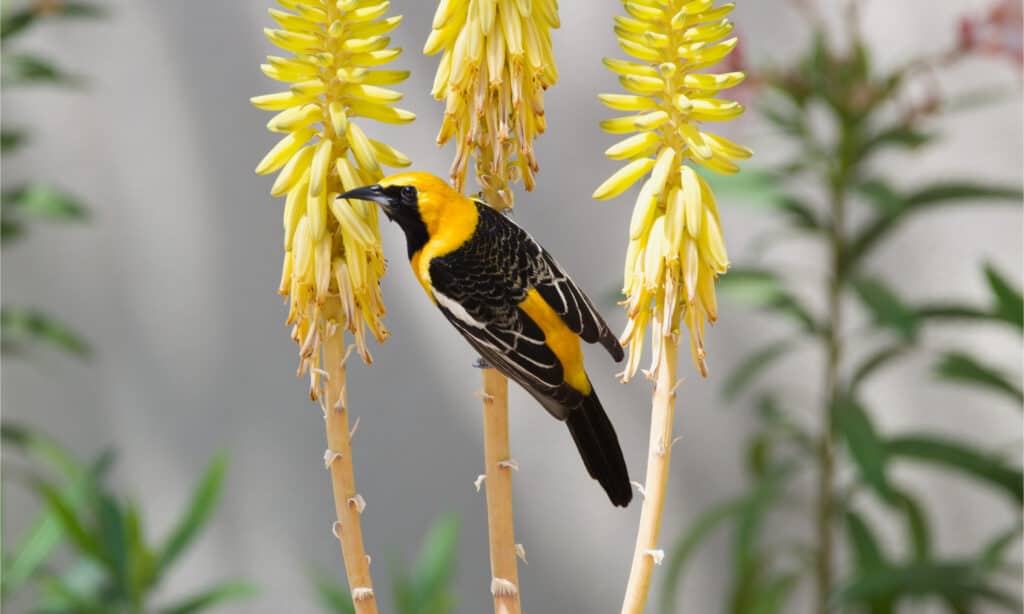
Hooded oriole on a yellow flower

The male hooded oriole has a deep orange head and chest, black-and-white striped wings, and long black tail feathers.

Behavior

Like all birds, the hooded oriole has a unique song. It emits a series of chattering notes and cries. Orioles are good mimics of other birds and will mix the sounds of woodpeckers and ash-throated flycatchers.

Migration

Hooded orioles are migratory, but they don’t make the long distances many bird species are famous for going on. Instead, they take short trips during the cold winter months to southern Texas, Nevada, and California. Their migration season is February through March.

Some hooded orioles choose to spend the winter at home without migrating. These are usually birds that have regular food sources in backyard feeders.

Diet

The hooded oriole finds its food in its favorite trees. This bird eats insects, spiders, fruits, and nectar. The hooded oriole is not an aggressive predator. It takes its time foraging among the tree leaves for its food. Among the birds’ favorite foods are:

Predators and Threats

Like all songbirds, hooded orioles are prey for domestic cats and raptors like hawks and owls. Snakes may also attack and eat orioles.

The major threat to hooded orioles is brood parasitism. Brown-headed and bronzed cowbirds frequently lay their eggs in the nests of hooded orioles, and female orioles may end up raising these intruder babies at the expense of their own offspring.

Reproduction, Babies, and Lifespan

Hooded orioles breed twice a year. Their breeding months are April and August. The male oriole performs a courtship dance that includes deep bowing and pointing his bill upward.

The female builds a cup-shaped nest high in the tree branches. After mating, the mother lays about four eggs. The eggs may be white or pale blue. Incubation takes 13 days. When the babies are born, both mother and father feed them. Fledglings leave the nest at about 14 days.

Hooded orioles typically have a lifespan of three to five years in the wild. The longest lifespan on record for a hooded oriole was a six-year-old male who lived in California.

Nest Features

The oriole’s nest is usually made from grasses, plant material, hair, and feathers. Some females place the nest under a large leaf, a clump of mistletoe, or a patch of moss. This helps hide the nest from predators. Males usually contribute building materials, but females do most of the nest-building work.

Hooded orioles use a technique that “sews” the nest to a secure leaf. When the nest is suspended from palm leaves, the mother pokes holes in the leaf and pushes the fibers through to make stitches. This creates a firm hold that keeps the nest secure under the leaf.

Population

There are an estimated 1,700,000 mature individuals worldwide. It is one of the few songbird species whose numbers are increasing. The species is listed as “least concern” on the International Union for Conservation of Nature (IUCN) Red List.

Sunny Backyard Bird

The hooded oriole is a harbinger of warm weather and a bright ray of golden sunshine. It’s easy to attract this favorite bird to a feeding station. If the bird likes the food you supply, it may stay in your yard all year.

View all 288 animals that start with H

Sources

  1. Audobon Field Guide to Birds / Accessed May 20, 2022
  2. Sonoma Birding / Accessed May 20, 2022
  3. American Bird Conservancy / Accessed May 20, 2022
  4. Birds and Blooms / Accessed May 20, 2022
A-Z Animals Staff

About the Author

A-Z Animals Staff

AZ Animals is a growing team of animals experts, researchers, farmers, conservationists, writers, editors, and -- of course -- pet owners who have come together to help you better understand the animal kingdom and how we interact.
Connect:

Thank you for reading! Have some feedback for us?


Hooded Oriole FAQs (Frequently Asked Questions)

Yes, but it does not travel a long distance. Most hooded orioles travel from their southern states to California, Nevada, or Texas. Some hooded orioles choose to over-winter and stay in the same place all year.