
K
Species Profile

Key Deer

Odocoileus virginianus clavium

Small deer, big Keys legacy
iStock.com/ArendTrent

Key Deer Distribution

Click a location to explore more animals from that region

Endemic Species
Loading map...

Found in 1 state/province

Size Comparison

Human 5'8"
Key Deer 2 ft 3 in

Key Deer stands at 39% of average human height.

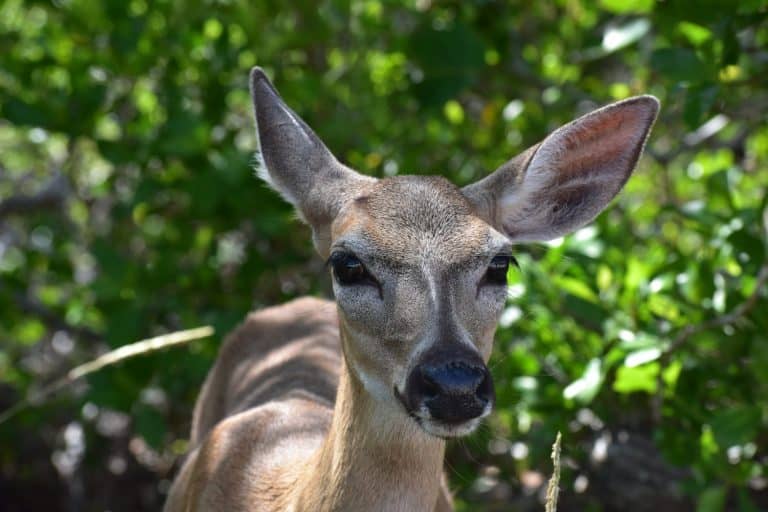
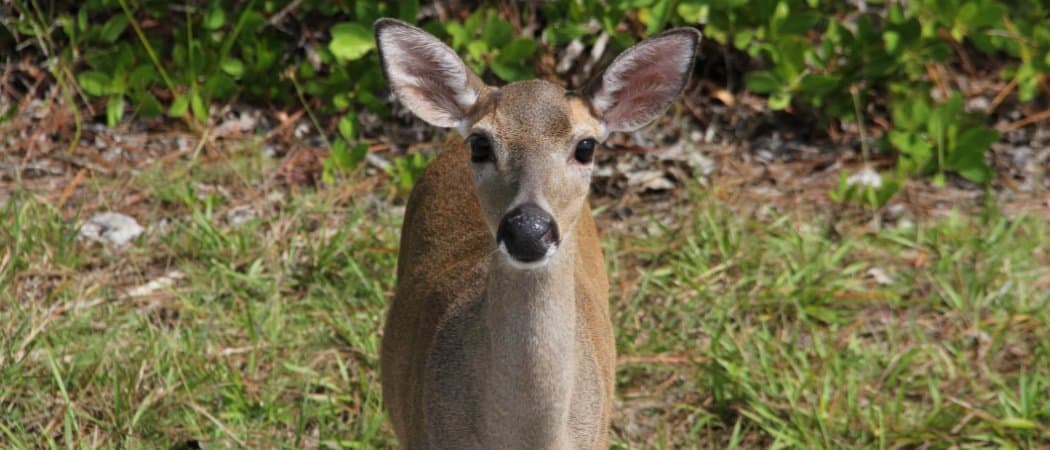
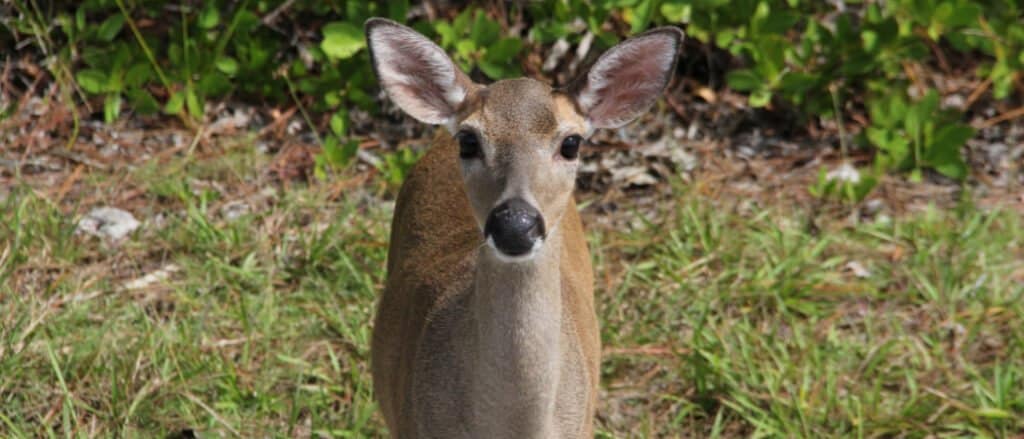
key deer looking into camera

At a Glance

Wild Species
Also Known As White-tailed deer, Whitetail, Virginia deer
Diet Herbivore
Activity Crepuscular+
Lifespan 7 years
Weight 34 lbs
Status Not Evaluated
Did You Know?

Key deer is a subspecies of white-tailed deer (not a separate species).

Scientific Classification

The Key deer is the smallest North American deer and an insular subspecies of the white-tailed deer, occurring naturally only in the lower Florida Keys.

Kingdom
Animalia
Phylum
Chordata
Class
Mammalia
Order
Artiodactyla
Family
Cervidae
Genus
Odocoileus
Species
Odocoileus virginianus

Distinguishing Features

  • Notably smaller body size than most mainland white-tailed deer (insular dwarfism)
  • Typical white-tailed deer tail-flagging and overall morphology, but more compact proportions
  • Island-endemic range restricted to the lower Florida Keys

Physical Measurements

Males and females differ in size

Height
2 ft 3 in (1 ft 12 in – 2 ft 6 in)
2 ft 2 in (1 ft 12 in – 2 ft 4 in)
Length
4 ft 2 in (3 ft 9 in – 4 ft 7 in)
Weight
66 lbs (55 lbs – 75 lbs)
55 lbs (44 lbs – 64 lbs)
Tail Length
5 in (4 in – 6 in)
5 in (4 in – 6 in)
Top Speed
30 mph
Based on white-tailed deer speed

Appearance

Primary Colors
Secondary Colors
Skin Type Mammalian fur (short, coarse guard hairs with a denser underfur seasonally); hair coat shows seasonal molt (more reddish-brown in summer, grayer in winter).
Distinctive Features
  • Key deer are the smallest North American deer. Adults commonly weigh about 16–34 kg; does about 16–25 kg and bucks about 20–34 kg. Weight varies by island, season, and food.
  • Short stature: commonly reported shoulder height about ~60-76 cm (again variable; cited in refuge/agency descriptions of Key deer morphology).
  • Proportionally slender legs and a compact body consistent with insular dwarfism (island ecology in the lower Florida Keys).
  • Seasonal coat shift: summer coat more reddish-brown; winter coat duller/gray-brown (typical white-tailed deer molt pattern; described for Key deer in management profiles).
  • Fawns: white spotting for camouflage; spots fade as juvenile coat is replaced.
  • Tail: brown upper tail with a bright white underside used as an alarm 'flag' (classic white-tailed deer trait retained in this subspecies).
  • Head/face: relatively large ears and dark nose; face often lighter tan around eyes and muzzle.
  • Antlers (bucks): relatively small compared with mainland bucks; typically several points with reduced beam size reflecting overall body size (reported in Key deer biology accounts).
  • Endemism cue (not a separate species): morphology and coat pattern match white-tailed deer, but reduced size and island-adapted proportions reflect long-term isolation in the lower Florida Keys.
  • Human-associated appearance/condition variability: individuals in developed areas may show altered body condition or coat quality due to artificial feeding/food conditioning (not a normal trait; documented as a management concern).
  • Common external risk markers in the population: scars/limp from vehicle strikes and entanglement hazards can be seen in some individuals in road-adjacent habitats (threat emphasized in Key deer recovery/management materials).

Sexual Dimorphism

Sexual dimorphism is present but subtle compared with many deer: bucks are larger and grow antlers; does are smaller and antlerless. This is typical of white-tailed deer, including the Key deer subspecies.

  • Antlers present (shed and regrown annually); antlers generally smaller than mainland white-tailed deer due to overall body size (not a separate species trait).
  • Larger average body mass and more robust neck/shoulders, especially during rut.
  • During rut, bucks may show swollen neck musculature and increased rubbing-related facial/forehead staining.
  • No antlers.
  • Smaller average body mass and finer neck/shoulder build.
  • Lactating does may show more pronounced udder/teat visibility and a leaner flank profile seasonally.

Did You Know?

Key deer is a subspecies of white-tailed deer (not a separate species).

Adult size is markedly smaller than mainland white-tailed deer: typical adult mass ≈20-34 kg (♀ ~20-25 kg; ♂ ~25-34 kg) reported in agency/species accounts (e.g., USFWS; FWC).

Gestation is ~200 days (as in white-tailed deer); Key deer commonly have single fawns, with twins considered uncommon on the Keys (USFWS species/recovery materials).

They naturally occur only in the lower Florida Keys (especially Big Pine Key and nearby islands), making them one of the most range-restricted U.S. deer taxa.

Key deer are strong swimmers and can cross channels between islands-important for moving among patchy habitats in the Keys.

Vehicle collisions are a leading, persistent mortality source in this subspecies; speed zones and wildlife underpasses are key management tools (USFWS/FWC conservation programs).

Unique Adaptations

  • Insular dwarfism: reduced body size relative to mainland O. virginianus is a classic island-ecology pattern, likely tied to limited resources and long-term isolation in the lower Keys.
  • Water-stress coping in a low-freshwater landscape: Key deer rely heavily on moisture in forage and localized freshwater sources (e.g., freshwater lenses/depressions) rather than abundant open freshwater typical of many mainland habitats (USFWS refuge ecology descriptions).
  • Movement ecology tuned to fragmented islands: routine use of narrow habitat corridors and willingness to swim short distances help maintain gene flow among nearby islands-an adaptation to naturally patchy Keys geography.
  • Smaller antlers and overall frame reduce energetic demands-an advantage where high-quality forage and fresh water can be limiting (noted broadly in island ungulate ecology; applied in agency descriptions of Key deer morphology).

Interesting Behaviors

  • Island foraging flexibility: browse and graze across hammock edges, pine rocklands, freshwater depressions, and residential vegetation where available; diet shifts with seasonal plant availability (documented in refuge/agency ecological summaries).
  • Human-habituation behavior: individuals readily approach yards/roadsides where fed-this increases collision risk and can elevate disease/parasite exposure; agencies actively discourage feeding.
  • Rut and fawning are less tightly seasonal than in temperate mainland herds; breeding activity can occur over much of the year in the subtropical Keys, with fawning often concentrated in late winter-spring (USFWS accounts).
  • Channel-crossing: deer use swimming to reach nearby keys, aiding recolonization after local disturbances but also increasing risk from storms and boat channels.
  • Thermal and shade use: during heat, deer spend more time in shaded hammocks and edge cover, shifting to crepuscular/nocturnal activity patterns near human development.

Cultural Significance

Key deer (Odocoileus virginianus clavium) is a symbol of the lower Florida Keys and a leader in island conservation. Its decline led to the National Key Deer Refuge (1957), new road safety measures, and work to teach people about feeding wildlife, habitat loss, and sea-level rise.

Myths & Legends

Naming origin: the subspecies name means "of the keys," reflecting its endemic home in the Florida Keys and long-standing local identity tied to the islands' geography.

Lower Keys lore says the tiny Key deer became a community symbol in the 20th century. Residents and refuge staff fought to stop hunting and save the deer’s shrinking habitat as it grew rare.

Across Native American traditions, many stories treat deer as a gift, teaching humility and careful hunting. These tales teach people to respect the Key Deer (Odocoileus virginianus clavium) and not feed or harm it.

Conservation Status

NE Not Evaluated (subspecies not separately assessed by IUCN; species Odocoileus virginianus is assessed as Least Concern)

Has not yet been evaluated against the criteria.

Population Stable

Protected Under

  • United States Endangered Species Act (ESA) - Key deer (Odocoileus virginianus clavium) listed as Endangered (federal protection; take prohibited; recovery planning required).
  • National Key Deer Refuge (established 1957) and associated refuge regulations/management to conserve Key deer habitat in the Lower Florida Keys.
  • State-level protections/management in Florida (species of high conservation concern; enforcement against feeding/harassment and coordination on road-mortality mitigation in Key deer range).
  • HUBS (Odocoileus virginianus complex) summary: At the species level, white-tailed deer is IUCN Least Concern with many robust mainland populations; however, conservation concern is concentrated in small-range or isolated subspecies (notably Key deer-federally Endangered; Columbian white-tailed deer-federally Threatened in parts of its range). Across the group, common threats where declines occur include habitat loss/fragmentation (urbanization/infrastructure), vehicle collisions and human-wildlife conflict, disease outbreaks, and-on islands/coastal lowlands-climate-change-driven sea-level rise and storm impacts.

Life Cycle

Birth 1 fawn
Lifespan 7 years

Lifespan

In the Wild
0–14 years
In Captivity
1–20 years

Reproduction

Mating System Polygyny
Social Structure Transient
Breeding Pattern Seasonal
Fertilization Internal Fertilization
Birth Type Internal_fertilization

Key deer (Odocoileus virginianus clavium) are seasonally polygynous: males compete and mate with several females during a short fall–winter rut. Females have a brief heat, get no male care, gestation ~200 days, usually one fawn in spring–summer.

Behavior & Ecology

Social Herd Group: 3
Activity Crepuscular, Cathemeral
Diet Herbivore Red mangrove (Rhizophora mangle) leaves/propagules (commonly reported as a key, readily used food source in the Lower Florida Keys when other forage is limited; see USFWS Key deer species accounts and Florida Keys ecological diet summaries).

Temperament

Generally vigilant and risk-averse; strong flight response in less-habituated areas (Odocoileus-typical anti-predator behavior described in Halls, 1984)
Key Deer (Odocoileus virginianus clavium) in the lower Florida Keys get used to people and seem tame or approachable, especially around human food and yard plants; this is from repeated safe contact, not domestication.
Bucks show increased aggression and dominance displays during the rut (sparring, chasing, threat postures), consistent with white-tailed deer breeding behavior (DeYoung, 2011)

Communication

Bleats Especially doe-fawn contact calls
Grunts Commonly during social interactions and rut-related encounters
Snorts / snort-wheezes Alarm and high-arousal threats; widely documented in white-tailed deer behavior accounts: Halls, 1984; DeYoung, 2011
Chemical communication via glandular scents Tarsal/metatarsal/interdigital glands) and urine; includes rub-urination and deposition of scent on vegetation/ground (Halls, 1984; DeYoung, 2011
Scrapes and rubs: bucks create ground scrapes and rub vegetation with antlers/forehead glands as signposts during the breeding season Halls, 1984; DeYoung, 2011
Visual signals: tail-flagging, head/neck postures, ear orientation, and threat stances used in alarm and dominance contexts
Tactile contact within family groups Grooming/licking of fawns; nose-to-nose investigation during reunions

Habitat

Biomes:
Tropical Dry Forest Wetland Temperate Forest Temperate Grassland Mediterranean Desert Hot Desert Cold Temperate Rainforest Boreal Forest (Taiga) Tundra Alpine Freshwater +6
Terrain:
Coastal Island Karst Sandy Muddy
Elevation: Up to 16 ft 5 in

Ecological Role

Primary consumer (large herbivore) in Lower Florida Keys terrestrial ecosystems; functions mainly as a browser/grazer rather than a predator.

Controls understory/shrub growth through browsing, influencing plant community composition and regeneration Seed dispersal via endozoochory of fleshy-fruited plants (e.g., seagrape and other hammock/coastal shrubs) and movement among habitat patches Nutrient cycling via dung and urine inputs, locally fertilizing soils and affecting plant productivity Creates/maintains foraging trails and small-scale disturbance that can alter microhabitats and plant recruitment patterns

Diet Details

Other Foods:
Woody browse Mangrove leaves and propagules Forbs and herbaceous plants Native grasses and sedges Fruits and berries Palms and palm fruits Cactus pads and fruits Salt-tolerant coastal plants and succulents Ornamental landscaping plants and garden vegetation Plant material +4

Human Interaction

Domestication Status

Wild

Key deer (Odocoileus virginianus clavium) are wild, non-domesticated deer found only in the lower Florida Keys. They have no history of domestication and are federally protected, so management focuses on conservation. Because they learn to approach people when fed, managers use education, feeding bans, fencing, wildlife crossings, and road-speed limits to cut vehicle deaths.

Danger Level

Low
  • vehicle-collision risk (deer-vehicle accidents can cause serious human injury/death; a key risk in the Florida Keys road network)
  • defensive kicks/bites at close range (especially if cornered, handled, or during the rut)
  • habituation from feeding increases approach/aggression risk and concentrates deer near roads and homes
  • possible tick exposure where deer concentrate (general cervid-associated tick nuisance/disease-risk context, though not unique to Key deer)

As a Pet

Not Suitable as Pet

Legality: Not legal to keep Key deer (Odocoileus virginianus clavium) as a pet. They are protected by the U.S. Endangered Species Act; take, possession, or sale need strict federal/state permits and facility rules.

Care Level: Expert Only

Purchase Cost:
Lifetime Cost: $25,000 - $150,000

Economic Value

Uses:
Ecotourism and recreation (wildlife viewing/photography) Conservation funding and public education Human-wildlife conflict costs (vehicle collisions, property/landscape damage) Research value (island ecology, conservation biology)
Products:
  • wildlife-viewing tourism revenue in the Florida Keys (non-consumptive)
  • cost avoidance/mitigation programs (road signage, reduced speed zones, fencing/wildlife crossings)
  • no legal consumptive products (no lawful hunting/venison/antler market for this subspecies)

Relationships

Ecological Equivalents 4

Animals that fill a similar ecological role in their ecosystem

Florida white-tailed deer Odocoileus virginianus osceola Closest comparable deer in Florida's warm, humid subtropical areas. Both are herbivorous and exhibit the typical white-tailed deer rutting behavior, but Key deer are much smaller due to island dwarfism and limited food and space.
Coues white-tailed deer Odocoileus virginianus couesi Small white-tailed deer; like the Key deer, they are a smaller subspecies of O. virginianus adapted to low-resource, often dry coastal habitats, and they use edges and young plants for food in pine rocklands, hammocks, and mangrove mosaics.
Sitka black-tailed deer Odocoileus hemionus sitkensis Island and coastal deer of temperate rainforest islands that swim between islands and feed on shoreline and edge plants. Used as a comparable example for island movement and human–wildlife conflict risk; same genus but a different species group.
Marsh deer Blastocerus dichotomus Although larger, marsh deer occupy similar low-lying wetland and edge-vegetation habitats. Key deer in the Florida Keys depend on these low-lying wetland and edge plants and are at risk from storm surge and sea-level rise, as noted in USFWS recovery plans.

“Smallest North American white-tailed deer species.”

Key deer, as their name implies, are deer that are native to the Florida Keys. They are the smallest subspecies of white-tailed deer in North America. They look almost identical to their relatives but are more like a miniature version. This is why some people call them “toy deer.” Key deer are closer in size to a dog than some other larger deer species. When alarmed, Key deer lift their tails, showing off the white that lies beneath.
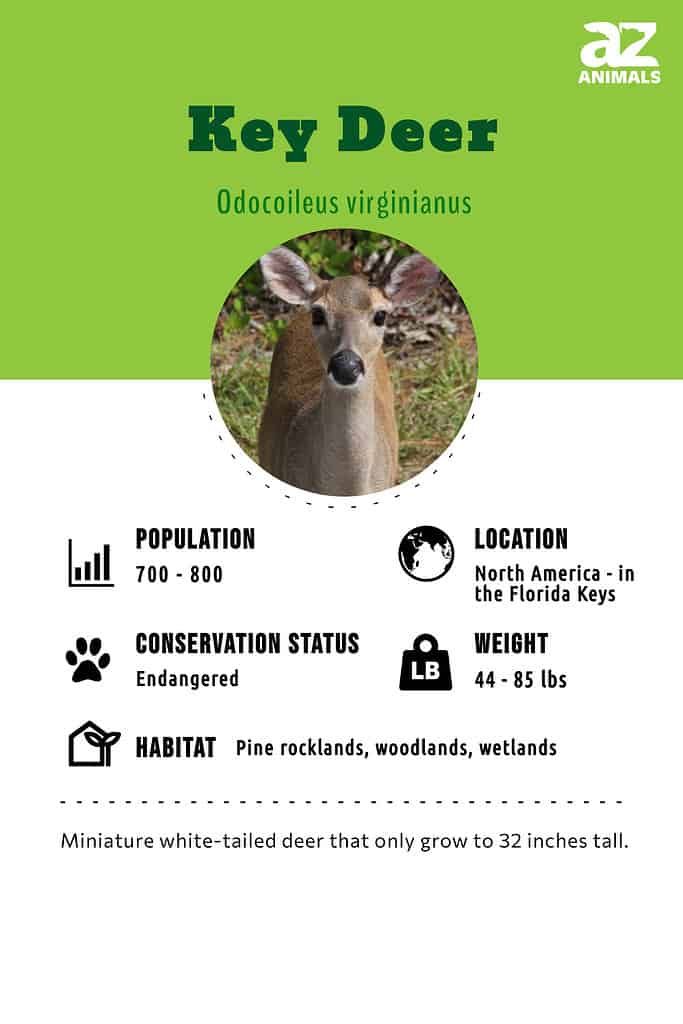
5 Incredible Key Deer Facts!

  • Key deer are endangered.
  • Key deer are the only existing large herbivore in the Florida Keys.
  • Like most deer, Key deer are mostly seen around dusk and dawn.
  • By the 1950s, Key deer were almost extinct.
  • Key deer have little-to-no fear of humans.
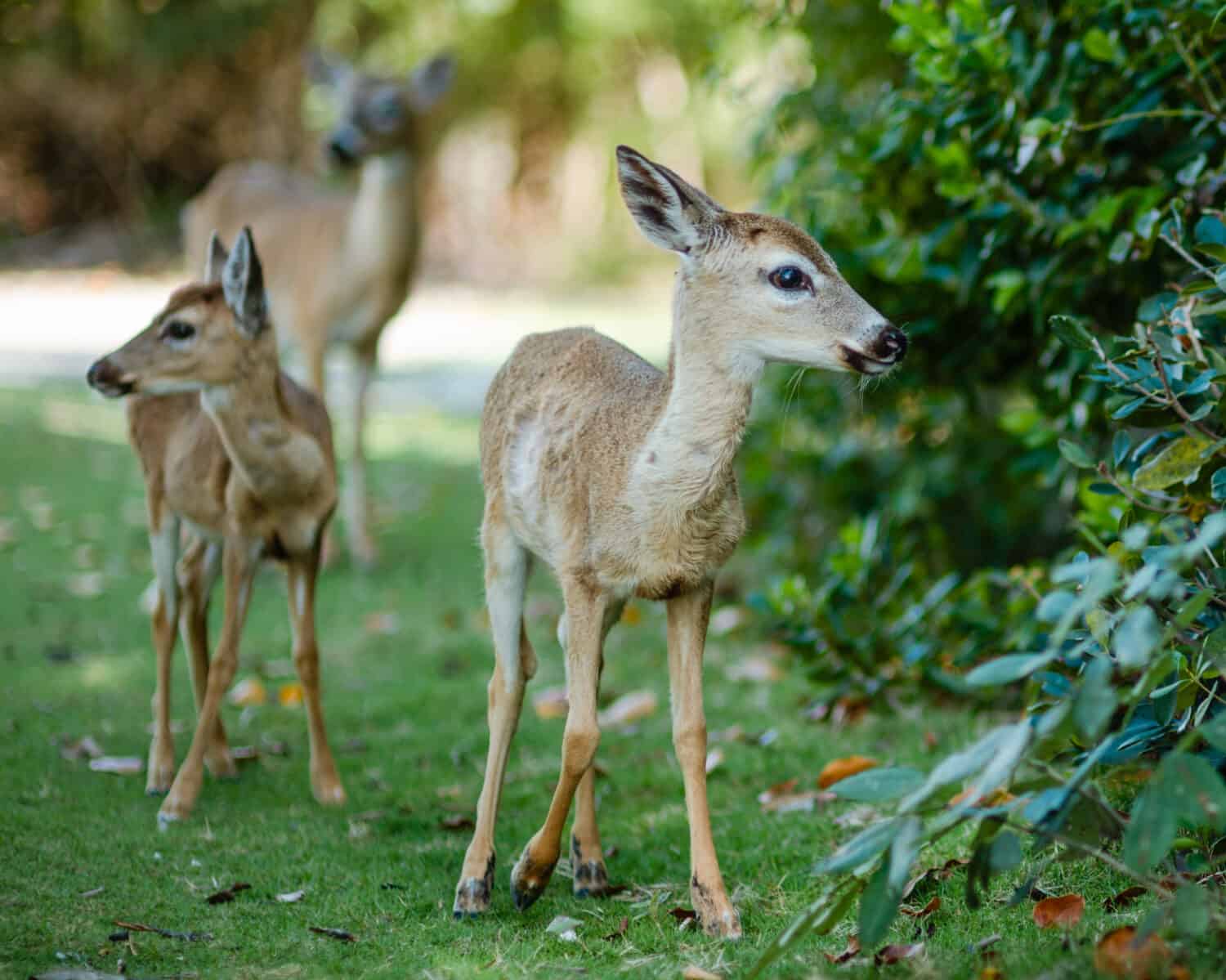
Small Deer in the Florida Keys

Like most deer, key deer are mostly seen at dusk and dawn.
Image: Abigail Marie, Shutterstock

Scientific Name and Species

The scientific name for Key Deer is Odocoileus virginianus clavium. They are also sometimes called toy deer due to their small size. This species is in the Mammalia class and belong to the Cervidae family. They are a subspecies of white-tail deer, Odocoileus virginianus, which are of the Odocoileus genus.

While there are 38 subspecies of white-tail deer, Key deer do not have any subspecies. The origin of the name Odocoileus virginianus clavium can be broken down into the meaning of each word. Odocoileus stems from the Greek words “odious” (tooth) and “koilos” (hollow) referring to their hollow teeth. Virginianus is a New Latin word that means “of Virginia.” Clavium means “key” in Latin.

Evolution

According to fossil records, the first ungulates appeared around 50 million years ago – during the Eocene. These animals evolved into two groups: those with an even number of toes (Artiodactyls) and those with an uneven number of toes (Perissodactyls). The first real deer didn’t appear until 25 million years later. Many people consider animals like the Syndyoceras to be a precursor to deer – and it shares features with deer, horses, giraffes, and antelopes – and had bony skull outgrowths similar to antlers. These fossils date around 35 million years ago and were found in North America.

Modern deer are believed to have evolved from ancestors during the Oligocene – 30 million years ago. They were small animals with antlers and large tusks that lived in the old world tropics. Deer migrated from what is now Europe across the Bering Land Bridge – and then, in the late Pliocene, approximately 2.5 – 3 million years ago, the Panamanian Land Bridge allowed deer to venture even further south into central and South America.

Appearance & Behavior
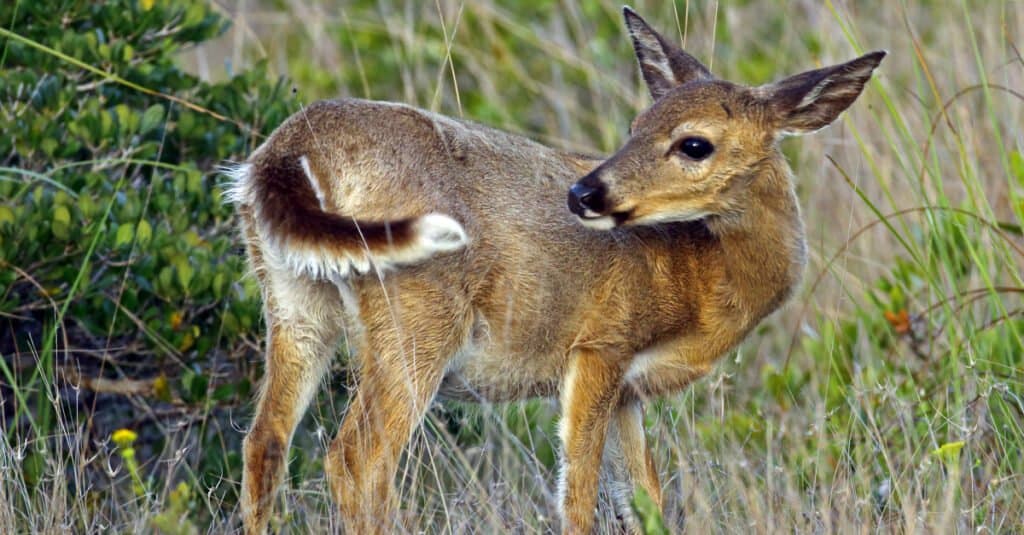
Key deer aren’t afraid of humans and may approach you out of curiosity.

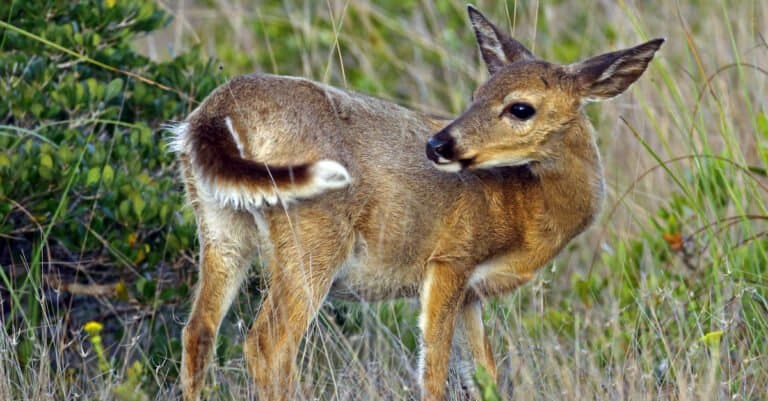
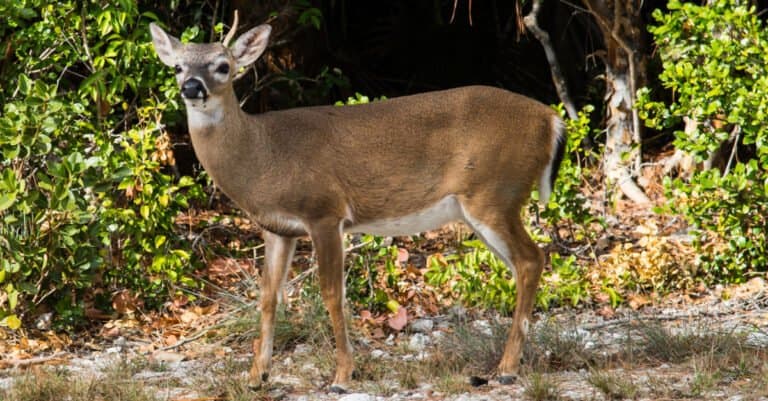
Key deer look similar to other white-tail deer species, but they are smaller. Their fur is reddish-brown to grayish-brown with white on the belly and under the tail. They usually have a darker coloring between the eyes. The snout is black and they have hooves. Males, or bucks, have antlers. They shed these antlers and regrow a new pair each year. Females, or does, do not have antlers.

This animal can be between 24 and 32 inches tall at the shoulders and weigh between 44 and 85 pounds. At the smallest, that is equal to the weight of two dachshunds. On the higher end, the weight is about half as heavy as a kangaroo. The average height for males is 30 inches, about two times the height of a bowling pin. The male’s weight ranges from 55 to 85 pounds. Though it is not typical, the heaviest males can reach up to 100 pounds. For females, the average height is 26 inches, 12 times as tall as a golf tee. Their weight is between 44 and 65 pounds.
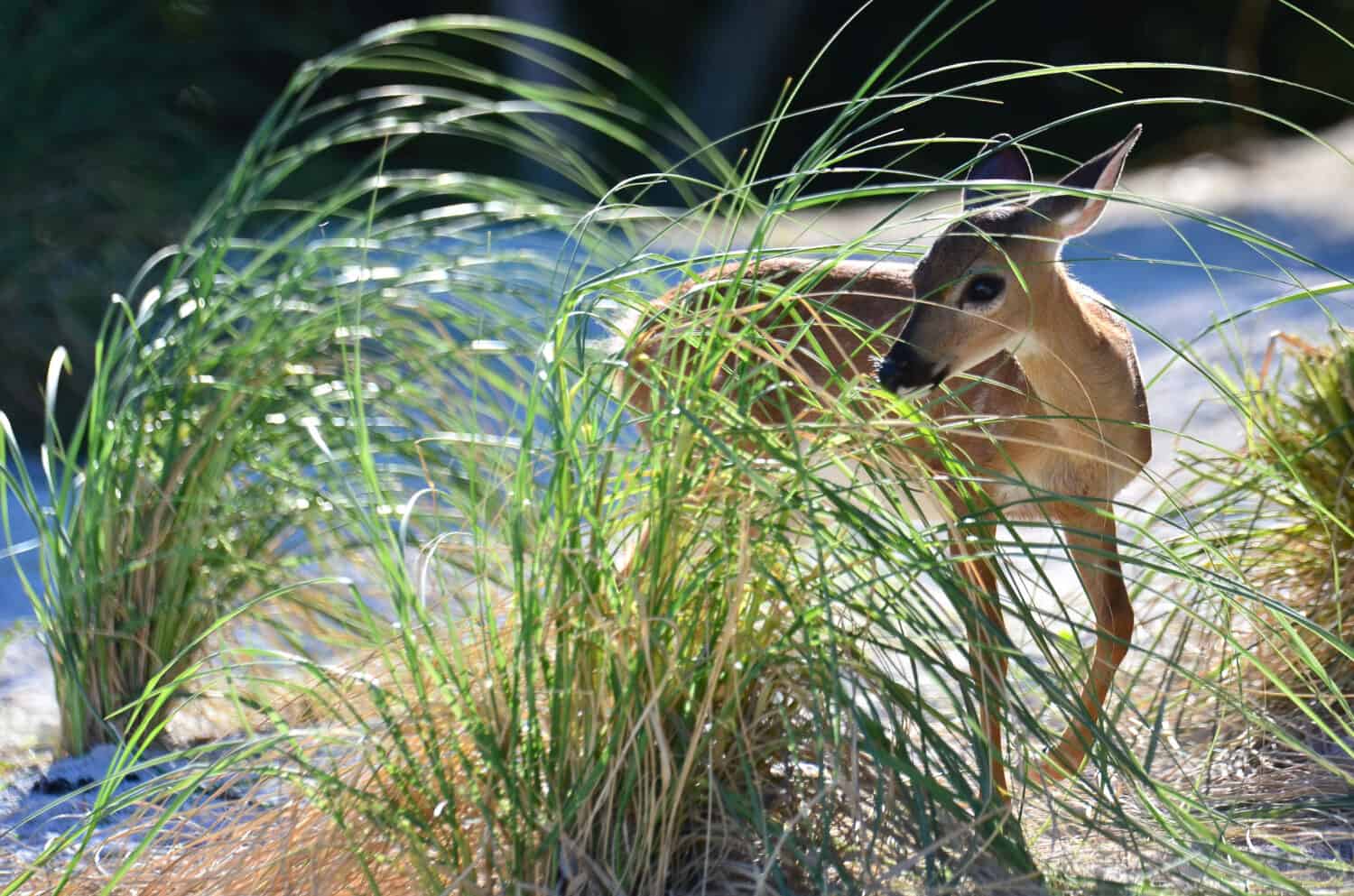
Key Deer posing behind the sea oats

Key Deer are small enough to hide behind a clump of sea oats.
Image: Virginia Blount, Shutterstock

Related species include 37 other white-tailed deer subspecies. Other species have the same coloring as Key deer but are larger. They can reach a height of 3.9 feet. Their legs are longer than a Key deer’s and they have a more narrow skull.

Key deer are mostly solitary. When they do form a group, it is called a herd. They can swim, run, and jump well. They are gentle creatures, however, bucks can become aggressive with each other when they are in a rut. They are not afraid of humans and will approach them for food at times. Key deer are most active during the late evening, night, and early morning.

Habitat

Aerial sunset with the bridge between Sugarloaf and Saddlebunch Keys, above Sugarloaf Creek, in Florida Keys, Florida.

Key Deer are able to swim easily from island to island.
Image: Mihai_Andritoiu, Shutterstock

Key deer are endemic to Florida, United States in North America. They live primarily in the Florida Keys. Their range used to include all of the lower Keys but after fragmentation, they are only present in Monroe County. They are present from Sugarloaf Key to Bahia Honda Key.

Key deer live in a tropical climate in nearly all habitats. They most commonly inhabit pine rocklands, wetlands, and woodlands. Rocklands provide a source of fresh water for them and are therefore a big part of where they live. In the dryer months, they will travel to places where there is more water available to them. They can swim from one island to another with ease.

Predators & Threats
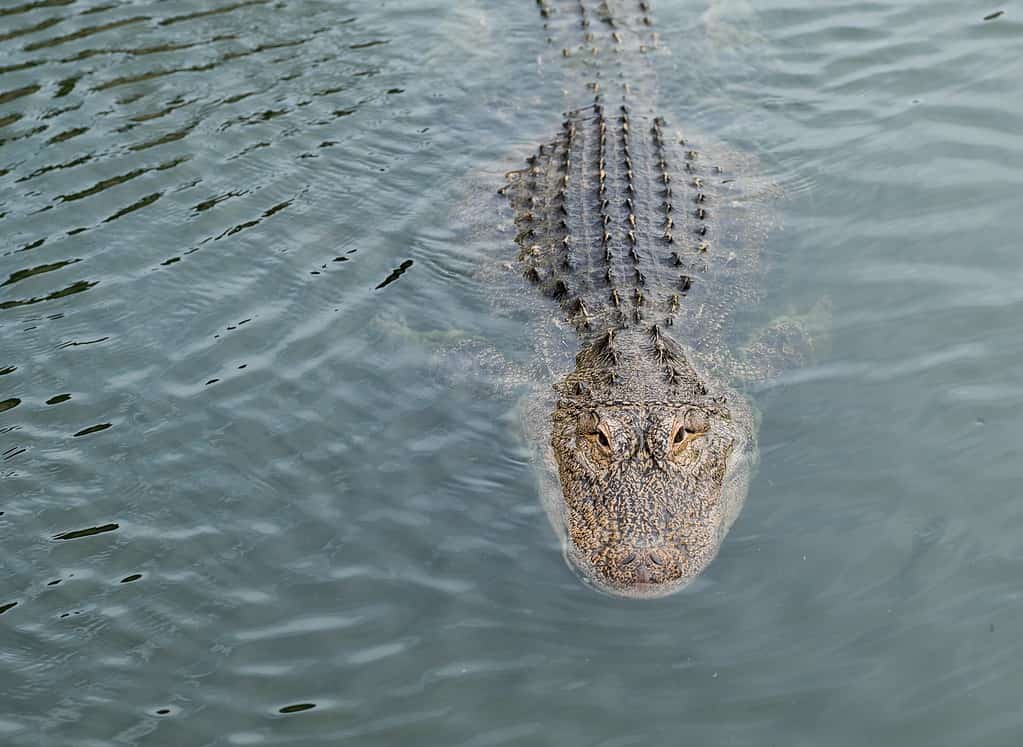
Alligator swimming through clear waters

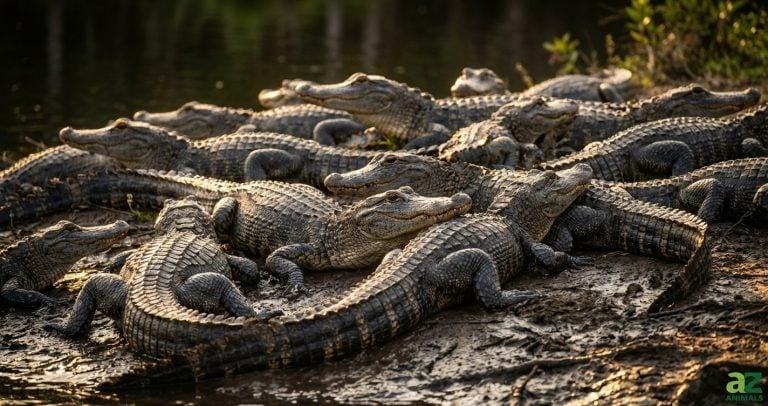
Alligators are a threat to young fawns.

Key deer are herbivores. Their diet consists of a large number of plants. Some plants can be toxic to deer, such as rhubarb. Deer can eat between six and eight percent of their body weight in a day. For this animal, that would be three-and-a-half to six pounds of food daily. That is equal to up to 60 times the weight of a golf ball.

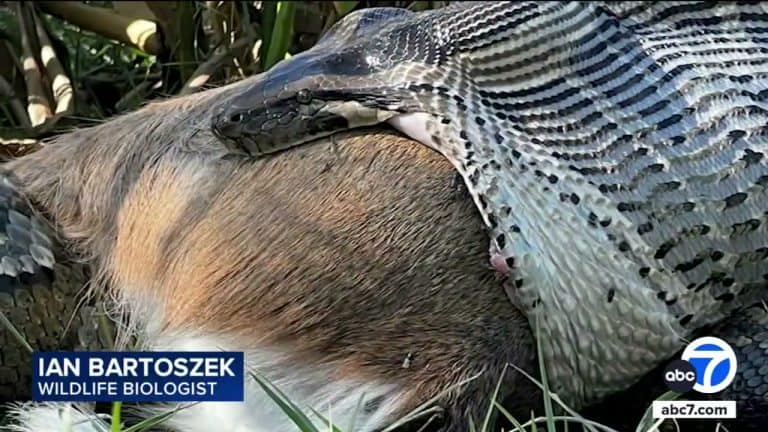
Adult Key deer generally do not have any natural predators, other than humans. It is rare for a fully grown Key deer to be killed by wild predators. However, fawns fall victim to large reptiles.

Environmental threats pose a risk to this species as well. Hurricanes can be very dangerous to these animals because they can lead to drowning and further fragmentation and habitat loss. Just as with many other species, humans cause a wide array of problems for these animals. Over-hunting of these animals almost led to their extinction by the 1950s.

After the ban, their numbers recovered partially but they are still affected by other human activity and encroachment. Urban development continues to take over more of their habitat. Illegal feeding by humans and the introduction of non-native plants can disturb their natural diet and impact their nutrition. They are not generally afraid of humans and this makes them more prone to human-related casualties. Sadly, these deer are killed by car collisions fairly often and this is currently considered their biggest threat.
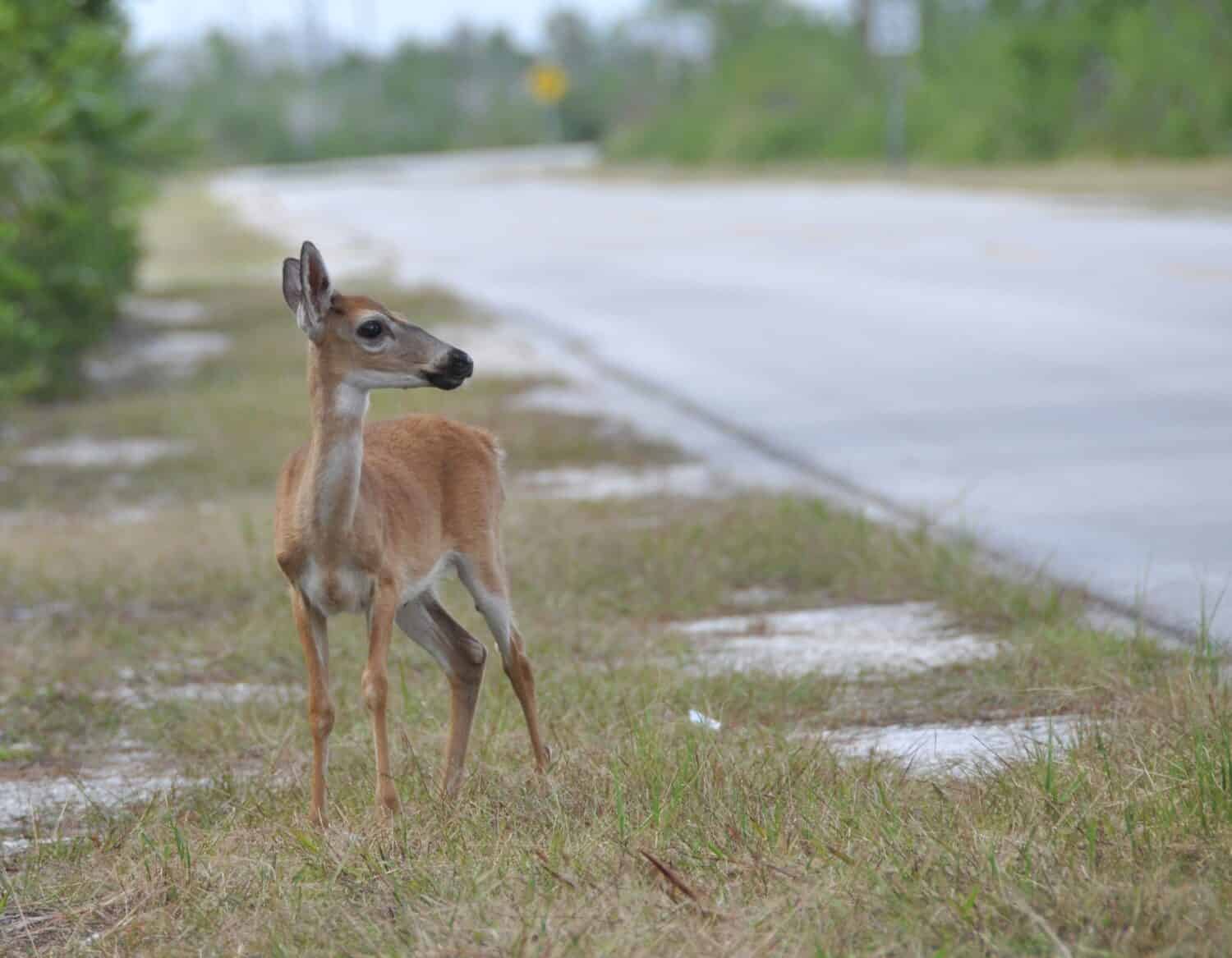
Key Deer

Many Key Deer are killed while trying to cross roads.
Image: Chuck Wagner, Shutterstock

A parasite known as screwworm greatly affected the Key deer population between 2016 and 2017. This parasite was deadly and killed roughly one-eighth of the herd. The infestation only lasted one year before scientists were able to figure out how to stop it. Since screwworms could only mate once, introducing sterile males was the solution that seemed to successfully eradicate the pests.

“The International Union for the Conservation of Animals” groups Key deer into a broad category of white-tailed deer. They list white-tailed deer as the least concern on the IUCN Red List. However, the federal conservation status of Key deer is endangered. The Florida Natural Areas Inventory classifies them as endangered and critically imperiled.

There have been a few conservation efforts put in place for this species. The National Key Deer Refuge offers a safe haven for these deer. The South Florida Multispecies Recovery Plan was introduced in 1999 and is ongoing. In 2003, part of U.S. Route 1 was lifted to provide a safe place for them to cross underneath the roadway.

National Key Deer Refuge
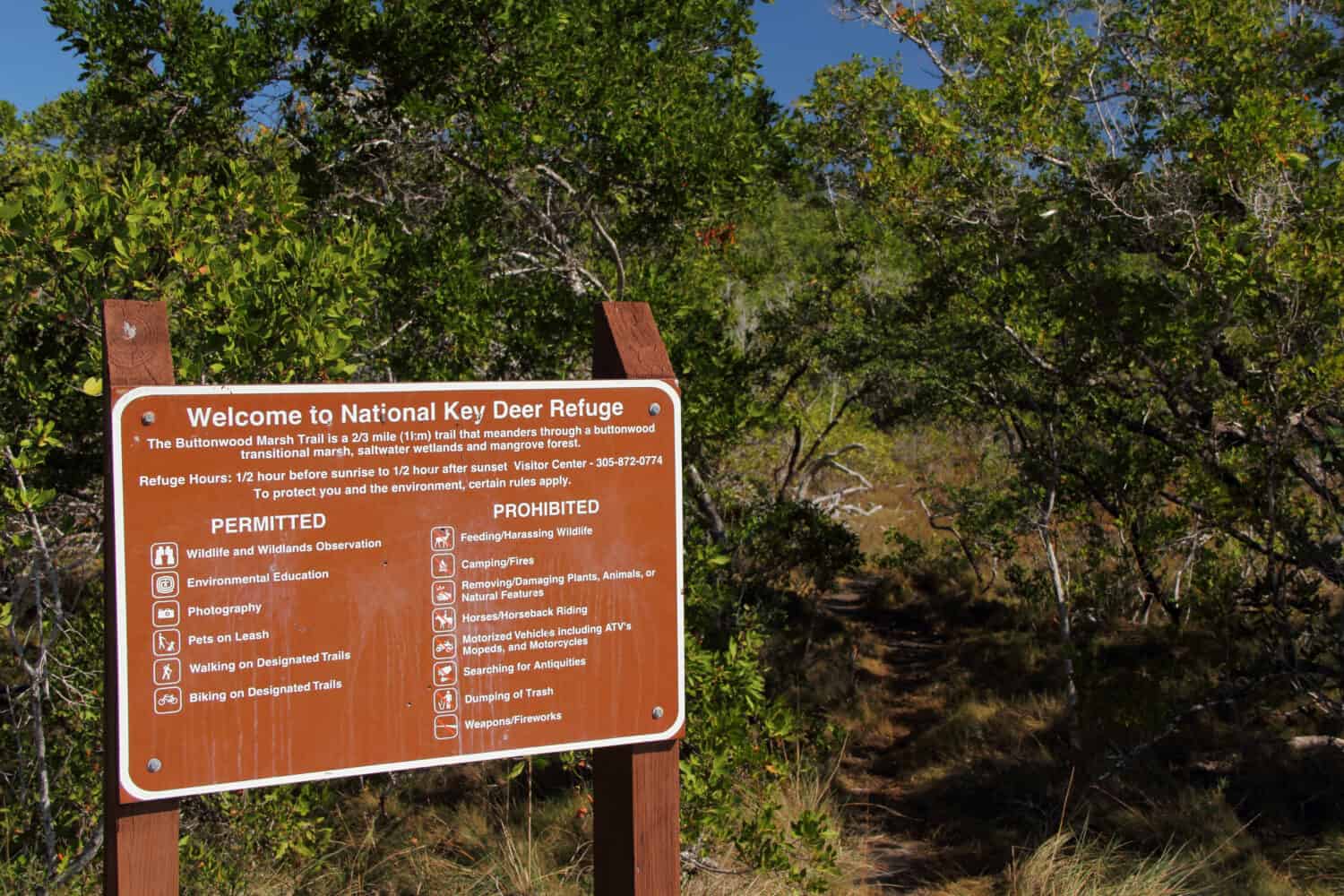
Buttonwood Marsh Trail Trail-head, National Key Deer Refuge, Florida Keys

The National Key Deer Refuge consists of 9,200 acres for the animals to roam freely.
Image: William Silver, Shutterstock

Founded by the US Fish and Wildlife Service in 1957, the National Key Deer Refuge is the main conservation effort in place for Key deer. The refuge consists of 9,200 acres of land for the deer to thrive. The location of the refuge is in Big Pine Key and No Name Key, Florida. About 75% of the population lives in the refuge. To help prevent any more accidents caused by humans, the US Fish and Wildlife Service discourages people from feeding these wild animals. They also ask people to secure their trash and drive slowly when they are in an area where Key deer live.

What eats Key deer?

Known hunters of young Key deer are American alligators (Alligator mississippiensis) and American crocodiles (Crocodylus acutus). They will feed on fawns who are vulnerable or separated from their parents. Before the hunting ban in the late 1930s, humans would eat adults as well.

Diet
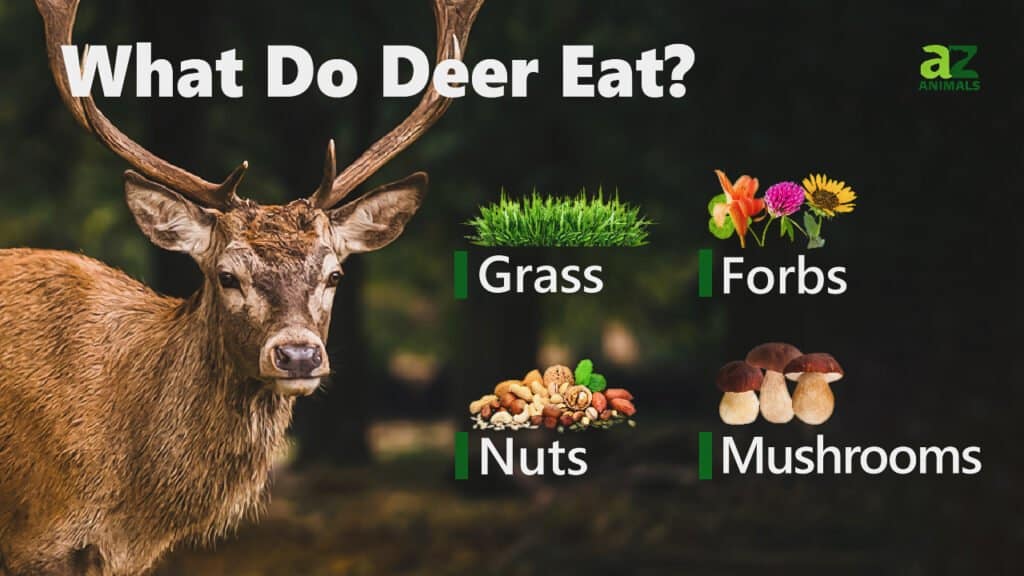
What Do Deer Eat
Key Deer eat grass, nuts, forbs, mushrooms and leaves, and fruit from mangrove and silver palm trees.

Key deer eat over 150 plant species. Their main food source is leaves and fruit from red, white, and black mangrove trees as well as berries from thatch palm trees. They also eat silver palm berries, acai, grasses, and a variety of flowers. The types of food available will change with the seasons and this will alter their diet slightly.

Reproduction, Babies, and Lifespan
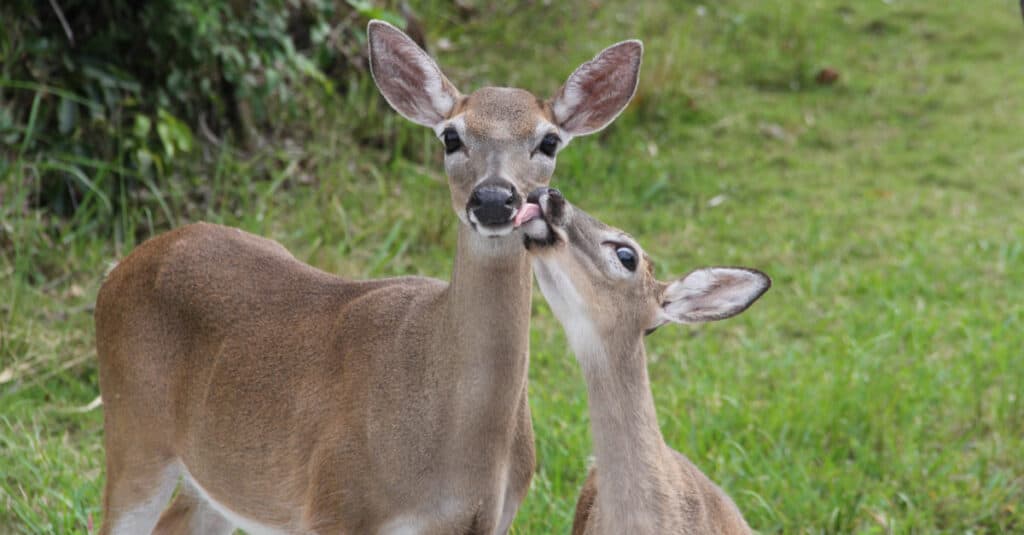
Key deer with baby

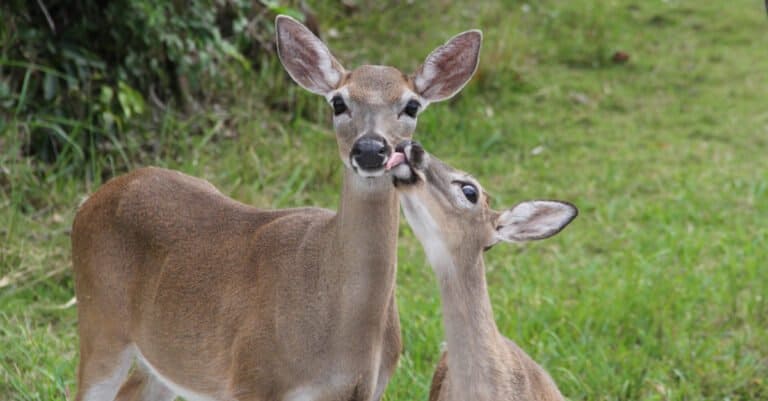
Female Key deer usually give birth to one fawn at a time.

When mating season is underway, bucks are in what we refer to as a rut. Fall and winter are the peak rut seasons, though mating can occur year-round. Males will mate with multiple females. To compete for a doe, bucks will fight each other, often locking their antlers. They can become very aggressive with one another and may injure or even kill another buck during the ritual. This is common mating behavior with many deer species. The winning buck earns the right to mate with the doe. Like all mammals, the doe carries the embryo of its young in her uterus. Gestation lasts about seven months before the mother gives live birth.

The mother gives birth to one baby called a fawn. Fawns can walk in under one hour after being born. They are mobile in as little as 30 minutes. They feed on their mother’s milk three to four times a day for about 12 to 16 weeks before weaning. When they are weaned, they eat the same foods as older Key deer. Male fawns typically leave their mother around one year old while females may stay around for years and begin having their own young. Females reach sexual maturity at only six months old. Males mature at 1.5 years of age.

The lifespan of this species is generally seven to nine years. According to the Fish & Wildlife Service, the average lifespan for a male is 2.9 years, and for a female is 6.5 years. The oldest known Key deer was a female who reached 19 years of age.

Population
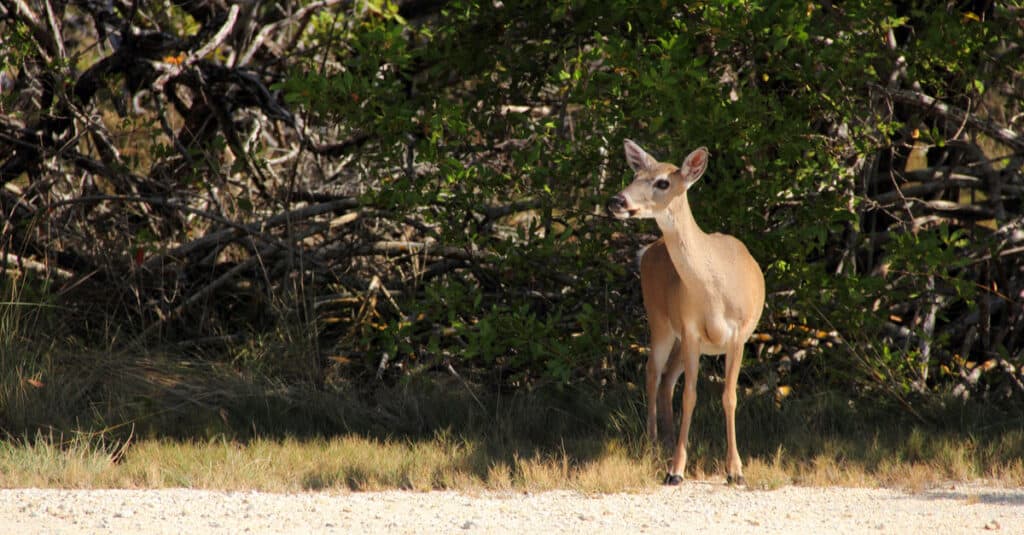
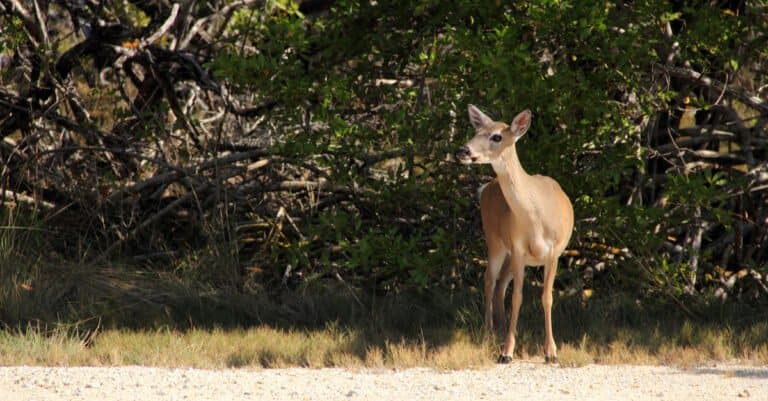
Key deer standing beside the road

Key deer were declared endangered in 1967 and remain in that status.

Hunting this species was banned in 1939 but there was already too much damage done by poachers over many years. In the 1940s, there were less than 50 Key deer. By 1955, the estimated population was only 25 mature individuals. After some time, the numbers have increased and are currently considered stable. Key deer were declared endangered in 1967 and still are to this day.

Researchers believe that there are less than 1,000 Key deer left in the wild. They are all in the Florida Keys. Today, the population size is estimated to be between 700 and 800 individuals.

View all 103 animals that start with K

Sources

  1. EOL / Accessed August 25, 2021
  2. Science Kids / Accessed August 25, 2021
  3. Reddit / Accessed August 25, 2021
  4. Britannica / Accessed August 25, 2021
  5. U.S. Fish & Wildlife Service / Accessed August 25, 2021
  6. The National Wildlife Federation / Accessed August 25, 2021
  7. Nature Serve Explorer / Accessed August 25, 2021
  8. Florida Fish and Wildlife Conservation Commission / Accessed August 25, 2021
  9. National Deer Association / Accessed August 25, 2021
Lisha Pace

About the Author

Lisha Pace

After a career of working to provide opportunities for local communities to experience and create art, I am enjoying having time to write about two of my favorite things - nature and animals. Half of my life is spent outdoors, usually with my husband and sweet little fourteen year old dog. We love to take walks by the lake and take photos of the animals we meet including: otters, ospreys, Canadian geese, ducks and nesting bald eagles. I also enjoy reading, discovering books to add to my library, collecting and playing vinyl, and listening to my son's music.

Thank you for reading! Have some feedback for us?


Key Deer FAQs (Frequently Asked Questions)

Less than 1,000 Key deer are left in the wild.