T
Species Profile

Texas Coral Snake

Micrurus tener

Bright bands, hidden danger.
Joe Farah/Shutterstock.com

Texas Coral Snake Distribution

Click a location to explore more animals from that region

Loading map...
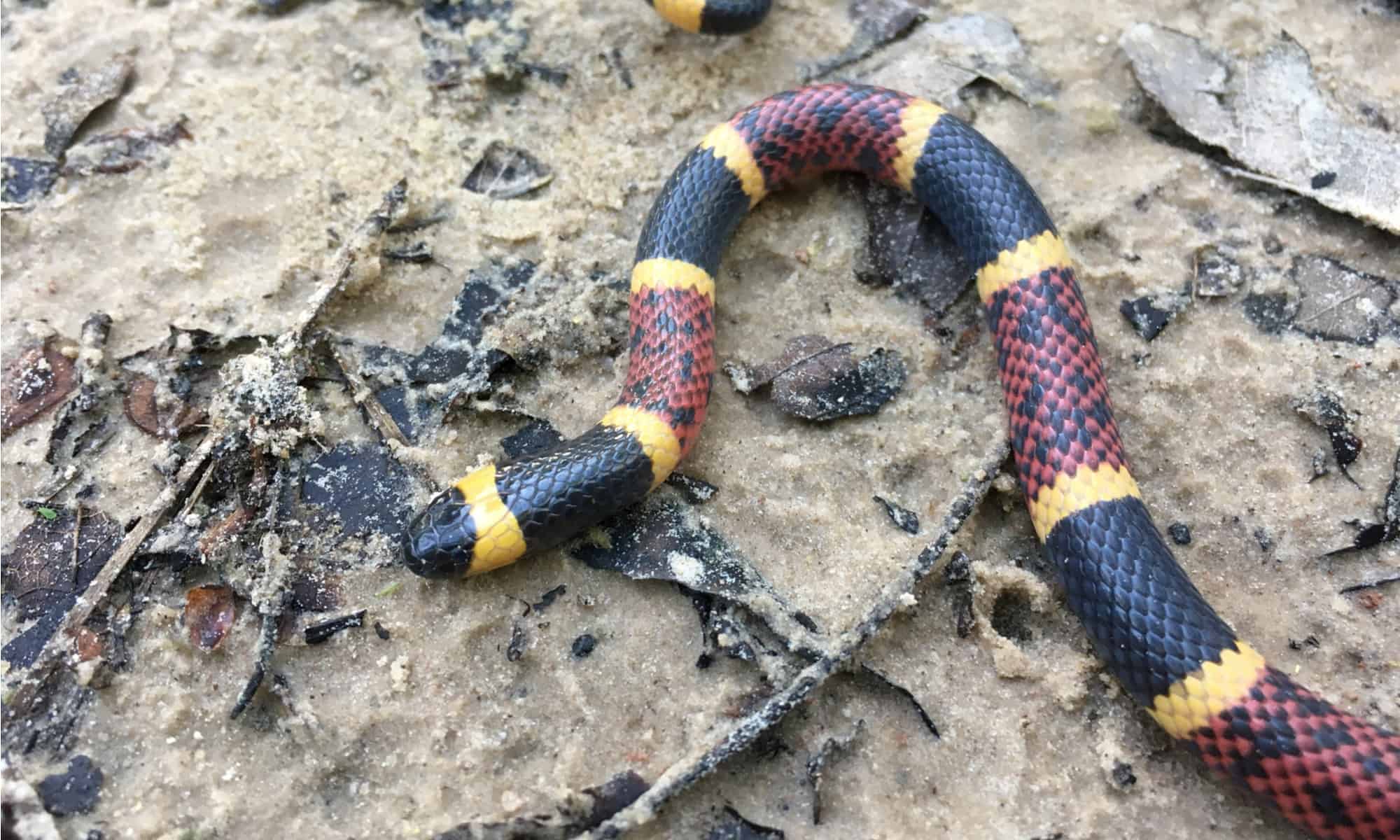
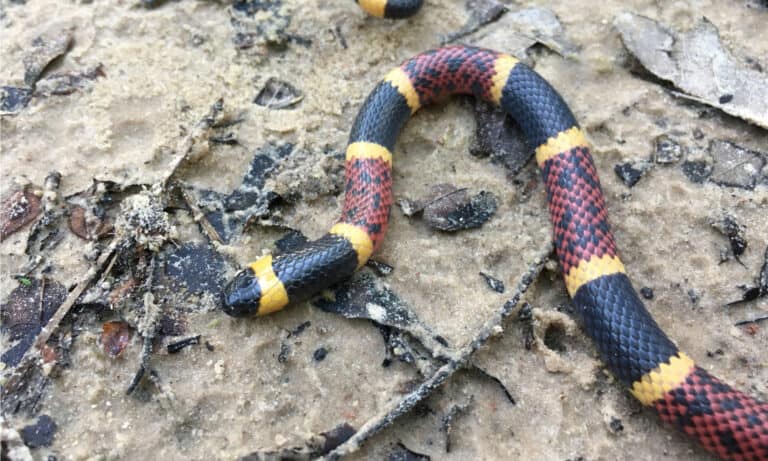
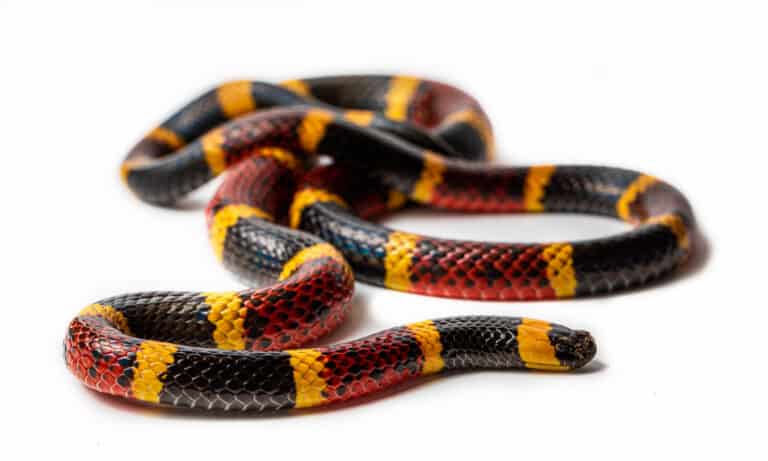
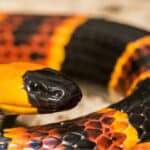
The Texas coral snake is notable for its bands of black, yellow, and red.

At a Glance

Wild Species
Also Known As coral snake, American coral snake, red-and-yellow snake, red-on-yellow coral snake, venomous coral snake
Diet Carnivore
Activity Nocturnal+
Lifespan 7 years
Status Least Concern
Did You Know?

Adults are commonly ~50-80 cm total length; a published maximum is about 122 cm (Ernst & Ernst, 2003).

Scientific Classification

A venomous elapid snake (a New World coral snake) native to parts of the southern United States and adjacent Mexico, known for its bright banded coloration and neurotoxic venom typical of coral snakes.

Kingdom
Animalia
Phylum
Chordata
Class
Reptilia
Order
Squamata
Family
Elapidae
Genus
Micrurus
Species
Micrurus tener

Distinguishing Features

  • Elapid coral snake with prominent banding (often red/yellow/black patterning, though exact arrangement and intensity can vary)
  • Relatively small, slender-bodied, secretive snake
  • Venom primarily neurotoxic (typical of coral snakes)

Physical Measurements

Length
1 ft 12 in (1 ft 4 in – 4 ft)
Top Speed
1 mph
slithering
Venomous

Appearance

Primary Colors
Secondary Colors
Skin Type Smooth, glossy, overlapping keratin scales (typically smooth rather than keeled); a proteroglyphous (fixed front-fanged) elapid with low-profile integument suited for moving under cover.
Distinctive Features
  • Adult total length commonly ~50-80 cm; reported maximum ~122 cm (Werler & Dixon, 2000; species accounts).
  • Typically 15 smooth dorsal scale rows at midbody (a common Micrurus trait; used in identification keys).
  • Head small and only slightly distinct from neck; short, blunt tail; round pupil typical of many elapids.
  • Defensive behavior often includes hiding the head, tail curling, and body coiling rather than prolonged striking; generally secretive/cryptozoic and often active at night or after rains.
  • Neurotoxic venom typical of New World coral snakes; fixed front fangs (proteroglyphous) distinguish from nonvenomous mimics.
  • Regional focus: south-central U.S. (Texas and adjacent areas) into northeastern Mexico; frequently encountered under cover (leaf litter, logs, debris) in suitable habitats.
  • Longevity: robust wild estimates are limited; captive records for Micrurus tener are reported on the order of several years (commonly cited up to ~7-10 years in husbandry reports, variable by care).

Sexual Dimorphism

Sexes are similar in coloration and banding, but females average larger body size and mass, while males typically have proportionally longer tails and longer subcaudal region (a common snake dimorphism) used during mating.

♂
  • Proportionally longer tail and subcaudal region; hemipenal bulges may be evident near tail base.
  • Often slightly more slender-bodied at similar total lengths.
♀
  • On average larger/heavier-bodied (greater trunk girth) when mature.
  • Proportionally shorter tail relative to total length.

Did You Know?

Adults are commonly ~50-80 cm total length; a published maximum is about 122 cm (Ernst & Ernst, 2003).

Like other New World coral snakes (genus Micrurus), it has short, fixed front fangs (proteroglyphous), unlike rattlesnakes' long, hinged fangs.

Its famous warning colors are "aposematic" (advertising danger), a pattern mimicked by nonvenomous kingsnakes and milksnakes in Texas.

Diet is strongly ophiophagous: it frequently eats other small snakes, along with lizards and their eggs-typical of Micrurus ecology (Campbell & Lamar, 2004).

It is largely cryptozoic (hidden-living): most encounters are under leaf litter, logs, or after heavy rains and warm nights.

It is oviparous; females lay a small clutch of eggs (commonly reported around 3-9 for M. tener in regional accounts; see Campbell & Lamar, 2004; Ernst & Ernst, 2003).

Unique Adaptations

  • Proteroglyphous fangs: short, fixed front fangs suited to holding and "chewing" venom into prey (a defining Elapidae trait).
  • Neurotoxic venom suite: Micrurus venoms are dominated by neurotoxins (notably three-finger toxins and/or phospholipase A2 components depending on population), producing neuromuscular paralysis risk (reviewed in Campbell & Lamar, 2004; broader toxin biology literature).
  • Aposematic ring pattern: high-contrast red/yellow/black banding functions as predator deterrence; multiple harmless snakes in Texas evolved similar banding (Batesian mimicry) which amplifies the warning signal at the community level.
  • Fossorial/cryptozoic body plan: smooth, glossy scales and a slender cylindrical body aid movement through litter and loose soil.
  • Ophiophagy-related morphology/behavior: a narrow head and precise prey-holding behavior help subdue other snakes in tight spaces-common across coral snakes.

Interesting Behaviors

  • Cryptozoic movement: spends much of its time under surface cover (leaf litter, rotting logs, debris) and may surface on warm, humid nights-especially after rains.
  • Defensive "head-hiding": when disturbed, it may tuck the head under body coils and present the tail, sometimes writhing the tail as a decoy (a behavior reported across Micrurus spp.; Campbell & Lamar, 2004).
  • Low tendency to strike: many coral snakes rely on concealment and warning coloration; bites often occur during handling or accidental contact rather than active pursuit of humans (general Micrurus natural history; Campbell & Lamar, 2004).
  • Specialized prey handling: uses a firm chewing grip to work venom into small, elongate prey (not the rapid stab-and-release typical of many vipers).
  • Seasonal surface activity: sightings in Texas are often reported in warmer months and during periods of elevated humidity, consistent with a secretive, cover-dependent lifestyle (regional field observations summarized in state guides).

Cultural Significance

Texas coral snake (Micrurus tener) is central to snake-safety lessons in Texas and the southern U.S. Its bands inspired the rhyme "red on yellow..." and shape how people treat mimics like scarlet kingsnakes and milksnakes. In Mexico and the Southwest it has Spanish names meaning "little coral".

Myths & Legends

Southern U.S. folk rhyme: "Red on yellow, kill a fellow; red on black, friend of Jack," a traditional saying repeated in Texas and neighboring states to recall (imperfectly) which banded snakes might be dangerous.

Frontier campfire stories in parts of Texas called any red-banded snake a "coral," teaching people to avoid banded snakes and making the Texas coral snake (Micrurus tener) a sign of "pretty but dangerous."

Spanish-derived local naming: in parts of northern Mexico and the United States-Mexico border region, coral snakes may be referred to by a Spanish common name that literally means "little coral," i.e., "little coral snake."

Naturalist storytelling: early regional accounts often emphasized the coral snake's secretive habits and "gentle" demeanor unless handled, reinforcing a persistent narrative of a hidden, enigmatic snake that few people see but many people fear.

Conservation Status

LC Least Concern

Widespread and abundant in the wild.

Population Unknown

Life Cycle

Birth 6 hatchlings
Lifespan 7 years

Lifespan

In the Wild
3–12 years
In Captivity
5–20 years

Reproduction

Mating System Promiscuity
Social Structure Solitary
Breeding Pattern Transient
Fertilization Internal Fertilization
Birth Type Internal_fertilization

Texas coral snakes are solitary and come together briefly to mate during the breeding season. Males likely actively search for females and may mate with multiple partners; females lay eggs and provide no parental care after oviposition.

Behavior & Ecology

Social Solitary Group: 1
Activity Nocturnal, Crepuscular, Cathemeral
Diet Carnivore Small snakes (ophiophagy), particularly slender, fossorial snakes (reported as the most frequent prey category in multiple diet summaries; e.g., Werler & Dixon, 2000; Ernst & Ernst, 2012).
Seasonal Hibernates

Temperament

Secretive, fossorial/cryptozoic; spends much time underground or beneath cover (Werler & Dixon 2000).
Generally non-aggressive; defensive strategy favors avoidance over biting when disturbed (Campbell & Lamar 2004).
Defensive displays may include head-hiding, tail presentation, body curling, and erratic writhing (Werler & Dixon 2000).
Surface activity often increases after rains and during warm, humid nights; seasonal/thermal shifts can produce daytime activity.
Across the species, behavior is primarily solitary and refuge-oriented; activity timing varies with temperature, rainfall, and soil moisture across its range.

Communication

hissing Rare/low intensity when handled or closely threatened
Chemical communication via pheromones and skin/lipid trails detected by tongue-flicking Mate-searching
Tactile cues during courtship Body alignment and contact
Visual signaling via aposematic banding that functions as a defensive warning pattern

Habitat

Biomes:
Temperate Forest Temperate Grassland Desert Hot
Terrain:
Plains Hilly Plateau Valley Riverine Rocky Sandy +1
Elevation: Up to 5577 ft 5 in

Ecological Role

Venomous mesopredator specializing on small reptiles (especially snakes), contributing to regulation of fossorial snake and small lizard populations in southern U.S.-northeastern Mexico ecosystems; also serves as prey for coral-snake-resistant predators (e.g., some kingsnakes) and larger vertebrate predators.

Population control of small fossorial snakes and lizards via reptile-specialist predation Energy transfer from cryptic, subterranean/leaf-litter prey communities to higher trophic levels Provides selective pressure on sympatric predators and potential model systems for studying venom evolution and predator resistance (documented broadly in coral-snake predator-prey systems)

Diet Details

Main Prey:
Small snakes Lizards Small amphibians

Human Interaction

Domestication Status

Wild

The Texas coral snake (Micrurus tener) is fully wild and has no domestication or breeding history. It hides under leaves and loose soil. Human contacts are usually accidental—surprise encounters, roadkill, or yard disturbance. It is sometimes collected for research or museums and occasionally appears in illegal venom trade; people often avoid or kill it out of fear.

Danger Level

High
  • Medically significant neurotoxic envenomation (elapid-type venom), potentially causing progressive cranial nerve dysfunction, weakness, and respiratory failure without timely supportive care.
  • Bites are uncommon because the species is secretive, but risk increases markedly when handled (intentional capture, attempted killing, or improper "ID by touch").
  • Delayed onset of serious symptoms is possible in coral snake envenomation; observation and access to advanced medical care are important even when early symptoms seem mild.
  • High occupational hazard for untrained keepers due to required close-contact husbandry and the need for specialized tools/protocols (secure caging, bite-response planning).

As a Pet

Not Suitable as Pet

Legality: Texas coral snake (Micrurus tener): Possession is usually regulated. No single statewide ban, but many cities/counties restrict or ban keeping venomous snakes. Check state, local laws, permits, and insurance.

Care Level: Expert Only

Purchase Cost: $200 - $1,200
Lifetime Cost: $3,000 - $20,000

Economic Value

Uses:
Biomedical/venom research Public education (zoos, nature centers) Antivenom/clinical toxicology relevance Ecosystem services (predation on small reptiles/snakes) Negative economic impact (medical care for bites, enforcement costs for illegal trade)
Products:
  • venom-derived research reagents (toxins for neurobiology and pharmacology studies)
  • educational programming and exhibits
  • clinical reference value for envenomation management (supports antivenom and critical-care protocols)

Relationships

Related Species 5

Eastern coral snake
Eastern coral snake Micrurus fulvius Shared Genus
Mayan coral snake Micrurus diastema Shared Genus
Tamaulipan coral snake Micrurus laticollaris Shared Genus
Arizona coral snake
Arizona coral snake Micruroides euryxanthus Shared Family
Tiger snake
Tiger snake Notechis scutatus Shared Family

Ecological Equivalents 4

Animals that fill a similar ecological role in their ecosystem

Scarlet kingsnake
Scarlet kingsnake Lampropeltis elapsoides A classic coral-snake mimic with red, yellow, and black bands. Shares leaf-litter and under-cover habitats and is often confused with Micrurus tener. It is nonvenomous, constricts prey, and eats reptiles, including snakes.
Milk snake
Milk snake Lampropeltis triangulum Many populations show banding that mimics coral snakes, use similar cover-focused microhabitats, and are nocturnal/crepuscular generalist predators. Ecological similarity is mainly via predator-avoidance (Batesian mimicry) and overlapping prey types (small reptiles).
Western ribbon snake Thamnophis proximus Micrurus tener and Thamnophis proximus are found together in parts of Texas and use similar cover and edge habitats. Both are small-to-medium snakes active during cooler periods that feed on small vertebrates, though Thamnophis proximus eats more amphibians and fish.
Black-striped snake Coniophanes imperialis Secretive, leaf-litter and ground-cover oriented snake in regions adjacent to the Mexico-Texas border; it similarly exploits concealed microhabitats and feeds on small vertebrates and invertebrates, making it an ecological counterpart in the 'cryptic ground-foraging snake' niche, though it is nonvenomous and has a different prey emphasis.

Texas coral snakes have the second most powerful venom in the world.
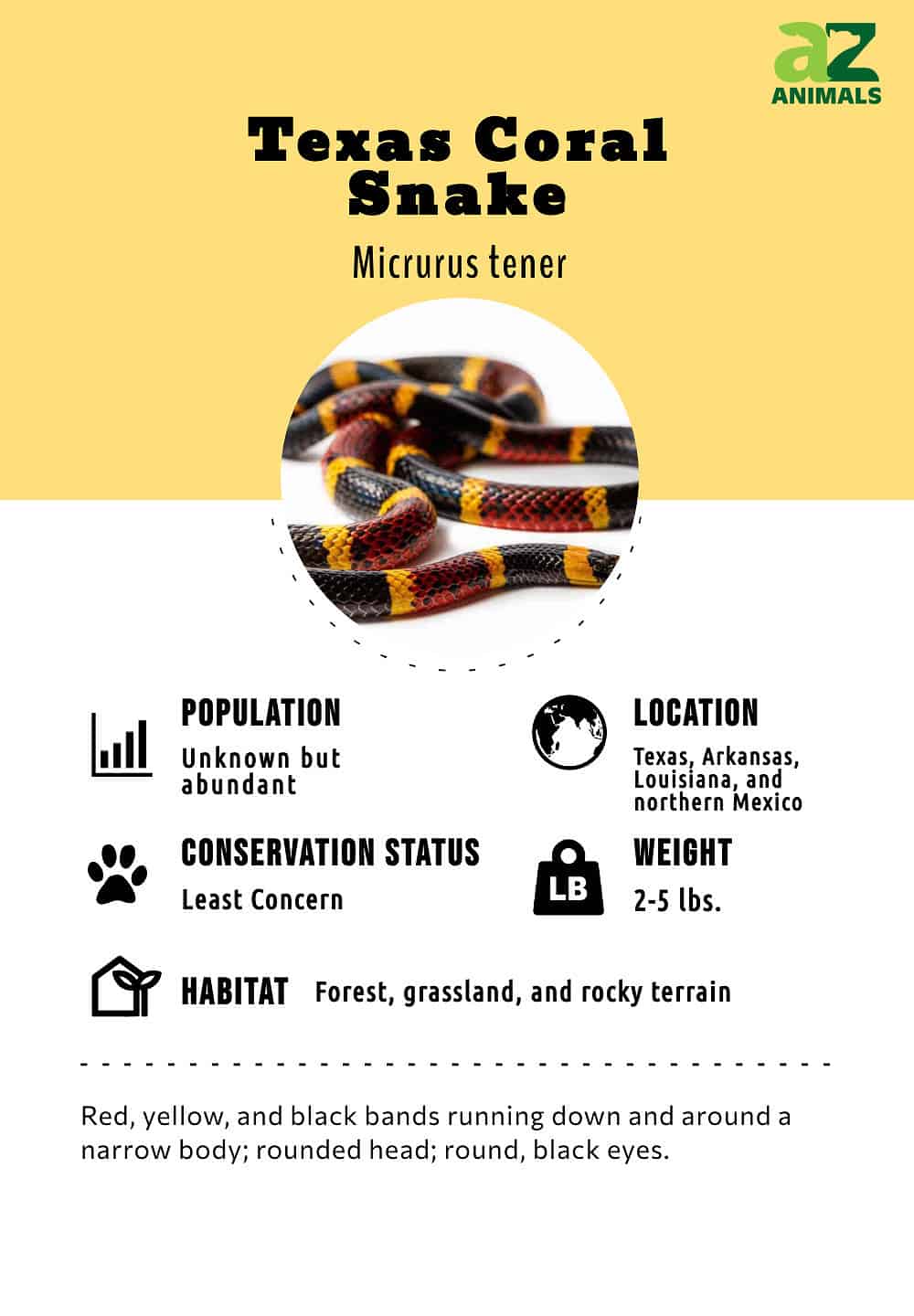
The nocturnal Texas coral snake is notable for its bands of black, yellow, and red. It has a diet consisting mostly of earth snakes and skinks. During the day, Texas coral snakes spend a lot of time underground or hiding under piles of brush. These reptiles have a toxic venom but are not aggressive.

4 Amazing Facts

  • The Texas Coral Snake sometimes passes gas as a way to deter predators.
  • Its snakelets display all of the colorful bands of adult snakes but are just seven inches long.
  • Its lifespan is 10 to 15 years.
  • Thanks to antivenom, the last death from this snake’s bite occurred in the 1960s.

Classification and Scientific Name

Micrurus tener is the scientific name of the Texas coral snake. The Latin word tener meaning soft refers to the rounded head of this snake. It’s called a coral snake because of its brightly colored scales. Coral in the ocean is known for its bright colors.

This snake is in the Elapidae family and the class Reptilia. The subspecies of this snake include:

  • Micrurus tener tamaulipensis
  • Micrurus tener microgalbineus
  • Micrurus tener maculatus
  • Micrurus tener fitizingeri

Appearance and Description
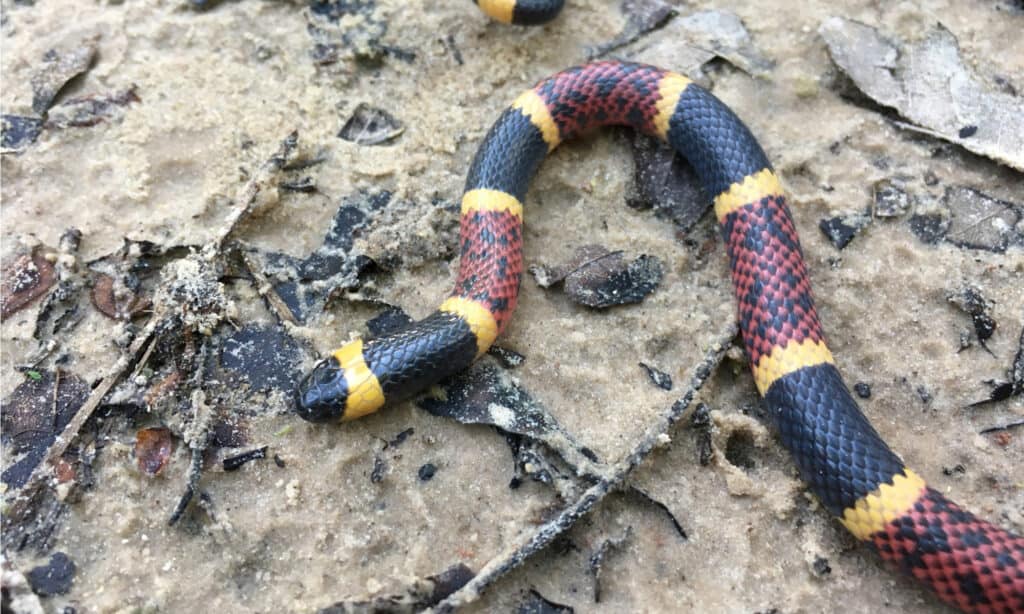
The Texas coral snake is notable for its bands of black, yellow, and red.

The Texas coral snake is notable for its bands of black, yellow, and red.

The colors and pattern of this snake are what stand out the most. Its body is covered with a series of bands. It has a wide red band, a thin yellow band, and a black band. These bands continue all the way around the snake’s body.

The Texas coral snake has a narrow body and is 24 to 48 inches long. Its head is rounded and its eyes are round and black. The fangs of this snake are short, grooved, and located at the front of its mouth on its upper jaw.

Here’s a summary of what to look for to identify a Texas coral snake:

  • Red, yellow, and black bands run down and around the body.
  • Narrow body
  • Rounded head
  • Round, black eyes

Texas Coral Snake vs Milk Snake

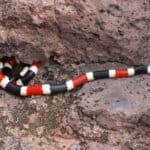
There are several snakes that mimic the appearance of the Texas coral snake. Having an appearance very similar to the venomous Texas coral snake gives a non-venomous snake a sneaky way to avoid predators! Predators know instinctively that a brightly colored snake is likely to have venom.

One of these mimics is the Central Plains milk snake. Studying the similarities and differences between these two snakes makes it a little easier to tell them apart.
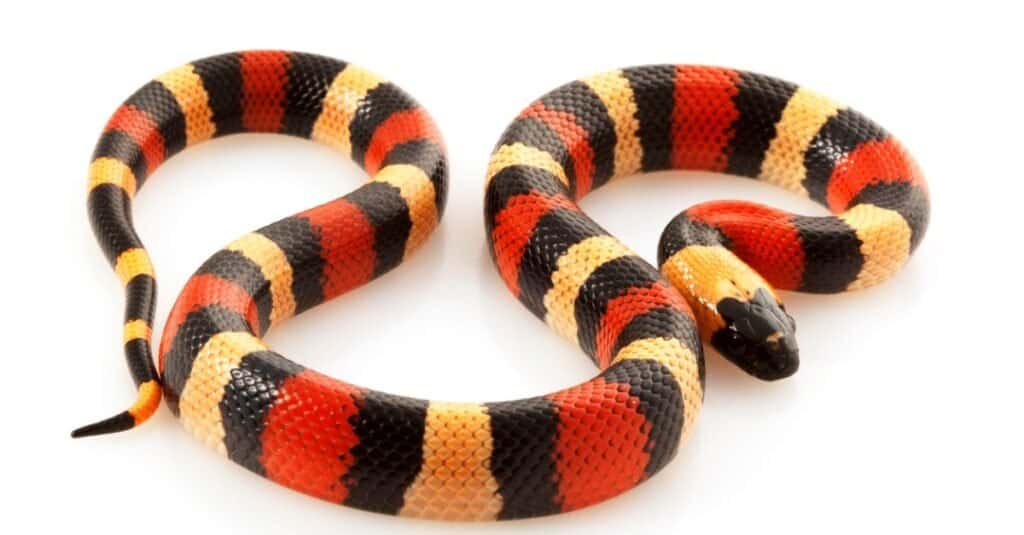
Milk snakes have a similar appearance to coral snakes and live in the same area and same habitat.

Texas coral snakes and milk snakes live in the same area and have the same habitat. At first glance, the colorful bands of the Texas coral snake and the milk snake look about the same. But there are differences.

The main difference in their appearance is that the Texas coral snake has a pattern of black, red, and yellow. Its red and yellow bands touch. Alternatively, a milk snake has yellow, black, and red bands. Its yellow and black bands touch. Remember the old rhyme? Red and yellow kill a fellow, red on black, friend of Jack. So, when yellow and red bands touch, you’re looking at a venomous Texas coral snake. However, don’t rely on the rhyme because it is not foolproof. Just take a look at a few with aberrant patterns, and you’ll see why the pattern is only one part of identification.

The bands of a Texas coral snake continue all the way around its belly while a milk snake has a belly with a white and black checkered pattern.

Another subtle difference between a Texas coral snake and a milk snake is that a Texas coral snake’s head is more rounded than its lookalike.

Behavior and Humans

Texas coral snakes are described as shy and secretive. If they encounter a person in the woods or a grassland, this snake is very likely to slither away to find a place to hide. Most bites from this snake are a result of a person trying to pick up the snake or otherwise interact with it. This snake eats mostly other snakes, particularly the earth snake, and it is cannibalistic.

Location

This North American snake makes its home in the southeastern part of the United States. They are seen in the southern part of Arkansas, in Louisiana, and, of course, in Texas. The territory of this snake extends into the northeastern and central areas of Mexico.
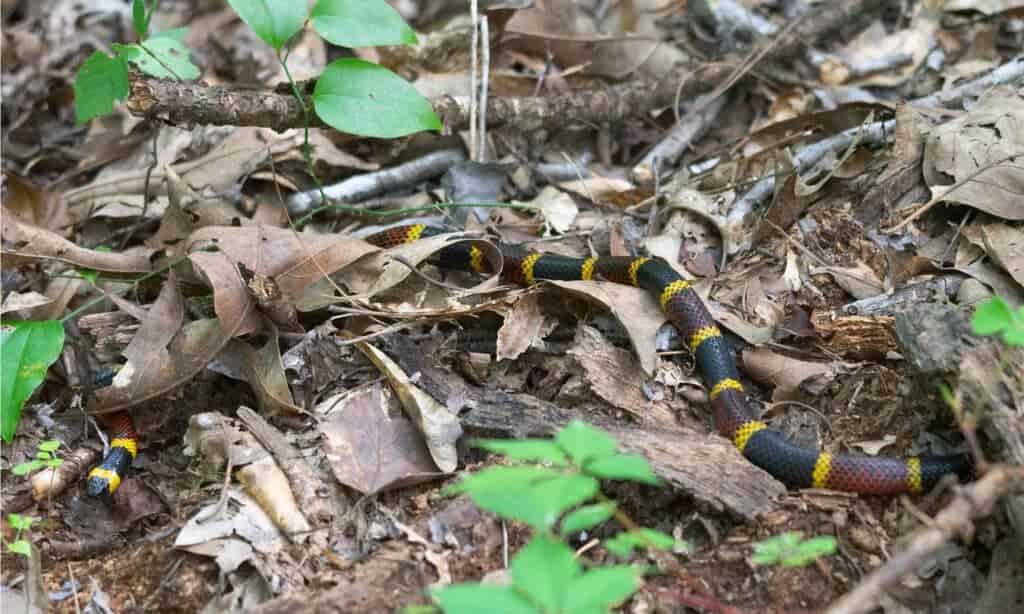
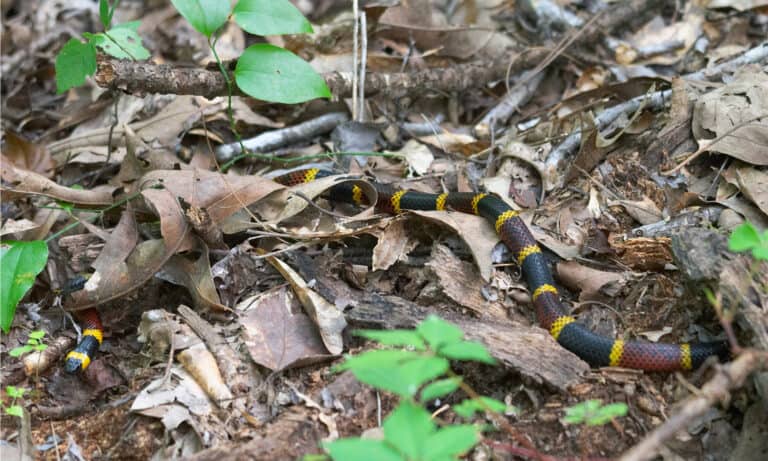
The Texas coral snake takes shelter in the daytime in burrows or beneath leafy piles of debris.

These snakes live in a wetland, grassland, savanna, or forest habitat. They take shelter in the daytime in burrows or beneath leafy piles of debris. They come out at night to look for food. Texas coral snakes are commonly seen after heavy rainstorms when the temperature exceeds 75 degrees Fahrenheit.

Reproduction

The female Texas coral snake is oviparous–it lays a clutch of eggs, usually 3-12, usually underground or in leaves or soil. They typically mate in the spring and lay them in June. Then the eggs hatch in September. Coral snake hatchlings typically measure from 6.5 inches to 9.5 inches.

Population and Conservation Status

This snake has a stable population with an estimated 100,000 plus adults. It’s listed as Least Concern by conservationists.

Danger

The Texas coral snake is venomous and can be dangerous to humans. It’s true that this snake is known for having the second most powerful venom in the world. (The black mamba takes first place in that contest.) However, the Texas coral snake is not aggressive. Plus, when this snake issues a bite to a human, it doesn’t inject a large amount of venom.

The small mouth along with the short, fixed fangs of a Texas coral snake prevent it from firmly biting into a human’s tough skin. This is why a bite from a Texas coral snake is not very painful. So, it doesn’t give a strong bite with plenty of venom in it like a rattlesnake. But any bite from this snake must always be taken seriously.

The first thing to do if someone gets a bite from this snake is to call an ambulance. Next, get the person to sit quietly in the shade and move as little as possible while waiting for help. Keep the injured area below the level of the person’s heart.

Today, there is an antivenom available to treat the bite of a Texas coral snake. In fact, since 1960 there have been no reported deaths from the bite of a Texas coral snake. But remember, receiving a bite from this snake means you should get to a hospital as soon as possible.

Similar Animals

View all 608 animals that start with T

Sources

  1. Texas Hill Country / Accessed April 28, 2022
  2. IUCN Redlist / Accessed April 28, 2022
  3. Wikipedia / Accessed April 28, 2022
  4. iNaturalist / Accessed April 28, 2022
  5. Herps of Arkansas / Accessed April 28, 2022
  6. The Orianne Society / Accessed April 28, 2022
  7. Texas Parks & Wildlife / Accessed April 28, 2022
Thank you for reading! Have some feedback for us?


Texas Coral Snake FAQs (Frequently Asked Questions)

Yes, Texas coral snakes have powerful venom.