A
Species Profile

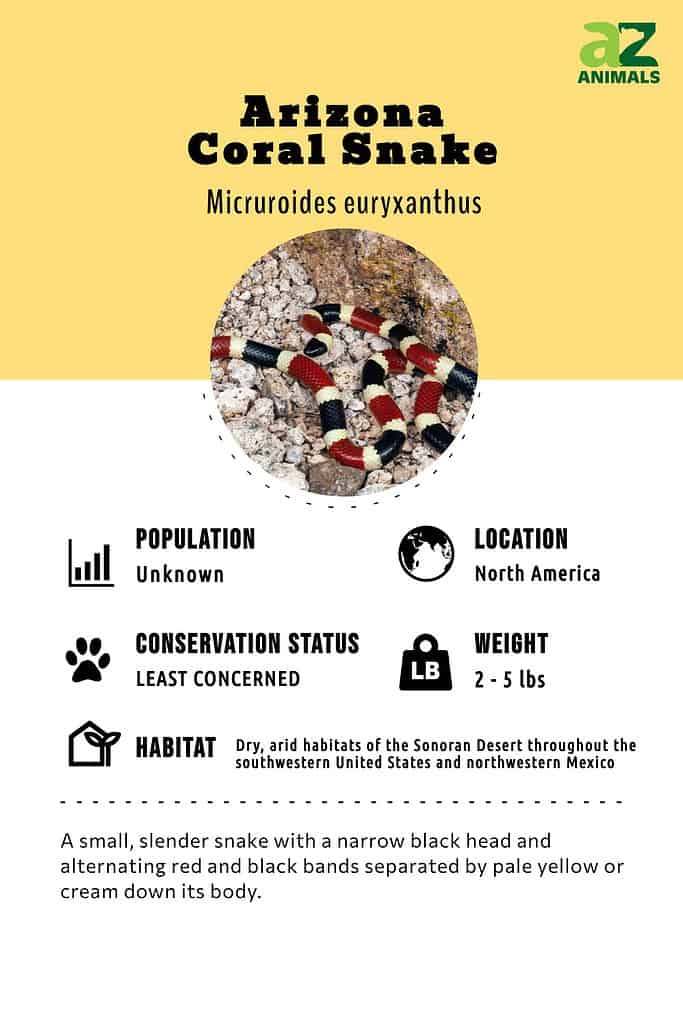
Arizona Coral Snake

Micruroides euryxanthus

Bright bands, hidden life.
jokerbethyname/Shutterstock.com

Arizona Coral Snake Distribution

Click a location to explore more animals from that region

This map shows coastal regions where Arizona Coral Snake are found.

Loading map...
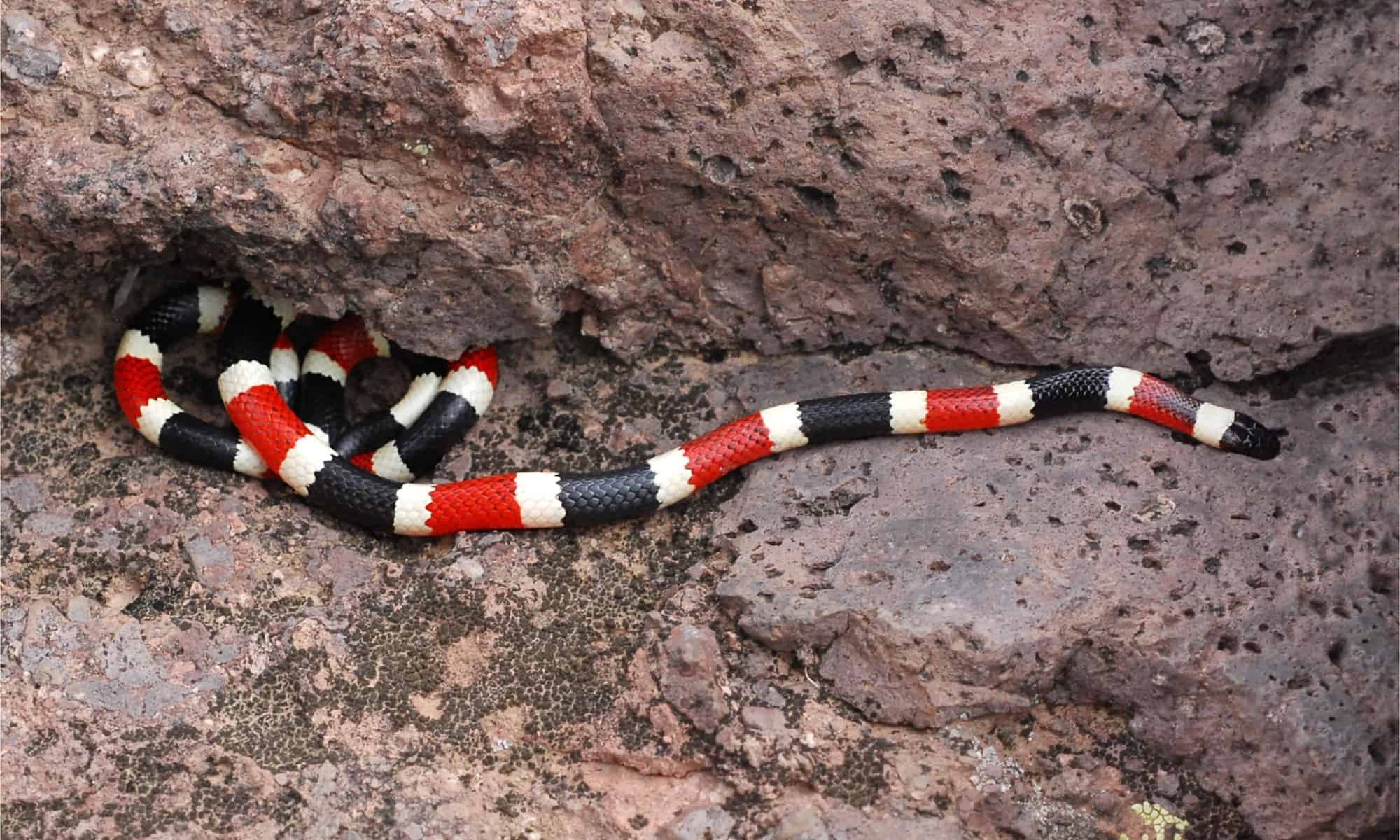
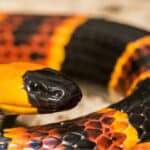
An Arizona coral snake resting on rocks

At a Glance

Wild Species
Also Known As Sonoran coral snake, Arizona coral snake
Diet Carnivore
Activity Nocturnal+
Weight 0.12 lbs
Status Least Concern
Did You Know?

It's the only native coral snake in Arizona (genus Micruroides), distinct from the many harmless "banded" mimics in the region.

Scientific Classification

A small, secretive, venomous elapid (coral snake) of the U.S. Southwest and northwestern Mexico, known for its banded red/yellow/black warning coloration and potent neurotoxic venom. It is generally non-aggressive and spends much time hidden underground or under cover.

Kingdom
Animalia
Phylum
Chordata
Class
Reptilia
Order
Squamata
Family
Elapidae
Genus
Micruroides
Species
euryxanthus

Distinguishing Features

  • Banded aposematic coloration (typically red, yellow/cream, and black rings; pattern can vary)
  • Slender body with a relatively small, blunt head and smooth, glossy scales
  • Fixed front fangs typical of elapids; venom primarily neurotoxic
  • Secretive, nocturnal/crepuscular tendencies; often remains concealed

Physical Measurements

Length
1 ft 6 in (12 in – 2 ft 6 in)
Weight
0 lbs (0 lbs – 0 lbs)
Tail Length
2 in (1 in – 4 in)
Venomous

Appearance

Primary Colors
Secondary Colors
Skin Type Dry, smooth, shiny overlapping scales like other elapids. Body is round, with a small head that is not much different from the neck, and a short, blunt tail tip, Micruroides euryxanthus.
Distinctive Features
  • Arizona (Sonoran) Coral Snake (Micruroides euryxanthus) adults usually are about 33–66 cm long; some reports list just over 1 m. Use local guides for the most cautious maximum length.
  • Small, secretive, fossorial-to-semi-fossorial build: frequently encountered under rocks, within leaf litter, in rodent burrows, under woody debris, and in wash/arroyo margins-especially following warm-season rains in Arizona/Sonoran-region habitats (desert scrub, thornscrub, rocky bajadas).
  • Elapid traits: short, fixed front fangs (proteroglyphous) and predominantly neurotoxic venom; despite potent venom, the species is typically non-aggressive and bites are uncommon because the snake is reclusive and often stays under cover.
  • Head often appears smoothly rounded with a dark (black) cap; eyes are relatively small with a round pupil; neck not sharply distinct from the body compared with many colubrids.
  • Arizona (Sonoran) Coral Snake, Micruroides euryxanthus, has a smooth glossy, almost cylindrical body, small indistinct head often black, and very crisp even bands. Don't rely only on the 'red-on-yellow' rhyme.
  • Found mainly in southern and central Arizona's Sonoran Desert, the Arizona (Sonoran) coral snake (Micruroides euryxanthus) also reaches northwestern Mexico (Sonora). Color and how crisp the bands are vary by region.

Sexual Dimorphism

Sexual dimorphism is subtle and primarily proportional rather than color-based: males and females are similarly patterned; differences are most often reported in relative tail length and (in some series) average body size. Precise direction/magnitude can vary by sample and locality, and many sources treat dimorphism as slight.

  • Often relatively longer tail length (typical snake sexual dimorphism linked to hemipenes), without consistent, sex-specific color differences reported.
  • May appear slightly more slender in some populations/series, though this is not a reliable field character on its own.
  • Often reported as slightly larger-bodied on average in some references/series (when gravid, noticeably heavier in the posterior body), with no consistent sex-specific coloration.
  • Tail proportion often relatively shorter than males (subtle; requires measurement to confirm).

Did You Know?

It's the only native coral snake in Arizona (genus Micruroides), distinct from the many harmless "banded" mimics in the region.

Adults are typically ~30-60 cm total length; the largest published records are about 70-80+ cm (various regional field summaries; maximum varies by source).

Like all elapids, it has fixed front fangs (proteroglyphous) and primarily neurotoxic venom (postsynaptic neurotoxins typical of coral snakes).

Despite its bright warning colors, it is strongly secretive-most encounters happen at night or after warm rains when it comes to the surface.

Diet is heavily reptile-focused: it commonly eats small lizards and other snakes (a trait shared across many coral snakes).

Bites to humans are uncommon; the snake is generally non-aggressive and often tries to escape or hide rather than confront.

Arizona's common mimics (e.g., kingsnakes, long-nosed snakes, shovel-nosed snakes) can resemble it; reliable ID uses multiple traits (band order, head pattern, snout color, and overall build), not a single rhyme.

Unique Adaptations

  • Aposematic tricolor banding (red/yellow/black) that signals danger to visual predators-an adaptation mirrored by multiple nonvenomous mimics in the Southwest.
  • Elapid venom system: short, fixed anterior fangs plus potent neurotoxic venom suited to quickly immobilize small, squirming reptile prey.
  • Smooth, glossy scales and a relatively slender body that reduce friction for moving through tight spaces underground or under dense surface cover.
  • Secretive microhabitat use (burrows/cover objects) that buffers extreme Sonoran Desert temperatures and dryness.
  • Small head with limited gape compared with many colubrids-paired with venom specialization for efficient handling of narrow-bodied prey (snakes/lizards).

Interesting Behaviors

  • Fossorial/cryptozoic lifestyle: spends much of its time under rocks, wood, leaf litter, or in rodent burrows; often active below the surface.
  • Warm-season, nocturnal/crepuscular activity: most frequently observed on warm nights, especially during summer monsoon conditions in the Sonoran region.
  • Defensive "tucking" displays: may hide its head under body coils and present the tail end, sometimes wiggling it as a decoy.
  • Reluctant biter: typically attempts to flee; if restrained, may deliver small "chewing" bites that help fixed fangs work venom into tissue (a common coral-snake trait).
  • Specialized predation: actively searches under cover for elongate prey (small snakes/lizards), subduing them with neurotoxic venom.

Cultural Significance

Arizona (Sonoran) Coral Snake (Micruroides euryxanthus) is a rarely seen venomous snake used in safety teaching to identify banded snakes. It shows warning colors and mimicry (kingsnakes), and elapid traits: fixed front fangs and nerve‑affecting venom.

Myths & Legends

Southwestern folk tradition popularized warning couplets about banded snakes (various "red/yellow/black" rhymes). These sayings became part of regional outdoor culture even though educators emphasize using multiple identification traits rather than a single rhyme.

In Hopi tradition, snakes are powerful messengers linked to rain and new life. The Hopi Snake Dance shows respect for snakes' spiritual role; it is not about coral snakes but shapes regional snake symbols.

In many Indigenous traditions of the Greater Southwest and northern Mexico, snakes are powerful beings tied to water, earth, and seasonal change; brightly patterned snakes are seen as rain or earth serpents, not modern species.

The name "coral snake" itself is a long-standing cultural analogy: the banding was likened to red coral beads in earlier natural history writing, helping the animal become an instantly recognized icon in North American herpetology.

Conservation Status

LC Least Concern

Widespread and abundant in the wild.

Population Unknown

Life Cycle

Birth 4 hatchlings

Lifespan

In the Wild
0 years
In Captivity
0–12 years

Reproduction

Mating System Data Deficient
Social Structure Solitary
Breeding Pattern Transient
Fertilization Internal Fertilization
Birth Type Internal_fertilization

Direct field data on Arizona (Sonoran) coral snake (Micruroides euryxanthus) mating are lacking, so the mating system is data deficient. They likely mate by copulation in brief, seasonal encounters, are solitary, may mate multiple times, and provide no care beyond egg laying.

Behavior & Ecology

Social Solitary Group: 1
Activity Nocturnal, Crepuscular, Cathemeral
Diet Carnivore Blindsnakes / threadsnakes (Leptotyphlopidae; Rena spp. are frequently cited prey).
Seasonal Hibernates

Temperament

Secretive and generally non-aggressive toward humans; typically attempts to flee or remain hidden rather than confront.
Defensive rather than offensive: may perform warning/avoidance behaviors (e.g., conceal head, elevate or curl tail, body/neck contortions) when handled or threatened; bites are uncommon without contact/restraint.
Temperature- and season-dependent surface activity: most above-ground activity tends to occur under favorable moisture/temperature conditions (often associated with warm-season rains), otherwise remains concealed.

Communication

Hissing Infrequent/low-intensity compared with many colubrids; primarily during defensive restraint
Chemical signaling: pheromonal cues for mate location and courtship Trail-following and close-range chemosensory assessment via tongue-flicking/Jacobson's organ), consistent with snake reproductive behavior and reported for coral snakes broadly (Campbell & Lamar 2004
Aposematic visual signaling: conspicuous red/yellow/black banding functions as a warning signal to predators Well established for coral snake mimicry systems and interpreted as anti-predator communication
Defensive posturing: head-hiding and tail-display/curling Tail may be presented as a decoy while the head is tucked), plus body thrashing/contortions to deter predators and reduce chance of head injury (reported for coral snakes in natural-history syntheses
Chemical defense: cloacal discharge/musk when handled Common in snakes; noted in coral snake accounts as a handling-stress response
Tactile communication during mating: alignment and cloacal contact during copulation; male tactile stimulation during courtship Typical snake courtship modality, applied to the species where direct quantification is limited

Habitat

Biomes:
Desert Hot Temperate Grassland Temperate Forest Tropical Rainforest Tropical Dry Forest Savanna Marine Wetland +2
Terrain:
Plains Valley Hilly Mountainous Rocky Sandy
Elevation: Up to 6000 ft 8 in

Ecological Role

Specialized mesopredator of small, secretive desert squamates (notably blindsnakes and small lizards), linking subterranean/under-cover microhabitats to the broader food web.

Population regulation of small fossorial reptiles (especially blindsnakes and other diminutive snakes) Energy transfer from subterranean prey communities to higher trophic levels (it is itself preyed upon by snake-eating predators such as kingsnakes, raptors, and mesocarnivores) Indicator contribution: presence can reflect intact desert microhabitat structure (cover objects/soil condition) supporting fossorial prey

Diet Details

Main Prey:
Blindsnake Small fossorial/secretive snakes Small lizards Amphisbaenians

Human Interaction

Domestication Status

Wild

Micruroides euryxanthus (Arizona/Sonoran coral snake) has no history of domestication. Human contact is mostly accidental—during hiking, yard work, or when uncovered under rocks, wood, at night, or after rain. Scientific collecting and rare captive care happen only by permitted institutions or experienced venomous keepers. The species is secretive and fossorial.

Danger Level

High
  • Medically significant envenomation risk: coral snake venoms are predominantly neurotoxic (postsynaptic and/or presynaptic toxins depending on species), with potential for progressive cranial-nerve signs and respiratory compromise in severe cases.
  • Bites are uncommon because the species is secretive and generally non-aggressive, but risk increases with intentional handling, capture attempts, or improper relocation.
  • Delayed-onset or initially mild symptoms can occur with elapid bites; medical observation is recommended after any suspected coral snake bite.
  • Handling risk is elevated because the snake is small/slender and can be underestimated; safe capture requires specialized tools, training, and secure containment protocols.

As a Pet

Not Suitable as Pet

Legality: Laws vary. Arizona (Sonoran) Coral Snake (Micruroides euryxanthus) is a native, venomous elapid often restricted—permits, limits on wild collection, transport, and sale. Many cities ban or tightly control keeping.

Care Level: Expert Only

Purchase Cost: Up to $800
Lifetime Cost: $3,000 - $15,000

Economic Value

Uses:
Medical/toxinology research value (neurotoxic venom; ion-channel and receptor pharmacology) Public education and conservation outreach (zoos, nature centers) Biodiversity/ecosystem value (predator of small reptiles/amphibians; part of desert food webs) Human-wildlife services (snake removal/relocation by licensed professionals)
Products:
  • venom used in laboratory research (handled by qualified facilities; contributes to antivenom/toxinology knowledge)
  • educational programming/exhibits (institutional, permitted displays)
  • professional snake-removal services (service economy rather than a biological product)

Relationships

Predators 5

Ecological Equivalents 5

Animals that fill a similar ecological role in their ecosystem

California kingsnake
California kingsnake Lampropeltis californiae The Arizona (Sonoran) coral snake (Micruroides euryxanthus) inhabits U.S. Southwest Sonoran desert scrub and rocky areas. It has coral-snake-like banding, hides in crevices, is shy in heat, and primarily eats other reptiles.
Sonoran shovel-nosed snake Chionactis palarostris Shares a niche in arid to sub‑arid Sonoran habitats: secretive and mostly burrowing or sand‑swimming, often found under cover or after rains. Nonvenomous, and although it has a different diet, it is similar in its subterranean/under‑cover habitat use and nocturnal or crepuscular activity.
Western black-headed snake Tantilla planiceps Small, secretive squamate predator that uses similar cover objects—rocks and woody debris—and occupies arid/semidesert edge habitats. Specializes on small herpetofauna and invertebrate prey in protected microhabitats, and is often encountered during cool, humid conditions (e.g., after rain or at night).
Desert nightsnake Hypsiglena chlorophaea The Arizona (Sonoran) Coral Snake (Micruroides euryxanthus) is a small desert, nocturnal snake that uses rocky washes, scrub, and rodent burrows and eats small lizards and snakes. It is rear-fanged and less dangerous, but occupies a similar nocturnal predator niche.
Southwestern threadsnake Rena dissecta Uses the same underground cover (burrows, loose soil, leaf litter) and often shares shelters with the Sonoran coral snake (Micruroides euryxanthus). It is eaten by small burrowing predators, as is the coral snake.

The Arizona coral snake is among the most venomous snakes in North America.

The Arizona coral snake, also known as the Sonoran coral snake or the Western coral snake, is highly dangerous to people. It should never be approached in the wild. Nevertheless, while their venom is highly toxic, the snake can’t always inject the full force of the venom into the human bloodstream. They are generally responsible for fewer deaths than rattlesnakes.
4 Amazing Arizona Coral Snake Facts!

  • The Arizona coral snake comes out at night to hunt during the summer, whereas it’s more active during morning and evening hours in the spring and fall. If the temperature drops far enough, it may hibernate (brumate) during the winter.
  • The reproductive season of the Arizona coral snake takes place during the late spring and sometimes even the fall. After mating, females lay two or three eggs in the summer, which takes about 10 weeks to hatch. The juveniles measure about 7 or 8 inches in size after emerging from the eggs. The lifespan is thought to be around 10 years. However, the lifespan may be cut short by predators like birds of prey.
  • The Arizona coral snake has an organ located on the roof of the mouth that senses scent molecules. To smell, it gathers odors on the forked tongue and presses the molecules against the two holes in the upper mouth.
  • A few species of harmless snakes in the same location attempt to mimic coral snakes to fool predators, but they don’t have the same patterns and colorations.

Where to Find Arizona Coral Snakes

The Arizona coral snake is native to the Sonora Desert region of northwestern Mexico and the southwestern United States, particularly Arizona. It prefers to inhabit the remote arid plains, hills, and mountain slopes far from any human habitats. The snake spends most of its time hiding under rocks and logs but may emerge at sundown or during rainy or overcast weather.
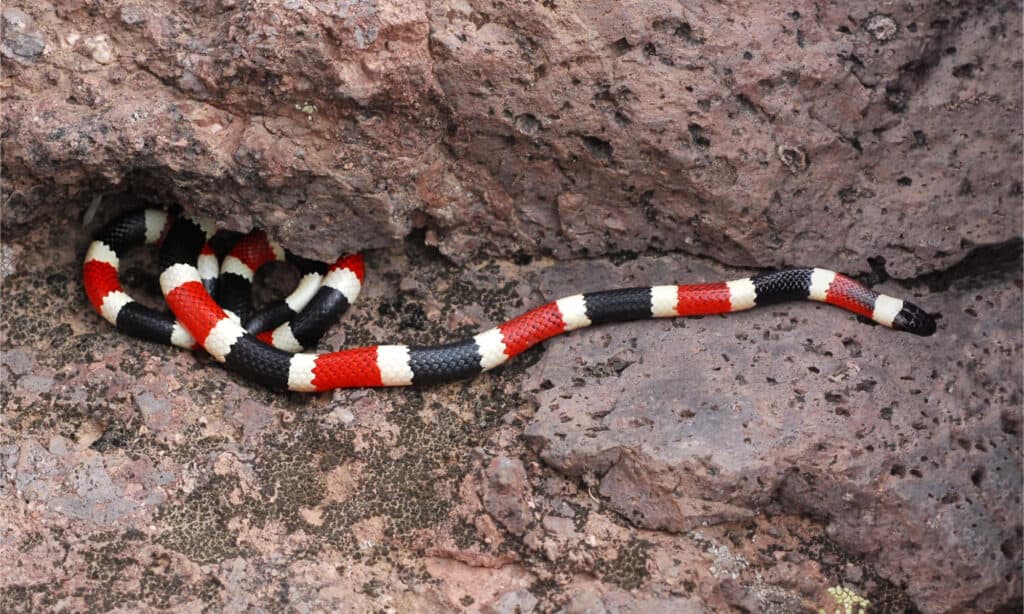
An Arizona coral snake resting on rocks

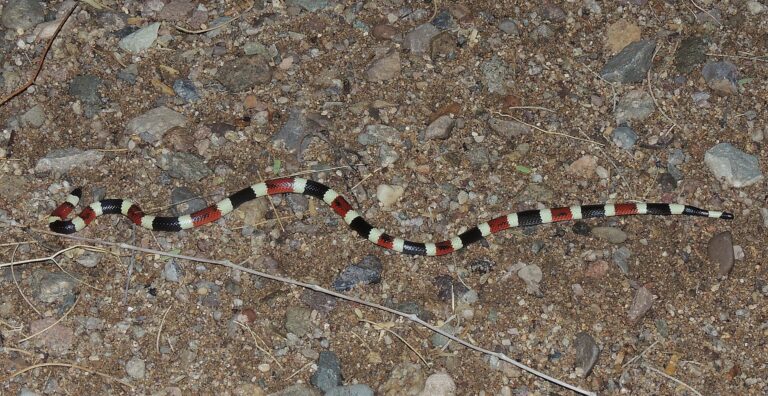
Arizona coral snakes, also known as Western coral snakes, have short, thin bodies measuring no more than 24 inches long

Scientific Name and Species

The scientific name of the Arizona coral snake is Micruroides euryxanthus. Micruroides is derived from the Greek term Micrurus, which means small tail. Euryxanthus, on the other hand, is derived from the two Greek words eury, which means wide or broad, and xanthos, which means yellow. This probably refers to the yellow bands along the snake’s entire body. The western coral snake is in the same family as cobras, mambas, and sea kraits. It is the only living member of its genus and the only species.
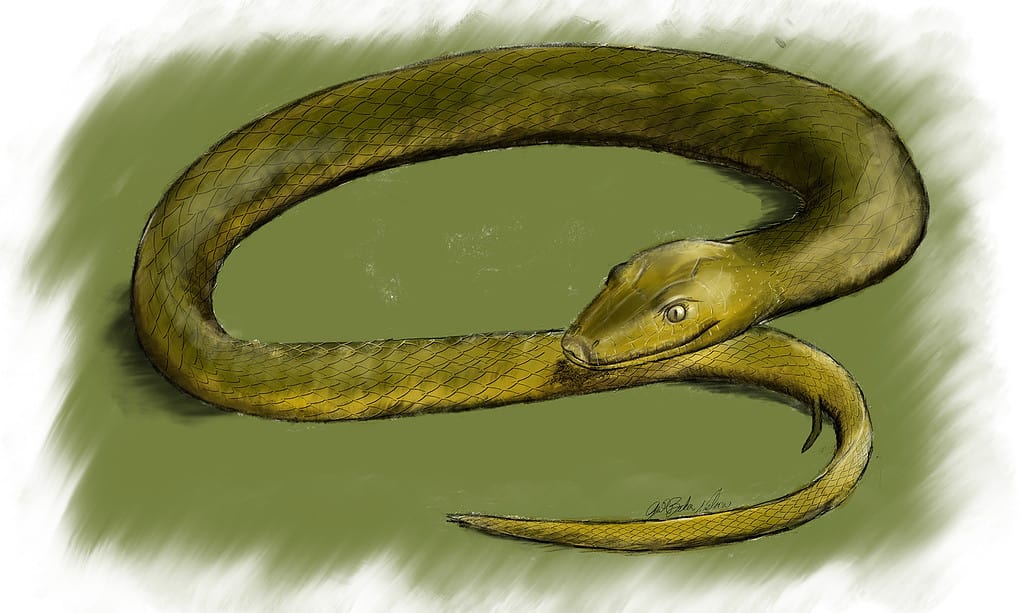
Haasiophis terrasanctus
Haasiophis terrasanctus, found in Israel, is one of the first “true” snakes and still has hind legs.

Evolution

Fossil records show that snakes first appeared during the Cretaceous period – although they often retained their hind limbs. The earliest true snake fossils come from the marine simoliophiids, the first being Hassiophis terasanctus, dated between 112 – 94 million years ago.

Scientists believe that snakes descended from lizards. Pythons and boas, the most primitive snakes, have vestigial hind limbs and some have remnants of a pelvic girdle appearing as horny projections.

Many modern snakes originated during the Paleocene alongside the radiation of mammals that occurred after the extinction of non-avian dinosaurs. The expansion of grasslands in North America led to a major radiation of snakes. During the Miocene, the number of snake species increased with the first vipers and elapids and the diversification of Colubridae.

Population & Conservation Status

According to the IUCN Red List, the Arizona coral snake is a species of the least concern. Population numbers are unknown, but they appear to be stable and widespread throughout their natural range. There are no serious threats to this species in the wild, but habitat loss may be a minor problem in some locations.

Appearance & Description
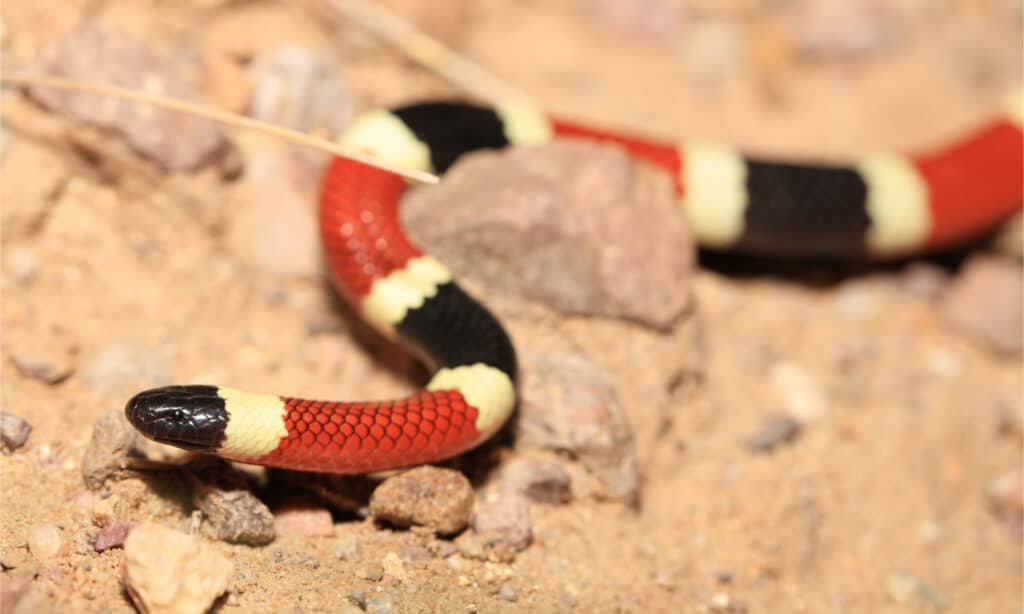
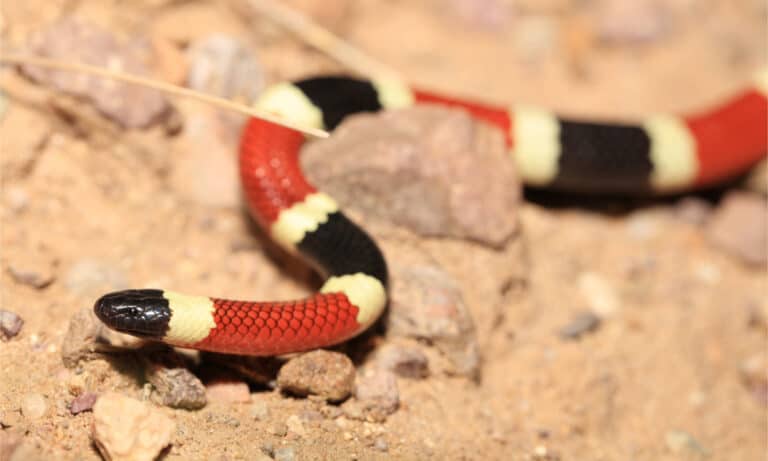
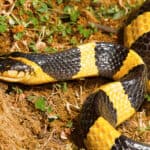
A western coral snake slithering over sandy soil

Arizona coral snakes are small, slender snakes that rarely grow longer than 24 inches long.

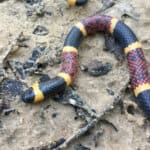
The Arizona coral snake does not look very intimidating at first. This small species measures about 13 to 18 inches long, up to a maximum of around 24 inches. The diameter of its body is also quite thin, about the same size as a pencil. Nevertheless, the unusual color scheme is a warning of its toxicity. Its entire body is covered in alternating red and black bands, each one separated by additional light yellow bands that are sometimes so pale that they look cream-colored or off-white. These bands, which are common to the coral snakes, should tell you to stay away. Another important feature is the very narrow black head, which measures about the same diameter as the body. It also has small fangs that, unlike rattlesnakes, cannot be folded back into the upper mouth. Males and females are very difficult to tell apart without a thorough examination.

Here is how to identify the Arizona coral snake:

  • Short, thin body measuring no more than 24 inches in size
  • Small head
  • Smooth scales
  • Alternating bands of black and red bands separated by yellow bands

How Dangerous Are They?
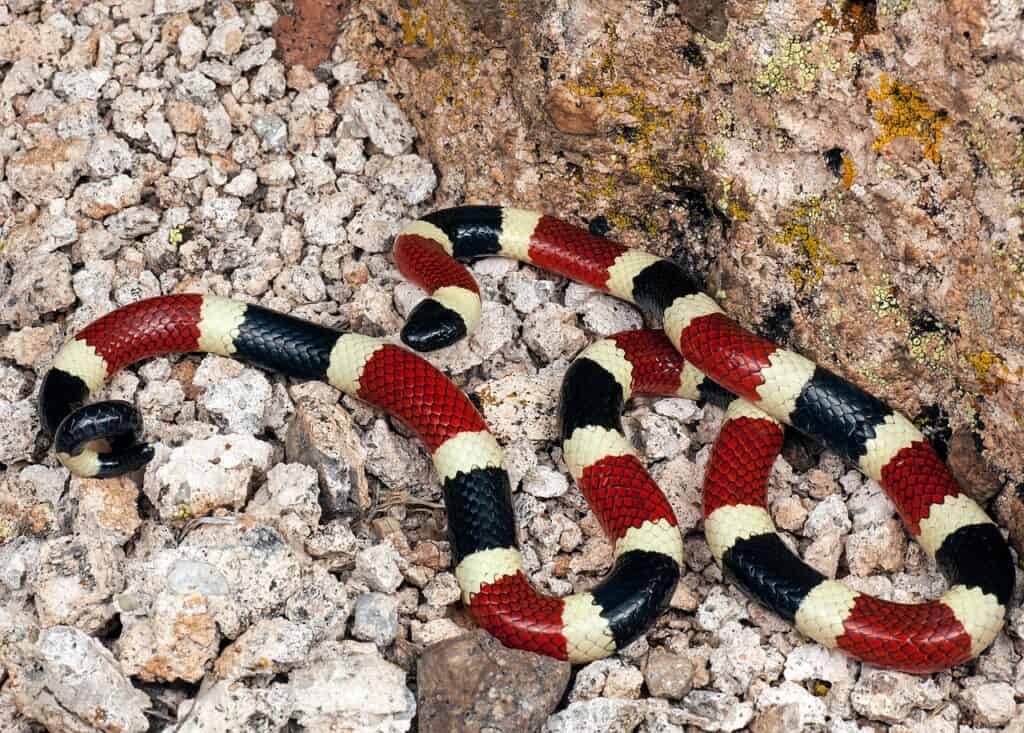
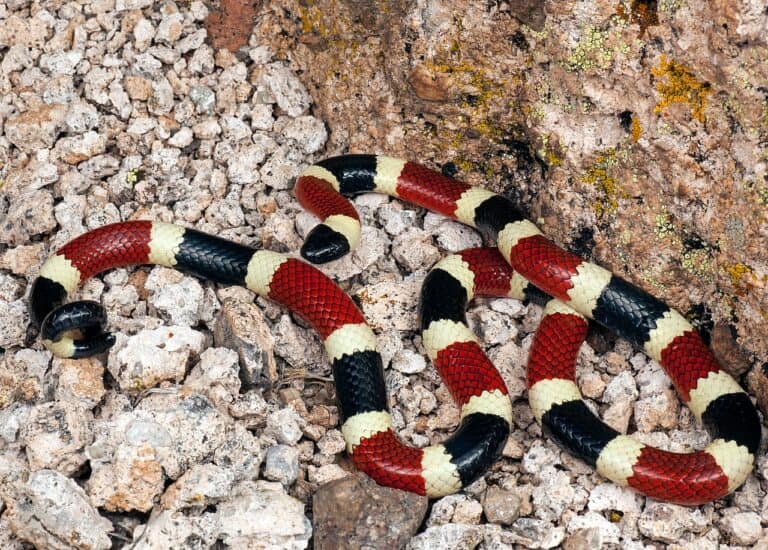
Arizona coral snake on rocky soil

Even though the Arizona coral snake’s venom is highly toxic – there has never been a fatality from its bite.

The Arizona coral snake is capable of producing a type of highly potent toxin that directly attacks the nervous system. A single drop is thought to be two or three times more powerful than the venom of the western diamondback rattlesnake. It is certainly potent enough to kill an adult even when the antidote has been administered. Yet it’s also true that not a single fatality has ever been reported from its bite. There are a few reasons for the lack of fatalities: Arizona coral snakes are found only in remote locations and like to hide underground, they are not very aggressive toward humans, and their small fangs have difficulty fully penetrating the skin, much less clothing and shoes, without almost chewing through. This species is thought to account for a minuscule number of snake bites every year, mostly due to accidental encounters when outdoors. And even when it does strike, 40 percent of bites contain almost no actual venom. Nevertheless, if bitten, you should seek medical attention as soon as possible because the symptoms can be serious and may require hospitalization.
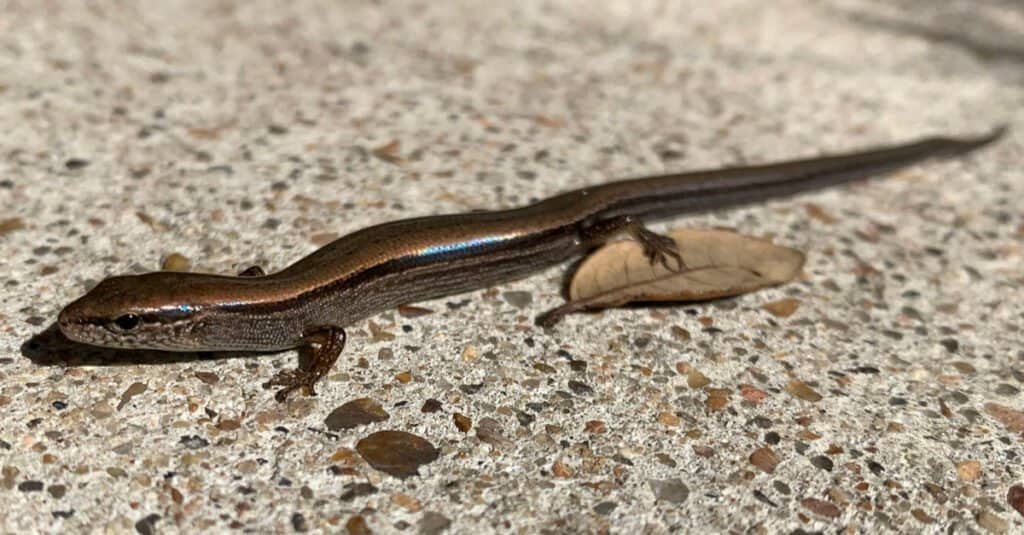
Smallest Lizards - Brown Skink

Arizona coral snakes eat mostly other snakes and small lizards like skinks.

Diet

The Arizona coral snake feeds primarily on blind, black-headed, and other small smooth-scaled snakes. Occasionally, it will eat lizards like skinks. This reclusive snake usually emerges at sundown and will hunt all through the night.

Behavior and Humans

The Arizona coral snake is surprisingly timid around people. They almost always run away and hide rather than stand their ground and fight. They only tend to strike people when they feel surprised or cornered. If you see one, your first response should be to back away and leave it alone. They will most likely slither into a nearby hiding spot. Needless to say, because of their toxicity, they do not make good pets.

Similar Animals
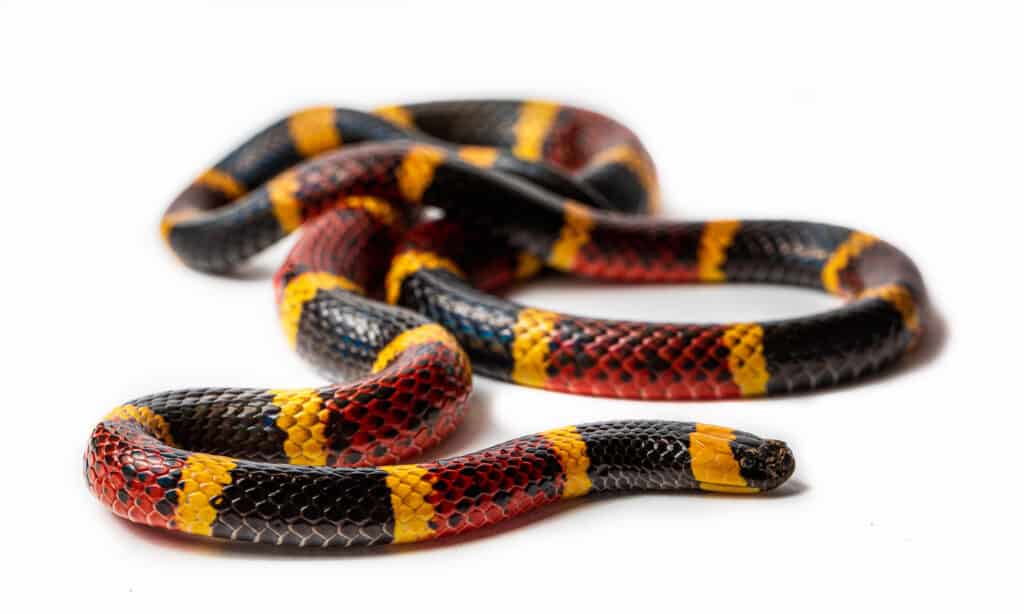
Texas coral snake

The Texas coral snake has a different banding pattern than the Arizona coral snake.

View all 328 animals that start with A

Sources

  1. New Mexico Fish & Game / Accessed April 26, 2022
  2. Reptiles Magazine / Accessed April 26, 2022
Lisha Pace

About the Author

Lisha Pace

After a career of working to provide opportunities for local communities to experience and create art, I am enjoying having time to write about two of my favorite things - nature and animals. Half of my life is spent outdoors, usually with my husband and sweet little fourteen year old dog. We love to take walks by the lake and take photos of the animals we meet including: otters, ospreys, Canadian geese, ducks and nesting bald eagles. I also enjoy reading, discovering books to add to my library, collecting and playing vinyl, and listening to my son's music.

Thank you for reading! Have some feedback for us?


Arizona Coral Snake FAQs (Frequently Asked Questions)

Yes, the western coral snake does produce highly toxic venom.