
C
Species Profile

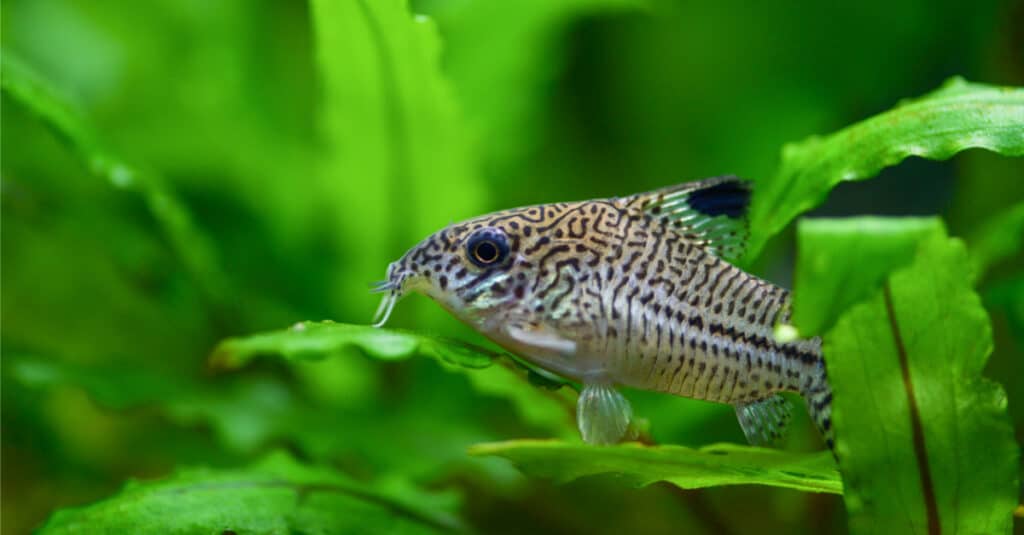
Cory Catfish

Corydoras

Armored, whiskered, and social
iStock.com/Borislav

Cory Catfish Distribution

Click a location to explore more animals from that region

This map shows coastal regions where Cory Catfish are found.

Loading map...

Size Comparison

Human 5'8"
Cory Catfish 1 in

Cory Catfish stands at 1% of average human height.

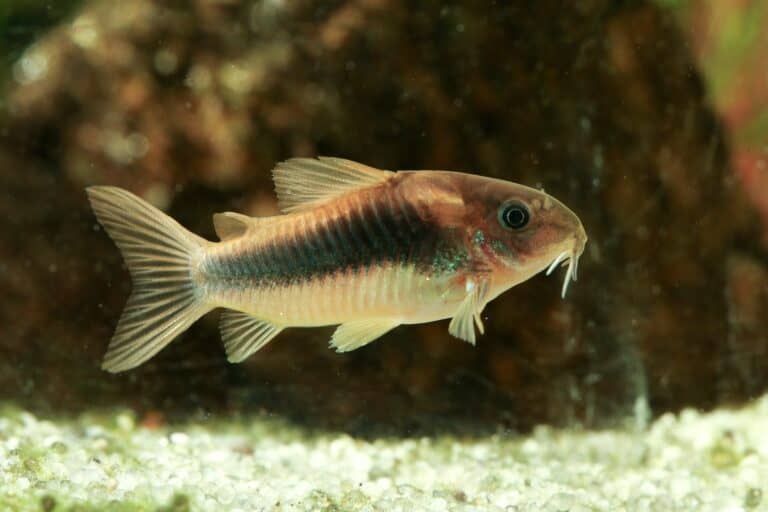
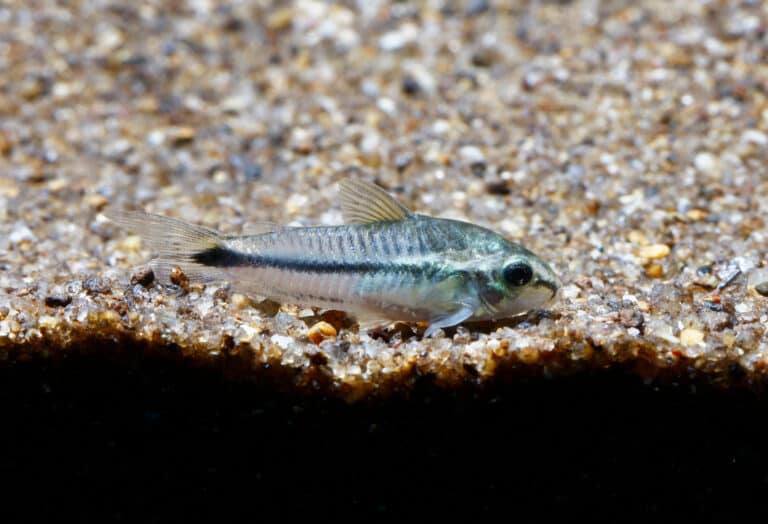
pepper cory catfish

At a Glance

Genus Overview This page covers the Cory Catfish genus as a group. Stats below are general traits shared across the genus.
Also Known As cory, cory cat, cories, armored catfish, armoured catfish
Diet Omnivore
Activity Diurnal+
Lifespan 5 years
Weight 0.06 lbs
Status Not Evaluated
Did You Know?

The genus includes tiny "dwarf corys" (~2.5 cm) up to much larger species around ~9-10 cm.

Scientific Classification

Genus Overview "Cory Catfish" is not a single species but represents an entire genus containing multiple species.

Corydoras are small South American armored catfishes widely kept in freshwater aquaria. They are schooling bottom foragers with bony plates (armor) and sensitive barbels, and they often gulp air at the surface (intestinal air-breathing adaptation).

Kingdom
Animalia
Phylum
Chordata
Class
Actinopterygii
Order
Siluriformes
Family
Callichthyidae
Genus
Corydoras

Distinguishing Features

  • Armored body with bony plates (callichthyid ‘armored catfish’)
  • Downturned mouth with barbels for substrate foraging
  • Generally small (often ~3–7 cm depending on species) and social/schooling
  • Adipose fin present; many show bold spots/reticulation
  • Can gulp air at the surface (facultative air-breathing)

Physical Measurements

Males and females differ in size

Height
1 in (0 in – 2 in)
Length
2 in (1 in – 4 in)
2 in (1 in – 5 in)
Weight
0 lbs (0 lbs – 0 lbs)
Tail Length
0 in (0 in – 1 in)
Top Speed
4 mph
Short bursts ~3–8 km/h
Venomous

Appearance

Primary Colors
Secondary Colors
Skin Type Corydoras are armored catfish with two rows of overlapping bony plates (not scales). Belly and fin bases softer; head smooth; fleshy barbels by mouth; dorsal and pectoral spines lock for defense.
Distinctive Features
  • Measurements (genus-level range): small-bodied bottom catfishes; adults commonly ~2-12 cm total length across Corydoras species (many popular aquarium species cluster ~4-7 cm, while a minority are notably smaller or larger).
  • Lifespan (range across species/conditions): typically ~3-15+ years, with shorter lifespans more common in smaller, fast-growing species and longer lifespans reported for some robust species in well-kept aquaria.
  • Body form: compact, slightly arched back; downturned/inferior mouth for bottom feeding; triangular dorsal fin plus a small adipose fin; forked to slightly rounded tail depending on species.
  • Armor and defense: paired rows of bony plates and strong dorsal/pectoral fin spines; many species can "lock" spines and may produce clicking sounds when stressed/handled.
  • Barbels: usually two pairs of short to moderate barbels (maxillary and mental) used to probe substrate; barbel length and robustness vary among species and are influenced by substrate quality and husbandry.
  • Behavior/ecology (general): schooling/loosely shoaling and peaceful; primarily benthic foragers that sift sand/mud and pick microinvertebrates, detritus, and biofilm; most are crepuscular to diurnal depending on predation pressure and habitat clarity.
  • Corydoras are found across many South American freshwater habitats—clearwater, blackwater, whitewater tributaries, floodplains, and forest streams. Species differ in preferred temperature, current, bottom type, activity, shyness, and cover.
  • Air-breathing adaptation: many Corydoras regularly gulp air at the surface and absorb oxygen via the intestine (facultative air-breathing), especially in warm/low-oxygen conditions; frequency varies among species and environments.
  • Corydoras (cory catfish) are common in community tanks. They do best in groups on fine sand with hiding places. Many trade fish are labeled by species, C-numbers/CW-numbers, or place of origin.

Sexual Dimorphism

Sexual dimorphism is generally mild to moderate across Corydoras and varies by species: females are often larger and deeper-bodied (especially when gravid), while males are slimmer; fin shape differences occur in some species but are not universal.

  • Often slightly smaller/slimmer overall body profile.
  • In some species, dorsal and/or pectoral fins may appear relatively more elongated or pointed (degree varies by species).
  • During courtship/spawning, males may show more frequent pursuit and positioning behavior (e.g., the typical Corydoras spawning "T-position"), though this is behavioral rather than strictly morphological.
  • Often larger adult size within a species and noticeably rounder abdomen when carrying eggs.
  • Broader body depth and wider pelvic region are common cues when comparing mature fish of the same species and age.
  • May appear slightly less "pointed" in fin tips than males in species where fin-length differences are expressed.

Did You Know?

The genus includes tiny "dwarf corys" (~2.5 cm) up to much larger species around ~9-10 cm.

They wear overlapping bony plates (scutes) like armor instead of typical fish scales.

Many Corydoras can gulp air and absorb oxygen through the intestine-handy in warm, low-oxygen waters.

Their pectoral spines can lock in place, making them hard for predators (or nets) to dislodge.

Corydoras barbels are touch-and-taste sensors used to "snuffle" through sand for tiny foods.

Different Corydoras occupy different niches: most are bottom dwellers, but some small species often school midwater.

Aquarium "cory cats" aren't one fish-common trade names (e.g., aeneus, paleatus, sterbai, panda) refer to distinct Corydoras species.

Unique Adaptations

  • Armored scutes: bony plates provide protection in shallow, debris-filled habitats where abrasion and predation risk are high.
  • Intestinal air-breathing: a vascularized gut allows supplementary oxygen uptake after surface gulps; especially useful in stagnant or warm waters.
  • Barbels packed with sensory cells: enable food detection in murky water and at night/low light; particularly important for sand-foraging species.
  • Locking pectoral spines (often with mild venom/irritants): a defensive "jam" mechanism that can deter predators and complicate swallowing.
  • Flexible habitat tolerance across the genus: species occur in blackwater, clearwater, and whitewater systems, and in streams to floodplains-reflecting broad ecological adaptability.
  • Compact, downturned mouth: optimized for picking and sifting small prey items from the substrate rather than biting large food.

Interesting Behaviors

  • Schooling/shoaling: most species prefer groups and synchronize foraging; some are tighter schoolers than others, especially smaller species.
  • Bottom sifting: they take mouthfuls of sand, sort edible bits (worms, insect larvae, crustaceans), and expel the rest through the gills.
  • Surface "air-gulp runs": individuals dash up, gulp, then return to the group; frequency varies with oxygen levels and species.
  • "Cory wink": many can rotate or retract the eye slightly, a noticeable motion that looks like a blink.
  • Rainy-season spawning patterns: in nature, breeding often coincides with rising water and cooler rain influx; in aquaria, similar cues can trigger spawning.
  • Egg placement diversity: many attach eggs to plants/glass/rocks; some choose sheltered undersides-strategies vary across species and habitats.
  • Peaceful community interactions: generally non-territorial and tolerant of other fish, though they may compete with one another at food spots.

Cultural Significance

Corydoras (cory catfish) are key freshwater aquarium fish worldwide. They school peacefully and clean tank bottoms. Central to South American biotope tanks, many are bred by hobbyists, while rare species show the need for careful collecting and river habitat protection.

Myths & Legends

Name-origin "legend": Corydoras comes from Greek roots commonly interpreted as "helmet" (kory) and "skin" (doras), a nod to their armor-like plates-an etymological story frequently repeated in natural history and aquarium circles.

Aquarium folk tradition: hobbyists long pass down the idea that a cool-water change and increased flow can "call the rains" and prompt Corydoras spawning-an anecdotal practice inspired by their wet-season breeding cycles.

Historical aquarium lore: early imported Corydoras (notably several widely traded species) became famous as some of the first catfishes many aquarists successfully bred at home, helping cement "cory cats" as beginner-friendly icons of the hobby.

Trade-name storytelling: common names like "panda," "peppered," and "bronze" function as modern cultural labels-mini origin tales based on distinctive patterns/colors that help aquarists remember the diversity within the genus.

Conservation Status

NE Not Evaluated (genus-level hubs are not assessed by IUCN; assessments are made at the species level)

Has not yet been evaluated against the criteria.

Population Unknown

You might be looking for:

Bronze cory / Green cory

28%

Corydoras aeneus

Very common, hardy aquarium cory; often the default ‘cory catfish’ in shops.

Peppered cory

22%

Corydoras paleatus

Another very common traded cory; mottled ‘peppered’ pattern.

Sterbai cory

15%

Corydoras sterbai

Popular species with white spotting and orange-tinged fins.

Panda cory

13%

Corydoras panda

Distinct black eye and tail patches; widely kept in aquaria.

Emerald catfish (often sold as a “cory”)

8%

Brochis splendens

Closely related callichthyid sometimes marketed as a cory; historically lumped near Corydoras in the trade.

Dwarf cory species (often still called ‘cories’)

6%

Aspidoras spp.

Small, closely related armored catfishes sometimes sold under the ‘cory’ umbrella name.

Life Cycle

Birth 100 frys
Lifespan 5 years

Lifespan

In the Wild
2–15 years
In Captivity
3–20 years

Reproduction

Mating System Polygynandry
Social Structure Aggregation Group
Breeding Pattern Transient
Fertilization Substrate Spawning
Birth Type Substrate_spawning

Corydoras show polygynandry (many males and females mate) in shoal spawning. They use the "T-position" and do substrate spawning with external fertilization; females attach sticky egg batches to surfaces. Interactions are brief and adults usually give no parental care.

Behavior & Ecology

Social Shoal Group: 12
Activity Diurnal, Crepuscular, Cathemeral
Diet Omnivore Chironomid larvae ("bloodworms") and other small insect larvae (widely taken across the genus when available).

Temperament

Generally peaceful and non-territorial toward conspecifics and other fishes; aggression is uncommon outside of brief jostling at food.
Confidence and boldness increase markedly with group size; many species become shy, inactive, or stress-prone when kept singly or in very small groups.
Primarily benthic foragers that sift substrate; foraging can be highly social with individuals tracking and joining active feeders.
Startle/defense behavior includes rapid darting, freezing, and erecting/locking the pectoral spines; handling risk varies by species (spines can snag nets).
Adult Corydoras range about 2–10+ cm and often live 3–15+ years depending on temperature, diet, and water quality. Dwarf species form tight groups; larger ones space out but stay social.

Communication

Stridulation/clicking or squeaking sounds produced by rubbing pectoral spines and/or elements of the pectoral girdle; often associated with alarm/handling and sometimes social disturbance.
Low-amplitude clicks during sudden movements that may function as startle or contact signals at close range.
Tactile contact during shoaling and courtship Body and barbel-to-substrate/barbel-to-body contact at very close range
Hydrodynamic and lateral-line cues for alignment and spacing within groups, especially in turbid water or low light.
Chemical signaling is likely important (e.g., reproductive readiness and aggregation cues), though strength and specifics vary among species.
Visual/postural displays at close range (orientation changes, fin erection, and spine presentation) during brief disputes or when startled.
Synchronized surfacing to gulp air (intestinal air-breathing) can create group-level rhythm/coordination; frequency varies by species and dissolved oxygen availability.

Habitat

Biomes:
Freshwater Wetland Tropical Rainforest Tropical Dry Forest Savanna Temperate Forest Temperate Grassland +1
Terrain:
Riverine Plains Valley Coastal Island Muddy Sandy +1
Elevation: Up to 4921 ft 3 in

Ecological Role

Benthic omnivorous micro-predator and detritus-associated forager in South American freshwater bottoms (streams, floodplains, and leaf-litter/soft-substrate habitats).

Bioturbation: reworking/sifting sediments while feeding, which can influence substrate oxygenation and microhabitat structure Nutrient cycling: processing detritus-associated organic matter and redistributing fine particles Invertebrate population regulation: consuming insect larvae and other small benthic invertebrates Food-web support: serving as common prey for larger fishes, birds, and other predators

Diet Details

Main Prey:
Aquatic insect larvae Small benthic worms Microcrustaceans Small insect eggs and tiny invertebrates Soft-bodied benthic invertebrates
Other Foods:
Detritus and organic mulm Periphyton Algae and diatoms Leaf litter Plant fragments and micro-seeds

Human Interaction

Domestication Status

Semi domesticated

Corydoras are not domesticated like farm animals, but many species have been bred in captivity for decades for the aquarium trade. Some lines are bred sustainably, with a few color varieties selected. Other forms are still collected and exported from South America, especially uncommon, not-yet-described or local variants.

Danger Level

Low
  • Pectoral/dorsal fin spines can puncture skin during handling or netting; pain and localized swelling are possible, with secondary infection risk if not cleaned.
  • Aquarium-related zoonotic risks are low but possible (e.g., opportunistic waterborne bacteria) if punctures occur or hygiene is poor.
  • Allergic reactions to aquarium water/organisms are uncommon but possible in sensitive individuals.

As a Pet

Suitable as Pet

Legality: Corydoras (cory catfish) are usually legal to own and sell in many places, but rules differ. Import limits, bans on collecting from protected areas, health or quarantine rules, or limits on wild-caught species may apply. Check local laws.

Care Level: Moderate

Purchase Cost: $3 - $60
Lifetime Cost: $250 - $2,000

Economic Value

Uses:
Ornamental aquaculture Wild-capture fisheries (ornamental trade) Pet retail and aquarium services Ecotourism/biodiversity value (indirect)
Products:
  • live aquarium fish (captive-bred and wild-caught)
  • selective-bred color variants/locality strains (limited to certain species)
  • aquarium-related goods/services driven by Corydoras demand (foods, tanks, filtration, breeding supplies)

Relationships

Predators 7

Cichlids
Cichlids Cichlidae
Pike characins Acestrorhynchus
Trahira Hoplias spp.
Raphael catfish Doradidae
Long-whiskered catfishes Pimelodidae
Wading birds
Wading birds Ardeidae
Neotropical river turtles Podocnemididae

Related Species 7

Aspidoras Aspidoras Shared Family
Scleromystax Scleromystax Shared Family
Armored catfishes Callichthys Shared Family
Hoplosternum Hoplosternum Shared Family
Megalechis Megalechis Shared Family
Dianema Dianema Shared Family
Brochis
Brochis Corydoras Shared Family

Ecological Equivalents 5

Animals that fill a similar ecological role in their ecosystem

Kuhli loach Pangio spp. Small, peaceful benthic foragers that spend much of their time sifting through substrate for invertebrates. Occupy a similar aquarium niche as gentle bottom scavengers, though loaches are not catfish and lack armor plates.
South American dwarf suckermouth catfishes Otocinclus spp. Small, schooling catfishes often kept in groups and associated with plant-rich, shallow margins. They overlap in size class and community-fish role, although Otocinclus species specialize more on grazing biofilm and algae than on consuming substrate microfauna.
Dwarf armored catfish Aspidoras spp. Very similar body plan and behavior (armored plates, barbels, bottom-sifting, schooling), and they often occupy comparable microhabitats; essentially a close ecological analogue within the same family.
South American eartheater cichlids Geophagus spp. Share the sand-sifting benthic feeding mode—taking mouthfuls of substrate and filtering edible items—creating functional niche overlap. Cichlids are often larger and can be predators or competitors rather than peaceful cohabitants.
Small loricariid catfishes Ancistrus spp. Bottom-associated, armored fishes common in similar habitats and aquaria; they overlap in shelter use and benthic space, although loricariids primarily graze surfaces rather than continuously sifting substrate.

Types of Cory Catfish

19

Explore 19 recognized types of cory catfish

Bronze cory Corydoras aeneus
Peppered cory Corydoras paleatus
Sterbai cory Corydoras sterbai
Panda cory Corydoras panda
Julii cory Corydoras julii
Three-line cory Corydoras trilineatus
Pygmy cory Corydoras pygmaeus
Salt and pepper cory Corydoras habrosus
Dwarf cory (tail-spot) Corydoras hastatus
Adolfo's cory Corydoras adolfoi
Duplicareus cory Corydoras duplicareus
Bandit cory Corydoras metae
Skunk cory Corydoras arcuatus
Leopard cory Corydoras leopardus
Schwarz's cory Corydoras schwartzi
Rabaut's cory Corydoras rabauti
Orange laser cory (trade name; lineage varies) Corydoras sp.
Venezuelan cory (often treated within the aeneus complex) Corydoras venezuelanus
Emerald 'cory' (historically placed in Brochis; closely allied to Corydoras) Corydoras splendens

Quick Take

  • Achieving a 27-year lifespan remains a rare biological milestone for specific Corydoras specimens.
  • The 3 pairs of barbels create a strict limitation on substrate selection for the fish.
  • Surprisingly, these peaceful scavengers possess toxins capable of neutralizing apex predators like piranhas.
  • Experts are currently studying hundreds of variations to classify the vast majority of unknown species.

Cory Catfish, also referred to as Corydoras, is a genus of catfish that originates from the coastal rivers in Brazil and Uruguay and the lower Parana river basin.

They are a popular freshwater fish in the aquarium hobby and are known for being peaceful and easy to care for. Cory Catfish come in many different colors, patterns, and sizes depending on their species.

There are over 200 described Cory Catfish species, with around 170 generally recognized as valid as of 2026. Not all species of the Cory Catfish originate from the same habitats, but they all live in the same water conditions and cannot tolerate saltwater environments.

A comprehensive infographic about Cory Catfish featuring anatomical diagrams, photos of different species like the Bronze and Albino Cory, and icons representing their habitat, diet, and lifespan.
Don't let their size fool you—these armored scavengers carry a hidden toxin capable of stopping a piranha in its tracks. © A-Z Animals

5 Facts About Cory Catfish

  • Cory Catfish can produce a sound by the abduction of their pectoral fins, which is used by males as a form of intrapersonal communication during courtship, or by both males and females when they feel stressed.
  • Researchers have identified over 200 described species of Corydoras, each with their own coloration, shape, and size. One fossil species, formerly known as Corydoras revelatus, is known only from paleontological records and is not a recently extinct species.
  • Some Cory Catfish shoals or schools can contain over a hundred fish in their natural habitat, which makes this a social fish species.
  • Cory Catfish rarely grow larger than 5 inches (12.7 cm) in size.
  • There are likely hundreds of Cory Catfish species that researchers have not yet identified and are currently being studied.

Classification and Scientific Name

Cory Catfish are part of the Corydoras taxonomic genus and part of the Actinopterygii class and the phylum Chordata. The scientific name for each Cory Catfish will depend on the species. Some common Cory Catfish that are popular in the aquarium hobby include the Corydoras paleatus, C. pygmaeus, and C. aeneus.

Species

Cory Catfish is the common name for the genus Corydoras, which includes over 200 described species as of 2026, with many more potentially undescribed species. Researchers and experts are currently studying the remaining species to find out more information. All Cory Catfish are bottom-dwelling scavengers and have a social and peaceful temperament. In the wild, Cory Catfish will form large shoals of their own species to feel safe as a group. All species of Corydoras originate from the rivers and streams located in South America.

These are some of the most common Cory Catfish species available:

  • Bronze Cory (Corydoras aeneus): A hardy and adaptable Cory Catfish found in shallow and fast-flowing rivers throughout South America.
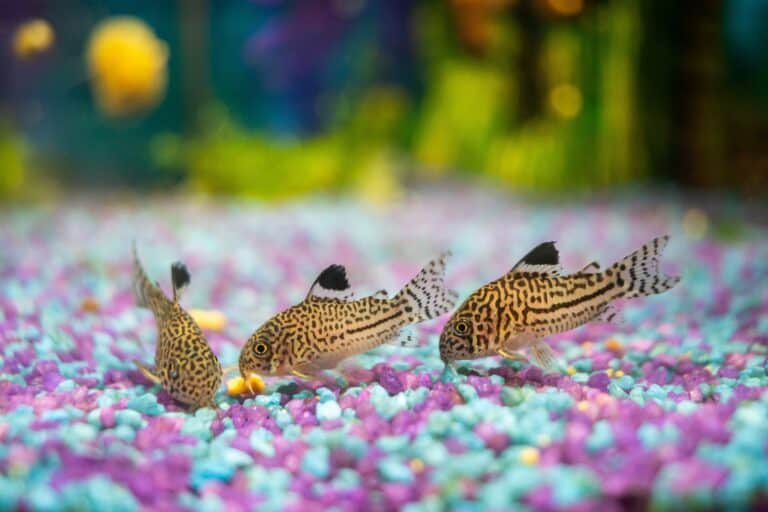
  • Julii Cory (Hoplisoma julii): A freshwater fish that is native to the flooded forest floors in the Amazon Basin with a leopard appearance.
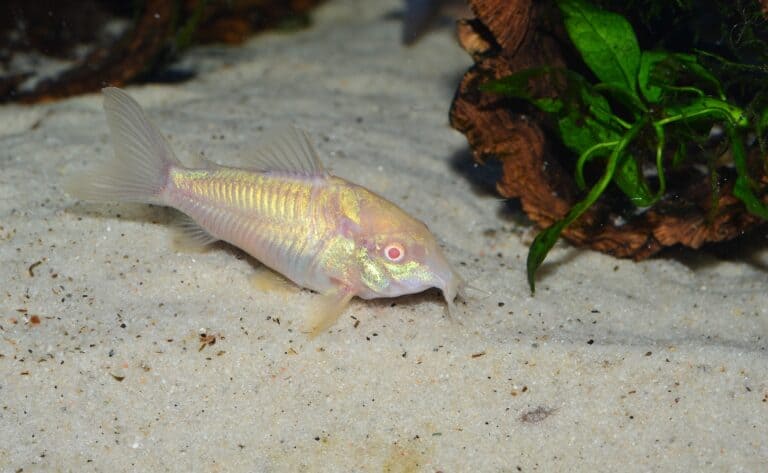
  • Albino Cory (Corydoras aeneus): Inhabits shallow, quiet streams with a muddy appearance throughout South America and has a creamy, transparent body.
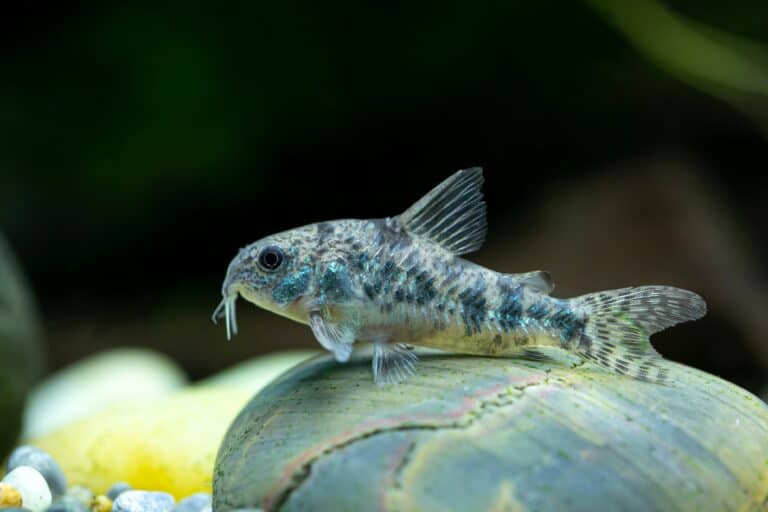
  • Pepper Cory (Hoplisoma paleatum): Better adapted to cooler waters than other Corydoras and has a dark-mottled appearance, hence their name.
  • Bandit Cory (Corydoras metae): A sensitive Cory Catfish that grows no larger than two inches and has a cream body with a thick white band across its head to tail.
  • Pygmy Cory (Corydoras pygmaeus): The smallest species of Corydoras, growing to an inch in size, and is considered a bottom-dwelling nano fish.

Appearance

The appearance of Cory Catfish will vary according to their species. However, none of the species grow much larger than 5 inches (12.7 cm) in length, which makes them small nano fish. All Cory Catfish have a similar body structure, with the main differences between the species being their adult size and coloration. Male Cory Catfish are slightly smaller than females, but they have a more defined dorsal and pectoral fin.

The Pygmy Cory is the smallest species, growing no larger than 1.5 inches, with the largest species being Corydoras britskii (formerly Brochis britskii), which can reach up to about 3.5 to 4.7 inches (9 to 12 cm) in length. Since Cory Catfish are bottom dwellers, they have a flattened belly with blunt heads to make it easy for them to skim the substrate or the bottom of a body of water. They come in various colors, ranging from cream, black, silver, brown, blue, and gold, with either stripes, spots, bands, or one solid color, depending on the species.

All Corydoras have three pairs of barbels around their mouth that they use to detect food. If you have observed a Corydoras sifting through the substrate in an aquarium, you will see that they wiggle their barbels into the substrate, along plants, rocks, and driftwood in search of food.
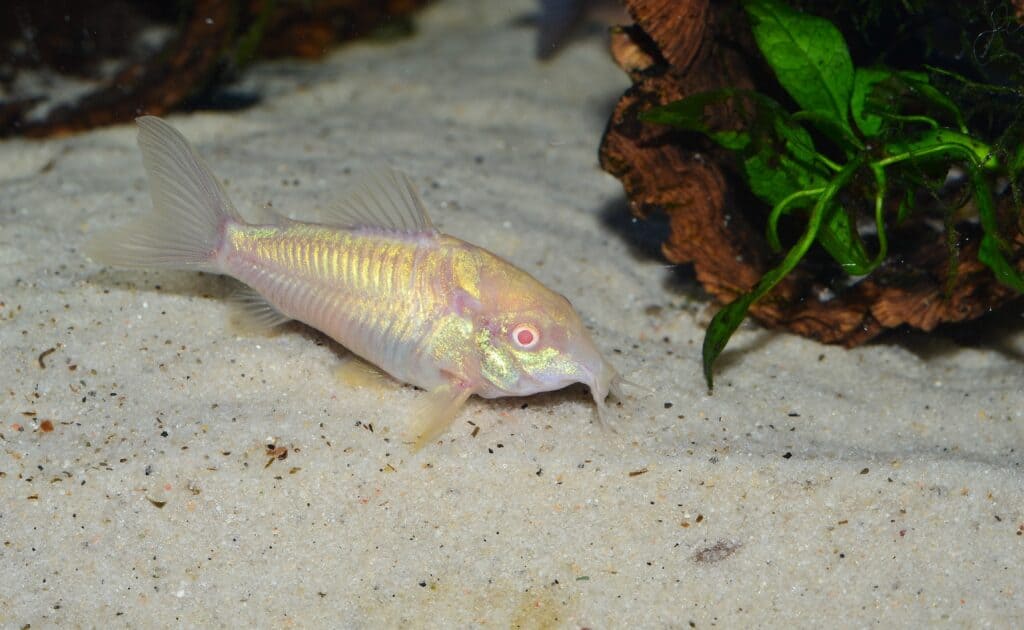
An albino Cory Catfish on the bottom of an aquarium

All Cory Catfish should be provided with smooth sand or gravel for their substrate so they don’t damage their delicate barbels.

Distribution, Population, and Habitat

All species of Corydoras originate from the streams in South America and regions of the Andes Mountains; however, the exact location can differ depending on the species’ water parameter preference.

They have a large distribution throughout the Amazon where they inhabit murky, slow-moving streams, rivers, marshes, ponds, and flooded forests. They prefer moderately warm waters, which is why they are kept as tropical fish in the aquarium hobby. In the wild, Cory Catfish prefer to form large shoals in freshwaters and can be found at the bottom of these bodies of water, amongst the mud and vegetation.

Since the Cory Catfish has been introduced into the aquarium trade industry, it can now be found worldwide in aquariums as a shoaling, bottom-dwelling fish. This fish prefers to stay in shallow water since they spend most of their time at the bottom of an aquarium or habitat, due to oxygen being able to reach them more easily.

Predators and Prey

Predators

Cory Catfish do not have many predators in the wild, mainly because they are covered in armored scales and spines in self-defense, and they also release toxins that can kill larger fish, such as piranhas. However, these self-defense mechanisms rarely happen in aquariums, so you do not have to worry about your Cory Catfish harming any tank mates in a community aquarium. Their spiky bodies also make it difficult for other fish to nip at them without escaping injury.

Prey

In the wild, Cory Catfish will scavenge at the bottom of murky streams and rivers in the Amazon to find worms, insects, larvae, plankton, and remains of other deceased fish (even their own species). Cory Catfish search for food by burying their snout and barbels into the mud or substrate to suck up food into their mouths. In an aquarium, Cory Catfish will eat foods that fall to the bottom of the aquarium, which can include flakes, pellets, sinking algae wafers, and any uneaten foods left over by other fish. Cory Catfish will rarely swim to the top of the aquarium to eat food like other fish because they are not surface dwellers.

Reproduction and Lifespan

Reproduction

The breeding behaviors of Cory Catfish depend on their species, and the number of eggs a female Cory Catfish produces will depend on its size and age. Most female Cory Catfish will lay small clutches of eggs during spawning season, and the fry (newly born or hatched fish) will hatch only a few days later. In the wild, spawning with this genus occurs during the rainy seasons, and females can lay eggs from multiple males at the same time, usually with a clutch of 10 to 20 eggs.

How Long Do Cory Catfish Live?

The lifespan of Cory Catfish will depend on the species; however, all species are able to live up to five years of age. However, most wild specimens can reach ages from up to 10 to 15 years, with some species recorded living up to 27 years of age. In an aquarium, your Cory Catfish’s lifespan will depend on how well they are cared for, which includes keeping them in a large tank with good filtration, aeration, a healthy diet, and the right water parameters that replicate the species’ preferred water conditions that they would experience in the wild.

Population

Cory Catfish are spread throughout South America, which is home to their original habitat. Since Cory Catfish have been introduced into the pet trade industry, they are mass-bred on commercial farms and made available at various stores where they can be purchased. Most of the species of Cory Catfish that are available as pets have the highest population around the world, and they are not considered endangered because they are widely distributed and there are no widespread threats that affect the Cory Catfish population, according to the IUCN Red List.

View all 392 animals that start with C

Sources

  1. Animals Network Team / Accessed July 17, 2022
  2. Wikipedia / Accessed July 17, 2022
  3. Animals net / Accessed July 17, 2022
Sarah Psaradelis

About the Author

Sarah Psaradelis

Sarah is a writer at A-Z Animals primarily covering aquatic pets, rodents, arachnids, and reptiles. Sarah has over 3 years of experience in writing and researching various animal topics. She is currently working towards furthering her studies in the animal field. A resident of South Africa, Sarah enjoys writing alongside her pets and almost always has her rats perched on her shoulders.
Connect:

Thank you for reading! Have some feedback for us?


Cory Catfish FAQs (Frequently Asked Questions)

Cory Catfish can be found throughout South America from the Andes to the Atlantic coast, all the way to Trinidad to northern Argentina in the Rio de le Plata drainage. They are not found in Panama, and the area where Cory Catfish are commonly distributed from the same genus is nearly equal to the entire Cory Catfish family distribution.

They have a more restricted geographic location than other callichthyids. Since most species of the Cory Catfish have been introduced into the aquarium industry, they can be found throughout the world and are bred for aquarium trading.