G
Species Profile

Green Anaconda

Eunectes murinus

Built for wetlands. Powered by constriction.
Patrick K. Campbell/Shutterstock.com

Green Anaconda Distribution

Click a location to explore more animals from that region

Loading map...
green anaconda closeup

At a Glance

Wild Species
Also Known As Anaconda, Common anaconda, Giant anaconda, Water boa, South American anaconda, Sucuri
Diet Carnivore
Activity Cathemeral+
Lifespan 10 years
Weight 97.5 lbs
Status Least Concern
Did You Know?

Females are much larger than males (strong sexual size dimorphism typical of boid snakes).

Scientific Classification

The green anaconda (Eunectes murinus) is a large, semi-aquatic boa native to tropical South America, famous for its heavy-bodied build and among the world’s largest snakes by mass and girth. It is a nonvenomous constrictor that hunts primarily in or near water.

Kingdom
Animalia
Phylum
Chordata
Class
Reptilia
Order
Squamata
Family
Boidae
Genus
Eunectes
Species
Eunectes murinus

Distinguishing Features

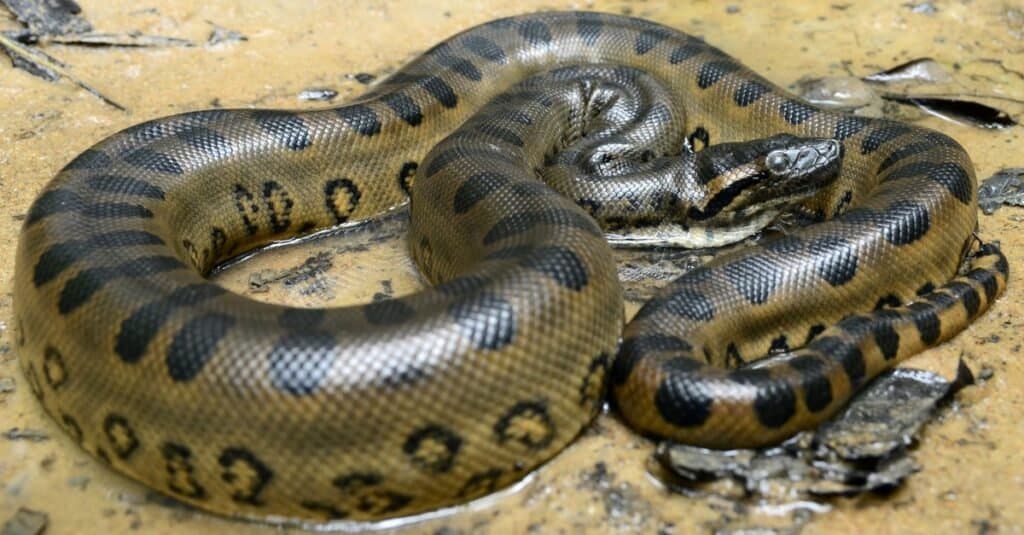
  • Olive-green to greenish-brown ground color with prominent dark oval/round blotches along the body
  • Very robust, heavy-bodied constrictor; relatively small head compared to body
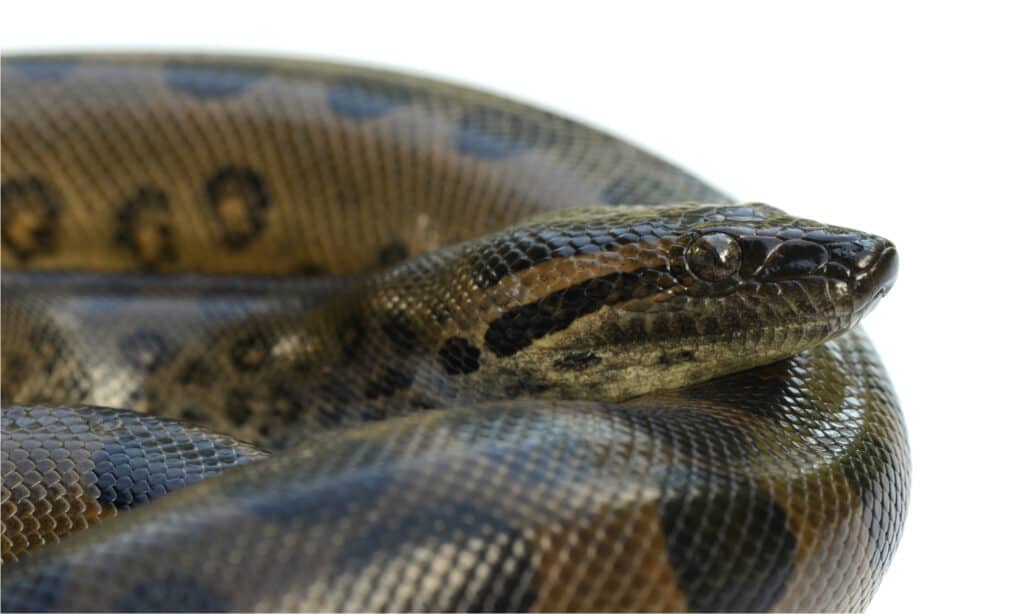
  • Strongly semi-aquatic; eyes and nostrils positioned to aid breathing/seeing while mostly submerged
  • Often confused with other anacondas, but typically the largest and most widely known species in the genus Eunectes

Physical Measurements

Males and females differ in size

Length
♂ 9 ft 2 in (4 ft 11 in – 11 ft 6 in)
♀ 14 ft 9 in (9 ft 10 in – 17 ft 1 in)
Weight
♂ 33 lbs (15 lbs – 77 lbs)
♀ 110 lbs (66 lbs – 215 lbs)
Tail Length
♂ 1 ft 1 in (6 in – 1 ft 6 in)
♀ 1 ft 10 in (1 ft 2 in – 2 ft 6 in)
Top Speed
1 mph
Top speed unknown

Appearance

Primary Colors
Secondary Colors
Skin Type Green Anaconda is a nonvenomous boa with a thick body and smooth scales that shed water and resist wear; belly scutes aid traction. Eyes and nostrils on top let it breathe and see while submerged.
Distinctive Features
  • Very heavy-bodied constrictor (Boidae) with exceptionally large girth relative to length; among the world's largest snakes by mass and diameter.
  • Dorsally placed eyes and nostrils for surface-level breathing/ambush while submerged; commonly encountered in flooded forests, marshes, oxbow lakes, and slow-moving rivers of the Amazon/Orinoco basins and adjacent seasonally flooded savannas (e.g., Llanos).
  • Distinct black spotting/ocelli on olive-green background; pale cream/yellowish underside. This overall green-olive palette contrasts with the generally more yellow/brown tone typical of E. notaeus (yellow anaconda).
  • Kills by constriction, not venom. Eats fish, water birds, rodents, capybaras, caimans and other reptiles; prey choices depend on the snake's size and the habitat.
  • Thermosensory labial pits (boid feature) assist in detecting warm-blooded prey during low-light ambushes along banks/vegetation.
  • Green anaconda (Eunectes murinus) in zoos often live into their 20s (about 20–30 years). Wild ones usually live less, and exact ages are harder to know.
  • Green anacondas show strong size differences between sexes. Most seen adults are about 3–5 m long; studies in the Venezuelan Llanos (Rivas) found females just over 5 m. Larger claims are often unproved.

Sexual Dimorphism

Green anacondas (Eunectes murinus) have strong size differences: adult females are much longer, heavier, and thicker than males in wild populations (e.g., Venezuelan Llanos). Males are smaller, slimmer, and often have more noticeable cloacal/pelvic spurs.

♂
  • Typically shorter and markedly slimmer-bodied than adult females; proportionally less massive for a given length (field studies consistently report males occupying lower size/mass ranges).
  • Pelvic/cloacal spurs generally more prominent (boid characteristic), used during courtship/positioning.
  • Often more active in mate-searching during breeding season; may be encountered moving overland between wetlands more frequently than large gravid females (behavioral tendency reported in field observations of semi-aquatic populations).
♀
  • Much larger overall (length, girth, and mass), producing the species' largest, most robust individuals in the population.
  • Greater abdominal volume and body depth associated with gestation (viviparous); gravid females can appear especially thick through mid-body.
  • More likely to occupy or defend prime aquatic ambush sites in wetlands where large prey is available; large body size enhances constriction capacity and prey breadth.

Did You Know?

Females are much larger than males (strong sexual size dimorphism typical of boid snakes).

It's among the world's largest snakes by mass and girth (not necessarily the longest).

Eyes and nostrils sit high on the head-useful for watching and breathing while the body stays submerged.

It is ovoviviparous: females give birth to live young (no eggs laid externally).

Mating can involve a "breeding ball," where multiple males coil around one receptive female.

Typical prey spans fish, birds, mammals, and reptiles-often taken at the water's edge (e.g., waterfowl, rodents, capybara-sized mammals, turtles, and caimans).

The name "anaconda" entered English via historical misapplication from South Asia, even though the species is South American. (The green anaconda's scientific name is Eunectes murinus.)

Unique Adaptations

  • High-set nostrils with valved openings and dorsally placed eyes allow breathing and visual scanning while mostly submerged.
  • Exceptionally heavy-bodied build (large cross-sectional girth) provides leverage for overpowering large prey in water.
  • Backward-curving teeth help hold slippery prey such as fish and waterbirds during the initial strike.
  • Camouflage pattern (olive-green base with dark oval blotches) breaks up the outline in dappled wetland light and floating vegetation.
  • Flexible skull and highly kinetic jaws (typical of snakes) enable swallowing prey far wider than the head.
  • Low-speed, stealth locomotion in water: muscular undulation and buoyancy reduce the need to support full body weight compared with land movement.
  • Viviparity/ovoviviparity in a wetland predator: giving birth to live young avoids egg incubation challenges in saturated floodplain habitats.

Interesting Behaviors

  • Semi-aquatic ambush hunting: often waits motionless in shallow water or flooded vegetation, striking at prey that approaches the shoreline.
  • Constriction: after seizing prey with recurved teeth, it coils and tightens with each exhalation; in boid snakes, constriction can cause rapid circulatory collapse (mechanism demonstrated experimentally in boids).
  • Breeding "mating balls": during the breeding season, 2-12+ males may compete and align their bodies to a single female for extended periods (days to weeks reported in field observations).
  • Scent-trailing and tongue-flicking: uses the vomeronasal (Jacobson's) organ to follow chemical trails-important for locating mates in dense wetlands.
  • Basking/thermoregulation: alternates between water (cooling, concealment) and sun-exposed banks or floating vegetation to regulate body temperature.
  • Sit-and-wait digestion strategy: after a large meal, activity drops while digestion proceeds; long intervals between large meals are common for big boids.
  • Seasonal movement with floods: individuals may shift among river channels, oxbow lakes, flooded forest, and savanna wetlands as water levels rise and fall.

Cultural Significance

The Green Anaconda (Eunectes murinus) is a powerful symbol of rivers, floods, and wetland dangers. As an icon of Amazon floodplains (seasonally flooded forests, swamps, oxbow lakes), it appears in stories, nature tourism, media, and conservation teaching about wetland food webs.

Myths & Legends

Great Snake (Amazonian and Brazilian stories): a huge, magical snake linked to the green anaconda (Eunectes murinus). It lives in deep rivers and flooded forests and can stir water or flip canoes.

Green Anaconda (Eunectes murinus) — in Amazonian Mother of the Waters legend, a huge snake spirit living in lagoons and river bends that pulls animals and sometimes people into water, showing the river's life and danger.

Brazilian Amazon anaconda legends: local stories describe enormous anaconda-like snakes that guard certain lakes, punish disrespectful behavior, or serve as omens tied to fishing and travel on flooded plains.

River-guardian narratives (Orinoco/Amazon basin oral traditions): giant aquatic snakes are sometimes portrayed as custodians of water places-demanding offerings or respect and enforcing taboos about overharvesting or improper conduct at sacred pools.

Early European travel stories spread the name anaconda. Over time it came to mean South American giant water boas (Eunectes murinus), making the species the famous giant river snake.

Conservation Status

LC Least Concern

Widespread and abundant in the wild.

Population Unknown

Protected Under

  • CITES Appendix II (international trade in specimens regulated; listings often implemented at the level of Eunectes spp.)
  • Occurs in numerous protected areas across its range in tropical South America; country-level legal protection varies by jurisdiction (generally covered under national wildlife protection frameworks).

Life Cycle

Birth 30 newborns
Lifespan 10 years

Lifespan

In the Wild
8–15 years
In Captivity
15–30 years

Reproduction

Mating System Polygynandry
Social Structure Aggregation Group
Breeding Pattern Seasonal
Fertilization Internal Fertilization
Birth Type Internal_fertilization

Green anaconda (Eunectes murinus) are mostly solitary but form temporary "mating balls" where several—sometimes over ten—males try to mate with one female for days to weeks. Polygynandry (many males and females mate); internal fertilization; give birth to many young.

Behavior & Ecology

Social Breeding ball (mating aggregation) Group: 1
Activity Cathemeral, Crepuscular
Diet Carnivore Capybara (Hydrochoerus hydrochaeris)

Temperament

Generally cryptic and avoidant; relies on concealment in water/vegetation and remaining motionless as primary defense.
When threatened at close range may become strongly defensive: hissing, striking, and biting; large adults can be dangerous due to strength and size despite being nonvenomous.
Ambush-oriented predator; often waits partially submerged with nostrils/eyes exposed, especially along banks or in flooded vegetation.
Intraspecific tolerance is highest during breeding aggregations; otherwise interactions are typically limited to brief encounters (avoidance, displacement).

Communication

Hissing/forceful exhalation as a defensive warning Air expelled through the glottis; not a true vocal call
Chemical communication via pheromones and cloacal/scent cues; males are thought to follow female chemical trails using tongue-flicking and the vomeronasal Jacobson's) organ-key for mate location in breeding season (reported for Eunectes in field and captive observations; e.g., Rivas 2000; Rivas 2007
Tactile communication during courtship and mating balls: extensive body contact, alignment, and mechanical positioning; prolonged physical contact can last days to weeks during mating aggregations Rivas 2007
Substrate/water-borne vibration sensitivity: detects movement of prey/conspecifics through body contact with ground/water; relevant for close-range awareness rather than long-distance signaling.
Visual displays are limited; body postures (coiling, head elevation) and open-mouth threat posture function primarily as defensive signals at close range.

Habitat

Biomes:
Wetland Freshwater Tropical Rainforest Savanna Tropical Dry Forest
Terrain:
Riverine Plains Valley Muddy
Elevation: Up to 3280 ft 10 in

Ecological Role

Large wetland apex/mesopredator in tropical South American floodplains, rivers, marshes, and seasonally inundated savannas; regulates populations of aquatic and semi-aquatic vertebrates and links aquatic-terrestrial food webs through predation at the shoreline.

Top-down control of prey populations (rodents such as capybara; waterbirds; fish; caimans/turtles) Maintains wetland community structure by selectively removing vulnerable/abundant individuals (often juveniles or weakened animals) Energy transfer across habitat boundaries (aquatic ambush leading to consumption of terrestrial and aquatic prey) Provides carrion and nutrient pulses via uneaten remains and predator-prey interactions in flooded habitats

Diet Details

Main Prey:
Fish Amphibians Aquatic and semi-aquatic birds Rodents Mammals Reptiles Snakes +1

Human Interaction

Domestication Status

Wild

The green anaconda (Eunectes murinus) is not domesticated and has no history of domestication. It is a wild, semi-aquatic boa sometimes kept in zoos or private collections and occasionally bred in captivity without selection for tame traits. People also kill or hunt them, use skins or meat, or display them.

Danger Level

High
  • Handling/keeping risk: very large body mass and strength create a serious constriction hazard; best-practice husbandry for giant constrictors typically requires multiple trained handlers for adult animals.
  • Bites and secondary infection risk (oral bacteria) from defensive strikes; although nonvenomous, bites can be deep and difficult to disengage in large individuals.
  • Drowning hazard: as a semi-aquatic constrictor, restraint incidents near water (tubs/ponds/enclosures) can add drowning risk during constriction events.
  • Zoonotic disease risk common to reptiles in captivity (e.g., Salmonella spp.) via fecal/oral contamination.
  • Wild encounters: attacks on humans are considered rare, but the species' maximum size means that an adult-especially a large female-has the physical capacity to seriously injure or kill a person under exceptional circumstances (risk elevated for swimmers/waders, intoxicated individuals, or during close harassment/capture).

As a Pet

Not Suitable as Pet

Legality: Rules vary by place. Eunectes (green anaconda) is listed on CITES Appendix II, so export permits and proof of legal sourcing are needed. In the United States many areas ban or restrict pets, require permits, secure cages, inspections, or insurance.

Care Level: Expert Only

Purchase Cost: $200 - $1,200
Lifetime Cost: $15,000 - $60,000

Economic Value

Uses:
Ecotourism/wildlife viewing Zoo and educational display Pet/live animal trade (limited compared to some pythons/boas) Leather/skins (historical/regional) Scientific research value
Products:
  • paid wildlife tours/photography opportunities in South American wetland regions
  • captive display programs (zoos, aquaria, museums)
  • live specimens for private/educational collections (subject to regulation)
  • skins/leather goods where legal and sourced under permit systems

Relationships

Predators 5

Jaguar
Jaguar Panthera onca
Black Caiman Melanosuchus niger
Spectacled Caiman Caiman crocodilus
Human
Human Homo sapiens
Gold tegu Tupinambis teguixin

Ecological Equivalents 5

Animals that fill a similar ecological role in their ecosystem

The green anaconda is the heaviest snake globally and the species most people refer to when they say “anaconda.”

It’s not venomous, but this giant snake lives in South America and sometimes reaches 30 feet long. It eats caiman and capybara and is big enough to eat deer and goats; some stories have them eating people.

Amazing Facts About Green Anacondas

  • The heaviest anaconda ever recorded was over 500 pounds, and it was 27.5 feet long.
  • The longest may have been 33 feet long, but no one took official measurements.
  • Females do not eat while pregnant and can give birth to upwards of 100 fully independent babies.

Green Anacondas: Where Can You Find Them?

Green anacondas have an extensive range and inhabit areas of Venezuela, Colombia, Ecuador, Brazil, northeast Peru, northern Bolivia, Guyana, and Trinidad. This species moves very slowly on the land due to its size and prefers the water, where it can move quickly and quietly.

This snake spends most of its time underwater waiting for its latest meal. Then, it stays near the shore, where it can explode outward to attack deer, giant rodents, peccaries, capybaras, tapirs, turtles, birds, dogs, sheep, caiman, and even jaguars. Most prey taken by an anaconda drowns before it dies of cardiac arrest due to constriction. However, smaller specimens sometimes hide in trees and drop down to surprise their prey.

If the snake lives in an area with a dry season, a green anaconda burrows into the mud and seeks out caves with water in which to hide. Otherwise, it prefers flooded forest floors, slow-moving rivers, swamps, and marshland. The green anaconda is a stealthy ambush predator that’s hard to study because it spends most of its time in the water.

The mating season is usually between March and May. The females release a pheromone to attract males, but scientists don’t know how this works. Some believe it may be airborne, and others think it’s a scent trail. Typically, several males find the female and compete for breeding rights, although sometimes the female chooses the male. Mating only happens in the water, and sometimes the female will eat one of the males. However, after mating, she won’t eat until after she gives birth to between 20 and 40 live young, in approximately six months.

Scientific Name of the Green Anaconda

The scientific name Eunectes murinus describes this giant, water-loving snake. Eunectes means “good swimmer,” and murinus means “mousy or mouse-colored.”

Green anacondas go by several names; among these names are sucuri, matatoro, and yakumama.

Green Anaconda Population and Conservation Status

Their current population is unknown. However, green anacondas are heavily harvested for their skins, and large females are frequently killed to prevent attacks. Even with these challenges, they are common throughout their range and seem unaffected by these practices.

Fully grown female anacondas have few natural predators, thanks to their size. However, the males and juveniles do not enjoy that same level of security and must defend themselves against predation.

The IUCN assessed green anacondas in 2014 and found that they weren’t declining at a dangerous rate for the species. The assessors also noted that it is likely in a relatively stable position due to their extensive range and many protected areas. As a result, they’re currently listed as Least Concern.

Identifying Green Anacondas: Appearance and Description

“It is an undisputed fact that anacondas devour cattle and horses, and the general belief in the country is that they are sometimes from sixty to eighty feet long.”

Alfred Russell Wallace, British naturalist and explorer, 1853.

While these snakes are, in a word, huge, they probably don’t reach the 60 to 80 feet that Wallace and other explorers claimed. Female green anacondas regularly reach 16 feet and can reach 30 feet long with a 12-inch diameter. Some believe they get even longer, but scientists haven’t measured those gargantuan snakes yet. Given how difficult they are to observe in nature, it’s certainly possible that we haven’t seen the biggest one yet.

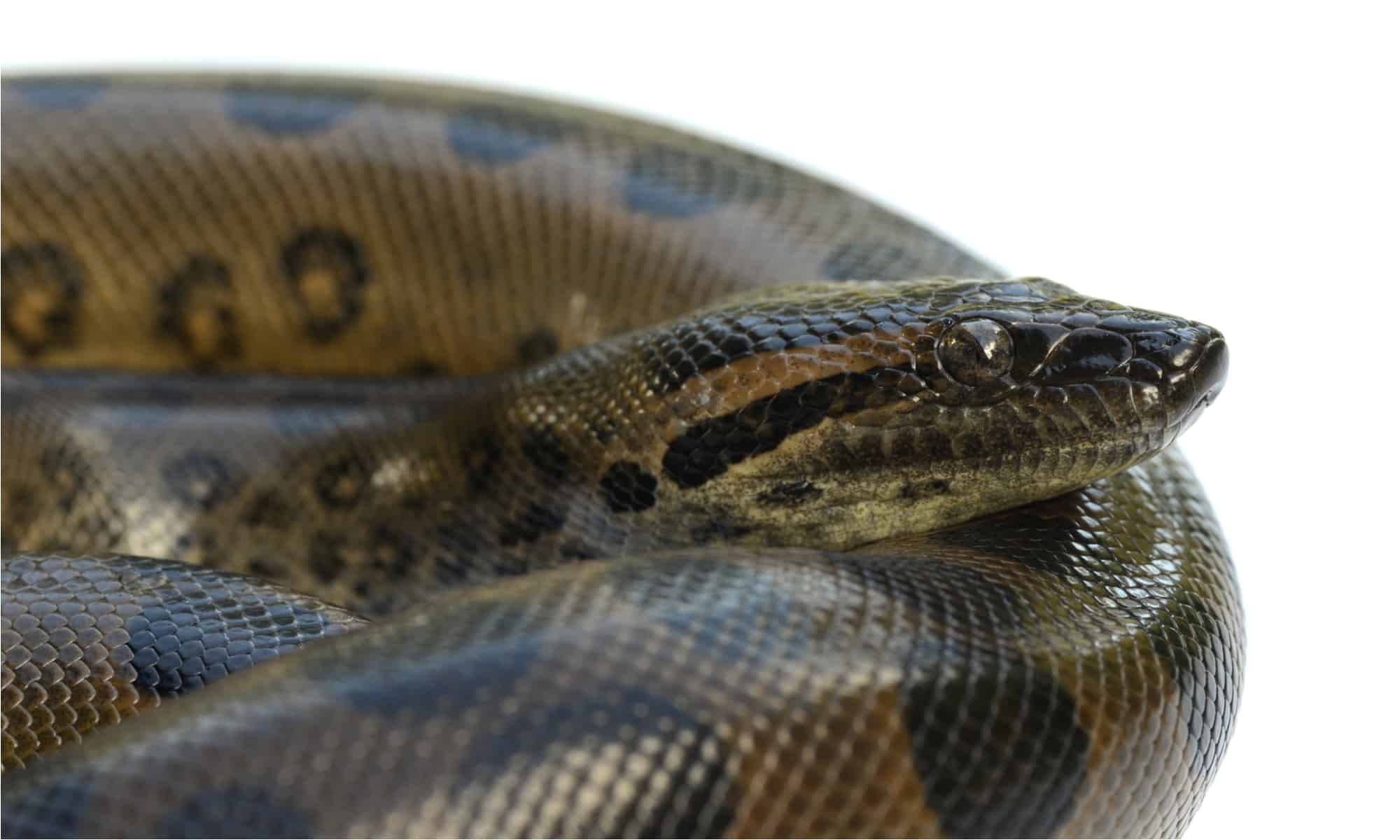
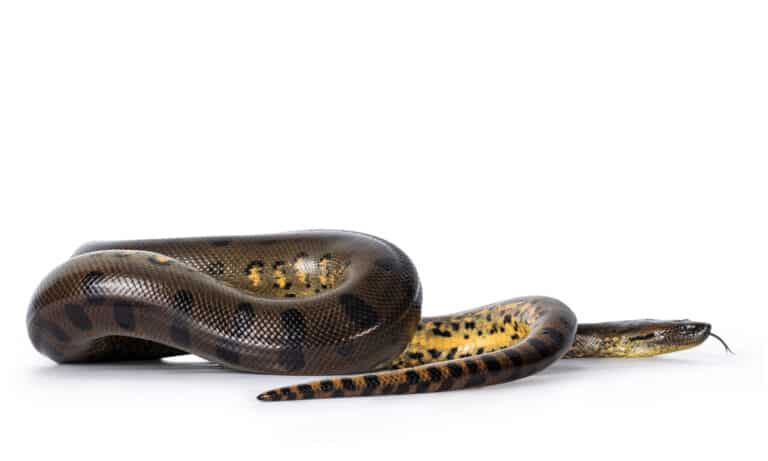
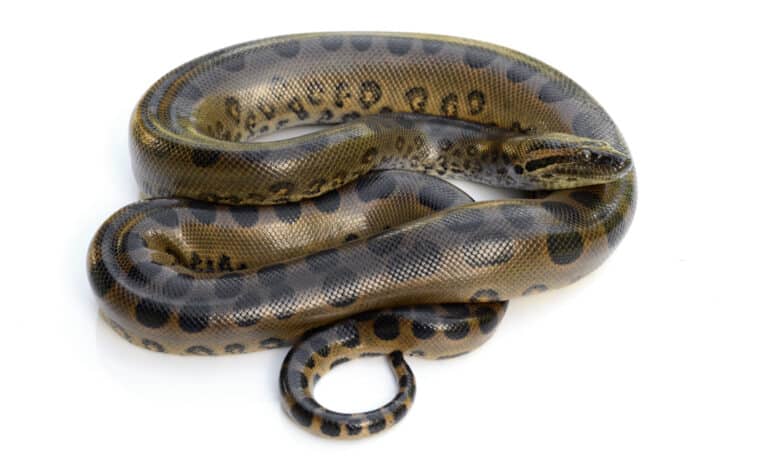
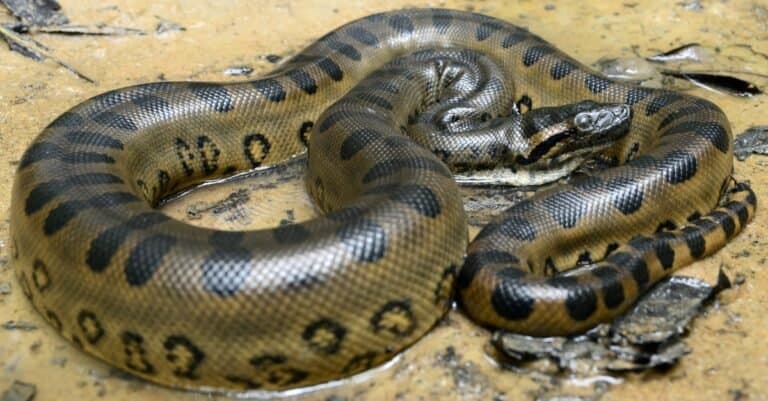
The green anaconda is a nonvenomous constrictor with a mouthful of rear-pointing, razor-sharp teeth. It’s a smooth, shiny snake with a greenish base color and has round or oval spots down its back and on both sides, with a black-spotted yellow belly. The spots along its side have yellow centers.

Its head, like other boas, is blunt; but its eyes and nostrils sit on the top of its head, allowing it to sit just under the surface of the water without being seen. Its body is thick and muscular and sometimes measures 12 inches in diameter. This species is sexually dimorphic, and the females are sometimes five times longer than the males.
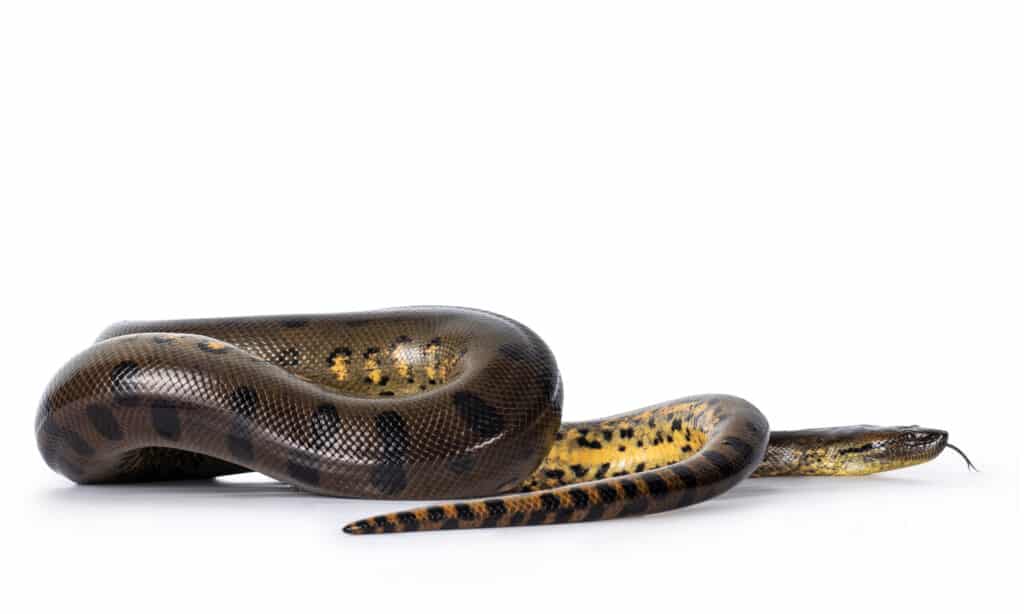
Young green anaconda; females of the species may reach 30 feet long as adults.

Pictures and Videos of Green Anacondas
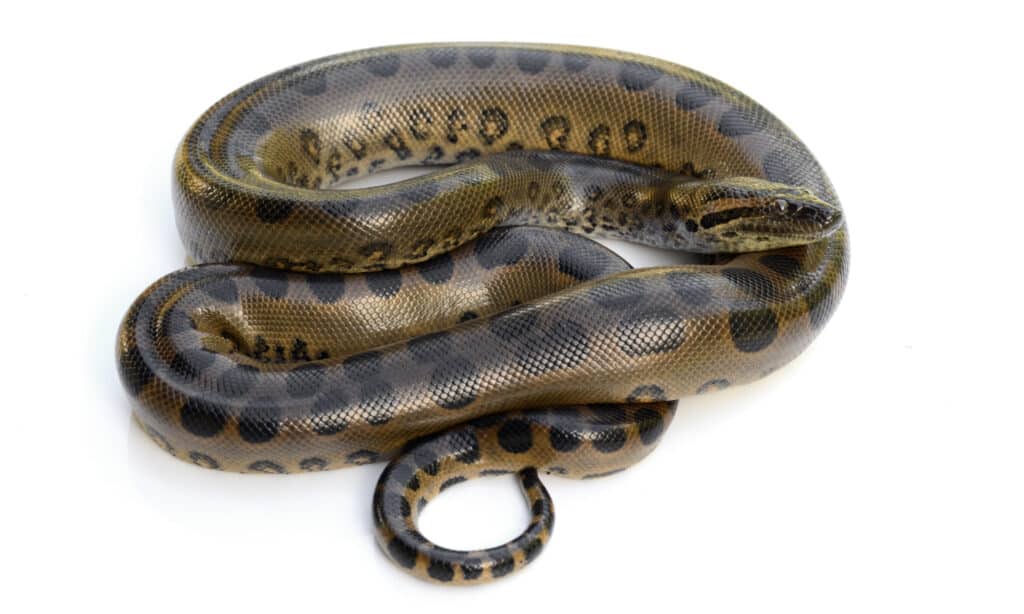
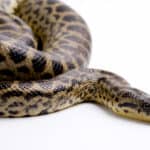
green anaconda

Green anacondas are aggressive when in captivity.

Where Do Snakes Live

A Green anaconda (Eunectes murinus), which is especially partial to flooded grassland.

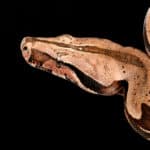
green anaconda closeup

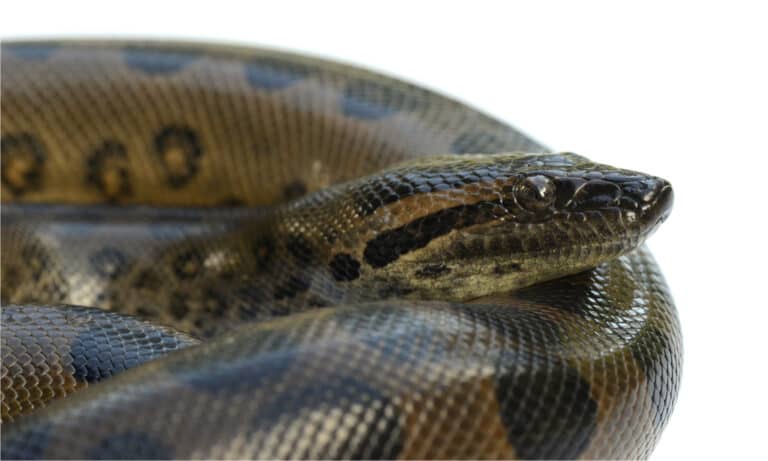
Green anacondas’ eyes and nostrils are on top of their head.

https://youtu.be/Y24Z3_4C8J8
This green anaconda may have been near 30 feet, but without actually measuring it, a guess is all we’ll get.
Green anacondas are generally shy, but if you are calm and do not act aggressively sometimes great experiences can happen.

How Dangerous are Green Anacondas?

This snake has a fearsome reputation, and it’s somewhat deserved. In the wild, it can be very aggressive in defending itself, but would usually rather escape. Sometimes, it is rather placid and curious about humans, as in the video above. However, in captivity, the species tends to be more aggressive and apt to bite.

Placid, beautiful experiences with the snake aside, it is exceptionally strong and can easily injure or kill a human. Verified reports of a green anaconda having eaten people are rare, yet the fact that they have been verified indicates the danger level with large specimens. People not trained in handling large snakes should give it some space, and never handle one without help.

Green Anacondas Behavior and Humans

In areas like Florida, where they are becoming more established, human encounters are happening with increasing regularity. Green anacondas were originally introduced to Florida by people who had grown tired of a huge pet snake. Florida Fish and Wildlife advises people who sight one to call a specialized phone number or report it through an app.

People in their native range hunt them for their skins, but most interactions are accidental and harmless. However, locals often blame green anacondas for missing children, dogs, and livestock. Sometimes this is accurate! They will eat anything they can overpower and swallow and scientists have found various species ranging from rats to deer and cattle in their stomachs.

View all 261 animals that start with G

Sources

  1. Smithsonian National Zoo / Accessed April 24, 2022
  2. The Ecology of Human-Anaconda Conflict / Published March 1, 2016 / Accessed April 24, 2022
  3. Rainforest Alliances / Accessed April 24, 2022
  4. USGS Nonindigenous Aquatic Species / Accessed April 24, 2022
  5. Reptiles of Ecuador / Accessed April 24, 2022
Gail Baker Nelson

About the Author

Gail Baker Nelson

Gail Baker Nelson is a writer at A-Z Animals where she focuses on reptiles and dogs. Gail has been writing for over a decade and uses her experience training her dogs and keeping toads, lizards, and snakes in her work. A resident of Texas, Gail loves working with her three dogs and caring for her cat, and pet ball python.
Connect:

Thank you for reading! Have some feedback for us?


Green Anaconda FAQs (Frequently Asked Questions)

They’re not to be messed with. In the wild, they’re probably going to attempt escape, but in captivity they can be very aggressive.