M
Species Profile

Moose

Alces alces

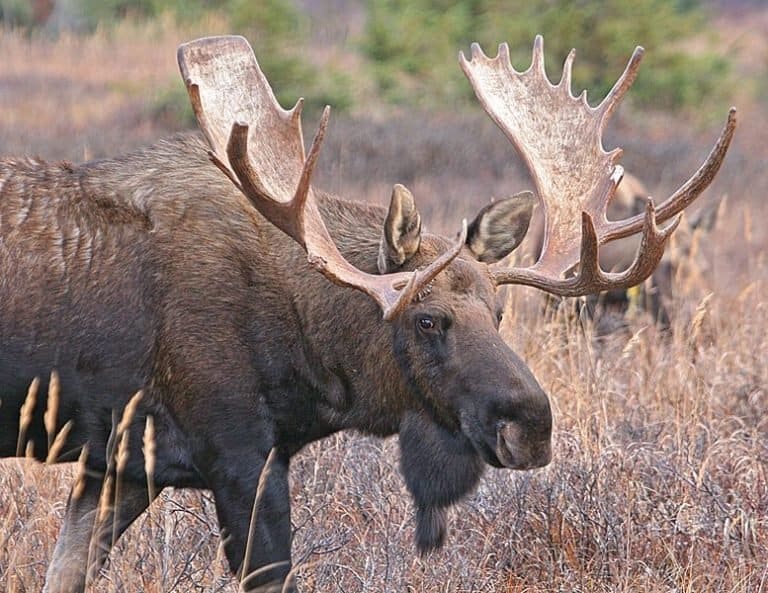
Palmate antlers, wetland giant.
Donna Dewhurst / Public Domain

At a Glance

Wild Species
Also Known As Elk, Eurasian elk, European elk
Diet Herbivore
Activity Crepuscular+
Lifespan 10 years
Weight 720 lbs
Status Least Concern
Did You Know?

Largest living deer (Cervidae): adult bulls commonly 380-700 kg; cows ~200-490 kg.

Size Comparison

Human 5'8"
Moose 5 ft 11 in

Moose is 1.0x the height of an average human.

Scientific Classification

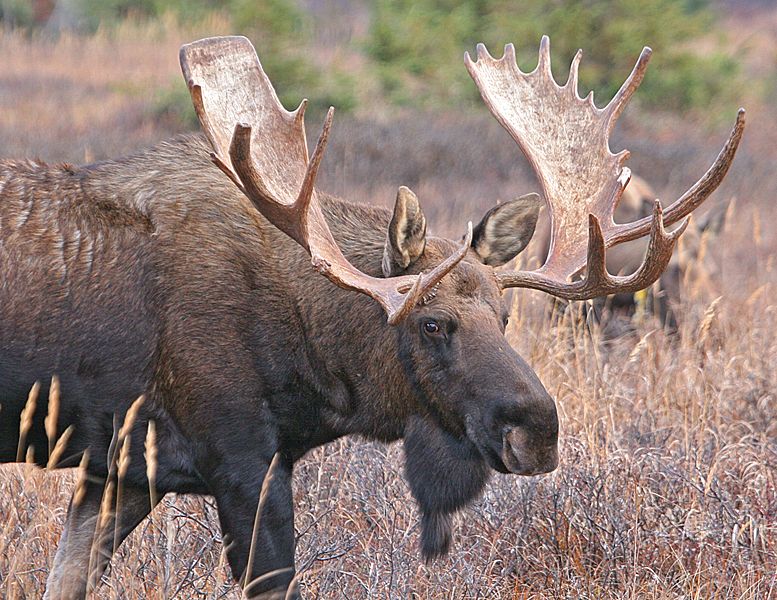
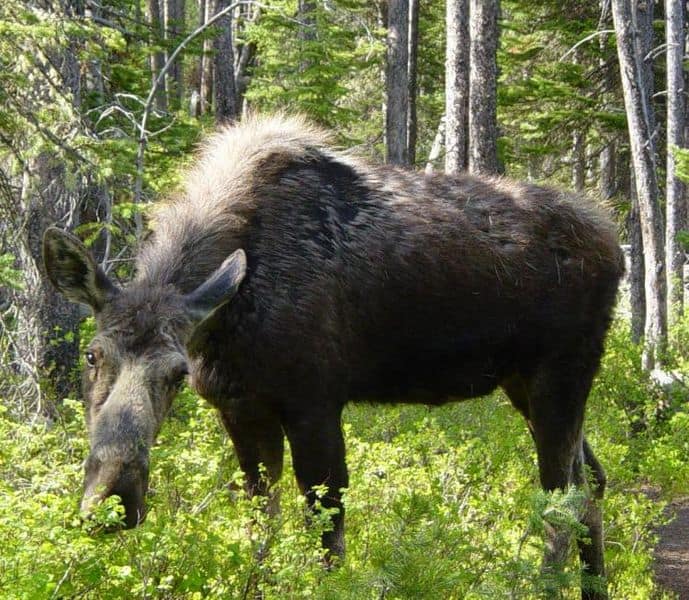
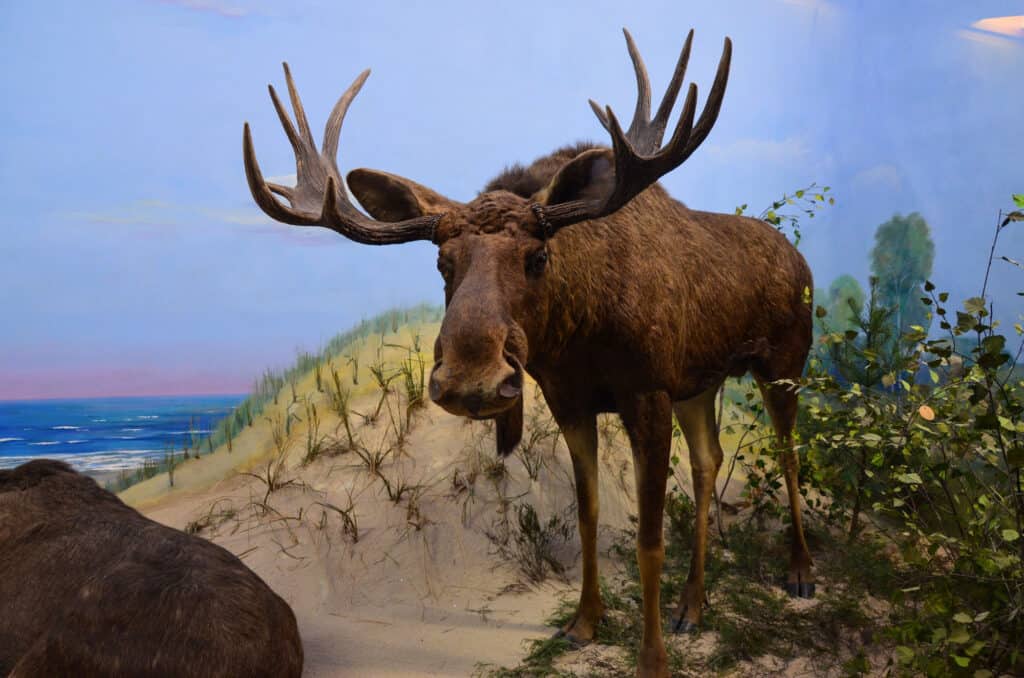
The moose (Alces alces) is the largest species in the deer family (Cervidae), characterized by long legs, a heavy shoulder hump, a large overhanging muzzle, and (in males) broad palmate antlers.

Kingdom
Animalia
Phylum
Chordata
Class
Mammalia
Order
Artiodactyla
Family
Cervidae
Genus
Alces
Species
Alces alces

Distinguishing Features

  • Largest living deer; long legs adapted for deep snow and wading
  • Male antlers are broad and palmate (shovel-like) rather than branched like many other deer
  • Prominent shoulder hump and large, drooping muzzle
  • Dewlap (“bell”) hanging from the throat

Physical Measurements

Males and females differ in size

Height
5 ft 11 in (4 ft 7 in – 6 ft 11 in)
5 ft 5 in (4 ft 7 in – 5 ft 11 in)
Length
9 ft (7 ft 10 in – 10 ft 2 in)
9 ft 1 in (7 ft 9 in – 10 ft 3 in)
Weight
1,190 lbs (838 lbs – 1,543 lbs)
661 lbs (441 lbs – 794 lbs)
Tail Length
3 in (2 in – 5 in)
3 in (2 in – 5 in)
Top Speed
35 mph
running

Appearance

Primary Colors
Secondary Colors
Skin Type Thick hide with coarse hollow guard hairs over dense insulating underfur; short summer coat, long winter coat.
Distinctive Features
  • Largest living cervid; long legs and high withers for boreal forest and wetland travel.
  • Pronounced shoulder hump created by elongated scapular spines and strong shoulder musculature.
  • Large overhanging muzzle with broad, flexible nose; efficient browsing on twigs and aquatic plants.
  • Expandable throat dewlap ("bell") present in both sexes, typically larger in adult males.
  • Broad, palmate antlers in males; antlers grow in velvet and are shed annually after rut (Franzmann, 1981).
  • Splayed, dewclaw-equipped hooves adapted for snow, muskeg, and soft wetland substrates.
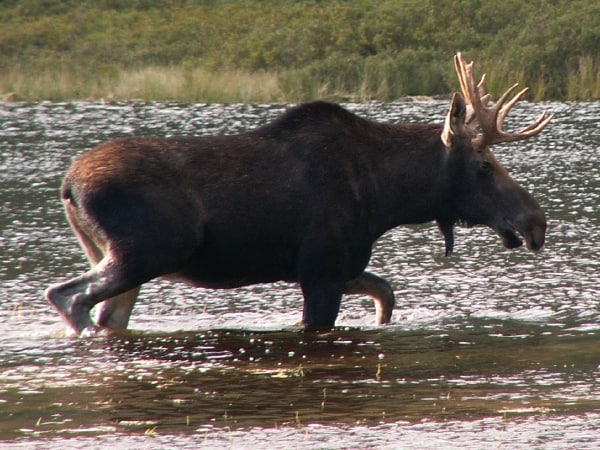
  • Aquatic foraging common: wades/swims to feed on submerged macrophytes; strong swimmer (Franzmann, 1981).
  • Adult size (typical ranges): shoulder height ~1.4-2.1 m; body mass commonly ~200-700 kg depending on sex/region (Franzmann, 1981; Geist, 1998).
  • Longevity: commonly up to ~15-20 years in the wild; maximum recorded ~25 years (Franzmann, 1981).

Sexual Dimorphism

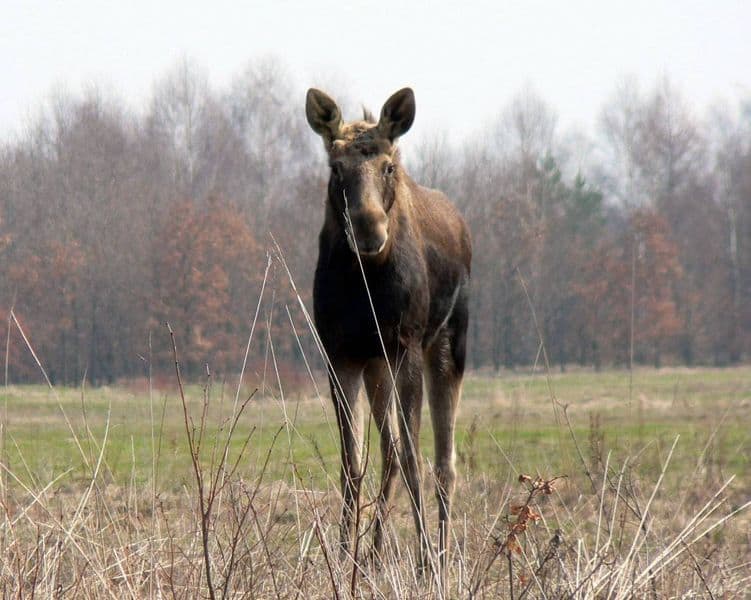
Males are substantially larger and grow broad, palmate antlers annually; females lack antlers. Males typically show a more pronounced shoulder mass and larger bell, especially in prime-age adults during the rut.

  • Broad palmate antlers (largest in prime-age adults), grown in velvet and shed yearly.
  • Greater average body mass and height; heavier shoulder/neck musculature in rut.
  • Bell (throat dewlap) typically larger and more conspicuous.
  • Rut behaviors include grunting, antler displays, and mate-guarding (Franzmann, 1981).
  • No antlers (rare exceptions not typical).
  • Smaller overall body size and lighter shoulder build.
  • Bell present but usually smaller/less pendulous than in adult males.
  • Maternal behaviors include solitary calving and aggressive calf defense.

Did You Know?

Largest living deer (Cervidae): adult bulls commonly 380-700 kg; cows ~200-490 kg.

Shoulder height is towering: bulls ~1.4-2.1 m at the shoulder (cows ~1.2-1.8 m).

Bulls grow broad, palmate antlers yearly; typical spread ~1.2-1.8 m, with exceptional records ~2.1 m.

Aquatic foragers: can swim about 9-10 km/h and readily cross lakes and rivers.

Can dive for underwater plants to roughly 5-6 m and remain submerged around ~30 seconds.

Gestation is about 230 days; calves weigh roughly 10-16 kg at birth, and twins are common in good habitat.

Unique Adaptations

  • Long legs + splayed hooves: efficient travel through deep snow, bogs, and marsh edges; hooves spread for support on soft substrates.
  • Shoulder hump: enlarged musculature supporting a heavy head and aiding in pushing through snow and dense brush while browsing.
  • Prehensile upper lip and large, overhanging muzzle: precise stripping of leaves and twigs; excellent for browsing woody plants.
  • Closable nostrils and comfort underwater: supports repeated submersion while feeding on aquatic vegetation.
  • Palmate antlers (males): broad "paddles" increase display area in rut and provide leverage in pushing contests; antlers are regrown annually.
  • Insulating coat: long guard hairs and dense underfur help retain heat in boreal winters; seasonal coat change matches temperature shifts.
  • Ruminant digestion: a multi-chambered stomach enables extraction of nutrients from fibrous browse and aquatic plants.

Interesting Behaviors

  • Aquatic feeding and diving: moose wade and submerge their heads to browse pondweeds and other aquatic plants, especially in summer.
  • Seasonal movement: shift between summer wetland/shoreline ranges and winter conifer cover where snow is shallower and browse is available.
  • Rut behavior (autumn): bulls advertise with grunts and thrashing vegetation; they may spar with other bulls, using antlers and body pushing.
  • Calf defense: cows can be highly aggressive near calves, striking with forefeet; calves typically stay with the cow for about a year.
  • Heat management: on hot days, moose seek shade and water; heat stress strongly influences daily activity patterns.
  • Browsing strategy: selective feeding on woody twigs (willow, birch, aspen) and abundant summer herbaceous/aquatic growth to rebuild body reserves.

Cultural Significance

Moose (Alces alces) are key animals for many Indigenous peoples of North America and northern Eurasia, used for meat, hides, and sinew. They matter to northern life (autumn hunts, road signs). In Sweden they are a national symbol; in Europe 'elk' often means moose.

Myths & Legends

Wabanaki (Northeastern North America) stories of the culture hero Gluskabe tell how he confronted an enormous, dangerous moose and diminished its size so humans could live alongside it and hunt it.

Cree and Ojibwe/Anishinaabe oral traditions include "Moose" as a powerful forest-being and a central figure in hunting teachings-stories commonly emphasize respect, restraint, and reciprocity with the animal that provides food and clothing.

In several Algonquian-language traditions, winter hunting tales feature Moose as a test of patience and proper conduct; success depends on humility and careful observance of hunting protocols taught by Elders.

Northern Eurasian (Siberian) Indigenous traditions-among Evenki and related peoples-include accounts of great elk/moose spirits of the taiga associated with hunting luck and the moral responsibilities of taking game.

Scandinavian folk belief and rural storytelling often treated the moose as a formidable "forest king," with hunters recounting cautionary tales of the animal's strength and unpredictability, reinforcing codes of careful, ethical pursuit.

Conservation Status

LC Least Concern

Widespread and abundant in the wild.

Population Decreasing

Protected Under

  • Not listed on CITES Appendices.
  • Generally regulated as a hunted game species under national/subnational wildlife legislation across its range (e.g., hunting seasons, licensing, quotas, and bag limits in Scandinavia, Canada, and U.S. states).
  • Occurs in numerous protected areas (national parks and reserves) where hunting may be restricted or prohibited, providing partial refuge depending on jurisdiction.

Life Cycle

Birth 1 calf
Lifespan 10 years

Lifespan

In the Wild
0.3–20 years
In Captivity
1–25 years

Reproduction

Mating System Polygyny
Social Structure Solitary
Breeding Pattern Seasonal
Fertilization Internal Fertilization
Birth Type Internal_fertilization

During the September-October rut, bulls roam and compete via displays and fights, mating with multiple receptive cows; cows may mate with more than one bull. Pairing is brief; females gestate ~230-240 days and rear 1-2 calves alone.

Behavior & Ecology

Social Family group Group: 1
Activity Crepuscular, Cathemeral
Diet Herbivore Willow (Salix spp.) browse and aquatic macrophytes (notably pondweeds, Potamogeton spp.)
Seasonal Migratory 19 mi

Temperament

Generally wary and avoidant of humans; habituation occurs in some urban/suburban populations.
Strong seasonal aggression: cows most defensive at calving; bulls most aggressive during rut (Franzmann & Schwartz 1998).
Dominance interactions are usually low-intensity (threat postures), escalating to kicking/antler pushing when crowded.
Across populations, sociality is low; grouping increases where forage is concentrated or snow limits movement.
Longevity context: wild individuals commonly reach 8-12 years; maximum ~20 years recorded (Franzmann & Schwartz 1998).

Communication

Cow long-range moans/low calls to attract bulls and maintain contact with calves Franzmann & Schwartz 1998
Calf bleats and bawls used for contact and distress, especially when separated from cow.
Bull grunts and rut vocalizations during courtship and competitive encounters; intensity peaks in rut.
Chemical signaling via urine and gland scents; bulls assess estrus and rival presence by scent Franzmann & Schwartz 1998
Visual threat displays: head-lowering, ear position changes, hair raising, and lateral presentation.
Antler/body displays and sparring (primarily bulls) establish dominance and reduce mating competition injuries.
Olfactory marking and investigation of rubs, wallows, and disturbed vegetation during rut.
Tactile signals within family groups: cow-calf nudging and close following for cohesion.

Habitat

Biomes:
Boreal Forest (Taiga) Temperate Forest Temperate Rainforest Tundra Alpine Freshwater Wetland +1
Terrain:
Plains Hilly Plateau Valley Mountainous Riverine Coastal Island +2
Elevation: Up to 9842 ft 6 in

Ecological Role

Large-bodied, landscape-shaping browser and aquatic macrophyte grazer in boreal and temperate forest-wetland mosaics; a key herbivore that regulates woody regeneration and wetland plant biomass.

Shapes forest succession and stand structure by selective browsing (influences willow/aspen/birch recruitment and shrub-layer density) Creates habitat heterogeneity for other species via patchy browsing pressure and trail formation Nutrient cycling and fertilization through dung/urine deposition; transfers nutrients between aquatic and terrestrial systems when feeding across wetlands and forests Provides carrion and supports scavenger guilds when individuals die (indirect ecosystem support)

Diet Details

Other Foods:
Willow twigs and buds Birch twigs and leaves Trembling aspen and other poplars Rowan / Mountain ash Conifer browse Herbaceous forbs and leaves Aquatic macrophytes +1

Human Interaction

Domestication Status

Wild

Alces alces is not domesticated. People tried limited taming (notably Russian 20th–21st moose‑farming) where calves were bottle‑raised for handling, riding and milk yields, but no stable domesticated lines. Humans hunt moose, manage collisions and conflicts, and watch them. Large size (males ~380–700 kg, females ~200–490 kg), rut aggression, strong flight response, special care needs, and ~15–20 year lifespan limit domestication.

Danger Level

High
  • vehicle collisions (major cause of severe human injury/fatality risk due to large body mass and high shoulder height, with the torso often impacting windshields)
  • aggressive encounters: cows defending calves (spring-summer) and bulls during rut (typically autumn) can charge, trample, and kick
  • handling risk in captivity (stress, unpredictable flight/charge behavior; difficult chemical immobilization/logistics)
  • ectoparasites and tick-borne disease exposure risk in shared habitats (e.g., ticks carried by moose), though moose are not a primary direct vector to humans

As a Pet

Not Suitable as Pet

Legality: Moose (Alces alces) are generally illegal or very restricted as pets. Some places allow them only with wildlife permits, inspections, and usually in licensed zoos, research, or rehab; private ownership is usually banned.

Care Level: Expert Only

Purchase Cost: $5,000 - $15,000
Lifetime Cost: $250,000 - $900,000

Economic Value

Uses:
Subsistence and recreational hunting Meat and hide production Antler and craft materials Wildlife viewing/ecotourism Traffic-safety and management costs (negative economic impact) Forestry/agriculture browsing damage (negative economic impact)
Products:
  • venison (meat)
  • hide/leather
  • antlers (craft/decoration; shed antler collection where legal)
  • licenses/permits and guided-hunt services
  • tourism services (wildlife tours, viewing)

Relationships

Ecological Equivalents 5

Animals that fill a similar ecological role in their ecosystem

Elk
Elk Cervus canadensis Often sympatric with moose in boreal and temperate forest mosaics. Both are large cervids influencing vegetation through heavy browsing and grazing, but elk tend to graze more while moose are primarily browsers.
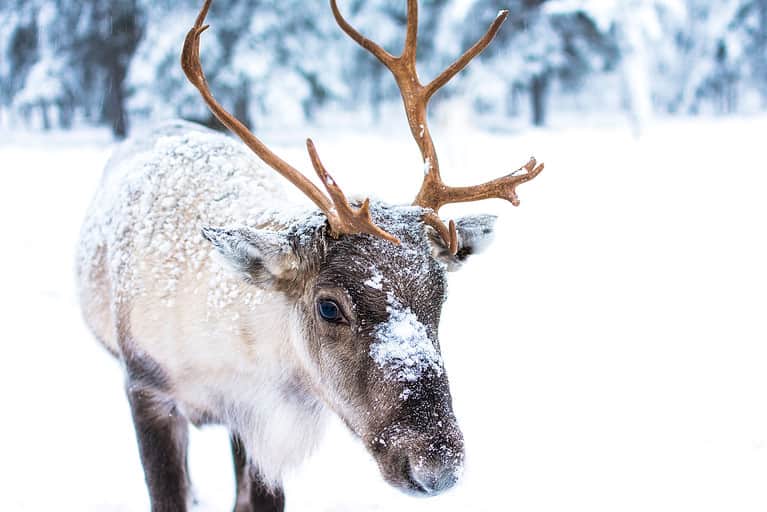
Woodland caribou Rangifer tarandus caribou Shares northern/boreal distributions and predator guilds. Both are large-bodied cervids adapted to cold climates and seasonal forage limitations — caribou are more lichen-focused, whereas moose rely more on browse and aquatic vegetation.
Muskox
Muskox Ovibos moschatus Overlaps in high-latitude ecosystems in parts of the Arctic and subarctic; both face winter forage constraints and predation by wolves, although muskoxen are more specialized tundra grazers.
American bison
American bison Bison bison Comparable large-herbivore ecological role: high biomass, strong vegetation impacts, and shared predators such as wolves in regions where their ranges or landscapes intersect. However, bison are primarily grazers while moose are primarily browsers.
European bison Bison bonasus A functional analogue in Eurasian forest-meadow systems: a very large ungulate that shapes plant communities and provides prey biomass for large carnivores, paralleling the moose's role in boreal forests.

“Largest of all deer species.”


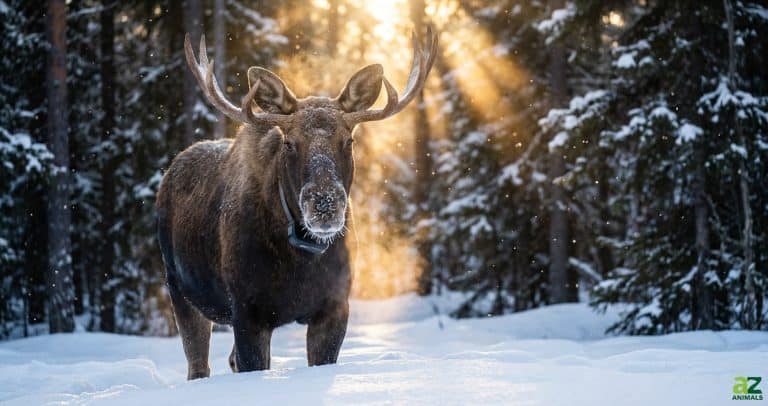
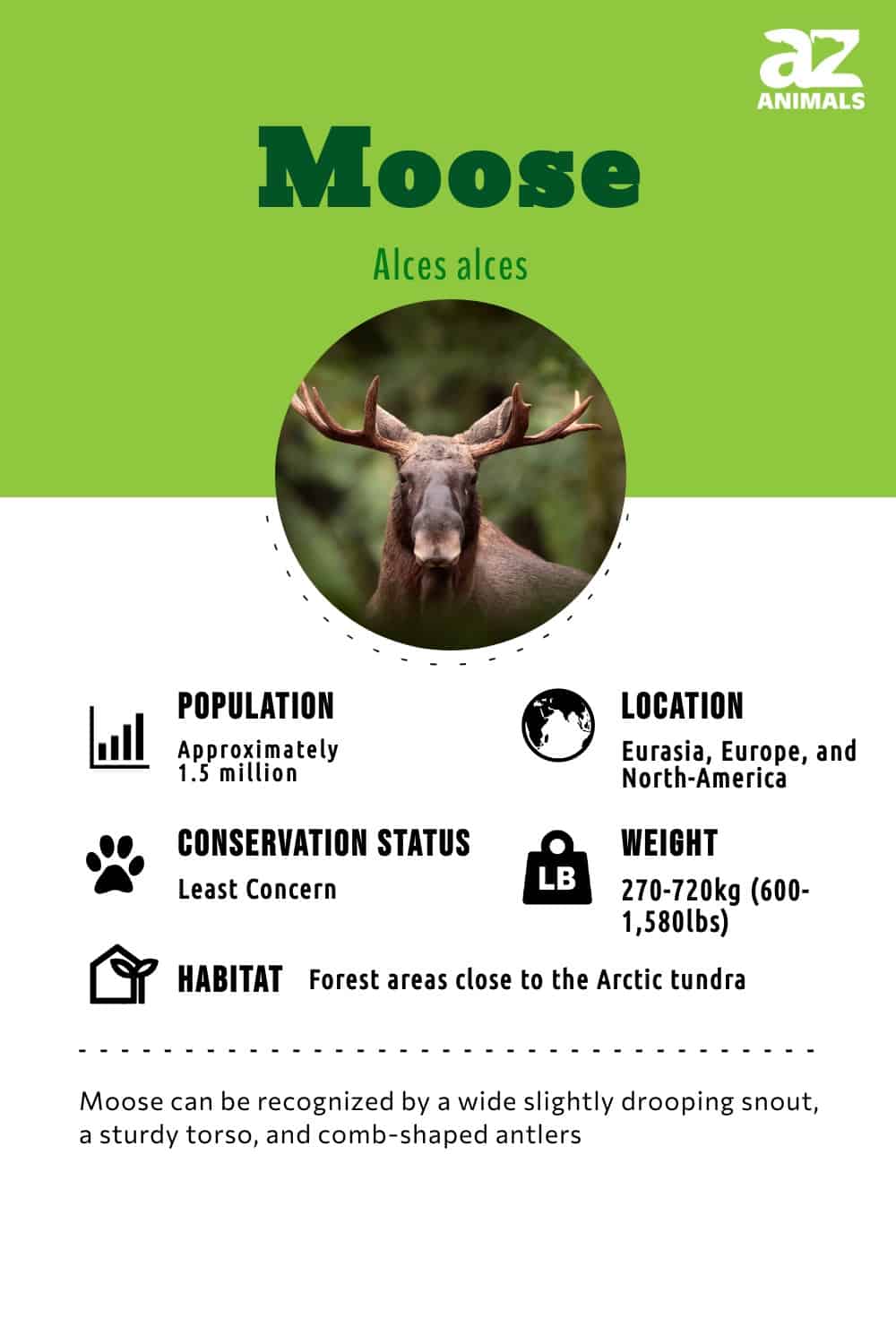
Moose are the largest of the deer species and the tallest mammals in North America. Found in the U.S., Canada, Asia, and Europe, fully grown adults stand six feet from ground to shoulder. They are identified by long faces, muzzles hanging over their chins, and a flap of skin swaying under their throat. Male moose grow huge antlers up to six feet wide from one end to the other.
 

5 Incredible Moose Facts

  • Adult male moose weigh between 1200 and 1800 pounds. The largest moose ever recorded weighed in at 1,808 pounds!
  • Life expectancy for a moose in the wild is 15 to 20 years.
  • Moose are animals that feed on land and aquatic plants.
  • Moose hooves work like snowshoes in harsh winter climates.
  • Despite looking clumsy, moose can run up to 35 miles per hour.
Scientific Name

Commonly called moose in America and elk in Europe and Asia, these large animals bear the scientific name “Alces alces.” As mammals, they belong to the order Artiodactyla, family Cervidae, and genus Alces.

The common name “moose” became a recognized English word no later than 1606. This term comes from the Algonquian language name “mo-swa” or “moosh” with possible influences from multiple other languages.
 

Evolution
moose

The ancestor of the modern moose lived during the Pliocene era in Western and Central Asia

The ancestor of the elk, Libralces gallicus, lived about 2 million years ago. The ancient cervid was known for its sweeping antlers capable of rivaling the Megaloceros’ with a spread of about 6 feet wide or even more. During the Pliocene era it wandered about the grasslands of Northern Europe where the climate was mild.

The ancestor of the moose was also about twice as large as the modern moose found in Alaska with its antlers extending horizontally. It is actually the best-known member of the genus of Eurasian deer Libralces which could be found in the area between France and Tajikistan.

Appearance & Behavior
Moose Size Comparison - Moose vs Elk vs Horse vs Human
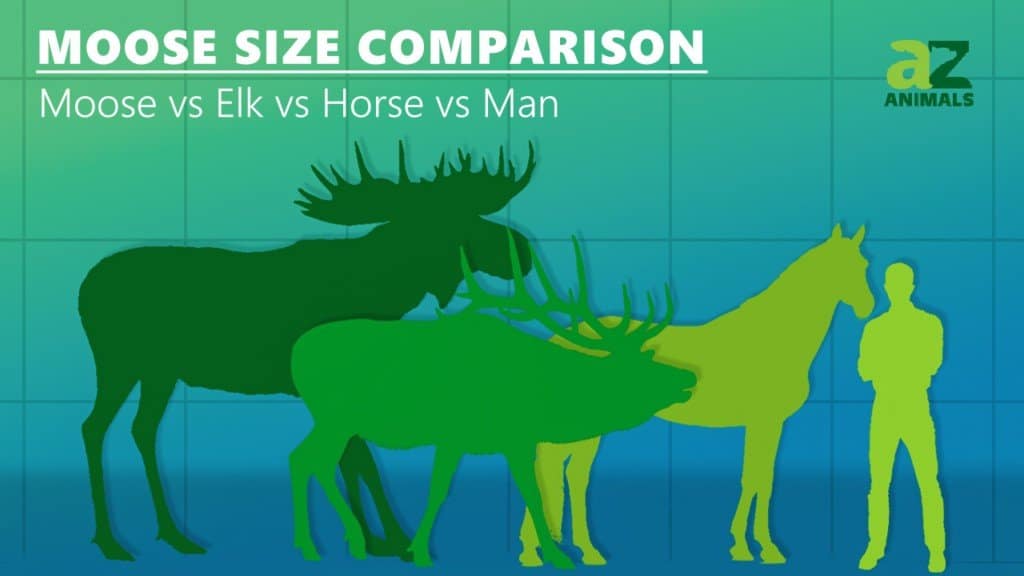
A size comparison of a moose up against an elk, horse, and human. See our moose size comparison article for a full analysis of their dimensions!

Moose are very large, sturdy, and strong animals. They stand from hoof to shoulder as high as a fully grown man, at about six feet. Their bones are large and their bodies are muscular. Females are smaller than males, usually weighing from 800 to 1200 pounds as adults. Although they can grow larger, male adults range from 1200 to 1600 pounds, on average.

Moose are animals that live in herds during the breeding season in the wild, although they typically appear solitary or at a distance from other members of the herd. In fact, they are the most solitary and antisocial animals in the wild, outside of breeding. During mating season, males form their own herds of females called “harem herds.” Males fight each other for the right to mate with a harem.

Moose fur is light brown to dark brown in color, easily camouflaging them in their surroundings. This fur is long and thick, with each hair being hollow to aid in warmth. Their legs are long, with the front pair being slightly longer than the back. This makes moose appear gangling and clumsy. But the longer front legs help them amble over forest debris, such as fallen trees and branches.

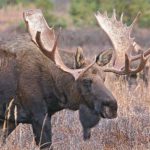
The moose’s head is long like a horse‘s, but features an enlarged nose and upper lip. Their ears are small, as is their tail. Adding to their funny faced-appearance is a humpback appearance caused by large and strong shoulder muscles. On their throat hangs loose skin called a dewlap.

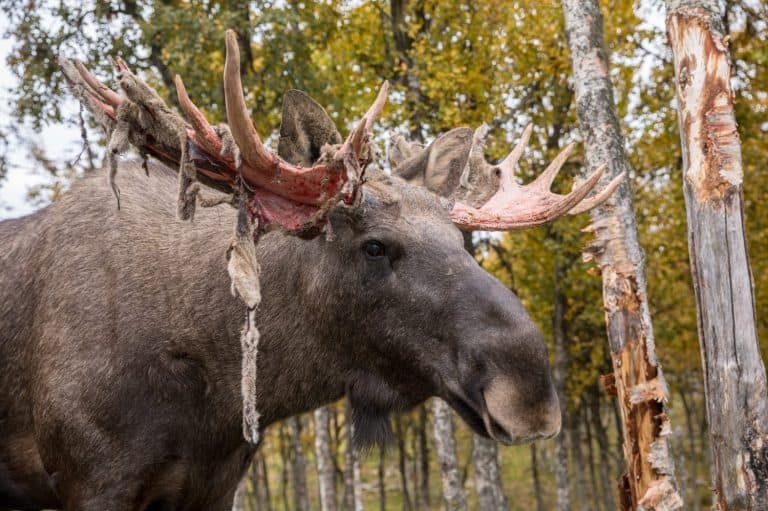
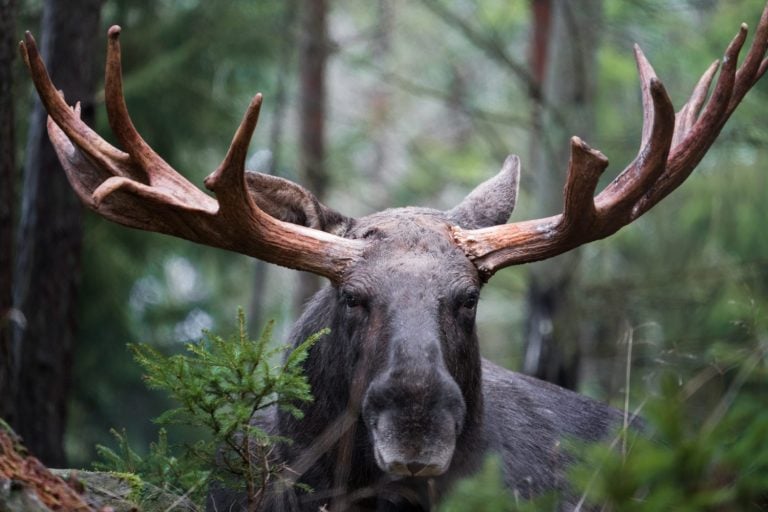
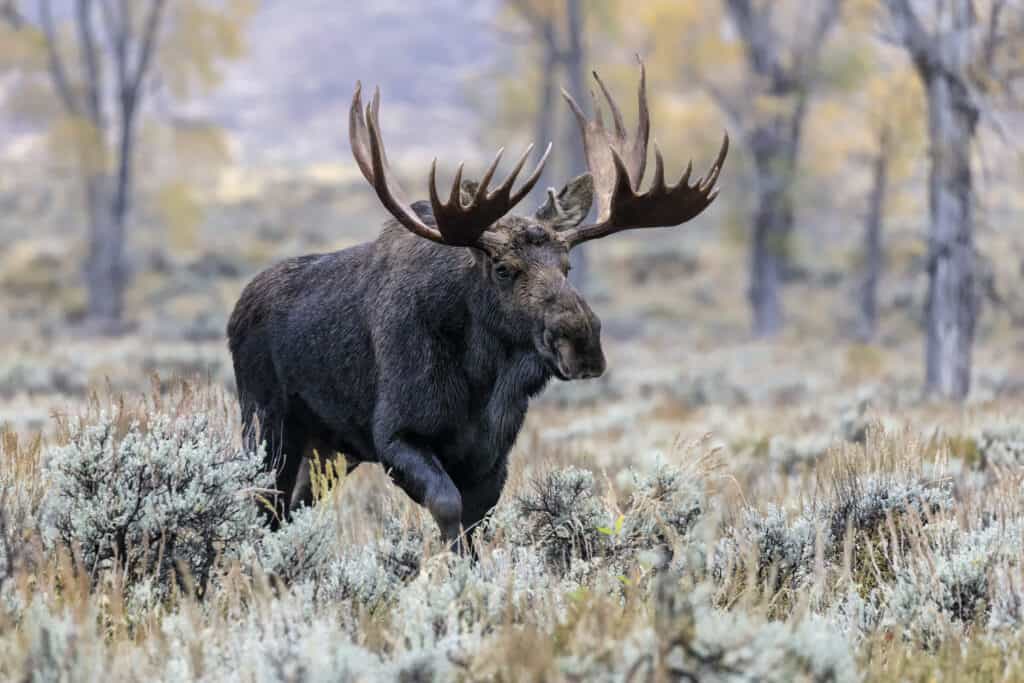
Large, broad, and flat antlers make a moose’s appearance even more distinct from other members of the deer family. Only males have these antlers that stretch between four and six feet across at full growth. These antlers start growing in late spring or early summer, first covered by a fuzzy skin called velvet. In the velvet are tiny blood vessels that feed nutrients to the antlers to help them grow. When the antlers stop growing by the end of summer, these blood vessels dry up and the velvet starts shedding. By early fall, moose antlers take on the characteristic look of dried bone. They weigh up to 40 pounds and fall off during winter.

Moose feed throughout the day. They are most active at dawn and dusk. Although they cannot see very well, they have an exceptional sense of smell. These large mammals also hear well. They are strong swimmers from a few weeks after birth and can reach a swimming speed of up to six miles per hour. Moose even fully submerge and stay underwater for up to 30 seconds at a time.

Moose are gentle and peaceful on their own in their natural habitat. But if bothered by other animals or humans, they become aggressive. These mammals are highly territorial and do not hesitate to charge at anyone or anything threatening their space. Even though they look clumsy and slow, moose can easily outrun humans. In a battle against one of their biggest predators, the brown bear, a moose puts up a good fight. They even sometimes win. To attack a predator or human, moose repeatedly stomp their legs on the threatening creature and use their antlers in defense.
 

Habitat
Large bull moose

Because they do not perspire, moose cannot withstand temperatures above 80 degrees Fahrenheit

Moose live throughout the colder northern regions of North America, Europe, and Asia where there is annual snow cover. They cannot live in temperatures above 80 degrees, as they do not sweat. The foods they eat create a lot of body heat during digestion.

Regions have subspecies, each with unique adaptations to their environment. North American moose include the eastern moose of Canada and the northeastern U.S.; the northwestern moose of central Canada, North Dakota, Minnesota, and Michigan; Alaskan moose of northwestern Canada and the state of Alaska; and the Shiras moose of the U.S. and the Canadian Rocky Mountains.

In Europe and Asia, some animal experts consider the moose family to contain several subspecies, too. These unofficial subspecies include the European moose, Siberian Yakut moose, west Siberian Ussuri moose and east Siberian Kolyma moose.

Each subspecies of moose differs according to its geography, size, antler characteristics and fur. Body sizes differ due to localized diet and conditions. Alaska and eastern Siberia have the largest moose, with bulls weighing an average of 1300 pounds and up to seven feet tall at the shoulder. Wyoming and Manchuria are home to the smallest moose with bulls weighing up to only 770 pounds.
 

Diet
What Do Moose Eat
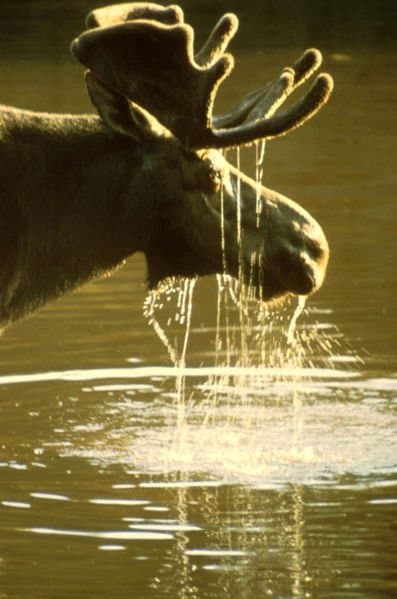
Moose enjoy both terrestrial and aquatic vegetation

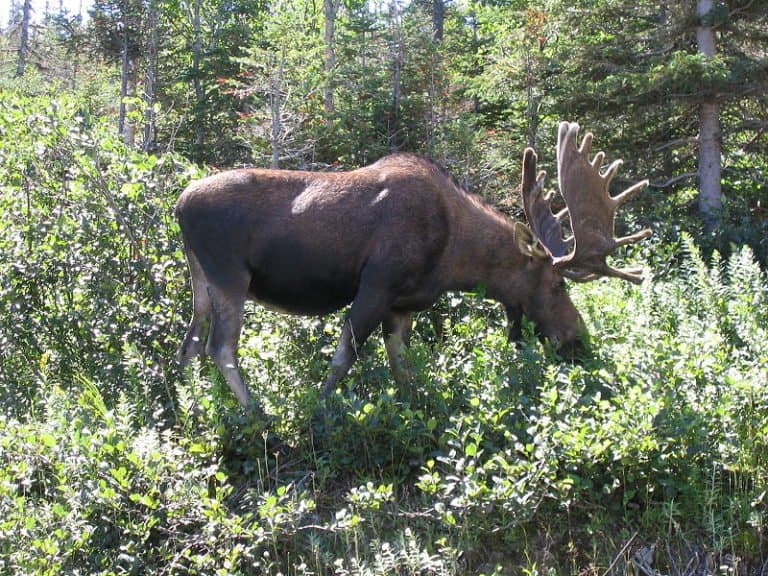
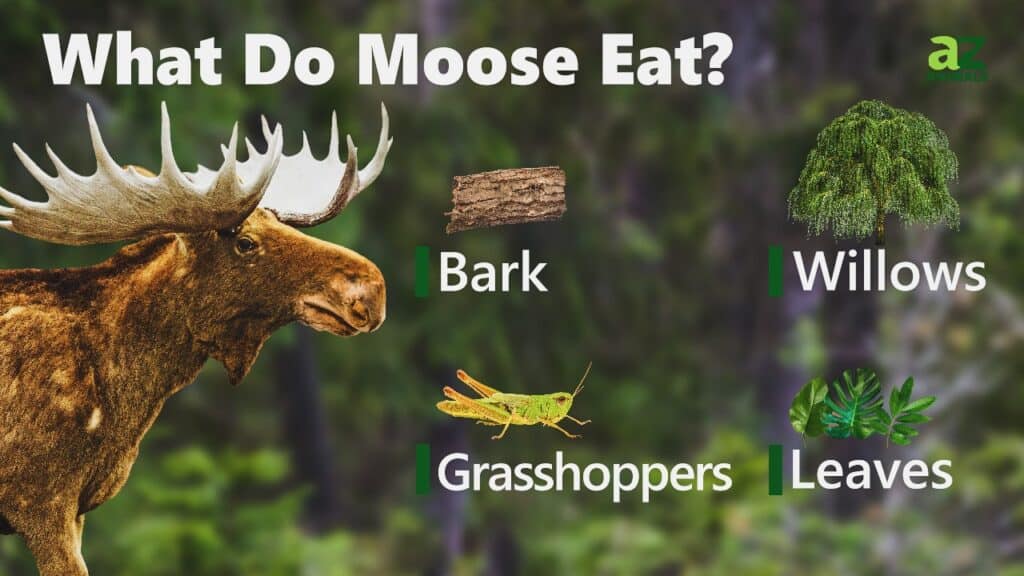
Moose are herbivores that graze from dawn to dusk. They eat up to 70 pounds of vegetation per day. Their habitat consists of plant-rich environments with shrubs available for feeding. The animals prefer shrubs disturbed by forest fires, flooding, or avalanches. In summer, moose also feed on aquatic vegetation. They wade into water to reach these plants and even dive underwater to reach them. These large mammals enjoy mineral licks.

In winter, you can find moose eating fir, yew, and other conifers. To get through heavy blankets of snow moose herds follow a system of trails they trample. These trails form a “moose yard.”

Preferred foods in their diets include bark, leaves, twigs, pine cones, tree buds, shrub buds, and water lilies. Favorites are willow, aspen, and balsam fir. When they eat, their food passes through four stomach chambers as part of digestion. The first chamber ferments the food and the other three chambers extract nutrients. Like cows, moose “chew their cud.” Cud is regurgitated food they chew on for a period of time before swallowing.

Foods poisonous to these otherwise hearty animals include chokecherry, European yew, and Japanese yew plants. The plants prove deadly to moose because their cells contain cyanide gas. Within a few hours of eating these plants the moose dies. Sadly, these trees and shrubs are common in cultivated gardens throughout moose territory, such as Alaska.

Moose prefer eating from plants at their head or shoulder level, especially with up to 40 pounds of antler weight on their heads. To reach other levels of food, they stoop to their front knees or spread their legs wide apart like a giraffe. For a complete analysis of their diet, give our ‘What Do Moose Eat?’ page a read!”

Predators & Threats
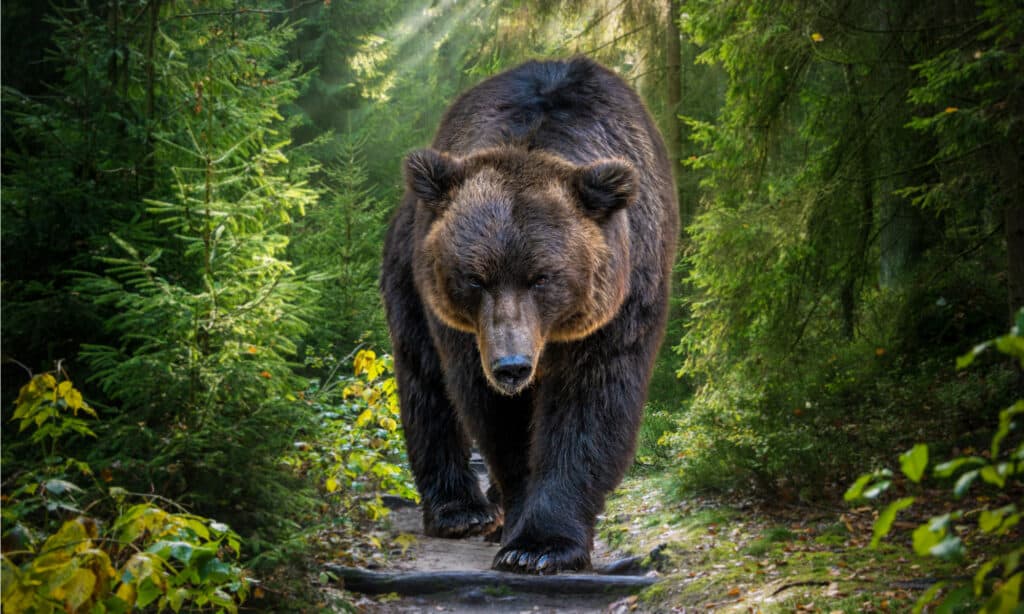
Toddler unfazed by stalking bear

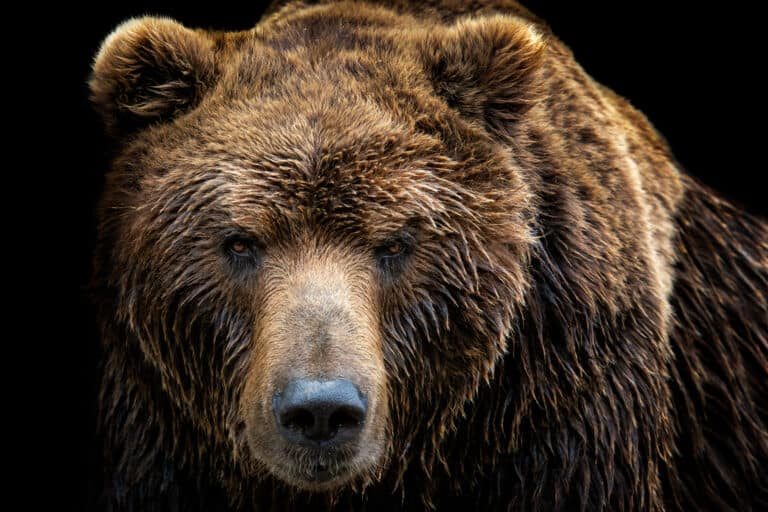
Brown bears are one of moose’s main predators

The biggest threats to moose include bears, wolves, humans, and ticks. Both brown and black bears target moose as a meal source, especially during calving season. One moose provides multiple meals for these large predators. A moose also makes an attractive buffet for a wolf pack.
To defend themselves against predators like bears and wolves, moose can run up to 35 miles per hour.

When deep snow covers the ground, they cannot run fast. This is when they use another defense tactic. They find hard ground with the least possible amount of snow, such as frozen lakes or areas of land where snow has blown away. They also back up against forests dense with trees to keep wolves away from their hindquarters. If they must face off these animals or packs, they charge at their predators, kicking their legs in a way that can kill wolves and leave bears dazed.

Another moose defense against predators is going into low-level bodies of water, not deep water where wolves can swim well. Wolves struggle to attack a moose in more shallow water.

Humans hunt moose but it often takes multiple shots to take one moose down. In fact, many hunters in Siberia prefer coming up against a grizzly bear, as opposed to an angry moose.

Global warming increases tick infestations where moose live. In a warmer winter, tick populations surge. These tiny parasites can wipe out a moose herd by weakening them through blood loss. Many moose die of anemia caused by ticks each year. Trying to rub ticks off of their bodies leaves many moose with hair loss in patches. This disrupted coat leads to hypothermia in winter. In New Hampshire, biologists credit a 40 percent decline in moose population in the past 10 years to ticks and other parasites like them.
 

Reproduction, Babies, and Lifespan
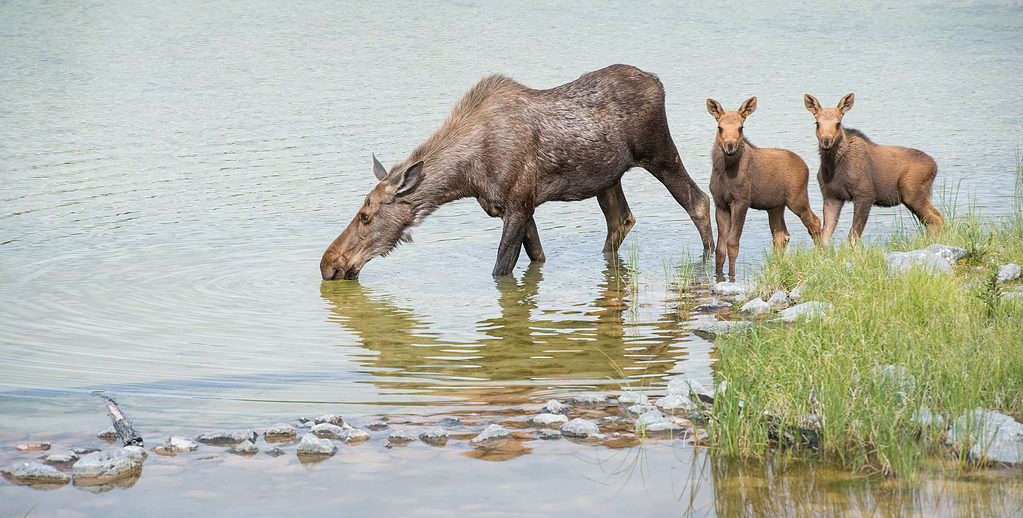
Moose and two calves

Moose often have one calf although they may give birth to twins, or even triplets

In early fall, male moose start forming harem herds of females ready to mate. These females attract the males using a strong scent and deep calls. Males sometimes challenge each other for the right to mate with a harem. These challenges involve use of their antlers as a threat display. They can also push each other with their antlers in a fight. But the fights do not usually get very serious because antlers can get caught together, leading to death of both bulls. At the end of these challenges, the dominant moose stays with the herd and the submissive loser of the fight scurries away.

Female moose give birth to one baby in spring or summer. Sometimes a moose can bear twins or even triplets. But most births are just one calf. Calves stand up on their first day and swim well within a few weeks. At about six months of age, calves wean from their mothers. But they remain with their mother until she has another calf in the following mating season. Moose are very aggressive in the protection of their young. In fact, bull moose even charge humans or other threats during mating season and before the birth of their young.

Being a moose calf is dangerous. Bears and wolves enjoy moose meat as part of their diet. About half of calves die due to these animal attacks before the age of six weeks. At four to six years of age, if they live that long, a moose calf is fully grown. But once they live to their full size, most survive into old age. Adult moose enjoy a survival rate of 95 percent. They typically live 15 to 20 years in the wild.
 

Population
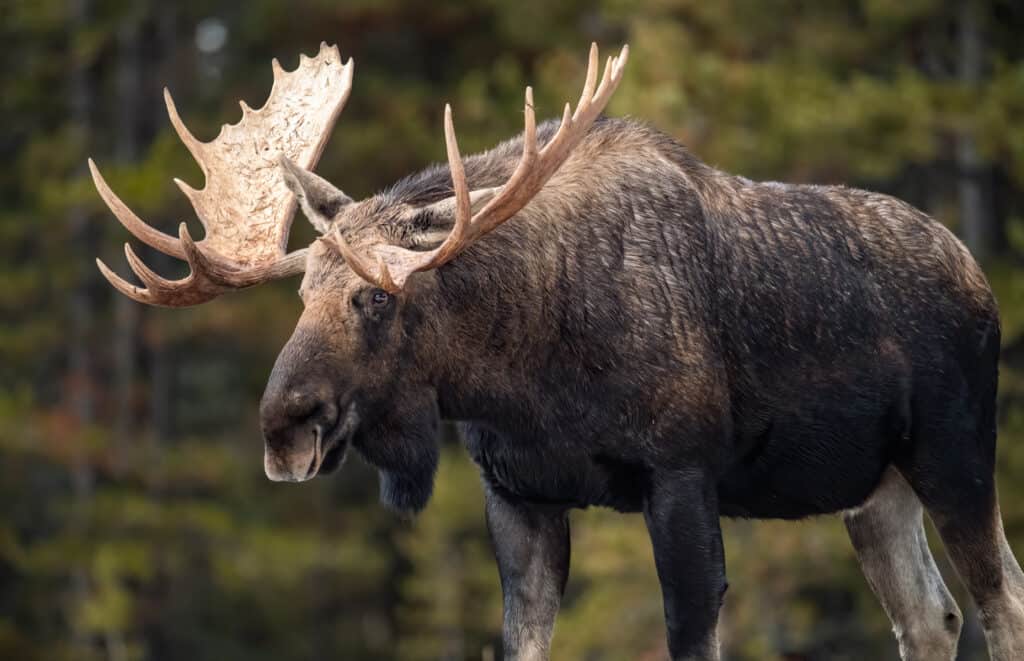
bull moose

Things look pretty bright for the world’s moose population which continues to increase

Moose are robust creatures. This keeps populations high. There are between 500,000 and one million moose in Canada, alone. In Newfoundland, moose were introduced to the area in the 1900s. Four moose placed in that region at that time reproduced effectively and now over 150,000 exist from those original parents.

In the United States, about 300,000 moose exist. Of these, 200,000 live in Alaska. Moose also live in Finland, Norway, Sweden, Latvia, Estonia, Poland, Czech Republic, and Russia. Their conservation status worldwide is listed as of least concern and their numbers continue to increase.
 

View all 330 animals that start with M

Sources

  1. David Burnie, Dorling Kindersley (2011) Animal, The Definitive Visual Guide To The World's Wildlife / Accessed December 14, 2008
  2. Tom Jackson, Lorenz Books (2007) The World Encyclopedia Of Animals / Accessed December 14, 2008
  3. David Burnie, Kingfisher (2011) The Kingfisher Animal Encyclopedia / Accessed December 14, 2008
  4. Richard Mackay, University of California Press (2009) The Atlas Of Endangered Species / Accessed December 14, 2008
  5. David Burnie, Dorling Kindersley (2008) Illustrated Encyclopedia Of Animals / Accessed December 14, 2008
  6. Dorling Kindersley (2006) Dorling Kindersley Encyclopedia Of Animals / Accessed December 14, 2008
  7. David W. Macdonald, Oxford University Press (2010) The Encyclopedia Of Mammals / Accessed December 14, 2008
Dana Mayor

About the Author

Dana Mayor

I love good books and the occasional cartoon. I am also endlessly intrigued with the beauty of nature and find hummingbirds, puppies, and marine wildlife to be the most magical creatures of all.
Connect:

Thank you for reading! Have some feedback for us?


Moose FAQs (Frequently Asked Questions)

While moose are very large animals, bison can be even larger! The key difference between moose and bison is that moose are taller, with larger horns, but also weigh less. Male bison often weigh over a ton while no moose on record has ever weighed that much.