
F
Species Profile

Fallow deer

Dama dama

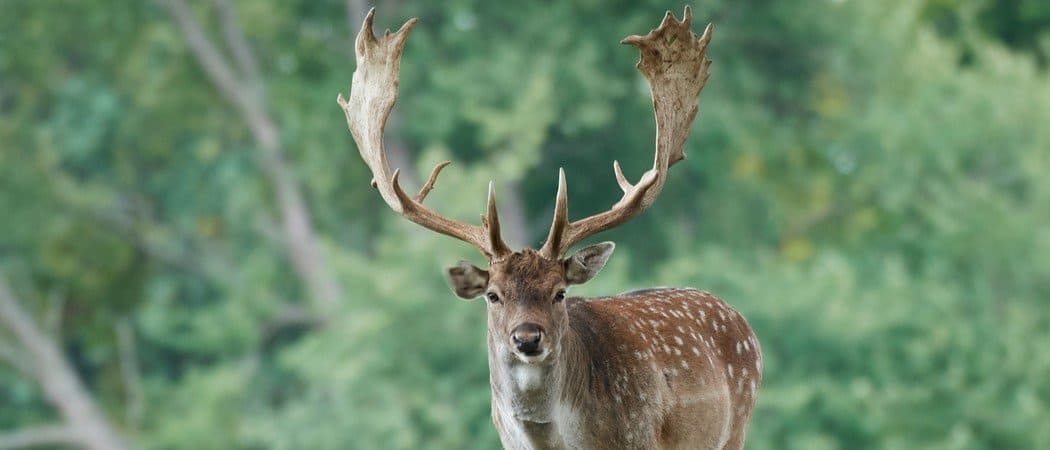
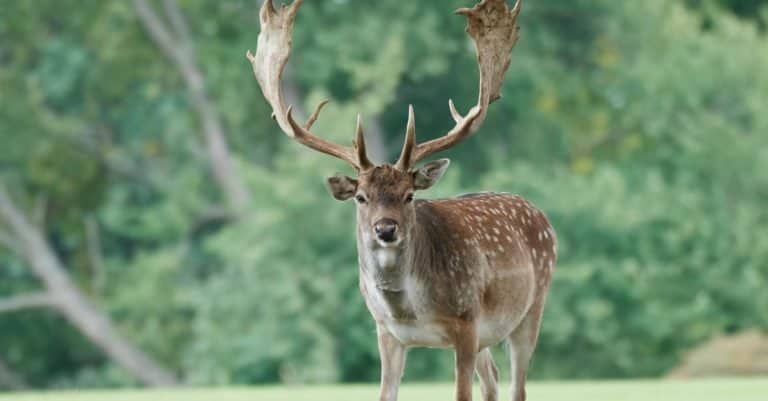
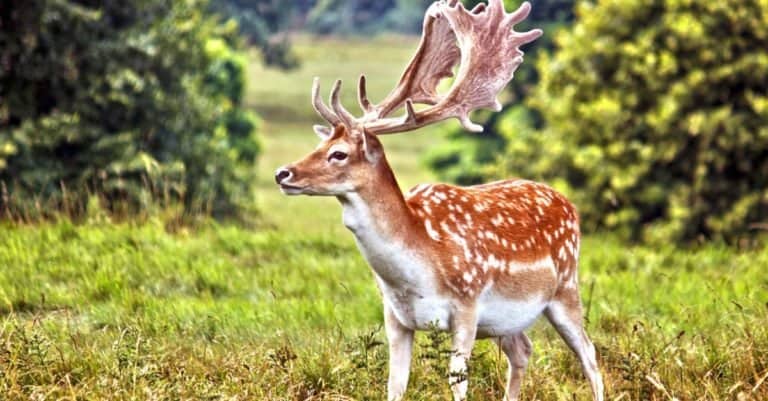
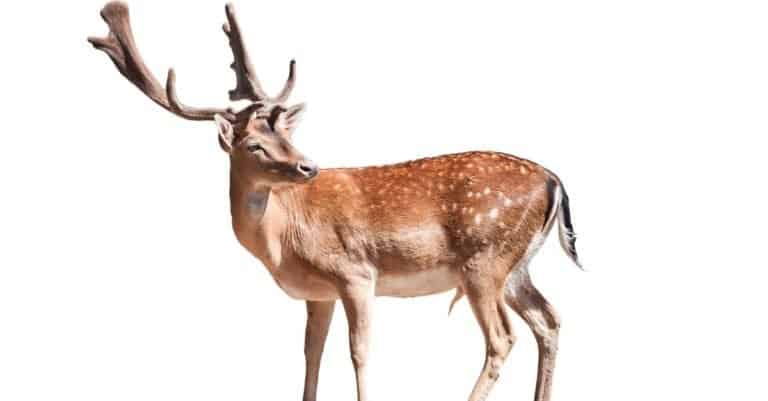
Palmate antlers, spotted summer style
Dennis Jacobsen/Shutterstock.com

Fallow deer Distribution

Click a location to explore more animals from that region

Invasive Species
Loading map...

Found in 1 country

Size Comparison

Human 5'8"
Fallow deer 2 ft 9 in

Fallow deer stands at 49% of average human height.

Fallow deer in its natural habitat in Denmark

At a Glance

Wild Species
Also Known As Fallow, Fallow stag, Fallow buck, Fallow hart
Diet Herbivore
Activity Crepuscular+
Lifespan 12 years
Weight 100 lbs
Status Least Concern
Did You Know?

Bucks grow distinctive palmate (shovel-shaped) antlers; does typically have no antlers.

Scientific Classification

The fallow deer (Dama dama) is a medium-sized cervid known for its variable coat (often spotted in summer) and distinctive palmate antlers in males. Native to parts of the eastern Mediterranean/Western Asia region, it has been widely introduced and is now established in many parts of Europe and elsewhere.

Kingdom
Animalia
Phylum
Chordata
Class
Mammalia
Order
Artiodactyla
Family
Cervidae
Genus
Dama
Species
dama

Distinguishing Features

  • Males typically have broad, palm-shaped (palmate) antlers rather than the multi-tined beams typical of many other deer genera.
  • Coat commonly shows white spots in summer; winter coat can become darker/greyer and less spotted.
  • Often has a contrasting rump patch outlined in black; tail relatively long for a deer.

Physical Measurements

Males and females differ in size

Height
♂ 2 ft 11 in (2 ft 9 in – 3 ft 1 in)
♀ 2 ft 8 in (2 ft 5 in – 2 ft 12 in)
Length
♂ 5 ft 7 in (4 ft 9 in – 6 ft 4 in)
Weight
♂ 176 lbs (132 lbs – 220 lbs)
♀ 99 lbs (77 lbs – 121 lbs)
Tail Length
♂ 7 in (6 in – 7 in)
♀ 7 in (6 in – 7 in)
Top Speed
31 mph
Sprint up to 50 km/h

Appearance

Primary Colors
Secondary Colors
Skin Type Fallow deer have hair over deer skin: a short, sleek summer coat and a longer, thicker winter coat. Males grow and shed bony antlers yearly, first in velvet, then cleaned before mating.
Distinctive Features
  • Male antlers are characteristically palmate (broad, flattened 'palm') with multiple tines; this palmate form is a defining appearance trait of Dama dama among European deer.
  • Adults: head-body length about 130–175 cm, tail 15–20 cm, shoulder height 75–95 cm (females smaller). Weight often 35–56 kg (females) and 46–94 kg (males), varies.
  • Rump pattern: conspicuous white rump patch ('disc') frequently outlined in black; tail shows a black dorsal stripe and contrasts with the rump disc when alarmed (tail often raised).
  • Seasonal neck/chest appearance: males often develop a thicker neck and more robust forequarters approaching and during the rut; winter pelage can accentuate a darker neck/chest area.
  • Coat polymorphism: besides the common spotted morph, populations may include darker (melanistic) and very pale/leucistic individuals; spotting intensity can vary (not a different species).
  • Behavior-linked visual signal: during rut (typically autumn in much of Europe), males may hold a lowered-head, stiff-legged posture and vocalize ('groaning') in display areas; these behaviors emphasize neck mass and antler palms in visual contests.
  • Fallow deer (Dama dama) are native to parts of the eastern Mediterranean and Western Asia but have been introduced across Europe and beyond; their look is the same species-wide, though size and coat patterns vary.
  • Fallow deer often live about 12–16 years in the wild, up to 20–25 in captivity; older males may have thicker antler palms and more worn or broken antler tips from fighting.

Sexual Dimorphism

Strong sexual dimorphism: males ('bucks') are larger and carry palmate antlers; females ('does') are smaller and antlerless. Dimorphism is most visually pronounced in the breeding season when males develop more robust neck/forequarters and carry fully mineralized, cleaned antlers.

♂
  • Palmate antlers (broad, flattened palms with multiple points) grown annually; antlers are typically largest/most palmated in mature males.
  • Larger overall body size: commonly ~46-94 kg body mass and ~85-95 cm shoulder height (population/season dependent).
  • More muscular neck and chest, especially during rut; can appear darker on neck/chest in winter pelage.
♀
  • No antlers (antlerless under normal conditions).
  • Smaller, more gracile build: commonly ~35-56 kg body mass and ~75-85 cm shoulder height (population/season dependent).
  • Often retains a more uniformly slender neck profile year-round; coat pattern follows the same seasonal spotted-to-winter change but may look slightly finer/less rugged due to smaller size.

Did You Know?

Bucks grow distinctive palmate (shovel-shaped) antlers; does typically have no antlers.

Adult size: head-body length ~130-175 cm; shoulder height ~75-95 cm; tail ~16-20 cm.

Typical mass: males ~60-100 kg (often heavier in rich habitats), females ~30-50 kg.

Gestation is about 229-234 days; most births are a single fawn in late spring/early summer.

Fallow deer have multiple recognized coat morphs (e.g., "common" spotted, dark/melanistic, and very pale/white), with strongest spotting in summer.

During the rut, bucks advertise with repeated, loud "groans" and defend rutting stands rather than roaming widely.

Antlers are shed and regrown annually; growth occurs under velvet, which is rubbed off when antlers harden.

Unique Adaptations

  • Palmate antlers as visual signals: The broad, flattened palm increases apparent size and display area during the rut, aiding both dominance contests and long-distance signaling in more open parkland/woodland-edge settings.
  • Seasonal coat change and spotting: A summer coat with contrasting spots can break up the body outline in dappled light; the winter coat is typically duller and less spotted.
  • Coat polymorphism: Persistent color morphs (from very dark to very pale) can help populations match local habitats and also reflect long histories of human selection in parks and estates.
  • Scent communication: Like other cervids, fallow deer use scent glands and urine marking for social and reproductive communication, especially around rutting stands.
  • Ruminant digestion: A four-chambered stomach enables efficient use of fibrous forage (grasses, herbs) while still taking browse (leaves, shoots) seasonally.

Interesting Behaviors

  • Rutting stands and groaning: In autumn (often Oct-Nov in many introduced European populations), bucks occupy traditional rutting stands, vocalize ("groan"), scent-mark, and challenge rivals; does visit these areas to mate.
  • Seasonal grouping: Outside the rut, fallow deer commonly form single-sex groups (buck groups and doe-fawn groups), with mixed groups more common in winter.
  • "Hider" fawns: Newborn fawns typically lie concealed in vegetation for extended periods while the doe returns to nurse, reducing detection by predators.
  • Crepuscular foraging: Activity often peaks at dawn and dusk, especially where human disturbance is high.
  • Alarm signals: Individuals may snort and stamp; groups can "bunch" and then bolt with high-speed, zig-zag flight when threatened.
  • Edge-habitat use: They frequently feed in open grassland/parkland and retreat to woodland or scrub for cover, especially in daytime.

Cultural Significance

Fallow deer (Dama dama) are linked with European deer parks and large estates. Brought from their eastern Mediterranean–western Asian home across Europe, the British Isles, Australia, New Zealand and the Americas, they were kept for meat, hunting, spotted coats, fan-shaped antlers, and rare pale color forms.

Myths & Legends

Fallow deer (Dama dama) were linked to Artemis/Diana, who protected sacred deer; hurting them brought the goddess's anger, and this idea shaped later European tales of taboo or enchanted deer hunts.

In Britain and Europe, folk tales tell of a rare 'white deer' that appears as an omen or guide to the otherworld or adventure, matched by pale fallow deer (Dama dama) kept in medieval parks.

Herne the Hunter (Windsor Forest, England): Local legend tells of a ghostly hunter associated with Windsor's deer, sometimes depicted with antlers, haunting the forest and presaging misfortune-linking the deer park landscape with supernatural folklore.

The white hart was a medieval symbol and story about an enchanted white stag. Over time the image mixed with park deer, often pale fallow deer (Dama dama), in art and lore.

Conservation Status

LC Least Concern

Widespread and abundant in the wild.

Population Increasing

Protected Under

  • National wildlife/game legislation and protected-area management measures in parts of the native range (local protection varies by country and management unit).
  • Hunting regulations/closed seasons and permitting frameworks in many countries where the species occurs (protection level varies; often managed as game outside strict reserves).

Life Cycle

Birth 1 fawn
Lifespan 12 years

Lifespan

In the Wild
8–16 years
In Captivity
15–29 years

Reproduction

Mating System Polygyny
Social Structure Lek Breeding
Breeding Pattern Seasonal
Fertilization Internal Fertilization
Birth Type Internal_fertilization

Fallow deer (Dama dama) are mainly polygynous; males gather on leks in the autumn rut, fight and court, and a few dominate mating. Females usually mate once; gestation ~229–234 days, usually one fawn in late May–June. No pair bonds or cooperative breeding.

Behavior & Ecology

Social Herd Group: 15
Activity Crepuscular, Cathemeral
Diet Herbivore Acorns (Quercus spp.) when seasonally abundant (autumn mast).

Temperament

Strongly gregarious and tolerant of conspecific proximity outside the rut (fission-fusion grouping with frequent joining/splitting).
Vigilant and generally wary in hunted/disturbed landscapes; can become habituated and bolder in protected urban parks with frequent human exposure (Putman 1988).
Adult males become very aggressive and more excited during the rut, with threat displays, parallel walking, chasing, and fights. Females are less openly aggressive but will defend their fawns.

Communication

Male rutting groan: repeated low-frequency groans produced at high rates during rutting to advertise and compete; widely documented as a key rut vocalization in fallow deer E.g., McElligott & Hayden 1999; Reby et al. 1999
Alarm bark/snort-like calls: short, loud alarm vocalizations given when disturbed, often accompanied by alert posture and grouping/flight Putman 1988
Doe-fawn contact calls Bleats): higher-pitched bleats used for close-range contact and during reunions (Chapman & Chapman 1975
Scent marking: males intensify scent communication in rut via glandular secretions and urine; rubbing/marking vegetation and rutting stands contributes to olfactory signaling Apollonio et al. 1992; Putman 1988
Visual displays: threat and dominance displays Parallel walk, head lowering, antler presentation, chasing) are central to male-male competition; antlers function as both weapons and signals (Clutton-Brock et al. 1982
Tactile interaction: sparring and antler wrestling in males; nose-to-nose and body contact during close-range assessment and courtship Clutton-Brock et al. 1982

Habitat

Biomes:
Temperate Forest Mediterranean Temperate Grassland Wetland
Terrain:
Hilly Plains Valley Coastal Island
Elevation: Up to 8202 ft 1 in

Ecological Role

Medium-sized herbivorous ungulate (mixed feeder) that shapes vegetation structure and understory composition via selective grazing/browsing, and moves nutrients across the landscape through dung/urine deposition; also serves as prey where large carnivores are present (or historically present).

Vegetation regulation (selective grazing/browsing influences plant community composition and woodland regeneration) Nutrient cycling (redistributes nitrogen and other nutrients via dung/urine; accelerates decomposition pathways) Seed dispersal (endozoochory of some small seeds and secondary dispersal via dung; also influences seedbed via trampling) Food-web support (prey base for large carnivores/scavengers where they co-occur; provides carrion and dung resources for invertebrates)

Diet Details

Other Foods:
Grasses Herbaceous forbs Sedges and rushes Browse Tree buds and young leaves Acorns and beech mast Fallen fruit and berries Agricultural crops Fungi +3

Human Interaction

Domestication Status

Semi domesticated

Fallow deer (Dama dama) are not fully domesticated like cattle or sheep. People have managed them for centuries in deer parks and estates, moving them across the Mediterranean and Europe for hunting and park-keeping. Long care and culling happened, but no single domestication or standard breed formed. Many populations today come from past releases or escapes.

Danger Level

Moderate
  • Physical injury: males can be dangerous during the rut (autumn)-charging, striking, and goring with palmate antlers; both sexes can kick when cornered/handled.
  • Vehicle collisions: in many introduced/native-range landscapes, deer-vehicle collisions are a major human safety risk.
  • Agricultural/garden damage leading to human-wildlife conflict (browsing, bark stripping).

As a Pet

Not Suitable as Pet

Legality: Fallow deer are usually regulated, not typical pets. Many places call them 'cervids', 'exotic livestock', or 'game' and need permits, inspections, and chronic-wasting-disease (CWD) movement controls or bans.

Care Level: Expert Only

Purchase Cost: $300 - $2,500
Lifetime Cost: $12,000 - $40,000

Economic Value

Uses:
Venison production (farmed cervid meat) Trophy hunting and paid stalking Deer parks/estate management and live-animal display (amenity/heritage landscapes) Hide/leather and by-products Antler products (craft, décor; occasionally velvet in some cervid industries) Ecotourism and wildlife watching Population control services (culling/management in introduced ranges)
Products:
  • Venison (meat)
  • Skins/hides
  • Antlers (hard antler for crafts/trophies)
  • Live animals for farms/parks
  • Hunting leases and guiding services

Relationships

Ecological Equivalents 5

Animals that fill a similar ecological role in their ecosystem

A person who first sees the most common type of fallow deer may wonder why it never got rid of the white spots other deer have when they’re fawns then lose as they grow up. But a spotted, light brown coat with a black stripe that runs down the back to the tail is just one of the many types of colors the pelage of this wide-ranging deer can sport.

Some fallow deer are white, some are black, and many have what is called menil coloration. This means that the spots stand out more, and there is no black on the tail or the rump. The spots persist throughout the winter, while with the common coloration the coat turns gray and the spots fade. The deer’s hind legs are also longer than the front legs, and the male has a distinct Adam’s apple that bobs up and down when it calls.

The fallow deer is native to Europe and Asia Minor and probably north Africa, and it’s been introduced in countries around the world as a game animal. It’s also raised for its meat and for the valve male’s antlers, which is supposed to have health-giving properties. Many zoos have a small herd of fallow deer.

3 Incredible Fallow Deer Facts!

  • Humans have been hunting fallow dear since the Old Stone Age which occurred between 420,000 and 200,000 BC. Humans at the time not only ate the meat of the deer but its bone marrow.
  • Over the centuries, it has been introduced around the world, including Australia, Canada, the United States, Madagascar, and South Africa and there are fairly large herds in England and Wales.
  • There’s a herd found in Dublin’s Phoenix Park that’s descended from deer who lived in the park in the 17th century.
Scientific Name

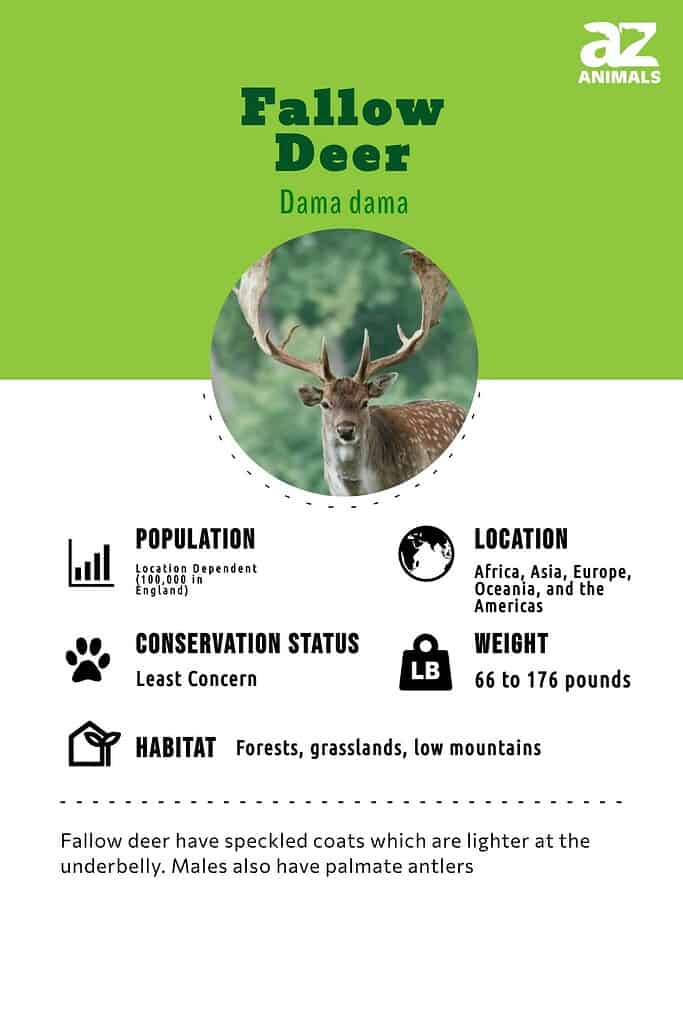
The deer’s scientific name is Dama dama. Dama is simply the Latin word for deer and related species such as antelope. Fallow refers to the light brown color of the deer’s pelt. There are two subspecies of the fallow deer. They are:

  • Dama dama dama, the European fallow deer: These cervids which are capable of weighing 220 lbs and measuring 37 inches at the shoulder, prefer woodland and grassland. They are rather versatile in terms of habitat they are capable of living in.
  • Dama dama mesopotamica, the Persian fallow deer: A shy elusive creature, it prefers to graze in pistachio and tamarisk groves. Once widespread throughout the Middle East, it is currently only found in Iran and Isreal where it was reintroduced.

Some scientists believe at the Persian fallow deer, which is rare, is a separate species.

Appearance
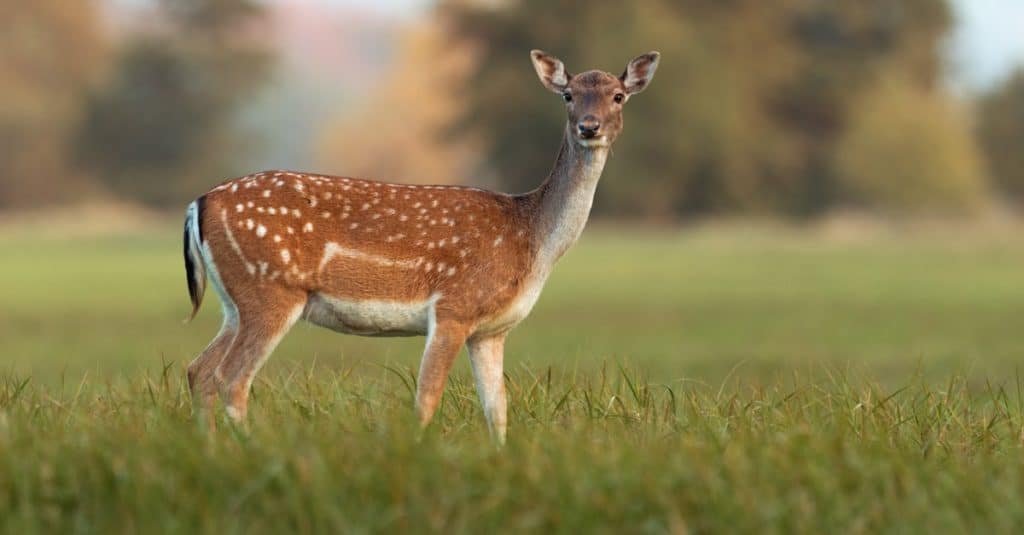
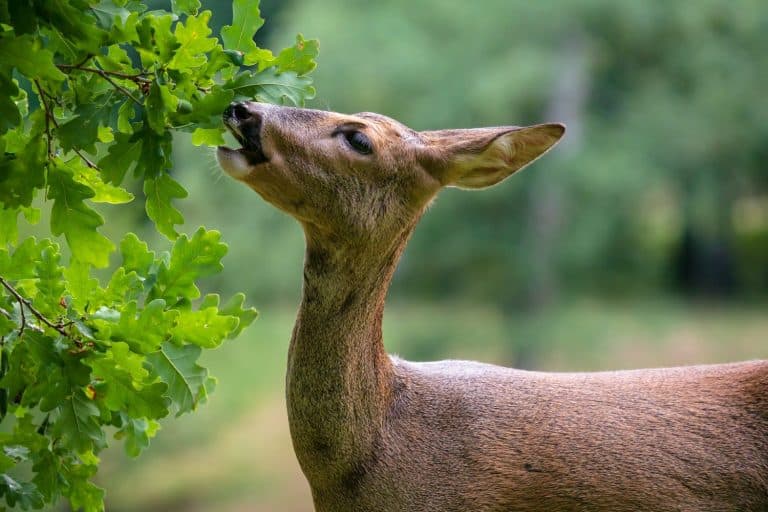
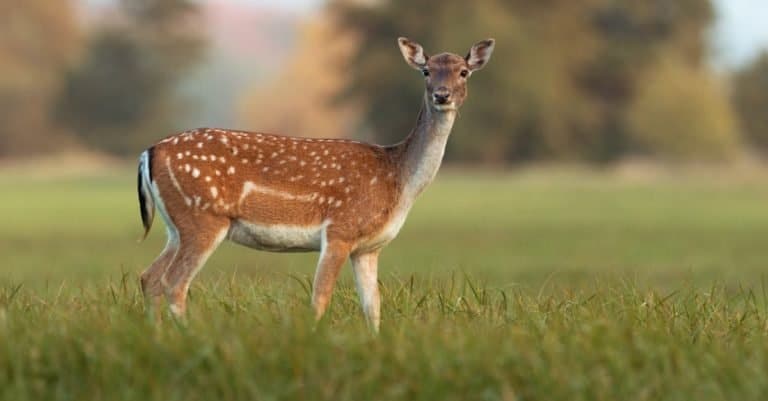
Female fallow deer, Dama dama, in a field in the Autumn.

The coats of fallow deer turn pale during warmer seasons and darken during winter

Fallow deer also differ from other deer in that males are much larger than females. Males can weigh twice as much as females, and the largest buck weighed as much as 330 pounds. Besides hunting and use as livestock, fallow deer are valued because of their beauty and grace.

The texture of the deer’s coat differs with the season. During the warm season, the colors of the coat are paler, and the hair is shorter and smoother. The winter coat is shaggy, darker, and has an undercoat. If the deer has white spots, they are abundant on the back and sides of the animal, absent on the legs and the head, and sparse on the neck.

Only the male fallow deer has antlers, and his antlers are large, shaped like shovels, and have many points. Indeed, they resemble the antlers of the bull moose, and they’re usually between 1.6 and 2.29 feet long. The buck starts growing palmate antlers when he’s about three years old. Before that, his antlers are simply spikes. The buck loses his antlers in April and grows another pair that are fully grown by August.

Behavior
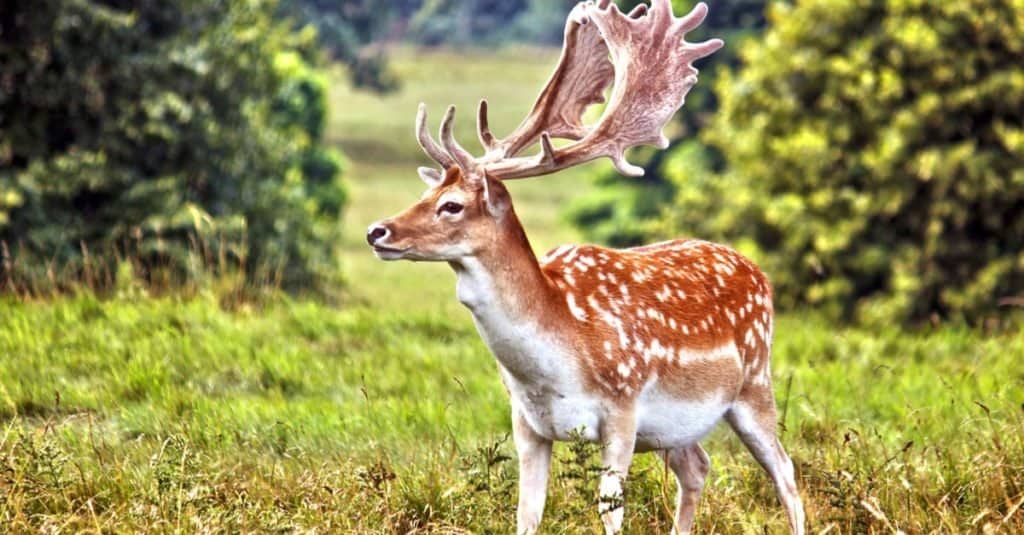
Fallow deer, buck, standing in a field displaying its horns.

Fallow deer have keen eyesight, hearing, and smell.

Fallow deer are nocturnal and are most active between just after sunset and sunrise. During those hours they feed, look for food, or rest. Bucks usually keep to themselves, but at the end of summer, they start to gather into herds that are made up of no more than six individuals. By the fall, which is their breeding season or rut, these bachelor herds drift towards herds made up of females and juveniles.

The senses of the fallow deer are quite acute, and their vision is especially sharp. They communicate with each other through posturing, vocalization, and smells. They have an impressive array of vocalizations, including:

  • The bark: this sound is uttered by females as an alarm call
  • The bleat: this is made while females are giving birth or communicating with their fawns
  • The mew: this is a sound of submission
  • The peep: this is the sound a baby deer makes when it wants its mother
  • The wail: this is the cry the baby makes when it’s in distress
  • The grunt and the groan: these sounds are made by rutting males

The deer also uses its body to communicate. An alert stance is a raised head and rigidly held body. They also trot, gallop and pronk, which is when the animal leaps high in the air on all four stiffly held legs. Like white-tailed deer, the fallow deer raises its tail when it runs.

Because fallow deer are the prey of so many carnivores, including humans, they are vigilant. This is especially true of females with fawns.

Habitat

The fallow deer can thrive in a variety of habitats, as long as it can support the vegetation that they eat. They do best in old-growth forests dominated by broad-leafed, deciduous trees such as oaks, especially if these forests contain glades. Fallow deer can also be found in forests of deciduous trees and conifers, in grasslands, savannas, and scrublands.

Diet

Like many types of deer, fallow deer are herbivores, but they are not particular when it comes to their diet. They eat grasses, acorns, and other fruit produced by trees, leaves, twigs, and shrubbery. They’ll also take herbs, shoots, and buds and will even eat bark. Their preferences depend on what is available.

Predators and Threats

Fallow deer are hunted by humans and other predators that are big or clever enough to bring them down. The mammal’s overall alertness to its surroundings and its propensity to gather in herds saves it from those predators who are not hunting with firearms.

Reproduction and Life Cycle
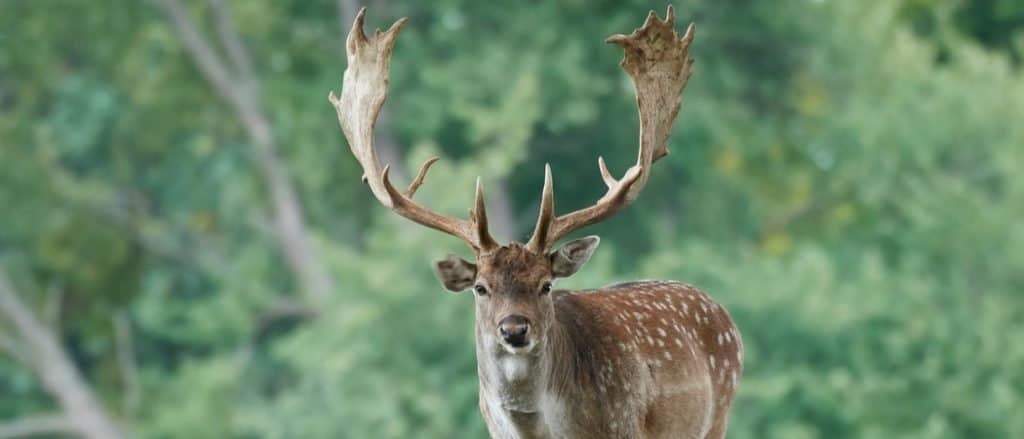
Fallow deer in its natural habitat in Denmark

Fallow deer remain dependent on their mothers until they reach a year old

Fallow deer have a somewhat complex reproductive strategy. When they enter the rut, bucks stop eating. Since the rut can last for 135 days, a buck can lose as much as 17 percent of his body weight and develop a fatty liver. If the deer lives in the northern hemisphere, the rut occurs in October. If they live in the southern hemisphere, it happens in April.

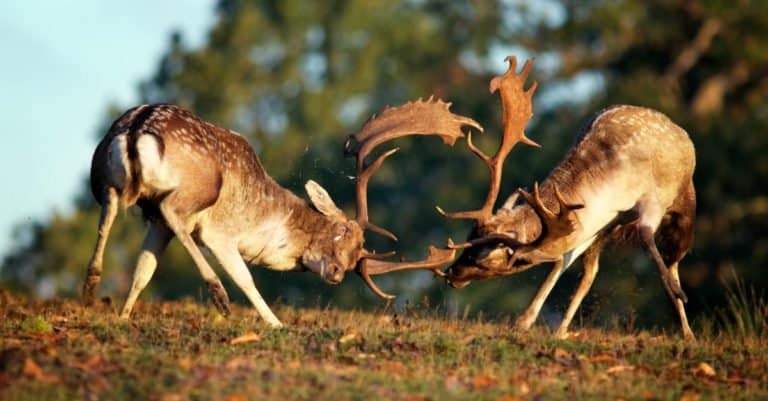
During the breeding season, the buck establishes a rutting stand or a territory. He does this by attacking low-hanging branches and leaves with their antlers, groaning and grunting and scraping the ground, and urinating in the area. Each buck has its own distinctive vocalization that both warns other bucks away and entices females. If a buck enters another’s territory and refuses to leave, the two may fight by shoving their antlers together. The antlers might sustain damage, but a severe injury to the body is unusual. On the other hand, females visit the males’ territories and choose a mate. The male will sniff the female and “dance” around her to impress her before she allows him to copulate.

Sometimes a group of bucks will claim a small territory in an area. This area is called a lek.

Female fallow deer are polyestrous, which means that they can go into heat several times during the breeding season if they don’t become pregnant. However, the doe usually does become pregnant during her first heat. Does can become pregnant when they are 16 months old, even though they are not fully grown until they are between four and six years old. Males are fertile when they’re 17 months old, but due to the dominance of older males, they usually don’t have a chance at mating until they are four years old. Bucks are fully grown when they are between five and nine years old.

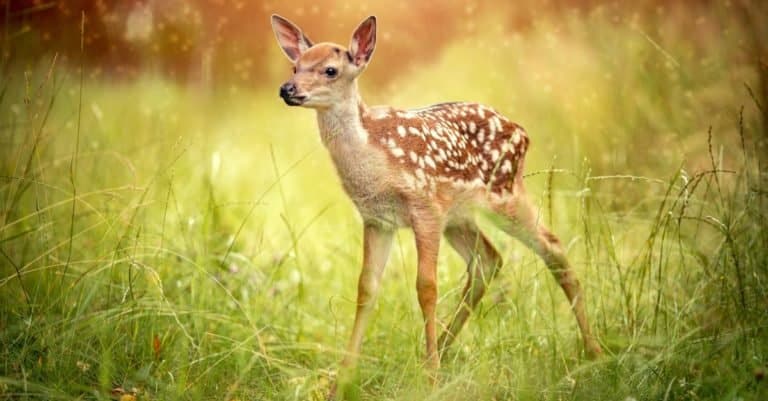
The doe is pregnant for between 33 and 35 weeks. When the time comes to give birth, she’ll find a hiding place then bear a single fawn, rarely twins. The baby weighs between 4.4 and 8.8 pounds, and its mother keeps it hidden in a thicket. She’ll leave to forage then come back to nurse it every four hours or so. When the fawn is about a month old, its mother will introduce it to the herd of other mothers and their fawns. Bucks do not help care for fawns.

The mother starts to wean the baby after about 20 days, and weaning is complete when the fawn is about seven months old. It is completely independent when it’s a year old.

Population
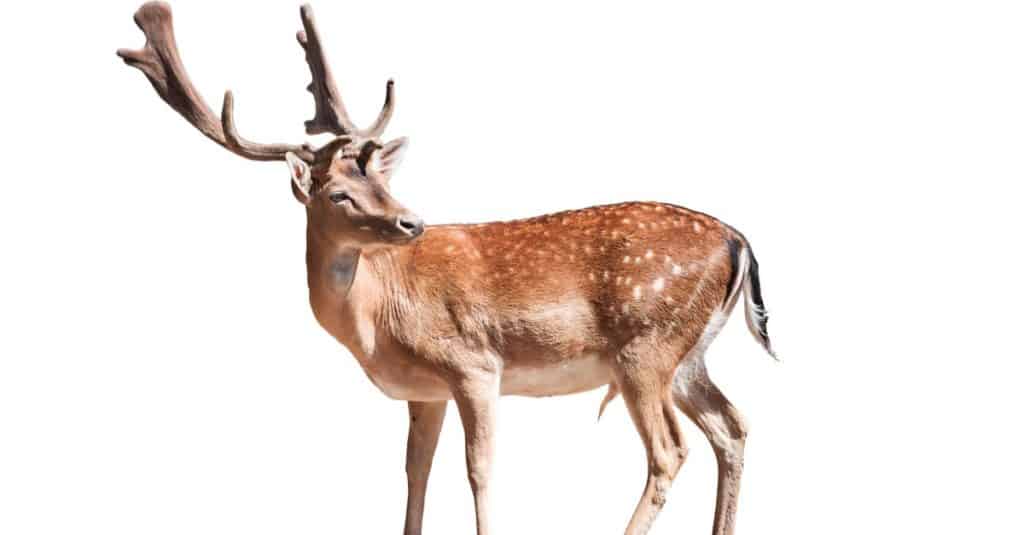
Fallow deer isolated on white background

The Persian fallow deer is found in Israel and Iran and has a shorter lifespan compared to the common fallow deer

The fallow deer’s conservation status is Least Concern, and there are places where they are considered either livestock or an invasive species. The former is true in Pennsylvania and other states while the latter is true in parts of California. There are at least 100,000 animals in Great Britain and 4,431 in Australia.

The Persian fallow deer is rare and considered endangered. It is only found in Israel and Iran. There are over a thousand of them as of 2021. The lifespan of this deer seems to be around 11 years in the wild, much less than the lifespan of D. dama.

View all 170 animals that start with F

Sources

  1. People's Trust for Endangered Species / Accessed May 7, 2021
  2. Fishbio / Accessed May 7, 2021
  3. Deer Scan / Accessed May 7, 2021
  4. Wikipedia / Accessed May 7, 2021
  5. Animal Diversity Web / Accessed May 7, 2021
  6. Biome Ecology / Accessed May 7, 2021
  7. Zoo Institutes / Accessed May 7, 2021
  8. Britannica / Accessed May 7, 2021
Dana Mayor

About the Author

Dana Mayor

I love good books and the occasional cartoon. I am also endlessly intrigued with the beauty of nature and find hummingbirds, puppies, and marine wildlife to be the most magical creatures of all.
Connect:

Thank you for reading! Have some feedback for us?


Fallow deer FAQs (Frequently Asked Questions)

One of the facts about the fallow deer is that it’s an ancient member of the Cervidae family. This mammal is recognized by the colors of its coat which can be varied but are often pale brown with white spots, and the male’s palmate antlers.