


B
Species Profile

Boskimo

Canis lupus familiaris

Spitz fluff, Boston charm.
Zero Degrees Photography/Shutterstock.com

Boskimo Distribution

Click a location to explore more animals from that region

Origin Location

This map shows the native origin of the Boskimo. As a domesticated species, they are now found worldwide.

Loading map...

Found in 1 state/province

Size Comparison

Human 5'8"
Boskimo 1 ft 3 in

Boskimo stands at 22% of average human height.

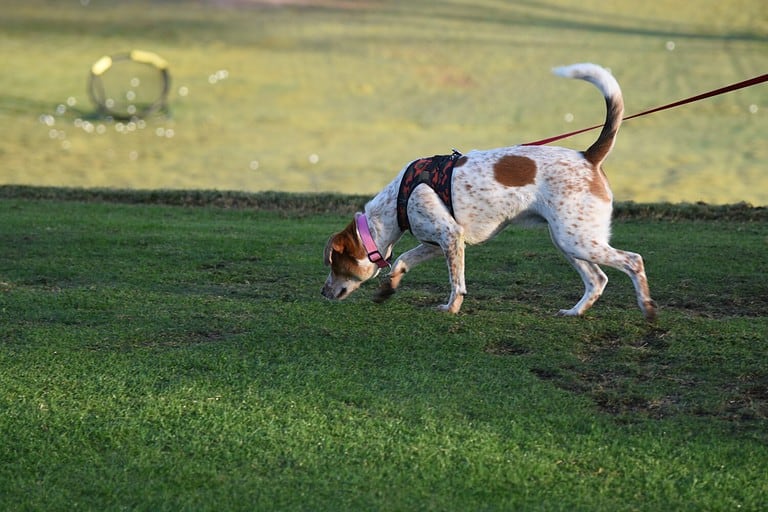
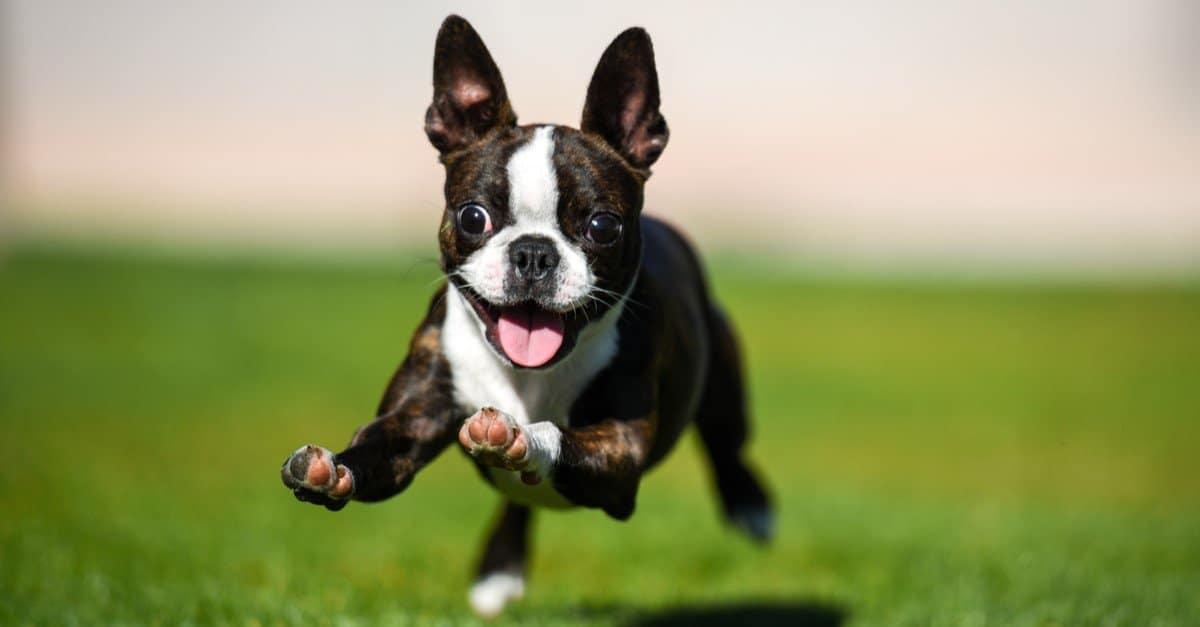
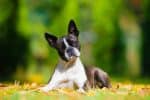
Boston terrier running through the yard.

At a Glance

Domesticated
Also Known As Boston Eskimo, Boston Terrier–American Eskimo mix, Boston Terrier Eskimo mix, American Eskimo–Boston Terrier cross
Diet Omnivore
Activity Diurnal+
Lifespan 13 years
Weight 16 lbs
Status Not Evaluated
Did You Know?

Boskimos are designer crossbreeds; pups can differ greatly in size, muzzle length, and coat from the same litter.

Scientific Classification

The Boskimo is a designer mixed-breed dog typically produced by crossing a Boston Terrier with an American Eskimo Dog. Individuals vary widely in size, coat length, and facial shape, reflecting differences in which parent traits are inherited.

Kingdom
Animalia
Phylum
Chordata
Class
Mammalia
Order
Carnivora
Family
Canidae
Genus
Canis
Species
Canis lupus familiaris

Distinguishing Features

  • Variable coat: short to medium, sometimes fluffy
  • Often black-and-white or white with dark markings
  • Compact, small companion-dog build
  • Face may range from Boston-like short muzzle to longer spitz-like muzzle
  • Temperament often lively, social, and alert

Physical Measurements

Males and females differ in size

Height
1 ft 2 in (10 in – 1 ft 6 in)
1 ft 3 in (10 in – 1 ft 7 in)
Length
2 ft 2 in (1 ft 8 in – 2 ft 7 in)
1 ft 11 in (1 ft 4 in – 2 ft 6 in)
Weight
22 lbs (13 lbs – 35 lbs)
21 lbs (9 lbs – 35 lbs)
Tail Length
8 in (6 in – 10 in)
6 in (4 in – 9 in)
Top Speed
22 mph
running

Appearance

Primary Colors
Secondary Colors
Skin Type Double coat
Distinctive Features
  • Designer crossbreed; size and head shape vary widely between litters.
  • Short muzzle possible; may snore or overheat in hot weather.
  • Tuxedo-style face blaze and chest common, Boston Terrier influence.
  • Erect triangular ears common; some have semi-prick or rose ears.
  • Coat ranges short-smooth to medium plush; occasional neck ruff.
  • Feathering on tail and hind legs more likely with Eskimo traits.
  • Dark, round eyes; occasional prominent eyes with shorter muzzle.
  • High shedding possible with double coat; seasonal coat blow common.
  • Lively, people-focused temperament; may be alert and vocal.
  • Screen for patellar luxation and brachycephalic airway issues.
  • Potential dental crowding in shorter muzzles; routine brushing recommended.
  • Moderate daily exercise plus mental games helps prevent nuisance barking.

Sexual Dimorphism

Sexual dimorphism is mild: males are typically slightly larger and heavier-boned. Females often look a bit finer through the chest and may carry less neck ruff when the coat is longer.

  • Slightly broader skull and chest; heavier overall bone.
  • More pronounced neck ruff in longer-coated individuals.
  • Slightly lighter frame and narrower chest.
  • Often a more refined muzzle and head profile.

Did You Know?

Boskimos are designer crossbreeds; pups can differ greatly in size, muzzle length, and coat from the same litter.

Many inherit the Boston Terrier's friendly, comic expression and the American Eskimo Dog's alert, vocal watchdog tendencies.

Coats range from sleek to thick double-coat; common colors include white, black-and-white, and cream with darker markings.

They're typically bright and trainable, but may show terrier stubbornness or spitz independence without consistent routines.

Health screening matters: watch for patellar luxation, dental crowding, eye disease, and hip issues seen in parent breeds.

Exercise needs are moderate; short, upbeat sessions suit many, especially those with shorter muzzles and heat sensitivity.

Unique Adaptations

  • Variable muzzle length affects breathing and heat tolerance; shorter-faced individuals may need cool, low-intensity summer routines.
  • Spitz-influenced double coats can insulate in cold, but require regular brushing to manage shedding and prevent matting.
  • Compact, athletic frames support agility-style games, though joint-friendly surfaces help reduce stress on knees and hips.
  • High social sensitivity suits therapy-style companionship, but early socialization helps prevent reactivity or separation distress.

Interesting Behaviors

  • "Shadow dog" tendency: many stick close to their person and prefer being included in every room-to-room move.
  • Alert barking at doors or new sounds is common, reflecting American Eskimo Dog vigilance and confidence.
  • Play style often mixes quick terrier pounces with spitz bouncing runs, especially in open spaces or snow.
  • Some show strong food motivation, making them responsive to reward-based training and fun trick work.
  • They may "talk" with grumbles and chirps, plus expressive head tilts when trying to read human cues.

Cultural Significance

Boskimos reflect modern "designer dog" culture, combining two iconic American companion types: the Boston Terrier's urban charm and the American Eskimo Dog's showy spitz heritage seen in U.S. entertainment and homes.

Myths & Legends

In Norse tradition, the hound Garmr guards Hel's gate, a dread sentinel whose howls signal Ragnarok's approach.

Greek myth tells of Cerberus, the multi-headed dog of Hades, preventing the dead from escaping the Underworld.

Ancient Egyptian belief linked the jackal-headed Anubis with guiding and protecting souls, shaping funerary rituals and iconography.

The American Eskimo Dog's name is tied to a real historical shift: German Spitz-type dogs were rebranded in America amid World War I tensions.

Conservation Status

NE Not Evaluated

Has not yet been evaluated against the criteria.

Population Stable

Life Cycle

Birth 4 pups
Lifespan 13 years

Lifespan

In the Wild
11–15 years
In Captivity
11–15 years

Reproduction

Mating System Polygynandry
Social Structure Managed Domestic
Breeding Season Year-round; estrus typically twice yearly
Breeding Pattern Transient
Fertilization Internal Fertilization
Birth Type Internal_fertilization

Boskimo (Boston Terrier × American Eskimo) varies in size and coat; watch for brachycephalic airway issues, patellar luxation, and dental disease, with exercise and grooming. Breeding is human-managed with internal fertilization; pairs are brief, and sires may service multiple dams.

Behavior & Ecology

Social Pack Group: 3
Activity Diurnal, Crepuscular, Cathemeral
Diet Omnivore Chicken

Temperament

Affectionate
Alert
Playful
Trainable
Watchful
Curious
Sensitive
Stubborn
Vocal
Separation-prone

Communication

barks
yips
whines
growls
howls
body language
scent marking
tail wagging
play bow
pawing

Habitat

Biomes:
Temperate Forest Boreal Forest (Taiga) Tundra Alpine Temperate Grassland Mediterranean Savanna Desert Hot Desert Cold Temperate Rainforest Tropical Rainforest Tropical Dry Forest Freshwater Wetland Marine +9
Terrain:
Plains Hilly Coastal Mountainous Island Valley Plateau Riverine +2
Elevation: Up to 14763 ft 9 in

Ecological Role

Domestic companion and occasional small-prey hunter

human companionship sentinel barking pest deterrence

Diet Details

Other Foods:
Brown rice Oats Sweet potato Pumpkin Carrots Blueberries

Human Interaction

Domestication Status

Domesticated

Domestic dogs descended from gray wolves and were domesticated at least 15,000 years ago for hunting, guarding, and companionship. The Boskimo is a recent U.S. designer mix (Boston Terrier × American Eskimo Dog) bred primarily for companionship and family life.

Danger Level

Low
  • Nipping during rough play
  • Reactivity if poorly socialized
  • Resource guarding without training
  • Barking nuisance with strangers
  • Scratch injuries from jumping

As a Pet

Suitable as Pet

Legality: Generally legal; subject to local dog/HOA rules.

Care Level: Moderate

Purchase Cost: Up to $1,500
Lifetime Cost: $15,000 - $35,000

Economic Value

Uses:
Companionship Services Breeding Tourism
Products:
  • pets
  • training
  • therapy

The Boskimo is a dog breed that was developed artificially by cross-breeding the Boston Terrier and the American Eskimo. This Boskimo is a medium-sized dog and is exceptionally friendly and loving. While they need a lot of attention and exercise, if you spend a lot of time at home, this dog can make the perfect companion for you and your family. 

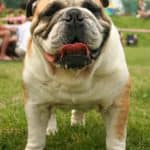
Boston Terrier - Boston Terrier Teeth

Boskimos are a hybrid dog breed comprised of Boston terriers (pictured) and American Eskimo dogs.

5 Boskimo Fun Facts

  • Boskimos are a very people-friendly breed that enjoys human company even more than most purebred dogs.
  • Boskimo dogs are known to be highly intelligent, making them very easy to train in any way you want.
  • The Boskimo dogs can be quite entertaining and make loveable companions.
  • Like their ancestors, the Boston terrier, the Boskimo can swim well.
  • They do not come in solid colors but often have spots of another color on their bodies, usually white.

3 Pros and 3 Cons of Owning a Boskimo

ProsCons
Very apartment-friendly
Owing to their small size, these dogs are well-suited for the indoors.
Not hypoallergenic
These dogs shed a lot, so they won’t be the best option for those allergic to dogs.
Perfect for first-time owners
Boskimos follow the cues of their owners and are obedient, making them easy to train for first-time owners.
Very prone to obesity
These dogs love to eat, so you’ll have to monitor their diet and exercise to ensure they don’t gain too much weight.
They drool much less than you’d think!
The Boskimo, unlike its relative, the Boston Terrier, drools much less than most dogs.
Prone to separation anxiety 
These dogs do not fare well if left alone. As a matter of fact, they get lonely and depressed very easily.

Size and Weight

The Boskimo is slightly smaller than most medium-sized dogs. They are smaller than standard-sized American Eskimo dogs but larger than Boston Terriers. The males are 12 to 17 inches tall, while the females are shorter than the males at 10 to 15 inches. The males weigh 30 to 40 lbs, while females weigh between 25 and 35 lbs.

Overall, Boskimos vary in their colors and coat length. Their bodies can be black, brindle, or beige, with white patches spread out over their bodies. These colors come from the Boston terrier side since their other parent, the American Eskimo, is entirely white. Their size depends on the American Eskimo and can be of three types: toy, small, and standard. Their coat is medium-sized and soft.

The Best Dog Food For Boskimo

A Boskimo requires the diet of a medium-sized active dog. This means their food should be rich in meat, vitamins, fiber, and fatty acids. For Boskimo puppies, the diet should have plenty of nutrients to help build their immunity and should be rich in vitamins and minerals.
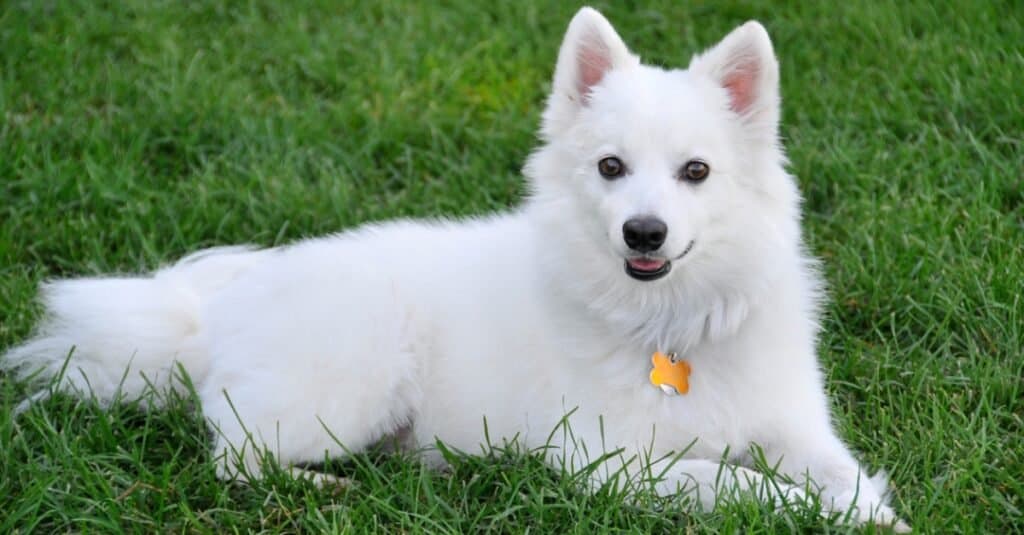
American Eskimo Dog laying in green grass

The American Eskimo dog is one-half of the hybrid dog breed, Boskimo. The other breed is the Boston terrier.

Boskimo Common Health Issues

Boskimos suffer from quite a few diseases. The most common are Hip Dysplasia, Legg-Calve-Perthes Disease, Progressive Retinal Atrophy (PRA), and deafness. Therefore, you should take the dog to regular vet checkups to ensure its health. Other common health issues for Boskimos are:

  • Cataracts
  • Diabetes
  • Patellar Luxation
  • Allergies
  • Brain Tumors
  • Cherry Eye
  • Heart Murmurs
  • Megaesophagus
  • Reverse Sneezing

Temperament

The Boskimo has a very happy, lively personality. They are full of energy all the time. Both the Boskimo parents (American Eskimos and Boston terriers) suffer from separation anxiety, so naturally, the Boskimo does as well. As a result, the dog’s coping behavior is chewing on things. So you’ll probably have to train them to develop a different coping mechanism. For example, a few toys to engage them can also keep them away from chewing on furniture or curtains.

These dogs also have very loving and affectionate personalities. Thus, they love to spend time with their owners. They can be shy in front of strangers. But it doesn’t take long before they acclimate to the new presence. They are incredibly adaptable and respond well to children and the elderly. But you’ll have to ensure someone is at home at all times. Otherwise, the Boskimo may get lonely and depressed.

Another personality trait of the Boskimo is that they are very protective of their territory. So if they feel that their owner is threatened in any way, they may exhibit aggressive behavior. They are sensitive dogs, do not like irregular routines, and don’t respond very well to punishments. So the best way to train them is with positive encouragement.

These dogs are also very sociable. They always need someone around them, so it’s often a good idea to have other pets around or play with them often.

There is a relatively low chance of your Boskimo biting someone unless threatened.

How To Take Care of A Boskimo

Boskimos are generally low-maintenance dogs. This section will detail how you should take care of your Boskimo pup. The most important aspects of caring for the dog are their diet, grooming, and playtime. In addition, they should also have regular vet visits to prevent any health issues.

Maintenance And Grooming

Boskimos shed quite a bit. Therefore, they are not recommended for people who have dog allergies. In addition, it is a good idea to brush them often, as much as 2-3 times a week during shedding season. Their teeth should also be brushed to prevent tooth decay and bad breath; give them calcium supplements to aid their dental health as well. You should also cut their nails every two weeks.

In terms of bathing, you should shower the dog more often than the average dog. Since their coat is long, soft, and easily oily, you should watch for when their hair is dirty. Typically, every 3 to 4 weeks is adequate unless your Boskimo spends a lot of time outdoors.

Training

Boskimos are very easy to train and are obedient dogs, so you should not have much trouble training them, even if you have never trained a dog before. Training this breed might initially take some patience, but it is always worth taking the time. They are more intelligent than most dog breeds, so don’t get too frustrated if they wander off on their own.

Exercise

Boskimos are happy, whether kept inside or outside. The key is to keep them engaged with some toys. They love playing fetch, so it will be easy to exercise them daily and to play fetch. Mind you, though, these dogs are very prone to obesity, so it is definitely recommended to monitor their physical activity.

Puppies

Female Boskimos usually give birth to 4 to 6 puppies in a litter. And like all other dog puppies, Boskimos need high-energy food when they are born. If you plan to breed Boskimos, it is not recommended to breed them more than once a year.

Boskimo And Children

Boskimos are very friendly with children and are extremely protective of them once they get used to them. These high-energy dogs love to play, so being surrounded by fun-loving children is a great way for them to expend some energy. So, as long as your child knows not to do things that could annoy the dog, they should be totally fine playing with each other.

View all 453 animals that start with B

Sources

  1. Wag Walking / Accessed December 29, 2022
  2. Dog Breed Info / Accessed December 29, 2022
  3. Dogell / Accessed December 29, 2022
Lev Baker

About the Author

Lev Baker

Lev is a writer at AZ Animals who primarily covers topics on animals, geography, and plants. He has been writing for more than 4 years and loves researching topics and learning new things. His three biggest loves in the world are music, travel, and animals. He has his diving license and loves sea creatures. His favorite animal in the world is the manta ray.
Connect:

Thank you for reading! Have some feedback for us?


Boskimo FAQs (Frequently Asked Questions)

Roughly estimated, you can get a Boskimo for $500 to $800, but it would be a better idea to get them from a shelter. In addition, it costs about $600 to $1500 a year to keep, with $35 to $45 in food costs every month.