P
Species Profile

Pollock

Gadidae

Pollock: cod-family powerhouse seafood
Miroslav Halama/Shutterstock.com

Pollock Distribution

Click a location to explore more animals from that region

This map shows coastal regions where Pollock are found.

Loading map...
Pollock - Pollachius pollachius (Atlantic or European pollock)

At a Glance

Family Overview This page covers the Pollock family as a group. Stats below are general traits shared across the family.
Also Known As Alaska pollock, Walleye pollock, Saithe, Coalfish, European pollock, Pollack
Diet Carnivore
Activity Cathemeral+
Lifespan 23 years
Weight 20 lbs
Status Least Concern
Did You Know?

"Pollock" is a seafood name, mainly for Alaska pollock (Gadus chalcogrammus) and Atlantic Pollachius species.

Scientific Classification

Family Overview "Pollock" is not a single species but represents an entire family containing multiple species.

“Pollock” is a common seafood name for several cod-family (Gadidae) fishes, especially Alaska pollock in the North Pacific and Pollachius species in the North Atlantic. They are schooling, cold-water, midwater-to-demersal fishes important in industrial fisheries and food products.

Kingdom
Animalia
Phylum
Chordata
Class
Actinopterygii
Order
Gadiformes
Family
Gadidae

Distinguishing Features

  • Cod-family body shape with three dorsal fins
  • Schooling behavior in cold marine waters
  • Commercially important white-fleshed fish

Physical Measurements

Males and females differ in size

Length
1 ft 12 in (4 in – 4 ft 3 in)
1 ft 12 in (8 in – 4 ft 3 in)
Weight
9 lbs (0 lbs – 46 lbs)
7 lbs (0 lbs – 44 lbs)
Top Speed
22 mph
burst swimming

Appearance

Primary Colors
Secondary Colors
Skin Type Small cycloid scales
Distinctive Features
  • Length range ~10-200 cm across family; pollocks usually mid-range.
  • Weight range roughly grams to ~100 kg in largest cods.
  • Lifespan range about 3-25 years, varying by species and region.
  • Cold-temperate to Arctic marine waters; North Pacific and North Atlantic centers.
  • Depth use from near-surface to ~1500 m; midwater to demersal variation.
  • Often schooling (pollocks) but many cods are more bottom-associated.
  • Diet broadly carnivorous: zooplankton, crustaceans, and fishes; shifts with size.
  • Three dorsal fins and two anal fins typical; exact fin ray counts vary.
  • Chin barbel common in cods; reduced or absent in many pollocks.
  • Color varies with habitat: silvery pelagic to browner demersal forms.

Sexual Dimorphism

Sexual dimorphism is generally subtle: females are often slightly larger or longer-lived, while males may mature earlier and show temporary darkening or fin abrasion during spawning aggregations; differences vary widely among genera.

  • May mature earlier; spawning-season darkening in some species.
  • Temporary fin wear or roughened skin during courtship/spawning.
  • Often slightly larger-bodied, especially in heavily fished populations.
  • Greater abdomen distension when ripe with eggs.

Did You Know?

"Pollock" is a seafood name, mainly for Alaska pollock (Gadus chalcogrammus) and Atlantic Pollachius species.

Across Gadidae, adult sizes span roughly ~20 cm to ~2 m, from small tomcod-type fish to giant cod.

Many gadids have three dorsal fins and two anal fins-an easy family-level ID in the field.

Alaska pollock supports one of the world's largest single-species food fisheries, supplying fillets, surimi, and fish sticks.

Atlantic/European pollock (Pollachius) are common in NE Atlantic markets; "Alaska pollock" is a separate North Pacific species.

Gadids commonly spawn by releasing eggs into open water; larvae drift before settling into juvenile habitats.

Cod-family fishes fueled preserved "stockfish" and salted-fish trade routes for centuries in northern Europe and beyond.

Unique Adaptations

  • High fecundity: many gadids produce large numbers of pelagic eggs, boosting chances in variable seas.
  • Sensory specialization: a well-developed lateral line helps detect prey and schooling neighbors in dim water.
  • Body plan for cruising: streamlined forms aid efficient swimming during migrations and school movements.
  • Cold-water performance: physiology suited to chilly, oxygen-rich seas, though tolerances differ among species.
  • Fin configuration (often 3 dorsals, 2 anals) supports fine maneuvering while foraging near bottom or in midwater.
  • Some gadids use chin barbels (in various cod relatives) to detect prey on or in sediment-presence varies by genus.

Interesting Behaviors

  • Schooling is common, but strength varies: tight midwater schools (pollock) to looser bottom groups (many cod).
  • Seasonal migrations to spawning grounds are widespread; timing and distance vary by species and region.
  • Feeding is often opportunistic: crustaceans, worms, and fish; some shift diet as they grow larger.
  • Habitat use spans midwater to demersal (near-bottom); juveniles often use shallower, structured nursery areas.
  • Predation risk is high for juveniles; adults may become major predators in their ecosystems.
  • Many species concentrate in cold, productive shelf seas; others extend into Arctic-edge waters as conditions allow.

Cultural Significance

Pollock and other Gadidae underpin major commercial fisheries and everyday foods-fillets, fish sandwiches, surimi, and traditional dried/salted products. The Atlantic vs Alaska "pollock" split mirrors two oceans' fishing cultures and trade networks.

Myths & Legends

New England's "Sacred Cod," a revered wooden codfish emblem, symbolizes the prosperity and identity built on cod-family fisheries.

Norse and Icelandic saga-era culture celebrated stockfish (dried cod-family fish) as a vital sea-gift sustaining winter life and voyages.

Italian tradition centers baccalà/stockfish (often cod-family fish) in Christmas-season feasts, especially Christmas Eve's fish-focused celebrations.

North Atlantic fishing communities long told "the fish that built the coast" stories-cod-family fish as the foundation of towns, trade, and survival.

Conservation Status

LC Least Concern

Widespread and abundant in the wild.

Population Unknown

You might be looking for:

Alaska Pollock (Walleye pollock)

45%

Gadus chalcogrammus

Major North Pacific commercial gadid used for surimi and fillets; often what “pollock” means in seafood contexts.

View Profile

Saithe / Coalfish (often called Atlantic pollock)

35%

Pollachius virens

North Atlantic Pollachius species; commonly called saithe/coalfish and frequently labeled “Atlantic pollock,” especially in North America.

View Profile

Pollack / European pollock

20%

Pollachius pollachius

Eastern North Atlantic species commonly called pollack (or European pollock); sometimes loosely referred to as “Atlantic pollock” in Europe.

View Profile

Life Cycle

Birth 1000000 frys
Lifespan 23 years

Lifespan

In the Wild
0–23 years
In Captivity
2–25 years

Reproduction

Mating System Promiscuity
Social Structure Aggregation Group
Breeding Season Mostly winter to spring; variable by latitude
Breeding Pattern Transient
Fertilization Broadcast Spawning
Birth Type Broadcast_spawning

Across Gadidae (cods, haddocks, pollocks), spawning typically occurs in seasonal aggregations where multiple males and females release gametes into the water column. Pair bonds are not maintained, fertilization is external, and parental care is generally absent.

Behavior & Ecology

Social School Group: 1000
Activity Cathemeral, Crepuscular
Diet Carnivore krill
Seasonal Migratory 621 mi

Temperament

Gregarious
Opportunistic
Cautious

Communication

grunts
knocks
schooling alignment
lateral-line sensing
chemical cues
body postures

Habitat

Coastal Open Ocean Seabed/Benthic Deep Sea Estuary Rocky Shore
Terrain:
Coastal Rocky Sandy Muddy Island
Elevation: Up to 4199 ft 6 in

Ecological Role

Mid-trophic predators linking plankton, forage fish, and top predators

trophic transfer prey base support population regulation

Diet Details

Human Interaction

Domestication Status

Wild

Gadidae (incl. "pollock" codfishes) are wild-caught, cold-water schooling to demersal fishes; not domesticated. Limited aquaculture/holding exists. Across the family, adults range ~15-200+ cm and ~3-25+ years, so human use spans small to industrial-scale fisheries.

Danger Level

Low
  • Sharp spines and minor cuts
  • Slippery handling injuries
  • Seafood allergy reactions
  • Parasites if undercooked
  • Commercial fishing accident risk

As a Pet

Not Suitable as Pet

Legality: Generally not kept; permits required; laws vary.

Care Level: Expert Only

Purchase Cost:
Lifetime Cost:

Economic Value

Uses:
Fisheries Aquaculture Processing Research Tourism
Products:
  • fillets
  • surimi
  • roe
  • fishmeal
  • oil

Relationships

Related Species 19

Cod family (true cods)
Cod family (true cods) Gadidae Shared Family
Alaska pollock (walleye pollock)
Alaska pollock (walleye pollock) Gadus chalcogrammus Shared Genus
Atlantic cod
Atlantic cod Gadus morhua Shared Genus
Pacific cod Gadus macrocephalus Shared Genus
Haddock
Haddock Melanogrammus aeglefinus Shared Family
Blue whiting
Blue whiting Micromesistius poutassou Shared Family
Southern blue whiting
Southern blue whiting Micromesistius australis Shared Family
Saithe (coalfish) Pollachius virens Shared Genus
Pollack (European pollock)
Pollack (European pollock) Pollachius pollachius Shared Genus
Whiting
Whiting Merlangius merlangus Shared Family
Norway pout Trisopterus esmarkii Shared Family
Poor cod Trisopterus minutus Shared Family
Pouting (bib) Trisopterus luscus Shared Family
Polar cod Boreogadus saida Shared Family
Arctic cod Arctogadus glacialis Shared Family
Navaga Eleginus nawaga Shared Family
Saffron cod Eleginus gracilis Shared Family
Atlantic tomcod Microgadus tomcod Shared Family
Silvery pout Gadiculus argenteus Shared Family

Ecological Equivalents 5

Animals that fill a similar ecological role in their ecosystem

Pacific hake Merluccius productus Cold-water schooling midwater-to-demersal predator; similar fisheries.
European hake Merluccius merluccius Shelf/slope gadiform-like niche; overlaps in habitat and behavior.
Atlantic herring
Atlantic herring Clupea harengus Large schooling cold-water fish; overlaps as prey/competitor in food webs.
Capelin Mallotus villosus Cold-water schooling pelagic fish; shared subarctic ecosystems.
Greenland halibut
Greenland halibut Reinhardtius hippoglossoides Cold shelf/slope demersal fish; overlaps in depth and predators.

Types of Pollock

19

Explore 19 recognized types of pollock

Atlantic cod
Atlantic cod Gadus morhua
Pacific cod Gadus macrocephalus
Greenland cod Gadus ogac
Alaska pollock (walleye pollock)
Alaska pollock (walleye pollock) Gadus chalcogrammus
Haddock
Haddock Melanogrammus aeglefinus
Whiting
Whiting Merlangius merlangus
Blue whiting
Blue whiting Micromesistius poutassou
Southern blue whiting
Southern blue whiting Micromesistius australis
Saithe (coalfish) Pollachius virens
Pollack (European pollock)
Pollack (European pollock) Pollachius pollachius
Norway pout Trisopterus esmarkii
Poor cod Trisopterus minutus
Pouting (bib) Trisopterus luscus
Silvery pout Gadiculus argenteus
Polar cod Boreogadus saida
Arctic cod Arctogadus glacialis
Navaga Eleginus nawaga
Saffron cod Eleginus gracilis
Atlantic tomcod Microgadus tomcod

Quick Take

  • You've almost certainly eaten Pollock without realizing it, and the products it hides in might genuinely surprise you. See the surprising products →
  • One species of Pollock is Near Threatened while the other is Least Concern, and most people would probably guess wrong about which is which. Check the conservation status →
  • A cheap, overlooked whitefish turns out to have a longer list of health benefits than most premium 'superfoods', with one of those benefits coming as a surprise to most pregnant women. Discover the pregnancy benefit →
  • The two Pollock species live dramatically different lifespans, and the gap between them reveals something unexpected about how commercial fishing pressure shapes a fish's biology. Compare the two lifespans →

The Pollock feeds on small fishes, sand eels, worms, and crustaceans on the ocean floor. They are fished for commercial purposes because they are a cheaper and more sustainable choice compared to whitefish like Hake, Cod, and Haddock.

A detailed infographic about the Pollock fish with sections covering its classification, appearance, diet, predators, and nutritional health benefits for humans.
More than just a sustainable alternative to cod, this deep-sea predator is the hidden powerhouse behind global fast-food staples and heart-healthy diets. © A-Z Animals

Amazing Pollock Fish Facts

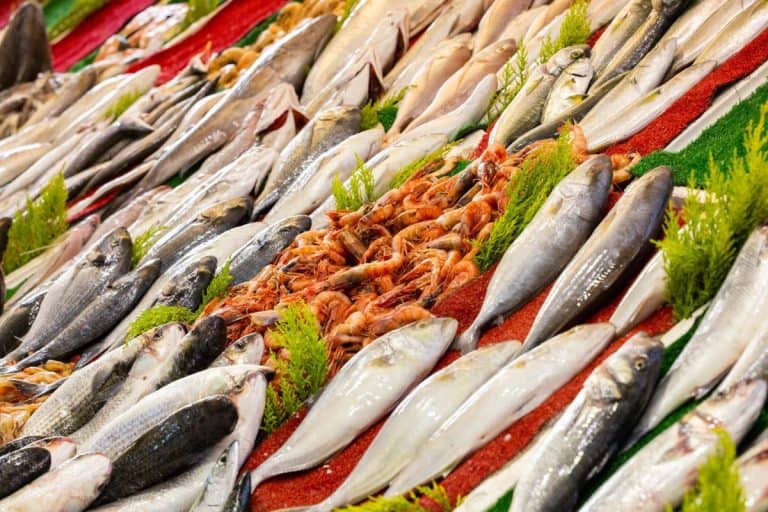
  • Humans eat this fish species, which is usually found in a variety of everyday products. For example, Pollock is the primary fish used for McDonald’s Filet-O-Fish sandwiches and imitation crab meat (surimi), and is also commonly used in fish sticks, though other whitefish may be used as well.
  • These fish inhabit different regions depending on their age. For example, younger fish occur in rocky areas closer to the coastline because there are more places to hide from predators. As they get older, they move deeper into the ocean.

Classification and Scientific Name

The Pollock belongs to the order Gadiformes, a diverse group of bathypelagic fishes found worldwide. They live in cool to cold water, with habitats ranging from the ocean depths to the inshore coastal areas.

Pollock belongs to the family Gadidae and consists almost exclusively of marine fish in the order Gadiformes. They are distinguished by their dorsal fin, which is located further down on their bodies, the absence of true spines in their fins, and many have extended dorsal and anal fins.

Gadidae is known as the Cod family because its members include Cod, Haddock, Whiting, Pollock, and Cuskfish. Cods and Haddocks are distinguished by their three dorsal fins and two anal fins. Members of this family occur in the Atlantic, Pacific, and Arctic Oceans, except the burbot, which is the only freshwater member of the cod family.

Pollock are generally divided into two major commercial species, Atlantic Pollock (Pollachius pollachius) and Alaska Pollock / Walleye Pollock (Gadus chalcogrammus). The Atlantic Pollock is found in the North Atlantic, particularly around the UK, Ireland, and the Bay of Biscay. The Alaska Pollock is found in the North Pacific Ocean, where it is most common in the eastern Bering Sea.

Appearance

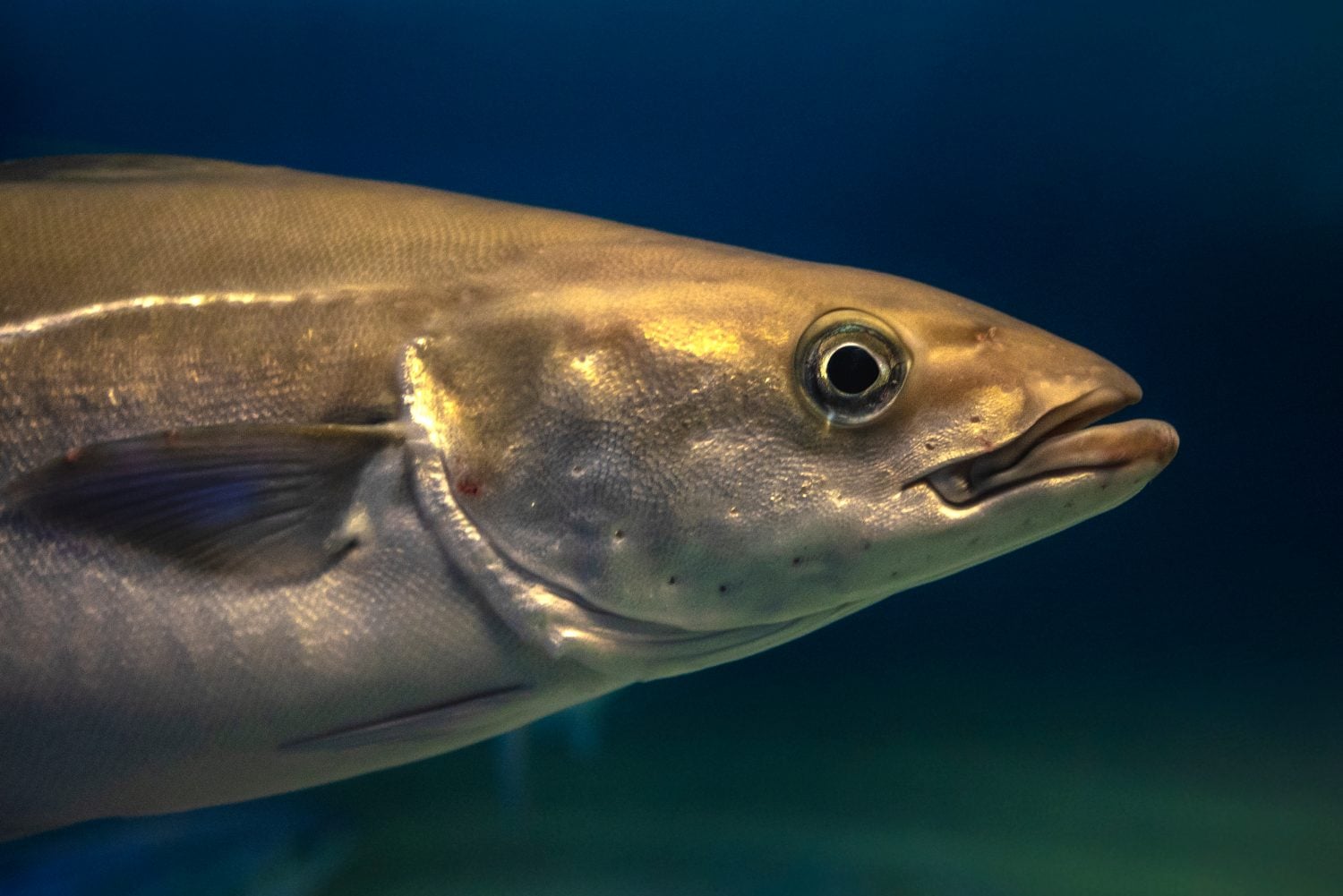
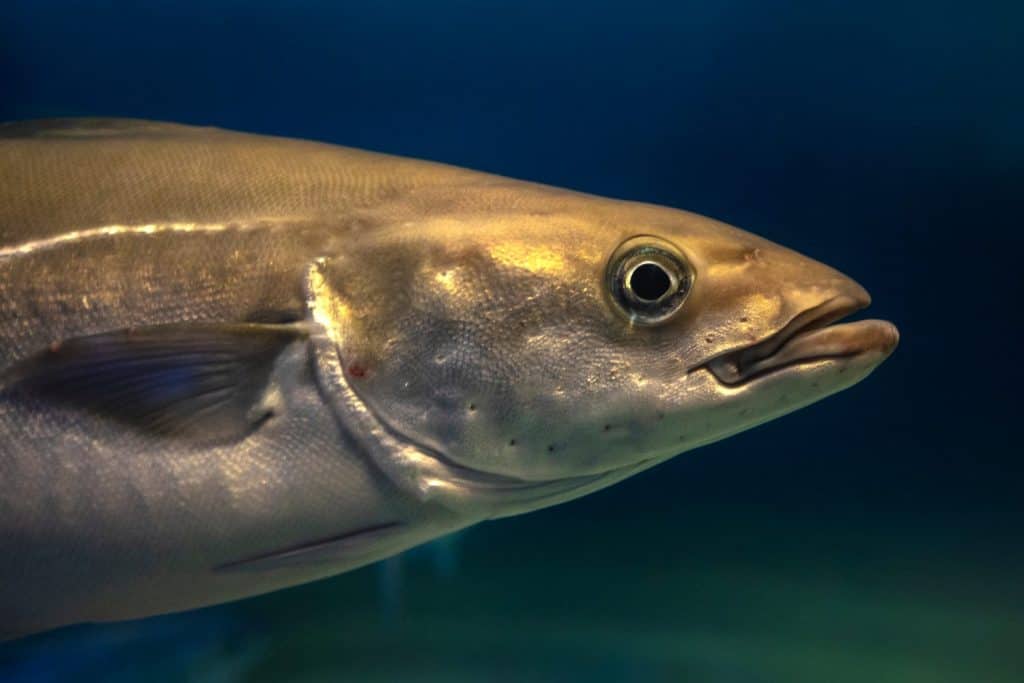
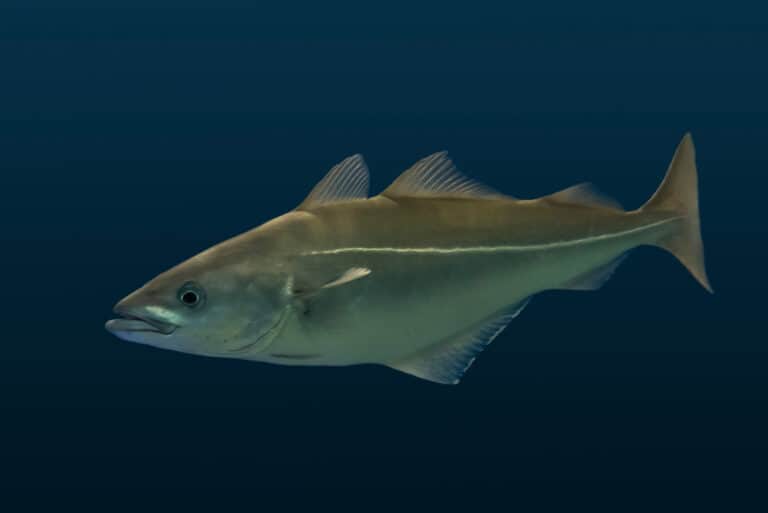
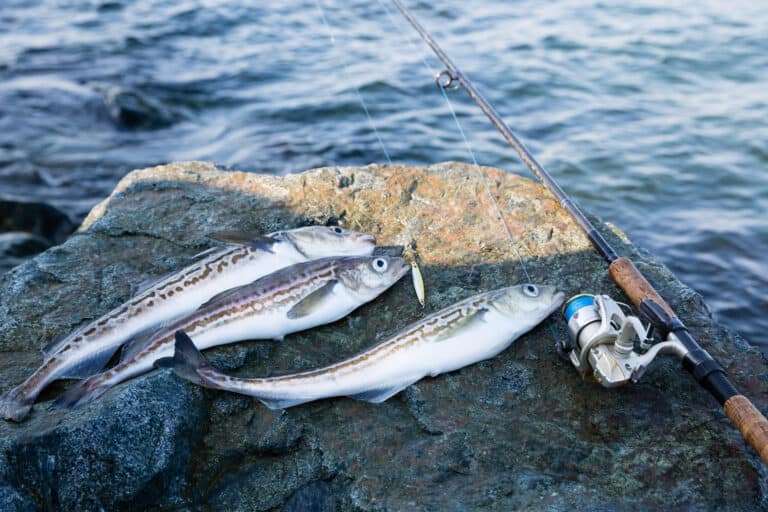
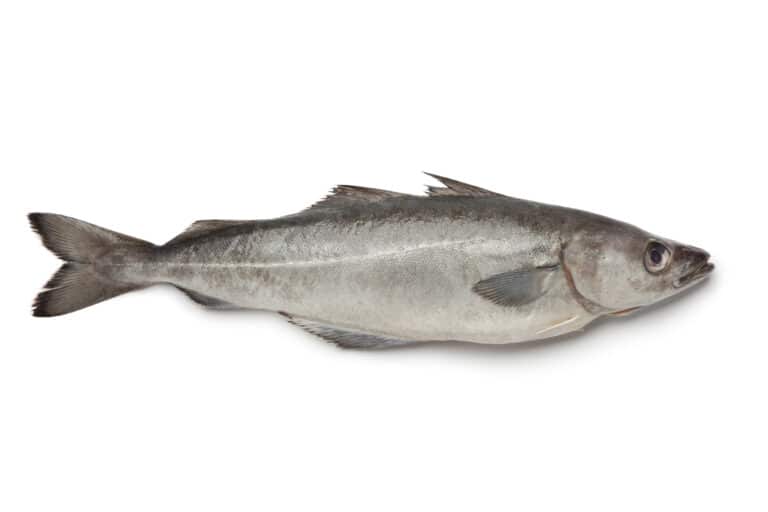
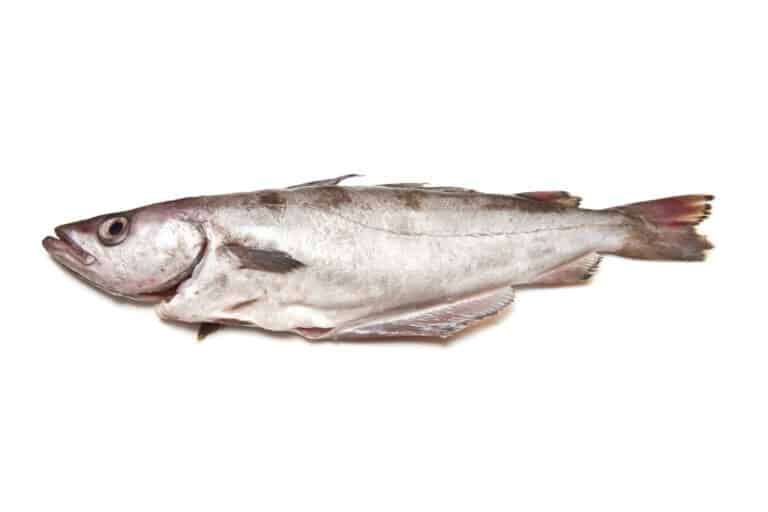
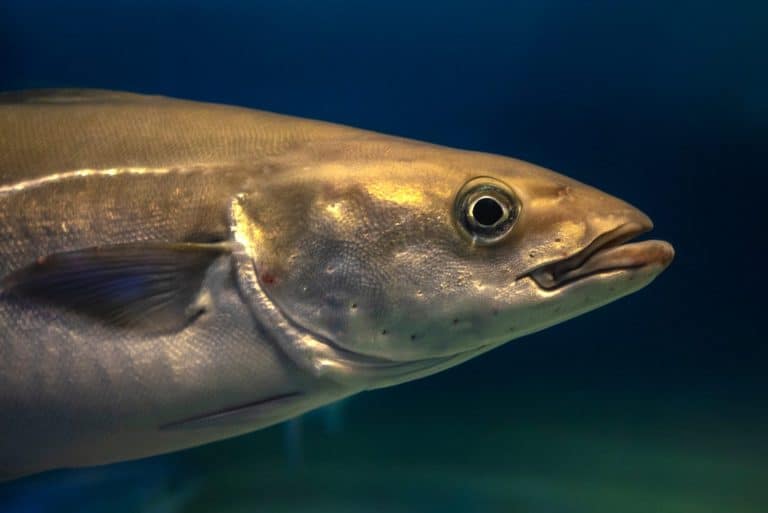
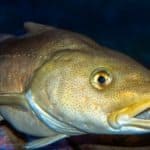
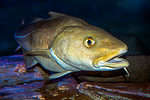
Atlantic Pollock have a lower jaw projection, pointed snouts, and a forked tail. Their bodies are brownish-gray, which fades into a yellow-gray, with a silvery-gray belly.

In addition, they have a small barbel that runs from their chin. Atlantic pollocks have big eyes, three dorsal fins, and elongated and slender bodies.

Their lateral lines have a silvery sheen, and the color turns to a greenish-black hue just below the line. In addition, they have a chin barbel, which they use as a tool to find food.

Behavior

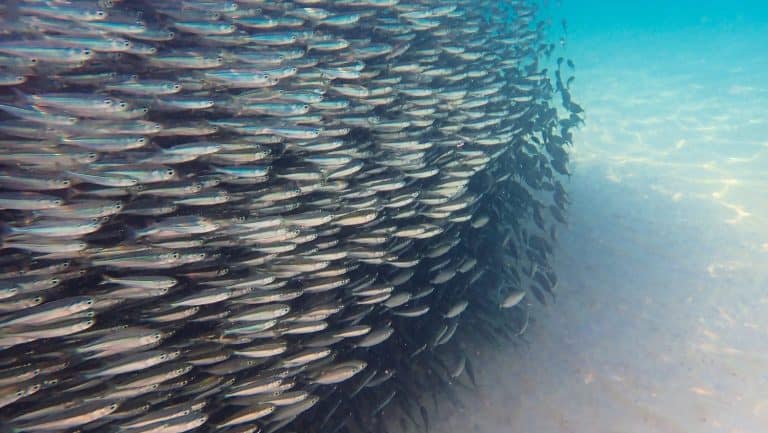
Pollock fish are social creatures, and adults live in groups called schools. As the juveniles grow, they move deeper into the ocean and congregate in masses.

In addition, these fish are believed to partake in some amount of migratory behavior during their breeding season. However, they mostly remain in the same area, never traveling too far from their habitat.

Habitat

Both species of Pollock occur in similar habitats. The juveniles inhabit shallow, rocky habitats where there are lots of places to hide from predators, while adults form large schools and live in oceanic waters.

In pelagic waters, these fish can swim through various levels. They typically range between 330 and 985 feet below the surface, though they are sometimes found at depths of up to 3,300 feet.

Diet

Pollock fish are carnivores and feed on an array of other marine animals. However, their diet changes with age. For example, juveniles prey on plankton, krill, and other small invertebrates, but as they grow, their diet changes to small fish, crustaceans, squid, and herring.

Predators and Threats

Pollock fish need to be wary of the following predators:

Unfortunately, Alaskan Pollock are Near Threatened because of their use in the commercial trade. However, the populations in the Northeastern Atlantic are rarely caught.

On the other hand, the Atlantic Pollock is listed as Least Concern on IUCN’s Redlist, although it is targeted by commercial fisheries, particularly in Europe. However, they are sometimes caught as bycatch, but this does not affect their population numbers or conservation status.

Reproduction, Babies, and Lifespan

The Atlantic Pollock reaches sexual maturity between 2 and 6 years old, with most individuals maturing at 3 to 4 years, and spawns in the cool waters from September to April. However, the majority of spawning takes place from December to February. They tend to spawn over rocky bottoms or stones, and after the eggs are fertilized, they rise in the water column.

Once hatched, the young live in inshore sub-tidal and intertidal zones for around 12 months. Once they are two years old, they begin to migrate into deeper waters. Because of their relatively short lifespan, Alaskan pollocks start reproducing at the ages of three or four.

Lifespan/Longevity

The Alaska Pollock does not live long in the wild; its average lifespan is 12 years. However, the Atlantic Pollock has a longer lifespan of around 25 years.

Population

Unfortunately, there is no conclusive information on the population size of either of these two species.

Eating Pollock Fish 

Pollock is a nutritious fish, readily available for human consumption, and more sustainable and affordable than other whitefish species like hake or haddock. Most pollock consumed worldwide is Alaska pollock, which is mainly fished in the North Pacific Ocean.

Nutritional Information

This fish is similar to tuna or salmon because it is a good source of protein and low in saturated fat. Pollock is also low in calories and a fantastic source of:

  • Vitamin B12
  • Phosphorus
  • Selenium
  • Calcium
  • Iron
  • Magnesium
  • Potassium
  • Sodium
  • Zinc
  • Vitamin A

Health Benefits

Pollock has multiple health benefits because of its nutrient-dense nature; these benefits include:

Good Nutrients for Heart Health

Pollock contains minerals that have a positive impact on blood pressure and circulation, and which reduce the risks of heart disease. Not only are they good for the heart, but they also taste great and can be used in various recipes, so .

Pollock has anti-inflammatory Effects

Pollock contains unsaturated fats high in omega-3 fatty acids, which act as anti-inflammatories and improve the overall health of the skin and stomach.

Helps with Weight Loss

Pollock is very low in calories when compared to other sources of protein. For example, this fish has only 92 calories in 3.5 ounces.

Increases Fertility

This fish species is excellent for reproductive health. They are known for increasing fertility because of their positive effects on metabolic processes and hormone production in the body.

Pregnancy Nutrition

Eating while pregnant can be tricky; while fish is generally good for pregnant women, fish does contain mercury, which can be dangerous. However, pollock contains low amounts of mercury, so it is safe to eat as long as it is cooked.

In addition, they are a great source of zinc and iron, which are incredibly beneficial to a baby’s development. Pollock is also high in omega-3 fatty acids, which help with babies’ brain development.

Hair Health

Pollock has a considerable amount of Vitamin B, which helps regulate your metabolism and strengthens your hair.

Brain Health

Phosphorus is one of the elements that control neurological responses, and having a deficiency of the element can result in disrupted cognitive functions. When this happens, it is usually due to a deficiency of Vitamin B. Pollock contains a substantial amount of Vitamin D, which helps reduce the risk of dementia, insomnia, and depression. In addition, Pollock contains omega-3 fatty acids that promote overall brain and mental health.

Reduced Risk of Cancer

Pollock is so rich in nutrients that it can be classified as a cancer-fighting food. For example, it contains selenium, which plays a part in the repair of cells damaged by cancer, specifically prostate cancer.

In addition, they contain Vitamin B2, which acts as an antioxidant that plays an essential role in reducing the free radical damage of cells in the development of cancer. Vitamin B2 also assists in maintaining the digestive tract lining, which plays a major role in the immune system.

The development of colorectal cancer has been linked to the body’s inability to absorb nutrients from food. However, Vitamin B2 helps the body absorb all the essential nutrients it needs, reducing the risk of colorectal cancer in women.

View all 247 animals that start with P

Sources

  1. Kidadl / Accessed August 27, 2022
  2. Animals.Net / Accessed August 27, 2022
  3. Global Sea Foods / Accessed August 27, 2022
  4. Wikipedia / Accessed August 27, 2022
  5. WebMD / Accessed August 27, 2022
Chanel Coetzee

About the Author

Chanel Coetzee

Chanel Coetzee is a writer at A-Z Animals, primarily focusing on big cats, dogs, and travel. Chanel has been writing and researching about animals for over 10 years. She has also worked closely with big cats like lions, cheetahs, leopards, and tigers at a rescue and rehabilitation center in South Africa since 2009. As a resident of Cape Town, South Africa, Chanel enjoys beach walks with her Stafford bull terrier and traveling off the beaten path.
Connect:

Thank you for reading! Have some feedback for us?


Pollock FAQs (Frequently Asked Questions)

Pollock is a nutritious fish, generally readily available for human consumption, and more sustainable and affordable than other whitefish species like hake or haddock.