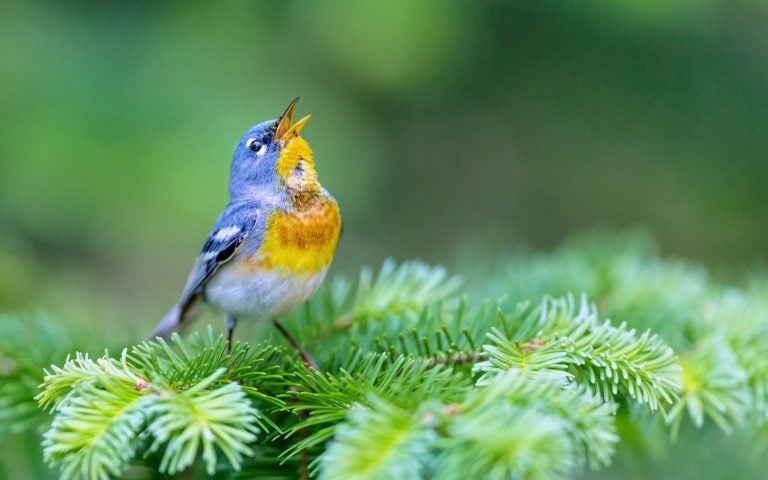
Northern Parula
The moss-nesting spark of spring

The moss-nesting spark of spring
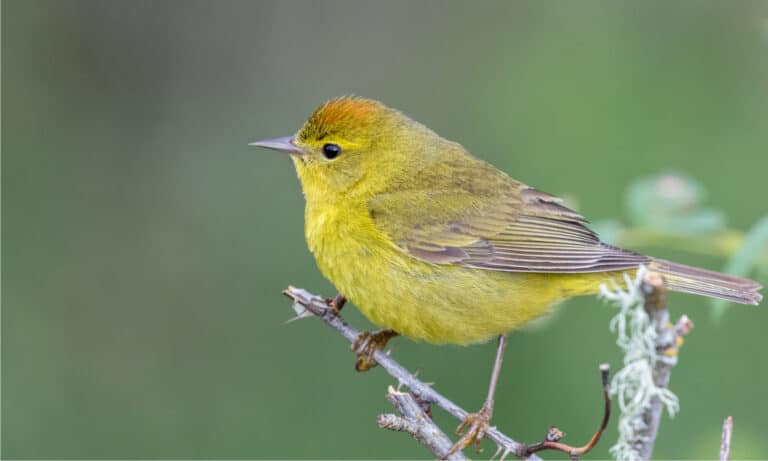
The warbler with the hidden crown
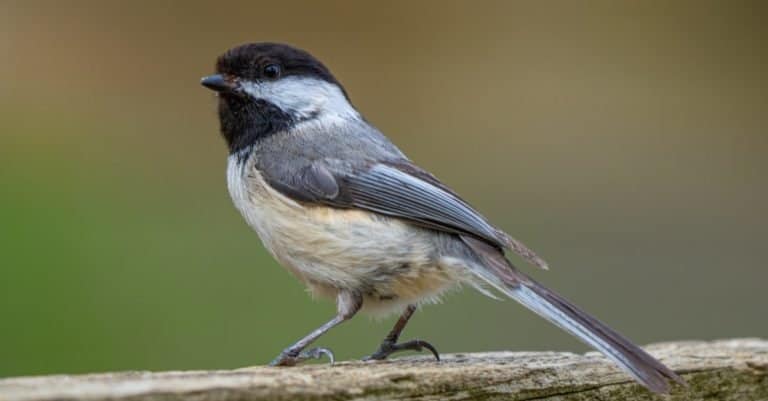
Big attitude in a tiny winter bird
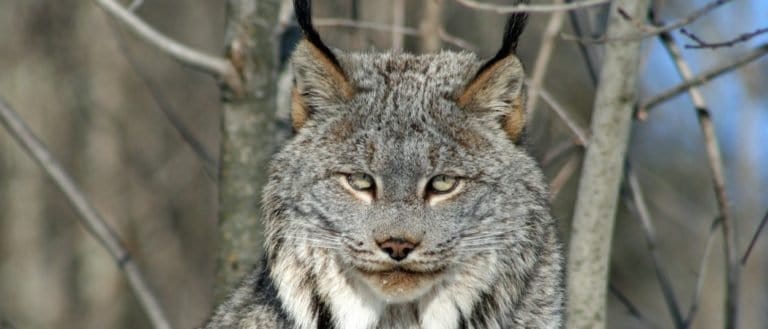
Taiga's snowshoe hunter
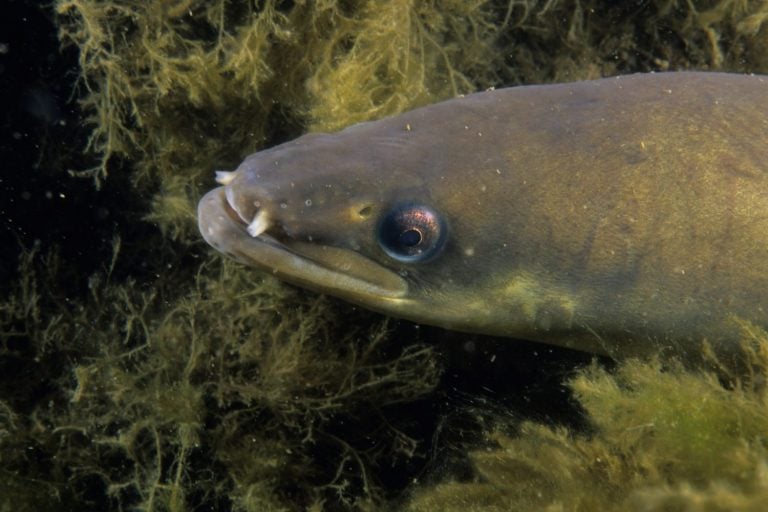
Born at sea, raised in rivers.
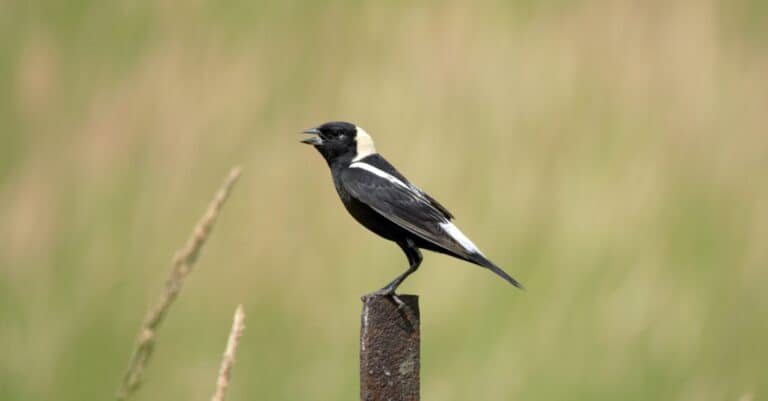
Bubbling song over hayfields, Southbound by night
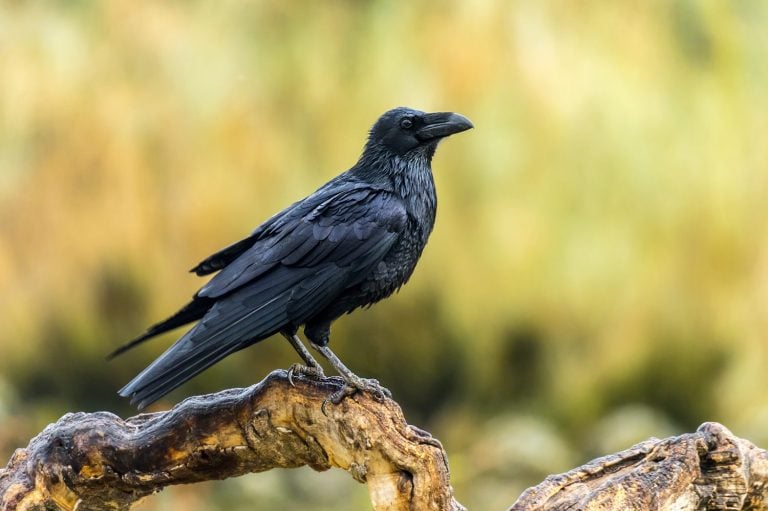
Wedge tail. Deep croak. Big brain.
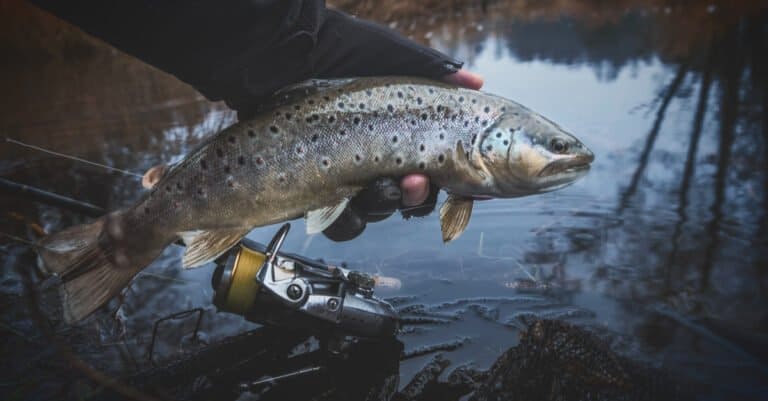
Vermiculations in the cold current
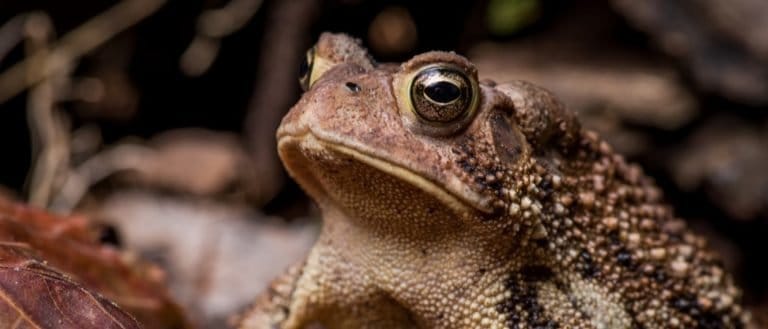
The trilling toad of the backyard
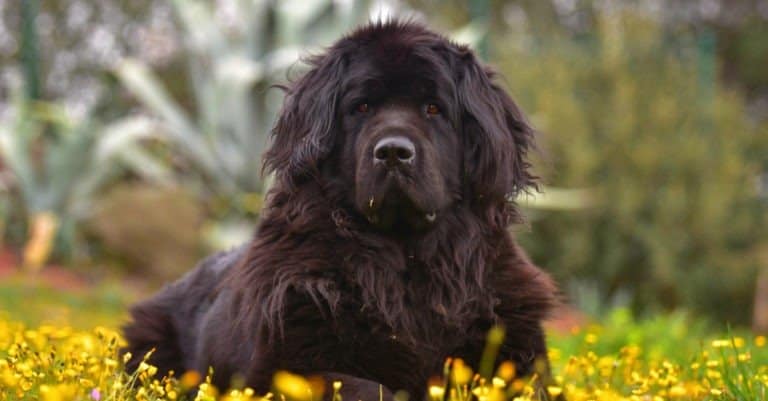
Built for the surf, born to save
Newfoundland and Labrador's wildlife is shaped where land meets sea, boreal forest meets tundra, and the cold Labrador Current meets the North Atlantic. The province is known for dramatic coasts with huge cliffside seabird colonies, roaring surf, and seasonal events like drifting icebergs and capelin spawning that draw whales and many seabirds. Inland, wide boreal forests and open barrens support caribou herds and top predators such as wolves and black bears. Key habitats include the rugged Atlantic coastline (islands, sea stacks, and nesting cliffs), the rich marine shelf and fjords (feeding grounds for whales and seals), and Labrador's taiga-to-tundra transition, important for migratory birds and Arctic species. Peatlands, rivers, and coldwater lakes add freshwater homes for fish and other wildlife. The region feels more subarctic and ocean-driven than nearby Maritimes or Quebec.
Newfoundland and Labrador is split between island Newfoundland (rugged, coastal) and mainland Labrador (colder, subarctic). Boreal forest, peatlands and rivers host moose, black bear and migratory birds. Tundra in higher north areas has caribou and arctic animals. Its Atlantic coast, fed by the cold Labrador Current and sea ice, creates rich marine life with seabird colonies and nearshore whales.
Sea level to 1,652 m (Mount Caubvick, Torngat Mountains)
Extensive North Atlantic coastline on the island of Newfoundland and the Labrador mainland, bordering the Labrador Sea and Atlantic Ocean; includes major coastal waters such as the Strait of Belle Isle (between Newfoundland and Labrador) and the Gulf of St. Lawrence (west/southwest of Newfoundland), with many fjords, bays, and estuaries that create diverse coastal habitats.
Designated 1992
Designated 1954
Designated 1997
Newfoundland and Labrador protects rugged Atlantic coasts, seabird breeding islands, boreal forest, rivers, and vast tundra and mountains in Labrador. Protection comes from federal parks (national parks and a national park reserve) and many provincial areas (wilderness, ecological and provincial parks, and river protections). Important wildlife include seabird colonies, whales, seals, caribou, and Atlantic salmon.
About ~10% of land area (rough, varies by accounting of provincial protected areas and marine components).
A UNESCO-listed landscape of fjords, boreal forest, barrens, and coastal habitats that supports strong populations of large mammals and raptors, plus rich coastal wildlife viewing opportunities.
Protects a classic Newfoundland mix of sheltered bays, islands, boreal forest and wetlands-excellent for viewing coastal birds, eagles, and marine mammals, and for rivers supporting fish runs.
One of Canada's wildest mountain-and-fjord systems, with Arctic/alpine ecosystems and a strong emphasis on protecting polar bear habitat and northern wildlife along the Labrador coast.
A vast, largely roadless boreal-to-subarctic mountain region in Labrador that helps conserve large-scale predator-prey dynamics and important caribou and fish habitats.
Coastal dune and beach habitat in southwestern Newfoundland that is important for shorebirds and provides high-quality coastal wildlife viewing (especially during migration).
Boreal forest and upland habitats near the Bay of Islands with good opportunities to see large mammals and raptors; also valued for intact freshwater and forest ecosystems.
A largely undeveloped river corridor (Canadian Heritage River) known for wilderness paddling and protecting high-quality habitat for fish, riparian wildlife, and raptors.
World-renowned seabird breeding islands and adjacent marine waters-one of the best places in North America for close viewing of puffins and other colonial seabirds, with frequent whale sightings offshore.
Iconic cliffside seabird colony that hosts dense nesting concentrations, making it a premier site for seabird conservation and viewing.
Major seabird colony off the Labrador coast with important nesting habitat and rich surrounding marine feeding areas used by seabirds and seals.
A huge, roadless wilderness protecting intact boreal forest, barrens, and headwater lakes/rivers-important for wide-ranging mammals, backcountry river systems, and large-scale ecosystem conservation.
Newfoundland and Labrador's wildlife is defined by a meeting of boreal forest, subarctic tundra, and one of the most productive marine shelves in the North Atlantic. The result is a province where the "big wildlife" experience is often coastal and offshore: immense seabird colonies on cliffs and islands, seasonal concentrations of whales feeding on capelin, and vast seal populations tied to sea ice. Inland, boreal mammals (black bear, lynx, beaver) share space with culturally and ecologically important caribou herds and highly visible moose on the island of Newfoundland.


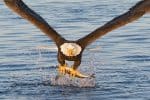
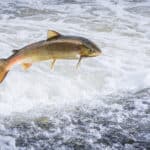
Newfoundland and Labrador has wild coasts and subarctic lands. You can see whales and seabirds along the island's Atlantic shores, and caribou, black bear, fox, and coastal sea life across both places. In summer whales come close, seabird colonies host puffins and gannets, and icebergs, tundra, and taiga feel remote.
Prime "Iceberg Season" along Newfoundland's east/northeast coasts (e.g., Bonavista Peninsula, Twillingate area). Seabirds begin returning to colonies; early bird migration ramps up. Weather is variable and fog can affect visibility, but the coastal drama is at its peak.
Peak for seabird colonies (puffins, gannets, murres, kittiwakes) and excellent chances of whales moving close to shore. Wildflowers brighten coastal barrens and tundra-like headlands. This is a top window for boat tours combining whales + seabirds + icebergs (especially in June).
Reliable whale watching (often including humpbacks) and continued seabird activity; generally warmer, steadier weather and calmer seas for boat trips/kayaking. Great time for multi-day coastal road trips and hikes with frequent wildlife encounters (plus more predictable operating schedules for tours).
Moose viewing improves as animals become more active (and the rut approaches/occurs depending on area). Migratory birds move through; dramatic fall colours in some inland regions. Cooler temps and shorter days, but fewer crowds and strong photography conditions.
A quieter season focused on northern lights potential (especially in Labrador and dark-sky coastal/inland areas), winter birding (e.g., sea ducks), and tracking wildlife in snow. Many marine tours are off-season; plan for self-guided viewing and winter conditions.
Newfoundland and Labrador spans two landmasses and a wide north–south range, from boreal forests and peatlands in Newfoundland and southern/central Labrador to subarctic tundra and alpine areas in northern Labrador, including Torngat Mountains. Glaciation left thin soils, many lakes, fjords, and barrens. Cold Atlantic waters fuel marine food webs; coasts, rivers, and wetlands support seabirds, salmonids, waterfowl, caribou, peatland specialists.
The dominant terrestrial biome across most of Newfoundland and much of Labrador, characterized by spruce-fir forests, lichen woodlands, extensive barrens, and fire/wind/insect disturbance regimes.
Widespread across the island of Newfoundland and large portions of southern to central Labrador; the majority of terrestrial area outside the far north and high mountains.
Low-shrub, moss/lichen tundra and coastal tundra in northern Labrador, with permafrost influence in places and short growing seasons; includes tundra heaths and polar barrens near the Labrador Sea.
Primarily northern Labrador and exposed coastal headlands; increases toward the Torngat region and higher latitudes.
Alpine barrens and cold, windswept high-elevation habitats in the Long Range Mountains (Newfoundland) and especially the Torngat Mountains (Labrador), including talus slopes and alpine heaths.
Patchy, confined to higher elevations (notably Gros Morne/Long Range and Torngat Mountains).
Dense networks of lakes, ponds, bog pools, and river systems shaped by glacial terrain; important for Atlantic salmon rivers, brook trout/Arctic char waters, and wetland-dependent birds.
Ubiquitous inland across both Newfoundland and Labrador; very high lake and river density.
Extensive peatlands (bogs and fens), wet meadows, and coastal wetlands; key carbon stores and major habitat for waterfowl and moose/caribou foraging.
Widespread, especially on Newfoundland's plateau and lowlands and across poorly drained areas of Labrador.
Cold-temperate to subarctic Northwest Atlantic waters (shelves, banks, fjords, and deep basins) supporting forage fish, whales, seals, seabirds, and benthic communities; strong influence of the Labrador Current and seasonal sea ice in the north.
Surrounds the province-Newfoundland-Labrador Shelf and adjacent offshore waters; dominant around all coasts.
Black spruce and balsam fir forests with mossy understories; extensive in Newfoundland's interior and much of Labrador's taiga.
Localized stands of birch, aspen, and poplar-often in mixedwoods, riparian areas, or post-disturbance sites (more common in parts of Labrador and western Newfoundland valleys).
Open lichen woodlands and stunted treeline forms, especially toward northern Labrador and exposed, wind-pruned uplands.
Heath and dwarf-shrub communities on coastal barrens and uplands (blueberry/crowberry heaths), often on thin soils and exposed sites.
Northern Labrador tundra with low shrubs, sedges, mosses, and lichen; important summer habitat for migratory birds and caribou use in some regions.
Short-growing-season herb and graminoid patches in sheltered alpine areas and along meltwater zones, particularly in the Torngats and Long Range.
Long Range Mountains and Torngat Mountains, including fjorded slopes, talus, and high plateaus; strong elevational gradients over short distances.
Sea cliffs and steep headlands hosting major seabird nesting sites (e.g., puffins, murres, kittiwakes) and raptor perches.
Thousands of glacial lakes and reservoirs; key fish habitat and staging/foraging areas for waterfowl.
Salmon rivers and large braided systems; includes important migration corridors and spawning gravels (Atlantic salmon and other salmonids).
Small ponds and kettle-like basins common across peatlands and barrens; often highly productive for amphibians/invertebrates in southern areas.
Peatlands, wet meadows, and riparian wetlands-core habitat for waterfowl, shorebirds, and peatland flora.
Fresh and brackish marshes in sheltered bays and river mouths; important for migratory birds and juvenile fish nurseries.
Raised and blanket bogs (especially on Newfoundland) with sphagnum mats, ericaceous shrubs, and peat pools; major carbon storage landscapes.
River mouths and fjord-head estuaries with strong salinity gradients that support nursery habitat and high bird use.
Highly indented coastline with bays, fjords, dunes, and headlands; frequent fog and high wave exposure shape specialized plant communities.
Sandy and cobble beaches (more localized than rocky shores) supporting shorebirds and coastal dune/strand vegetation where present.
Dominant shoreline type: wave-exposed rock platforms and boulder coasts with rich intertidal communities (mussels, seaweeds).
Nearshore kelp beds in cold, clear waters that provide structure for fish and invertebrates, especially along exposed and semi-exposed coasts.
Offshore waters used by whales, seabirds, and pelagic fish; strong seasonal productivity tied to mixing, ice edge dynamics (north), and shelf processes.
Deep basins and slope waters off the shelf supporting cold-water fauna and deep-diving marine mammals; includes canyon-like features in places.
Shelf and slope benthic habitats (sand, gravel, mud) supporting invertebrate communities and groundfish assemblages; includes sensitive sponge/coral areas in some offshore zones.
Concentrated primarily around St. John's and a few regional centers; coastal development and ports influence nearby habitats.
Low-density development around major towns, expanding into forest and wetland edges.
Limited and localized (notably parts of western Newfoundland such as the Humber Valley/Deer Lake area), including hayfields and small mixed farming landscapes.
There were no moose on Newfoundland until people brought them over (introductions in 1904 and 1910). Today, that single decision shapes forests, road safety, and even what predators can (and can't) do on the island.
Newfoundland is one of the few large regions in North America with no native snakes-an oddity for a province with extensive forests, wetlands, and coastlines.
Beavers are also not native to Newfoundland; they were introduced in 1908 and spread rapidly. Their dam-building has since reshaped wetlands and altered habitat for fish and waterfowl across large parts of the island.
The Newfoundland marten is an island-only subspecies found nowhere else on Earth. It became endangered largely due to habitat loss and incidental capture, turning Newfoundland into the only place where saving that particular marten lineage is even possible.
Labrador is the southern edge of the usual polar bear range in eastern Canada. Bears sometimes show up along the Labrador coast—and rarely farther south when sea ice carries them—bringing an Arctic predator into boreal and Atlantic areas.
Witless Bay Ecological Reserve (near Bay Bulls) hosts North America's largest Atlantic puffin colony-about 260,000 breeding pairs on Great Island alone-plus well over a million seabirds in total during the nesting season.
Baccalieu Island Ecological Reserve (off the Bay de Verde Peninsula) has one of the world's largest Leach's storm-petrel colonies—about 3 million breeding pairs—making it an important safe place; they nest underground and are rarely seen by day.
Funk Island (off northeastern Newfoundland) supports the largest common murre (thick-billed "turr" relatives are farther north; this is the classic "murre" colony) breeding colony in North America-hundreds of thousands of birds packed onto a tiny, wave-battered island.
Labrador's George River Caribou Herd was, at its late-20th-century peak, widely cited as the largest caribou herd on Earth (roughly 700,000-800,000 animals), roaming across Labrador and into northern Québec.
Moose were introduced to Newfoundland and then their numbers exploded. The island (~111,000 km²) has some of the highest moose densities anywhere, with past provincial counts reaching into the six figures.
134 species documented in our encyclopedia
Thank you for reading! Have some feedback for us?
We appreciate your help in improving our content.
Our editorial team will review your suggestions and make any necessary updates.
There was an error submitting your feedback. Please try again.