


Quick Take
- The giant armadillo holds a bizarre mammal record involving its teeth, though scientists have no idea what purpose those teeth actually serve. See the tooth record →
- Its claws are longer proportionally than a lion's or tiger's, and the reason why reveals something unexpected about its lifestyle. Explore the claw details →
- No giant armadillo has ever successfully bred in captivity, and the reasons why make it one of the most challenging animals to protect. Captivity challenges explained →
- Its burrows quietly shape an entire ecosystem, though not in the way you'd expect from a solitary, armor-plated insect-eater. How burrows shape ecosystems →
The giant armadillo, also called tatou, ocarro, and other names, gets its common name honestly. It is a huge animal for its order, Cingulata, and can weigh well over 71 pounds and be over 3 feet long without the tail, which can add another 20 inches to its length.
It also has a huge central claw on both forefeet. The claws can grow as long as 8.7 inches in length, and even lions and tigers don’t have such long claws proportional to their size. The armadillo’s claws are one of the adaptations nature gave it for its termite-eating lifestyle. The claws tear into termite mounds and are used to dig burrows where the armadillo rests for much of the day.

5 Amazing Giant Armadillo Facts
- The giant armadillo has more teeth than any other land mammal. It can have up to around 74 to 100 teeth, depending on the source. They grow all the time like the teeth of rodents, look alike to one another, and lack enamel. Since they don’t help the armadillo catch or eat its prey, scientists aren’t sure what so many teeth are good for.
- A captive ocarro sleeps on average about 18 hours a day.
- Unlike some smaller armadillos, the giant armadillo can’t completely roll itself into a protective ball.
- An armadillo can eat all the termites in a single mound in one sitting. Then, they’ll rest in what’s left of the mound for about a day.
- Glyptodonts are extinct, prehistoric armadillos that were even bigger than the giant armadillos. The glyptodont could be as big as a car and weigh over 2 tons.
Evolution
Giant armadillos are members of the subfamily Tolypeutinae, which contains three genera, including Priodontes, to which they belong. These large armored mammals’ closest relatives are the members of the other two genera, including:
- Cabassous: Armadillos found in Central and South America.
- Tolypeutes: Brazilian and southern three-banded armadillos which are capable of rolling themselves into a ball.
The subfamily to which all three genera belong is part of the larger family Chlamyphoridae, which also contains two other subfamilies: Chlamyphorinae (the fairy armadillos) and Euphractinae, which includes the hairy armadillos, the six-banded armadillos, and the dwarf armadillo.
The Chlamyphoridae belong to the order Cingulata, which has origins that likely predate the fossil record, though cingulate remains are not definitively known until the Eocene (approximately 34 to 56 million years ago).
Scientific name
The tatou’s scientific name is Priodontes maximus. Maximus means “the biggest” in Latin, as it is the biggest living armadillo. Priodontes means ‘saw-toothed’ in Greek, derived from ‘prion’ (saw) and ‘odontes’ (teeth). The giant armadillo is the only member of its species and genus.
Appearance
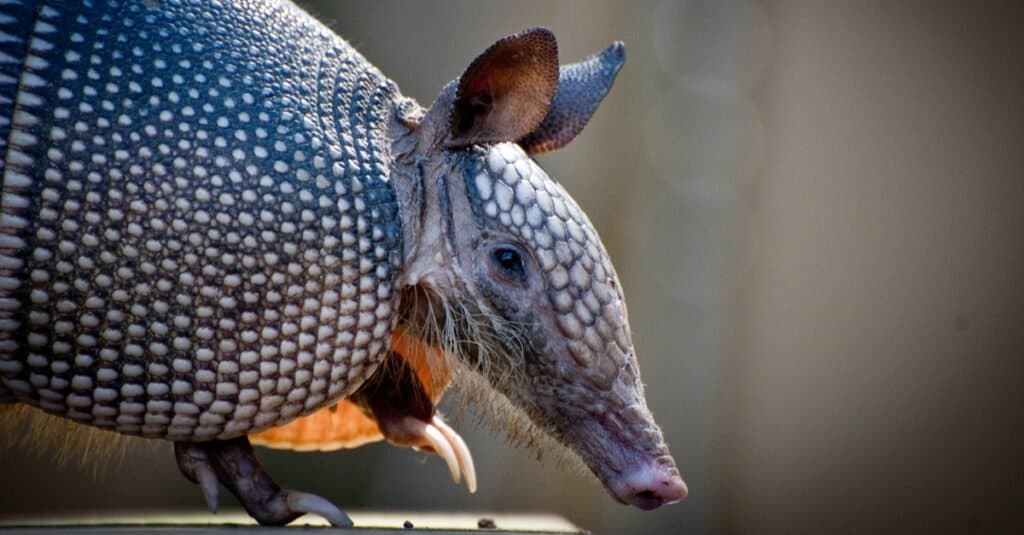
Giant armadillos’ hinged bands enable them to enjoy a greater degree of flexibility compared to tortoises
©Heiko Kiera/Shutterstock.com
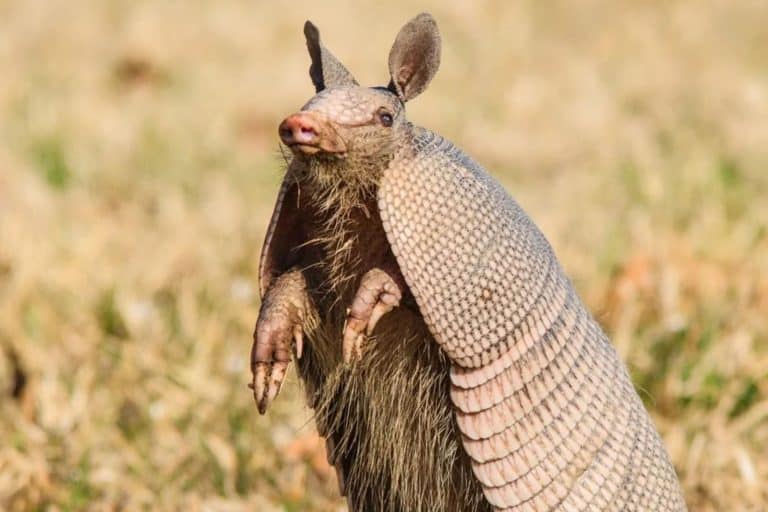
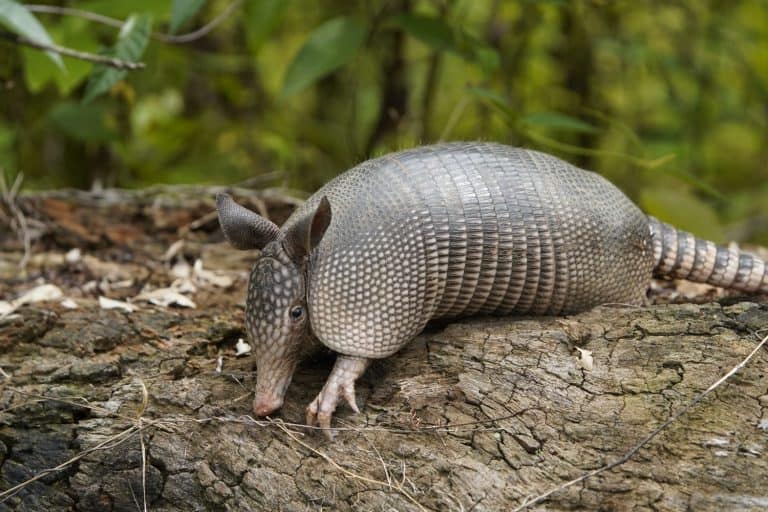
Other than its size, the giant armadillo is like other armadillos in that it has a carapace, much like a turtle. The carapace is made of scutes, which are bony scales made of the same substance as fingernails. These scales are large and cover the top of the animal’s head and the top of its body. However, because the scales extend halfway down the sides, it’s impossible for the armadillo to curl up into a ball. The tail and legs are protected by smaller, five-sided scales. Males are larger than females, and females have two teats.
The tatou is dark brown on top, with a band of yellow along its flanks. The head is cream-colored, long and narrow, and the underside is pale. Beneath the carapace, the animal’s skin is nearly hairless, pink, and wrinkled.
The giant armadillo also has about a dozen bands made of tiny plates over its body and three to four bands on its neck. These hinged bands are adaptations that allow the animal to be more flexible than a turtle or even a glyptodont. Its tongue is long and wormlike. The tongue’s shape allows it to get into the nooks and crannies of termite and ant colonies and capture the insects.
The animal walks on the tips of its powerful third claws.
Behavior
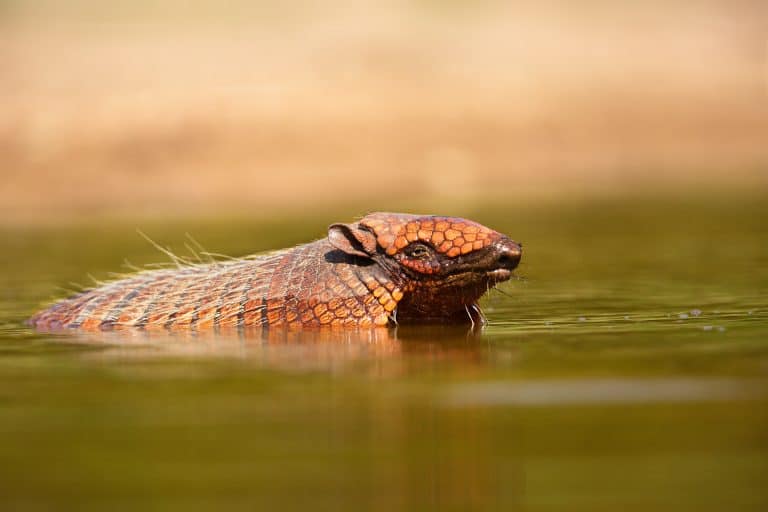
The giant armadillo is nocturnal and spends most of its day in its burrow. When it leaves its burrow to find food, it does so alone. It uses its enlarged claws to tear apart even the toughest and driest termite mound and can balance on its tail and back legs to get to the top of some of them. The animal will also use this stance to protect itself against would-be predators while brandishing its dangerous claws. Even the smaller claws of the giant armadillo are formidable. The animal can also climb and is believed to know how to swim.
After the armadillo has destroyed the termite nest, it will rest in the ruins for as long as 24 hours before returning to its burrow or finding another termite mound.
Habitat
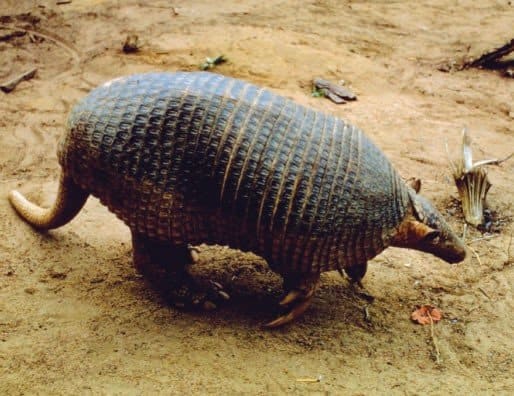
Giant Armadillos may be found in grasslands or forests.
The ocarro is found throughout the northern part of South America, except in the eastern areas of Paraguay and Brazil. It’s not found west of the Andes Mountains, though it’s been discovered at elevations of up to 1,640 feet above sea level. It prefers grasslands, forests, scrub forests, and cerrado grasslands. Cerrado grasslands are tropical savannas found in Brazil, particularly in the highlands of Planalto. A giant armadillo usually has a range of at least 1,112 acres.
Interestingly, the large burrows of the giant armadillo are used by a variety of species, including birds, ocelots, small-eared dogs, and other mammals. Animals dust bathe in front of these burrows and check them for prey.
Diet

Giant armadillos are fond of arthropods such as scorpions.
©Tobias Hauke/Shutterstock.com
The giant armadillo eats termites and certain species of ants. It is partial to the termite species Nasutitermitidae and Termitidae. It will also eat scorpions, millipedes, spiders, cockroaches, and beetles. The animal also eats worms, small snakes, and even carrion, and has rarely been observed eating fruit and seeds.
Predators and Threats

Big cats such as jaguars can pose a threat to giant armadillos.
©Pedro Helder Pinheiro/Shutterstock.com
The armor of the giant armadillo is one of the adaptations that makes it nearly impervious to all but the largest predators, such as pumas and jaguars. Humans are the biggest threat to the animal, as humans alter its natural habitat, hunt it, and run it over on roads.
The giant armadillo has a low body temperature for a mammal, and its immune system is weak. Yet, it seems fairly resistant to diseases and parasites, though ticks have been found on some specimens.
Reproduction and Life Cycle
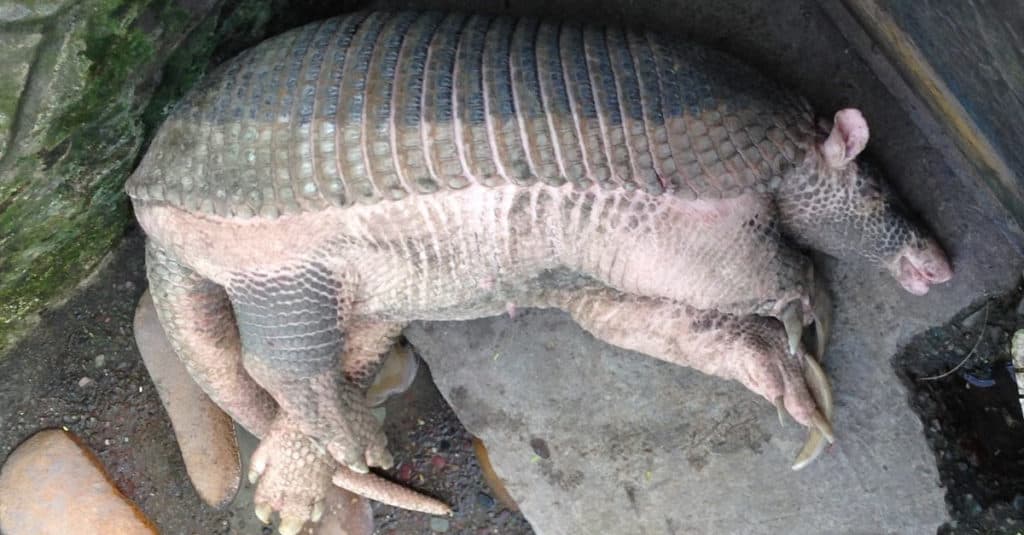
Giant armadillos become independent once they’re weaned at about four or six months.
©pipeafcr / CC BY-SA 3.0, Wikimedia Commons – Original / License
Scientists aren’t entirely sure how giant armadillos court and mate. From research on other types of armadillos, they assume that a pair stays together for the breeding season and then parts ways after sharing a burrow. It’s not known if there’s a breeding season, and scientists don’t know what the interval between breeding seasons is.
The female is pregnant for about 4 months and then gives birth to one or rarely two pups. A pup weighs about a quarter of a pound and is weaned when it’s between four and six months old. After weaning, juvenile giant armadillos are independent. However, at least one juvenile armadillo called Alex was living with his mother in the Brazilian Pantanal even though he was over a year old and probably reproductively mature himself. Scientists believe that giant armadillos live about 12 to 15 years in the wild.
Scientists do not know if giant armadillo fathers have any role in the raising of their offspring.
Population
Scientists aren’t sure what the population of wild armadillos is, and the animals are difficult to keep in captivity. Many that are captured die on their way to a zoo or other facility. If they survive, they may refuse food, and even if they do, no giant armadillo has ever bred while in captivity. Since they are excellent climbers, they can climb out of an enclosure and injure themselves, sometimes fatally. The best way to protect them is when they are in the wild. The giant armadillo is now protected in Argentina, Brazil, Colombia, Guyana, Paraguay, Peru, and Suriname. The conservation status of the animal is listed as Vulnerable on the IUCN Red List.
Giant Armadillo Pictures
View all of our Giant Armadillo pictures in the gallery.

Sources
- Britannica / Accessed May 28, 2021
- The Guardian / Accessed May 28, 2021
- Reference / Accessed May 28, 2021
- Wikipedia / Accessed May 28, 2021
- Animal Diversity Web / Accessed May 28, 2021
- WWF / Accessed May 28, 2021
- Oxford Academic / Accessed May 28, 2021