








Quick Take
- This harmless snake has a clever trick for impersonating a deadly one, and one detail gives it away.
- A tiny insect sometimes turns a snake egg into a nursery for its own young.
- Its nickname comes from a barnyard habit that has nothing to do with rats.
- Its scientific name honors a person, and the genus debate is still unsettled.
The Texas rat snake is one of the most common subspecies of the western rat snake in the wild.
If you live anywhere in the south-central United States, then you may see these large snakes out in the grass or somewhere near your home, but don’t panic. They’re generally not dangerous to people and can be safely avoided. They even make for good pets provided you’re willing to properly care for one.

5 Texas Rat Snake Amazing Facts

The Texas rat snake is a relatively long snake, measuring about 4 to 6 feet in size.
©South O Boy/Shutterstock.com
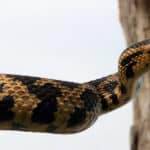
- Rat snakes are semi-arboreal. They are good climbers and spend at least part of their time in trees. They are also considered to be excellent swimmers.
- Rat snakes tend to be nocturnal (meaning they primarily hunt at night) the farther south you go. However, they still need to soak up the sun in the daytime to warm their bodies. In colder climates, they hibernate for the winter.
- Males will attract mates with the use of pheromones. They will sometimes fight each other for access to the females.
- After mating, females lay a clutch of 5 to 20 eggs in hollow logs, compost piles, and other hidden locations.
- The young hatch about two months later, measuring about a foot long. Since they receive no parental care, many of the juveniles fall prey to fearsome predators such as hawks and other snakes. Burying beetles will sometimes lay eggs on the snake eggs, and the larvae will then consume the growing embryo inside.
- Rat snakes sometimes consume chicken eggs, which has given them the alternate name of chicken snake.
Evolution and Origins
Research indicates that ratsnakes evolved in tropical Asia during the late Eocene era and then spread to the Western and Eastern Palearctic regions by the early Oligocene period.
These snakes are present in North America, Europe, and Asia as far as the Philippines. They are mostly found in wooded areas and near agricultural structures, where they prey on rats and mice and kill them through constriction.
Texas rat snakes are not venomous. They kill their prey through constriction, preferring rats and mice, but they also eat birds and their eggs.
Classification and Scientific Name
The scientific name is Pantherophis obsoletus lindheimeri. This subspecies of the western rat snake was named in honor of the person who collected the first specimen, the German American naturalist Ferdinand Jacob Lindheimer.
It was originally a part of the genus Elaphe, but based on DNA evidence, some experts recommended moving the species into the genus Pantherophis instead (a name that essentially means panther snake). However, since this is not universally recognized, some organizations still classify it in the genus Elaphe.
Where to Find Texas Rat Snakes

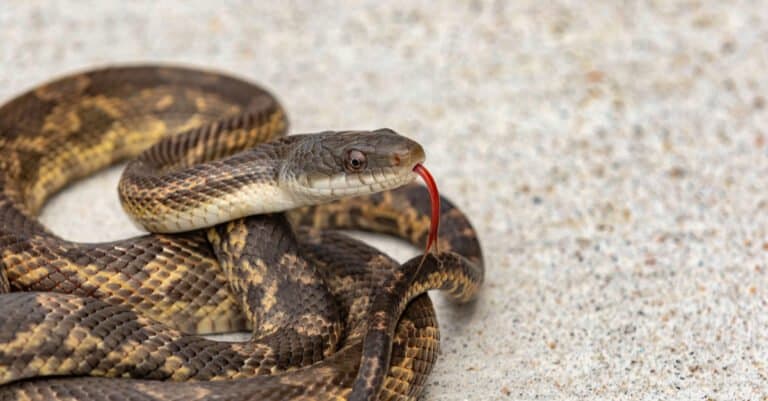
The skin of the Texas Rat Snake can come in multiple colors, including green, reddish-brown, or yellow with gray bellies and heads.
©Silent Shoot/Shutterstock.com
The Texas rat snake can be found throughout the entire south-central region of the United States, including Texas, Oklahoma, Arkansas, and Louisiana. They are comfortable living in a variety of habitats and locations, including forests, grasslands, swamps, and suburban and urban areas.
Appearance and Description

The Texas rat snake sometimes occurs as white albino snakes; they’re particularly popular in the pet trade but quite rare in the wild.
©Kuznetsov Alexey/Shutterstock.com
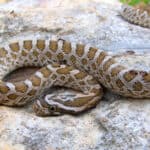
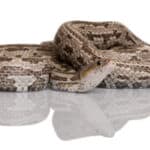
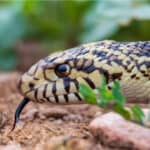
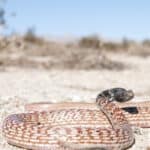
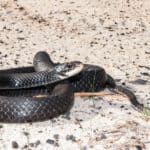
The Texas rat snake is a relatively long snake, measuring about 4 to 6 feet in length. The skin can come in multiple colors, including green, reddish-brown, or yellow with gray bellies and heads and irregular blotches along the entire length of the body.
Albino and all-white leucistic snakes are sometimes born as well; they’re particularly popular in the pet trade but quite rare in the wild. Males and females tend to look similar to each other.
How to identify the snake:
- Long, slender body
- Large triangle-shaped head
- Reddish brown, yellow, or olive-green body with gray head and light belly
- Darker blotches from head to tail
- White leucistic snakes with no blotches are common in the pet trade
How Dangerous Are They?
Despite their large size, these snakes do not pose any significant danger to people. These are non-venomous snakes without any sharp fangs. While it’s generally recommended to leave them alone, you have little to fear from them.
Behavior and Humans
These snakes can be a little defensive around people. When they’re disturbed, some may open their mouths and try to bite, but most of them would prefer to run away and hide. They have the ability to vibrate their tails to mimic the far more dangerous rattlesnake in hopes that any potential predators will be fooled.
The lack of a rattle on the tail will help greatly in identification, however. If this mimicry fails, then the rat snake can also release a foul-smelling substance around it to deter predators.
Population and Conservation Status
As a subspecies, the Texas rat snake has not been given its own separate conservation status, but according to the IUCN Red List, the entire western rat snake group is considered to be a species of least concern.
We do not have enough data about their population numbers to make a good estimate, but they appear to be quite common and widespread throughout their entire natural range.
Texas Rat Snake Pictures
View all of our Texas Rat Snake pictures in the gallery.

Silent Shoot/Shutterstock.com
Sources
- Live Science / Accessed January 21, 2022
- Reptiles / Accessed January 21, 2022