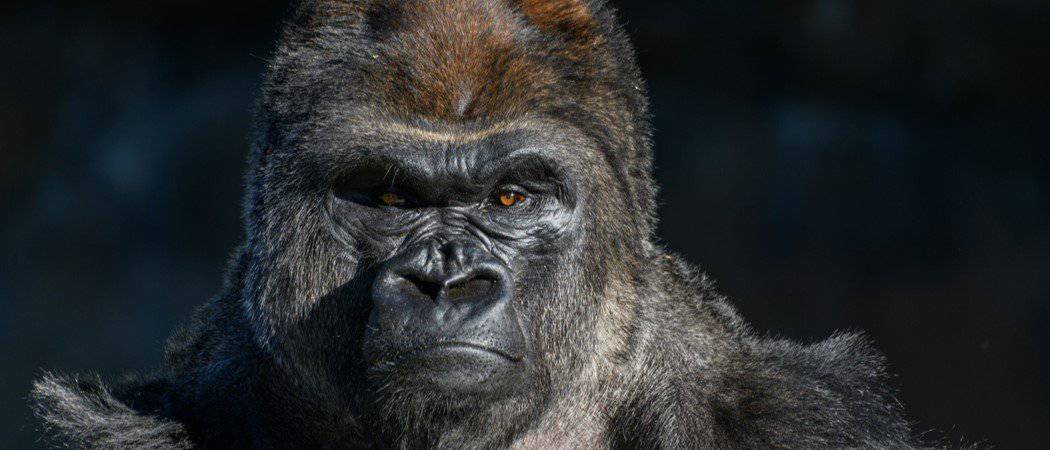
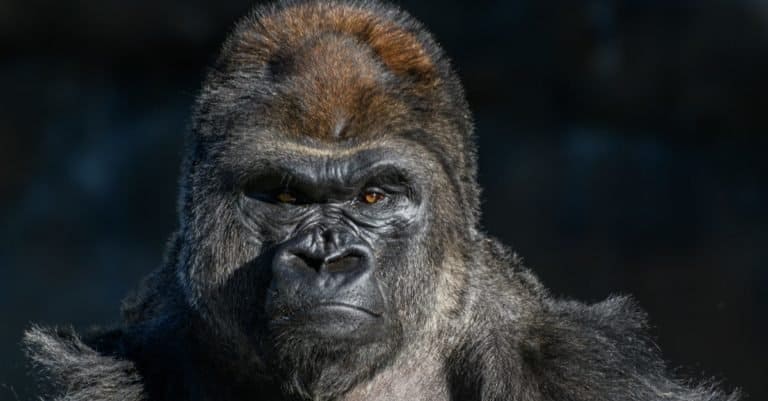













“The gorilla is one of the closest living relatives to humans.”
The name gorilla actually refers to four different subspecies of animals. They share 98 percent of their DNA with humans, and they are smart enough to learn sign language and use tools. Gorillas are far from the wild, violent beasts portrayed in entertainment, and they could even be considered rather shy. The wild population of gorillas is in rapid decline, and they are critically endangered. The average gorilla is as much as four times as strong as a human.
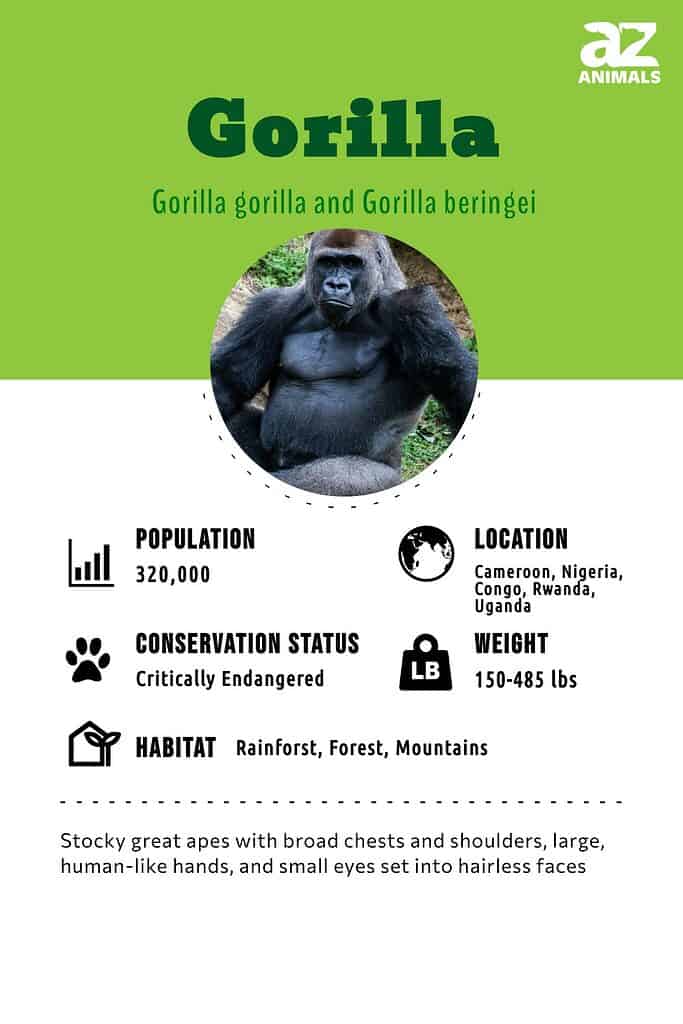
6 Incredible Gorilla Facts!
- Despite their massive size and impressive strength (learn about the strongest animals in the world here), these great apes are primarily vegetarians.
- Wild gorillas live only 35 years, but the oldest captive gorilla lived until the age of 63.
- An adult is capable of bending an iron bar with only their hands.
- These animals are actually quite shy, and they will normally choose to flee if given the opportunity when threatened.
- Healthy adults have no natural predators.
- Ape vs. Gorilla: Gorillas are larger than other ape species and can weigh twice as much as the largest orangutans and more than five times the size of mandrills!
You can check out more incredible facts about gorillas.
Scientific Name
Gorilla is the genus that is commonly used to refer to two species of great apes that are divided further into four total subspecies. The western gorilla (Gorilla gorilla) is split into the western lowland gorilla with the scientific name Gorilla gorilla gorilla and the Cross River gorilla (Gorilla gorilla diehli). The eastern gorilla (Gorilla beringei) is comprised of the eastern lowland gorilla (Gorilla beringei graueri), which is also known as the Grauer’s gorilla, and the mountain gorilla with the scientific name Gorilla beringei beringei. These scientific names are typically abbreviated with initials for the genus and species while the subspecies are spelled out like G. g. gorilla.
These animals are members of the class Mammalia, the order Primates, and the family Hominidae. The term gorilla itself originates from a word in the ancient African local dialect along the west coast of the continent that translates roughly into a hairy person. This was first recorded by an explorer in the region over 2,500 years ago.
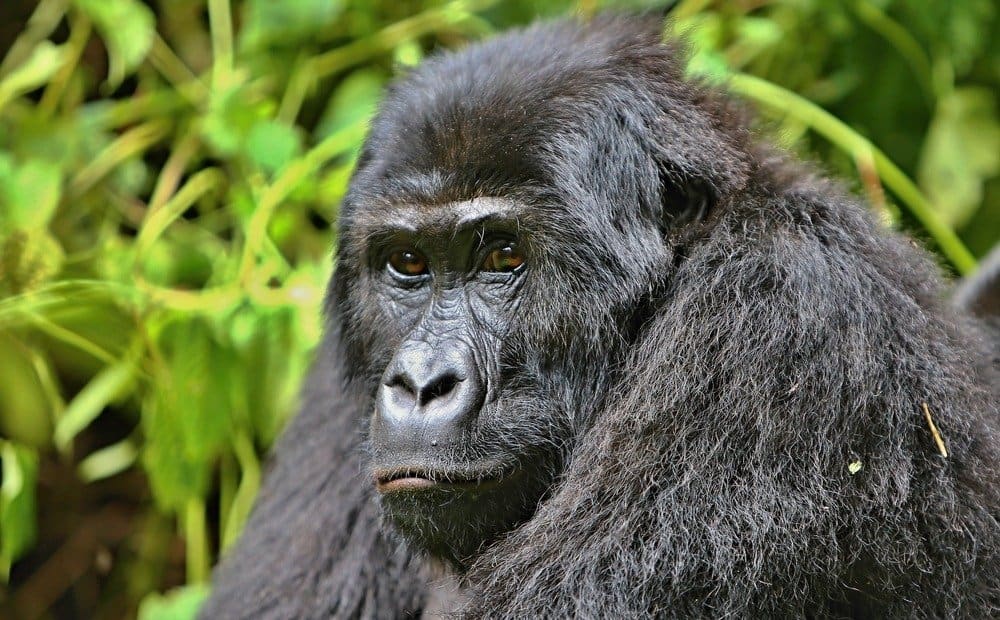
Gorillas are members of the class Mammalia, the order Primates, and the family Hominidae.
©PhotocechCZ/Shutterstock.com
Evolution and Origin
The evolutionary history of gorillas is not well understood. However, population genetic data has helped researchers better understand the evolution of this species. Molecular geneticists have determined that the population of gorillas split into two groups (western and eastern gorillas) around 77,700 years ago.
The closest relatives of gorillas are humans and chimpanzees. They all diverged from a common ancestor about 7 million years ago. Human gene sequences differ from gorilla sequences by only 1.6% on average. Gorillas were previously thought to be a single species with three subspecies (western lowland, eastern lowland, and mountain gorillas), but it is now agreed that there are two main species, and they each have two subspecies. They all developed from a single type of gorilla during the Ice Age when their forest habitats shrank and became isolated from each other.
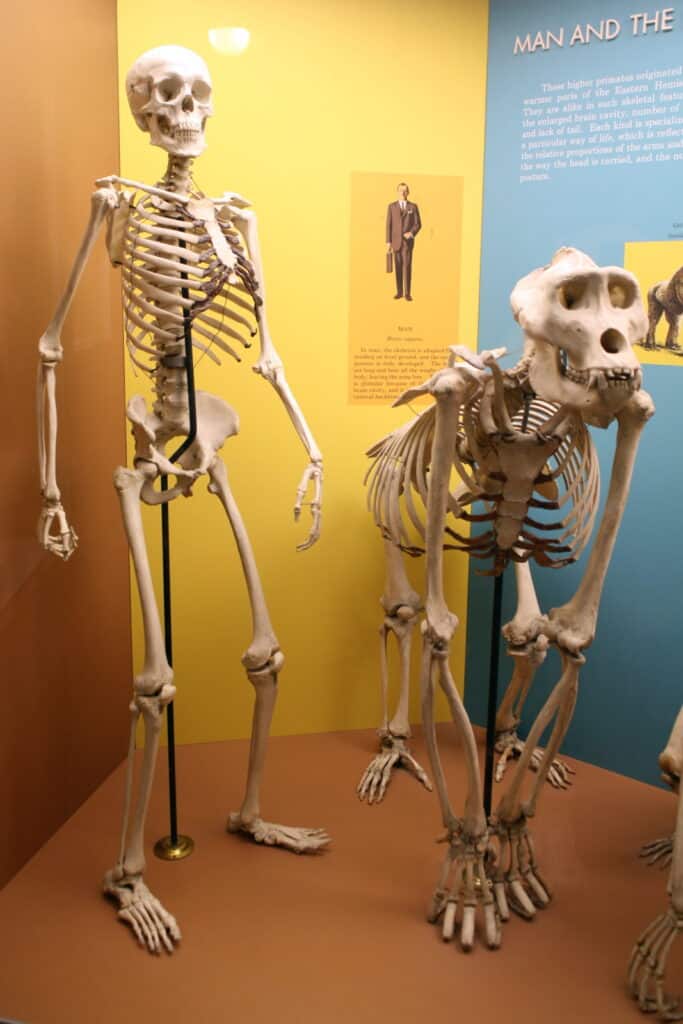
Human gene sequences differ from gorillas by only 1.6 percent!
©Cliff from Arlington, Virginia, USA, CC BY 2.0, via Wikimedia Commons – Original / License
Appearance and Behavior
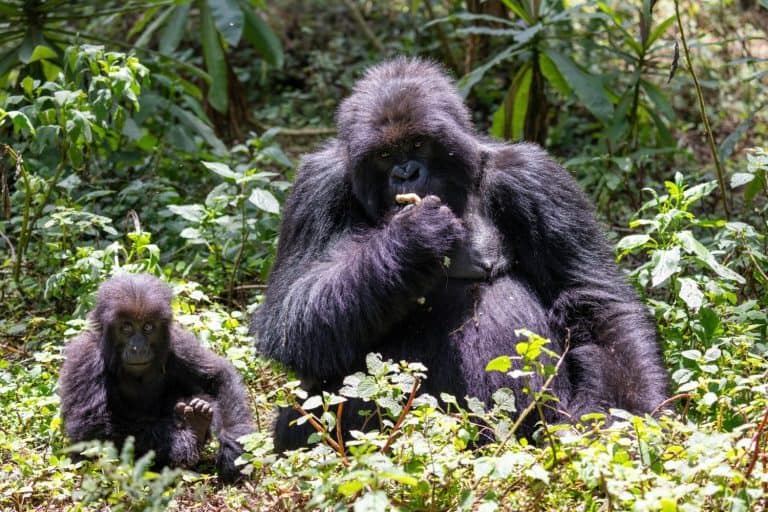
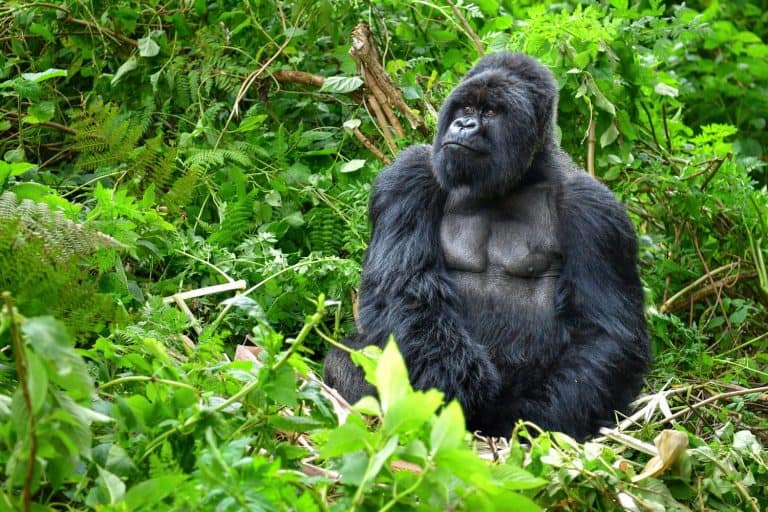
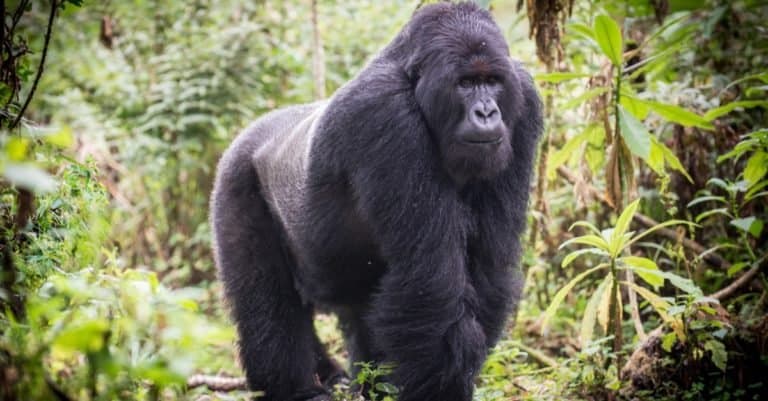
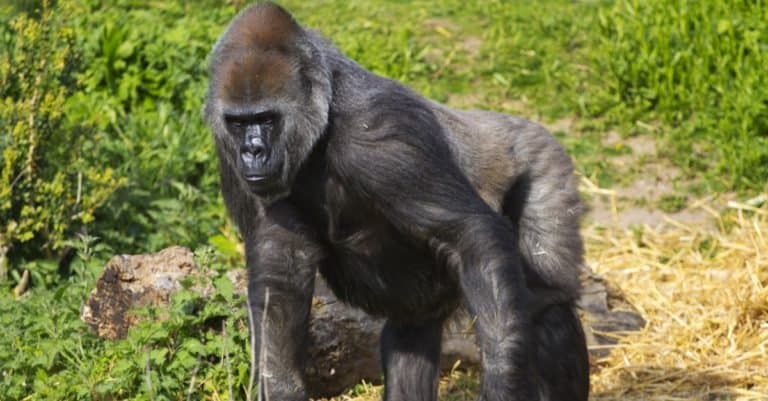
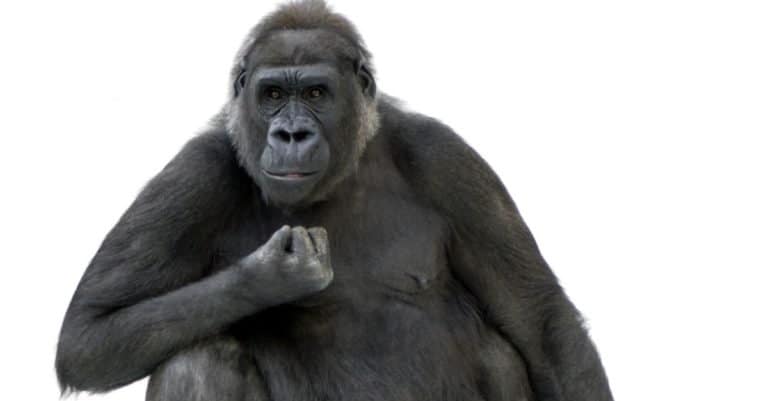
This is an impressively strong animal, and its appearance backs that up. They possess thick chests with wide shoulders and an abdomen that is pushed forward. Adults have long, heavily muscled arms that they use to help propel themselves on their knuckles. Gorillas are covered in black fur except for their faces, hands, and feet; older males also have bare chests. Adult males develop gray or silver hairs in a saddle pattern on their lower back which is why mature males are often referred to as silverbacks. Mountain gorillas have noticeably longer hair than the other three species. Gorillas have truly unique skulls within the animal kingdom.
Male gorillas can grow to nearly five and a half feet tall, with their weight ranging between 300 and 485 pounds. Females generally stay below five feet tall and weigh 150 to 200 pounds. Gorillas living in captivity tend to grow fat and may be much heavier than their wild cousins. The largest recorded gorilla in captivity was Phil of the St. Louis Zoo, who died weighing 776 pounds; that’s bigger than a grizzly bear!
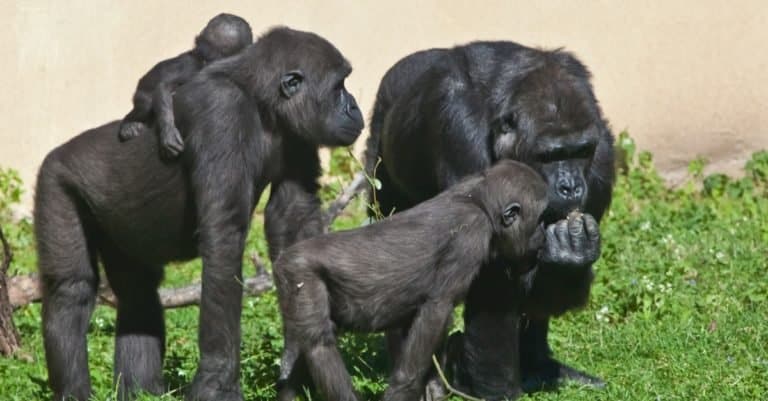
Despite their reputation in the entertainment industry as aggressive, gorillas are actually quite shy unless threatened or harassed. They live in family groups ranging from six members up to 30 that are led by one or two related silverbacks. Generally, the leadership pair are father and son, but it is not uncommon for brothers to lead a troop. The remainder of the group is comprised of females, infants, and juveniles. They are active during the day and primarily move to feed.
Learn more about the toughest animals in the world here.
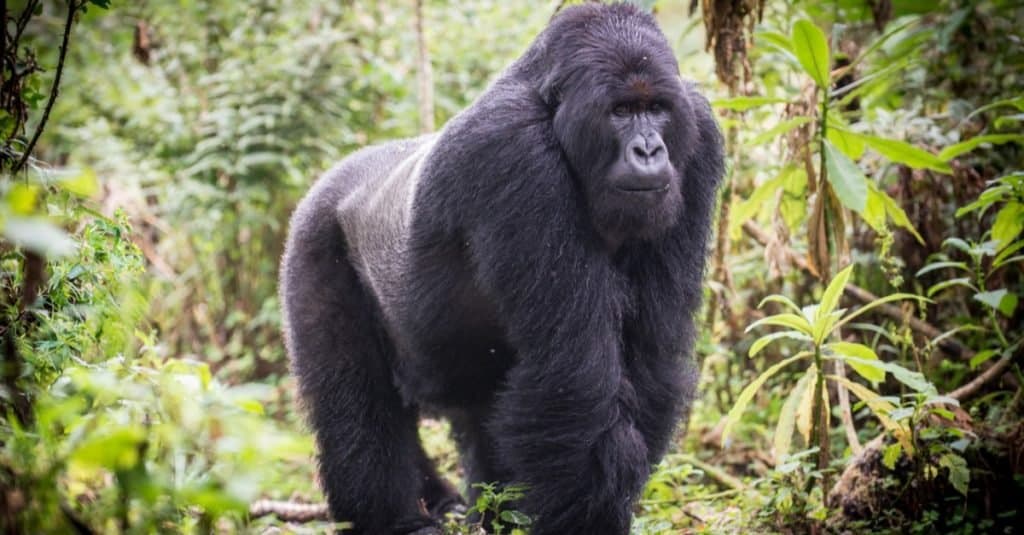
Male gorillas can grow to nearly five and a half feet tall, with their weight ranging between 300 and 485 pounds. Females generally stay below five feet tall and weigh 150 to 200 pounds
©Jurgen Vogt/Shutterstock.com
Habitat
While all gorillas inhabit the tropical forests of Africa, the specific habitat of gorillas varies widely depending on which of the subspecies you are talking about. The western lowland gorilla lives in the rainforests between Cameroon and the Congo River. The Cross River gorilla resides in only a small forest area between Nigeria and Cameroon, directly on the Cross River. Grauer’s gorilla lives in the rainforests of Congo, and the mountain gorilla lives in the mountain forests of the border region of Rwanda, Uganda, and Congo.
A group of gorillas is called a troop or a band. A troop claims an area between one and 16 square miles, and they will walk short distances throughout that territory to feed. Several bands may inhabit the same area without conflict. They will build nests of vegetation every night, either on the ground or in trees.
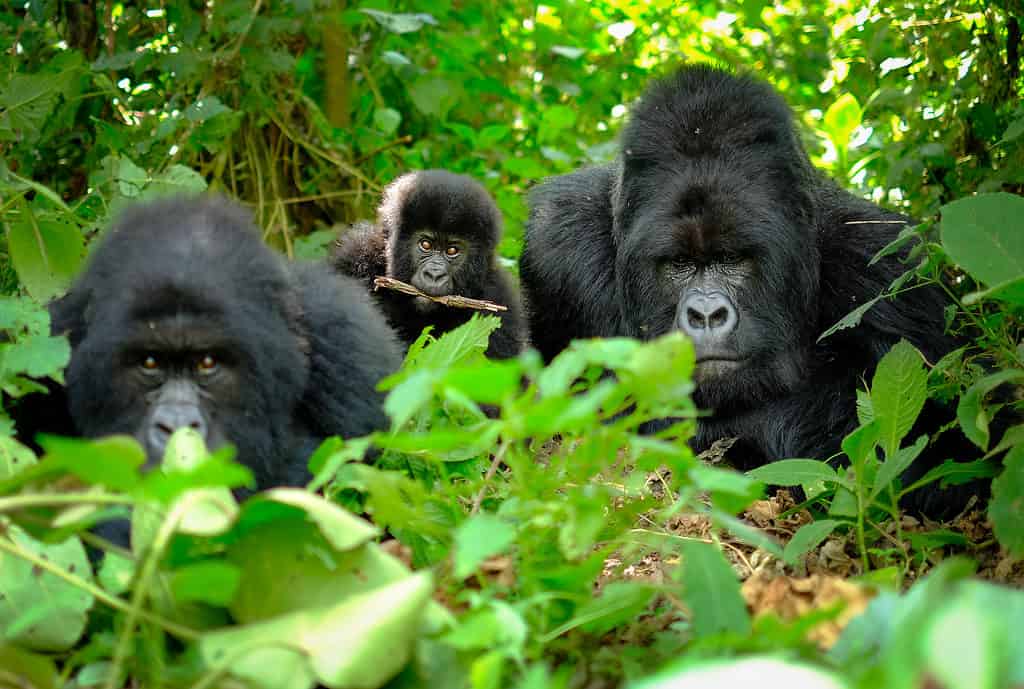
A group of gorillas is called a troop or a band. A troop claims an area between one and 16 square miles, and they will walk short distances throughout that territory to feed.
©Marian Galovic/Shutterstock.com
Diet
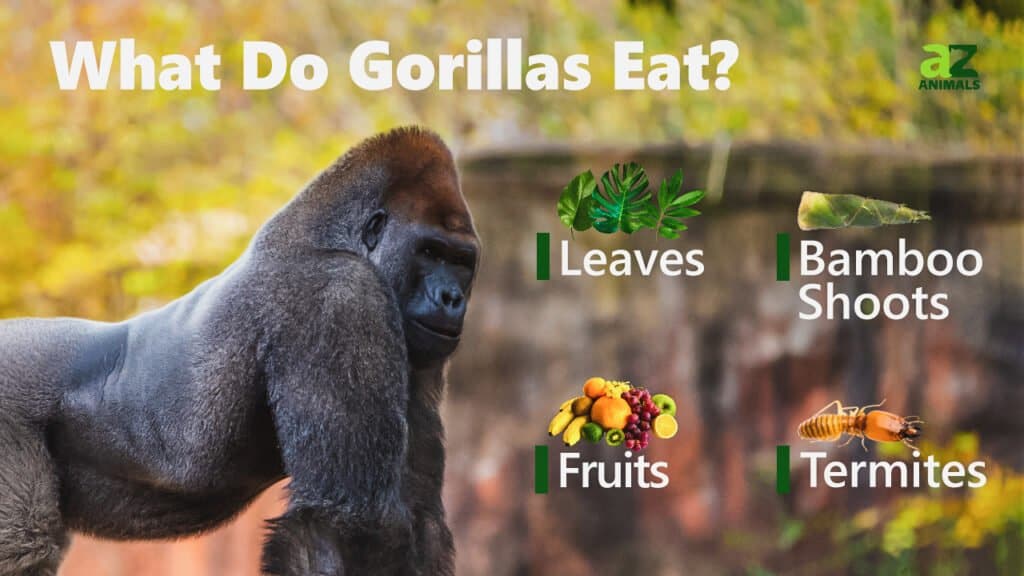
Most of these animals are vegetarian, but the western lowland gorilla also eats insects.
What eats gorillas?
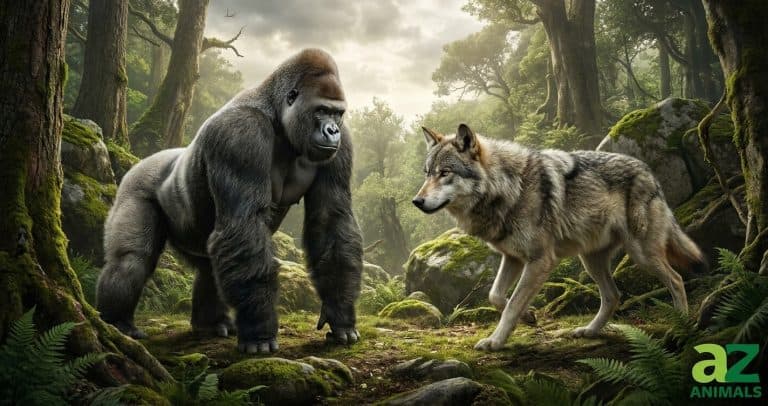
The short answer is not much. Leopards possess the ability to kill young animals, but they do not have many opportunities since the young rarely stray far from the adults. Scavengers will eat these animals who die from natural causes or injury, but there are no true predators for healthy gorillas.
What does a gorilla eat?
Eastern gorillas thrive on leaves, shoots, and stalks of many different plants, while western gorillas eat more fruit. The western lowland gorilla will smash open termite and ant mounds to eat the insects inside and has been known to eat snails as well. These animals can eat as much as 40 pounds of plant matter per day.
If you’re looking for the full details on what gorillas eat, check out our ‘What Do Gorillas Eat’ guide!
Predators and Threats
As mentioned earlier, the only true predator of these animals is a leopard. Leopards don’t commonly hunt gorillas due to their sheer size and strength. It makes much more sense for them to focus on less dangerous prey.
Sadly, the greatest threat to these animals comes from humans. Exposure to disease, deforestation, trophy hunting, and even subsistence hunting to feed logging crews have all taken a terrible toll on the gorilla population. Since they share 98 percent of their DNA with humans, many of the diseases that affect our race are also faced by gorilla populations. That is why conservation efforts have focused on eliminating physical contact between humans and wild gorilla populations, as their immune systems can’t handle the diseases that humans transmit.
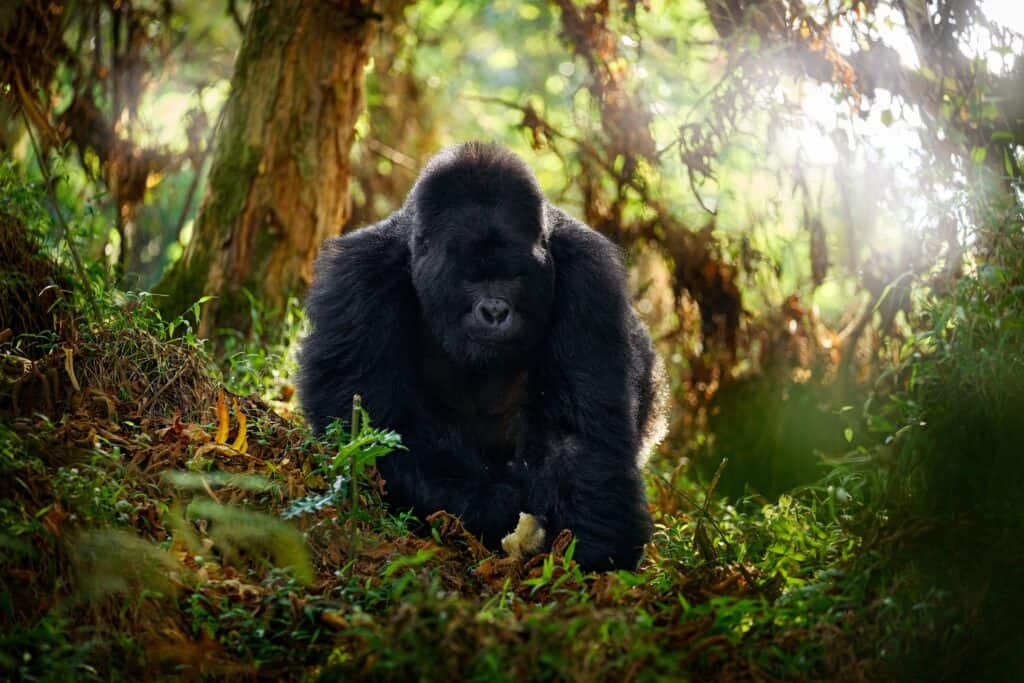
The greatest threat to gorillas is humans. Exposure to disease, deforestation, trophy hunting, and even subsistence hunting to feed logging crews have all taken a terrible toll on the gorilla population.
©Ondrej Prosicky/Shutterstock.com
Reproduction, Babies, and Lifespan
Females reach sexual maturity around the age of seven or eight years old. Their gestational period is approximately eight and a half months long. On average, they give birth to a sole baby every four years or so. Males mature more slowly, and they attain maturity between 12 and 13 years. Upon reaching maturity, males leave the troop and form their own with adult females that they kidnap from other bands during raids. The juveniles of the troop are all fathered by the one or two silverbacks that lead the group.
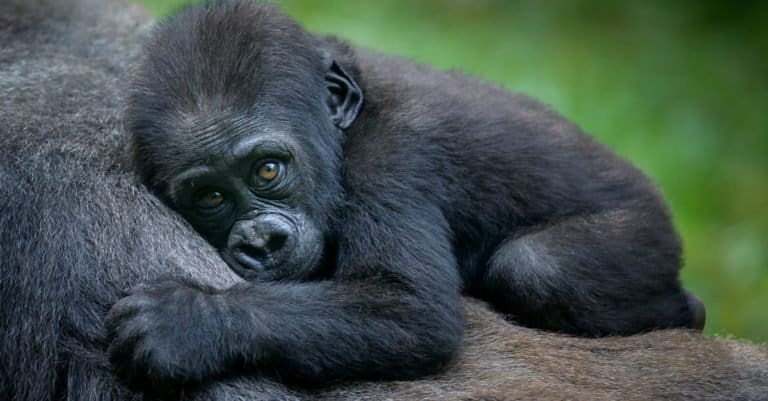
A baby is entirely helpless from birth to around three months and spends a good amount of time being carried in its mother’s arms. They also possess the ability to fiercely cling to their mother’s chest or back, but they are not able to care for themselves or walk during that time. A baby gorilla weighs only four to five pounds at birth.
Wild gorillas live anywhere between 20 and 40 years, while captive animals have been known to live well into their 40s. Until recently, the oldest known gorilla living in captivity was a female western lowland gorilla named Trudy. She died at the age of 63 in Little Rock Zoo in 2019. She was also believed to be the last captive gorilla in North America that was captured in the wild. As of 2021, a gorilla named Fatou is believed to be 64 years old. This makes Fatou the oldest gorilla in the world.
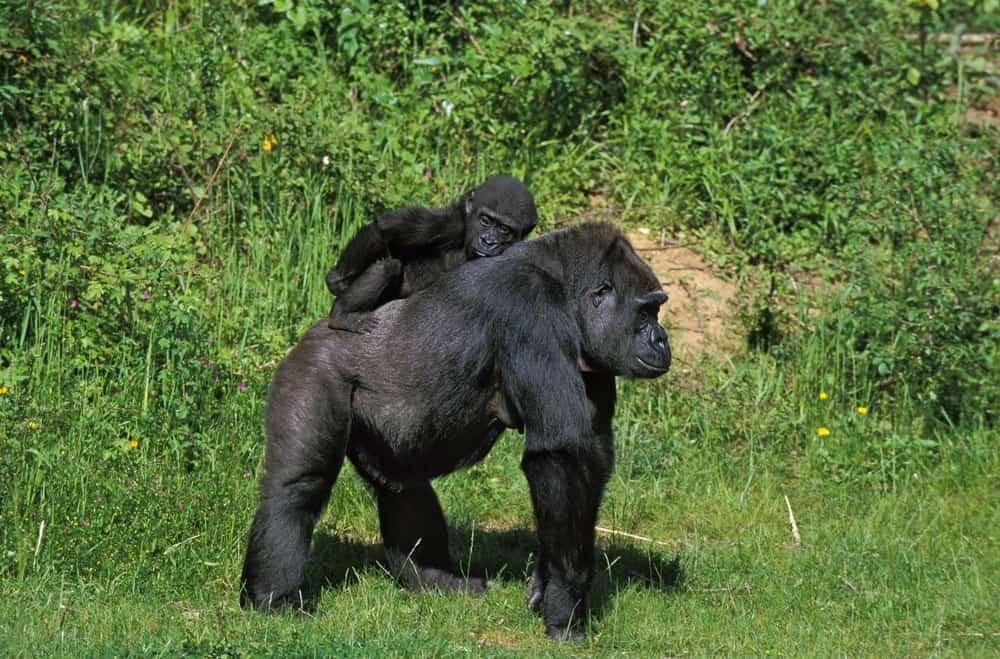
Gorillas give birth to a sole baby every 4 or 5 years.
©slowmotiongli/Shutterstock.com
Population
All species are currently considered to be critically endangered, and their populations are all in decline. Only 4,000 eastern lowland gorillas and 880 mountain gorillas are estimated to be in the wild. Of both of those groups, only 2,600 are mature adults. Approximately 300,000 western lowland gorillas are living, but they are experiencing a double-digit percentage population decline. Only 250 to 300 Cross River gorillas remain in a small region surrounding the Cross River.
Gorillas In the Zoo
These animals can be found in almost any major zoo. All gorillas in zoos in the United States are western lowland gorillas, and they were all born in captivity. None of these animals were captured in the wild. Both the Detroit Zoo and the Bronx Zoo are well-known for their gorillas.
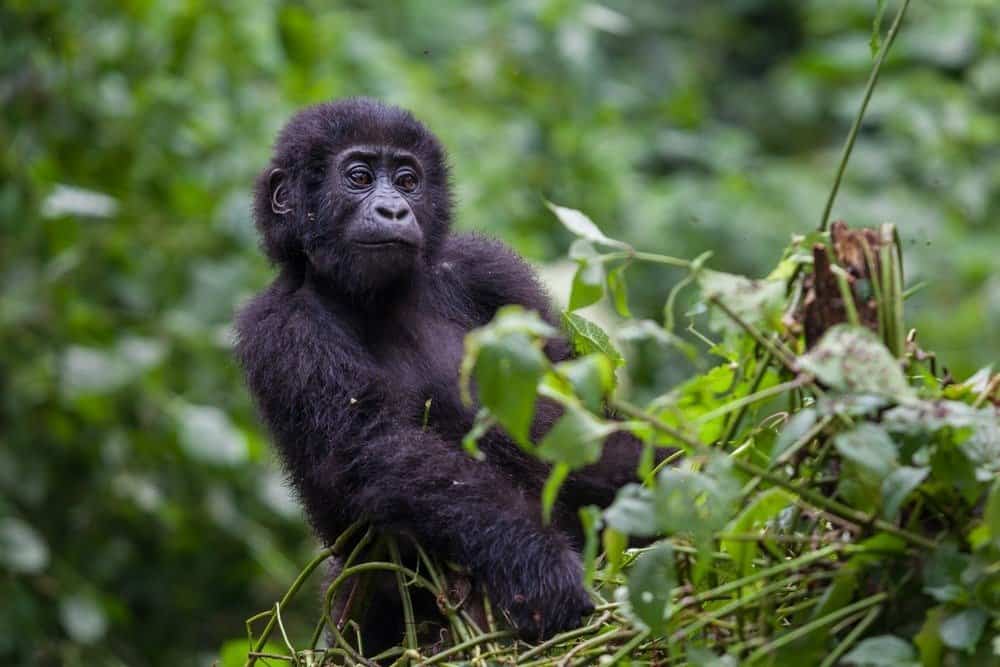
All species of gorillas are critically endangered.
©Katja Tsvetkova/Shutterstock.com
4 Types of Gorillas
There are two main types of gorillas in the world- eastern and western species. Both of these species contain subspecies. Eastern gorillas include the mountain and eastern lowland subspecies. Western gorillas include the Cross River and western lowland subspecies. All of these gorillas live in tropical and subtropical regions of Africa. The key difference between them is size, with eastern gorillas typically being larger than western gorillas. However, both types of gorillas are endangered due to the destruction of their natural habitats.
- Cross River Gorilla – Only 200-300 Cross River gorillas are left in the world, making them critically endangered. They live in the forests and rainforests of Cameroon and Nigeria, an area of about 3,000 square miles. However, their habitat is being destroyed by humans who clear the forests for timber and create fields for agriculture and livestock. Additionally, poaching is a problem in the area, which further contributes to the decline in the Cross River gorilla population.
- Mountain Gorilla – The mountain gorilla is a subspecies of gorilla that lives in forests at high altitudes, between 8,000 and 13,000 feet. They are found in Rwanda, Uganda, and the Virunga Mountains in the Democratic Republic of Congo. Mountain gorillas are slightly larger than other gorilla subspecies and can weigh up to 440 pounds. They have thick fur, which helps them stay warm in colder temperatures. However, as humans move into their habitat, the gorillas are forced to move to higher and more dangerous ground. The mountain gorilla is critically endangered, with a population of only 880 remaining.
- Western Lowland Gorilla – The Western Lowland is the most numerous of all gorillas. They are found throughout the region from Cameroon to the Republic of Congo. Most of these gorillas live in isolated swamps and the Republic of Congo. Compared to other subspecies, they are smaller and have brown-grey coats and auburn chests, wider skulls, and smaller ears. However, they also are about 4 to 5 1/2 feet tall and weigh 440 pounds. Due to poaching, the population has decreased by more than 60% within the last 20-25 years. They are considered critically endangered.
- Eastern Lowland Gorilla – The Eastern Lowland is the largest of the gorilla subspecies and inhabits the tropical rainforests of the Democratic Republic of Congo. In the last 50 years, their historical range has decreased significantly, and they now only occupy about 13% of their original range. They are also critically endangered due to factors such as poaching.
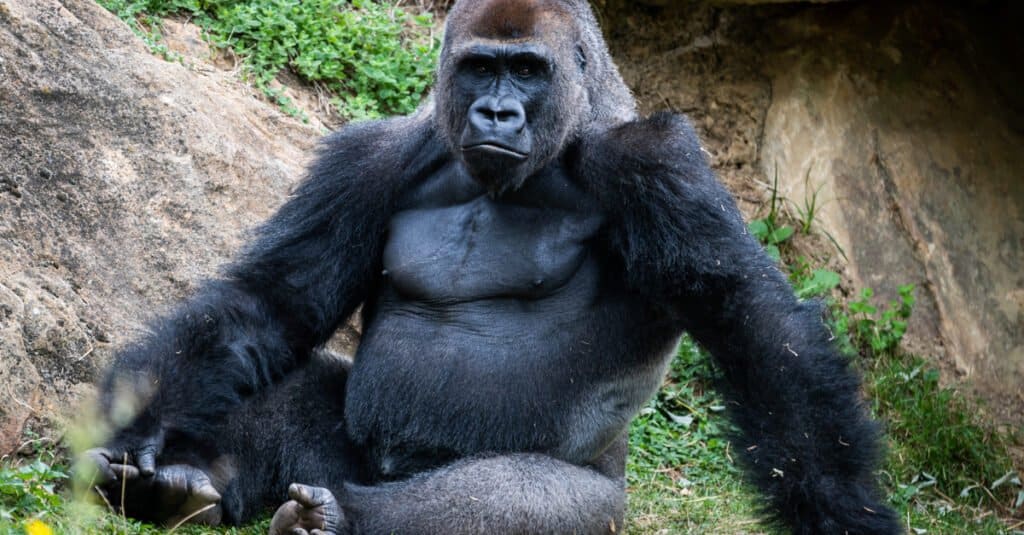
There are four subspecies of gorilla, all crucially endangered.
©AB Photographie/Shutterstock.com
Gorilla Pictures
View all of our Gorilla pictures in the gallery.

Jeff W. Jarrett/Shutterstock.com
Sources
- Britannica / Accessed March 3, 2021
- Sea World / Accessed March 3, 2021
- Reference / Accessed March 3, 2021
- National Geographic / Accessed March 3, 2021
- BBC Earth / Accessed March 3, 2021
- ABC News / Accessed March 3, 2021