Quick Take
- Despite its name, the clouded leopard isn't really a leopard at all. Its true place in the cat family tree is far stranger than you'd expect. Explore its family tree →
- Its canine teeth rival those of a far larger, deadlier predator, but scientists discovered its actual diet completely overturns what those teeth seemed to imply. See what it actually eats →
- A single luxury item made from this animal's fur demands a number of individuals that will genuinely shock you. See the shocking pelt count →
- The clouded leopard can move through trees in ways most cats physically cannot, including one move that defies what you'd think gravity would allow. See its tree-climbing feats →
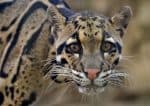
The clouded leopard is a medium-sized feline that inhabits the dense tropical jungles of Southeast Asia. The clouded leopard bridges the gap between big and small cats, forming an evolutionary link between the two groups. Clouded leopards are incredibly shy animals, and coupled with their highly nocturnal lifestyle, this has meant that little is known about their behavior in the wild, as they are very rarely seen.

Evolution
The clouded leopard is believed to be the first cat to diverge from the common ancestor of the Felidae.
©Various images/Shutterstock.com
Fossil records and DNA evidence indicate that the clouded leopard forms an evolutionary link between the big cats, Pantherinae, and small and domestic cats, Felinae. This increase in taxonomic diversity began in the Miocene around 14.45 to 8.38 million years ago in Asia. The clouded leopard is believed to be the first cat to diverge from the common ancestor of the Felidae 9.32 to 4.47 million years ago. The clouded leopard crossed from mainland Asia via a submerged land bridge to Borneo and Sumatra during the Pleistocene and became isolated, diverging into the two current species approximately 1.4 million years ago.
Classification and Scientific Name
The clouded leopard is classified in the Family Felidae. It has recently been split into two separate species: the Mainland clouded leopard (Neofelis nebulosa), which is found in the Himalayan foothills, Northeast India, Bhutan, mainland Southeast Asia, and southern China, and the Sunda clouded leopard (Neofelis diardi), which is found in Borneo and Sumatra. Both species are already very rare, with numbers constantly declining due to hunting for their meat and fur, along with the loss of vast areas of their tropical forest habitat.
Anatomy and Appearance
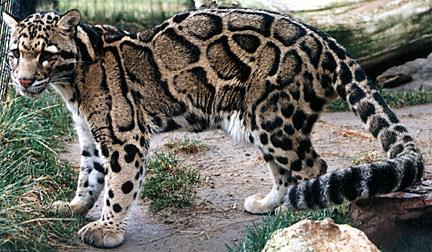
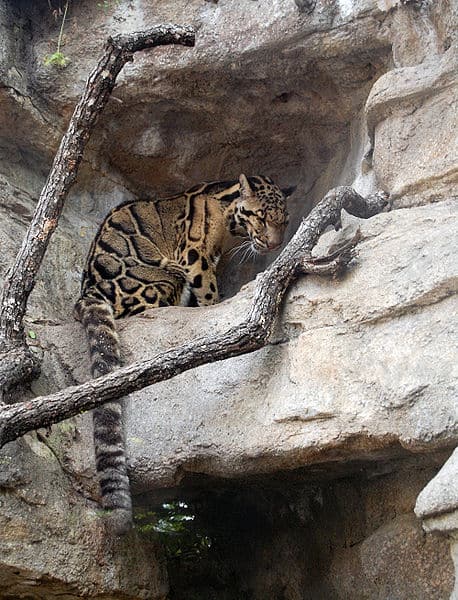
The tail of the clouded leopard is extra long to help it balance while moving through the trees.
©Nancy Vandermey / Creative Commons – Original
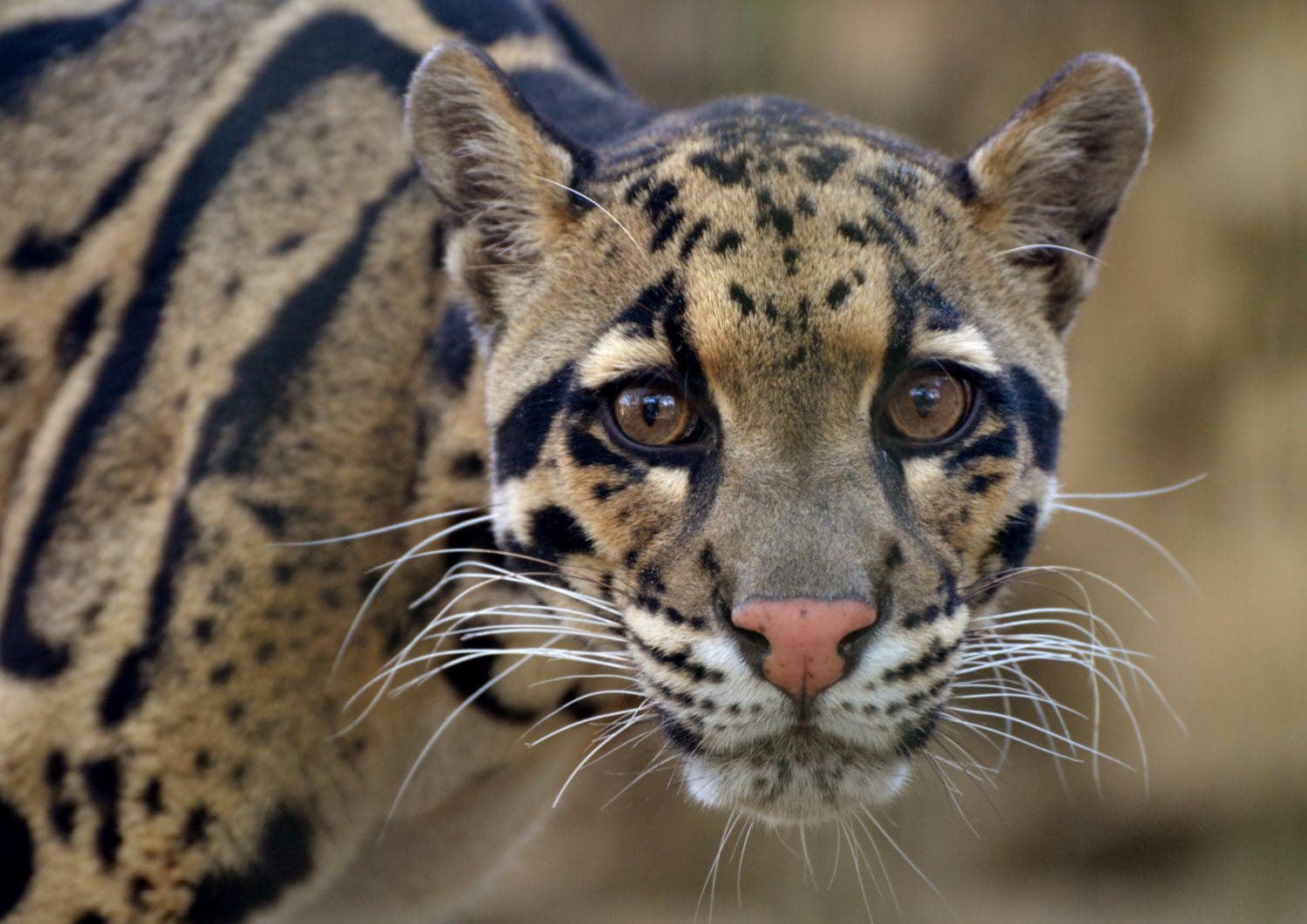
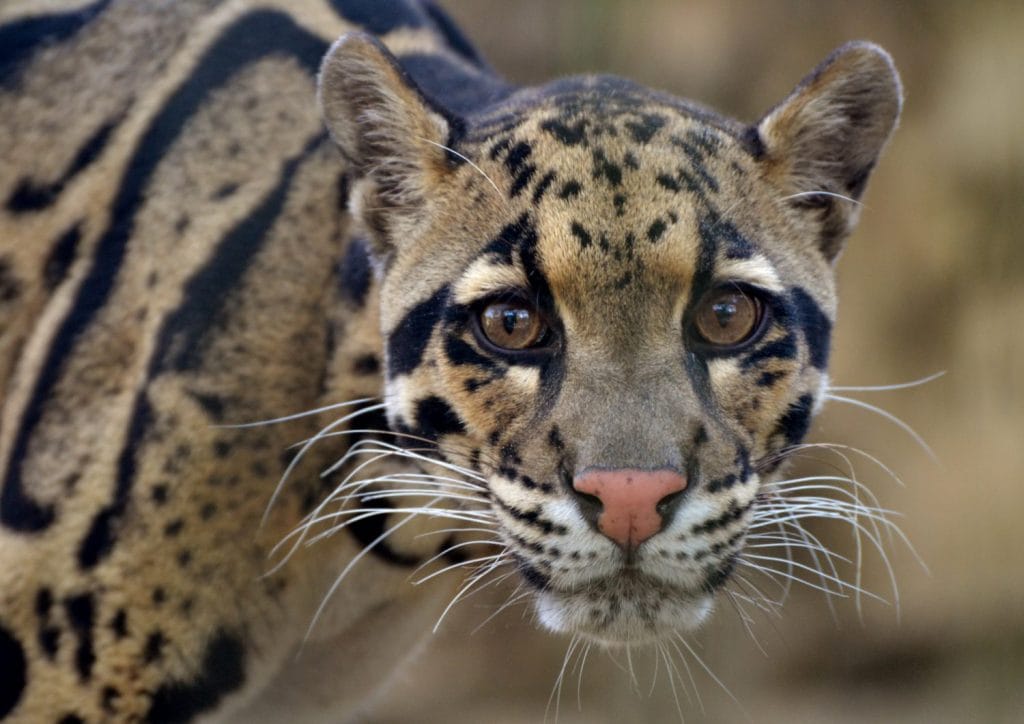
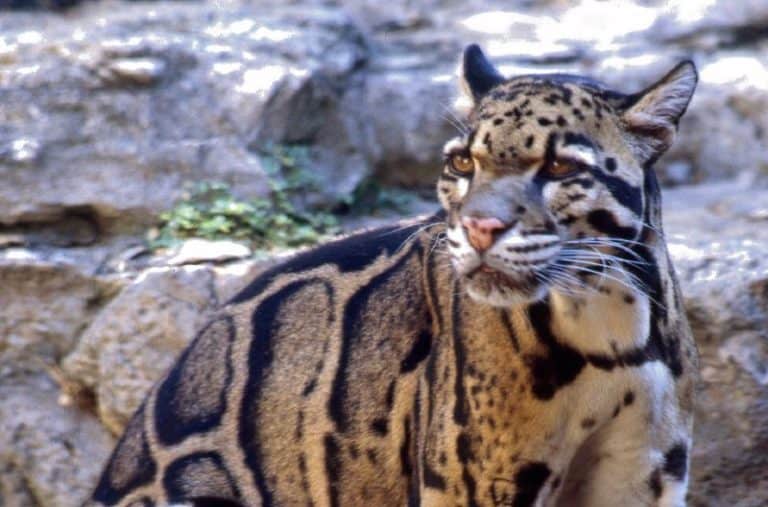
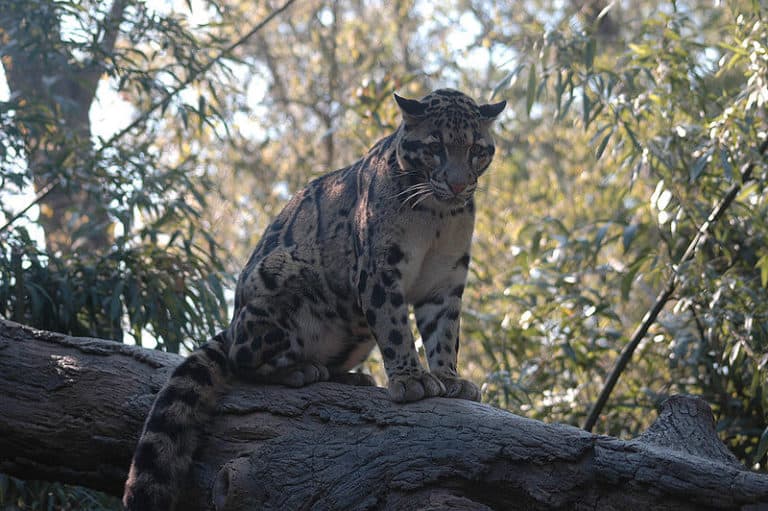
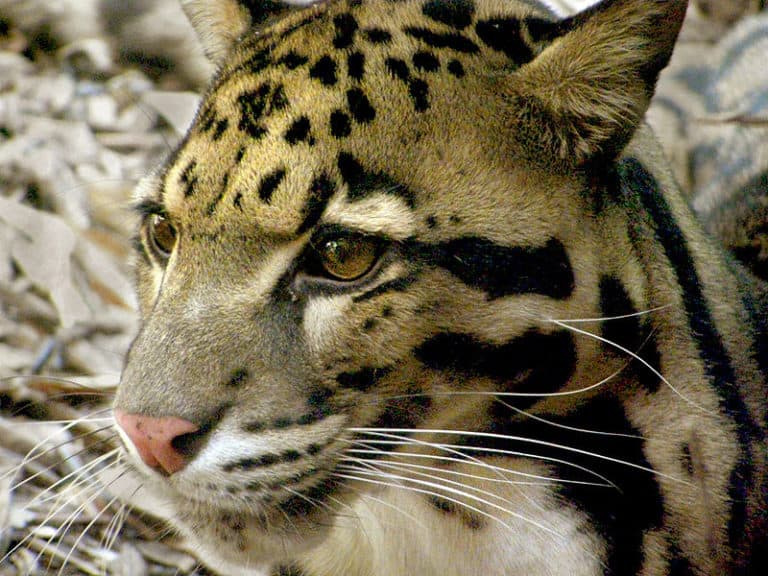
The clouded leopard is one of the most distinctive of all the big cats and one of the most beautiful. As their name suggests, they have yellow- to gray-colored coats patterned with large, cloud-like markings that are lined with black and dark in the center. Their small but stocky bodies are supported by short legs, and like other cat species (besides the cheetah), the clouded leopard can retract its claws into the skin on its toes to keep them sharp.
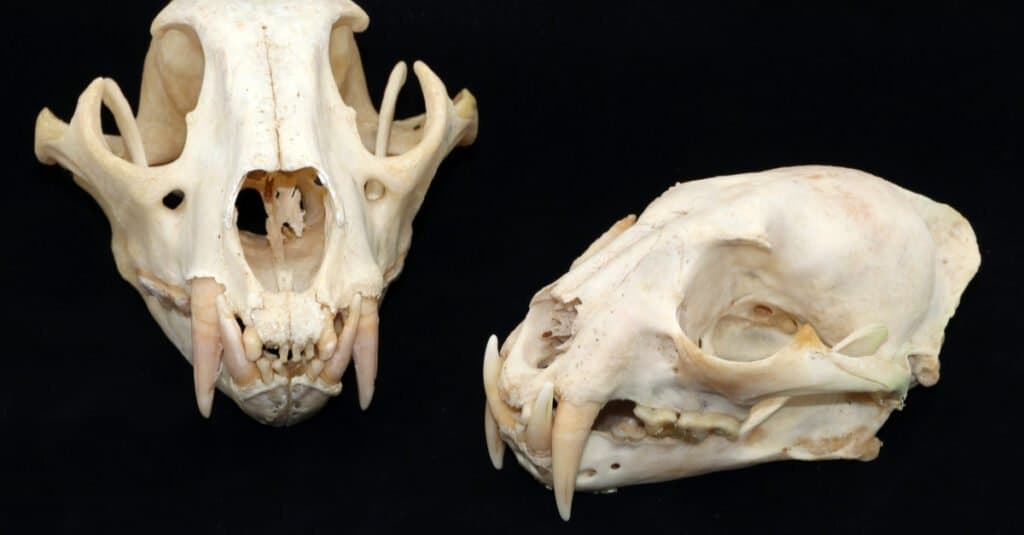
One of the most distinctive features of the clouded leopard is its rather long canines, which can grow up to two inches long, making them about the same length as those of a tiger. They have two broad black bars on the back of their neck and black rings that run the length of their incredibly long tail. The tail of a clouded leopard can reach up to 36 inches (91 cm) in length and is used to help the animal to balance whilst moving about in the trees.
Distribution and Habitat
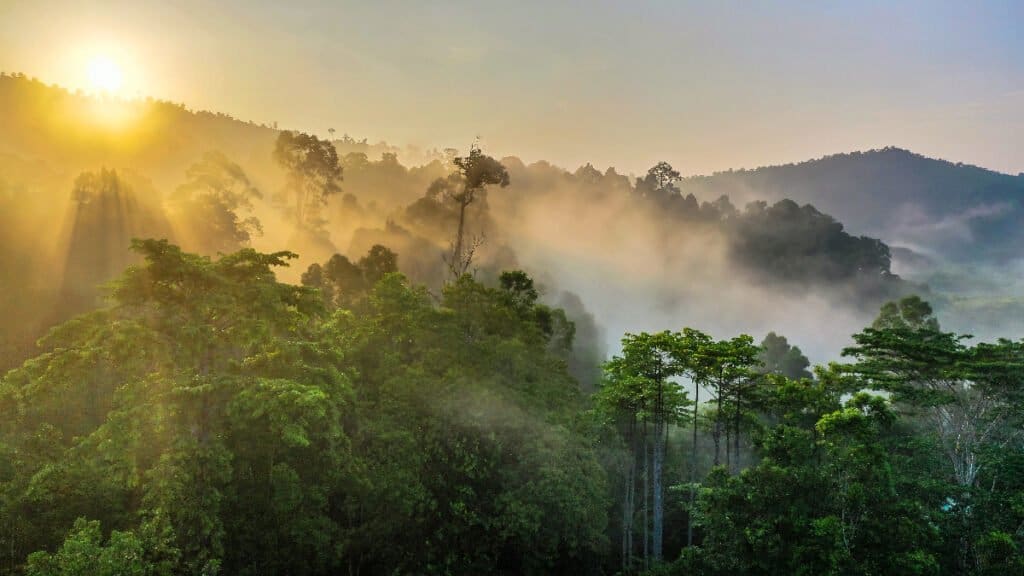
Borneo is home to the oldest rainforests in the world and has the largest population of clouded leopards.
©BorneoRimbawan/Shutterstock.com
The clouded leopard is native to Southeast Asian countries including India, Southern China, Burma, Nepal, throughout Indochina, and the islands of Borneo and Sumatra. It was once also found in Taiwan but is now widely thought to be extinct there. Clouded leopards spend nearly all their lives in the trees and so prefer dense forest habitats, including both tropical and subtropical forests and jungles, and at altitudes of up to 6,562 feet (2,000 meters).
However, despite seemingly only being found in very dense rainforest, the clouded leopard has also been recorded in a variety of other habitats, including in tall grasslands in Nepal and in the mangrove swamps of Borneo. The highest population is thought to reside on the island of Borneo, but they are threatened throughout their natural range by deforestation to clear land for agriculture or by loggers.
Behavior and Lifestyle
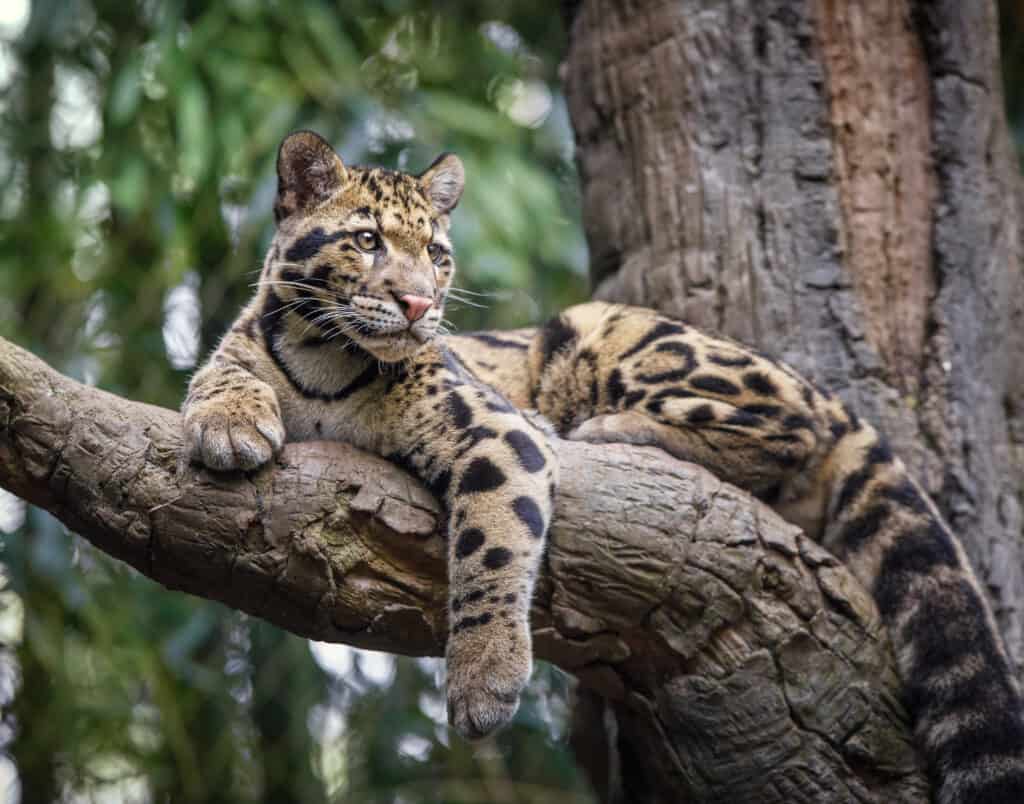
Clouded leopards rest high in the trees during the day and hunt at night.
©jdross75/Shutterstock.com
The Clouded leopard is an incredibly shy and elusive animal that rests high in the trees during the day and actively hunts under the cover of night. They are territorial animals that move just over a mile a day throughout their home range, which typically ranges from around 12 to 42 square miles in size, depending on the region.
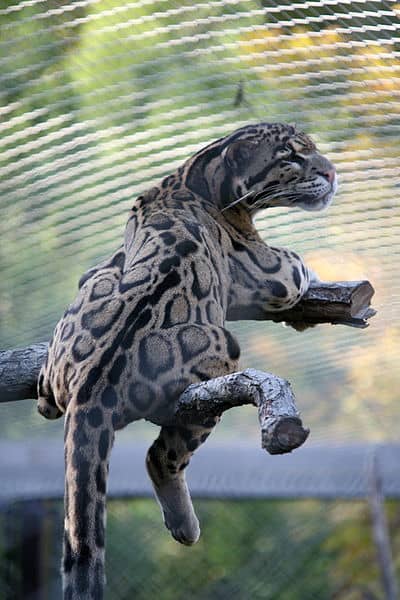
They are incredibly agile climbers that can speed up trunks and climb easily in the branches. They have also been observed running headfirst back down tree trunks and moving along horizontal branches by hanging underneath, using their tails for balance. The Clouded leopard is a solitary animal that marks its territory using urine and scratch marks on trees; however, very little is actually known about their social behavior in the wild.
Reproduction and Life Cycles
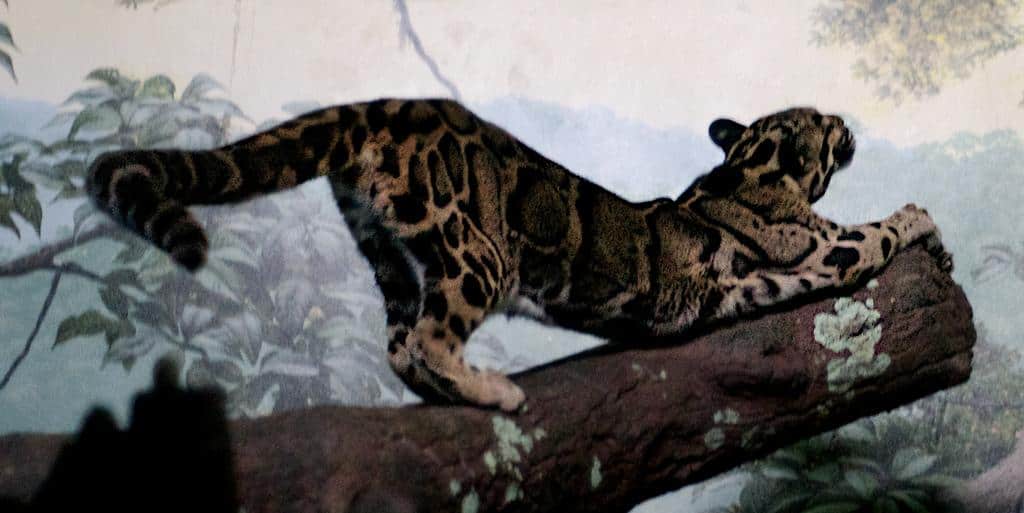
Clouded leopards can live up to 17 years in captivity, but little is known about their lifespan in the wild.
©Charles Barilleaux / Flickr – Original
Clouded leopard kittens are born in the summer months after a gestation period that lasts for around 86 to 93 days. Between one and five kittens are born blind, and the large spots on their fur are completely dark in color and don’t develop adult coloration for about six months. Clouded leopard kittens open their eyes by the time they are around 10 days old and are fully active at five weeks of age, beginning to learn how to hunt with their mother shortly afterward.
Although they are eating solid food by the time they are 10 weeks of age, they are not fully weaned until nine months, when they become independent and leave their mother to establish a territory of their own. Clouded leopards are known to live up to 17 years in captivity, but little is known about their lifespan in the wild due to their incredibly elusive nature.
Diet and Prey
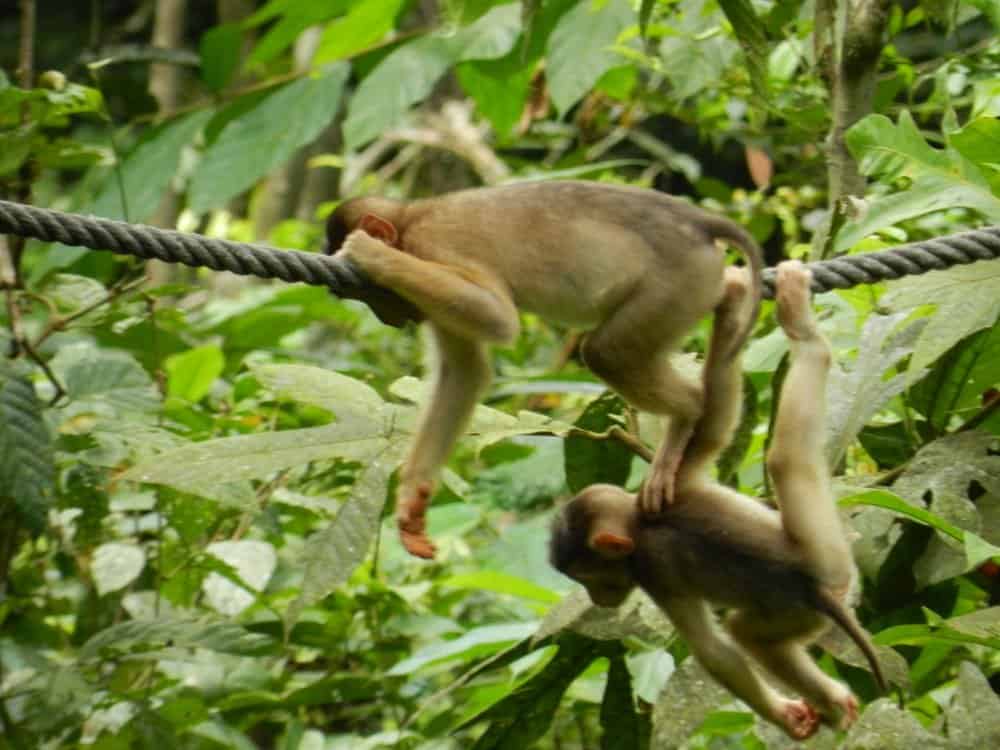
Clouded leopards prey on pig-tailed macaques and other small primates.
©Millie Bond – Copyright A-Z Animals
The clouded leopard is a carnivorous animal that only hunts and eats other animals to obtain the nutrition it needs. Their preferred prey species are quite dependent on the region where they live, as clouded leopards found in Thailand favor rodents, ground squirrels, and porcupines, whereas individuals elsewhere more readily hunt primates, including pig-tailed macaques, gibbons, and proboscis monkeys.
Clouded leopards are nocturnal hunters that either descend to the ground to stalk their prey or lie in wait on a branch to pounce on prey below. They are also known to hunt birds, deer, cattle, young wild boars, and livestock such as chickens and goats in areas close to human habitation when food in the jungle is hard to find. Clouded leopards are known to retreat to the trees after eating to rest and digest their meal.
Predators and Threats
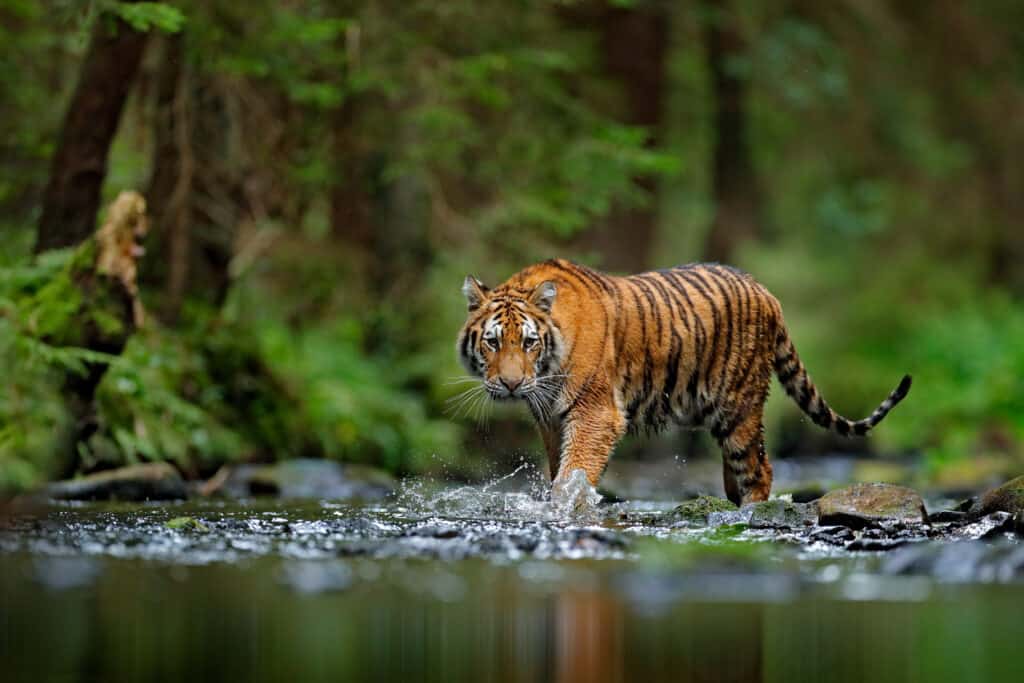
Tigers sometimes prey on clouded leopards, but humans are their biggest threats.
©Ondrej Prosicky/Shutterstock.com
Due to its large size and incredibly secretive nature, the clouded leopard has no real natural predators in the jungle, with the exception of the occasional tiger or leopard, which are also its competitors for food. People are the primary threat to clouded leopards as they are hunted for meat and their beautiful pelts, which is a particularly serious problem in some regions.
They are also severely threatened by habitat loss as vast areas of their natural forest habitats are being deforested either to harvest tropical timber or to clear land for agriculture, including oil palm plantations. Increasing human activity is also pushing the remaining populations even deeper into the forests, making it even harder for experts to try to study them.
Interesting Facts and Features
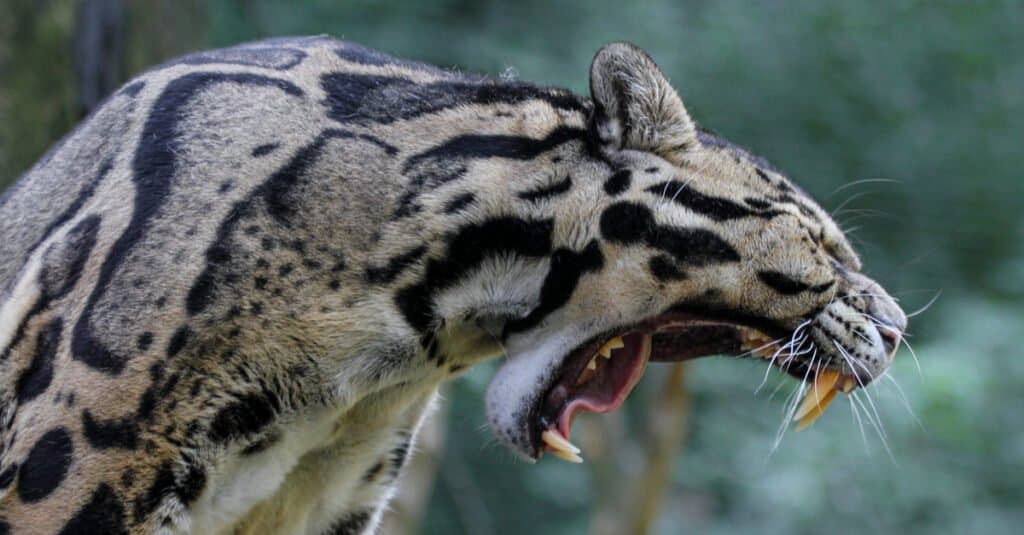
Clouded leopards have unusually long canine teeth up to two inches long.
©Adalbert Dragon/Shutterstock.com
The clouded leopards’ diet consists mostly of smaller prey species, including rodents and primates. This challenges the previous theory that the animal’s large size and long canines were adaptations for hunting larger prey. Although the clouded leopard is thought to only hunt in the dead of night, some individuals have been observed leading a more crepuscular lifestyle and more actively hunting in the early morning or at dusk.
Despite the hunting and trading of the clouded leopard now being banned, the practice still continues as people are after their beautifully patterned fur. This fur is often used to make fur coats, with just one coat requiring the pelts of around 25 clouded leopards to produce.
Relationship with Humans
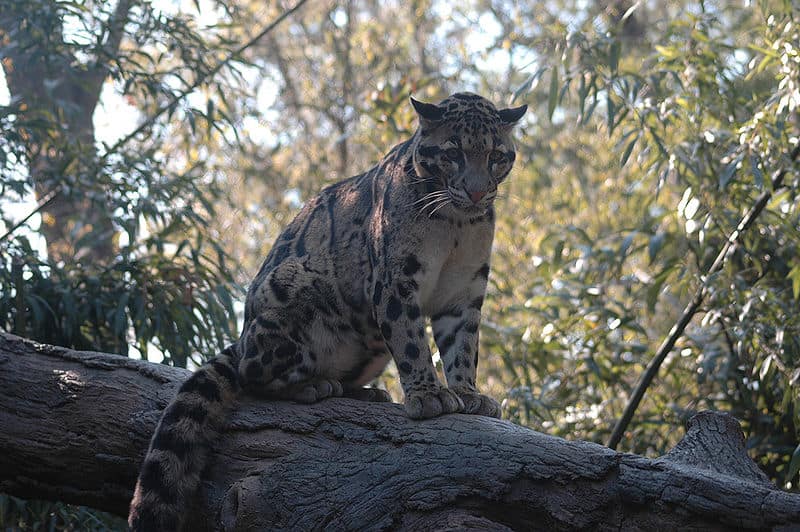
In spite of conservation efforts, people still hunt the clouded leopard for its beautiful pelt.
People have hunted the clouded leopard for food for many years but also for its body parts. Its beautiful pelt is highly sought after, and its bones and canine teeth are often sold to both local people and outsiders for medicinal and decorative purposes. Despite being banned, the hunting and trading of their body parts still continues today, but the biggest threat to the world’s clouded leopard populations is their rapidly dwindling range. Vast areas of ancient forests are being cleared every day for logging or to make way for palm oil plantations. Land in these regions is often cleared illegally, which has devastating consequences in areas that are home to some of the rarest and most unique species on the planet.
Conservation Status and Life Today
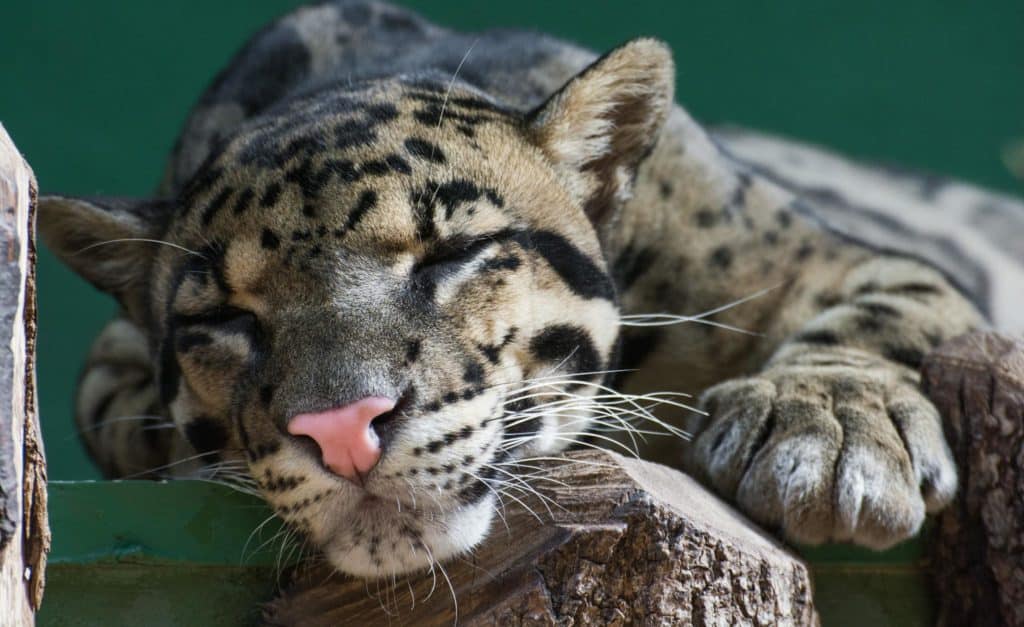
Clouded leopards are listed as Vulnerable to extinction.
©Soren Wolf / Flickr – Original
Today, both species of clouded leopards are listed by the IUCN as animals that are Vulnerable to extinction from their natural habitats in the near future. It is estimated that there are fewer than 10,000 mature clouded leopard individuals left in the wild, with the highest densities thought to be found on the tropical island of Borneo. However, population numbers are continuing to decline throughout their natural range due to habitat loss and hunting for their fur, with the species having already become extinct in its native habitat in Taiwan.
Clouded leopard Pictures
View all of our Clouded leopard pictures in the gallery.

How to say Clouded leopard in ...
Sources
- David Burnie, Dorling Kindersley (2011) Animal, The Definitive Visual Guide To The World's Wildlife / Accessed September 29, 2009
- Tom Jackson, Lorenz Books (2007) The World Encyclopedia Of Animals / Accessed September 29, 2009
- David Burnie, Kingfisher (2011) The Kingfisher Animal Encyclopedia / Accessed September 29, 2009
- Richard Mackay, University of California Press (2009) The Atlas Of Endangered Species / Accessed September 29, 2009
- David Burnie, Dorling Kindersley (2008) Illustrated Encyclopedia Of Animals / Accessed September 29, 2009
- Dorling Kindersley (2006) Dorling Kindersley Encyclopedia Of Animals / Accessed September 29, 2009
- David W. Macdonald, Oxford University Press (2010) The Encyclopedia Of Mammals / Accessed September 29, 2009
- IUCN Red List / Accessed September 29, 2009
- IUCN Red List / Accessed September 29, 2009