















P
Species Profile

Portuguese Podengo

Canis lupus familiaris

Portugal's quick-eared rabbit hunter
2,559 × 1,323 pixels, file size: 527 KB, MIME type: image/jpeg

Portuguese Podengo Distribution

Click a location to explore more animals from that region

Origin Location

This map shows the native origin of the Portuguese Podengo. As a domesticated species, they are now found worldwide.

Loading map...

Found in 1 country

Size Comparison

Human 5'8"
Portuguese Podengo 1 ft 6 in

Portuguese Podengo stands at 26% of average human height.

Portuguese Podengo

At a Glance

Domesticated
Also Known As Podengo, Podengo Português, Portuguese Warren Hound, Portuguese Rabbit Hound, Portuguese Harehound
Diet Omnivore
Activity Diurnal+
Lifespan 5 years
Weight 30 lbs
Status Not Evaluated
Did You Know?

Recognized in three size varieties-Pequeno, Médio, and Grande-under one breed identity.

Scientific Classification

The Portuguese Podengo is an ancient, primitive-type Portuguese hunting dog breed (podenco-type hound) traditionally used for coursing and flushing game, especially rabbits. The breed is commonly recognized in three size varieties (Pequeno, Médio, Grande), which share the same overall breed identity but differ in height/weight and historical quarry.

Kingdom
Animalia
Phylum
Chordata
Class
Mammalia
Order
Carnivora
Family
Canidae
Genus
Canis
Species
Canis lupus

Distinguishing Features

  • Podenco-type silhouette: wedge-shaped head, erect triangular ears, lean athletic build
  • Typically short- or wire-coated varieties (depending on standard/variety)
  • High agility and endurance; keen scenting and/or sight-chasing tendencies
  • Strong prey drive and hunting instincts; alert, lively demeanor

Physical Measurements

Height
1 ft 6 in (8 in – 2 ft 2 in)
Length
2 ft 9 in (1 ft 5 in – 4 ft 3 in)
Weight
36 lbs (9 lbs – 57 lbs)
Tail Length
10 in (6 in – 1 ft 2 in)
Top Speed
28 mph
running

Appearance

Primary Colors
Secondary Colors
Skin Type Domestic dog skin with tight, athletic build; coat is either smooth/short or wire/rough. Low oil and low drool; wire coats benefit from periodic hand-stripping for texture.
Distinctive Features
  • Primitive podenco-type domestic breed from Portugal; not a separate wild Canis species.
  • Three size varieties: Small, Medium, Large; same breed identity with different height/weight and historical quarry.
  • Erect, triangular ears and wedge-shaped head; alert, foxlike expression.
  • Lean, agile, square-to-slightly-rectangular outline built for coursing and flushing rabbits.
  • Deep chest with moderate tuck-up; long, slightly curved tail carried in a sickle when moving.
  • High prey drive and strong scent/sight hunting instincts; requires secure fencing and leash reliability.
  • Generally hardy breed; watch for patellar luxation (especially Pequeno), hip dysplasia (more risk in larger dogs), and occasional eye issues.
  • Care needs: high daily exercise and mental enrichment; minimal grooming for smooth coat, more maintenance/stripping for wire coat; regular dental care important in smaller individuals.

Sexual Dimorphism

Males are typically slightly taller and heavier with broader heads, necks, and chests, while females tend to be finer-boned and more lightly built. Temperament differences are minimal, with hunting drive strong in both sexes.

  • Broader skull and stronger muzzle; more pronounced neck musculature.
  • Slightly greater height/weight within the chosen size variety.
  • Often deeper chest and heavier bone, especially in Médio/Grande.
  • More refined head and lighter overall frame within the chosen size variety.
  • Slightly narrower chest and finer bone; athletic, agile build remains evident.
  • May appear more tuck-up and streamlined when in hunting condition.

Did You Know?

Recognized in three size varieties-Pequeno, Médio, and Grande-under one breed identity.

Often comes in two coat types: smooth (short) and wire (rough), adapted to varied terrain and brush.

A classic "podenco-type" hound: upright ears, wedge-shaped head, and a light, springy build for quick turns.

Traditionally prized for rabbit work-flushing, coursing, and locating game in rocky, scrubby landscapes.

Considered a "primitive-type" breed: independent problem-solver with strong prey drive and keen senses.

In Portugal, the Pequeno became especially common as a practical rabbit dog for everyday hunters.

Despite being a sighthound-like sprinter at times, it also works with nose and persistence like a versatile hunting hound.

Unique Adaptations

  • Lean, athletic frame and strong hindquarters for acceleration and abrupt turns-useful in rocky, uneven Portuguese terrain.
  • Large, upright ears and alert carriage that enhance directional hearing while hunting in dense scrub.
  • Efficient heat management: short-to-moderate coat options and lightly built body suited to warm climates and long activity.
  • Hardy feet and nimble gait that help navigate stony ground and thorny cover while pursuing small game.
  • Behavioral "adaptation" of primitive-type dogs: self-directed problem solving and persistence when quarry doubles back or hides.

Interesting Behaviors

  • Flash-and-freeze scanning: sudden stillness with ears locked forward, then a rapid burst to investigate movement.
  • Tight, agile zigzags in brush as it flushes rabbits-using quick feints rather than long straight runs.
  • Independent search pattern: may range and self-task, then "check in" rather than continuously looking to the handler.
  • High chase motivation: fast trigger to pursue small animals; many individuals are highly animated by squeaks and rustling.
  • Watchful territorial alertness: tends to notice changes in the environment and may alarm-bark when something is "off."
  • Play that mimics hunting: pounce-and-turn games, rapid directional changes, and "catch" rituals with toys.
  • Climbing and perching: some Podengos like elevated viewpoints (rocks, steps, furniture) to monitor surroundings.

Cultural Significance

The Portuguese Podengo (Canis lupus familiaris) is a national hunting breed tied to rural Portugal and hunting rabbits. Three sizes—Pequeno, Médio, Grande—serve different jobs. It is a podenco-type, prick-eared, agile dog from the Iberian Mediterranean.

Myths & Legends

Portuguese Podengo (Canis lupus familiaris) is called a 'little hunter with a big heart' in Iberian tales—sharp dogs who listen for rabbit rustles in stone walls and bramble, earning their keep on farms.

A story says sailors and merchants brought pointed-eared hunting dogs along Mediterranean trade routes to Iberian ports. Over generations, local hunters shaped them into the Portuguese Podengo (Canis lupus familiaris) for Portugal's bushy, rocky hills.

In country tales, the Portuguese Podengo (Canis lupus familiaris) is a household guard and provider: it kept pests away, warned at night, hunted rabbits at dawn, and showed thrift and toughness.

Stories often use the name 'podengo' to mark Portuguese Podengo (Canis lupus familiaris) as a native hunting dog, meaning 'our dog for our land,' set against imported fashionable breeds.

Old hunting tales sometimes attribute near-magical endurance to wire-coated Podengos in harsh brush, describing them as dogs that can 'slip through thorns without slowing'-a poetic exaggeration reflecting their practical toughness in dense cover.

Conservation Status

NE Not Evaluated

Has not yet been evaluated against the criteria.

Population Stable

Life Cycle

Birth 5 pups
Lifespan 5 years

Lifespan

In the Wild
3–8 years
In Captivity
10–16 years

Reproduction

Mating System Polygynandry
Social Structure Managed Domestic
Breeding Pattern Not Applicable
Fertilization Managed Selective
Birth Type Internal_fertilization

Unlike wolf packs that often form stable breeding pairs with helper care, Portuguese Podengos reproduce under human-managed, selective matings. Reproduction is via internal fertilization, and individuals typically have no enduring mate bonds across breeding opportunities.

Behavior & Ecology

Social Pack Group: 3
Activity Diurnal, Crepuscular
Diet Omnivore Rabbit/lean game meat (traditionally associated quarry)

Temperament

Breed-specific vs base domestic dog: more primitive, self-directed problem-solver; less biddable than many breeds.
High prey drive; rapid chase response to small animals, especially rabbits; reliable recall requires intensive training.
Alert, watchful, and vocal as a natural alarm dog; can be reserved with strangers but not typically aggressive.
Affectionate with family; may be selective with unfamiliar dogs if poorly socialized, especially intact males.
The breed comes in Small, Medium, and Large varieties that share a hardy hunting temperament; smaller dogs are often busier, larger dogs more steady.
Health concerns (breed-leaning): patellar luxation (Pequeno), progressive retinal atrophy risk, hip issues in larger dogs.
Care requirements: daily vigorous exercise and scent games; secure fencing due to roaming/chasing tendency.
Care requirements: early, ongoing socialization; reward-based training with impulse-control work to manage independence.
Care requirements: coat is generally low-maintenance; routine ear, nail, and dental care important for working lifestyles.

Communication

sharp alert barking
short excited barks during pursuit
whining/whimpering when frustrated or anticipating activity
growling for boundary-setting
occasional howling in response to novel sounds or separation
intense visual fixation and stalking posture before chase
rapid ear and tail signaling; high tail carriage when aroused
scent-marking with urine and ground sniffing to map territory and trails
body-blocking and shoulder checks to direct movement in tight brush
mouthy play and pawing used to solicit interaction from people and dogs

Habitat

Biomes:
Mediterranean Temperate Forest Temperate Grassland Tropical Rainforest Tropical Dry Forest Savanna Desert Hot Desert Cold Boreal Forest (Taiga) Tundra Alpine Freshwater Wetland +7
Terrain:
Rocky Hilly Plains Coastal
Elevation: Up to 16404 ft 3 in

Ecological Role

Domestic mesopredator and human-associated hunting dog; locally functions as a rabbit-control hunter where used traditionally.

Rabbit and small-rodent population control (managed hunting) Support of human subsistence/recreation through hunting assistance Deterrence of some pest species around farms/holdings Companionship and working-dog roles that contribute to human well-being

Diet Details

Main Prey:
European rabbit Hares Small rodents Ground-nesting and small birds Reptiles
Other Foods:
Fallen fruit Berries grasses Root and leafy vegetables

Human Interaction

Domestication Status

Domesticated

Portuguese Podengo (Canis lupus familiaris) is an ancient Iberian podenco hound in three sizes: Pequeno, Médio, Grande. It has a strong hunt and chase drive, is independent outdoors, and bonds with families but may be shy with strangers. Needs lots of exercise, secure fencing, early socialization. Generally hardy; watch joints, teeth, ears, and field injuries.

Danger Level

Low
  • Bites typically associated with fear, poor handling, or insufficient socialization rather than predatory aggression toward humans
  • High prey drive can lead to chasing incidents (risking knocks/falls) and conflicts if restrained roughly while aroused
  • Potential for dog-dog scuffles, especially around high arousal/prey cues or intact animals, if not managed

As a Pet

Suitable as Pet

Legality: Generally legal to own as a domestic dog in most jurisdictions; subject to standard local dog licensing/leash laws and any breed-agnostic dangerous-dog regulations. Not commonly targeted by breed-specific bans.

Care Level: Moderate

Purchase Cost: $600 - $2,500
Lifetime Cost: $15,000 - $35,000

Economic Value

Uses:
Companion animal Working/hunting dog Sport/performance dog Breeding and showing
Products:
  • hunting services (rabbit flushing/coursing in traditional settings)
  • breeding stock and puppies
  • training services (recall, impulse control, scent work)
  • sport participation (agility, lure coursing, nosework) and related fees/equipment

Relationships

The Portuguese Podengo is a “primitive” dog. The Phoenicians bred it around 700 BC and introduced it to Portugal around 600 BC. The breed became more common in the northern part of the country and was popular as a hunting and companion dog. It is a high-energy hunting sighthound, meaning it hunts by sight and keys on motion. Most Podengos in Portugal are part of hunting packs.

The Podengo makes a good watchdog and companion for families that are willing to exert the energy to train this high-spirited dog. Also, they are good with children if they are socialized or raised with them (especially the Pequeno.) They like to work and play, though they should be enclosed in a yard with a high fence due to their food-driven nature and their ability to jump.

3 Pros And Cons Of Owning Portuguese Podengos

ProsCons
The Portuguese Podengo bonds to a family and has strong pack instincts, giving it a very protective nature. Podengos make good watchdogs.Since the Podengo is such a good hunter, it tends to be food-driven. This means it may be more obedient to its nose than its master. Once it fixates on food, it may be difficult to rein in.
This dog’s energy level, athletic ability, and intelligence make it very good at sporting activities. Obedience trials, agility courses, scent work, rally, and coursing are all good options.Its predilection for food means that it may also tend to obesity. Watching how much it is fed, monitoring what it catches and eats, and limiting treats will help avoid that pitfall. Exercise is also a key component in controlling weight.
The different types of Podengo are all excellent hunters. The Grandé was bred to hunt deer and boar. The Medio and Pequeno are excellent rabbit hunters. The dog can catch the prey and flush it out for hunters.Its hunting instincts may also be problematic if you have other small pets. The Podengo may perceive cats, hamsters, and other smaller dogs as prey to be chased. If you have other small pets, it is important to socialize them together at a young age.

Types Of Podengos

The Podengo comes in 3 sizes: small or Pequeno, medium (Medio), and large (Grandé). Of the three sizes, the large one hunted deer and wild boar, the medium version hunted rabbits, and the Pequeno hunted mice and flushed rabbits out for hunters. The AKC recognizes only the Portuguese Podengo Pequeno as a breed. The Medio and Grandé sizes are not recognized by the AKC. In Portugal, all three sizes are recognized as varieties of the same breed by the Portuguese Kennel Club. The medium-sized version is the standard for this breed, which is the chosen symbol of the Portuguese Kennel Club.

The Best Dog Food For Portuguese Podengos

Give them high-quality, high-protein dog food. They are driven by food and tend to get overweight, so be careful with treats and their diet.

Size And Weight

The Podengo Pequeno is about 8-12 inches tall and weighs up to 13 pounds. The medium-sized Medio is about 16 to 22 inches tall and weighs 35 to 44 pounds, while the large (Grandé) is about 22 to 28 inches in height and weighs about 44 to 66 pounds.

Common Health Issues

Not so many Podengos are imported into the United States from Portugal, and Portugal doesn’t perform health screening for the dog. As a result, we don’t know much about the dog’s health, though they may be screened for allergies, deafness, and thyroid problems in the United States. Most of this screening is done just to gather information.

Some health conditions arise due to the breed’s behavior and temperament. Since they are active dogs, constantly playing and competing in dog sports, injuries are possible. Also, their food-driven nature predisposes them to weight issues.

Temperament

The Portuguese Podengo has an independent, energetic, and fun-loving personality. It requires a great deal of mental stimulation and likes to play. It loves its family, yet it views strangers warily. Its traits of protectiveness and alertness make it a good watchdog.

This dog is an agile hunter that hunts on its own or in packs. Usually, it will kill the game or else flush it towards the hunter. Although it can be good with other dogs, it might look at small animals as prey, so it’s not necessarily very good around smaller dogs or cats.

Podengos really like tasks, challenges, and tests. They tend to enjoy agility courses, nose work, and chasing (they like to chase toys and one another).

How To Take Care Of Portuguese Podengo

Portuguese Podengo dog

Given its protective and hunting backgrounds, exposing it to many experiences as a puppy moving forward is best.

Maintenance And Grooming

The Podengo has one of two coat types: either a wiry coat or a smooth one. The wiry coat sheds in sections and should be brushed weekly with a pin-type brush. If the dog has a smooth coat, occasional brushing with a rubber brush or a grooming mitt should do. The smooth coat is prone to less shedding than the wiry; overall, shedding is moderate. Do not shave or trim the coat.

Bathing is rarely necessary, so once every 3 to 6 months is fine. Wipe down the smooth-coated Podengo with a damp cloth occasionally.

Brush their teeth, trim their nails with trimmers or a nail grinder, and regularly check their ears for wax and debris. Be mindful that the feet of the Podengo are sensitive and that you should be careful not to cut into the quick.

Training
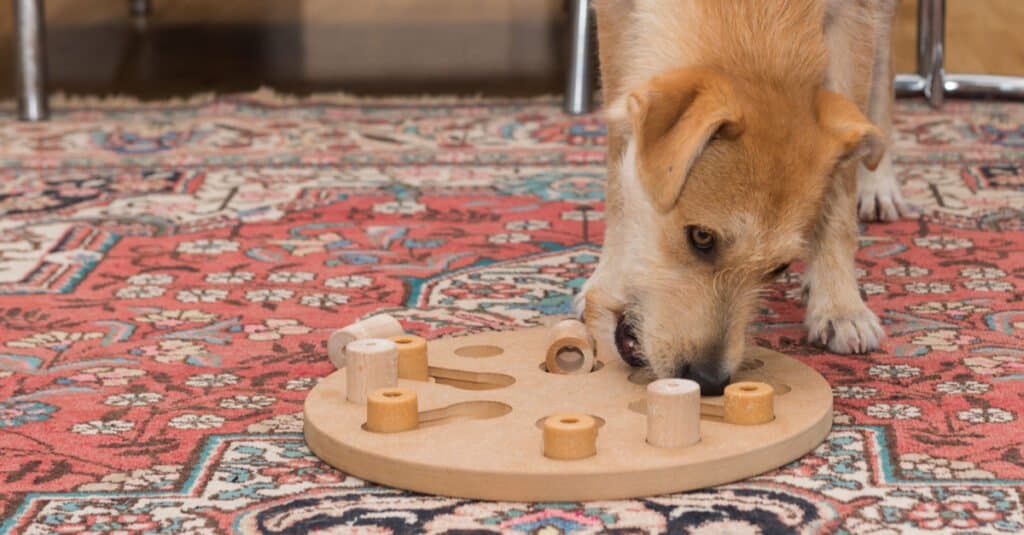
Nina Ottosson dog puzzles

Interactive puzzle games help channel your Portuguese Podengo dog’s energy constructively.

The Portuguese Podengo is a smart, athletic, and energetic dog. This combination of intelligence and energy makes it easily distractible. It can learn quite a bit but needs firm training or follows its own initiative. Short bursts of training with large amounts of positive reinforcement work best. Reward it with praise, play, or treats.

If it does not receive much work or interaction, the Podengo can become bored. This dog is always looking for a good time; if it’s not engaged, it can find a good time in barking or destruction.

Another aspect of its training is socialization with strangers, children, smaller animals, and other dogs. Given its protective and hunting backgrounds, exposing it to many experiences as a puppy moving forward is best. Invite many people to your home to decrease the dog’s wariness of strangers. Train it to avoid its hunter/prey drive with small animals and children.

Exercise

With all that energy, one must spend time exercising the Portuguese Podengo. 20 to 30 minutes of leash exercise daily, plus free play in a well-fenced yard, will go a long way toward expending some of that energy. Hunting, obedience training, agility drills, and scent work are also useful.

Puppies

Begin training as soon as the puppy comes home, as early as 8 weeks, because it is intelligent enough to handle the training, and without it, it can become headstrong and hard to train later on. The Podengo should attend puppy kindergarten at ten to twelve weeks. Extensive socialization as a puppy is key to the dog’s adjustment and temperament later on.

Portuguese Podengo And Children

Overall, the Portuguese Podengo is good with children. Given the dog’s rambunctious nature, socialize the dog with children from a young age. The smallest type of Podengo (the Pequeno) is best with children, rating highly on the AKC’s scale.

Dogs Similar To Portuguese Podengo

  • Ibizan Hound: Ibizan hounds are similar in temperament, energy level, and purpose to the Portuguese Podengo. The Phoenicians also brought them to the Iberian Peninsula (Spain) to hunt rabbits.
  • Italian Greyhound: Another “primitive” dog, the Italian Greyhound has many of the physical characteristics of a sighthound. Although it is classified as part of the “toy” group, it is a solitary, motion-oriented hunter.

Famous Portuguese Podengo

Portuguese Podengos (Tito, Rosa, and Nikki) were in several movies, including Zeuss & Roxanne, Cheaper by the Dozen, Dante’s Peak, Homeward Bound 2, and others.

View all 246 animals that start with P

Sources

  1. American Kennel Club / Accessed October 17, 2022
  2. American Kennel Club / Accessed October 17, 2022
  3. Wikipedia / Accessed October 17, 2022
  4. Vet Street / Accessed October 17, 2022
  5. Pet Finder / Accessed October 17, 2022
  6. The Kennel Club / Accessed October 17, 2022
  7. Wag! / Accessed October 17, 2022
  8. Dog Names / Accessed October 17, 2022
  9. Wag! / Accessed October 17, 2022
  10. AdoptAPet.com / Accessed October 17, 2022
  11. WolfBarkGrowl / Accessed October 17, 2022
Melissa Bauernfeind

About the Author

Melissa Bauernfeind

Melissa Bauernfeind was born in NYC and got her degree in Journalism from Boston University. She lived in San Diego for 10 years and is now back in NYC. She loves adventure and traveling the world with her husband but always misses her favorite little man, "P", half Chihuahua/half Jack Russell, all trouble. She got dive-certified so she could dive with the Great White Sharks someday and is hoping to swim with the Orcas as well.
Connect:

Thank you for reading! Have some feedback for us?


Portuguese Podengo FAQs (Frequently Asked Questions)

Portuguese Podengos are fun-loving dogs that are devoted to their families. The smaller Podengo Pequeno is especially loving and great with children.