

R
Species Profile

Ringed Kingfisher

Megaceryle torquata

Big-billed diver of the Neotropics
iStock.com/reisegraf

Ringed Kingfisher Distribution

Click a location to explore more animals from that region

Loading map...
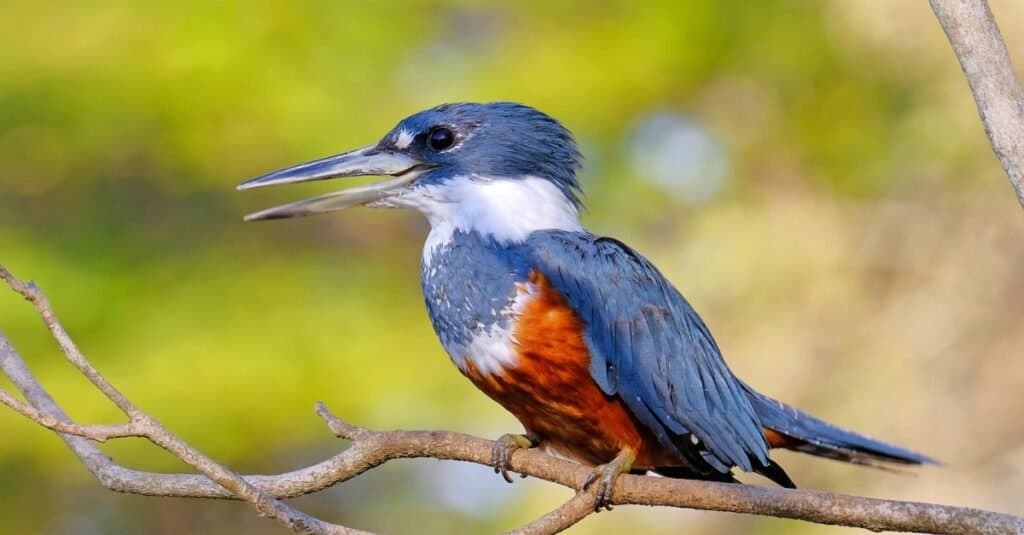
Female Ringed Kingfisher, Megaceryle torquata, a large, conspicuous and noisy kingfisher bird, Mato Grosso, Pantanal, Brazil, South America. Also found in southern USA, Central America, South America

At a Glance

Wild Species
Also Known As martín pescador grande, martín pescador anillado, martim-pescador-grande, martim-pescador-anilhado
Diet Carnivore
Activity Diurnal+
Lifespan 5 years
Weight 0.341 lbs
Status Least Concern
Did You Know?

Size: 37-41 cm long (Birds of the World/Cornell Lab).

Scientific Classification

A very large, heavy-billed kingfisher of the Americas, typically found along rivers, lakes, estuaries, and coasts where it hunts fish and aquatic prey by plunge-diving.

Kingdom
Animalia
Phylum
Chordata
Class
Aves
Order
Coraciiformes
Family
Alcedinidae
Genus
Megaceryle
Species
torquata

Distinguishing Features

  • Very large kingfisher with a robust bill and shaggy crest
  • Prominent rufous/chestnut underparts and collar-like banding on the neck/upper breast (the ‘ringed’ look)
  • Commonly perches openly over water and performs direct plunge-dives for prey
  • Broad distribution from the southern United States through Central America and much of South America

Physical Measurements

Length
1 ft 3 in (1 ft 3 in – 1 ft 4 in)
Weight
1 lbs (1 lbs – 1 lbs)
Top Speed
28 mph
flying

Appearance

Primary Colors
Secondary Colors
Skin Type Feathered body; keratinous, dagger-like bill; bare scaly tarsi and feet typical of kingfishers.
Distinctive Features
  • Very large Megaceryle kingfisher with proportionally massive, straight bill and shaggy crest.
  • Typical adult size: total length ~33-41 cm; wingspan ~53-61 cm; mass ~0.305-0.341 kg (Birds of the World; Dunning, CRC Handbook of Avian Body Masses).
  • Underparts rich rufous; white throat and partial neck collar create high-contrast 'ringed' look.
  • Aquatic hunter: perch-and-wait followed by direct plunge-diving to seize fish and aquatic prey (Birds of the World).
  • Often uses riparian, lacustrine, estuarine, and coastal habitats; commonly seen along rivers and mangroves across the Neotropics/Americas.
  • Nests by excavating a tunnel in earthen banks (riverbanks, cutbanks), a typical Alcedinidae trait (Birds of the World).

Sexual Dimorphism

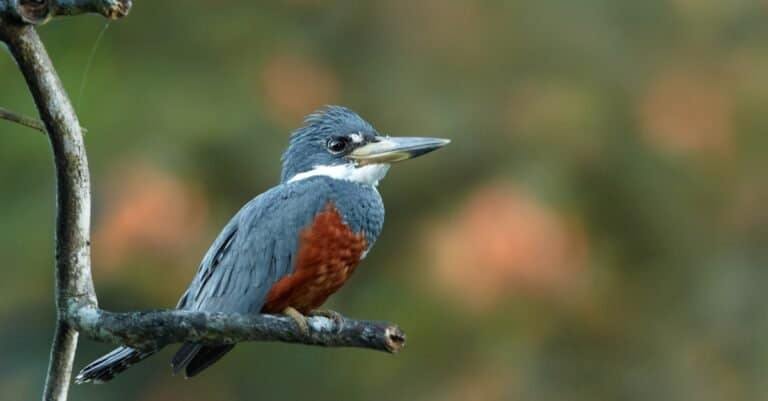
Sexes differ mainly in chest band patterning. Adult males show a rufous breast band below the white throat, while adult females replace the upper band with blue-gray and retain a separate rufous band lower on the chest.

  • Rufous breast band directly below the white throat.
  • Overall cleaner rufous underparts with less gray banding on chest.
  • Blue-gray band across upper breast below white throat.
  • Additional rufous band lower on chest, producing a two-band look.

Did You Know?

Size: 37-41 cm long (Birds of the World/Cornell Lab).

Mass: about 0.305-0.341 kg-often more than double a Belted Kingfisher's weight (Birds of the World).

Females are more "banded": they add an extra rufous belly band beneath the bluish breast band, aiding sex ID in the field (Birds of the World).

Nesting is underground: pairs excavate a burrow in an earthen bank and raise chicks at the end chamber (kingfisher family trait; Birds of the World).

Prey handling is dramatic: it commonly beats fish against a perch to subdue and align it for swallowing head-first (reported widely for Megaceryle; Birds of the World).

The genus Megaceryle spans three continents: Ringed (Americas), Belted (N. America), Crested (Asia), Giant (Africa)-all big, crested, fish-eating kingfishers.

Unique Adaptations

  • Oversized bill (genus Megaceryle): a deep, dagger-like bill helps seize slippery fish and larger aquatic prey efficiently (functional morphology consistent across Megaceryle).
  • Impact-tolerant plunge-diving design: reinforced skull structure and strong neck musculature help withstand water-entry forces when diving (well-studied in kingfishers generally; comparative avian biomechanics literature).
  • Syndactyl foot (kingfisher trait): partially fused toes improve gripping on branches and earthen banks-useful for perching and burrow excavation.
  • Cryptic-yet-bold patterning: the sharp contrast of rufous underparts, white collar, and dark breast band aids species recognition in dense riparian corridors while still blending with warm shoreline tones.
  • Versatile diet for variable waters: beyond fish, it can take crustaceans and other aquatic/semiaquatic prey-an advantage in estuaries and muddy rivers where fish visibility fluctuates (Birds of the World).

Interesting Behaviors

  • Perch-and-pounce hunting: typically watches from a branch, snag, or rock over water, then plunge-dives to seize fish or aquatic prey (Birds of the World).
  • Territorial river sentinel: defends favored stretches of shoreline and foraging perches, using loud rattling calls and chase flights to repel intruders (Birds of the World).
  • Prey processing routine: returns to a perch to beat prey repeatedly, then swallows it (usually head-first for fish), reducing spine/fin snagging risk.
  • Bank-burrow breeding: excavates a tunnel in a vertical or steep bank; both sexes participate in digging and provisioning (Birds of the World).
  • Reproductive parameters reported for the species include clutches of 3-6 eggs; incubation and nestling periods are reported in the low-to-mid 20s days and roughly ~4 weeks, respectively, depending on study/site (Birds of the World; published regional studies vary).
  • Habitat flexibility across the Neotropics: occurs on forest rivers, open-country canals, mangroves, estuaries, and coastal lagoons-often exploiting human-altered waterways where fish remain abundant.

Cultural Significance

Ringed Kingfisher (Megaceryle torquata) is called “great kingfisher” across Latin America. Seen as a symbol of healthy rivers, mangroves, and wetlands, it draws birders with its large size, loud rattling call, reddish underparts, and sit-and-wait hunting.

Myths & Legends

Halcyon days: Greek myth says Alcyone and Ceyx were turned into kingfishers; the gods calmed the seas so she could nest in winter, giving us the phrase 'halcyon days.' Not specific to M. torquata.

In the Middle Ages and early modern Europe, people used dried kingfisher bodies as charms, believing they stopped lightning or changed wind and weather — a common kingfisher superstition (Ringed Kingfisher, Megaceryle torquata).

Name-as-story (scientific/natural-history tradition): the species name means "collared," echoing the prominent white neck ring; many local names also foreground its fishing prowess-embedding the species in everyday riverside identity rather than a single formal myth.

In many cultures, kingfishers stand for calm water and quick, decisive action—images that match the Ringed Kingfisher's quiet watching and sudden plunge dives, a broad cultural link for the kingfisher group.

Conservation Status

LC Least Concern

Widespread and abundant in the wild.

Population Decreasing

Protected Under

  • Migratory Bird Treaty Act (United States, 1918)
  • Generally protected from take under national wildlife legislation in many range countries (species occurs in numerous protected areas).

Life Cycle

Birth 4 chicks
Lifespan 5 years

Lifespan

In the Wild
1–12 years
In Captivity
3–15 years

Reproduction

Mating System Monogamy
Social Structure Socially Monogamous
Breeding Pattern Long Term
Fertilization Internal Fertilization
Birth Type Internal_fertilization

Pairs are territorial along waterways and typically form monogamous bonds; both sexes excavate a riverbank burrow, incubate the clutch, and provision nestlings. Extra-pair mating is unquantified, so genetic monogamy is unconfirmed.

Behavior & Ecology

Social Pair Group: 2
Activity Diurnal, Crepuscular
Diet Carnivore Fish

Temperament

Strongly territorial; aggressively chases conspecifics and other fish-eaters from preferred perches (Stiles & Skutch 1989; HBW Alive/Handbook of the Birds of the World).
Hunting is perch-and-plunge; typically waits motionless then dives headfirst for fish/crabs (HBW; Ridgely & Greenfield, The Birds of Ecuador).
Breeding is generally monogamous with biparental nest excavation, incubation, and chick-feeding (Stiles & Skutch 1989; HBW).
HUBS pattern: across its range, individuals are solitary outside breeding; tolerance may increase locally where prey is superabundant (HBW).
Published size: total length 36-43 cm; body mass reported around 0.305-0.341 kg (HBW; Dunning 2008, CRC Handbook of Avian Body Masses).
Longevity: species-specific maximum lifespan is poorly documented in major syntheses; robust banding-derived maxima are rarely reported for this species (HBW).

Communication

Loud rolling rattle/series of harsh notes used in territorial advertisement HBW
Sharp single-note calls given as alarm or during chases HBW
Paired calling near nest site, sometimes overlapping during defense Stiles & Skutch 1989
Visual signaling: crest raising, wing-flicking/tail-bobbing, and upright bill-pointing postures HBW
Aerial chase flights and looping display flights during territorial disputes and courtship HBW
Courtship/partner communication via prey Fish) presentation and transfer at perch (Stiles & Skutch 1989

Habitat

Biomes:
Freshwater Wetland Marine Tropical Rainforest Tropical Dry Forest Savanna Temperate Forest Temperate Rainforest Mediterranean +3
Terrain:
Riverine Coastal Island Valley Plains Hilly
Elevation: Up to 8202 ft 1 in

Ecological Role

Riparian/shoreline mesopredator linking aquatic and terrestrial (riparian) food webs.

Top-down regulation of small fish and crustacean populations in rivers/estuaries Energy and nutrient transfer from aquatic prey to riparian habitats via guano and discarded prey remains Potential bioindicator of fish availability and nearshore water quality/clarity due to reliance on visible aquatic prey

Diet Details

Main Prey:
Fish Crustaceans Aquatic and semi-aquatic insects Amphibians Small vertebrates

Human Interaction

Domestication Status

Wild

Ringed Kingfisher (Megaceryle torquata) is fully wild with no history of domestication. Territorial, usually alone or in pairs, it lives by rivers and coasts and hunts fish by perching and plunge-diving. Adults 36–41 cm, ~0.305–0.341 kg. Nests in earthen banks near human waterways; sensitive to pollution and fishing gear.

Danger Level

Low
  • Painful puncture/laceration risk from the large bill if handled (e.g., during rescue/rehab) or if a nest bank is approached closely; defensive strikes are possible at close range.
  • General wildlife-handling zoonosis risk (e.g., Salmonella/Campylobacter exposure from feces), mainly relevant to rehabilitators and researchers.
  • Minor conflict risk at fish-rearing ponds where birds may take cultured fish; human risk is indirect (economic), not physical.

As a Pet

Not Suitable as Pet

Legality: Ringed Kingfisher (Megaceryle torquata) is usually illegal to keep as a private pet without government permits. In the U.S. it is protected by the Migratory Bird Treaty Act; many Latin American countries also require permits. Commercial trade is not usual.

Care Level: Expert Only

Purchase Cost:
Lifetime Cost: $15,000 - $60,000

Economic Value

Uses:
Ecotourism and birdwatching value Ecosystem service: indicator of healthy fish-bearing waterways Non-market cultural/educational value (wildlife education, nature media)
Products:
  • No standard legal commercial products (not domesticated; not a livestock/game species).

Relationships

Predators 7

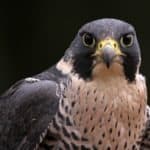
Peregrine Falcon
Peregrine Falcon Falco peregrinus
Aplomado Falcon Falco femoralis
Roadside Hawk Rupornis magnirostris
Great Horned Owl Bubo virginianus
Boa constrictor
Boa constrictor Boa constrictor
Raccoon
Raccoon Procyon lotor
White-nosed Coati Nasua narica

Related Species 8

Belted Kingfisher
Belted Kingfisher Megaceryle alcyon Shared Genus
Giant Kingfisher Megaceryle maxima Shared Genus
Crested Kingfisher Megaceryle lugubris Shared Genus
Amazon Kingfisher Chloroceryle amazona Shared Family
Green Kingfisher Chloroceryle americana Shared Family
American Pygmy Kingfisher Chloroceryle aenea Shared Family
Green-and-rufous Kingfisher Chloroceryle inda Shared Family
Pied Kingfisher Ceryle rudis Shared Family

Ecological Equivalents 6

Animals that fill a similar ecological role in their ecosystem

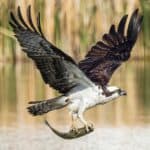
Osprey
Osprey Pandion haliaetus Shares a primarily fish-eating niche along rivers, lakes, and estuaries; both capture surface fish by sight. The Ringed Kingfisher plunge-dives from a perch and is about 33–38 cm long, with a heavy bill for handling fish.
Neotropic Cormorant Nannopterum brasilianum Often co-occurs on freshwater and coastal waterbodies. Both are fish specialists that hunt in shallow waters: the cormorant by pursuit-diving and the kingfisher by plunge-diving from exposed perches.
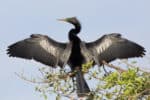
Anhinga
Anhinga Anhinga anhinga Uses similar habitats—slow rivers, lagoons, and lakes—and targets comparable small-to-medium fish. Differs in technique (underwater spearing) but overlaps in foraging zones and prey base.
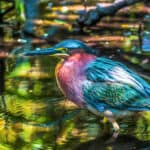
Green Heron
Green Heron Butorides virescens A sit-and-wait shoreline hunter in overlapping habitats. Both species commonly take small fish and aquatic invertebrates from banks and edges — the heron by stalking and striking, the kingfisher by plunge-diving.
Black-crowned Night-Heron Nycticorax nycticorax Nocturnal/crepuscular shoreline predator that strongly overlaps in prey (fish, crustaceans, amphibians) with Ringed Kingfishers in estuaries and inland wetlands where both forage.
Brown Pelican Pelecanus occidentalis In coastal and estuarine settings, both are plunge-diving fish predators; they may exploit similar baitfish concentrations, with pelicans taking larger volumes and kingfishers taking individual prey.

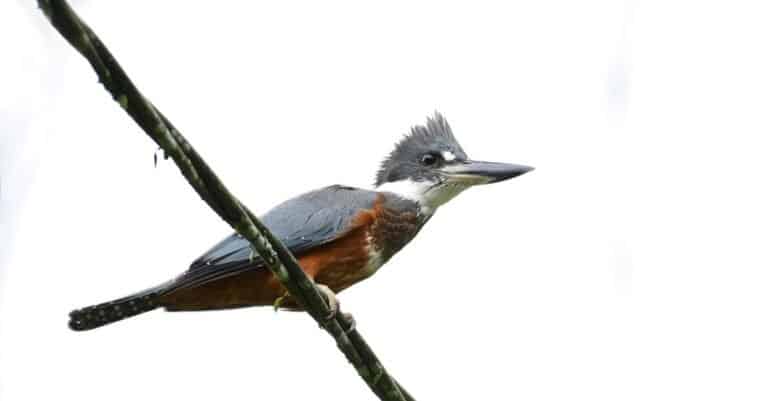
The ringed kingfisher is the largest Kingfisher species native to North America. This bird is not exceptionally tall, but it can reach a length of 16 inches and a wingspan of 2 feet or more. The ringed kingfisher is known for its bright white collar and dark, rust-colored breast.

5 Incredible Ringed Kingfisher Facts

  • Ringed kingfishers are twice the weight of belted kingfishers.
  • Besides eating fish, they sometimes eat hummingbirds.
  • Kingfishers use their wings to help them row underwater.
  • They make loud, harsh calls while swooping over rivers and streams.
  • Males and females work together to build nests and feed their chicks.

Scientific Name

The scientific name of this bird is Megaceryle torquata.

Appearance

The ringed kingfisher is the second-largest member of the kingfisher family. Only the laughing kookaburra is larger. It is a sturdy, slightly stocky bird. Its large body size is matched by an equally large beak, which makes this bird an expert predator.

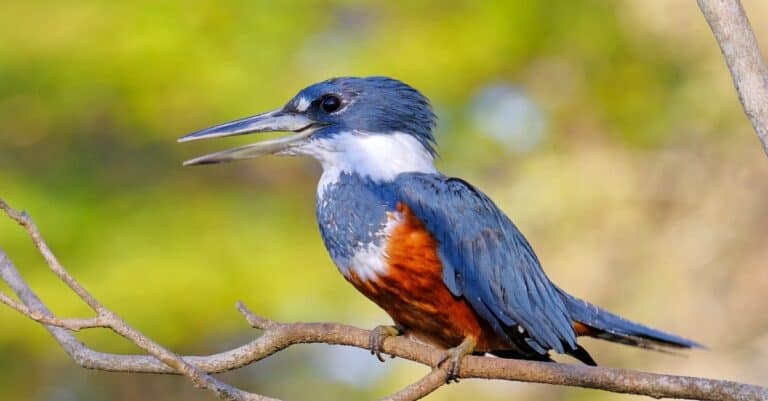
Like all kingfishers, it is strikingly colored. The ringed kingfisher has deep, blue-gray feathers with a white collar and a rust-colored breast. For proper identification, look for the reddish breast feathers. Males and females look alike, but the male’s breast is completely reddish or rust. The female’s breast usually has a blue-gray band bordered by white and a smaller patch of reddish feathers.

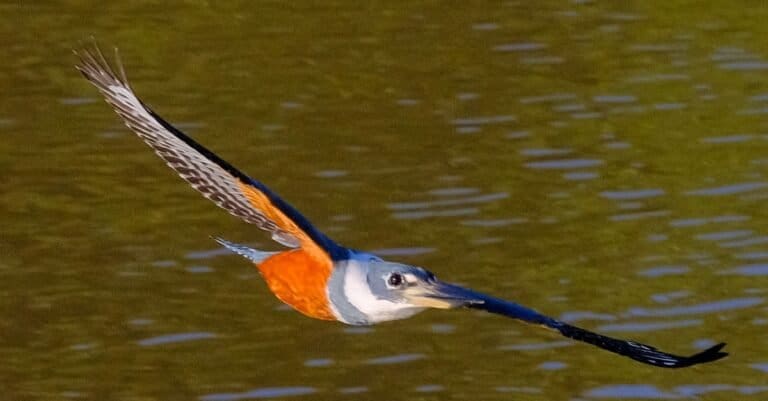
Its wingspan can be 19 to 24 inches or more. With its powerful beak, swift flight, and large wings, this bird is well-designed for catching and eating fish.

Behavior

Ringed kingfishers are highly territorial. When they find good food sources, they establish their perching and roosting spots in the nearby trees. From there, they watch the water for signs of fish that are close to the surface.

They usually hunt in the early mornings and early evenings. They use many vocal calls and songs, and they use them for different reasons. Some vocalizations establish their territory and warn other birds from getting too close. Others are used for communicating with their mates or chicks.

Identification of the ringed kingfisher is easy because of its raucous call, which sounds like it is saying, “Tchak, tchak.” It likes to make this call while swooping along rivers and other bodies of water. The song of a ringed kingfisher sounds like a rattle, chuckle, chirp, or shriek.
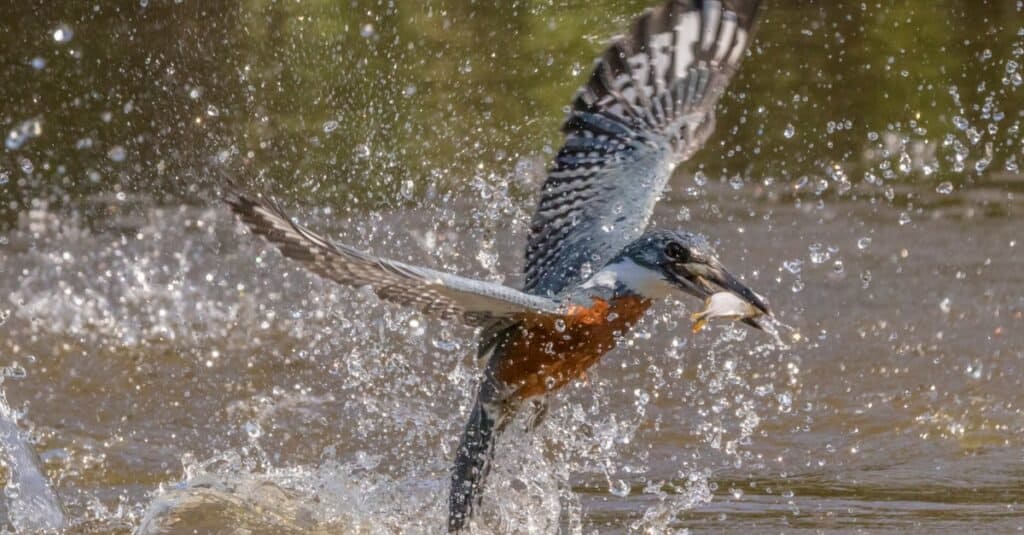
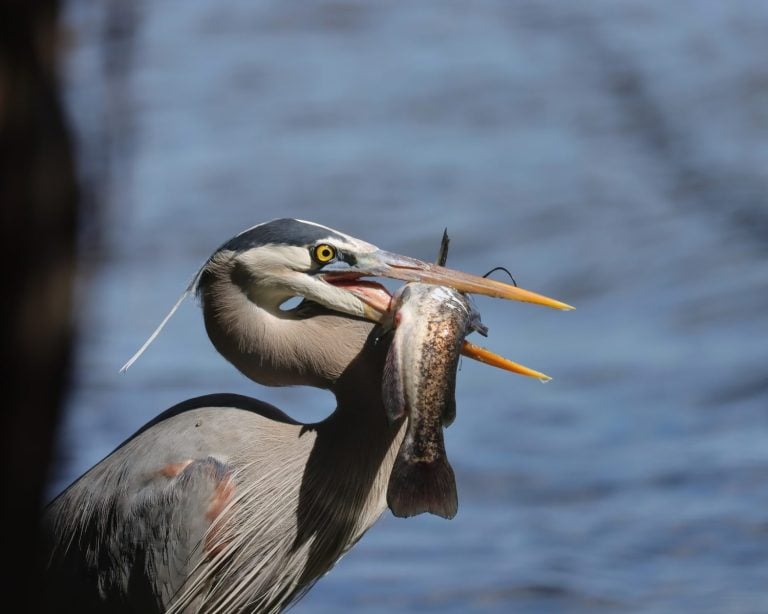
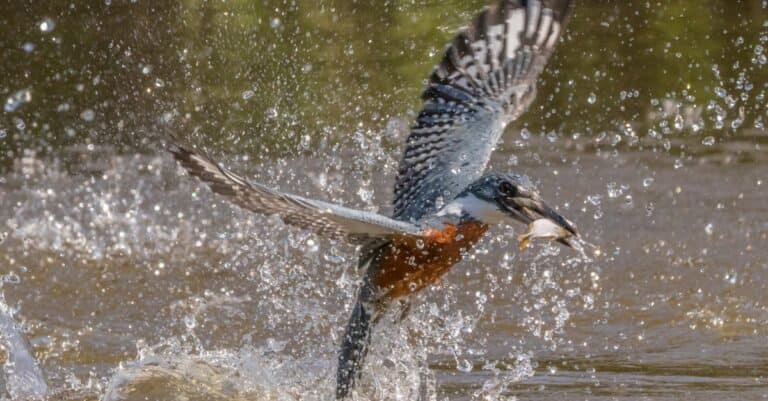
Ringed kingfisher with fish prey.

Ringed kingfisher with fish prey.

Habitat

The ringed kingfisher prefers a wet, marshy habitat and tropical weather. It builds its nest near rivers, streams, and ponds. In tropical regions, it will nest in mangrove swamps, coastal areas, and freshwater bodies. Some kingfishers form colonies on banks near these bodies of water.

The ringed kingfisher is native to North and South America. Ringed kingfishers live in Mexico and the Caribbean. It is a permanent resident of Texas, especially in the state’s southern regions.

Diet

The ringed kingfisher is an expert at catching and eating fish. It likes to perch high in a tree and watch for fish or other prey. When the fish is close to the surface of the water, the kingfisher dives headfirst to catch its prey in its beak. Unlike other waterfowl, it doesn’t hover near the water before taking the plunge.

What Does the Ringed Kingfisher Eat?

The kingfisher prefers small fish of 6 inches or smaller. It occasionally includes frogs, small snakes, and crustaceans in its diet.

Predators and Threats

The ringed kingfisher’s chief predators are raptors, including the white-tailed hawk, bald eagle, golden eagle, and peregrine falcon. Like all birds, ringed kingfishers are threatened by climate change and habitat destruction.

Reproduction and Life Cycle

Ringed kingfishers reach sexual maturity at about one year old. The male seeks out a female and performs a mating ritual that includes dancing and singing. Females and males dig a burrow where they place the nest, which they also build together. They use twigs, reeds, and fish scales to build it.

The burrow is typically 5 to 8 inches long with a nest chamber at one end. The female lays 3 to 6 eggs in the nest chamber. Incubation takes about 23 days. Both parents help incubate the eggs and feed the nestlings. After about 5 weeks, the fledglings leave the nest, but they are still looked after by their parents for several weeks after that.

Ringed Kingfisher Population

The bird’s estimated population is 20,000,000. Its population is considered stable by wildlife conservationists.

Conservation Status

These birds are classed as “least concern” by the International Union for the Conservation of Nature (IUCN). They are protected by the Migratory Bird Treaty Act (MBTA).

View all 181 animals that start with R

Sources

  1. Audubon Guide to North American Birds / Accessed December 29, 2021
  2. WhatBird / Accessed December 29, 2021
  3. BirdLife International Data Zone / Accessed December 29, 2021
A-Z Animals Staff

About the Author

A-Z Animals Staff

AZ Animals is a growing team of animals experts, researchers, farmers, conservationists, writers, editors, and -- of course -- pet owners who have come together to help you better understand the animal kingdom and how we interact.
Connect:

Thank you for reading! Have some feedback for us?


Ringed Kingfisher FAQs (Frequently Asked Questions)

The harsh, swooping call of the ringed kingfisher is a chief form of identification. The call sounds like the bird is saying, “Tchak, tchak.” The ringed kingfisher makes other calls that sound like shrieks, cackles or chuckles.