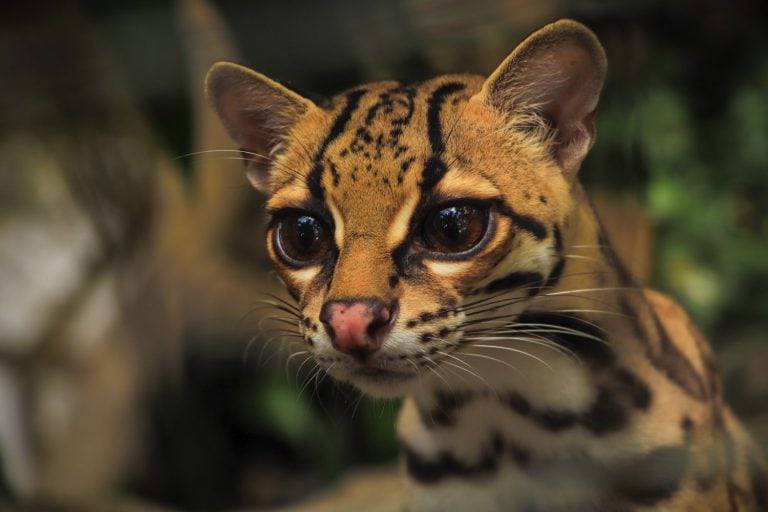
Margay
The cat that climbs like a monkey

The cat that climbs like a monkey
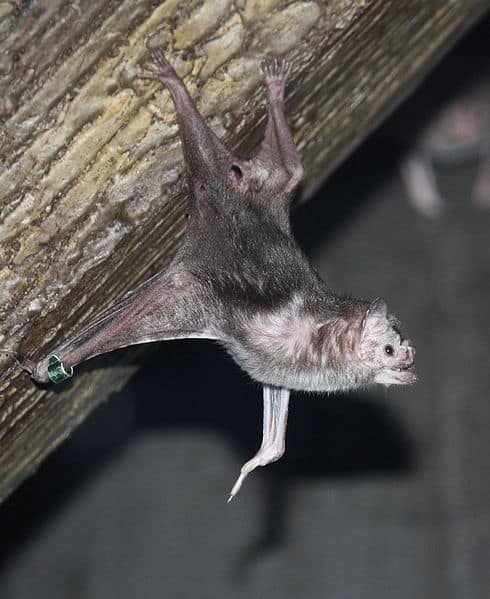
Small bite, big biology.
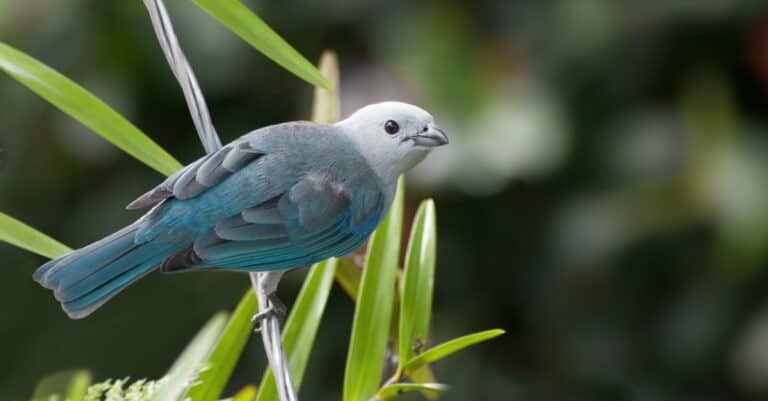
Blue bishop of the backyard edges
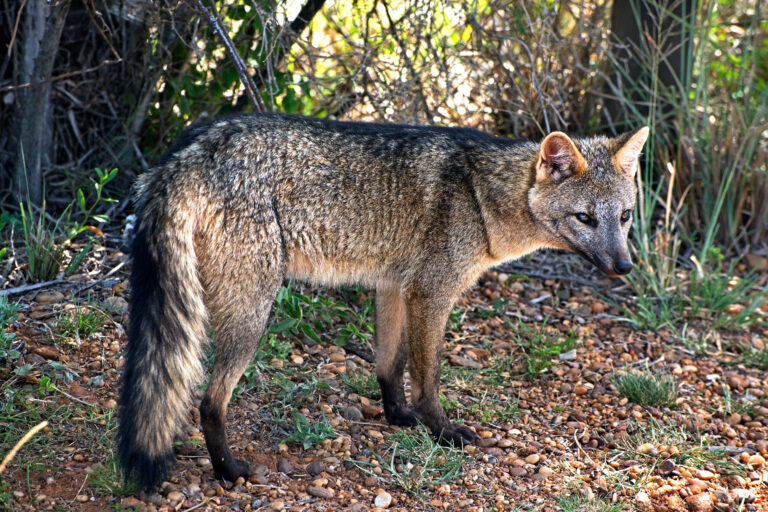
Adaptable 'not-a-fox' of South America
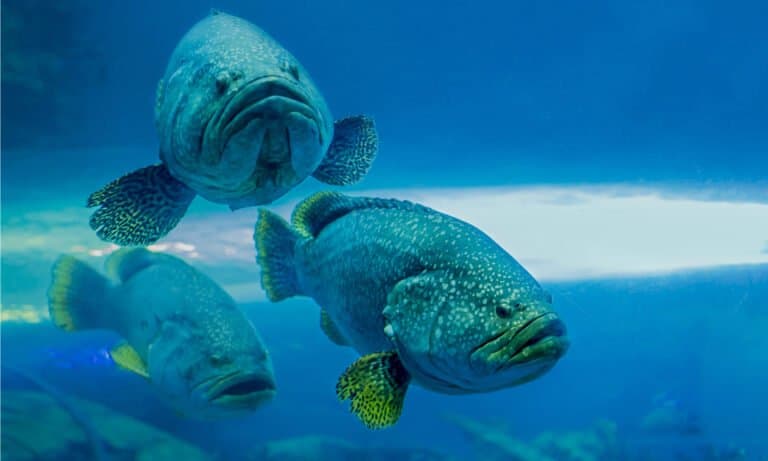
Mangroves to wrecks-Atlantic giant
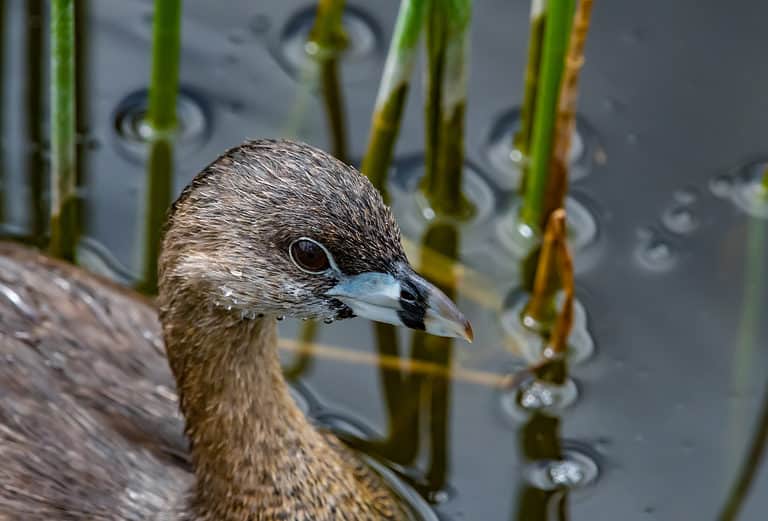
Thick-billed master of the marsh
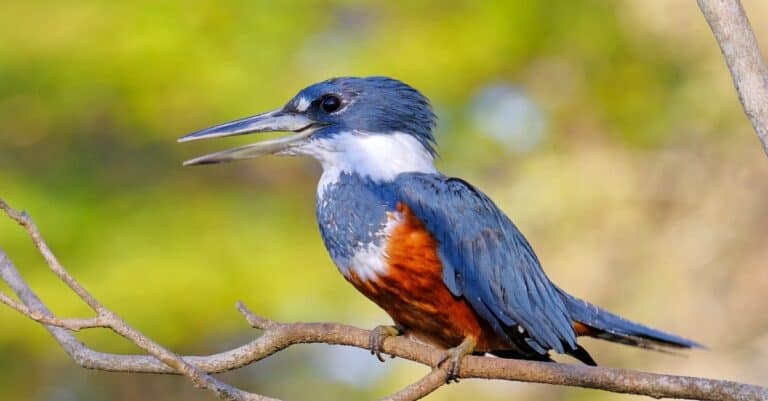
Big-billed diver of the Neotropics
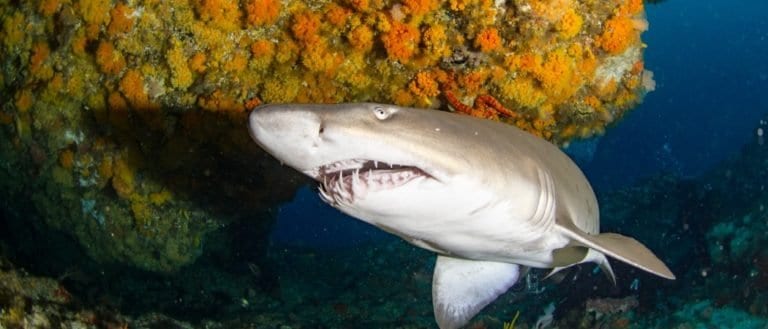
Protruding teeth, gentle glide.
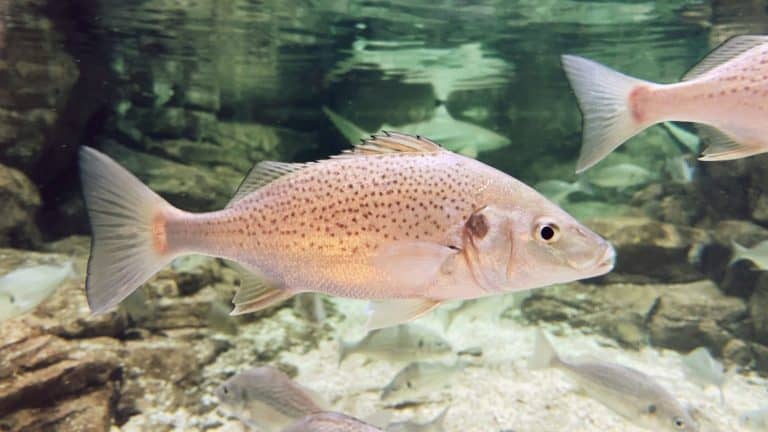
From mangroves to wrecks: built to hunt
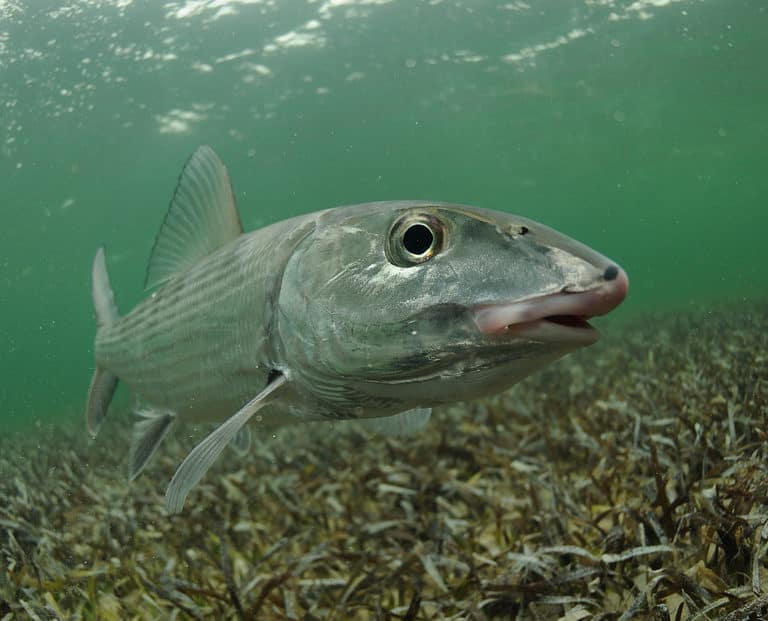
Grey ghost of the tidal flats
Pernambuco's wildlife is shaped by fast changes in habitats over short distances: humid Atlantic Forest patches and mangrove-lined estuaries near Recife quickly turn into drier agreste and the semi-arid Caatinga inland. This close mix of habitats concentrates biodiversity and favors isolation, broken-up forests, seasonal extremes, endemic species, special adaptations, and big bursts of life after rains. Along the coast, Atlantic Forest fragments, restinga, and mangroves are refuges for forest birds, tree mammals, amphibians, and pollinators and support coastal food webs. Inland, agreste mosaics lead to Caatinga dry forest and thorn scrub, where many animals are nocturnal, use resources when available, or time life cycles to brief wet seasons; riparian corridors are vital lifelines. You can often move between very different ecosystems in one day, finding Atlantic Forest endemics, Caatinga specialists, and migratory coastal birds. Birding and wildlife viewing depend on tides on the coast and rain inland.
Pernambuco shows a strong east–west wet-to-dry pattern: humid Atlantic winds support coastal mangroves, reefs and the remaining Atlantic Forest along the coast. Rainfall falls sharply inland across a transition belt into semi-arid backlands of thorn scrub and seasonal dry forest. Borborema highlands have cool, wet pockets—high-altitude forest patches that shelter forest species and raise habitat diversity and endemism.
Sea level to ~1,268 m (uplands of the Borborema Highlands and the Pajeu range area; higher elevations form cooler, wetter refuges that increase habitat heterogeneity)
Atlantic Ocean coastline (~187 km), with extensive estuaries and mangrove belts near river mouths plus nearshore reef formations that shape coastal and marine habitats.
Pernambuco's protected areas cover three habitats: fragmented coastal Atlantic Forest with many endemic and threatened species; coastal mangroves, estuaries and reefs vital for marine turtles, reef fish and West Indian manatees; and interior semi-arid scrub, dry forests and canyons with drought-adapted animals like threatened armadillos and unique birds. Protection is by federal (Chico Mendes Institute), state, municipal and private reserves.
About 10% of Pernambuco's land area is under some form of protected-area designation (including Environmental Protection Areas and extractive reserves); the share in strictly protected categories is smaller (roughly a few percent).
One of the most important protected semi-arid landscapes in Pernambuco, notable for broad, scenic sandstone canyons, rocky outcrops, and seasonal dry forests that support a strong assemblage of dryland specialists and serve as a key refuge in a heavily used interior region.
Brazil's flagship oceanic island marine park, outstanding for wildlife viewing: spinner dolphins close to shore, major green turtle nesting and foraging areas, dense seabird colonies, and clear-water reefs with abundant fish and sharks.
An urban-proximate Atlantic Forest stronghold in Recife that protects a key forest fragment and watershed; notable for accessible wildlife viewing of forest birds, small mammals, and reptiles in a rare green refuge within the metropolitan area.
A priority Caatinga protected area in Pernambuco's semi-arid backlands, conserving thorn scrub and seasonal dry forest and providing habitat for Caatinga birds and mammals, including dryland specialists.
A strategically important Atlantic Forest area and reservoir catchment south of Recife, supporting forest-dependent birds and mammals and functioning as a corridor fragment in a heavily altered coastal landscape.
A federally protected area in Pernambuco created specifically to conserve the threatened Brazilian three-banded armadillo and associated Caatinga habitat, safeguarding native wildlife in a semi-arid ecosystem.
Mangrove-and-estuary protected area focused on sustainable use that also conserves critical nursery habitat for fish and crustaceans and supports rich waterbird communities; important for maintaining ecological function in an intensively used coastal zone.
A wildlife refuge in Pernambuco within the Caatinga (seasonally dry tropical forest and scrub) created to conserve habitat for the threatened Brazilian three-banded armadillo and other native Caatinga biodiversity.
Pernambuco's wildlife follows a sharp change from humid coastal Atlantic Forest fragments (lowland forest and coastal sandy-plain forest/shrub), mangroves and estuaries around Recife, and humid highland forest patches, to semi-arid thorn scrub and seasonally dry forest in the west. This creates many different habitats in short distances, with Atlantic Forest endemics in the east and dryland specialist species inland. Marine life is key, especially around Fernando de Noronha, with large seabird colonies, dolphins, sea turtles, nearshore reefs, and seagrass and mangrove nurseries.
Pernambuco offers diverse wildlife in a small area: coastal reefs and mangroves near Recife, Atlantic Forest remnants with rare endemic species in coastal highlands, and Caatinga drylands inland. Visitors can see sea turtles, reef fish, dolphins, herons, kingfishers, crabs, and forest birds and mammals. Fernando de Noronha is famous for spinner dolphins, sea turtles, seabirds, and snorkeling.
Best all-around beach and marine season: clearer water for snorkeling/diving (especially Fernando de Noronha), active sea turtles and reef fish, great conditions for boat trips and sunrise/sunset wildlife outings. In the interior Caatinga, heat is intense-plan early-morning wildlife walks.
Atlantic Forest fragments become lush and vocal-excellent for birding (antbirds, tanagers, manakins). Amphibians and insects peak after rains (great for night walks). Coastal waters can be rougher; plan flexible sea days.
Strong season for inland/Caatinga trips (Catimbau area) with comfortable nights and good visibility. In the wider NE Brazil, humpback migration is underway (mostly farther south/east), and offshore pelagic bird activity can increase with winds-conditions vary by week.
Shoulder-season sweet spot: improving sea visibility, fewer crowds than peak summer, and excellent bird activity as habitats shift from wet to dry. Good time to mix Recife-area parks + Atlantic Forest birding + a coastal reef/mangrove day.
Pernambuco has a strong east–west wet-to-dry gradient, from humid Atlantic coastal plains and escarpments near Recife to a drier transition and a semi-arid interior of thorn scrub and seasonally dry forests. Despite heavy land conversion, it still has Atlantic Forest remnants, high-elevation humid forest pockets, large rivers and reservoirs, mangrove estuaries, and coastal/offshore habitats including Fernando de Noronha.
Atlantic Forest formations along the coastal zone and windward slopes, including evergreen to semi-evergreen forests and humid montane enclaves (high-elevation humid forest enclaves) that act as biodiversity refugia within drier regions.
Mainly a coastal strip and scattered montane enclaves inland; now highly fragmented and largely confined to protected areas and forest remnants.
Seasonally dry tropical forests and thorny woodlands of the semi-arid interior, with drought-deciduous trees, cacti, and spiny shrubs; includes drier transition-zone mosaics shifting from Atlantic Forest to the interior backcountry.
Dominant across the interior and especially the far interior backcountry, covering a majority of the state's land area.
Rivers, intermittent streams, reservoirs, and riparian corridors across both Atlantic-draining basins and portions of the Sao Francisco basin; strong seasonality in the semi-arid interior.
Statewide along drainage networks; highest permanence and density near major rivers/reservoir systems and wetter eastern catchments.
Estuarine wetlands, floodplain marshes, coastal lagoons/lowlands, and riparian wetlands; includes mangrove-associated wetland complexes near Recife and other estuaries.
Patchy but locally extensive around estuaries/coastal lowlands and along some river floodplains.
Tropical Southwestern Atlantic coastal and offshore systems, including beaches, reefs/reef-like formations (including calcareous algae/bank systems), seagrass/algal areas, and the oceanic island ecosystems of Fernando de Noronha.
Along the entire coastline plus offshore waters; highest habitat distinctiveness around Fernando de Noronha and nearshore reef belts.
Humid Atlantic Forest remnants (lowland and submontane), with high endemism; notable in protected fragments near the coast and in high-elevation humid forest enclaves such as those in the Borborema highlands.
Mixed Atlantic Forest mosaics and secondary forests/regrowth in coastal and escarpment areas, often embedded in agricultural landscapes.
Seasonally dry, drought-deciduous Caatinga forests (arboreal Caatinga), especially in less rocky soils and along some interior valleys.
Open Caatinga woodlands with scattered trees over shrub layers; common across the Sertão and transitional Agreste.
Dense thorn scrub with cacti and bromeliads (typical Caatinga shrublands), frequently on shallow, rocky, or heavily seasonal sites.
Open herbaceous areas and natural/secondary campos within Caatinga/Agreste mosaics, often expanding with grazing and land clearing.
Atlantic-draining rivers (e.g., Capibaribe, Ipojuca, Una) and tributaries to the Sao Francisco basin (e.g., Pajeu), ranging from perennial reaches near the coast to intermittent interior channels.
Natural coastal lagoons are limited, but large artificial lakes/reservoirs are widespread and ecologically important in the semi-arid interior.
Small farm ponds and seasonal waterholes in Caatinga landscapes, critical for wildlife during dry months.
Riparian wetlands, floodplain patches, and lowland wet areas near river mouths; important for waterbirds and nutrient cycling.
Brackish and freshwater marshes in estuarine margins and low-lying floodplain zones, especially near major coastal rivers.
Mangrove forests in estuaries and backwaters (notably around the Recife metropolitan estuarine complex and other river mouths), providing nursery habitat for fish and crustaceans.
Highly productive estuaries where major rivers meet the Atlantic, mixing freshwater and marine systems and supporting mangroves, mudflats, and fisheries.
Coastal plains with dunes, coastal sandplain vegetation, coastal cliffs in places, and a mosaic of urban and natural shorelines.
Extensive sandy beaches along the Atlantic coast, important for coastal dynamics and recreation; some stretches adjacent to nearshore reef structures.
Localized rocky headlands and reef-exposed shorelines, including intertidal hard substrates associated with nearshore reefs/rock outcrops.
Reef and reef-like carbonate formations and patch reefs in nearshore waters; especially notable in the broader Northeast Brazil reef province and around oceanic islands.
Pelagic waters off the Pernambuco shelf and around Fernando de Noronha, used by migratory fish, seabirds, and marine mammals.
Continental shelf and slope habitats with sandy/muddy bottoms and carbonate features; supports demersal fisheries and benthic communities.
Large urban/industrial footprint around Recife and other cities, with strong interactions with estuaries, rivers, and coastal habitats.
Extensive croplands and pasture, including long-established sugarcane zones in the Zona da Mata and mixed farming/ranching in Agreste and Sertão.
Recife, named for its stone reefs, has reef lines that make calm pools. Gaps and channels in the reef are where big predatory fish and sharks travel, so encounters happen in specific spots.
Fernando de Noronha has essentially no native terrestrial mammals aside from bats; many of the land mammals people notice there (e.g., rats, cats) are human-introduced, which is why invasive-species control is a central part of protecting seabirds and reptiles.
Pernambuco's "dry" backlands (Caatinga) host frogs that survive the long rainless season by going dormant underground (aestivation)-for example, the Caatinga frog Pleurodema diplolister can remain buried for months and then emerge quickly after heavy rains to breed in temporary pools.
The seven-colored tanager (Tangara fastuosa)-one of Brazil's most striking Atlantic Forest birds-is not an Amazonian species at all: it's restricted to a narrow band of northeastern coastal forest, including Pernambuco, making tiny forest remnants disproportionately important for its survival.
Fernando de Noronha (Pernambuco) is well-known for large daytime resting groups of spinner dolphins (Stenella longirostris) in Dolphin Bay, where numbers can reach hundreds to over 1,000 animals.
Recife's Boa Viagem shoreline became one of the world's most notorious urban shark-incident hotspots from the 1990s onward, with most incidents linked to bull sharks (Carcharhinus leucas) and tiger sharks (Galeocerdo cuvier) moving along the river/port-influenced coast.
The Fernando de Noronha elaenia (Elaenia ridleyana) is a bird found nowhere else on Earth-its entire global range is restricted to the Fernando de Noronha archipelago.
The Noronha skink (Trachylepis atlantica) is another "only-on-Pernambuco" species: an endemic lizard whose natural global distribution is limited to Fernando de Noronha and nearby islets.
Pernambuco lies in the Atlantic Forest's 'Pernambuco Endemism Center,' one of the forest's most broken-up parts, with under 5% of original forest left north of the Sao Francisco River, including coastal forests.
12 species documented in our encyclopedia
Thank you for reading! Have some feedback for us?
We appreciate your help in improving our content.
Our editorial team will review your suggestions and make any necessary updates.
There was an error submitting your feedback. Please try again.