
Quick Take
- Wood turtles have a clever hunting trick that turns an ordinary rainstorm into a free meal, and remarkably they don't even need actual rain to pull it off. See the worm-luring behavior →
- This turtle won't be ready to reproduce until it reaches an age that would surprise most pet owners, and that delay has serious consequences for the species. Explore sexual maturity details →
- The wood turtle's shell has a name that describes it perfectly, and the reason scientists chose those words reveals something unexpected about its structure. Discover the shell's name →
- One conservation technique used to save wood turtles involves temporarily taking hatchlings out of the wild, and the reasoning behind it is counterintuitive. Learn about head-starting programs →
The wood turtle is an impressive, pretty little turtle with a big personality and some interesting traits that make it stand out among all other species. They spend the winter months hibernating in fast-flowing water streams while most turtles prefer sluggish ponds. They are known to be aggressive — especially toward each other, and they have learned to trick worms into coming to the surface by imitating rainfall with their dancing little feet. Unfortunately, the wood turtle is considered to be one of the most endangered freshwater turtles in North America due to loss of habitat.

Amazing Wood Turtle Facts
- A well-cared-for turtle can live as long as 58 years. A person who wants one as a pet should take this into account.
- These turtles have attractive scutes that show growth rings much like the cross-section of a tree.
- They are omnivorous and eat both plant and animal matter.
- They’re sometimes seen deliberately stomping on the ground as they walk. Some scientists believe the noise mimics the sound of rain falling on the ground. This brings earthworms up to the surface where the turtle can easily snap and eat them.

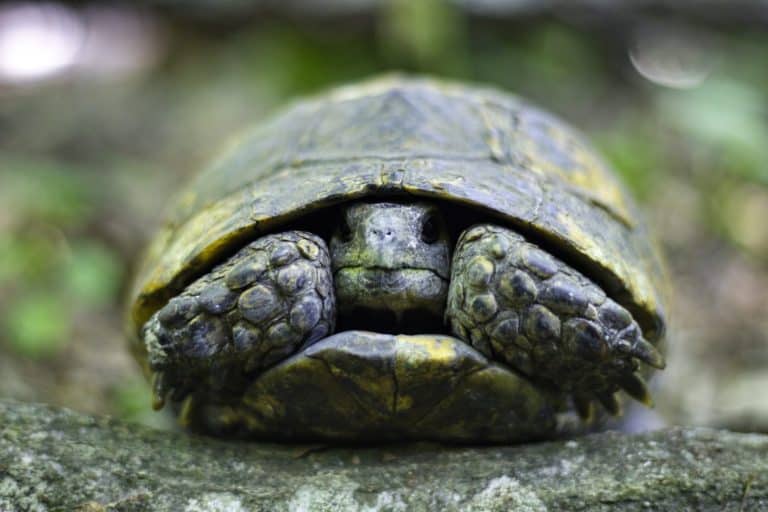
The North American wood turtle’s scientific name refers to the carved wood look of its shell.
©Eric Isselee/Shutterstock.com
Evolution
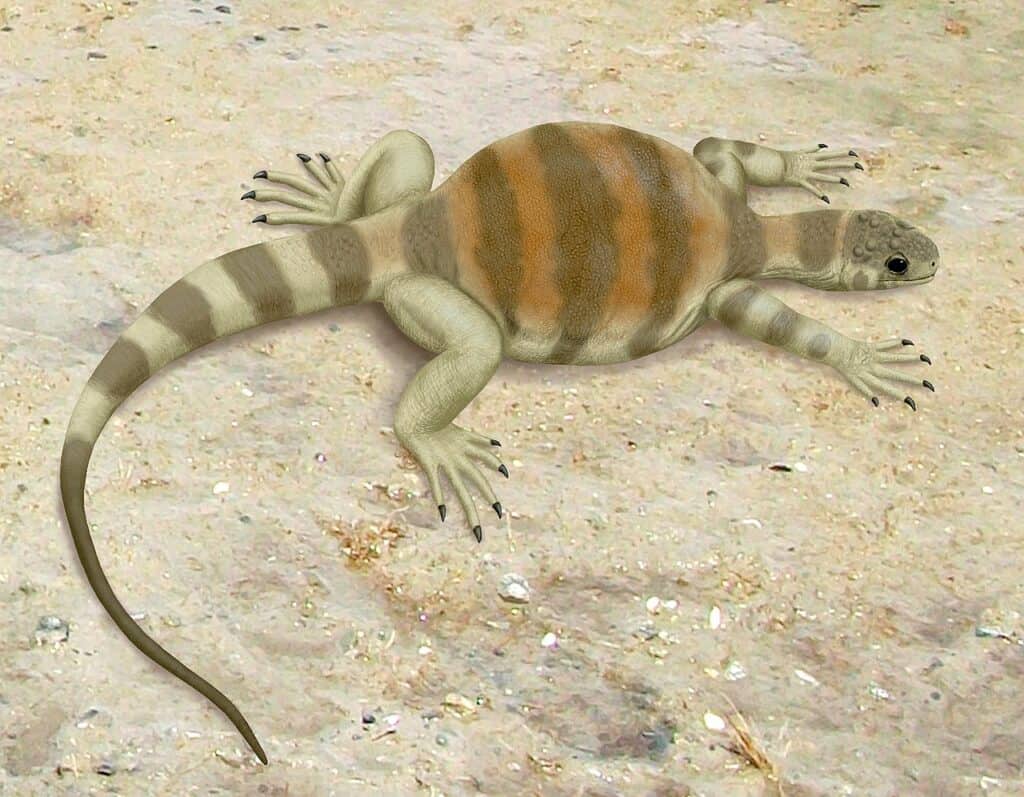
The earliest ancestor of modern turtles was Eunotosaurs, a reptile that existed 260 million years ago.
The earliest known ancestor of modern turtles was Eunotosaurus, a reptile that existed during the Permian epoch, around 260 million years ago. This strange little lizard had the makings of modern-day turtles with nine broadened ribs that helped shield the animal’s body and anchor it while burrowing. Eunotosaurus didn’t have a shell but did have the framing for one with wide ribs that shielded the animal’s underside. Recent studies reveal that those wide ribs aided the animal in digging and burrowing by anchoring it to the ground. Eunotosaurus had evolved to be an efficient excavator. The animal was once thought to be a swimmer, but the big claws and thick bones would have helped it to withstand compressive forces while burrowing. The powerful, back-facing front limbs and weaker back limbs indicated a master burrower.
Eunotosaurus fossils have been found in what is now South Africa, and this turtle relative lived during a period when the land was dry and arid. The animal may have evolved its burrowing ability to escape droughts. Bony rings around Eunotosaurus’s eyes indicate that it may have spent a lot of time underground.
A reptile called Odontochelys semitestacea appeared approximately 220 million years ago in the shallow marine waters of what is now China. The Odontochelys had one trait that modern turtles and tortoises share — a plastron or bottom shell. It is believed that these turtle ancestors developed lower shells first because sharks and other predators attacked them from below the surface of the water.
Proganochelys, or “beast turtle”, lived among dinosaurs and was armored above and below. In addition to its protective shell, this ancient turtle had bony neck spikes, leg spikes, and tail spikes. Like its modern relatives, it had a bony shell and a toothless mouth.
Pappochelys and Odontochelys also seemed to be equipped with digging abilities. It is believed that after the digging adaptations were made, many turtles became aquatic. Over time, complete shells formed from the wide ribcage, perhaps to protect the slow-moving turtles hampered by broad ribs from predators. Digging platforms evolved into suits of armor.
These three turtle ancestors diverged into the terrapin, sea turtle, and tortoise we know today.
Scientific name
The North American wood turtle’s scientific name is Glyptemys insculpta. Glyptemys means “carved turtle,” and insculpta builds on this, as it means “sculptured” in Latin. This refers to the annular rings on its scutes.
Species
The wood turtle is one of two species in the genus Glyptemys, the other being the bog turtle (Glyptemys muhlenbergii). There are nine species of wood turtle, including:
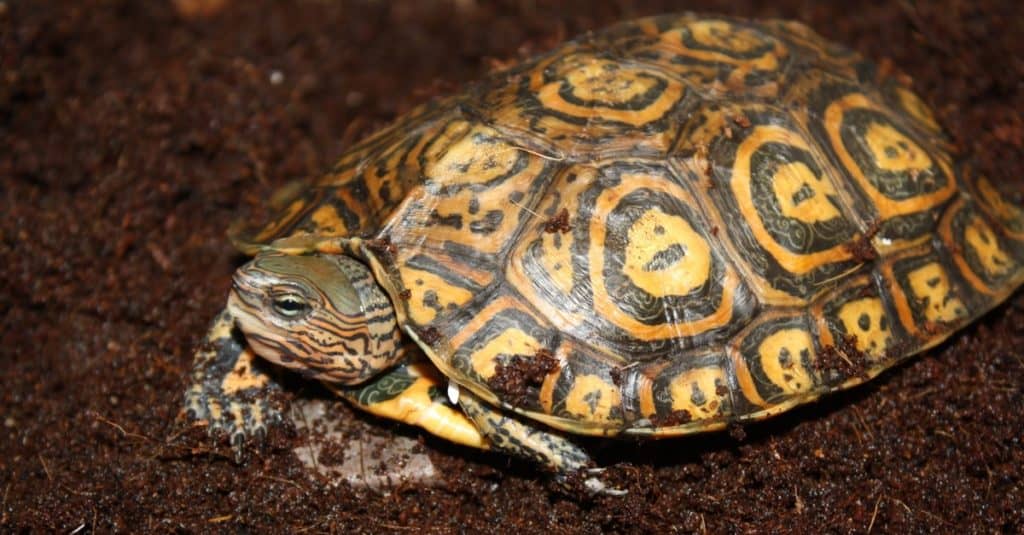
Central American Ornate Wood turtles have beautiful, brightly-colored shells.
©Bildagentur Zoonar GmbH/Shutterstock.com
- Central American wood turtle (Rhinoclemmys pulcherrima): Also known as the Honduran wood turtle, these painted wood turtles have beautiful, brightly-colored shells. They can be found from Sonora, Mexico through Guatemala, El Salvador, Honduras, and Costa Rica.
- North American wood turtle (Glyptemys insculpta): This little turtle stands out from the crowd, with well-defined scutes with concentric rings that resemble carved wood. They can be found in Canada and the northeastern United States.
- Furrowed Wood Turtle (Rhinoclemmys areolata): Not as showy as other wood turtles with more muted coloring, these turtles can be found in the Yucatan Peninsula, Veracruz, Mexico, Belize, and northwestern Honduras.
- Black Wood Turtle (Rhinoclemmys funerea): Also known as the black river turtle, this turtle has a black shell and dark skin. They can be found in Panama, Honduras, Costa Rica, and Nicaragua.
- Maracaibo Wood Turtle (Rhinoclemmys diademata): With beautiful patterns resembling tie-dye in shades of yellow to brown, this pretty turtle lives in northern South America, Venezuela, and Colombia.
- Spot-legged Wood Turtle (Rhinoclemmys punctularia): These turtles have a bluish shell and can be found in Venezuela, Trinidad and Tobago, Suriname, Guyana, French Guiana, and Brazil.
- Brown Wood Turtle (Rhinoclemmys annulata): This elusive turtle lives in Panama, Honduras, Ecuador, Costa Rica, and Colombia.
- Large-nosed Wood Turtle (Rhinoclemmys nasuta): Found in Ecuador and Colombia, this turtle is mostly brown and does have a slightly larger nose than its cousins.
- Colombian Wood Turtle (Rhinoclemmys melanosterna): This wood turtle’s shell looks like hammered metal. They live in Ecuador, Colombia, and Panama.
Rhinoclemmys is from the Greek for “nose” and “turtle,” and describes the prominent noses on some of these turtles. Pulcherrimus means “prettiest” in Latin.
Appearance
Central American Ornate Wood Turtle.
©Bildagentur Zoonar GmbH/Shutterstock.com
The North American wood turtle can grow from 5.5 to 9 inches long. They have distinctive scutes, and the description of the annular rings compares them to elegant wood carvings in older specimens.
The North American turtle has a black head which may have lighter markings, with yellow, orange, or salmon pink on the throat and the lower legs, depending on where the turtle is found. Adult males’ heads are wider than the females’, and the carapace has more of a dome shape. The plastron, which is the underside of the shell, is depressed in the center, and their tails are longer and thicker than those of the females.
The Central American or painted turtle has a beautiful, multicolored carapace. The colors are believed to mimic those of the coral snake, which is venomous. Females are larger than males.
The furrowed turtle has a boxy carapace with red markings on its face, while the Maracaibo turtle has a somewhat pyramidal shell that is the brown and amber color of traditional tortoiseshell. The spot-legged wood turtle is known for its freckled legs.
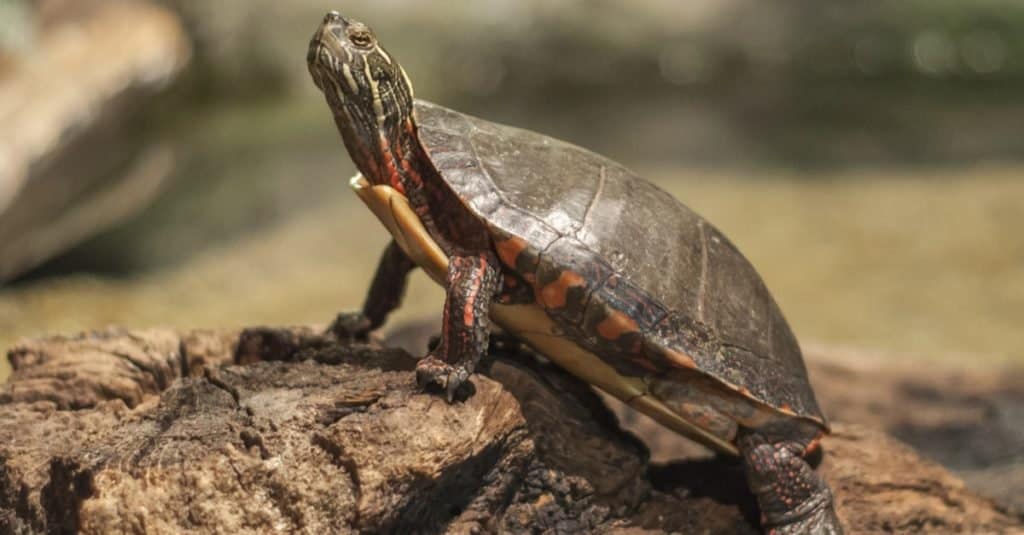
Just like all cold-blooded creatures, wood turtles love to bask in the sun.
©Lmnopg007/Shutterstock.com
Behavior
Wood turtles are active during the day, and since they’re cold-blooded, they spend much time basking on logs or other surfaces near water. Sometimes they will bask in a hidden area on land. The North American wood turtle, which is found in Canada, has evolved behaviors such as angling its shell toward the sun in a certain way to keep its body warm during cooler months.
Northern wood turtles in cooler climates hibernate in the winter. They dig into the bottoms of shallow streams and rivers and may stay there for six months. Turtles may also estivate when the weather becomes too hot.
These animals are generally careful not to roam too far from a water source, though they can travel a long way in search of food. Even turtles that are moved a long way from their home territory return to it, even if it takes weeks or months. However, the turtles do not seem to be very territorial, even though they can be aggressive to other wood turtles. This is true of both male and female wood turtles. When sold as pets, wood turtles seem to be curious, friendly, and intelligent.
Habitat

Wood turtles like slow-moving, shallow waters with muddy bottoms.
©Tabitha Gardner/Shutterstock.com
The North American turtle’s habitat is wide-ranging, though it prefers to live near slow streams with sandy or muddy bottoms that are edged by shrubbery. The soft bottoms of these streams are easy for the turtle to dig into when it hibernates, and the shrubbery helps to hide nests. The turtle spends the warmer months in wet meadows, bogs, and fields, then spends the rest of the year in the water.
Diet
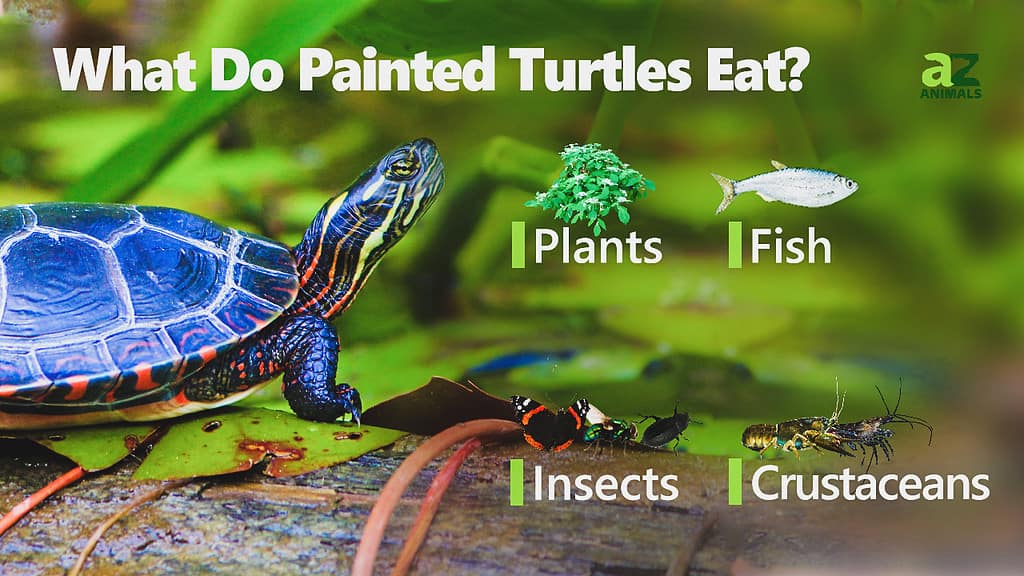
Since these turtles are omnivores, they eat eggs, insects, snails and slugs, worms, crustaceans, and small, newborn animals. Indeed, they seem amenable to eating any food source that they can catch. Because turtles are slow, many don’t have fish or any other animal that can get away quickly in their diet, though the painted wood turtle has been seen to catch and eat fish. They will consume carrion. They also eat fruit, leaves, flowers, tubers, roots, and fungi. The North American turtle can eat on land and in water, while the painted wood turtle usually eats on land.
Predators and Threats
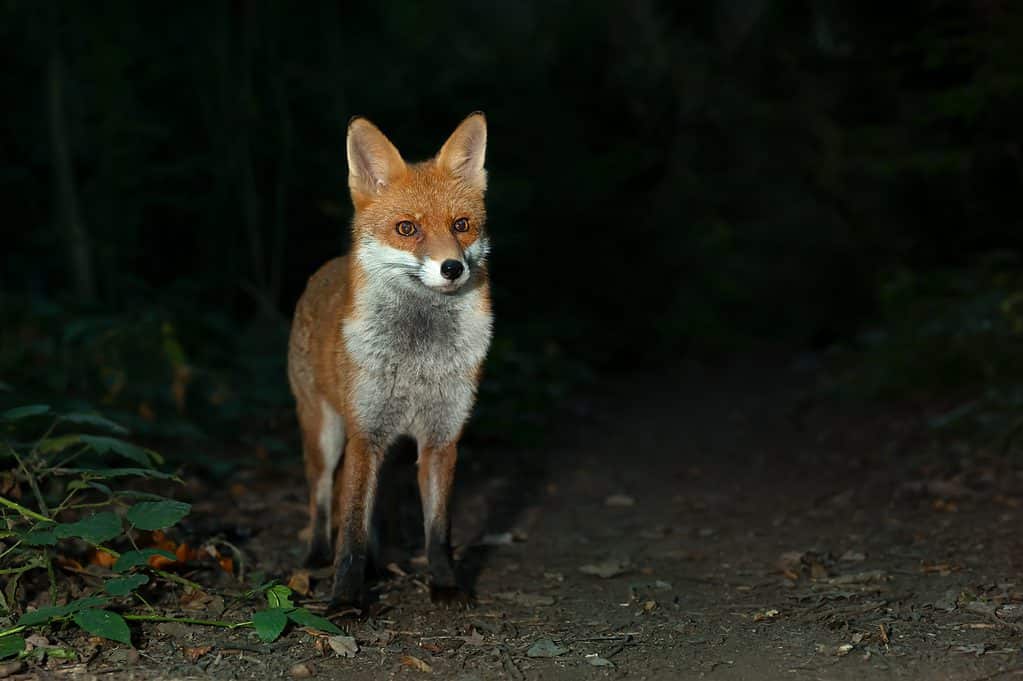
Foxes are among the predators of the wood turtle.
©Giedriius/Shutterstock.com
Humans are the biggest threat to these turtles. Humans break up their natural habitat, which makes it difficult for turtles to find mates and nests. Many turtles are run over and killed as they try to cross roads to get to old nesting areas. Other turtles are collected as pets from the wild, which should be discouraged. There are cultures where wood turtles are food. Even if none of this were true, the mortality for turtle eggs and hatchlings has always been high. Just about every carnivore in the forest, whether they be foxes, raccoons, skunks, snakes, snapping turtles, alligators, or even domestic cats, is fond of eating them.
Reproduction and Life Cycle
A North American wood turtle isn’t ready to breed until it’s between 12 and 20 years old. When this finally happens, older male turtles dominate younger ones and may push one off a female even during copulation. Still, the female may mate with more than one male.

Female Wood Turtles lay around 20 eggs in soft soil.
©Brandt Bolding/Shutterstock.com
Before this can happen, male and female turtles engage in a courtship ritual where they swing their heads or touch noses. Sometimes the male simply chases the female until he catches her. Some turtles mate in shallow water or on land. A description of wood turtle mating emphasizes its singular passion. It most often occurs in spring or fall.
The female will start nesting in late spring to summer. She’ll find a place with soil that’s soft enough for her to dig into. The area is often elevated to protect the eggs from flooding. She may start several nests but discard them as inadequate before she finds a perfect spot. The number of eggs laid depends on the species. The North American wood turtle can lay as many as 20.
When the eggs are laid, the female covers them up with care and then leaves, never to see them again. Temperature determines the sex of a baby turtle. A female baby is the result of higher temperatures, while a male baby is the result of lower temperatures. Eggs can hatch in as little as 47 days.
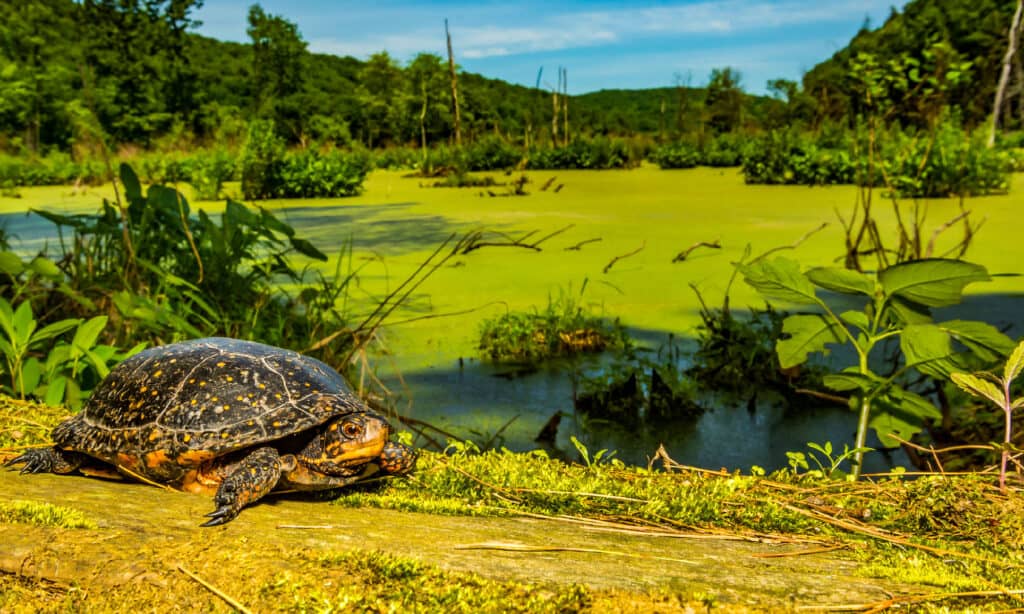
The wood turtle has been listed as endangered due to habitat loss, invasive plants, and degraded water quality.
©iStock.com/JasonOndreicka
Population
Wood turtles are now considered to be endangered by the IUCN due to habitat loss, invasive plants, degraded water quality, agricultural machinery, disease, road-crossing mortality, and illegal collection for the black market pet trade. The U.S. Fish and Wildlife Service is working on a variety of measures to help the wood turtle — from habitat restoration to head-starting, a technique in which hatchling turtles are temporarily removed from the wild in hopes of improving survival rates when they are released months later.
Wood turtles Pictures
View all of our Wood turtles pictures in the gallery.

Jay Ondreicka/Shutterstock.com
Sources
- WBUR / Accessed May 14, 2021
- Reptiles Magazine / Accessed May 14, 2021
- Wikipedia / Accessed May 14, 2021
- Animal Diversity Web / Accessed May 14, 2021
- Fresh Marine / Accessed May 14, 2021
- All Turtles / Accessed May 14, 2021
- The Reptile Database / Accessed May 14, 2021
- Backyard Nature / Accessed May 14, 2021
- Turtle Source / Accessed May 14, 2021