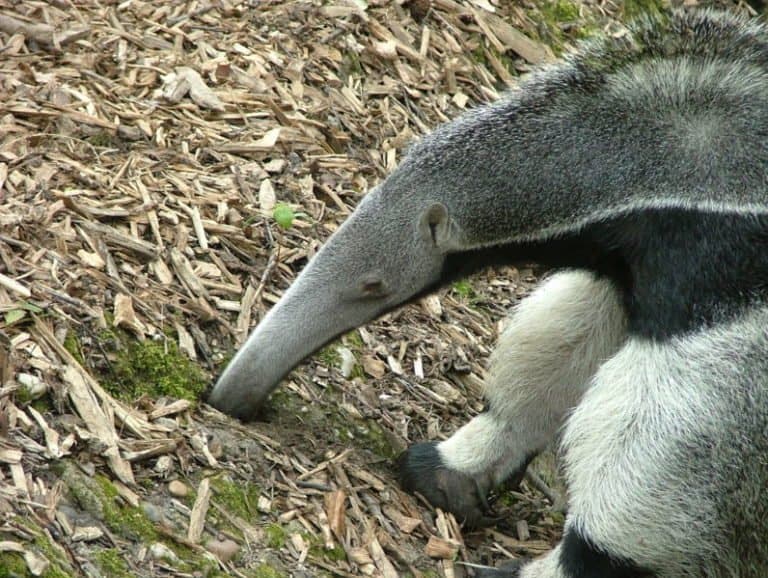

A giant anteater can consume up to 35,000 ants in one day!
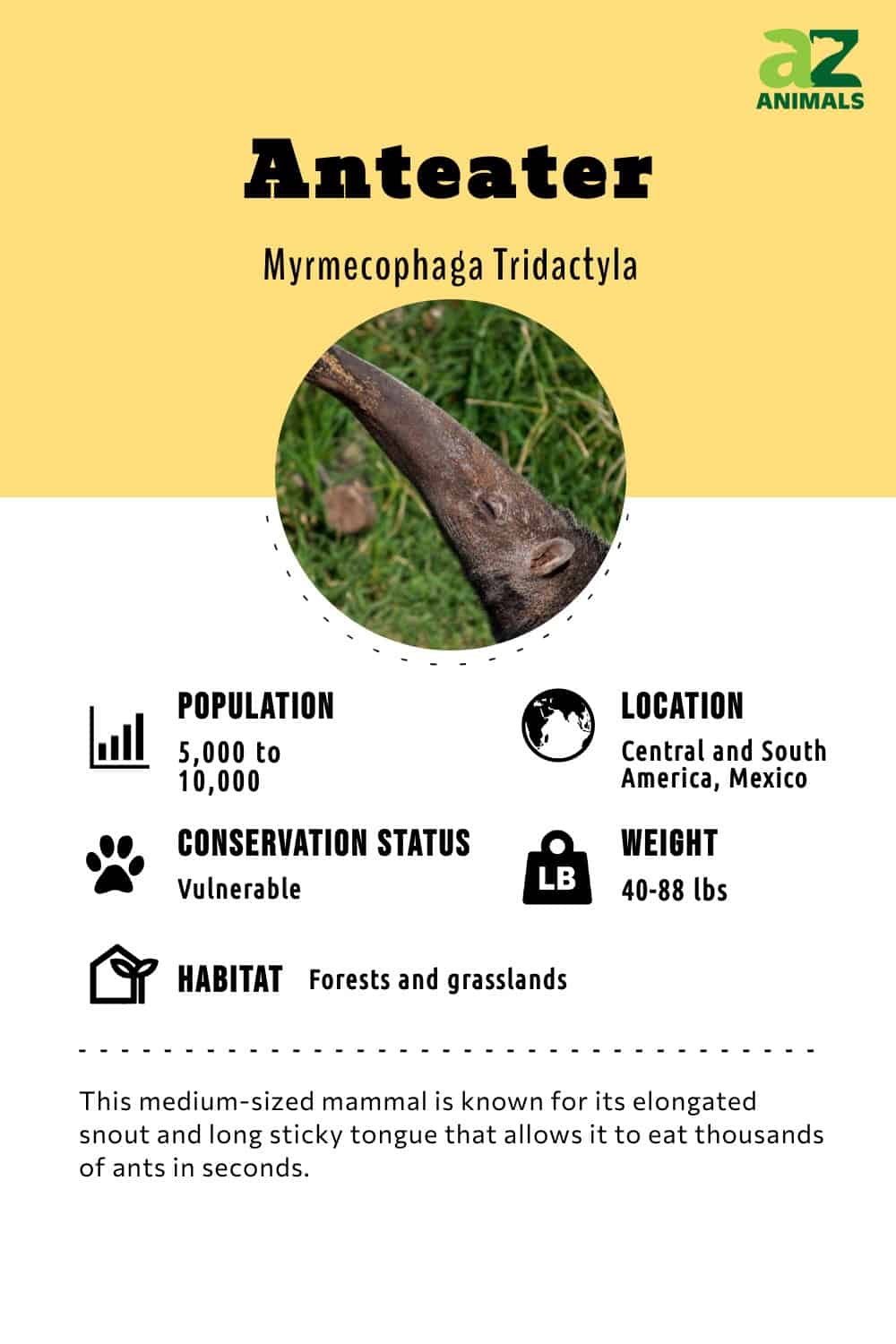
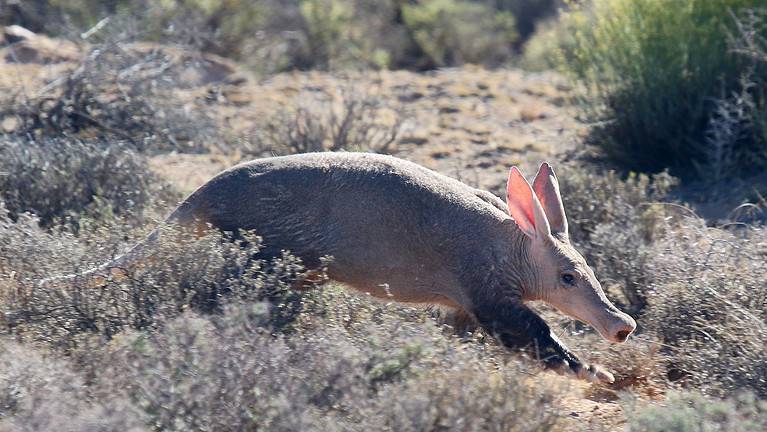
Anteater refers to several medium-sized insect-eating mammals found in the Southern Hemisphere. Anteaters are edentate animals, meaning they have no teeth. However, they use their long tongues to eat the insects that comprise the bulk of their diet. Giant anteaters, the most well-known of the four species, can consume as many as 35,000 ants or termites in a single day.
5 Incredible Anteater Facts
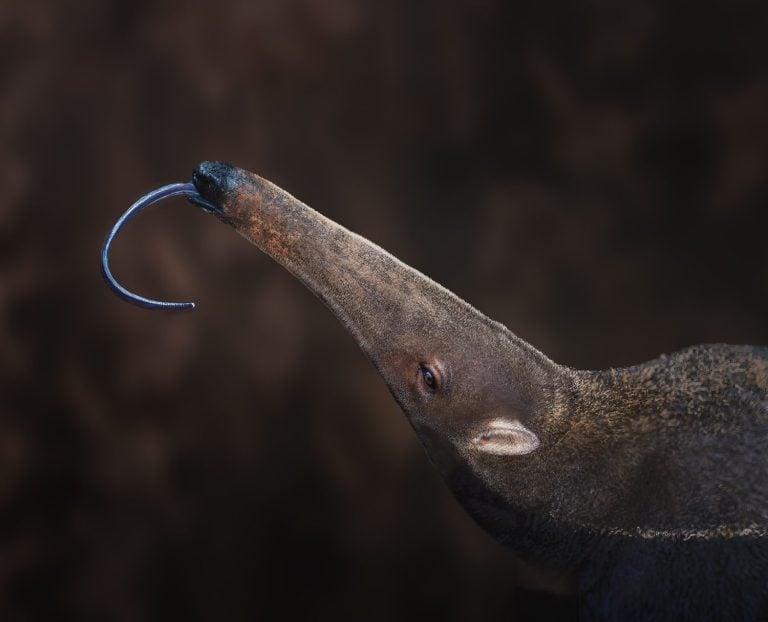
- The anteater has the longest tongue of any animal in relation to its body size.
- The pygmy sloth is one of the anteater’s closest relatives, but their common ancestor is more than 55 million years old.
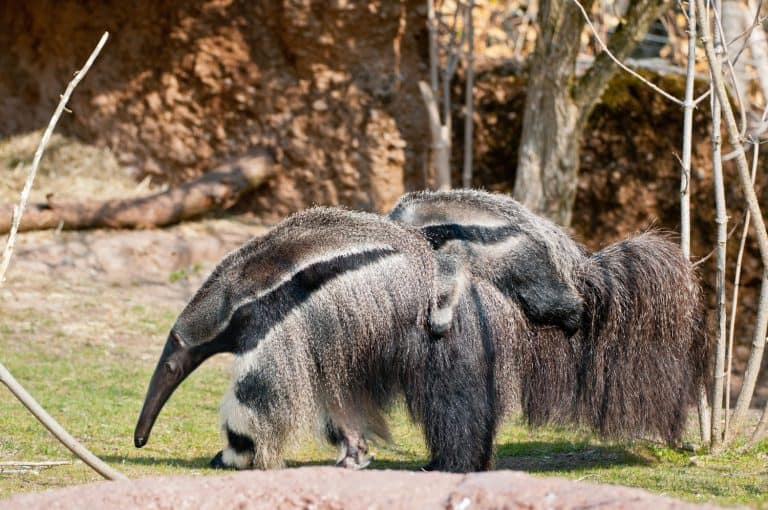
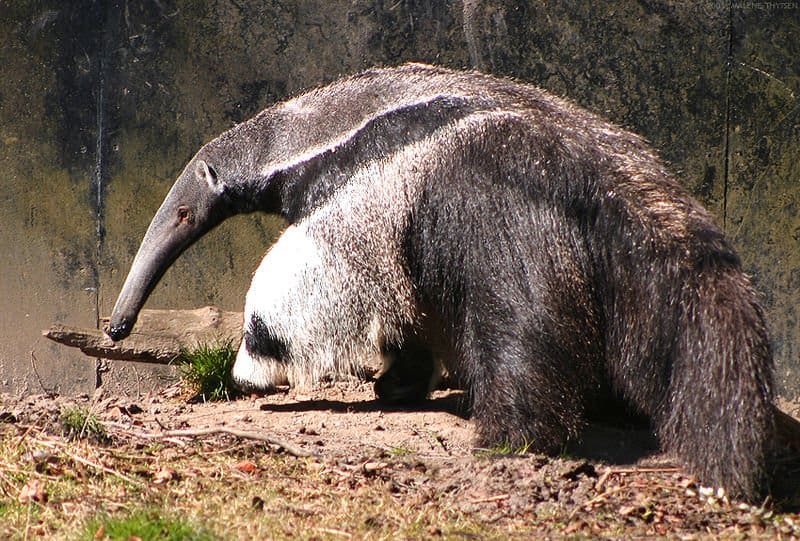
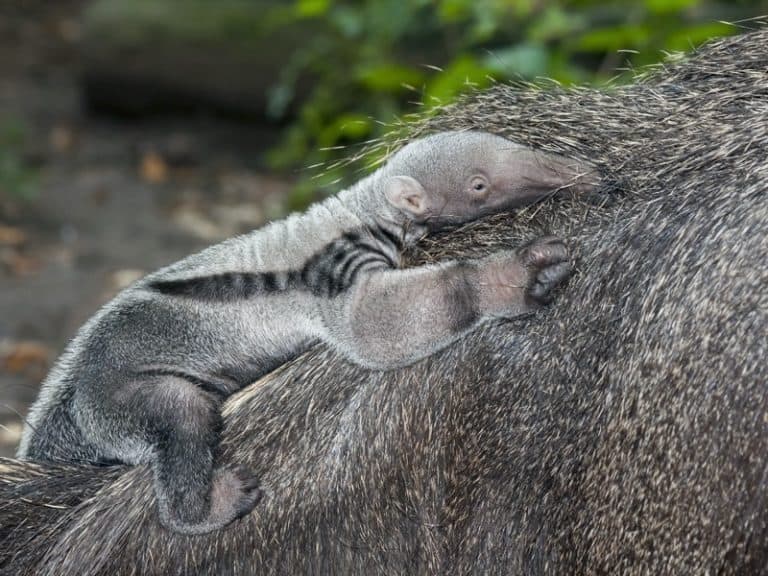
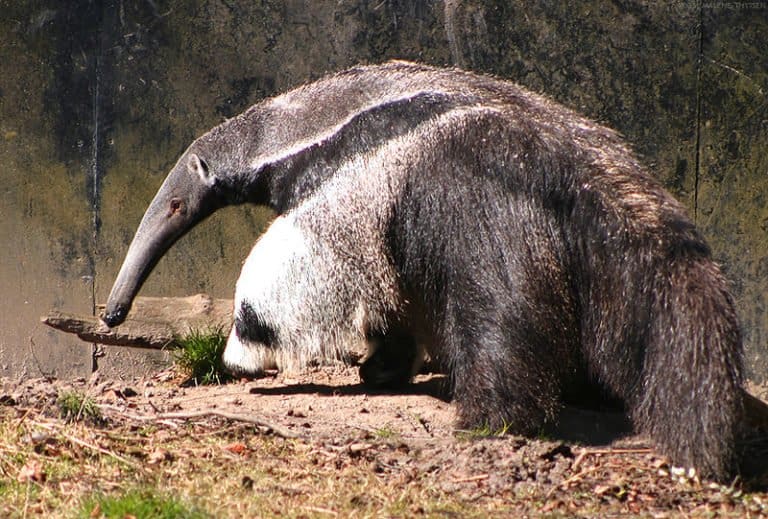
- Their legs, which look like panda faces, are part of the giant anteater’s protective coloring. Baby anteaters have similar coloring, which allows the baby to “vanish” while making its mother look bigger.
- The paws of all four species feature enormous, long, and sharp claws that require the animals to walk on their knuckles or wrists to avoid stabbing themselves.
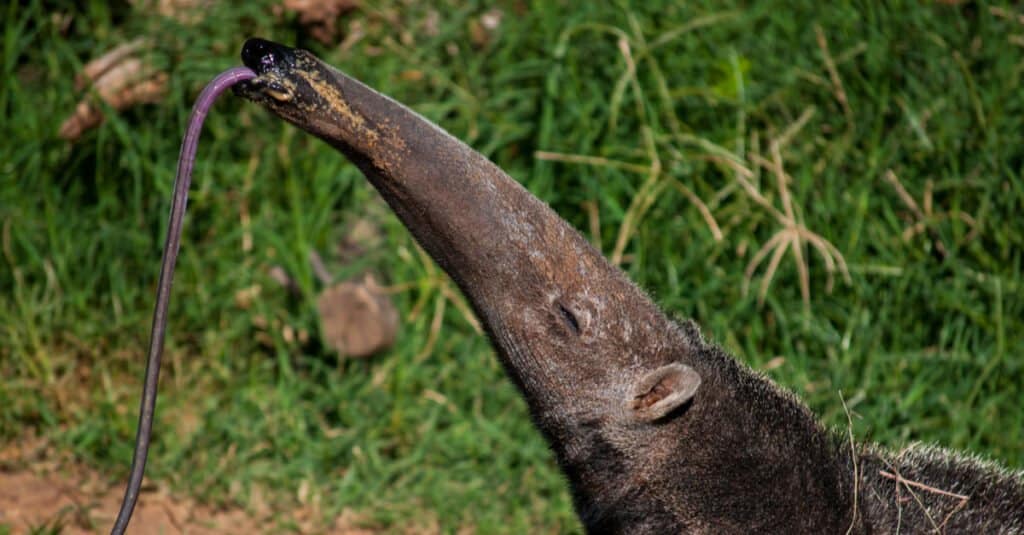
The anteater is known for its long, thin tongue that can extend greater than the length of its head.
©esdeem/Shutterstock.com
Scientific Name
The giant anteater’s scientific name is Myrmecophaga tridactyla, which is Greek in origin and means three-fingered anteater. This is the animal that most people think of when referring to anteaters. Other anteaters are southern tamanduas (Tamandua tetradactyla), northern tamanduas (Tamandua Mexicana), and silky anteaters (Cyclopes didactylus), the smallest animal in this classification. Tamandua means anteater in the native language Tupi and in Brazilian Portuguese. Tetradactyla is Greek for four claws. Cyclopes, also from Greek, means squirrel, while didactylus means two-toed.
Evolution and History
Anteaters have a lineage that can be traced back millions of years. When the Xenarthra superorder of mammals present in South America divided during the Late Cretaceous Epoch 66 million years ago, it separated the order Pilosa — which anteaters, as well as sloths, belonged — from Cingulata (whose only surviving member is the armadillo). It was between the Paleocene and Eocene epochs, around 55 million years ago, that anteaters split from sloths. Then anteater species evolved, with the genus Cyclopes (family of the silky anteater) developing in the Oligocene Epoch around 30 million years ago and the Myrmecophaga (family of the giant anteater) becoming distinct from the Tamandua (family of the northern and southern tamanduas) in the Late Miocene subepoch around 10 million years ago.
Anteaters lived in the isolated island continent of South America up until about 3 million years ago, when the Isthmus of Panama formed, connecting South America to North America. Members of all species of anteaters migrated via Central America as part of the Great American Biotic Interchange.
Early fossil records for anteaters are relatively rare, with some evidence of animals that were extinct anteater species or close relatives. It’s thought that the giant anteater may have had a more arboreal (tree-dwelling) lifestyle like the silky anteater and northern and southern tamanduas but changed to its current ground-dwelling lifestyle due to being in open habitats including savannah in South America and having access to insects such as termites.
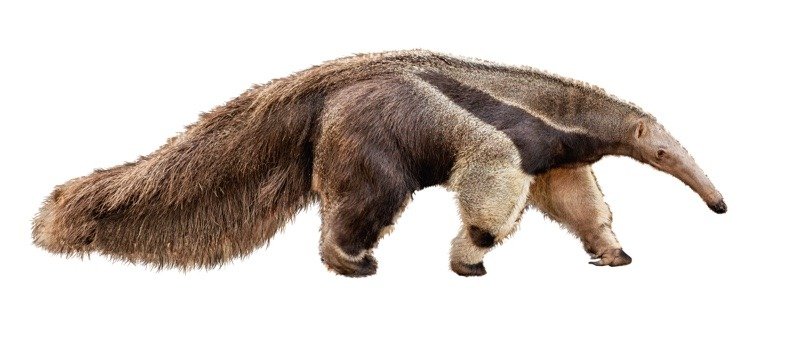
Anteaters’ lineage goes back as far as 66 million years.
©Susan Schmitz/Shutterstock.com
4 Types of Anteaters
While there are some extinct species of anteaters, four types of anteaters exist today:
- Giant anteater (Myrmecophaga tridactyla)
- Silky anteater (Cyclopes didactylus), also known as the pygmy anteater
- Northern tamandua (Tamandua mexicana)
- Southern tamandua (Tamandua tetradactyla), also called the collared anteater or lesser anteater.
They vary in size, with the giant anteater being the largest species of anteater. Their habitats also vary, with species preferring different environments and locations.
All anteater species have long snouts, thin tongues that extend to be greater than the length of their heads, and no teeth. While the other three species have a prehensile tail, the giant anteater does not. Read on to learn about the differences in appearance, behavior, habitat, diet, predators, threats, reproduction, and lifecycles of these four anteater species.
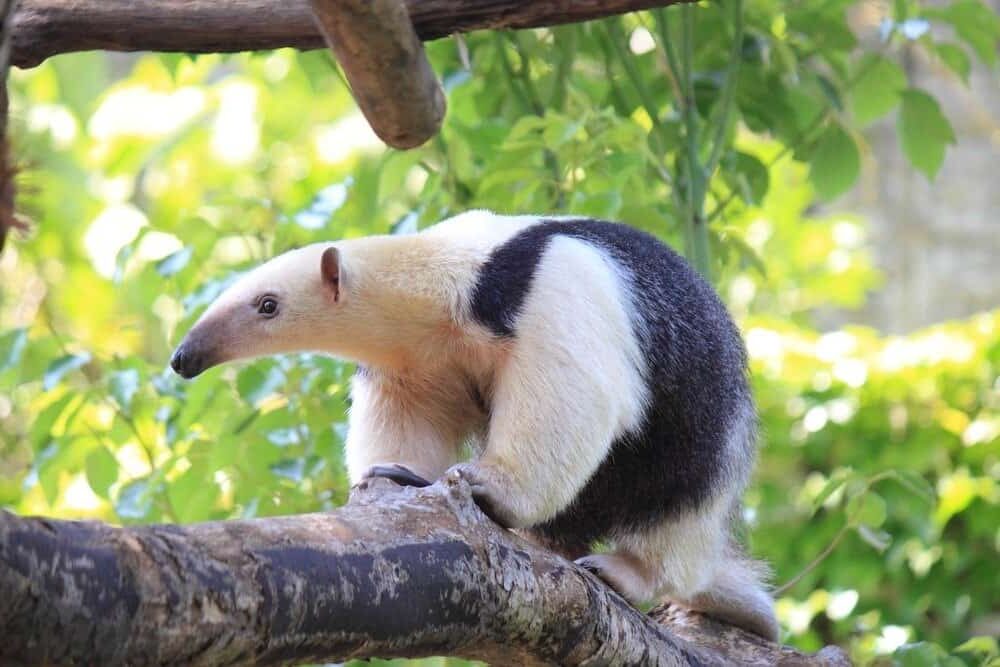
The tamandua, also called the lesser anteater, is one of the four types of anteater.
©darock/Shutterstock.com
Appearance and Behavior
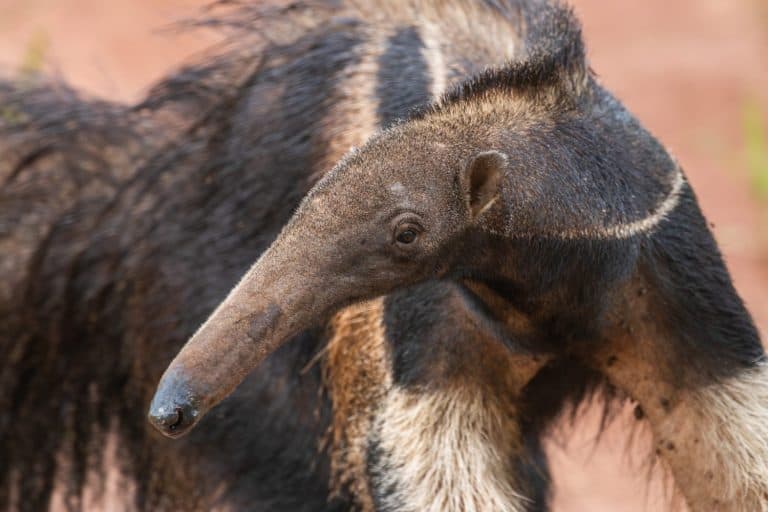
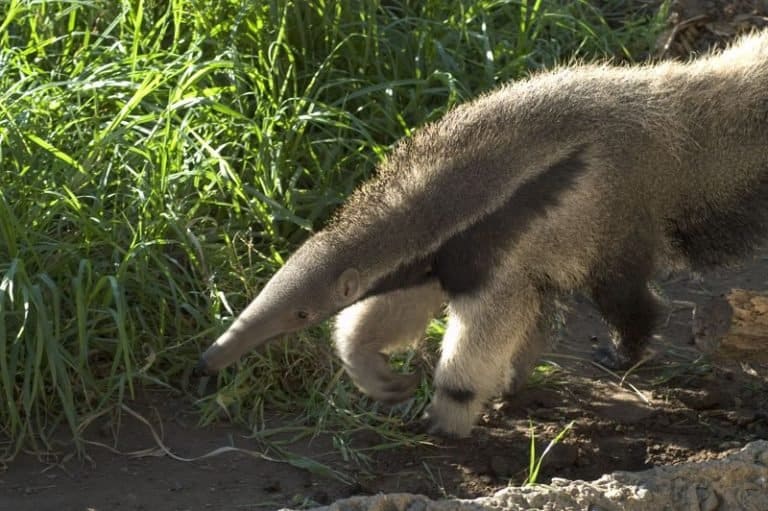
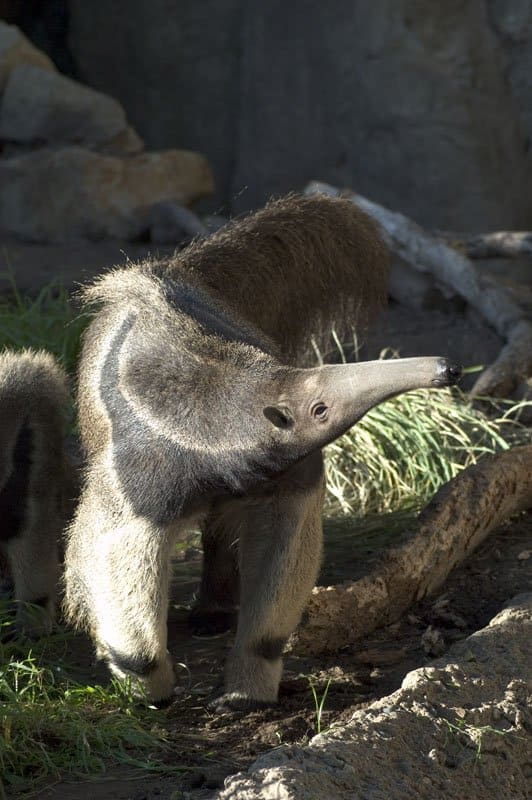
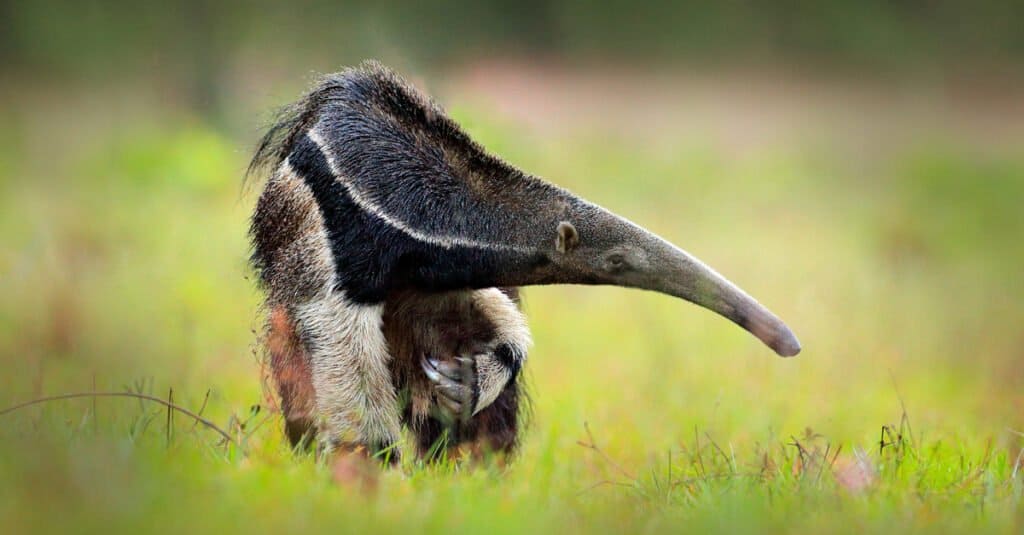
The giant anteater typically measures 5-8 feet long from nose to tail and weighs up to 140 pounds. It has a long nose and a narrow head with small eyes and round ears. Giant anteaters have coarse grey or brown hair with a white-and-black stripe running the length of their bodies. The bushy tail is two to three feet long.
Giant anteaters are animals with long front claws, which they curl under to walk. They use their powerful legs and claws to ward off larger animals and can become aggressive when cornered, rearing up on their hind legs, and using their tails for balance. They are generally asocial, avoiding other animals, including other anteaters, and only coming together to mate.
These animals have poor vision, so they use their keen sense of smell, which is 40 times more powerful than humans, to find food. Giant anteaters have tongues that can reach two feet, beginning at their breastbones. Backward-facing spiny projections cover their tongues, which, combined with their sticky saliva, help collect bugs.
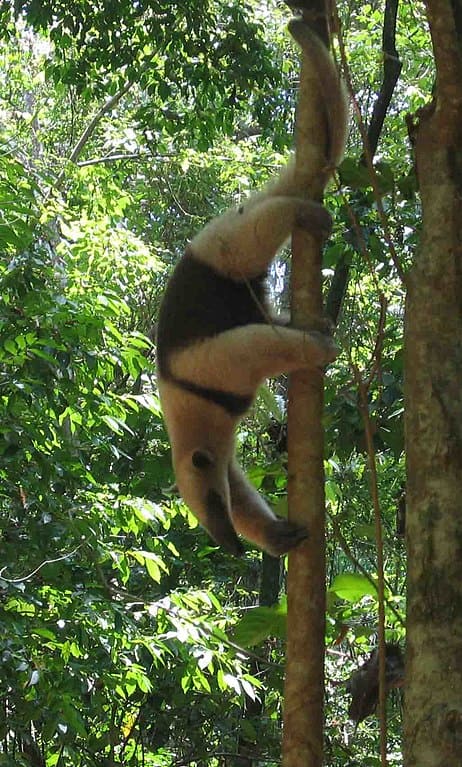
Northern tamanduas are much smaller than giant anteaters, their body length ranging from 1.5 feet to 2.5 feet, with tails measuring 1.3 feet to 2.2 feet. These anteaters are fawn to brownish in color with a distinct, black “V” running down their backs. These anteaters are active both in the day and night, usually for about eight-hour stretches, and spend about half of their time in trees, many of which are hollow.
Southern tamanduas range from 1.7 feet to 2.9 feet, with tails measuring 1.3 feet to 1.9 feet. Some have strong black markings on a body that is blond, tan, or brown. The underside and the end of the tail are hairless and somewhat scaly. They are primarily nocturnal but are occasionally active during the day. Collared anteaters spend much of their time foraging arboreally as they are somewhat clumsy on the ground. When threatened in a tree, this anteater may grasp a branch with its hind feet and tail, using its powerful forearms for self-defense.
Tamanduas are sometimes called the “stinkers of the forest” because of their ability to detonate a skunk-like stink bomb from a gland under its tail when it is threatened.
Silky anteaters are, by far, the smallest of the species, weighing less than a pound. They are nocturnal creatures, living high up in trees, rarely descending to the ground. These animals almost look like little creampuffs because of their silky fur that resembles the seed pods of the Ceiba trees where they primarily live. They are difficult to find in the wild, so little is known about their social habits.
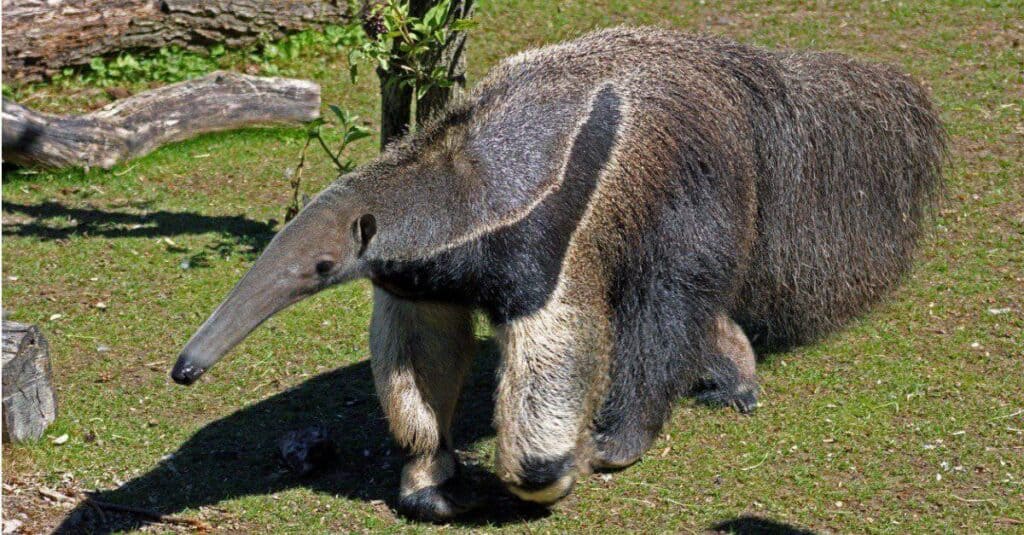
Giant anteaters have long front claws, which they curl under to allow them to walk.
©iStock.com/Ivan Mattioli
Habitat
The giant anteater is an animal that lives in the grasslands, forests, jungles, and lower mountain regions of Central and South America. To thrive, they require large grassy areas that are abundant in ants along with patches of forest.
Northern tamanduas live in rainforests, plantations, gallery forests, and arid savannahs. They typically live beside streams and trees with abundant amounts of vines, which often house ant and termite nests. When not active, they rest in hollow trees or burrows of other animals. In Panama, northern tamanduas often swim between islands.
Southern tamanduas live in South America, ranging from Venezuela and Trinidad southward to northern Argentina, southern Brazil and Uruguay at elevations up to 6,500 feet. These anteaters also commonly live near streams and rivers.
An anteater’s habitat varies depending on the species.
©Ondrej Prosicky/Shutterstock.com
Population
Giant anteater population numbers are declining primarily due to habitat loss and overhunting by humans. Reports indicate that about 5,000 to 10,000 individuals are left in the wild. According to IUCN, the tamanduas and silky anteaters are relatively widespread, but no population estimates are available.
Diet
All types of anteaters use their sharp claws to tear into anthills and insect nests. They eat quickly, flicking their long tongues up to 150 times per minute. Most giant anteaters and tamanduas feed on anthills or termite mounds in less than 40 seconds. These quick meals have a two-fold purpose. For one, they leave some of the insects in their nests to repopulate so that they have a continual source of food. Secondly, they avoid painful stings from ants when the insects begin to realize the danger to their nests.
Silky anteaters consume insects found in the tops of trees. Southern tamanduas avoid eating army ants and leaf-eating ants as these species have strong chemical defenses. They also eat honey and bees.
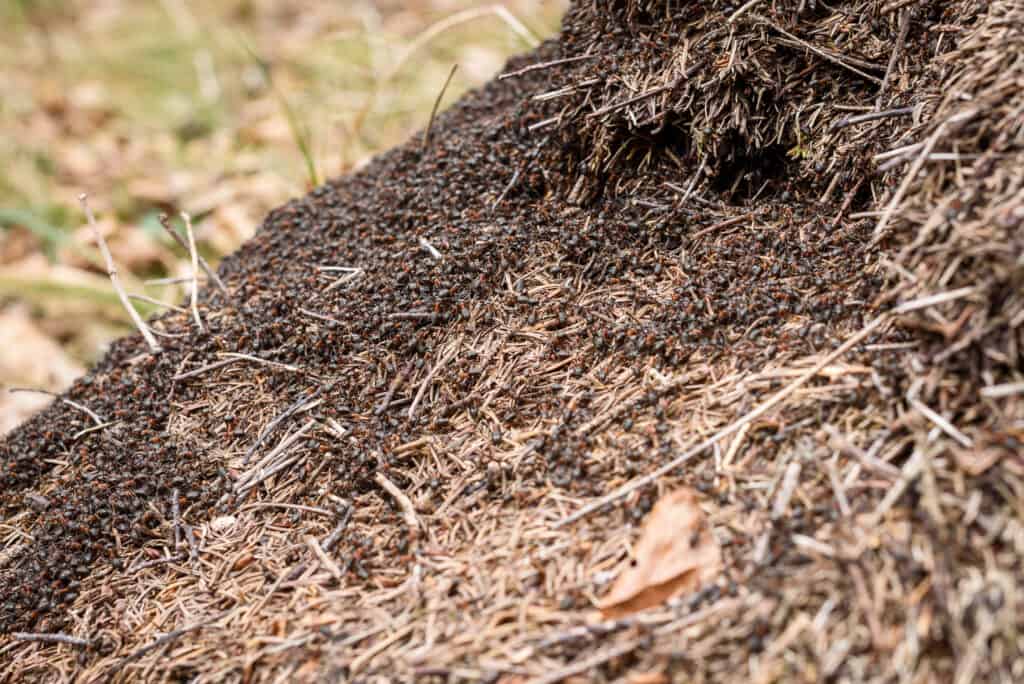
Most giant anteaters and tamanduas will take less than 40 seconds to feast on an anthill.
©iStock.com/_jure
Predators and Threats
The International Union for Conservation of Nature (IUCN) Red List officially classifies giant anteaters as vulnerable, as they are the most threatened mammals in Central America and are extinct in Guatemala, El Salvador, and Uruguay. The loss of their grassland habitats is a major threat as sugar cane growers regularly burn their fields, ultimately affecting anteater habitats. Some humans hunt them for food, while others kill them simply because they consider anteaters to be pests. In the Brazilian Cerrado Biome, many are killed by road traffic. Cougars and jaguars are their natural predators.
The Iberá Project has rescued more than 10 orphaned anteaters and reintroduced them to the wild in Argentina. Conservationists are collecting data in the Cerrado Biome to determine how roadways affect these animals in the hope that new protections will be enacted.
Northern tamanduas are not considered threatened. Their natural predators include jaguars, large snakes, and eagles. Harpy eagles, eagle hawks, and spectacled owls prey on silky anteaters. The conservation status of tamanduas and silky anteaters is listed as least concern.
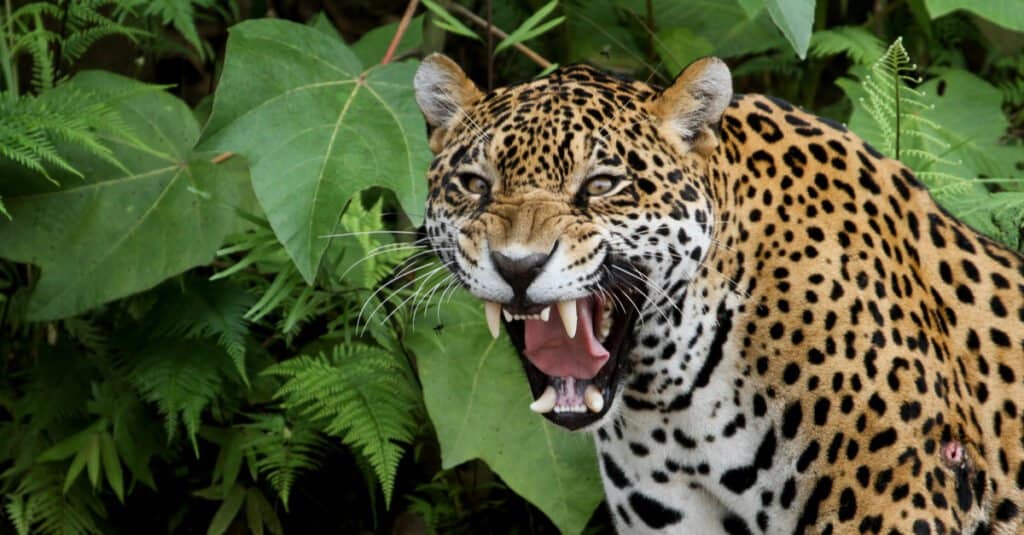
One of the anteater’s natural predators is the jaguar.
©Adalbert Dragon/Shutterstock.com
Reproduction and Life Cycle
All female anteaters give birth to a single baby, although the gestation period varies by species and sometimes by region. Giant anteaters have a gestation period of about 190 days, while tamandua gestation ranges from 130 to 150 days. Silky anteaters have a 120-day gestation.
Female anteaters give birth standing up. Babies immediately climb onto their mothers’ backs and have a full coat of hair and adult-like markings. They spend much of their nursing period on their mothers’ backs to remain safe from predators, remaining there until they are about half the size of their mothers. They can spend up to two years with their mother and usually become independent when the female becomes pregnant again. Male anteaters hide their testicles inside their body; little is known about their breeding habits, but they can breed as often as every nine months. Anteaters reach sexual maturity between 2.5 and 4 years. Their lifespan is 14 years in the wild and as much as 26 years in captivity.
Tamandua females are polyestrous, meaning they will come into heat multiple times during the mating season if they don’t become impregnated. Mating normally occurs in the fall, with birth in the spring. These babies also cling to their mothers’ backs, but the female will sometimes place a baby on a safe branch while she forages. Their maximum lifespan is approximately 9 years.
Silky anteater females place their young in a nest of dry leaves inside a tree trunk. Both parents raise the young, with the male sometimes carrying the baby on its back. Parents feed their offspring by regurgitating semi-digested insects. These animals have an average lifespan of 2.3 years.
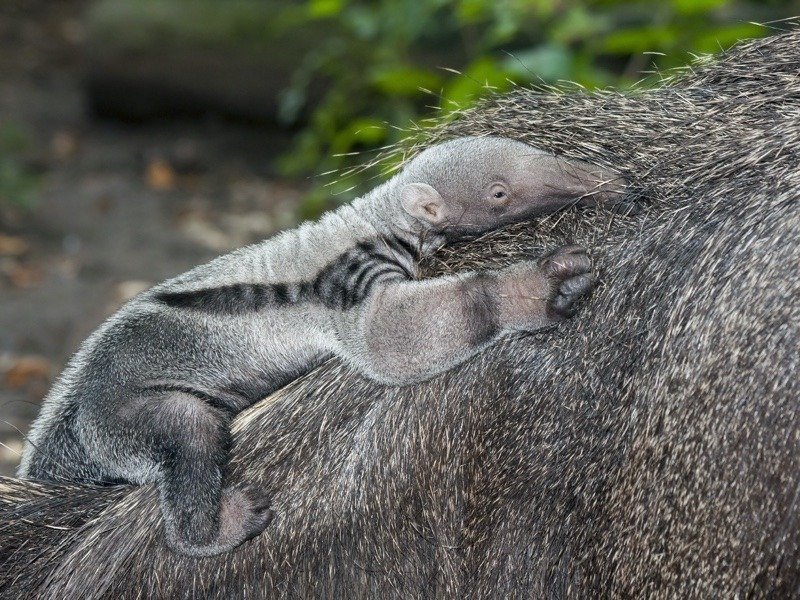
Baby anteaters stay on their mothers’ backs during nursing to remain safe from predators.
©belizar/Shutterstock.com
Anteaters in Zoos
About 90 giant anteaters live in zoos around the world. Breeding occurs year-round in captivity, although births are rare. The San Diego Zoo is one of the few facilities that have anteaters. The first anteaters came from Paraguay in 1937, and the first birth at the zoo occurred in 1980. Their diets may be different, too, with anteaters in captivity getting a specially manufactured high-protein diet along with fruit and meat in addition to insects.
Both the San Diego Zoo and Denver Zoo often keep their anteaters off exhibit, using them primarily as animal ambassadors, meaning they are only displayed for special events or outreach programs.

The San Diego Zoo is one of the few facilities to house anteaters.
©The Image Party/Shutterstock.com
Anteater Pictures
View all of our Anteater pictures in the gallery.