N S W E
Wildlife Expeditions

Wildlife of
Chhattīsgarh

India's "forest heartland," Chhattisgarh blends vast sal forests, river valleys, and tiger landscapes with standout sloth bear and bird diversity.
1 Species
135,191 km² Land Area
Overview

About Chhattīsgarh

Chhattisgarh is covered by large areas of tropical deciduous forest, especially sal and teak woodlands on plateaus and hills. These forests support a typical central India group of mammals — tigers, leopards, gaur, and wild dogs — and quieter reserves give a raw, wild feel for wildlife lovers. Main habitats include dry and moist deciduous forests, bamboo brakes, riparian corridors along rivers like the Mahanadi, and a forest–farm mix that helps both prey and predators. Rivers and reservoirs add wetlands for waterbirds, and forest edges and clearings are good for raptors and nightjars. These habitats connect Chhattisgarh to larger central Indian landscapes, helping long-term protection. Lower tourism and varied plateaus and river basins make birding and tracking signs especially rewarding.

Physical Features

Geography

Chhattisgarh's wildlife is strongly shaped by its broad forested plateaus and river basins: extensive tropical dry deciduous forests (notably sal- and teak-dominated) form large habitat blocks for wide-ranging mammals, while the Mahanadi and Godavari-linked tributary systems create riparian corridors, wetlands, and forest-agriculture mosaics that support high bird diversity and enable seasonal movement between protected areas and surrounding landscapes.

135,191 km² Land Area
9th largest state in India (by area) Size Rank
India Country
State Type
Elevation Range

Approximately ~100 m to ~1,276 m (low river plains to the Bailadila highlands), creating a mix of warm lowland deciduous forests, riparian habitats, and cooler upland plateaus

Key Landscapes

Chhattisgarh Plain (Mahanadi basin): lowland plains with forest-agriculture mosaics and wetlands important for ungulates, carnivores, and waterbirds Bastar Plateau (southern Chhattisgarh): rugged plateau with large contiguous deciduous forests supporting tiger, leopard, dhole, and sloth bear habitat Northern hills and plateaus (Surguja-Jashpur belt): higher, cooler forested uplands increasing habitat diversity and refuge value Maikal Hills/Satpura extensions around the central-northern belt: hill forests and valleys that act as movement routes and seasonal foraging areas Bailadila Hills (southern highlands): steep, forested ridges and valleys creating microhabitats and connectivity toward the Eastern Ghats-Deccan landscapes Major rivers and tributaries: Mahanadi, Shivnath, Hasdeo, Kharun, Mand, Arpa (Mahanadi system) plus Indravati and Sabari (Godavari-linked), forming riparian forests, sandbars, and reservoir wetlands
State Symbols

Official Wildlife Symbols

animal

Wild water buffalo

bird

Bastar hill myna

tree

Sal (sal tree)

Parks & Reserves

Protected Areas

Chhattisgarh's protected areas lie in one of India's most forested states, with sal (Shorea robusta) and mixed deciduous forests, the Mahanadi river valleys, and the Bastar plateau. National Parks, Tiger Reserves (core and buffer zones) and many Wildlife Sanctuaries protect tiger prey animals, elephant movement corridors, limestone caves, riparian forests, and threatened grassland and edge species.

Protected Coverage

~5-6% of the state's land area is under formal protected areas (National Parks + Wildlife Sanctuaries/Tiger Reserve cores; approximate, as some designations overlap and boundaries have changed over time).

National Parks & Preserves

Indravati National Park (Bijapur District)

~1,258 km²

A large, relatively remote Bastar plateau landscape with extensive sal and mixed deciduous forests and riverine habitats; historically significant for tiger conservation and known for supporting one of central India's most intact large-mammal assemblages.

Bengal tiger Leopard Dhole (Indian wild dog) Sloth bear Wild water buffalo (regionally significant)

Kanger Valley National Park (Kanger Ghati NP; Bastar District)

~200 km²

Notable for rugged terrain, deep forested valleys, and famous limestone caves (karst systems) that create varied microhabitats; strong for birding and smaller mammals alongside charismatic carnivores.

Leopard Sloth bear Dhole (Indian wild dog) Gaur (Indian bison) Bastar hill myna (state bird; locally notable)

Guru Ghasidas (Sanjay) National Park (Koriya/Surajpur region)

~1,440 km²

A major protected block in northern Chhattisgarh with sal-dominated forests and important connectivity toward the larger Central Indian Highlands landscapes; valued for tiger recovery potential and large herbivore populations.

Bengal tiger Asian elephant (landscape use) Leopard Sloth bear Sambar deer

State & Provincial Parks

Achanakmar Tiger Reserve (including Achanakmar Wildlife Sanctuary; Bilaspur/Mungeli region)

~914 km² (tiger reserve landscape; core sanctuary is smaller)

A key Central Indian Highlands tiger landscape with strong habitat continuity and prey base; also a critical linkage area (Achanakmar-Amarkantak corridor) supporting wide-ranging mammals.

Bengal tiger Leopard Gaur (Indian bison) Dhole (Indian wild dog) Sloth bear

Udanti-Sitanadi Tiger Reserve (Gariaband/Dhamtari region)

~1,840 km²

Mosaic of sal forests, grasslands, and riparian zones; notable for tiger conservation and for historically supporting some of the last central-Indian wild water buffalo populations (conservation focus area).

Bengal tiger Leopard Sloth bear Gaur (Indian bison) Wild water buffalo (conservation-significant; historically)

Barnawapara Wildlife Sanctuary (Mahasamund/Baloda Bazar region)

~245 km²

One of the most accessible wildlife-viewing areas in the state, with mixed deciduous forests and good chances for common ungulates and their predators; important for education and nature tourism.

Leopard Sloth bear Gaur (Indian bison) Chital (spotted deer) Sambar deer

Bhoramdeo Wildlife Sanctuary (Kabirdham region)

~164 km²

Forested hills and valleys near the Maikal ranges with rich birdlife and good habitat for carnivores and shy ungulates; complements nearby tiger/elephant landscapes as a stepping-stone forest block.

Leopard Sloth bear Gaur (Indian bison) Four-horned antelope (chousingha) Indian giant squirrel

Wildlife Refuges

Tamor Pingla Wildlife Sanctuary (Surguja/Balrampur-Ramanujganj region)

~608 km²

A large northern sanctuary important for elephant movement and forest connectivity; supports a full suite of central-Indian forest mammals and is managed with a strong corridor perspective.

Asian elephant Leopard Sloth bear Gaur (Indian bison) Dhole (Indian wild dog)

Semarsot Wildlife Sanctuary (Surguja region)

~430 km²

Sal and mixed deciduous forests forming part of an elephant-use landscape; good for tracking forest birds and observing signs of large mammals in relatively low-disturbance habitat.

Asian elephant Leopard Sloth bear Gaur (Indian bison) Barking deer

Gomarda Wildlife Sanctuary (Raigarh region)

~277 km²

Undulating forest-agriculture interface with strong edge habitats; notable for ungulates, meso-carnivores, and bird diversity typical of eastern-central Indian deciduous mosaics.

Leopard Sloth bear Gaur (Indian bison) Striped hyena Chital (spotted deer)

Pamed Wildlife Sanctuary (Bijapur region)

~262 km²

Remote forest tract in southern Chhattisgarh with low road density and high wilderness character; important as a refuge for wide-ranging mammals and as part of a broader Bastar landscape conservation mosaic.

Leopard Sloth bear Dhole (Indian wild dog) Gaur (Indian bison) Sambar deer

Wilderness Areas

  • Abujhmarh (Abujhmad) forest wilderness (Narayanpur-Bastar region): one of central India's most roadless, least-fragmented forest blocks
  • Bastar plateau interior forests between Indravati-Pamed-Kanger landscapes: large contiguous deciduous tracts with limited access in places
  • Maikal Hills / Achanakmar-Amarkantak corridor forests: critical linkage terrain with rugged hills and lower road density
  • Upper Indravati river catchment forests and riparian stretches: important riverine/valley habitats embedded in broader deciduous forests
  • Bailadila range forested slopes and surrounding tracts (Dantewada region): rugged hill forests with pockets of relatively intact habitat
Animals

Wildlife

Chhattisgarh sits in India's Central Indian forest belt, dominated by sal and teak-mixed deciduous forests, bamboo brakes, forest-farm mosaics, and major river systems (notably the Mahanadi and its tributaries). This combination supports classic central-Indian megafauna (tiger-leopard-sloth bear-gaur), strong ungulate prey bases in large forest blocks, and high bird diversity across wetlands, riverine forests, and agricultural edges. The state is also nationally important for its remnant population of Wild Asian Water Buffalo and for elephant movements spilling in from eastern India.
≈80-100 species Mammals
≈300-400 species Birds
≈70-100 species Reptiles
≈25-40 species Amphibians
≈150-250 species (rivers, reservoirs, floodplains) Fish
Examples

Iconic Species

Bengal Tiger
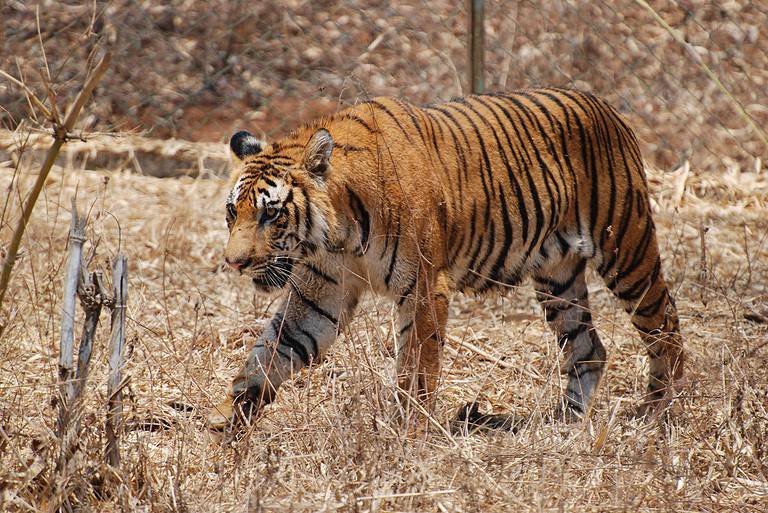
Bengal Tiger Flagship predator of Chhattisgarh's large forest landscapes; seen (rarely) in key protected areas and corridors of the Central Indian tiger landscape.
Indian Leopard More adaptable than tigers and frequently the most commonly detected big cat in forest-agriculture mosaics; an important draw for wildlife tourism and camera-trap sightings.
Sloth Bear A signature central-Indian species strongly associated with dry deciduous forests and mahua-dominated landscapes; often the most conspicuous large carnivore sign (digging, scats) in many reserves.
Gaur (Indian Bison) Largest wild bovine in India; key attraction in better-protected forest blocks where herds use grassy openings and water sources.
Dhole (Asian Wild Dog) An endangered pack-hunting carnivore of intact forests; sightings are uncommon but highly prized, and its presence indicates functional prey and habitat.
Asian Elephant
Asian Elephant Noted for seasonal/irruptive movements into northern and eastern parts of the state from neighboring landscapes; encounters and signs are increasingly part of the wildlife experience (and management challenge).
Sambar Deer The main large deer of Chhattisgarh's forests and a crucial prey species supporting tigers and leopards; commonly seen near water and forest edges.
Chital (Spotted Deer) Abundant in many forest-grass mosaics and a key prey base; frequently observed in open sal forest and along meadow edges.
Indian Peafowl
Indian Peafowl Widespread and conspicuous in forest fringes and villages, adding to the classic central-Indian 'soundscape' and visitor experience.
Changeable Hawk-Eagle A prominent forest raptor often seen soaring above ridges and valleys in larger forest tracts, reflecting healthy woodland bird communities.

Endemic & Rare Species

Wild Asian Water Buffalo

Bubalus arnee

Endangered (globally); one of India's most important remnant populations persists in/around key protected landscapes

Chhattisgarh is nationally significant for holding one of the last truly wild/feral-free buffalo lineages in central India; threatened by hybridization with domestic buffalo, disease, and habitat pressures.

Indian Pangolin

Manis crassicaudata

Endangered; heavily threatened by illegal trade

Occurs at low densities in forest-farm mosaics; its presence highlights both Chhattisgarh's remaining habitat connectivity and ongoing poaching risk.

Dhole (Asian Wild Dog)

Cuon alpinus

Endangered

Naturally occurs at low densities and is sensitive to prey depletion and disease; a key indicator of large, functioning forest ecosystems.

Four-horned Antelope (Chousingha)

Tetracerus quadricornis

Near Threatened; range-restricted to the Indian subcontinent and dependent on dry forest mosaics

A quintessential central-Indian specialty of open, undulating forests and scrubby clearings; prized by naturalists because it is shy and localized.

Sarus Crane

Antigone antigone

Vulnerable; wetland specialist facing habitat loss

Found in suitable wetlands and irrigated landscapes; emblematic of intact marsh-agriculture mosaics and wetland conservation needs.

Smooth-coated Otter

Lutrogale perspicillata

Vulnerable

Dependent on healthy rivers/reservoirs with fish and undisturbed banks; an important indicator of aquatic ecosystem condition in major river systems.

White-rumped Vulture

Gyps bengalensis

Critically Endangered

Historically widespread; now scarce but slowly recovering in parts of India after diclofenac controls-any breeding/roosting groups are regionally important.

Rusty-spotted Cat

Prionailurus rubiginosus

Near Threatened

A small, elusive felid of forest edges and scrub; camera traps increasingly document it, adding to Chhattisgarh's reputation for diverse carnivores beyond the 'big cats'.

Notable Populations

  • One of the most nationally significant remnant populations of Wild Asian Water Buffalo (Bubalus arnee) in central India, centered on protected landscapes in the state.
  • Part of the Central Indian tiger landscape and corridor network linking tiger-bearing forests across central India; the state's large forest blocks remain strategically important for long-term connectivity.
  • Regionally important elephant use areas in northern/eastern Chhattisgarh due to sustained movement from adjoining eastern Indian landscapes, making the state a key interface zone for elephant conservation and conflict mitigation.

Recent Changes

  • Elephant presence has expanded/strengthened in parts of the state over recent decades via continued movements from Odisha/Jharkhand, increasing both sightings/sign and human-elephant conflict in some districts.
  • Vulture communities suffered major declines historically (linked to veterinary diclofenac across South Asia); localized signs of stabilization/partial recovery are reported in some regions following regulatory controls, though populations remain low.
  • Wild Asian Water Buffalo face ongoing genetic dilution risks from hybridization with domestic buffalo and disease exposure; conservation efforts increasingly emphasize securing core areas and improving separation from livestock.
  • Large carnivore occurrence is increasingly documented via camera-trapping across multiple forest divisions; leopards and smaller carnivores are often detected more widely than tigers, reflecting adaptability to forest-farm mosaics.
  • Pressure from linear infrastructure, mining, and fragmentation continues to degrade some corridors; this is a growing concern for long-term tiger/elephant connectivity despite remaining forest cover.
Visit

Wildlife Viewing

Chhattisgarh is a very forested state with sal and teak forests, rocky plateaus, and rivers like the Mahanadi and Indravati. Wildlife viewing is mostly forest drives with permits in some areas. You can see leopards and sloth bears and many birds, especially near wetlands. Main sites: Achanakmar, Udanti-Sitanadi, Indravati, Barnawapara, Guru Ghasidas.

Best Seasons

Winter (Nov-Feb)

Best all-round season: comfortable temperatures, high visibility in dry deciduous forests, and peak birding as winter migrants arrive. Expect strong bird diversity at reservoirs and wetlands (raptors, waterfowl), plus consistent chances for leopard and sloth bear on early-morning/late-afternoon drives. This is also the easiest time for multi-stop itineraries across the state.

Spring / Dry season (Mar-mid Jun)

Prime mammal season in many areas: hotter days concentrate wildlife near waterholes and along shaded drainage lines, improving odds of seeing sloth bear, gaur, sambar, and sometimes tiger in tiger landscapes. Expect dusty roads and very warm afternoons-plan dawn and late-evening safaris, carry water, and prioritize waterbody edges and saltlick routes.

Monsoon (mid Jun-Sep)

Forests turn lush and dramatic; excellent for landscapes, amphibians, reptiles, butterflies, and fresh tracks-however many protected-area routes may be restricted/closed and sightlines are reduced. Good time for short nature walks (where allowed), waterfall corridors near forest edges, and cultural add-ons; check road/entry conditions carefully.

Post-monsoon (Oct-early Nov)

Green forests with improving visibility as grasses begin to drop. Bird activity picks up, and mammals become more active as temperatures cool. This shoulder season can feel quieter (fewer visitors) while still offering good safari conditions once tracks reopen.

Top Wildlife Experiences

  • Jeep safari in Achanakmar Tiger Reserve (Achanakmar-Amarkantak landscape): target leopard, sloth bear, gaur, sambar, and forest birdlife; pair dawn and dusk drives for the best odds.
  • Birding and raptor-spotting day trip around wetlands/reservoirs near Raipur and Barnawapara Wildlife Sanctuary: look for waterbirds, winter migrants, and open-country raptors along the forest-agriculture mosaic.
  • Sloth-bear focused drives in Barnawapara Wildlife Sanctuary (near Raipur): best in the hotter months and at forest-edge water sources; combine with a slow-paced evening drive for herbivore movement.
  • Explore Udanti-Sitanadi Tiger Reserve on guided safaris and village-edge birding: a good choice for a quieter tiger landscape with strong chances for leopard, wild dog (dhole) possibility in the broader region, and rich forest birds.
  • Southern forest expedition to Indravati Tiger Reserve (Bastar region): remote, scenic tiger habitat with strong 'wilderness' feel; plan for longer travel times and confirm access/permits well in advance.
  • Early-morning nature walk (where permitted) or interpretive trail with forest guides near eco-stays around key reserves: focus on tracking (pugmarks, scat), smaller mammals, butterflies, and mixed-species bird flocks.
  • Mahanadi riverbank and riparian birding (seasonal hotspots along sandy bars and backwaters): look for kingfishers, herons/egrets, river terns (seasonal), and wetland specialists depending on water levels.

Wildlife Watching Types

Tiger and big-cat safaris (jeep/gypsy) in tiger reserve landscapes (best with official permits and local naturalists) Leopard and sloth-bear viewing via early/late forest drives and waterhole routes Birding hotspots: forest birding (mixed flocks), wetland/reservoir birding (winter waterfowl), and raptor watching over open country Wetland and riverine wildlife watching (waterbirds, otter possibility in suitable stretches, seasonal sandbar birding) Tracking and interpretive nature walks (flora, insects, butterflies, signs-and-tracks) where allowed Night sky + nocturnal wildlife listening sessions at eco-stays (owls, nightjars, insects)-only in permitted zones and with guides Herbivore viewing (gaur, sambar, chital, wild boar) on grassland patches and forest-edge mosaics

Guided Options

  • Forest Department-approved gypsy/jeep safaris with assigned local guides in Achanakmar Tiger Reserve, Udanti-Sitanadi Tiger Reserve, and other notified sanctuaries (bookings/permits vary by site and season).
  • Local naturalist-led birding circuits around Raipur-Barnawapara and nearby reservoirs (half-day and full-day), useful for visitors with limited time.
  • Community and eco-stay naturalist programs near reserve fringes: guided nature trails, bird walks, and tracking-focused interpretation (ask for certified guides and current route permissions).
  • Multi-day 'Central India wildlife circuit' itineraries run by Indian wildlife tour operators that can combine Chhattisgarh reserves with neighboring Madhya Pradesh/Maharashtra parks, often improving big-cat odds and logistics.
  • Forest interpretation centers and park-organized awareness programs (availability varies): short talks, checklists, and guided walks when conditions allow-best arranged on arrival through park reception or the local DFO office.
Habitats

Ecosystems

Chhattisgarh is in central India. It is mostly covered by tropical deciduous forests on plateaus (Bastar Plateau, northern hills) mixed with farms, sal and teak forest patches, and river corridors. Rivers like the Mahanadi and parts of the Godavari create reservoirs, riparian zones, seasonal streams, and floodplain wetlands that support tigers, leopards, sloth bears, and many birds.

Biomes

Tropical Dry Forest

Main land biome: widespread tropical dry to moist deciduous forests, sal- and teak-dominated with bamboo and mixed deciduous trees, from intact inner parts of protected areas to heavily used community forests and forest-agriculture mosaics.

Widespread across most districts; forms the dominant natural land cover statewide.

Savanna

Open woodland and grass-dominated patches occur as forest openings, plateaus with shallow soils, and along disturbance gradients (fire/grazing), creating grass-scrub-woodland mosaics used by ungulates and ground-nesting birds.

Scattered pockets and mosaics within the broader deciduous-forest matrix; most common on plateaus and in degraded/managed forest fringes.

Freshwater

Large rivers (Mahanadi system; parts of Godavari tributaries), reservoirs, tanks, and seasonal streams provide fish habitat, waterbird foraging areas, and riparian corridors that connect forest blocks.

Statewide along major rivers and impoundments; densest in river valleys and around large reservoirs/barrages.

Wetland

Riverine wetlands, floodplain depressions, seasonal marshes, and paddy-linked wetlands support amphibians, reptiles, and diverse migratory/resident waterbirds; many are highly seasonal with monsoon pulses.

Localized but widespread in lowlands, along river floodplains, and around irrigation networks and tanks.

Habitats

Forest

Extensive forest tracts across Bastar and northern belts; key wildlife habitat and connectivity for large carnivores and prey species.

Deciduous Forest

Sal (Shorea robusta) and teak (Tectona grandis) dominated deciduous forests with bamboo understorey; strong seasonal leaf-fall and monsoon-driven productivity.

Woodland

Open-canopy dry deciduous woodland on ridges/plateaus and around village-use zones; often transitions into scrub and grass patches.

Grassland

Natural and semi-natural grassy clearings on plateaus, along powerline/road edges, and in forest openings; important for foraging ungulates and raptors.

Shrubland

Secondary scrub in degraded forest margins and shifting-use areas; thorny and fire-tolerant species common in drier sites.

Mountain

Hilly terrain and plateau escarpments (e.g., northern hill ranges and Bastar Plateau edges) create elevational microclimates and refugia for forest species.

Cliff/Rocky Outcrop

Escarpments, river-cut gorges, and waterfall-associated cliffs (notably in plateau landscapes) provide raptor nesting sites and specialized rock-face flora.

Cave

Limestone/karst cave systems (e.g., in the Kanger Valley area) supporting bats and cave-adapted invertebrates, with high local geodiversity.

River/Stream

Mahanadi and major tributaries (plus parts of the Godavari basin) with riparian forests, sand/rock bars, and seasonal flow variation shaping aquatic communities.

Lake

Reservoirs and large tanks formed by dams/barrages that function as major waterbird habitats and fisheries.

Pond

Village ponds and small irrigation tanks; critical dry-season refuges for amphibians, reptiles, and local waterbirds.

Wetland

Seasonal floodplain wetlands, paddy-linked wet areas, and riparian backwaters that expand during monsoon and contract in summer.

Marsh

Reed- and sedge-dominated shallow wetlands around tanks/reservoir margins and floodplain depressions; important for nesting/roosting waterbirds.

Agricultural/Farmland

Rice-dominated plains (especially in the Mahanadi basin) with mosaics of fields, hedgerows, and fallows that interact strongly with adjacent forest biodiversity.

Plantation

Localized forestry and agroforestry plantations (e.g., teak/eucalyptus or mixed timber/fuelwood plantings) embedded within the broader forest-farm landscape.

Urban

City and town habitats (e.g., Raipur, Bilaspur, Durg-Bhilai) with urban lakes/ponds and green spaces supporting adaptable bird and bat species.

Ecoregions

Eastern Highlands moist deciduous forests Bastar Plateau dry deciduous forests Chhota-Nagpur dry deciduous forests
Protection

Conservation

Primary Threats

  • Large-scale coal mining (e.g., Korba belt, Hasdeo-Arand region) and iron ore mining in the south (Bastar/Dantewada region) drive forest diversion, fragmentation of tiger/elephant habitat, increased road density, and chronic disturbance from blasting, haul roads, and worker settlements.
  • Expansion/upgrading of highways, rail corridors, transmission lines, and mining logistics routes increases wildlife mortality risk and slices through forest blocks that function as corridors between protected areas (especially for elephants moving between Chhattisgarh, Odisha, and Jharkhand).
  • Forest diversion for industry and associated settlements, coupled with gradual edge degradation around villages, reduces effective habitat quality for interior-forest species and narrows corridor bottlenecks in northern and central Chhattisgarh.
  • Elephant movement into crop fields and village edges (particularly in northern districts and coal-bearing landscapes) leads to crop loss, property damage, and occasional human fatalities; retaliatory actions and high stress for both people and elephants are recurrent issues.
  • Illegal felling and chronic fuelwood extraction around forest fringes degrade canopy structure and understory, reducing prey base and nesting/roosting sites; selective removal of high-value timber also opens forests to further encroachment.
  • Opportunistic snaring and subsistence hunting persist in some forested landscapes, impacting small ungulates and ground-dwelling fauna and indirectly affecting predator prey availability; enforcement is challenging in remote areas.
  • Targeted poaching for trade-especially Indian pangolin (scales) and occasionally reptiles/birds-continues along inter-state trafficking routes; seizures indicate demand networks that exploit forest-road connectivity.
  • High dependence on non-timber forest products (tendu leaves, mahua, sal seeds, medicinal plants) can cause localized depletion and habitat disturbance when harvest is intense or poorly timed, affecting regeneration and food availability for wildlife.
  • Dams, barrages, and river regulation on tributaries feeding the Mahanadi and Indravati systems alter flow regimes, reduce sediment transport, and degrade riparian habitats used by otters, turtles, and riverine birdlife.
  • Coal ash, mine runoff, and industrial effluents can contaminate streams and reservoirs (notably in industrial belts), affecting aquatic fauna and downstream drinking-water sources; localized fish kills and habitat smothering occur near discharge points.
  • Invasives such as Lantana camara proliferate in disturbed sal and mixed forests, forming dense thickets that suppress native regeneration and reduce grass/forb availability for herbivores, thereby influencing prey dynamics for large carnivores.
  • Hotter summers, more variable monsoon patterns, and longer dry spells elevate fire frequency/intensity and water stress in deciduous forests, increasing edge mortality and reducing the reliability of seasonal water sources for wildlife.
  • High fishing pressure in rivers and reservoirs, sometimes using destructive methods, reduces fish biomass and disrupts aquatic food webs, with knock-on effects for otters, waterbirds, and turtle populations.
  • Grazing, frequent forest entry, collection activities, and unmanaged tourism/pilgrimage pressure in some protected areas increase noise and encounter rates, displacing shy species and raising the likelihood of conflict at forest edges.
  • Spillover risks from free-ranging dogs and livestock (e.g., canine distemper for wild carnivores; livestock diseases affecting wild ungulates/bovids) are elevated near villages and grazing areas, posing episodic but serious conservation risks.
Fun Facts

Did You Know?

Chhattisgarh's dry deciduous forests can host the four-horned antelope-the only antelope species on Earth in which males can grow four horns, and it prefers wooded hills over open grasslands (counter to most people's "antelope = savanna" intuition).

Bastar's hill myna is famous for uncanny human-speech mimicry; that same talent historically drove heavy trapping for the pet trade-today the bird is legally protected under India's Wildlife (Protection) Act, and wild capture/trade is prohibited.

In sal and Indian butter tree (Madhuca longifolia) forests, when butter tree flowers fall, sloth bears, civets, deer and even feral or domestic animals gather, making brief wildlife hotspots at forest edges.

Kanger Valley's caves run on an "upside-down" food chain: bat colonies import nutrients into the cave via guano, and many cave invertebrates (and cave-adapted predators) depend on that guano-based energy rather than on plants or sunlight.

Chhattisgarh's tiger, leopard, and sloth bear sightings are often reported from forest-farm mosaics and corridors rather than only deep inside parks-because many protected areas are embedded in large inhabited forest belts, wildlife movement can be surprisingly visible along transition zones.

Udanti-Sitanadi Tiger Reserve is one of India's last strongholds for the endangered wild water buffalo (Bubalus arnee), and is repeatedly cited in conservation literature for retaining some of the country's most genetically "wild" animals (low domestic-buffalo introgression).

Guru Ghasidas-Tamor Pingla Tiger Reserve was notified in 2021, making it one of India's newest tiger reserves-and Chhattisgarh's 4th (after Indravati, Achanakmar, and Udanti-Sitanadi).

Kanger Valley National Park (near Jagdalpur) is one of India's standout protected areas for limestone cave ecosystems; the Kutumsar-Kailash-Dandak cave system is among the country's most famous cave complexes for wildlife roosts (notably bats) and cave-adapted fauna.

The Achanakmar-Amarkantak Biosphere Reserve (spanning Chhattisgarh and Madhya Pradesh) is part of UNESCO's World Network of Biosphere Reserves (added in 2012), placing it in a relatively small, internationally recognized set of multi-use landscapes managed explicitly for biodiversity plus people.

Chhattisgarh lies in the Central India landscape that supports the world's largest remaining wild tiger population (India has most wild tigers). Its tiger reserves are part of this globally important source landscape.

Thank you for reading! Have some feedback for us?