







Quick Take
- This bird is a master thief that steals other species' songs and weaves them into its own, though only one gender does this during mating season. Discover the mimicry ability →
- Another bird secretly exploits white-eyed vireo nests in a way that often turns fatal for the vireo's own chicks. Learn about brood parasitism →
- White-eyed vireo males do something during incubation that most male birds physically can't, and this ability changes how both parents share the work. See how incubation is shared →
- These birds are monogamous, but there's a catch to that loyalty that most people wouldn't expect. Explore their mating habits →
Vireo griseus, or the white-eyed vireo, is a small bird belonging to the Vireonidae family and Passeriformes order. This family contains approximately 62 species of birds.
Their name comes from their white eyes, and they inhabit several states in North America, such as Missouri, New Jersey, Florida, and Texas. In addition, they occur in the Bahamas and Cuba.
White-eyed vireos like habitats with dense shrubs and bushes, preferably in abandoned fields. In addition, they are year-round residents in many areas across the Caribbean and Central America. They have a greenish tinge that blends in well with their surroundings, providing them with the essential camouflage they need.
Their mating season begins in April and lasts until August. These birds are monogamous, and both genders build nests and incubate the eggs. Once the eggs hatch, males and females feed the young for several days.
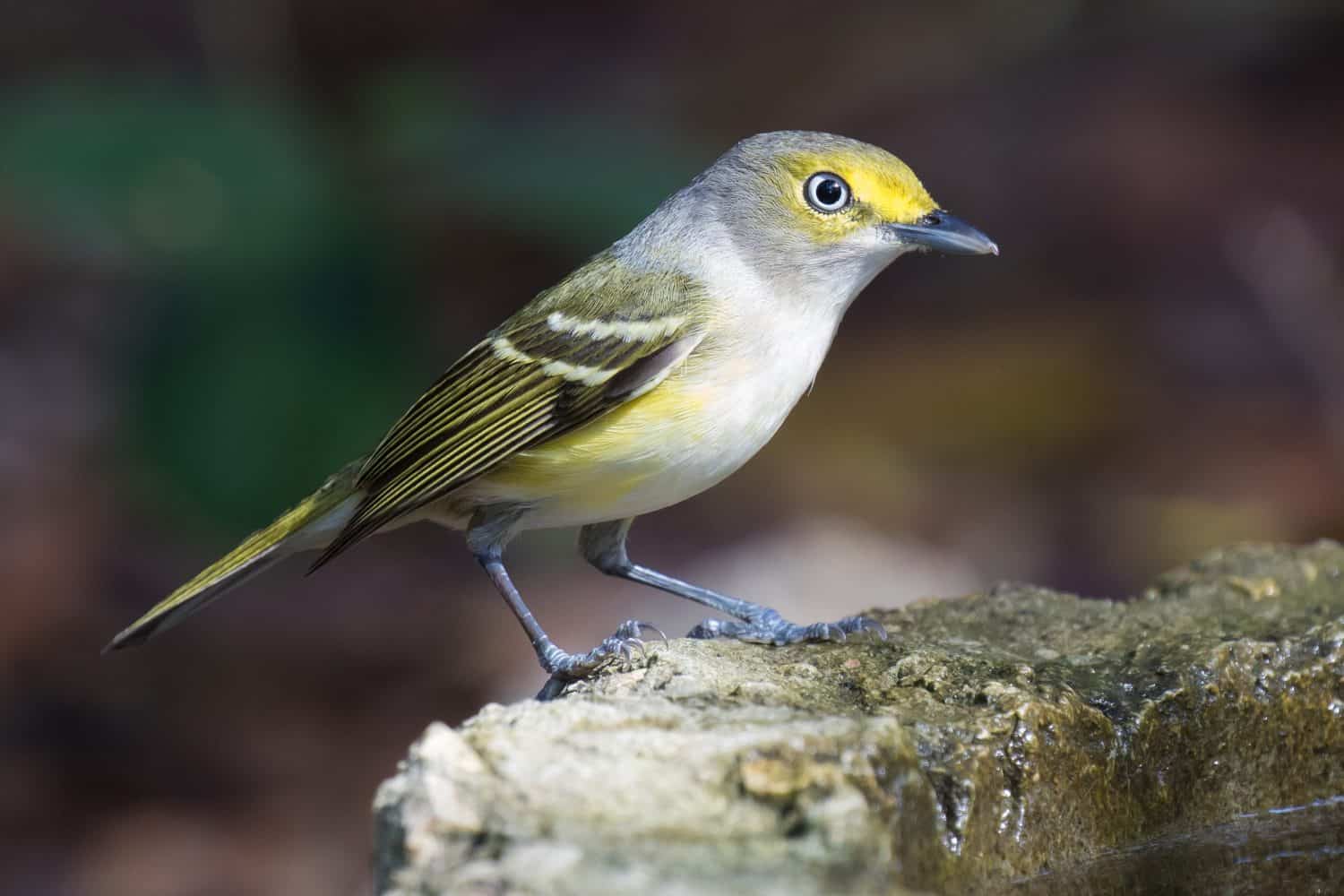
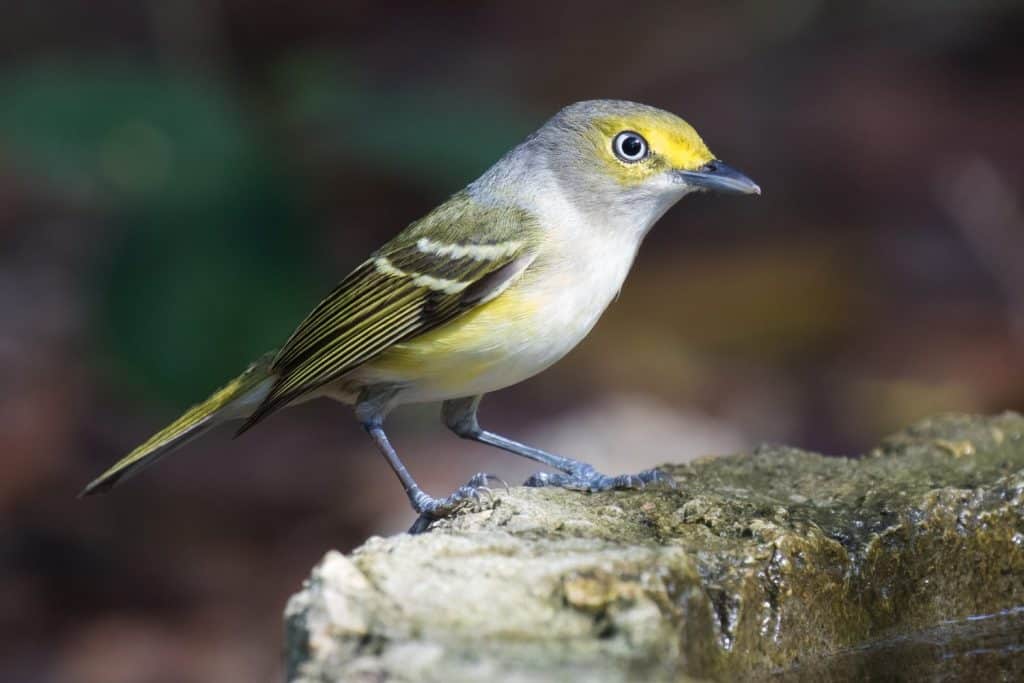
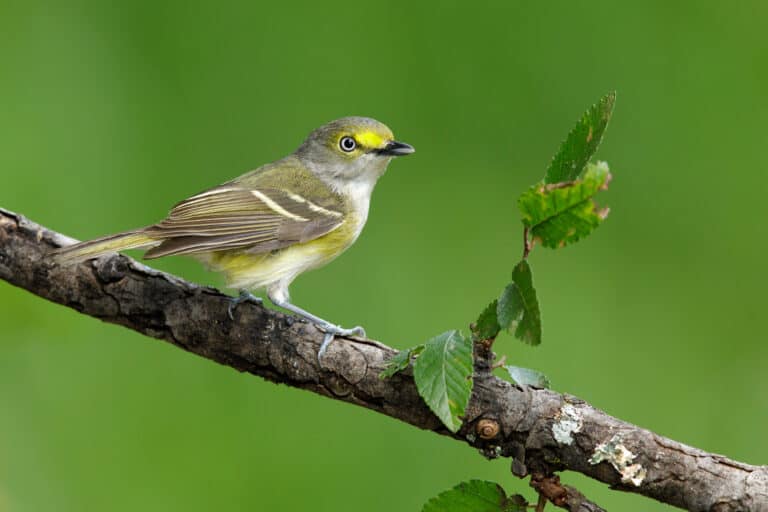
Their plumage is yellowish-gray, and they have yellow sides with white bellies. In addition, they have a black beak and legs. Their song consists of six to seven short phrases, generally used by the male to attract a mate during the breeding season. However, chicks also use this call.

Three Incredible White-Eyed Vireo Facts
- The white-eyed vireo is unique because it is one of two species of North American passerines with white eyes. However, another bird with the same characteristic, the Wrentit, is also found in dense shrubbery or bushes but occurs along Northern Mexico and the West Coast.
- White-eyed vireos are great mimickers and often copy the songs of other bird species within their habitat. In fact, they incorporate them into their own songs. Interestingly, males are the only ones that sing during mating season. However, both genders sing in the winter.
- Unfortunately, like many other birds, the white-eyed vireo is a victim of the Brown-headed cowbird’s brood parasitism. Cowbirds lay their eggs in other birds’ nests and leave the rearing to the host parents. Often, these hatchlings outcompete the vireo chicks, which end up starving or being pushed from the nest.
Where to Find the White-Eyed Vireo
White-eyed vireos are native to North America and Central America. They are Neotropical migrants that participate in seasonal migrations multiple times a year.
However, they inhabit the southeastern United States and Northern Mexico during mating season. This distribution occurs over states like:
These birds are year-round residents along the southeast coastline of the USA from Texas to South Carolina and Mexico.
However, during the colder months, most populations will migrate to Belize, Mexico, Cuba, Guatemala, the Cayman Islands, and the Bahamas.
They like to inhabit dense, brushy vegetation close to a water source.
Nests
To defend their nesting territory, white-eyed vireo males sing incessantly from early spring to late summer.
During courtship, males put on exciting displays by fluffing their plumage, spreading their tails, and letting out a whining call. Then, both genders help to build the nest, which they construct low to the ground in a shrub or sapling.
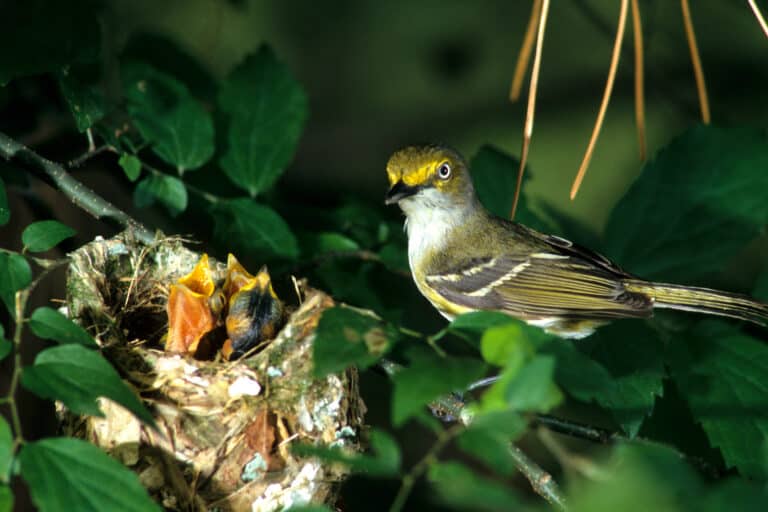
They will weave the rim onto a horizontal forked twig to ensure the nest is secure. The nest is deep and hangs in the shape of a cup. White-eyed vireos make their nest from roots, shreds of bark, twigs, grass stems, leaves, plant down, moss, lichen, and sometimes pieces of wasp nests. They construct their nests with spiderwebs, which help bind them and line them with fine grass, feathers, and fibers.
Classification and Scientific Name
The white-eyed vireo’s scientific name is Vireo griseus, and they belong to the order Passeriformes. The members of this order make up more than half of all the bird species.
Their most distinguishing feature is the arrangement of their toes, with three pointing forward and one pointing back, which aids with perching.
White-eyed vireos are members of the Vireonidae family, which consists of approximately 62 species of small arboreal songbirds, divided among eight genera. The relationships of this family with other bird families are not entirely clear, but evidence suggests that they are closely related to the New World warblers.
The family Vireonidae is divided into three subfamilies:
- Vireoninae — consists of Greenlets (Hylophilus) and True Vireos (genus Vireo)
- Cyclarhidinae
- Vireolaniinae
Size and Appearance
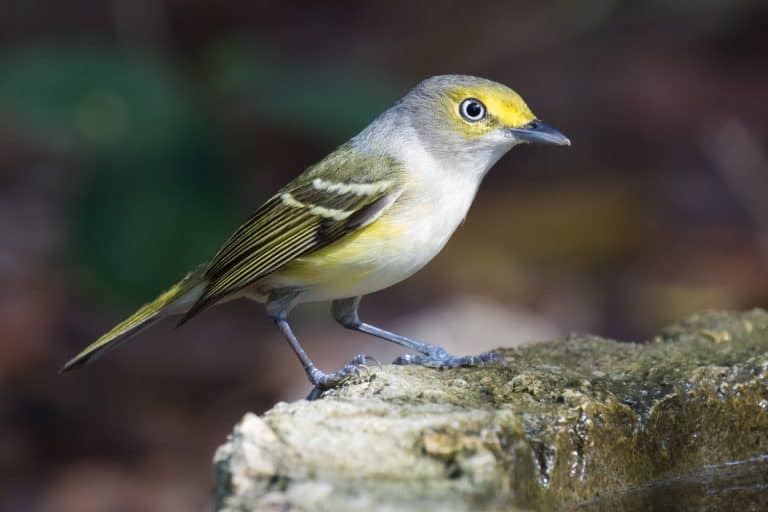
White-eyed vireos are small birds that measure 5 inches in length and have a wingspan of around 7.4 inches. In addition, adults weigh approximately 0.40 ounces. Their sides are dark olive, and they have black wings and tails. Each wing sports two white wing bars with white or yellow margins on the primaries.
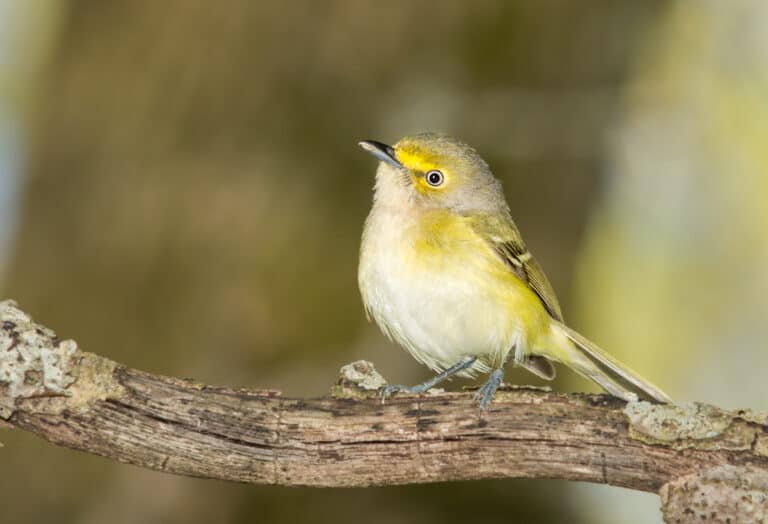
Their heads are olive, and they possess a gray nape. However, their most distinctive feature is their vivid yellow spectacles, which include the area between and around the eyes. Another identifying feature is their white irises, only visible in adults.
In addition, they have white bellies and throats and dull yellow sides. Their legs and beaks are dark black. Juveniles have dark irises that only change color when they reach 2 years of age.
Juveniles differ from adults in more than one way; instead of yellow spectacles, they have white, and their heads are pale gray. In addition, their plumage is paler in comparison to their parents. However, unlike most bird species, both genders look similar.
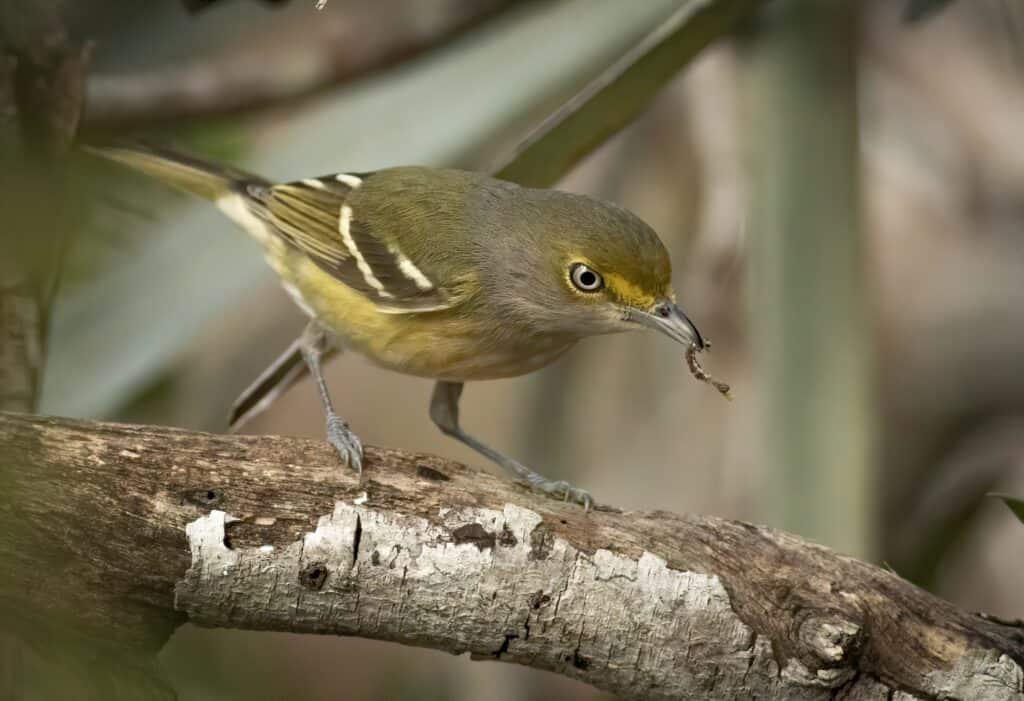
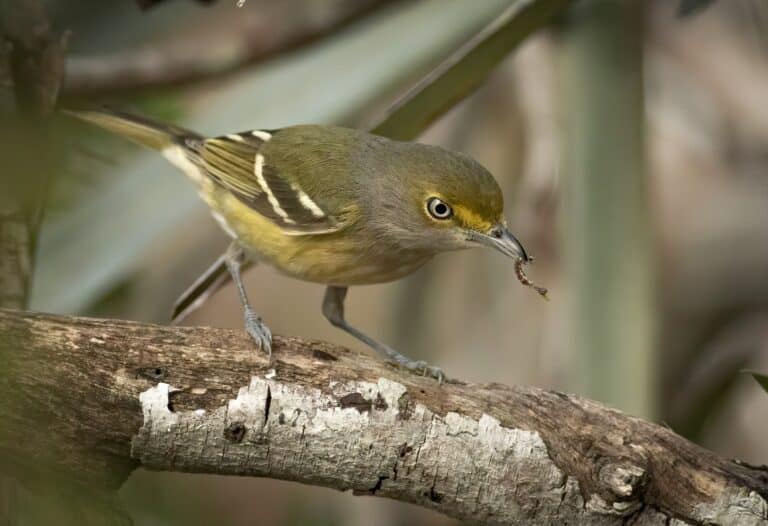
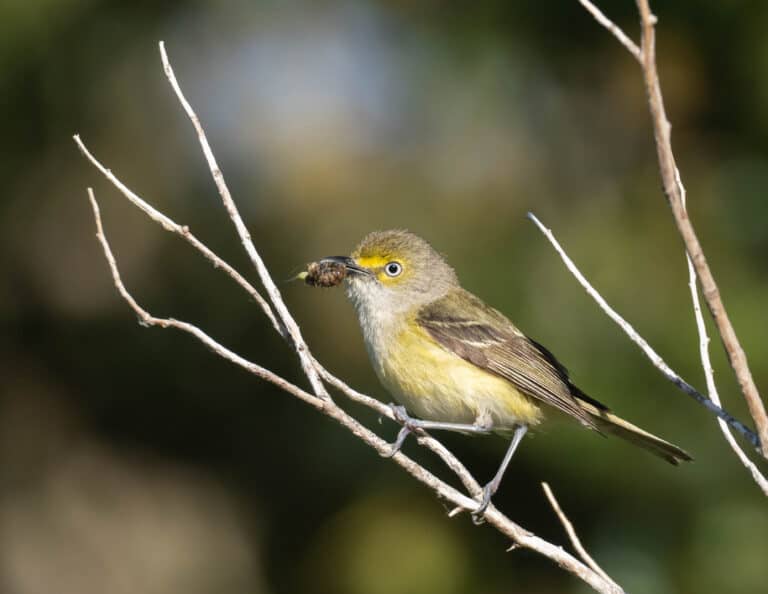
White-eyed vireos are omnivorous and eat insects, snails, and lizards as well as berries.
©Matthew Jolley/Shutterstock.com
Migration Pattern and Timing
During the mating season, white-eyed vireos spread throughout eastern Texas and travel as far north as southeastern Iowa and Illinois. In addition, they expand as far as southern Ontario, Maryland, and Connecticut in the east.
However, in the winter months, white-eyed vireos occupy southern territories in Mexico and Central America, as far as Honduras. Other winter locations include Bermuda, the Caribbean, the Bahamas, and Cuba.
Sometimes these birds get lost while migrating and end up much further west or north than they typically fly.
Behavior
White-eyed vireos are typically solitary but sometimes live in pairs. During their fall migration, it is common for these birds to join mixed foraging flocks containing other species.
In order to stay well-hidden, they tend to inhabit lower thickets, which makes it difficult to see their coloration properly. However, their white eyes and yellow spectacles stick out and act as good field marks, even when visuals are obscured.
Diet
These birds prey primarily on insects and enjoy a range of insects, spiders, and larvae. Sometimes, if there is a food shortage, white-eyed vireos also eat snails and small lizards. In addition, they feed on berries and other fruits.
Reproduction and Lifespan
White-eyed vireos are monogamous, and females will visit the males’ territories to choose a mate. The males do not engage in elaborate courtship displays. However, the pair will court each other for several days, during which they will forage together.
While these birds are monogamous, they do not mate for life. Surprisingly, they only stay together for one season. The mating season ranges from early April to August, and after pairing up, both genders search for a nesting site.
They build their nest off the ground, usually around 3 feet high. Females seek out a comfortable nesting site with a forked branch for support. White-eyed vireos build their nests in a cup shape and construct them with grass, spider silk, twigs, and bark strips.
It takes the pair around 3 to 5 days to build the nest, and once done, the female lays 3 to 5 white eggs with dark spots. Then, the male and female white-eyed vireos incubate the eggs for around 13 to 15 days.
Once hatched, the juveniles leave the nest within 9 to 11 days. However, before they go, both parents share the responsibility of caring for them. As a result, fledglings sometimes depend on their parents for up to 23 days after leaving the nest.
Chicks hatch blind and naked, with only a few scattered down patches. White-eyed vireos have a unique characteristic: both parents develop a brood patch on their bellies to provide the eggs with extra warmth.
Lifespan
White-eyed vireos have an average lifespan of about 7 years.
Predators, Threats, and Conservation Status
The predators that prey on white-eyed vireos have rarely been documented, as most predation occurs during the mating season when eggs and hatchlings are abundant. However, these birds likely fall prey to:
The white-eyed vireo’s numbers are increasing annually due to its large geographical range and stable population size, and it is listed as Least Concern on IUCN’s Redlist.
However, their numbers could start decreasing because of habitat loss and extensive human activity in their natural habitats.
Population
The white-eyed vireo population is increasing, and its population size is estimated at 24 million mature individuals.
White-Eyed Vireo Pictures
View all of our White-Eyed Vireo pictures in the gallery.

Danita Delimont/Shutterstock.com
Sources
- The Spruce / Accessed August 29, 2022
- All About Birds / Accessed August 29, 2022
- Audubon / Accessed August 29, 2022
- Wikipedia / Accessed August 29, 2022
- Kidadl / Accessed August 29, 2022
- ABC Birds / Accessed August 29, 2022