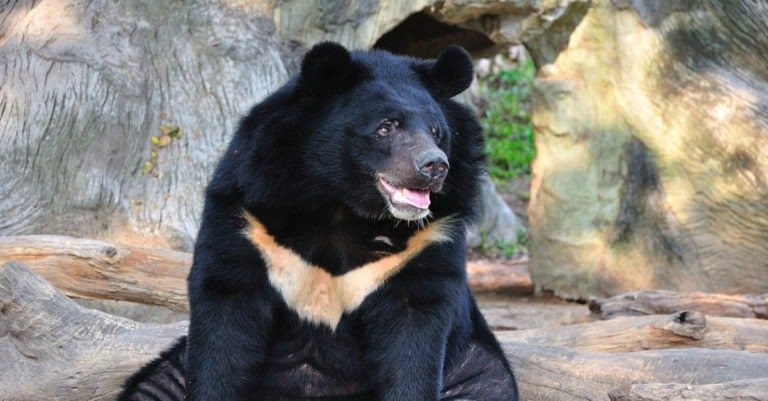
Asiatic Black Bear
Moon-marked climber of Asian forests

Chongqing's wildlife is shaped by steep mountains, limestone hills, and the upper Yangtze River and its tributaries. This creates a humid subtropical landscape of deep valleys, forested slopes, and river corridors. Sitting between the Sichuan Basin and the Three Gorges, Chongqing is a biological crossroads that mixes basin-edge broadleaf forests with montane habitats. These areas shelter many birds, amphibians, and small mammals adapted to warm, wet summers and foggy winters. Key ecosystems include riparian wetlands and backwaters along the Yangtze and Jialing rivers, vital for migratory waterbirds and aquatic food webs; evergreen and mixed broadleaf forests on lower mountains, which support diverse songbirds and forest amphibians and reptiles; and higher-elevation montane forests and karst areas with cooler pockets that hold unique communities. The wildlife feel here is very "vertical": in one trip you can move from riverbank to ridge-top and see river species, stream amphibians, and forest birds.
Chongqing's wildlife is shaped by steep land at Sichuan Basin's eastern rim and the upper Yangtze network. Deep gorges, reservoir shores, humid subtropical forests, high mountain ridges, and reserves create sharp habitat changes, supporting riverine species along the Yangtze, Jialing and Wu rivers; broadleaf evergreen and mixed forests on mid-slopes; and cooler montane forests and shrublands on high peaks.
Approximately 70 m (low Yangtze valley areas) to ~2,797 m (highest mountain areas in the northeast), creating strong lowland-to-montane habitat diversity.
No ocean coastline; extensive river and reservoir shorelines along the Yangtze and major tributaries (including the Three Gorges Reservoir).
Chongqing's protected areas focus on steep Daba-Wuling montane forests, deep Yangtze/Jialing/Wu gorges and Wulong karst. National nature reserves, forest parks, geoparks/World Heritage sites, wetland parks and fish conservation zones along the upper Yangtze protect subtropical evergreen broadleaf forests, limestone-karst cave and forest biodiversity, and remaining homes for upper-Yangtze endemic fish, with good bird, mammal and amphibian viewing.
Approx. 15-20% of Chongqing's land area under some form of formal protection (nature reserves, forest parks, wetland parks, geoparks/scenic protected units; estimate varies by definition and boundary accounting).
A flagship montane reserve combining karst plateaus, cliffs, and old-growth-like subtropical forest. Strong elevational gradients and intact headwater streams support high amphibian and bird diversity and a suite of forest mammals that are increasingly scarce outside protected areas.
One of the most accessible examples of subtropical evergreen broadleaf forest near a major megacity. Notable for birdlife, small carnivores, and refuge value for native flora/fauna under heavy regional development pressure.
High-ridge Daba Mountains habitat with cooler, wetter forests and relatively roadless headwaters. Important for large forest mammals, pheasants, and stream-dependent amphibians in a region that forms a biogeographic bridge between Sichuan Basin margins and central China.
A key block of upper-Yangtze montane forest and ridge-valley mosaics that functions as a wildlife corridor across county boundaries. The reserve is valued for its comparatively intact broadleaf-mixed forests supporting forest ungulates, carnivores, and diverse breeding birds.
Spectacular karst (large sinkholes, natural bridges, caves) with humid subtropical forest patches and cave systems that support bat assemblages, cave invertebrates, and forest birds along sharp microclimatic gradients.
Low-to-mid elevation forest close to urban Chongqing, valuable for woodland birdwatching and as a stepping-stone habitat patch in an otherwise heavily built-up landscape.
Forest and ridge habitats on the municipality's urban fringe, supporting mixed woodland birds and small mammals; best for easy-access wildlife viewing and seasonal migration stopovers.
A chain of protected green spaces and forested slopes overlooking the Yangtze, important for maintaining urban biodiversity (raptors, passerines, reptiles) and protecting steep-slope vegetation from further fragmentation.
Riverine conservation zone focused on spawning, nursery, and migration habitats for upper-Yangtze endemic fishes in a heavily regulated large-river system. Conservation value is highest where remaining natural banks, tributary mouths, and flow refugia persist.
A key freshwater wetland for wintering and passage waterbirds within Chongqing's reservoir-and-lake landscape; also important for amphibians and wetland vegetation communities.
Reservoir-lake wetland complex providing important habitat for waterbirds and fish, and functioning as a regional biodiversity node amid intensive agriculture and peri-urban development.
Chongqing lies where the upper Yangtze River cuts through steep Daba and Wuling mountains and then widens into reservoirs and rivers near the Three Gorges. Its mix of humid subtropical evergreen broadleaf forests, mountain mixed forests, limestone karst like Jinfo Mountain, fast tributary streams, and large rivers supports many animals typical of the Upper Yangtze and the Sichuan Basin gateway. Key wildlife includes river megafauna (especially the Yangtze finless porpoise), frogs and salamanders in cool streams, forest mammals, and pheasants such as tragopans in mountain reserves.
Chongqing offers rich wildlife viewing from river habitats where the Yangtze meets the Jialing, to forested karst mountains and protected reserves on its rugged edges. Look for subtropical birds, amphibians and reptiles in humid valleys, mountain mammals higher in the forests, and famous river scenery near the Three Gorges. Best seen by day trips and multi-day river journeys.
Peak bird activity and song; mixed flocks move through forest edges and valleys. Rivers run higher and landscapes are lush, good for scenic boat-based wildlife spotting and amphibian activity after rains. Bring rain protection and plan early-morning walks for the best sightings.
Hot, very humid, and frequently rainy-best for night walks targeting frogs, toads, and insects in forested parks/valleys. Daytime wildlife viewing is tougher due to heat haze, but high-elevation escapes (e.g., Jinfo Mountain area) can be comfortable and productive for forest birds.
Most consistently pleasant weather for hiking and viewpoints. Excellent season for raptor movement and general birding, with clearer skies and better visibility over river corridors. Great for combining wildlife with karst and gorge scenery; water levels stabilize for boat trips.
Cool and often foggy, but solid for waterbirds on rivers/reservoirs and quieter trails. Leaf-off conditions in some areas can improve visibility in forests. Dress warmly for damp chill; plan for short daylight and occasional transport delays due to fog.
Chongqing covers the humid subtropical edge of the Sichuan Basin, nearby Daba and Wuling mountains, and the steep Three Gorges corridor of the upper Yangtze. Large elevation changes, deep rivers, and karst make a patchwork of evergreen and deciduous broadleaf forests, conifer patches, river corridors, cliffs, caves, and floodplain wetlands, creating varied habitats despite heavy human use in valleys.
Dominant natural biome across hills and mountains: subtropical evergreen broadleaf forests mixed with deciduous broadleaf components, plus secondary forests/shrub mosaics from long land-use history; strong altitudinal zonation in species composition.
Widespread across most non-urban uplands; largest share of remaining natural/semi-natural land cover.
Cool, high-elevation montane conditions on the highest ridges with stunted forests, wind-exposed shrub/grass patches, and localized near-treeline communities (true alpine is limited due to elevations mostly below extensive treeline environments).
Very limited; confined to highest peaks/ridges in the Daba-Wuling highlands.
Major riverine network of the upper Yangtze River and tributaries (e.g., Jialing, Wu), including the Three Gorges reservoir reach, supporting lotic-to-lentic gradients, riparian zones, and aquatic biodiversity.
Linear but extensive; present throughout the municipality along main stems and tributaries, with large area influence from the Yangtze reservoir reach.
Floodplain and reservoir-margin wetlands, backwaters, oxbow-like embayments, small valley-bottom marshes, and rice-paddy wetland analogs that provide habitat for waterbirds and amphibians.
Patchy and localized; most common along major rivers, reservoir margins, and low-lying valley floors.
Subtropical evergreen broadleaf and mixed forests on slopes and ridgelines; substantial areas are secondary/regenerating after historical logging and conversion.
Deciduous broadleaf components increase with elevation and in cooler aspects; often mixed within broader evergreen-dominated forest matrices.
Montane conifers on higher, cooler slopes and ridges (often in patches or plantations), contributing to altitudinal habitat diversity.
Open-canopy slopes and degraded/managed hillsides transitioning between forest and shrub/grass, common around settlements and along roads.
Early-successional shrub communities on disturbed slopes, landslides, and abandoned terraces; important for edge fauna and erosion-prone terrain.
Small, discontinuous grass-dominated openings on ridges, steep sunny slopes, and managed grazing areas; not extensive due to humid climate and forest potential.
Complex topography of the Daba and Wuling mountains and the Three Gorges dissected landscape, producing sharp microclimates and high beta-diversity.
Gorge walls and limestone cliffs along deeply incised valleys (notably in the Three Gorges region), providing nesting/roosting sites and specialized flora.
Karst caves and subterranean streams in limestone areas (especially in the southeast), supporting bats and cave-adapted invertebrates.
The Yangtze main stem and major tributaries with rapids-to-reservoir transitions, riparian belts, gravel bars, and backwaters.
Reservoir-like lacustrine habitats (notably the Three Gorges reservoir reach) and scattered small impoundments used for water supply and fisheries.
Farm ponds and small impoundments in agricultural landscapes; important for amphibians and local water storage.
Riverine backwaters, floodplain remnants, reservoir drawdown-zone wetlands, and paddy-associated wet habitats.
Shallow, vegetated margins of backwaters and reservoir embayments; seasonally exposed zones fluctuate with river/reservoir levels.
Intensive valley and terrace farming (rice, maize, rapeseed, vegetables) interwoven with riparian corridors; major driver of habitat fragmentation.
Managed tree/crop plantations such as citrus orchards, bamboo stands, and timber plantings on hillsides and terraces.
Dense metropolitan core and expanding built-up areas along river corridors, with heat-island effects and heavily engineered banks.
Peri-urban mosaics of settlements, small farms, secondary vegetation, and infrastructure spreading along valleys and transport routes.
The Yangtze finless porpoise is "finless" on purpose: instead of a dorsal fin it has a low ridge covered with tiny bumps (tubercles), a tactile surface thought to help with sensing water flow while swimming in the Yangtze's often-turbid currents.
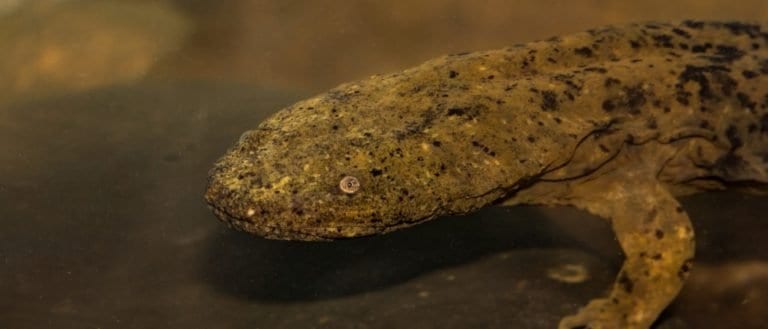
Chinese giant salamanders can breathe significantly through their skin, letting them stay submerged for long periods in oxygen-rich mountain streams-an unusual strategy for an animal that can grow longer than an adult human.
Some of the upper-Yangtze sturgeons that passed Chongqing (including Chinese sturgeon) can go long stretches without feeding during migration, relying on stored energy-more like a salmon-style endurance athlete than a typical "always-eating" river fish.
The Three Gorges/upper-Yangtze reach around Chongqing creates a sharp "vertical habitat stack" over short distances (river valleys to cool high ridgelines), which is why you can find subtropical lowland fauna and cold-adapted montane stream species within the same municipality.
In the Yangtze near Chongqing, many fish reproduction hotspots are surprisingly small features-shallow gravel bars and fast riffles. Losing just a few of these micro-habitats can disproportionately crash local recruitment for species that need clean, oxygenated spawning substrate.
The Chinese giant salamander (Andrias davidianus)-native to cold, fast mountain streams in Chongqing's reserves-is the world's largest amphibian, recorded at up to about 1.8 m long and >50 kg.
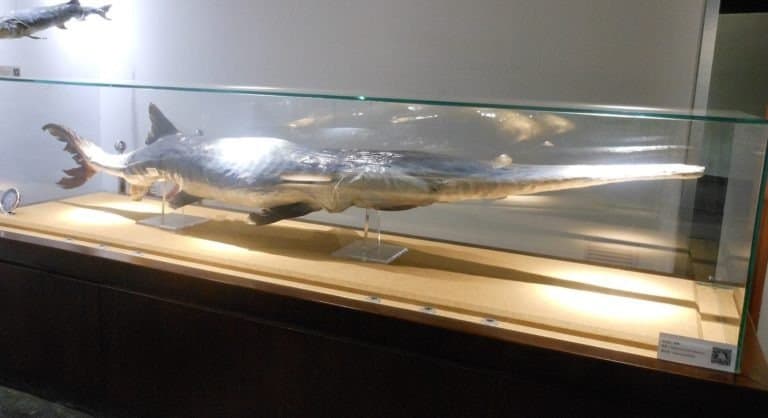
Chongqing's Yangtze mainstem was part of the range of the Chinese paddlefish (Psephurus gladius), one of the largest freshwater fishes ever documented (reported up to ~7 m). It was endemic to the Yangtze basin and is now considered extinct.
The Yangtze finless porpoise (Neophocaena asiaeorientalis asiaeorientalis), which historically occurred through the Three Gorges/Chongqing reach, is the world's only freshwater porpoise (and the only porpoise known to live entirely in freshwater).
The Chinese sturgeon (Acipenser sinensis), a giant anadromous fish that historically migrated upstream through the Chongqing reach toward spawning areas, is among the largest sturgeons-reported to reach ~5 m in length and hundreds of kilograms.
5 species documented in our encyclopedia
Thank you for reading! Have some feedback for us?
We appreciate your help in improving our content.
Our editorial team will review your suggestions and make any necessary updates.
There was an error submitting your feedback. Please try again.