
Quick Take
- Adult mayflies are unable to eat, and the reason has nothing to do with not having time. Why adults can't eat →
- Mayfly swarms get so massive they show up on weather radar, which is actually good news. About those massive swarms →
- Mayflies are one of Earth's oldest insect lineages, yet their lifespan is measured in hours. There's a reason that paradox works. Ancient origins explained →
- Mayflies undergo something no other insect does, and it happens right before they can reproduce. The subimago stage →
Mayflies are aquatic insects whose name is associated with the fact that several species appear in May. Mayflies hatch in large numbers in the spring but continue hatching until fall. Since the adult mayfly’s purpose is to reproduce, it has a short lifespan.
Mayflies are beloved and celebrated creatures. There have been poems and books written about mayflies, and even festivals are named after this insect with a brief lifespan.

Mayfly Facts
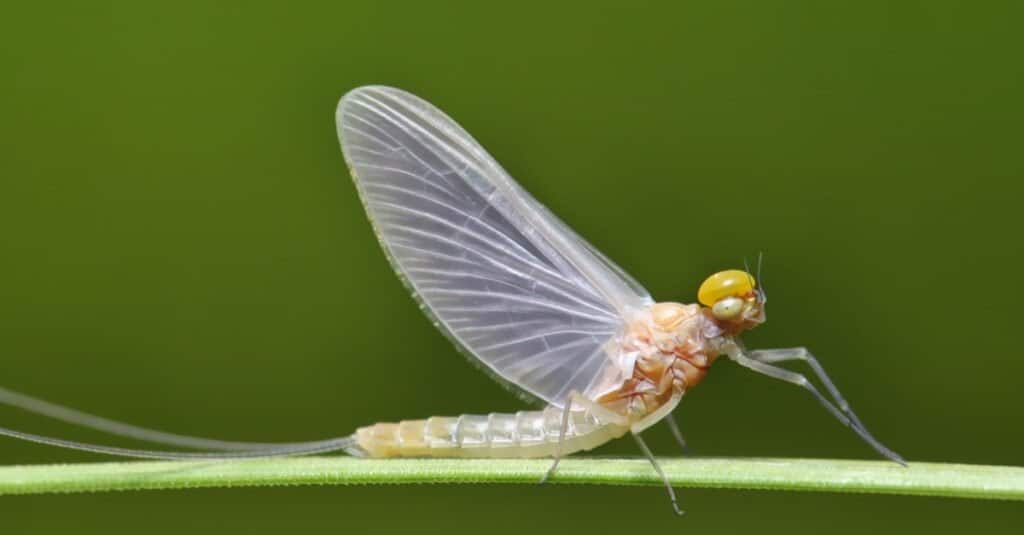
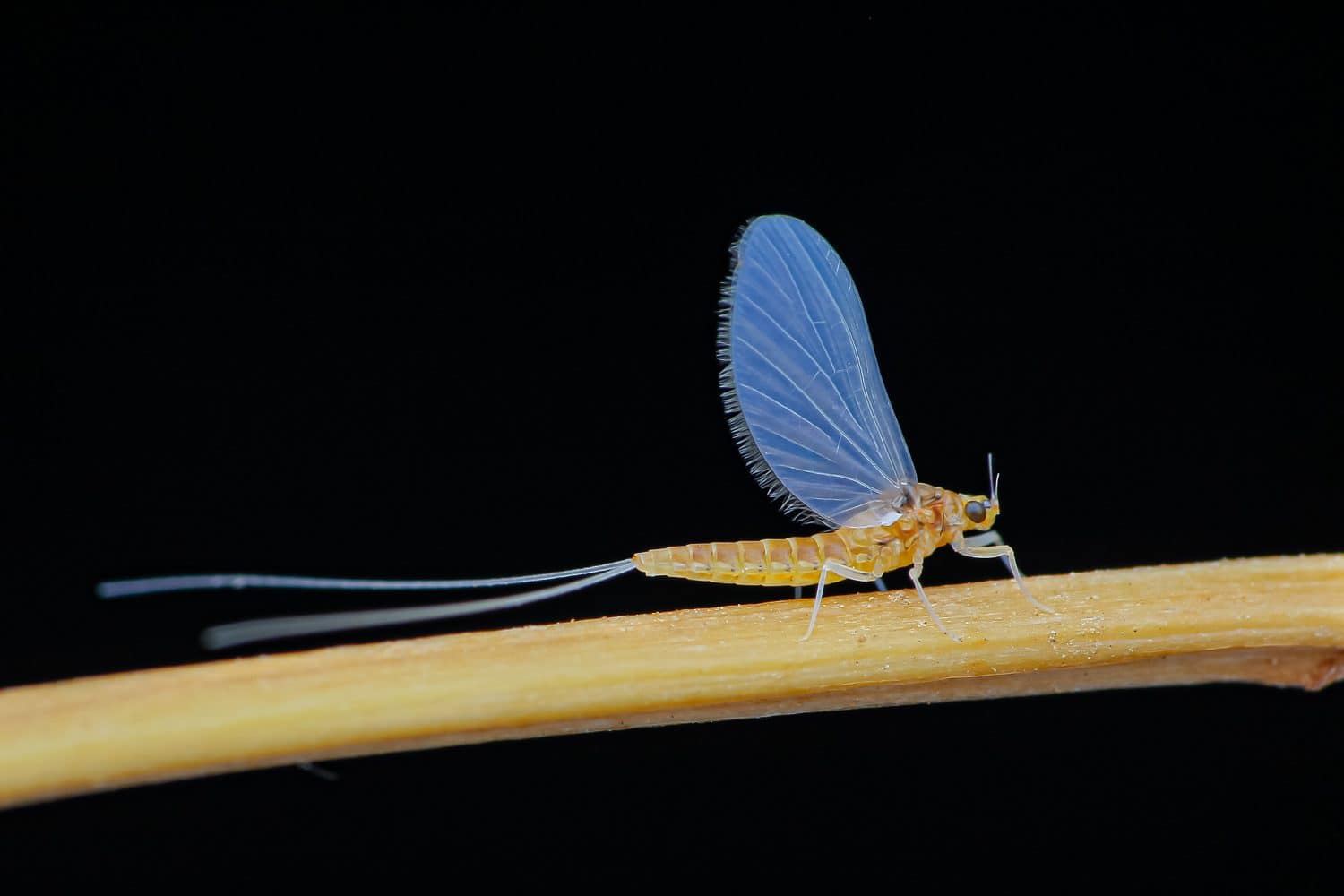
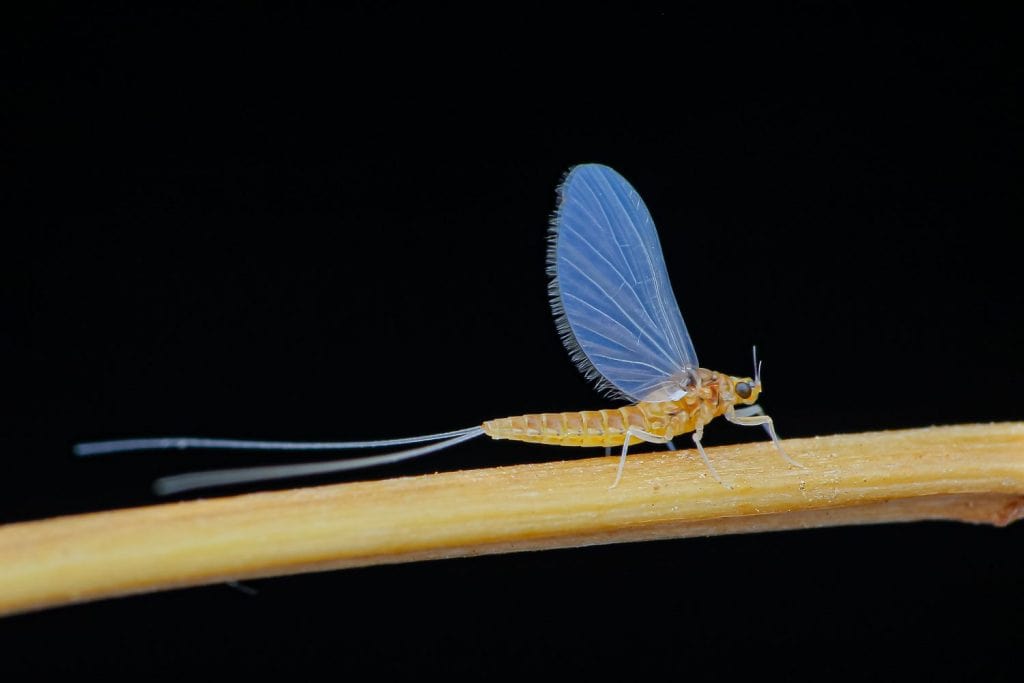
A small mayfly resting on a blade of grass.
©Achkin/Shutterstock.com
- Mayflies are indicators of water quality; while many species are sensitive to pollution and require clean, well-oxygenated waters, some species are more tolerant of polluted conditions.
- There are over 3,000 species of mayflies, with around 672 species living in North America. Except for the Arctic and Antarctica, mayflies exist throughout the world.
- When mayflies swarm near freshwater habitats, the gathering can be so dense that it can be hard to see when driving.
Evolution and Origins
Mayflies belong to the order Ephemeroptera, which is one of the oldest groups of insects still in existence today. Fossil records of mayflies date back to the late Carboniferous and early Permian periods, around 290 to 300 million years ago, with mayfly-like fossils such as Triplosoba extending the record even further into the Upper Carboniferous. The evolution of mayflies has made them aquatic insects, and they have remained in this environment for the majority of their life cycle.
Due to their aquatic nature, mayflies have developed several unique adaptations, such as gills to help them breathe underwater and specialized mouthparts for feeding.
Over time, these adaptations have enabled mayflies to become successful and diverse insects, with over 3,000 known species worldwide. Despite their evolutionary success, mayflies have a relatively short lifespan, with many living only for a few hours or days after reaching their adult stage.
Classification and Scientific Name
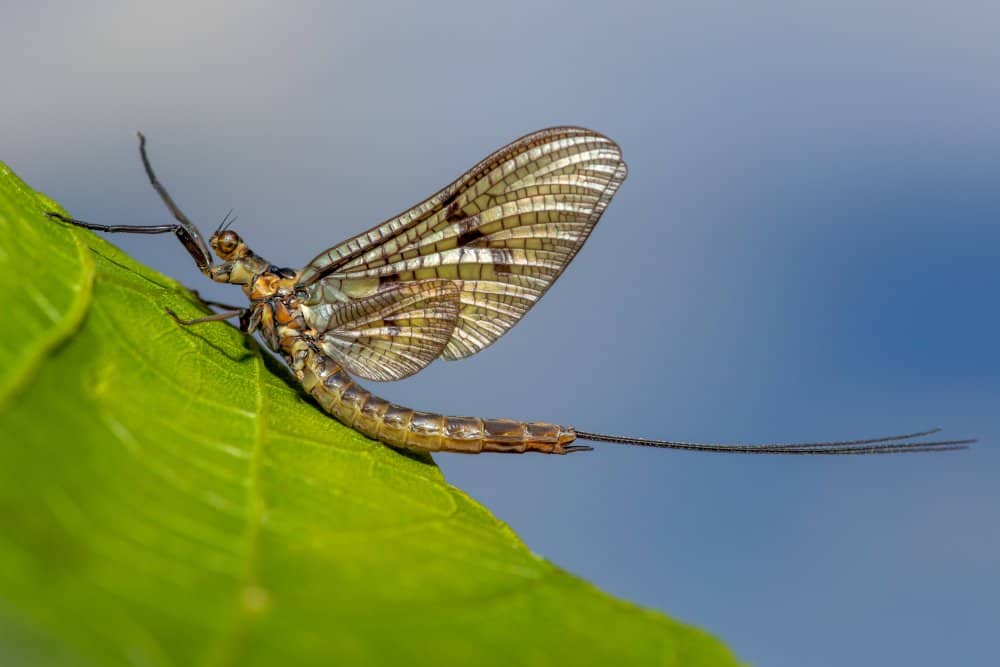
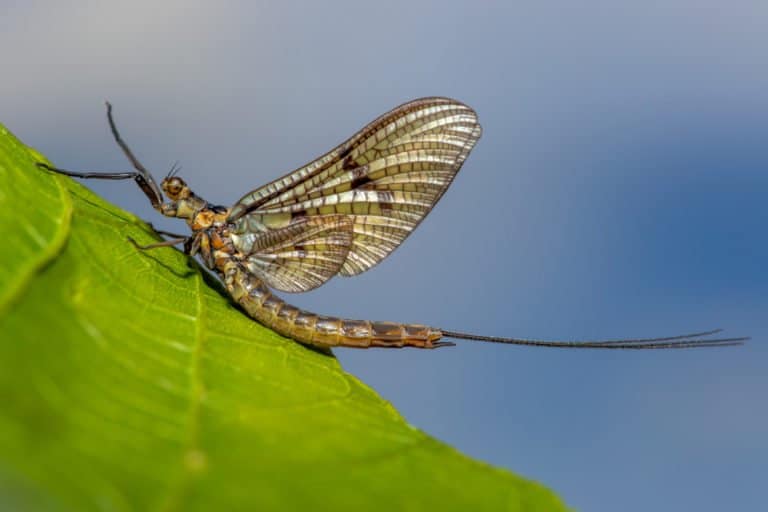
Other names for the mayfly include the dayfly, drake, fishfly, sandfly, and shadfly.
©bt_photo/Shutterstock.com
Mayflies belong to the order Ephemeroptera, which comes from the Greek language and means “short-lived wings.” Mayflies emerge in large groups but have short lifespans.
Other names for the mayfly include the dayfly, drake, fishfly, sandfly, and shadfly.
Appearance and Behavior
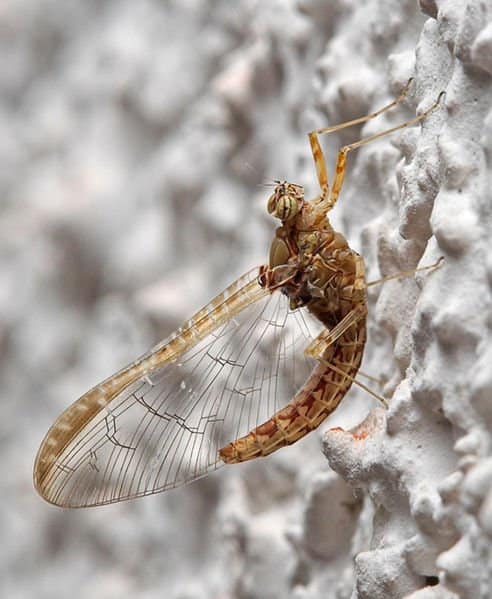
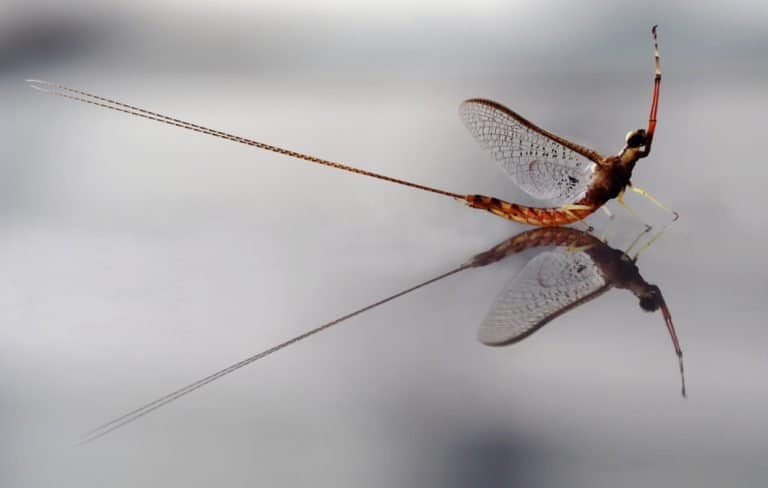
Mayflies in their adult stage have sizable eyes and abbreviated antennae.
©Reinhold Stansich / Creative Commons – Original
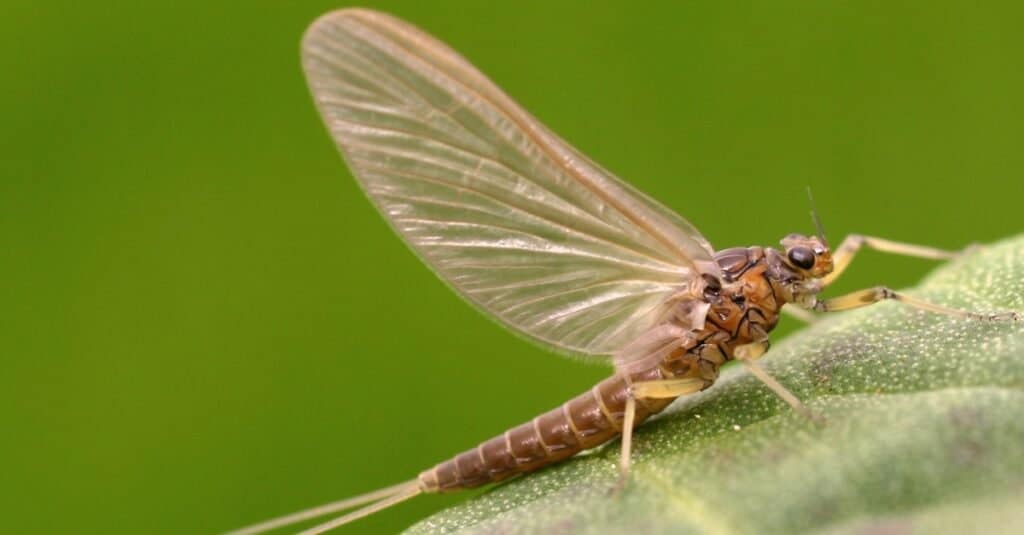
Adult mayflies have large eyes and short antennae. A mayfly’s slender body makes the eyes seem more pronounced, which is why they are described as “bug eyes.” Mayflies have pairs of large clear triangular wings with vertical and horizontal veins that give them a delicate netlike appearance.
The mayfly’s wings are similar to butterfly wings in how they are attached to the insect’s thorax. The mayfly’s larger wings are at the front of the body, with small round wings behind. The tiny hind wings on some species can be challenging to see, and some appear to have no hind wings.
The mayfly has two or three tails that look like threads. The tails can be longer than the insect’s body. Mayflies vary in color and size, but they tend to blend in with their background.
The different colors and sizes of mayflies seen in an area are the result of different species inhabiting a single water source. However, the mayfly is one of the easiest aquatic insects to identify because of its large eyes, slender body, and threadlike tails. The mayfly can range from one-tenth of an inch to just over an inch (about three centimeters) — roughly the size of a quarter.
Mayflies sometimes emerge in such large numbers that they cover light posts, trees, and tall grasses, making them a nuisance around homes and businesses. Swarms of mayflies can be so large that they appear on Doppler weather radars.
Habitat
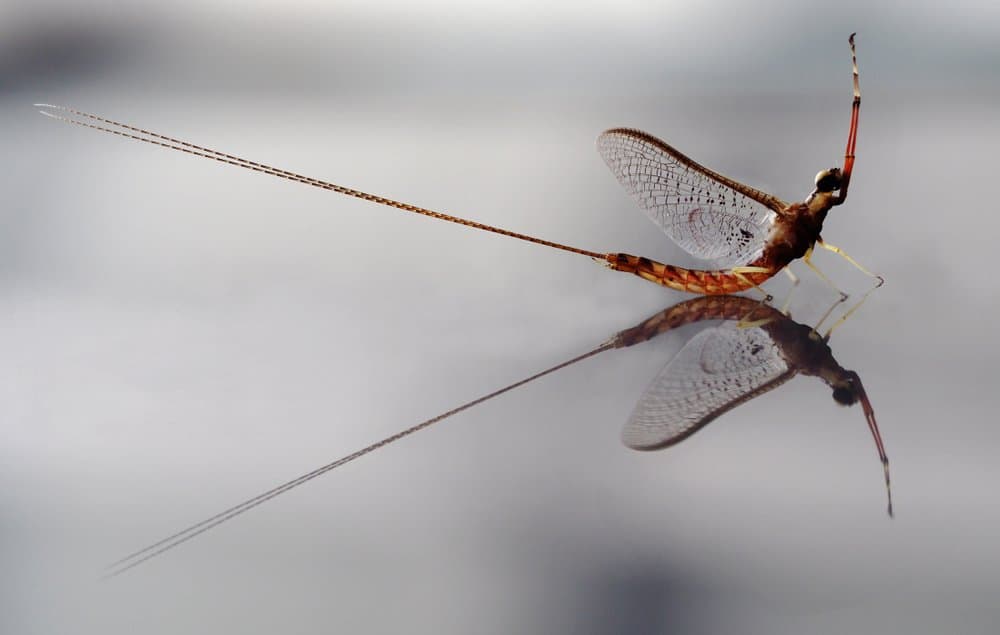
The majority of mayfly nymphs, or naiads, inhabit streams that have clear and shallow water. However, a few can be found dwelling in still waters and along the perimeters of lakes.
©Maple Ferryman/Shutterstock.com
Most mayfly nymphs, or naiads, live in streams with clear, shallow water, but some reside in still waters and around the edges of lakes. As naiads age, they start to develop gills.
Naiads that live in still waters have larger gills, and those living in moving streams have smaller gills. Naiads’ gills control water flow, salt, and oxygen intake. The gills also deflect water at angles, which can mislead predators because it makes the naiads harder to track. Nymphs can live for several months and then emerge from the water as adults.
When large numbers of mayflies hatch near bodies of water, it can be reassuring because it indicates the habitat is environmentally sound, as a naiad’s gills are sensitive to polluted waters. Efforts by communities to keep rivers and streams clean ensure the existence of mayflies.
Diet
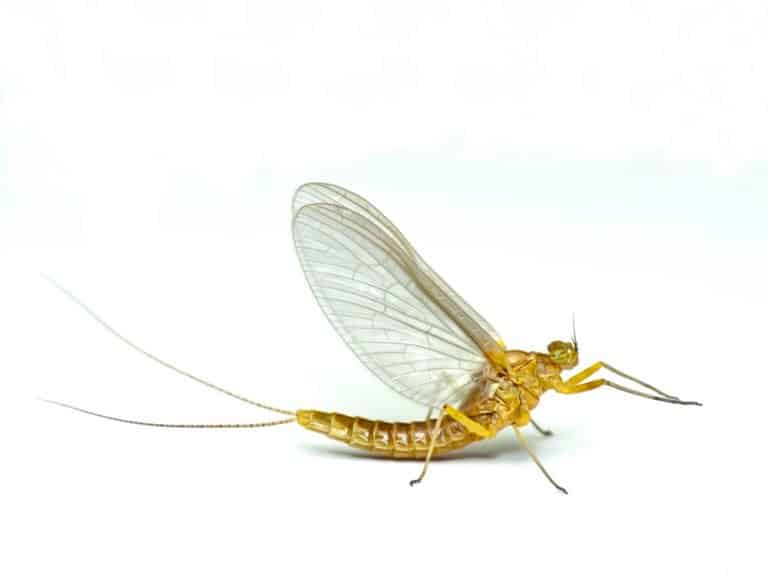
The Mayfly has the shortest lifespan of any animal in the world.
©iStock.com/englishriver
Mayfly naiads feed on algae, microscopic aquatic organisms, organic matter consisting of leaves and decaying animals, and plants. Once a mayfly gets its wings, it can no longer feed.
Adult mayflies have only vestigial, non-functional mouthparts, so they are unable to eat. Since they die within hours or days after emerging, the inability to feed is not a survival issue.
Predators and Threats
Trout and other fish consume mayfly naiads as food. Mayfly naiads are also eaten by birds, flies, frogs, parasitic roundworms, and water beetles. Caddisfly larvae and snails may eat the eggs of mayflies. Birds, dragonflies, fish, and water beetles eat mayflies that are in the early adult stage.
When mayflies swarm, they tend to cause fish to swarm, which is helpful to fishermen looking for places to cast their lines. Fishermen sometimes use lures crafted to look like mayflies.
Reproduction, Babies, and Lifespan
The purpose of the adult mayfly is to reproduce, and once they reproduce, they die. During swarming, adult mayflies mate. Once the male mates with a female, he guards her to prevent other males from mating with her. Females can produce as few as 50 to several thousand eggs.
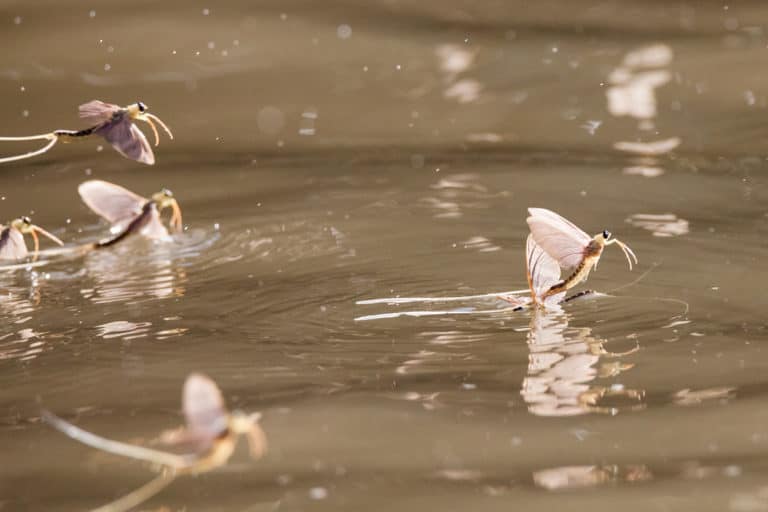
After mating, a female mayfly deposits her eggs into the water by dipping. A female mayfly dips several times to release eggs into the water. Some mayflies drop their eggs on the water’s surface. The eggs sink into the water, resting among debris and aquatic plants. However, when mayflies deposit eggs this way, the eggs can be eaten by fish before sinking.
Mayfly larvae are known as naiads or nymphs, which emerge a short time after the female lays the eggs. The new naiads are very tiny with no gills. The developmental stages of naiads are known as instars. Depending on the species of the nymph, the number of instars can range from 12 to 45. The location where naiads live and the water temperature determine how long a species remains in the naiad stage.
Eventually, the nymph molts or sheds its outer layer. Mayflies are unique, being the only insect with two adult molts. Molting is the process of shedding the outer shell or outer skin.
Mayflies live most of their lives underwater. After several months of living underwater, mayfly naiads float to the top and molt into the stage known as subimago, or sub-adult, stage. At this stage, just before it can fly, the young mayfly is vulnerable to predators. As a sub-adult, the mayfly is not able to mate or reproduce. However, within hours the mayfly molts again into the imago stage, becoming an adult winged insect with the ability to reproduce but not to eat or drink. This version of the mayfly lives for hours or, at most, a few days.
Population
The mayfly population in a specific area can depend on the quality of the habitat. Cleaner streams attract more mayflies. Since mayflies can deposit from 50 to several thousand eggs, the number of mayflies in an area depends on the number of eggs adult females deposit in the water. Mayflies have come back in some areas recently because of improved water quality.
Mayfly Pictures
View all of our Mayfly pictures in the gallery.

bt_photo/Shutterstock.com
Sources
- David Burnie, Dorling Kindersley (2011) Animal, The Definitive Visual Guide To The World's Wildlife / Accessed January 18, 2010
- Tom Jackson, Lorenz Books (2007) The World Encyclopedia Of Animals / Accessed January 18, 2010
- David Burnie, Kingfisher (2011) The Kingfisher Animal Encyclopedia / Accessed January 18, 2010
- Richard Mackay, University of California Press (2009) The Atlas Of Endangered Species / Accessed January 18, 2010
- David Burnie, Dorling Kindersley (2008) Illustrated Encyclopedia Of Animals / Accessed January 18, 2010
- Dorling Kindersley (2006) Dorling Kindersley Encyclopedia Of Animals / Accessed January 18, 2010