
B
Species Profile

Bigfin Reef Squid

Sepioteuthis lessoniana

Big fins. Bright signals. Reef-speed life.
iStock.com/kororokerokero

Bigfin Reef Squid Distribution

Click a location to explore more animals from that region

This map shows coastal regions where Bigfin Reef Squid are found.

Loading map...
Bigfin reef squid

At a Glance

Wild Species
Also Known As Reef squid, Oval squid
Diet Carnivore
Activity Diurnal+
Lifespan 240 years
Weight 1 lbs
Status Least Concern
Did You Know?

Can reach ~38 cm mantle length (ML) and is among the largest 'inshore' loliginid squids (FAO cephalopod catalogue: Jereb & Roper, 2010).

Scientific Classification

A common Indo-Pacific coastal squid (an oval squid) known for its broad fins running along much of the mantle length, rapid color changes, and schooling behavior over reefs and seagrass beds.

Kingdom
Animalia
Phylum
Mollusca
Class
Cephalopoda
Order
Myopsida
Family
Loliginidae
Genus
Sepioteuthis
Species
Sepioteuthis lessoniana

Distinguishing Features

  • Broad, continuous fins along the mantle giving an “oval” outline (big fin appearance)
  • Rapid chromatophore-driven color and pattern changes for signaling and camouflage
  • Nearshore reef-associated lifestyle; often forms schools
  • Ten appendages (8 arms + 2 longer tentacles) typical of squids

Physical Measurements

Males and females differ in size

Length
1 ft 2 in (8 in – 1 ft 8 in)
Weight
1 lbs (0 lbs – 3 lbs)
2 lbs (0 lbs – 4 lbs)
Top Speed
6 mph
Top speed ~2.6 m/s

Appearance

Primary Colors
Secondary Colors
Skin Type Soft, smooth, muscular mantle with dense chromatophores plus iridophores/leucophores enabling rapid color and contrast changes; no external shell. Skin texture is generally sleek (not warty), with broad fin membranes along most of the mantle length.
Distinctive Features
  • Oval squid form: a relatively broad, laterally compressed mantle with very large fins that run along most of mantle length (diagnostic 'bigfin/oval squid' silhouette).
  • Indo-Pacific shallow coastal habitat association: commonly observed over coral reefs, lagoon edges, sandy patches, and seagrass beds rather than deep-sea environments.
  • Fast, high-frequency color change and pattern switching for communication: conspicuous barred/striped and mottled patterns used in schooling, courtship, and agonistic interactions.
  • Large, paired fin 'wings' provide precise hovering and maneuvering over reefs; fin margins often used as a visual signaling surface (contrast bands along fin edges).
  • Size (published maxima): mantle length reported up to ~30 cm for Sepioteuthis lessoniana (commonly smaller); total length correspondingly larger when arms are included (FAO cephalopod catalog sources such as Jereb & Roper).
  • Bigfin reef squid (Sepioteuthis lessoniana) is short-lived, fast-growing, usually about one year or less. They become adults quickly and lay eggs many times in warm, shallow coastal waters; timing changes by region.

Sexual Dimorphism

External dimorphism is subtle but present: males are often larger and have a modified arm (hectocotylus) used to transfer spermatophores; display behavior also differs strongly during mating (male aggression/courtship signaling vs. female receptivity/egg-laying behavior).

  • Typically larger body size at maturity in many populations (region-dependent).
  • Hectocotylized arm (modified sucker arrangement on one arm used for spermatophore transfer), consistent with loliginid reproductive morphology.
  • More frequent/intense high-contrast signaling (e.g., bold stripes/bars) during male-male competition and courtship approaches.
  • Generally smaller/rounder at comparable ages in many populations; abdomen/mantle may appear fuller when gravid.
  • Color displays occur but are often less dominated by competitive 'zebra' barring outside of courtship contexts; females commonly show camouflage patterns while selecting egg-laying sites.
  • Egg-laying occurs on shallow substrates (e.g., seagrass, reef-associated structures), aligning with coastal reef/lagoon ecology.

Did You Know?

Can reach ~38 cm mantle length (ML) and is among the largest 'inshore' loliginid squids (FAO cephalopod catalogue: Jereb & Roper, 2010).

Its broad fins run along most of the mantle (often ~80-90% of mantle length), giving it an 'oval squid' profile and great hovering control.

Forms schools over reefs and seagrass beds; individuals coordinate spacing and direction with rapid skin-pattern signals.

Males use alternative mating tactics: large 'consort' males guard females, while smaller 'sneaker' males attempt quick matings and different spermatophore placement (reported in Sepioteuthis lessoniana behavioral studies; summarized in Hanlon & Messenger, cephalopod behavior texts).

Skin can flash high-contrast patterns (e.g., bars/zebra displays) in under a second via chromatophores-used in courtship, threat, and schooling coordination.

It is a species complex in parts of its range: multiple genetically distinct lineages have been reported under the name S. lessoniana, which matters for fisheries and conservation planning.

A major coastal fishery squid across the Indo-West Pacific; highly valued in Japan and commonly eaten raw because of its firm, sweet flesh.

Unique Adaptations

  • Oversized lateral fins extending along most of the mantle: increases maneuverability, braking, and station-keeping in reef turbulence compared with more 'torpedo-shaped' squids.
  • A sophisticated skin 'display stack' (chromatophores + reflective iridophore/leucophore layers) enabling both camouflage (mottle/countershading) and conspicuous social signals (high-contrast bars).
  • Well-developed visual system for close-range social communication; like many squids, it can exploit contrast, motion cues, and (in loliginids) polarization-related visual information to enhance signaling in clear shallow water.
  • Jet propulsion plus fin swimming: can switch instantly from efficient fin-driven cruising/hovering to high-acceleration jets for escapes and strikes.
  • Ink release paired with rapid direction change: a short-range 'smokescreen' tactic that is especially effective in complex reef structure.
  • Fast growth and early reproduction: a classic 'live fast' coastal squid strategy that helps populations rebound quickly after seasonal fishing pressure (noting that growth rates and timing vary by region).

Interesting Behaviors

  • Schooling over shallow reefs, lagoons, and seagrass beds, with synchronized turns and spacing maintained by rapid body-pattern signaling.
  • Hovering and slow 'fin-sculling' close to structure (coral heads, rocks, pier pilings) to hunt without stirring sediment.
  • Ambush-to-burst predation: a slow approach followed by a rapid tentacle strike to seize fish or crustaceans, then beak processing.
  • Courtship 'conversation' using dynamic color bands, mottling, and high-contrast flashes; pattern changes can escalate into chases and brief grappling between males.
  • Mate guarding by larger males (consort behavior) versus opportunistic sneak copulations by smaller males; females may receive spermatophores in different body regions depending on male tactic (documented for this species in the behavioral literature).
  • Spawning in shallow coastal habitats where egg clusters are attached to vegetation or hard substrate; adults often aggregate at spawning sites and may show heightened territorial displays.
  • Diel habitat shifts: commonly observed shallower and more visible over reefs by night or low light (aiding both feeding and predator avoidance), with variable patterns by location.

Cultural Significance

Bigfin reef squid (Sepioteuthis lessoniana) is a common, important coastal squid in the Indo‑West Pacific. Caught by jigging, nets and traps, eaten fresh, dried or raw, it supports local fisheries, night‑jig fishing in Japan, and regional cuisine. Market names may group similar lineages.

Myths & Legends

In Japanese coastal folklore, squids are seen as sea spirits or monsters—most famously the "Squid Monk," a huge squid that rises and threatens boats. These stories are common where reef squids like Sepioteuthis lessoniana live.

Across maritime Southeast Asia, squid ink has been treated in some local traditions as a substance with 'concealing' power-used in stories and sayings about vanishing, trickery, or escaping notice, echoing the animal's sudden inking-and-escape behavior.

In parts of Japan, the bigfin reef squid (Sepioteuthis lessoniana) season is tied to fishing stories: moon phases, tide changes, and reef edges are thought lucky; bait colors and jigs get passed between fishers.

The scientific name memorializes natural history exploration: "lessoniana" honors Rene Primevere Lesson, a 19th-century French naturalist; in museum and naming history, the squid carries the legacy of early Indo-Pacific voyages and specimen collecting.

Conservation Status

LC Least Concern

Widespread and abundant in the wild.

Population Unknown

Life Cycle

Birth 500 hatchlings
Lifespan 240 years

Lifespan

In the Wild
120–365 years
In Captivity
150–365 years

Reproduction

Mating System Polygynandry
Social Structure Aggregation Group
Breeding Pattern Transient
Fertilization Substrate Spawning
Birth Type Internal_fertilization

Behavior & Ecology

Social School Group: 20
Activity Diurnal, Crepuscular
Diet Carnivore Small schooling fishes (teleosts), when available (reported as dominant prey in multiple stomach-content studies across Indo-Pacific localities; crustaceans become more important in smaller size classes and in some habitats).

Temperament

Highly social and visually attentive; individuals rapidly adjust spacing and alignment to neighbors (schooling/anti-predator context).
Bold, fast-responding predator that can shift from coordinated schooling to opportunistic, competitive feeding when prey density is high (Hanlon & Messenger 1996).
During reproduction, males become strongly competitive and can escalate to aggressive display and physical interference; alternative tactics (guarding vs. sneaking) indicate flexible, opportunistic mating behavior (Wada et al. 2005).
Context-dependent reactivity: generally tolerant within schools, but prone to sudden flight responses to threats and intense rivalry near spawning sites.

Communication

None documented as functional vocal communication; like other cephalopods, S. lessoniana lacks specialized sound-producing/vocal organs, though incidental jet/water sounds may occur during rapid propulsion Hanlon & Messenger 1996
Dynamic skin patterning via chromatophores/iridophores: rapid color changes, contrast bars/stripes, and flashing used in courtship, male-male contests, and group coordination Hanlon & Messenger 1996; Wada et al. 2005
Postural/body-pattern displays: arm spreading/curling, mantle orientation, fin undulations, and lateral presentation to rivals or mates; displays can escalate in graded sequences during competition Wada et al. 2005
Locomotor signaling within groups: synchronized turns, speed changes, and polarized alignment serve as coordination cues in schools/shoals Hanlon & Messenger 1996
Tactile communication during mating: contact with arms and positioning during copulation; physical interference among males around a female is common in aggregations Wada et al. 2005
Likely use of visual polarization/contrast cues Common in coastal loliginids) to enhance signaling and detection in variable light over reefs and seagrass (general cephalopod visual ecology summarized in Hanlon & Messenger 1996

Habitat

Coastal Coral Reef Seabed/Benthic Rocky Shore Estuary Mangrove Beach Open Ocean +2
Biomes:
Terrain:
Coastal Island Rocky Sandy Muddy
Elevation: Up to 328 ft 1 in

Ecological Role

Mid-trophic-level coastal mesopredator linking secondary consumers (small fishes/crustaceans) to higher predators in Indo-Pacific reef-seagrass-lagoon systems.

Regulates populations of small coastal fishes and mobile crustaceans via predation Transfers energy from nearshore/seagrass food webs to higher trophic levels (e.g., tunas, mackerels, groupers, dolphins, seabirds) that prey on squid Contributes to nutrient cycling through excretion and through carcasses/ink release supporting scavengers and microbial loops Serves as an important prey base for commercially important predators, indirectly supporting coastal fisheries food webs

Diet Details

Main Prey:
Small teleost fishes Penaeid shrimp Decapod crustaceans Mysids and small pelagic crustaceans Cephalopods

Human Interaction

Domestication Status

Wild

Bigfin reef squid (Sepioteuthis lessoniana) is not domesticated. Animals are wild-caught or raised in hatcheries from wild parents. Captive breeding happens in research but not multi-generation domestication. Mantle length up to 38 cm; fins ≈90% of mantle. Life short (6–12 months). School on reefs and seagrass, change color, mate in groups, and lay demersal egg capsules on firm substrates.

Danger Level

Low
  • Minor bite/pinch from beak when handled (puncture risk, usually superficial)
  • Skin/eye irritation from ink or seawater aerosols during handling
  • Allergic reactions to cephalopod proteins in sensitized individuals (food handling/consumption)
  • General hazards associated with night fishing/diving where the species is encountered (not caused by the squid itself)

As a Pet

Not Suitable as Pet

Legality: Bigfin reef squid (Sepioteuthis lessoniana) are not usually banned as pets, but keeping or collecting them often needs permits and must follow local fishing, biosecurity, transport, and reef/seagrass rules—check local and national laws.

Care Level: Expert Only

Purchase Cost: Up to $200
Lifetime Cost: $2,000 - $12,000

Economic Value

Uses:
Human food (fresh/chilled/frozen squid) Small-scale to industrial coastal fisheries and artisanal night-light fisheries Bait (hook-and-line and trap fisheries) Aquaculture/R&D (limited; culture trials and laboratory studies) Education/outreach and underwater tourism interest (behavioral displays; spawning aggregations)
Products:
  • Edible mantle and arms/tentacles; processed squid products (rings, tubes)
  • Bycatch and target catch in nearshore net/line fisheries; sold fresh locally
  • Fishing bait (whole or pieces)
  • Research animals for neurobiology/behavior, sensory ecology, camouflage/signaling studies
  • HUBS (group-level, Myopsida/Loliginidae squids): interactions range from major global seafood commodities and bait fisheries, to high bycatch sensitivity in coastal nets/trawls, to model organisms in physiology/behavior labs; limited ornamental trade because most loliginids are short-lived, require large high-flow marine systems, and are prone to stress/injury in captivity.

Relationships

Predators 5

Related Species 5

Caribbean reef squid Sepioteuthis sepioidea Shared Genus
Southern calamari Sepioteuthis australis Shared Genus
European squid Loligo vulgaris Shared Family
Indian squid Uroteuthis duvaucelii Shared Family
Japanese flying squid Todarodes pacificus Shared Class

Ecological Equivalents 5

Animals that fill a similar ecological role in their ecosystem

Caribbean reef squid Sepioteuthis sepioidea Shares a nearshore reef niche: day-active hovering and schooling, rapid color changes for signaling, and shallow coastal egg laying. Fast growth and a short lifespan of about one year, similar to other loliginid squids such as Sepioteuthis lessoniana.
European squid Loligo vulgaris Temperate NE Atlantic and Mediterranean loliginid: a coastal, demersal-neritic squid that schools, hunts small fish and crustaceans, uses shallow nurseries, and, like Sepioteuthis lessoniana, hunts by sight and serves as a key mid-level prey species.
Indian squid Uroteuthis duvaucelii Indo-West Pacific coastal loliginid that overlaps Sepioteuthis lessoniana in nearshore and shelf roles; forms schools, eats small fish and crustaceans, is important to fisheries, and is short-lived and grows quickly like other loliginids.
Broadclub cuttlefish Sepia latimanus Shares shallow reef habitat use and extreme, rapid color and texture change for camouflage and signaling. Both are visually oriented predators on reef-associated fishes and crustaceans. Although they differ taxonomically (cuttlefish vs. squid), they overlap strongly in microhabitat (coral reefs) and trophic role.
Day octopus Octopus cyanea A common Indo-Pacific reef mid-level predator on reef flats and slopes that eats crabs, shrimp, and small fish. It is solitary (does not school) but competes for the same benthic and reef prey and is part of the reef predator group.

Also known as the glitter squid or oval squid, the bigfin reef squid belongs to the loliginid squid family Loliginidae. They get their name from the large oval fin connected to the mantle. Although they rank as a medium-sized species and only measure around 1.5 to 13 inches long, they grow faster than almost any other large marine invertebrate. They engage in elaborate mating displays and live relatively short lives, with a maximum age of just 315 days. 

5 Bigfin Reef Squid Facts

  • You can often find bigfin reef squids near shorelines, coral reefs, and rocky outcrops. 
  • Due to their fast growth rate, bigfin squids are fished in vast quantities as food in Asia. 
  • Like other cephalopods, bigfin reef squids can rapidly change color by controlling their chromatophores.
  • Bigfin squids exhibit shoaling behavior, often swimming close together and rarely cannibalizing each other. 
  • Bigfin squids react strongly to the presence of light and often involuntarily stop all movement in the presence of strong light sources. 

Bigfin Reef Squid Scientific name

The bigfin reef squid goes by many other names, including the oval squid, glitter squid, and green-eyed squid. In Australia, people sometimes refer to it as the northern calamari. Its genus name, Sepioteuthis, derives from the Greek words sepia, meaning “cuttlefish,” and teuthis, or “squid.” This name references the similarities in appearance between the bigfin reef squid and another cephalopod, the cuttlefish

Bigfin Reef Squid

Bigfin Reef Squid grow faster than almost any other large marine invertebrate and typically live to just 315 days of age.

Bigfin Reef Squid Appearance 

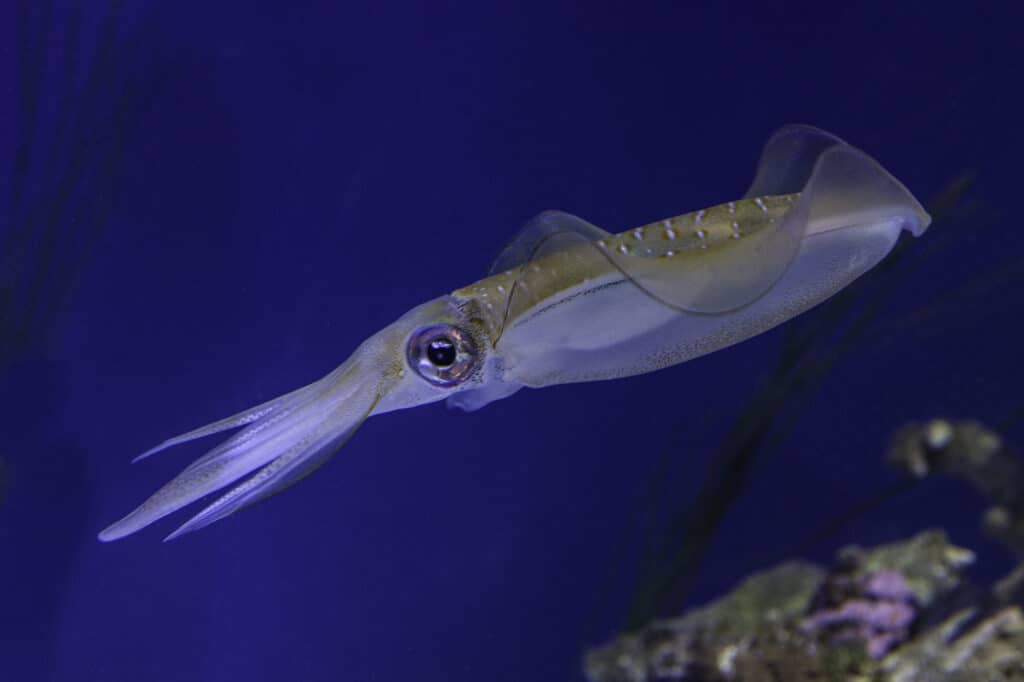
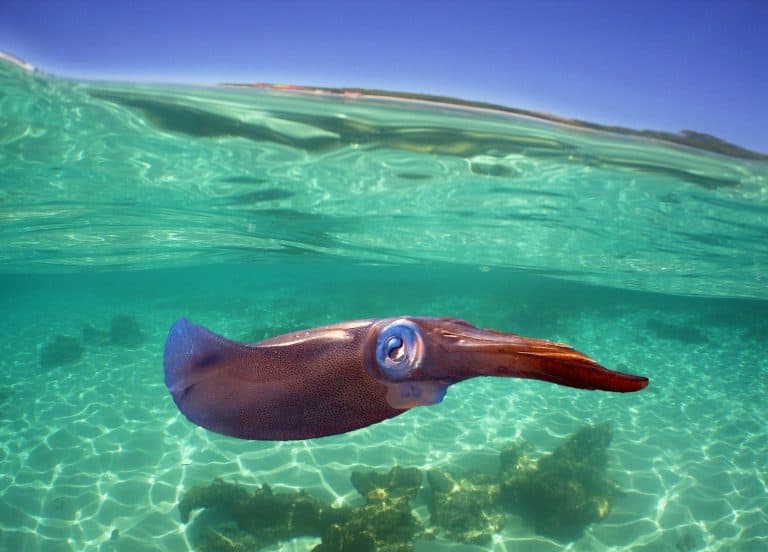
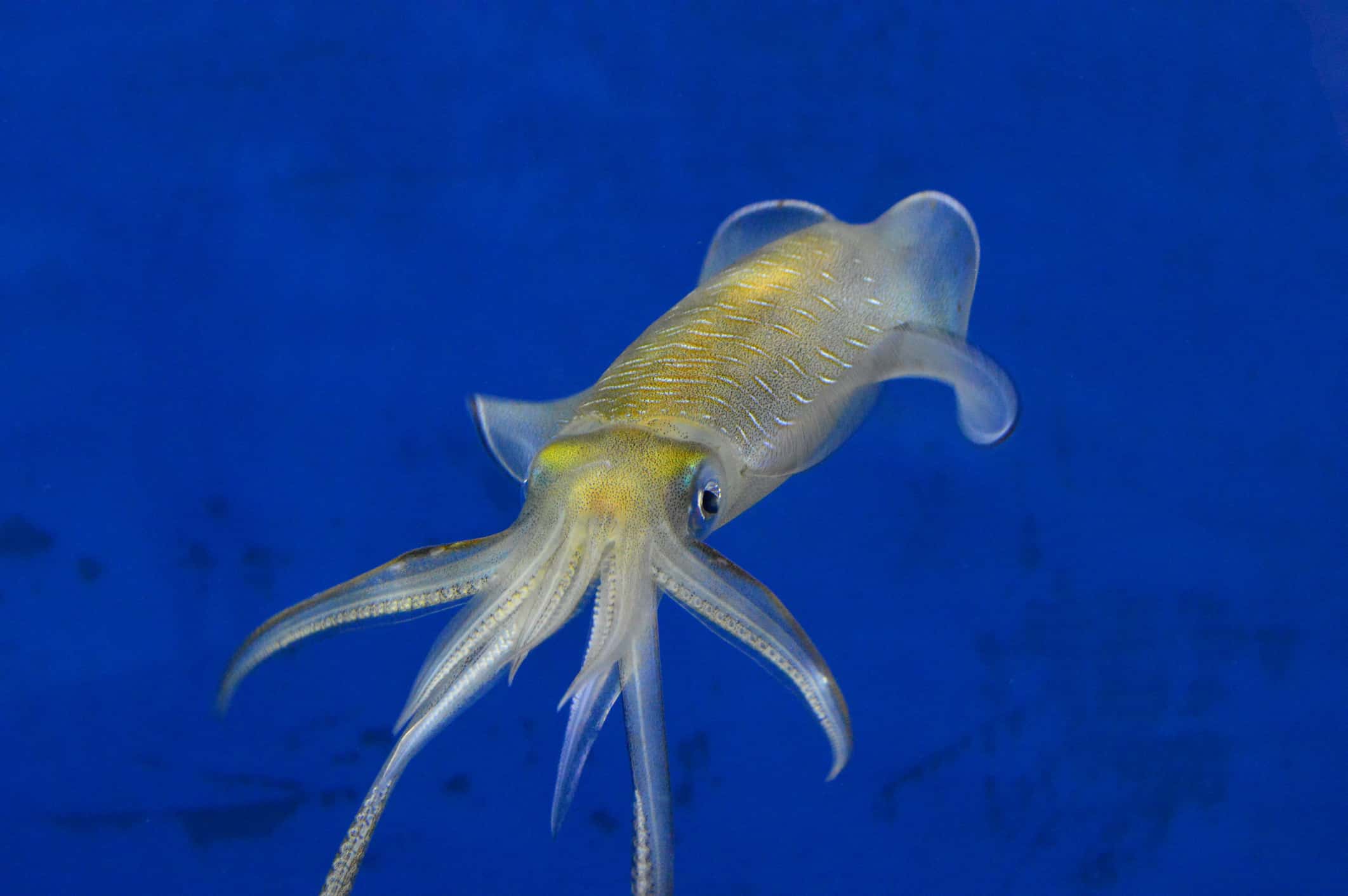
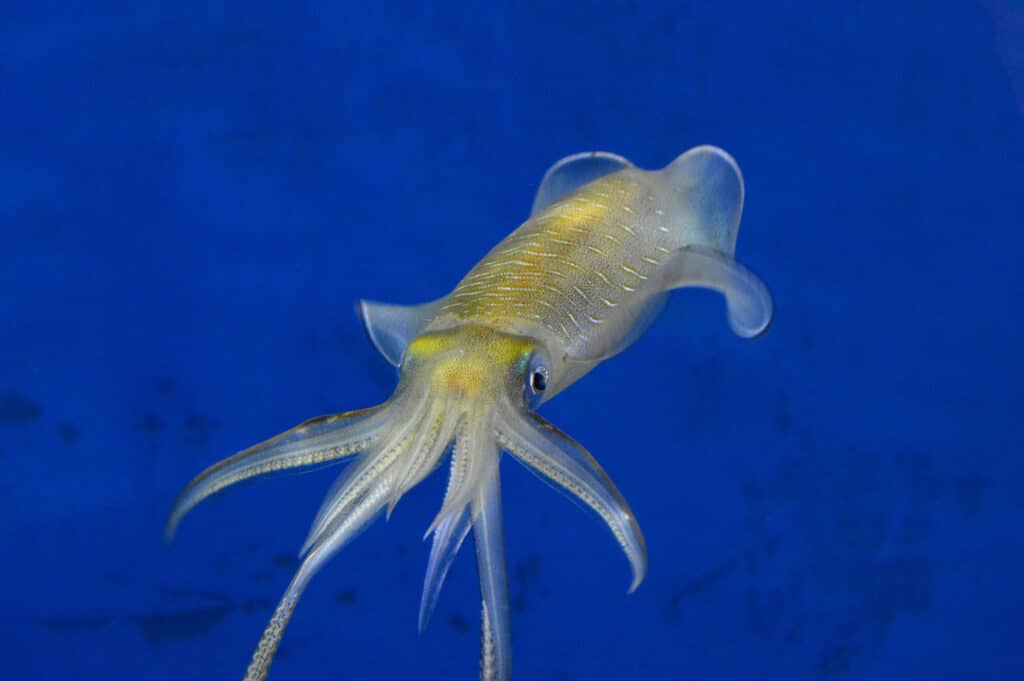
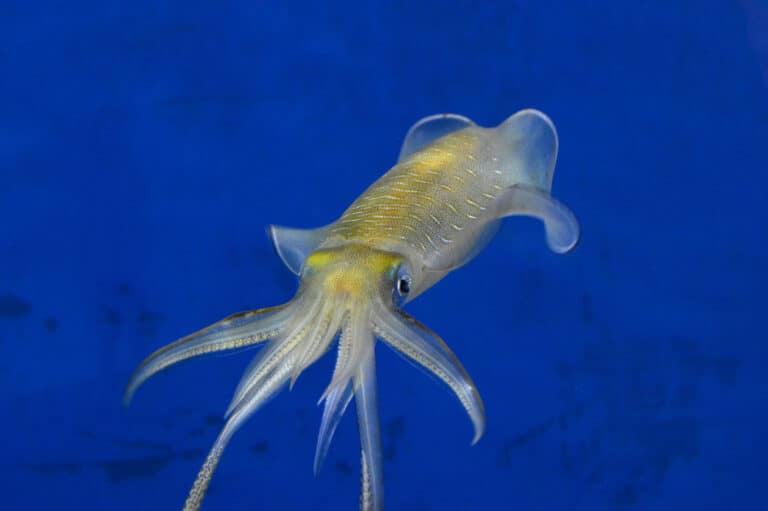
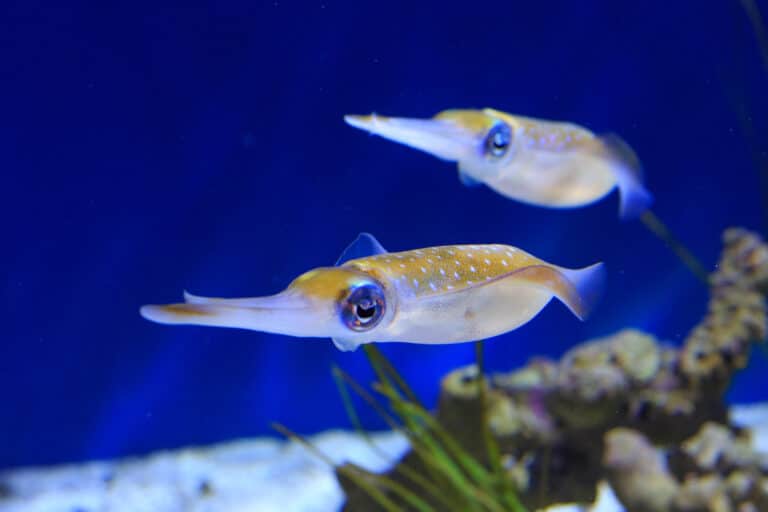
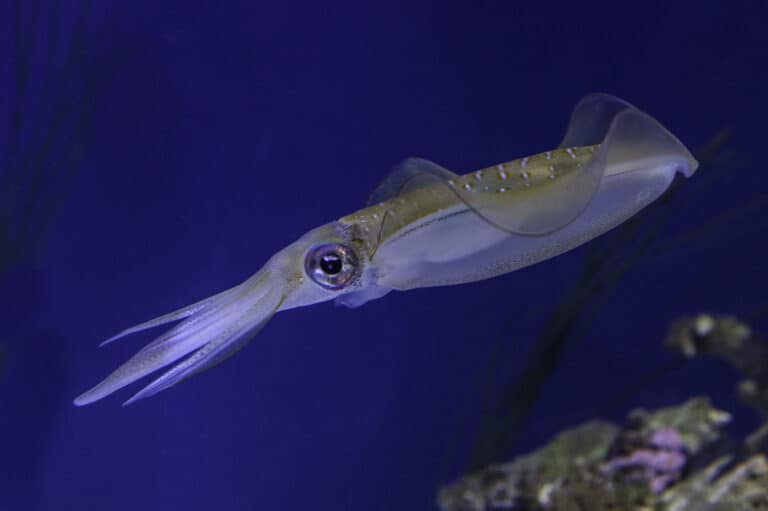
Like other members of their genus, bigfin reef squid feature characteristic oval fins through the mantle that distinguish them from other squids. These fins extend anywhere from 83% to 97% of the mantle length and up to 70% of the mantle width. Due to these fins, people often mistake them for cuttlefish. The mantle appears cylindrical and tapers to a cone at the end. At its longest, the mantle can measure up to 15 centimeters, with males typically measuring larger than females. Males typically weigh between 0.9 and 3.1 pounds, while females weigh from 0.3 to 2.3 pounds. 

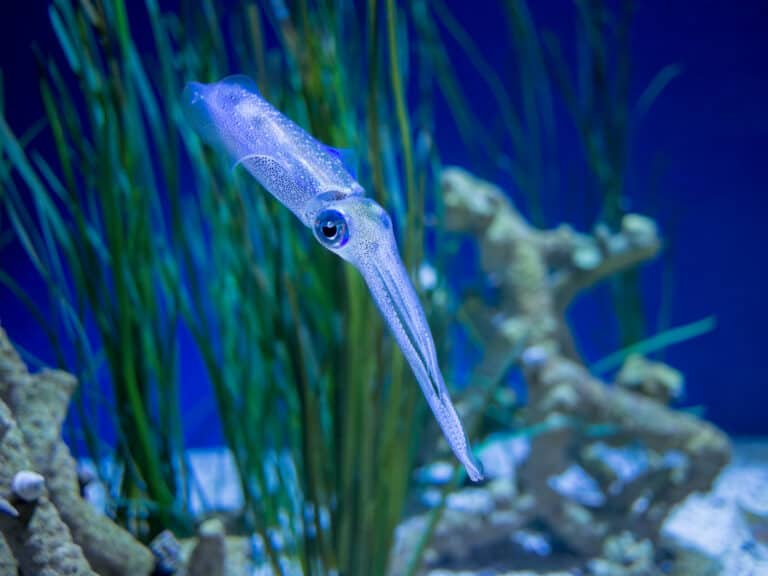
Bigfin reef squid possess large eyes and strong, curved beaks. They have 2 tentacles as well as 8 arms of varying lengths. The arms measure thickest near the body and taper to a narrow point. Each arm possesses two rows of suckers, with each sucker measuring less than 2 millimeters wide and sporting a ring of sharp teeth. 

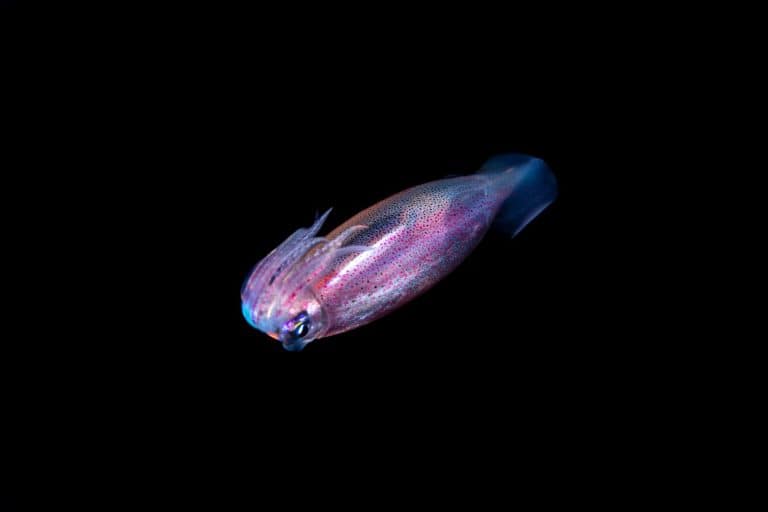
Living bigfin reef squid range in color, including translucent white, pale yellow, and brownish pink. Chromatophores cover the top of the head, mantle, and arms, but not the underside of the fins. These chromatophores allow bigfin reef squid to rapidly change body color and patterns in a process called metachrosis. Additionally, they possess iridophores in the head, which produce iridescent red and green lights when exposed to light. 
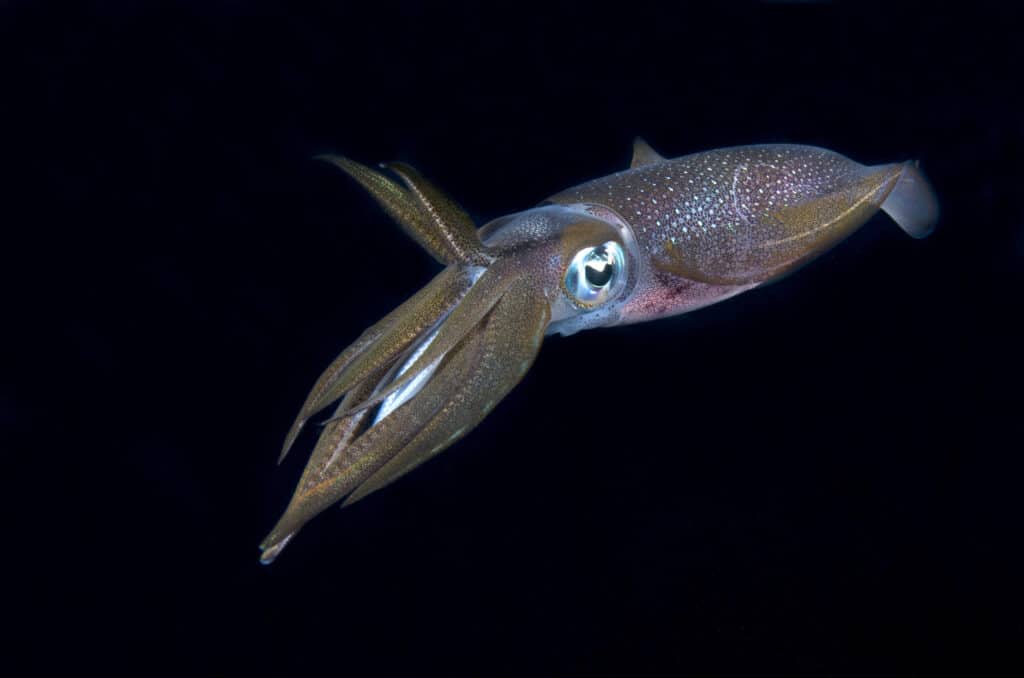
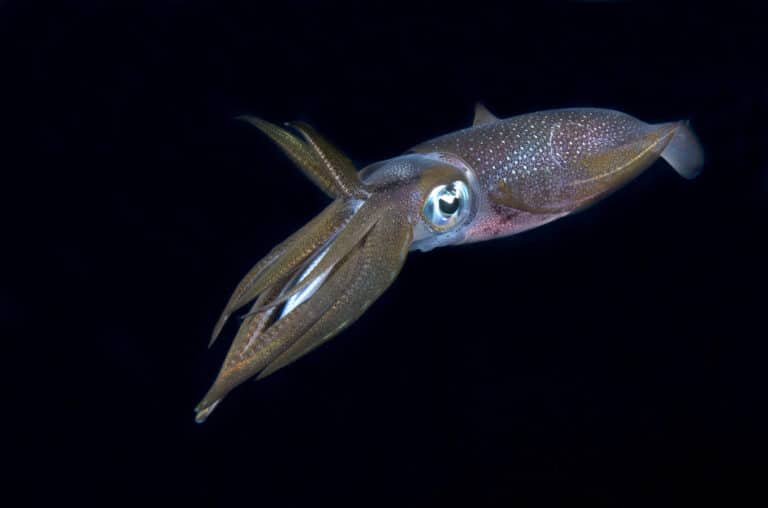
Bigfin Reef Squid in a night dive

Bigfin reef squid have large eyes, strong, curved beaks, 2 tentacles, and 8 arms of different lengths.

Bigfin Reef Squid Behavior

Depending on their age, bigfin reef squid exhibit both shoaling and schooling behavior. Juvenile squid often swim together in groups, although not parallel to each other like some schooling fish. Also, unlike some other squid, adult bigfin reef squid rarely cannibalize one another. This allows squid of different sizes to swim together without the threat of larger members attacking and eating the smaller ones. 

In the presence of light, bigfin squid display intense phototactic responses. They will move close to the light and then stop all other movement. This behavior does not vary based on the color of the light, but stronger lights appear to generate a more powerful response. 

Bigfin Reef Squid Habitat

You will most likely encounter bigfin reef squid in warm, shallow water. They commonly inhabit depths up to 328 feet below sea level. Their preferred habitats include regions near shorelines, rocky outcroppings, and coral reefs, hence their name. The juveniles often congregate under driftwood or other obstructions to avoid predators, particularly during the daytime. 

Bigfin Reef Squid Diet

Bigfin reef squid are carnivorous predators that eat various marine life. They often hunt at night and retreat to deeper waters to hide during the day. Their diet consists primarily of prawns, crustaceans, and fish. They use their tentacles to grab and their 8 arms to hold onto their prey while they eat. Their strong, curved beaks are immensely powerful and perfectly suited for tearing flesh or breaking shells. While they can eat once every few hours, they can also go up to 24 hours between meals. 

Bigfin Reef Squid Predators and threats

Several species prey on bigfin squid, including marlin, tuna, swordfish, sharks, whales, and groundfish. They are most vulnerable during their larval stage when their small size makes them especially susceptible to predators. Bigfin reef squid rely on their camouflage skills and ink sacs to avoid and escape from predators, respectively. They also have rather acute hearing compared to most cephalopods, which allows them to detect nearby predators. Although adult bigfin reef squid rarely cannibalize one another, cannibalism frequently occurs among juveniles. In addition to predators, bigfin reef squid also serve as hosts for several marine parasites such as Doricicola similis, Dicyema koshidae, and Dicyema orientale. 
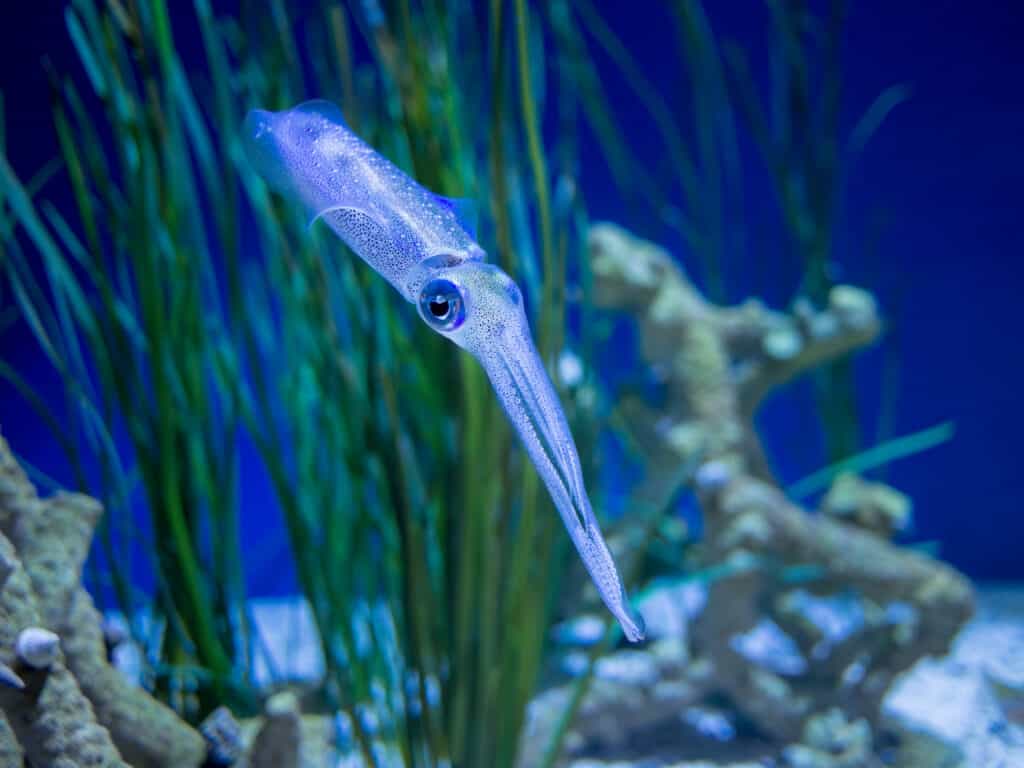
Bigfin reef squid

Bigfin reef squid commonly inhabit depths up to 328 feet below sea level, preferring habitats near shorelines, rocky outcroppings, and coral reefs.

Bigfin Reef Squid Reproduction and Life Cycle

Although bigfin reef squid often spawn in May, they can mate and lay eggs year-round. They typically engage in two different posturing behaviors. The first is called “accentuated gonads,” in which the squid draws attention to its sexual organs by making its mantle translucent while the gonads appear bright white. The second method is often used by males and is called spread arms. This tactic involves the squid tilting its body forward and spreading its arms widely, and most often occurs when a male pursues a prospective female mate. 

When mating, bigfin reef squid employ several approaches, most of which last for only a few seconds. Sometimes, a male may swim rapidly back and forth beside a female before quickly depositing his spermatophores inside the female’s mouth funnel. Smaller males may also sneak up on females while they court a larger male in the hopes of successfully mating while the females are distracted. Other times, males and females may swim together side by side until the male directly deposits his spermatophore into the female’s mantle cavity at the opening of the oviduct. 

Female bigfin reef squid can lay anywhere from 20 to 1,180 eggs throughout their lives. They can lay eggs year-round and die shortly after spawning. The eggs are often attached to rocks, corals, plants, or other underwater surfaces. After incubating for around 3 weeks, the larval squid emerge. They develop rapidly and can exhibit complex color-shifting behavior shortly after birth that doesn’t develop until much later in most other squid species. Males reach sexual maturity at around 140 days, while females sexually mature between 156 and 196 days old. The oldest bigfin reef squid ever recorded lived a total of 315 days, which represents a relatively short lifespan compared to other squid. 
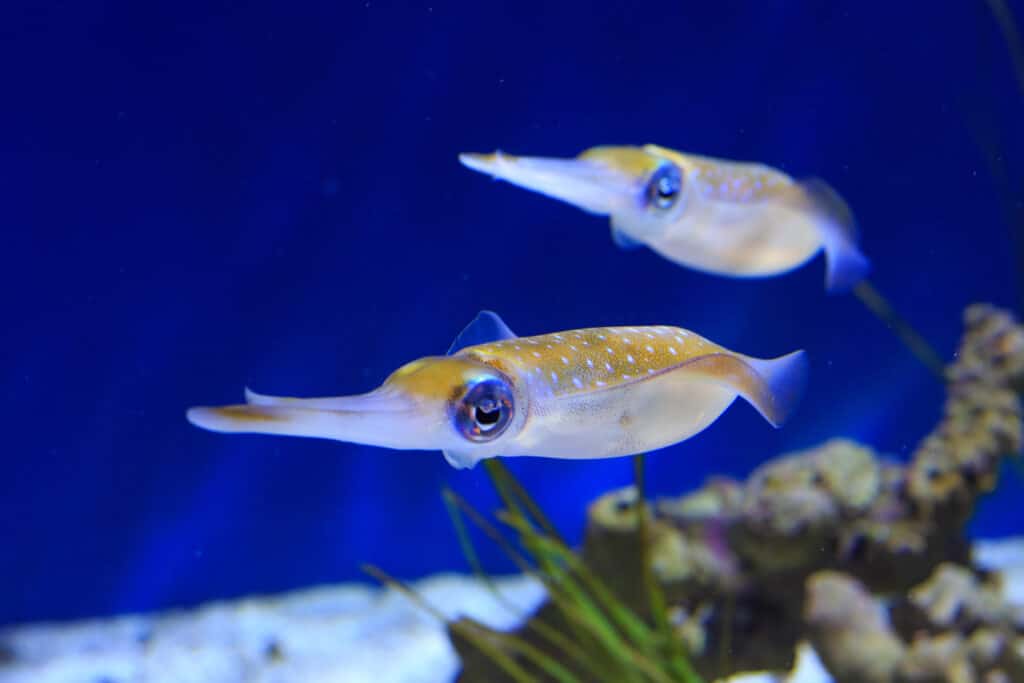
Bigfin reef squids

Male bigfin reef squid reach sexual maturity at around 140 days, while females sexually mature between 156 and 196 days old.

Bigfin Reef Squid Population

Due to their rapid growth rate and abundance, bigfin reef squid are among the most commercially popular squid species. Every year, fishers harvest millions of bigfin squid from the ocean through trawling, seine fishing, and net traps. While most abundant during full moons and in foggy weather, their populations remain stable year-round. This likely has to do with the fact that they do not breed seasonally, so populations are constantly replaced. Despite their increasing importance as a food source, their worldwide population remains stable. As a result, bigfin reef squid have become the subject of much debate concerning their viability for mariculture. 

Bigfin Reef Squid Locations

The bigfin reef squid is the most populous species in the genus Sepioteuthis. You can find them throughout the temperate and tropical waters of the Indian Ocean and the western Pacific Ocean. Their native range extends from the Hawaiian Islands to the Red Sea and from Japan to Australia and New Zealand. In recent years, their range has expanded to include parts of the Mediterranean Sea and the Aegean Sea. 

Bigfin Reef Squid Conservation Status

Given their fast growth rate, fecundity, and widespread distribution, bigfin reef squid are extremely prolific. Their abundance makes them extremely important to commercial fishing operations, and they are a popular food source for many cultures worldwide. Even though fishers collect millions of bigfin reef squid each year, their population shows no signs of decline. Still, the IUCN lists the bigfin reef squid as a Data Deficient species, as not enough information exists at this time to determine its conservation status. 

View all 453 animals that start with B

Sources

  1. Monterey Bay Aquarium / Accessed November 1, 2022
  2. Australian Museum / Accessed November 1, 2022
Thank you for reading! Have some feedback for us?


Bigfin Reef Squid FAQs (Frequently Asked Questions)

Bigfin reef squids are carnivores that typically hunt at night. Their diet consists of crustaceans such as prawns and small fish.