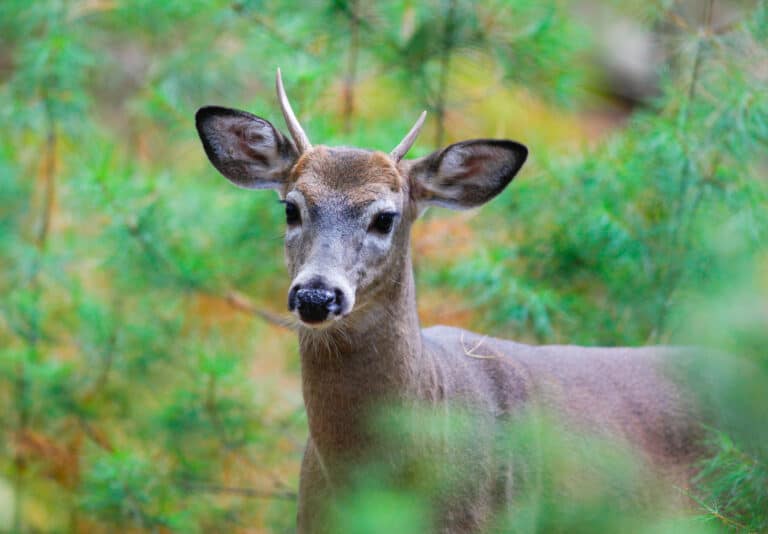
Interesting Fact
“Deer can see blue and yellow, but they cannot distinguish red and orange.”
White-Tailed Deer Summary
White-tailed deer are a common species found in the Americas. They get their name because they flash the white underside of their tails when they are frightened and run away. They are a key species in the ecosystem and have also been a staple for humans, especially in frontier days, as a source of meat and leather. Despite heavy hunting, this species remains plentiful throughout most of its habitat.
White-Tailed Deer Facts
- Texas has the largest white-tailed deer population in the U.S. with 5.3 million.
- Although they are herbivores, they will also occasionally eat mice and birds.
- They have multi-chambered stomachs that enable them to eat toxic mushrooms and poison ivy.
- Deer can see shades of blue and green but not red and orange.
White-Tailed Deer Scientific Name
The scientific name of the white-tailed deer is Odocoileus virginianus. These Latin words mean “hollow-tooth” and Virginia. They are plentiful in Virginia. In fact, one of this species’ common names is the Virginia deer. White-tailed deer are part of the Mammalia class and the Cervidae family. There are 26 subspecies of the white-tailed deer, with 17 of these living in North America. They get the name “white-tailed” from the fact that they hold up their tails when they run away, flashing white hair.
White-Tailed Deer Appearance
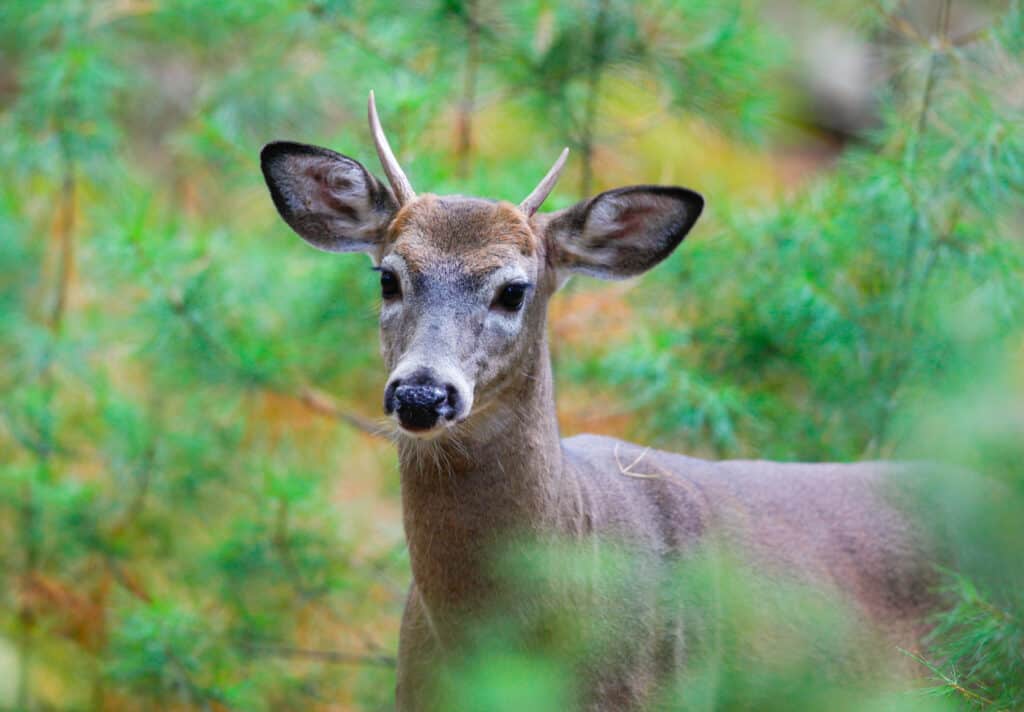
This is a medium-sized deer species. They range in size from 72 to 96 inches long and 24-48 inches tall at the shoulder. They grow larger in colder climates. Males are called bucks and can weigh anywhere from 150-300 pounds. Females, called hinds or does, can weigh 88-200 pounds. Bucks grow antlers each spring and shed them in winter after the mating season. The animal’s age, nutrition, and genetic background influence the size and number of branches in a buck’s antlers.
Interestingly, there is a population of entirely white (not albino) white-tailed deer in New York state. They are concentrated in Deer Haven Park at the Seneca Army Depot in Romulus, New York.
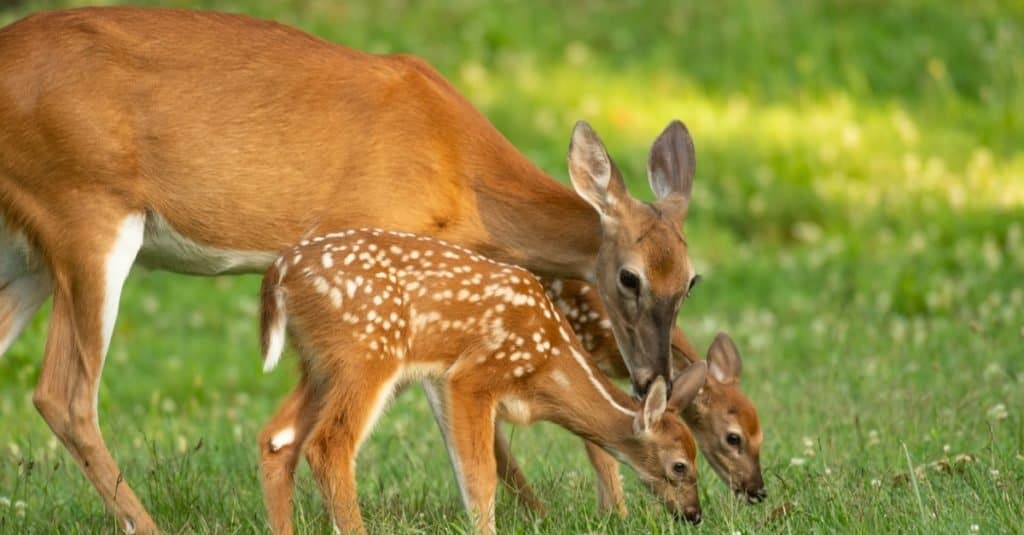
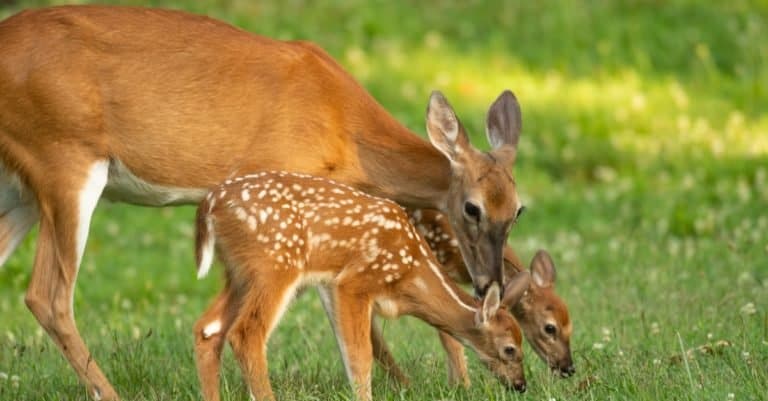
A white-tailed doe and her twin fawns.
©Tony Campbell/Shutterstock.com
White-Tailed Deer Behavior
White-tailed deer are crepuscular, meaning they are most active around dawn and dusk. They have pupils that are slit horizontally, giving them good night vision. Their eyes are adapted to process visual images quickly and see in low light. However, this visual sensitivity is also why they tend to freeze in the road when looking into car headlights; their pupils are dilated at night so they freeze until their eyes adjust to the unexpected light.
They can see in color in shades of blue and yellow but cannot distinguish reds and oranges very well. This is why hunters can wear bright orange as a safety color without attracting a deer’s attention.
White-tailed deer communicate with sounds and body language. Under threat, they will stomp, snort, and raise their tails to show the white fur underneath as a warning to other deer. They also mark their territory with urine and scent glands. A deer’s territory is usually less than one square mile.
Does stay together in family groups with their fawns. Males form their own groups with other males, but separate as individuals during mating season.
White-Tailed Deer Habitat
White-tailed deer are indigenous to North America, Central America, and South America, as far south as Peru, Bolivia, and northern Brazil. This species is the most widely distributed ungulate (a classification of large-hooved mammals) in the Americas. They can adapt to many different habitats: prairies, savannahs, arid sagebrush, and forests, including tropical rainforests.
In North America, they are most plentiful east of the Rocky Mountains, while black-tailed or mule deer are found west of these mountains. Texas is the U.S. state with the largest population of this species—an estimated 5.3 million. White-tailed deer have been successfully introduced to several Caribbean Islands, European countries, and New Zealand. In 1935, four specimens were introduced into Finland; by 2020 these had increased to 109,000.
White-Tailed Deer Diet
White-tailed deer are herbivores. Their appetites are enormous. In one year, a single adult can consume 2,000 pounds of vegetable matter, about the weight of a small car. If you’ve passed a field and seen large round bales of hay about 6′ tall and 5′ wide—a single whitetail deer eats the equivalent in grass and leaves of 1 1/2 of those in a year.
Deer like to forage around dawn and dusk. They like legumes, grasses, leaves, cacti, acorns, and fruit. Because of their multi-chambered stomachs, they are able to digest some foods that are inedible for humans, including toxic mushrooms and poison ivy. In farming areas, they eat hay, clover, corn, and other crops and in suburbs they browse on grass, garden plants, flowers, and shrubbery. Some homeowners intentionally plant deer-resistant species for this reason. Others like to feed deer to attract them to their backyard or out of compassion for them in cold weather. This is a bad idea, though, because it can upset their digestion with an unbalanced diet, alter their normal foraging behavior, and make them unafraid of people. This makes them more vulnerable to hunters and to car accidents.
Although this species is herbivorous, sometimes they do venture into meat-eating territory, which many people would find surprising and even disturbing. They will eat mice and birds sometimes when they are hungry and can catch them. They will also chew on the bones of dead animals when they are lacking minerals like calcium.
Aournd populFeeding wild deer is not a good idea as it can upset the balance of their digestion, make them less afraid of humans and more vulnerable to hunters and car accidents, and increase their population leading to starvation and disease.
White-Tailed Deer Predators, Threats, and Conservation Status
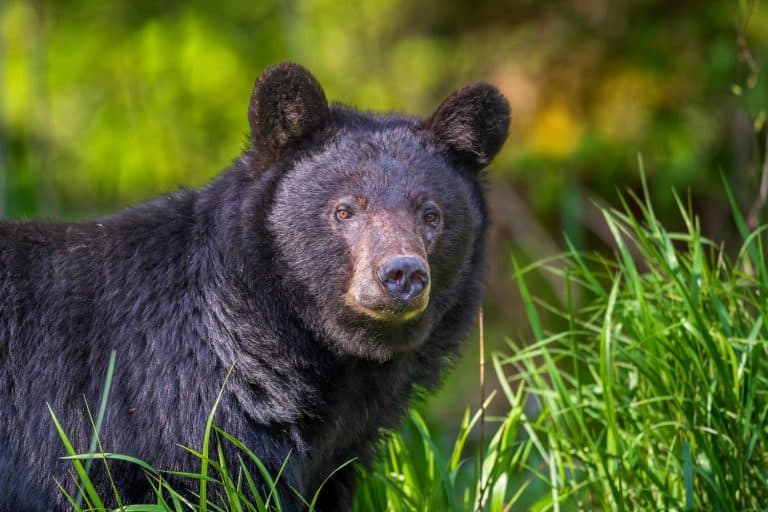
The wild predators of the white-tailed deer include wolves, pumas, American alligators, bears, coyotes, lynx, bobcats, wolverines, and feral dogs. A more recent threat has emerged in the Everglades of south Florida, where a growing population of invasive Burmese pythons can eat adult deer when full-grown. Fawns can fall prey to predatory birds, including eagles.
As with many species, white-tailed deer are most threatened by humans. Historically they have been an important source of nutrition, leather, and materials for traditional handicrafts. Today, the main threat to them from humans is loss of habitat, sport hunting, and collisions with vehicles on the road. Farmers and homeowners often consider them a nuisance because of the damage they do to crops and landscaping.
Despite these threats, white-tailed deer remain plentiful, with a worldwide population of over 10 million. Their population is stable, and their conservation status is “Least Concern.” However, two subspecies of the white-tailed deer, the Florida key deer and Colombian white-tailed deer, are considered “endangered.
White-Tailed Deer Reproduction, Babies, and Lifespan
The breeding season for white-tailed deer is called the rut. It happens in October or November. Bucks spend most of the year in same-sex groups, but during the rut they become solitary and use their antlers to fight other males for their choice of does. Each buck tries to mate with as many females as possible during mating season.
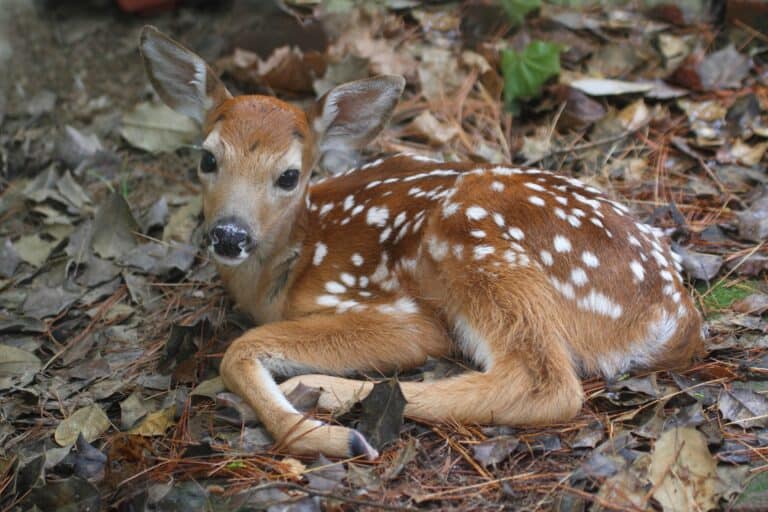
After mating, gestation takes 201 days. A doe gives birth to between one and three fawns weighing 6-8 pounds at birth. These babies will grow to 60-70 pounds by their first winter. They have reddish fur with a white underbelly and white spots on their backs for camouflage. These fade away with adulthood. Does hide their fawns in the undergrowth and nurse them four to five times a day. They are weaned from their mother’s milk after two to three months.
Young bucks leave their mothers earlier than their sisters. Bucks mature at about 18 months, while young does mature sexually at six months but stay with their mothers until they are two years old.
The life expectancy of a white-tailed deer ranges from six to 14 years. In captivity, they can live as long as 20 years.
White-Tailed Deer Population
The global population of white-tailed deer is estimated at over 10 million and is stable. In some areas, they hybridize with local species or displace them from their habitat.
Similar Animals to the White-Tailed Deer
- Elk – Like deer, elk are part of the Cervidae family, but they grow much larger, up to 1,300 pounds. They prefer mountainous forests and travel in large herds.
- Moose – These members of the deer family have large, wide, flat antlers and a large muzzle. They are the largest deer species in the world, weighing up to 1,500 pounds.
- Reindeer – Also known as caribou, these deer range further north than other deer species. They can be found in sub-Arctic boreal forests and tundra regions. They do not weigh as much as elk, but they have larger antlers than elk relative to their body size.
Related Animals
Whitetail Deer Pictures
View all of our Whitetail Deer pictures in the gallery.

Steve Byland/Shutterstock.com
Sources
- ThoughtCo. / Published June 2, 2019 / Accessed November 9, 2022
- Wikipedia.org / Published November 4, 2022 / Accessed November 9, 2022
- AnimalWised / Published January 8, 2017 / Accessed November 9, 2022
- SteaksAndGame.com / Accessed November 9, 2022
- New Hampshire Charitable Foundation / Accessed November 9, 2022
- The New York Times / Accessed November 9, 2022