N S W E
Wildlife Expeditions

Wildlife of
District of Columbia

A surprisingly wild capital where river corridors, tidal wetlands, and big-city parks host eagles, ospreys, and major migratory birdlife.
56 Species
158.3 km² Land Area
Overview

About District of Columbia

Even though the District of Columbia is mostly urban, the Potomac and Anacostia rivers and many protected parklands give it a strong natural heritage. Green and blue corridors provide safe places for wildlife—raptors overhead, turtles and fish in shallow water, and songbirds moving through wooded slopes during migration. Key habitats include tidal freshwater wetlands and mudflats on the Anacostia, river edges and riparian forests on the Potomac, and mature urban woodlands and meadows such as Rock Creek Park. These areas help resident animals and serve as a rest and refuel stop on the Atlantic Flyway. You can see bald eagles and ospreys over working riverfronts, meet beavers and river otters inside the city, and visit many habitat types in one small district.

Physical Features

Geography

The District of Columbia sits on the tidal Potomac River at the fall line between the Piedmont and Atlantic Coastal Plain, creating river, wetland, and upland parks in an urban area. Wildlife is shaped by the Potomac and Anacostia corridors, Rock Creek and remnant stream valleys, and fragmented forests and parks serving as refuges for birds, mammals, amphibians, and pollinators.

158.3 km² (land area) Land Area
Smallest U.S. federal district; smaller than any U.S. state Size Rank
Federal district Type
Elevation Range

Approximately sea level (tidal river margins) to ~125 m (Fort Reno area)

Coastline

No ocean coastline; has tidal river shoreline along the Potomac and Anacostia (within the Chesapeake Bay watershed)

Key Landscapes

Potomac River (tidal freshwater reach) and associated riparian forests, mudflats, and wetlands Anacostia River and tidal tributary wetlands/marshes Rock Creek valley (forested stream corridor; major urban wildlife corridor) Small tributary stream networks and floodplains (habitat for amphibians, turtles, and riparian birds) Fall-line/Piedmont-Coastal Plain transition zone (subtle but important changes in soils, hydrology, and plant communities) Urban parklands and wooded fragments (e.g., Rock Creek Park, national mall tree canopy, large cemeteries) that provide stopover and breeding habitat
State Symbols

Official Wildlife Symbols

bird

Wood thrush

Designated 1938

wildflower

American Beauty rose

Designated 1938

tree

Scarlet oak

Designated 1938

Parks & Reserves

Protected Areas

Urban Washington, D.C., has protected river corridors, tidal wetlands, and forested parklands along the Potomac and Anacostia. National Park Service lands like Rock Creek, Anacostia/Kenilworth, and Potomac Park, plus city greenways and stream-valley parks, support Atlantic Flyway migratory birds, urban mammals, and native pollinators. No federal wilderness, but large parks and marshes give roadless-feeling habitat.

Protected Coverage

≈20-25% of D.C.'s land area is in parks or conservation-managed open space (notably NPS and District parklands; exact share varies by definition of "protected").

National Parks & Preserves

Rock Creek Park (National Park Service)

≈1,754 acres

A large forested stream-valley running through the city, providing interior woodland habitat, a migratory bird corridor, and one of the best places in D.C. to see forest birds and mammals away from the waterfront.

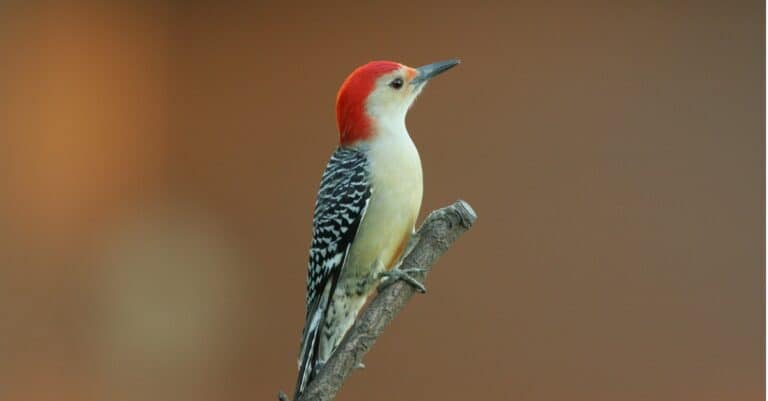
White-tailed deer Red fox Barred owl Pileated woodpecker Wood duck

Anacostia Park (National Park Service)

≈1,200+ acres

A major riparian greenbelt along the tidal Anacostia River with marsh edges, river shallows, and restored habitat patches that support waterbirds, raptors, turtles, and seasonal fish and waterfowl activity.

Bald eagle Osprey Great blue heron Double-crested cormorant Painted turtle

Kenilworth Park & Aquatic Gardens (National Park Service)

≈700 acres (Aquatic Gardens core ponds are smaller within the larger park)

D.C.'s signature freshwater marsh-and-pond complex, famous for lotus and water lilies and exceptional for birding, dragonflies, amphibians, and wetland restoration in an urban setting.

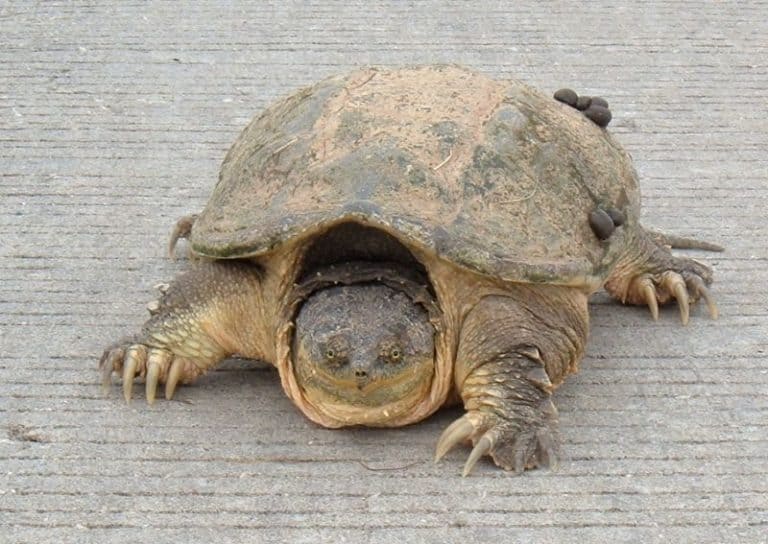
Great egret Green heron Red-winged blackbird Snapping turtle Beaver

National Mall and Memorial Parks (National Park Service)

≈1,900+ acres (overall managed area; habitat value concentrated near water and tree canopy)

Primarily monumental landscapes, but with meaningful urban habitat around the Tidal Basin, Constitution Gardens, and Potomac Park edges-good for waterfowl, gulls/terns seasonally, and night-flying bats.

Mallard Canada goose Ring-billed gull Bald eagle (overflight/river edge) Eastern red bat

Chesapeake & Ohio Canal National Historical Park (D.C. segment) (National Park Service)

D.C. segment is small; entire park is ≈19,650 acres across MD/WV

The canal and Potomac shoreline at Georgetown provide riparian cover and a linear travel corridor for birds and mammals, with wintering waterfowl and spring migration activity along the river.

Great blue heron Belted kingfisher Song sparrow Red-tailed hawk Wood duck

Theodore Roosevelt Island (part of George Washington Memorial Parkway) (National Park Service)

≈88 acres

A wooded Potomac River island with boardwalks through swampy forest and marsh edges-excellent for spring songbird migration and close-range views of riverine wildlife.

Bald eagle Osprey Prothonotary warbler (seasonal) Great blue heron Beaver

State & Provincial Parks

Kingman and Heritage Islands (District of Columbia parkland)

≈110 acres combined (approx.)

Restored tidal-island habitat in the Anacostia River with boardwalks and expanding wetlands-strong for birding, pollinators, and showcasing urban river restoration.

Osprey Great egret Red-winged blackbird Northern water snake Monarch butterfly (seasonal)

Glover-Archbold Park (District of Columbia parkland)

≈180 acres (approx.)

A wooded ravine/stream corridor that functions as a quiet refuge for forest and edge species; valuable for migratory songbirds and small-mammal urban biodiversity.

Red fox Barred owl Downy woodpecker Eastern gray squirrel Wood thrush (seasonal)

Oxon Run Park (District of Columbia parkland)

≈100+ acres (approx., varies by counted parcels)

Stream-valley green space in southeast D.C. that supports riparian birds, amphibians, and pollinators, and provides connectivity between neighborhood green patches.

Red-tailed hawk American robin Eastern box turtle (possible/regionally present) Gray treefrog (seasonal) Eastern cottontail

Wilderness Areas

  • No designated federal Wilderness Areas exist within the District of Columbia.
  • Rock Creek Park interior forest and tributary ravines (largest continuous "roadless-feeling" woodland in D.C.).
  • Kenilworth Marsh and adjacent Anacostia River tidal wetland edges (best undeveloped wetland habitat block).
  • Glover-Archbold stream valley corridor (quiet, wooded ravine habitat with limited roads).
  • Theodore Roosevelt Island trail network (compact but notably natural river-island woodland).
Animals

Wildlife

Despite being fully urbanized, the District of Columbia supports surprisingly high wildlife diversity because it sits on a major Atlantic Flyway corridor and contains substantial green/blue infrastructure: the Potomac and Anacostia Rivers, tidal marshes and backwaters (e.g., Kenilworth Aquatic Gardens), wooded stream valleys (Rock Creek Park), and large parklands and riparian edges. Wildlife viewing is strongest for birds (migration, wintering waterfowl, raptors), riverine fish and turtles, and adaptable urban mammals (deer, foxes, beaver).
~45-60 species (including bats and common urban/suburban mammals) Mammals
~300+ species recorded (very strong migration and winter waterfowl diversity) Birds
~20-25 species (turtles and snakes most commonly encountered) Reptiles
~10-15 species (frogs and salamanders in park wetlands/woods) Amphibians
~70-100+ species in DC waters of the Potomac and Anacostia (varies by source and sampling) Fish
Examples

Iconic Species

Bald Eagle
Bald Eagle A flagship conservation success: eagles are now regular year-round along the Potomac and Anacostia, and nesting/foraging birds are a marquee wildlife sight in the nation's capital.
Osprey
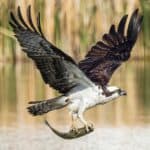
Osprey Frequently seen hovering and diving for fish along the Potomac/Anacostia; a signature raptor of DC's river corridors and restored waters.
Great Blue Heron
Great Blue Heron Commonly stalks shorelines, wetlands, and park ponds; one of the most visible large wading birds for visitors in river and marsh habitats.
Wood Duck
Wood Duck A colorful wetland species often seen in backwaters and wooded creeks (including Rock Creek and Anacostia wetlands), especially in spring and summer.
Peregrine Falcon
Peregrine Falcon Uses tall buildings and bridges as cliff analogs; an iconic urban raptor that draws attention during migration and (in some years) local nesting attempts/territorial pairs.
White-tailed Deer
White-tailed Deer The most conspicuous large mammal in DC's park forests (notably Rock Creek Park), shaping vegetation and frequently seen at dawn/dusk.
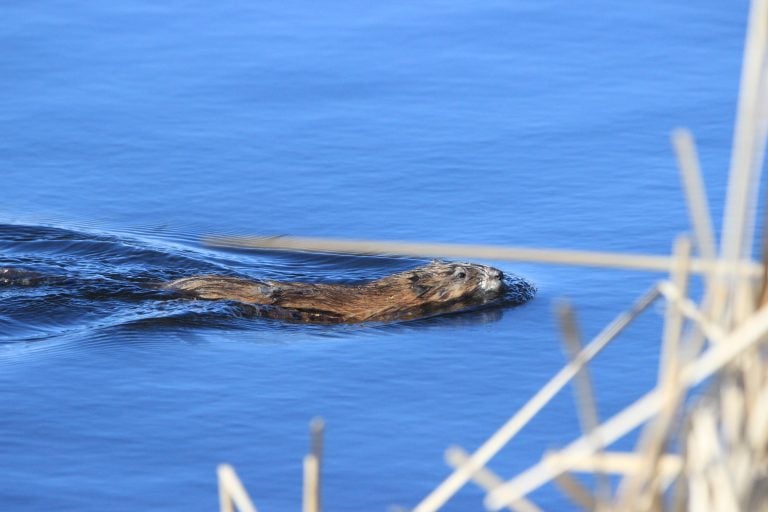
American Beaver A charismatic wetland engineer increasingly associated with Anacostia tributaries and slow-water edges; signs include gnawed trunks and lodges/bankside burrows.
North American River Otter
North American River Otter A celebrated indicator of improving urban waterways; still not guaranteed, but sightings have increased in and around DC's rivers.
Eastern Painted Turtle The classic basking turtle of DC ponds and slow river edges-easy to spot on logs and rocks during warm months.
American Shad A migratory fish historically central to the Potomac fishery; spring spawning runs are a key natural spectacle tied to river restoration and fish-passage efforts.

Endemic & Rare Species

Hay's Spring Amphipod

Stygobromus hayi

Federally Endangered (U.S.)

A tiny groundwater crustacean endemic to a handful of springs in the Washington, D.C. area (notably associated with Rock Creek Park). It's one of the most locally unique animals tied to DC's hidden subterranean habitats.

Peregrine Falcon

Falco peregrinus

Locally uncommon breeder; widely recovered from historic declines

While now commoner as a migrant, nesting in dense urban cores remains relatively limited and closely watched; DC sightings highlight raptor recovery and urban adaptation.

Rusty Blackbird

Euphagus carolinus

Globally vulnerable/steeply declining (population decline across North America)

A scarce migrant/winter visitor in the region; when it appears in DC wetlands/park edges it reflects broader conservation concern for rapidly declining boreal wetland birds.

Wood Thrush

Hylocichla mustelina

Significant long-term decline (continental); sensitive forest-interior breeder

Breeds in larger wooded parks (especially Rock Creek). Its presence is a key indicator of higher-quality urban forest habitat, but it has declined due to habitat loss and pressures on migratory routes/wintering grounds.

Northern Long-eared Bat

Myotis septentrionalis

Federally listed as Endangered (U.S., current listing framework); impacted by white-nose syndrome

Historically present in the region but now rare; any occurrence in/near DC underscores ongoing bat declines and the importance of protecting roosts and forest foraging habitat.

Notable Populations

  • Atlantic Flyway concentration: DC's rivers, reservoirs, and parks host heavy spring/fall migration with notable raptor and songbird turnover, plus large wintering waterfowl on the Potomac.
  • Urban bald eagle recovery: regular year-round use of DC's river corridors by eagles is nationally emblematic of raptor recovery in heavily developed landscapes.
  • Shad and river herring restoration context (regional significance): spring runs in the Potomac system-adjacent to and within DC waters-are a high-profile benchmark for Chesapeake Bay watershed river restoration.

Recent Changes

  • Bald eagles and ospreys have increased dramatically since late-20th-century lows, reflecting reduced contaminants and improved legal protection; they are now routine sights along DC's rivers.
  • River otter sightings have increased in the Potomac/Anacostia system, widely interpreted as a sign of improving water quality and habitat connectivity in urban rivers.
  • Beavers have expanded/returned in parts of the Anacostia watershed, with more frequent evidence of dam- and lodge-building in tributaries and slow-water reaches.
  • White-tailed deer densities have risen in urban park forests (notably Rock Creek Park), increasing browse pressure on native understory plants and complicating forest regeneration.
  • Invasive fish (notably Northern Snakehead, Channa argus) have expanded in the Potomac/Anacostia system, altering local angling and potentially affecting food webs.
  • Some forest and wetland birds (e.g., Wood Thrush and other Neotropical migrants) show long-term declines tied to habitat fragmentation, predation pressures, and broader continental drivers.
Visit

Wildlife Viewing

Urban Washington, D.C. still has rich wildlife along the Potomac and Anacostia, big parks, and wetlands. Birding is excellent in spring and fall migration; raptors and waterfowl are reliable in winter. Beavers, otters, and foxes live in larger parks. Bald eagles and ospreys are often seen near monuments. Key habitats: tidal river edges, marshes, forested ravines, and managed islands.

Best Seasons

Spring (Mar-May)

Peak migration season: warblers, vireos, thrushes, and shorebirds pass through; resident bald eagles and ospreys become very active; amphibian calls ramp up in wooded parks. Best for early-morning walks at riverside parks and wetlands, with frequent "new bird" days.

Summer (Jun-Aug)

Breeding season for many residents: ospreys fishing the Potomac, herons/egrets along tidal creeks, swallows and chimney swifts overhead; turtles basking and dragonflies abundant. Start early to beat heat/humidity; evenings are great for bats and firefly viewing in larger green spaces.

Fall (Sep-Nov)

Second strong migration wave with raptors and songbirds moving through; excellent hawk watching on clear, breezy days; waterbirds build in number along the Potomac; foliage improves forest-park wildlife visibility. Ideal for photography and longer hikes without summer humidity.

Winter (Dec-Feb)

Best season for waterfowl and many raptors: ducks and geese concentrate on open water; bald eagles are often easiest to spot; quiet trails make for good mammal tracking (fox, deer sign in larger park units). Cold snaps can push birds to certain river sections-great for focused viewing.

Top Wildlife Experiences

  • Bird the tidal wetlands and boardwalks at Kenilworth Aquatic Gardens (Anacostia River) for marsh birds, herons/egrets, turtles, and (in season) lotus and water-lily habitats that attract insects and feeding birds.
  • Scan for bald eagles, ospreys, and waterfowl along the Potomac River waterfronts-especially around Roosevelt Island and East Potomac Park-using early morning light for the best viewing and photography.
  • Take a paddle (kayak/canoe) on the Anacostia River with a focus on wildlife: look for herons, kingfishers, turtles, and beaver sign along quieter shorelines; dawn/evening trips often have the most activity.
  • Walk Rock Creek Park's forested trails (e.g., along Rock Creek and quieter side paths) to look for woodpeckers, owls (at dusk), migratory songbirds in spring/fall, and mammals like fox and deer in low-traffic areas.
  • Visit Fort Dupont Park and nearby green corridors for dawn chorus birding, butterflies, and woodland species-especially productive during spring migration.
  • Plan a winter waterfowl day: combine river overlooks and park shorelines (Potomac and Anacostia corridors) to tally ducks, geese, gulls, and raptors; bring a spotting scope if you have one.
  • Do a twilight 'urban nature' session: watch bats and swifts over open fields and waterways, then listen for owls in larger parks (Rock Creek Park is a classic choice); a headlamp and quiet pacing help minimize disturbance.

Wildlife Watching Types

Birding hotspots (migration, wetlands, woodland birding) Raptor watching (bald eagles, ospreys, hawks-seasonal concentrations) Waterfowl and shorebird viewing along tidal rivers and marsh edges Urban mammal watching (fox, deer sign in larger parks; beaver sign along waterways) Heron/egret and kingfisher watching along riverbanks Reptile and amphibian watching (turtles basking; seasonal frog/toad choruses) Butterfly and dragonfly watching in gardens, meadows, and wetland edges Night wildlife walks (owls, bats-best at dusk/early night)

Guided Options

  • National Park Service (NPS) ranger-led walks and interpretive programs in Rock Creek Park and other NPS-managed sites-seasonal schedules often include bird walks and natural history programs.
  • Kenilworth Aquatic Gardens (NPS) ranger/nature programs and seasonal events focused on wetlands ecology, birds, pollinators, and aquatic habitats.
  • DC Audubon Society bird walks and field trips (often covering migration hotspots, urban birding routes, and seasonal species targets).
  • Paddling and river-ecology programs with local boating organizations on the Anacostia and Potomac (look for guided nature paddles and cleanup-plus-wildlife outings).
  • Local nature centers and partner organizations offering family-friendly wildlife programs, birding basics, and seasonal bio-blitz style events in D.C. parks and along river trails.
Habitats

Ecosystems

Washington, D.C., on the Potomac River at the Mid-Atlantic fall line where Piedmont uplands meet the Coastal Plain, is very urban but still has different ecosystems. Large parks (Rock Creek Park, National Arboretum), river corridors (Potomac, Anacostia), tidal freshwater shorelines, and restored wetlands keep parts of the temperate broadleaf forest and riverine wetlands.

Biomes

Temperate Forest

Historically dominated by Mid-Atlantic oak-hickory and mixed hardwood forests; today represented by mature second-growth forest patches, wooded ravines, and managed urban tree canopy in major parks (notably Rock Creek Park).

Moderate but fragmented; concentrated in large park units and stream valleys, with extensive street-tree canopy elsewhere.

Freshwater

The Potomac River and Anacostia River define the district's aquatic core; includes tidal freshwater reaches, tributary streams (e.g., Rock Creek), and engineered waters (canals, stormwater outfalls) influencing water quality and habitat.

Linear corridors along both rivers plus smaller streams; aquatic areas are a small fraction of land area but dominate ecological connectivity.

Wetland

Tidal freshwater marshes, riparian wetlands, and floodplain swales occur along the Potomac and Anacostia margins, including restored and managed wetlands that support waterfowl, amphibians, and nursery habitat for fish.

Limited and patchy; mostly confined to river edges, backwaters, and restoration sites (especially along the Anacostia and Potomac floodplain).

Habitats

Urban

Dominant matrix of dense development, impervious surfaces, and managed greenspaces; significant urban tree canopy and park system create habitat islands and corridors.

Suburban

Lower-density residential neighborhoods with yards, street trees, and small parks; important for urban-adapted birds, pollinators, and small mammals.

Deciduous Forest

Hardwood stands in Rock Creek Park and other ravines/uplands, with oaks, tulip poplar, beech, and understory communities typical of the Mid-Atlantic.

Woodland

Edge habitats and mixed tree cover in parks, cemeteries, and along stream buffers; often includes invasive understory but still provides nesting and foraging structure.

River/Stream

Potomac and Anacostia main channels and tidal tributaries; includes riprapped banks, natural shore segments, and aquatic migration/foraging routes.

Wetland

Riparian and tidal freshwater wetlands along both river corridors; functions include nutrient filtering, flood storage, and wildlife breeding habitat.

Marsh

Tidal freshwater marsh pockets and restoration areas along the Anacostia and Potomac margins; dominated by emergent vegetation and shallow-water habitats.

Pond

Small impoundments, ornamental ponds, and stormwater ponds/retention basins that provide localized amphibian and bird habitat (often heavily managed).

Agricultural/Farmland

Very limited; mostly community gardens and small institutional plots rather than broad agricultural landscapes.

Ecoregions

EPA Level III: Piedmont EPA Level III: Middle Atlantic Coastal Plain WWF Terrestrial Ecoregion: Middle Atlantic coastal forests
Protection

Conservation

Primary Threats

  • City stormwater runoff from paved areas sends nutrients, sediment, road salt, metals, oils, and bacteria into the Anacostia and Potomac. Old contamination (like PCBs in sediments) and warnings about eating fish remain. Combined sewer overflows during storms were reduced by big control tunnels but still occur.
  • Because the District is built-out, habitat is limited to parks, riparian corridors, and small patches. Ongoing redevelopment can reduce tree canopy, simplify habitat structure, increase light/noise, and intensify shoreline hardening along waterfront areas unless mitigated through green infrastructure and habitat-sensitive design.
  • Wetlands and tidal marsh edges have been lost or narrowed by shoreline armoring, fill, and channelization along the Anacostia and Potomac. Small headwater streams in the Rock Creek and Anacostia watersheds are constrained by culverts and altered hydrology, reducing spawning and nursery habitat for aquatic species.
  • Road crossings, culverts, outfalls, seawalls/bulkheads, and navigation-related dredging/engineered channels fragment habitat and alter flow and sediment dynamics. Stream burial and barriers limit movement of fish and aquatic organisms and reduce connectivity between floodplains, wetlands, and mainstem rivers.
  • Historically straightened/armored streams, altered storm hydrographs (flashier flows), and managed river edges reduce habitat complexity. In-park deer overbrowsing in forested areas (notably Rock Creek Park) can suppress native understory regeneration and affect ground-nesting birds and pollinator plants.
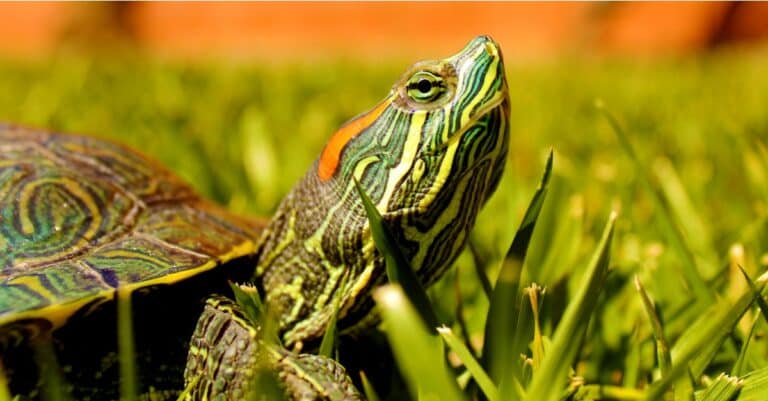
  • Invasives are widespread in riparian and forest understories (e.g., English ivy, Japanese stiltgrass, mile-a-minute) and in aquatic systems (e.g., snakehead in the Potomac/Anacostia region; aquarium/pet releases like red-eared sliders). These species outcompete natives and can shift food webs and habitat structure in small urban natural areas.
  • Heavier downpours increase stormwater pulses and erosion, stressing streams and worsening bacteria/nutrient delivery. Hotter summers elevate urban heat impacts and warm-water stress for aquatic life. Sea-level rise and tidal influence in the lower Anacostia and Potomac increase risks of tidal wetland squeeze where shorelines are hardened.
  • High visitation in major parks and along river trails increases disturbance to nesting birds, roosting bats, and sensitive riparian zones; off-trail use and informal access points can accelerate bank erosion and trampling of wetlands and emergent vegetation.
  • White-nose syndrome has severely affected cave-hibernating bats regionally, reducing local populations and increasing vulnerability of remnant roosts in park trees and structures. Periodic outbreaks of avian diseases (e.g., avian influenza) can affect waterfowl concentrations on the Potomac/Anacostia and urban impoundments.
  • Conflicts concentrate around adaptable urban wildlife: deer impacts on vegetation and gardens, resident Canada goose issues on lawns and waterfront parks, and occasional beaver/fox/coyote encounters. These conflicts can drive pressure for removals rather than habitat-based solutions.
Fun Facts

Did You Know?

Bald eagles now nest and raise young inside the District again; a well-known nest along the Anacostia corridor (near the U.S. National Arboretum area) has made eagle sightings a routine part of D.C. commuting routes.

The Anacostia and Potomac can host northern snakehead, an invasive fish that can gulp air and survive out of water long enough to wriggle between wet areas-one reason it became a headline species in the D.C. region.

Remote cameras and reports have confirmed coyotes using green corridors like Rock Creek Park-an apex-ish urban predator living within miles of the U.S. Capitol and helping suppress rats and other small mammals.

Despite heavy urbanization, river otters have been documented again in the D.C. area's tidal rivers-an animal that typically signals improving aquatic habitat and food webs in recovering waterways.

Washington, D.C. has a resident pair of peregrine falcons at the Washington National Cathedral-meaning you can see the world's fastest animal (peregrine dives can exceed 200 mph) hunting over a downtown skyline.

Rock Creek Park (1,754 acres) is the District's largest contiguous natural habitat, and its long bird list (200+ species recorded) is exceptional for a fully urbanized U.S. capital.

Kenilworth Aquatic Gardens is the only National Park Service unit dedicated to cultivated aquatic plants-its lotus and water-lily ponds make it a one-of-a-kind wildlife-and-habitat site in the entire national park system.

The Potomac's tidal reach through D.C. is visited by Atlantic sturgeon-one of the largest and longest-lived fish in North America (often 6-10+ feet, decades old), a living "dinosaur fish" that still moves past the capital on spawning runs.

Thank you for reading! Have some feedback for us?