G
Species Profile

Gypsy Moth

Lymantria dispar

Big appetite. Big forest impact.
iStock.com/yod67
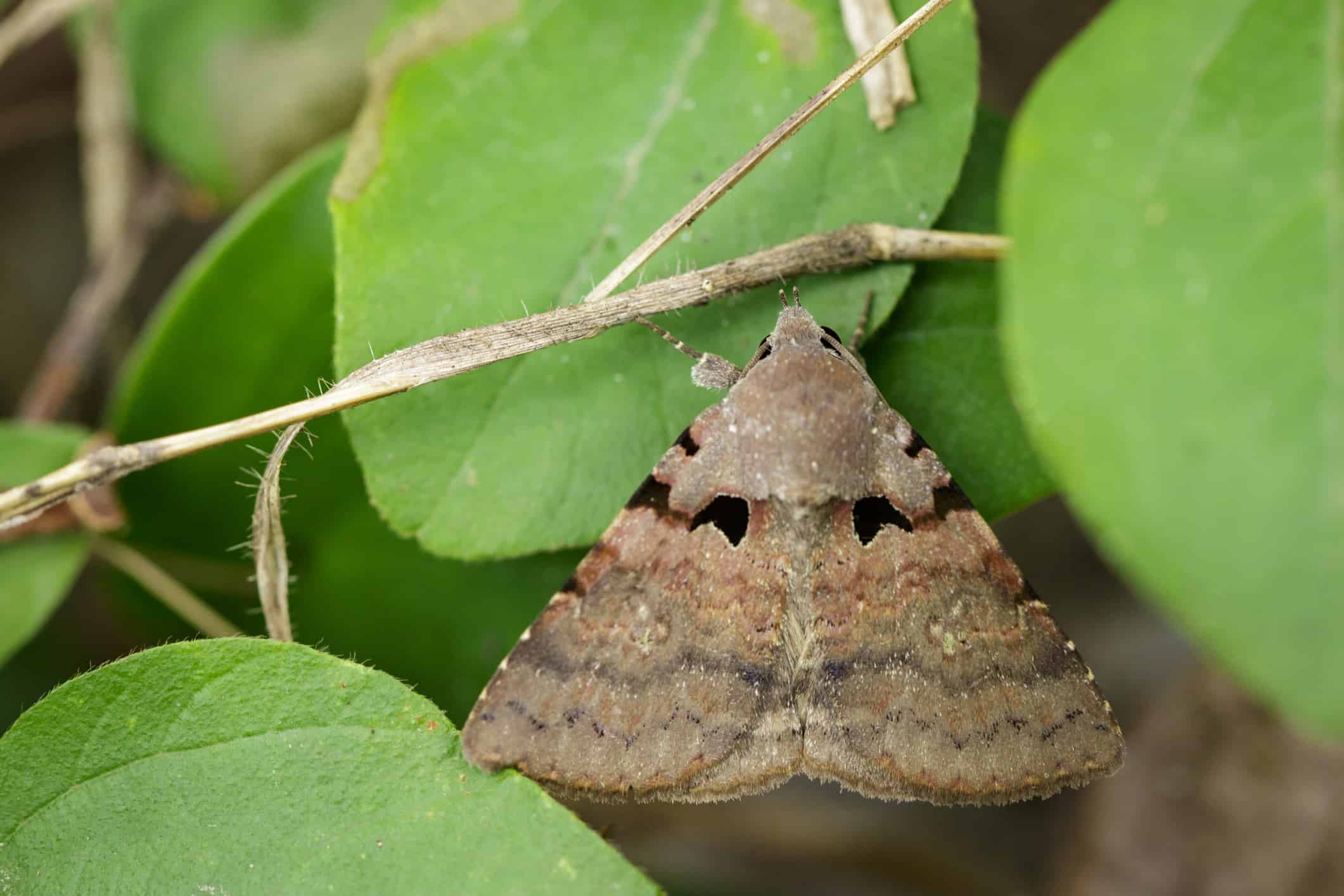
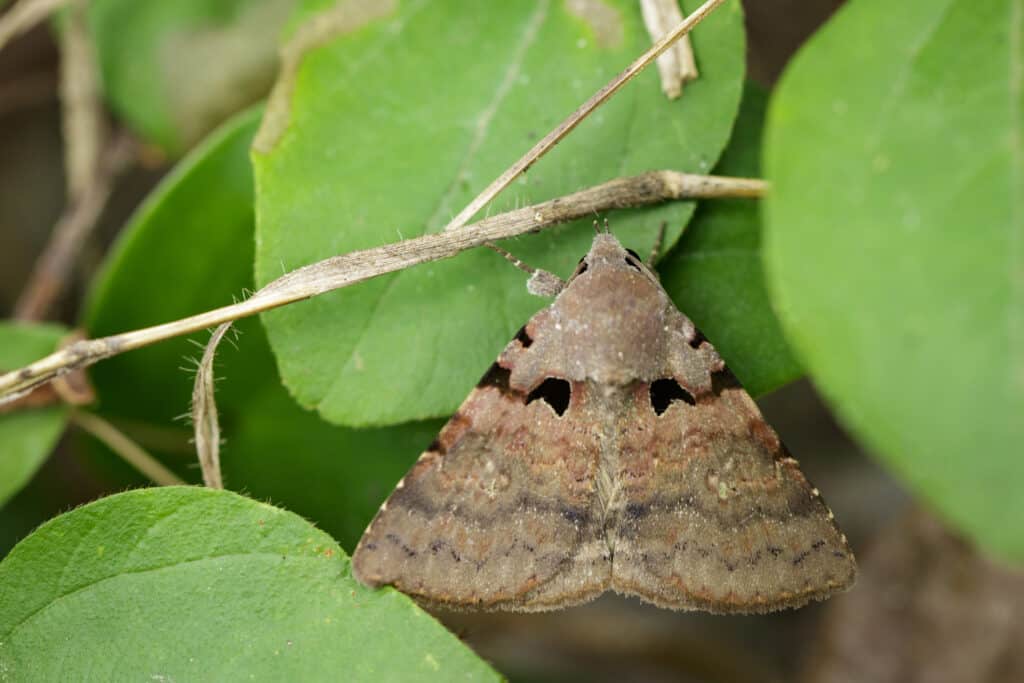
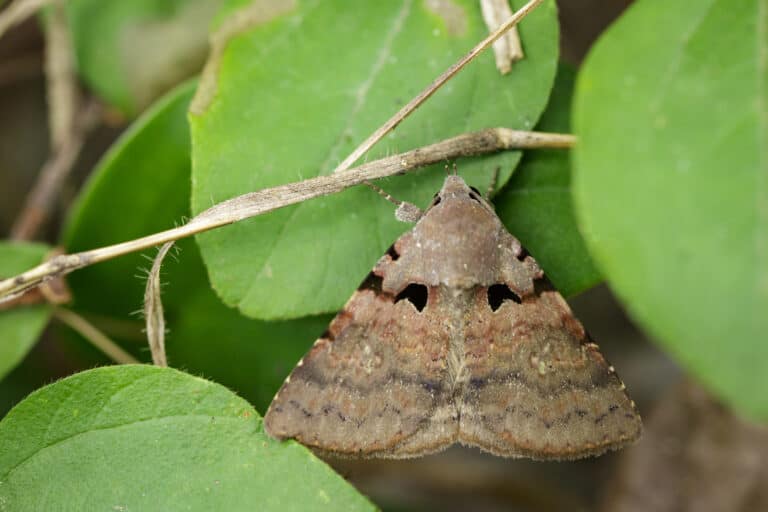
a gypsy moth on a green leaf

At a Glance

Wild Species
Diet Folivore
Activity Nocturnal+
Lifespan 11 years
Status Not Evaluated
Did You Know?

A single female typically lays ~500-1,000 eggs in one tan, fuzzy "spongy" egg mass (often ~2-5 cm long).

Scientific Classification

Lymantria dispar is a moth whose larvae are well-known defoliators of many broadleaf trees. The common name “gypsy moth” has been widely used historically; “spongy moth” is now commonly recommended in North America.

Kingdom
Animalia
Phylum
Arthropoda
Class
Insecta
Order
Lepidoptera
Family
Erebidae
Genus
Lymantria
Species
Lymantria dispar

Distinguishing Features

  • Hairy caterpillars that can occur in large numbers during outbreaks
  • Egg masses laid on tree trunks and other surfaces; masses are often buff/tan and felt-like
  • Strong association with episodic, large-scale defoliation of deciduous trees

Did You Know?

A single female typically lays ~500-1,000 eggs in one tan, fuzzy "spongy" egg mass (often ~2-5 cm long).

Early-instar caterpillars can disperse by "ballooning," riding wind on silk threads-one reason new infestations appear suddenly.

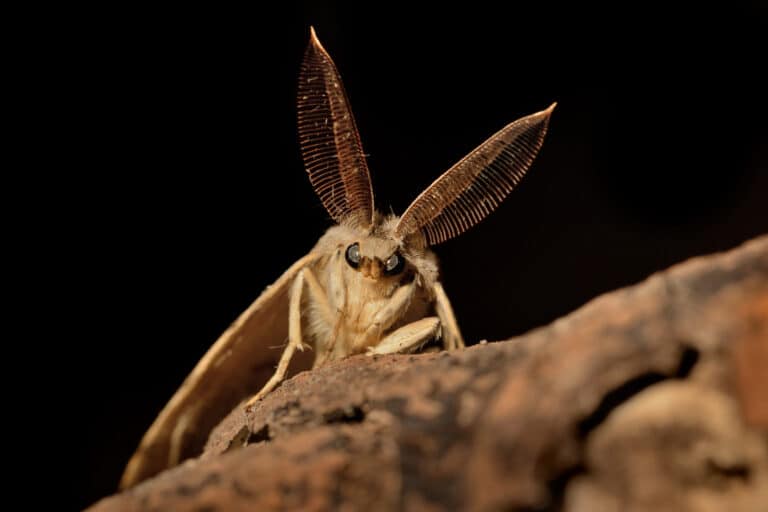
Males are strong fliers with feathery antennae that detect female sex pheromone; in many North American populations, females are effectively flightless.

Late-instar larvae reach ~60-70 mm long and are recognizable by paired blue bumps then red bumps along the back.

Host range is huge: larvae have been recorded feeding on 300+ tree and shrub species; oaks are among the most preferred in many regions.

Adults don't chew leaves-damage is almost entirely from larvae; adults mainly focus on mating and egg-laying and live about ~1-2 weeks.

Unique Adaptations

  • Egg-mass insulation: eggs are covered with abdominal hairs and a foamy matrix that helps buffer cold and desiccation during winter diapause (basis for the name "spongy moth").
  • Generalist digestion: larvae tolerate and process diverse plant defenses (e.g., tannins/phenolics) better than many specialists, enabling the very broad host range reported for L. dispar.
  • Phenology matching: spring hatch is timed so small larvae encounter expanding, nutrient-rich leaves, improving early growth and survival.
  • Long-range pheromone detection: males' plumose antennae provide high sensitivity to female pheromone, enabling mate-finding at low densities.
  • Behavioral thermoregulation: larvae shift between sun and shade and choose bark/leaf microhabitats that help manage temperature and water loss.

Interesting Behaviors

  • Life cycle timing: overwintering egg mass → spring larval hatch (often coinciding with leaf-out) → pupation in early summer → adult emergence and mating in mid-late summer; one generation per year in most of its range.
  • Nocturnal feeding: larvae commonly feed at night and rest in sheltered spots by day, reducing exposure to predators and heat stress.
  • Ballooning dispersal: first instars climb upward, spin silk, and let wind carry them to new hosts-most common soon after hatch.
  • Outbreak ecology: populations can erupt and cause heavy defoliation over large areas; repeated severe defoliation (often 2-3 consecutive years) can contribute to tree mortality, especially when combined with drought or other pests/pathogens (forest health literature; USDA/FS syntheses).
  • Predator/parasitoid interactions: larvae are attacked by birds, small mammals, predatory insects, and parasitoid wasps/flies; disease agents (notably the fungus Entomophaga maimaiga in many areas) can crash outbreaks.
  • Mating dynamics: males actively "zig-zag" up pheromone plumes to locate females; females emit pheromone from a calling posture soon after emergence.
  • Larval defense: when disturbed, larvae may thrash, drop on silk, or regurgitate; hairs can irritate skin in some people.

Cultural Significance

Lymantria dispar was introduced near Medford, Massachusetts in 1869 by Etienne Trouvelot and became a major forest pest that shaped management, quarantine rules, and outbreak responses. The common name shifted from 'gypsy moth' to 'spongy moth' in the 2020s to avoid a hurtful name and note its spongy egg masses.

Myths & Legends

The 'Trouvelot escape' story says French artist and astronomer Étienne Leopold Trouvelot accidentally let L. dispar (gypsy or spongy moth) escape near Boston in 1869, and newspapers used it as a warning about foreign species.

Folklore about Gypsy moth (Spongy moth) outbreak summers tells of streets and porches 'raining caterpillars' and trees going bare in July, turning real leaf loss into stories shared across generations.

Name origin: the newer common name 'spongy moth' refers to the sponge-like egg masses. The renaming became part of modern stories about language in science and public conservation, a naming tradition, not a myth.

Conservation Status

NE Not Evaluated

Has not yet been evaluated against the criteria.

Population Unknown

Life Cycle

Birth 500 larvas
Lifespan 11 years

Lifespan

In the Wild
10–12 years
In Captivity
2–4 years

Reproduction

Mating System Polygyny
Social Structure Solitary
Breeding Pattern Transient
Fertilization Internal Fertilization
Birth Type Internal_fertilization

Gypsy moth (spongy moth) (Lymantria dispar) females call with pheromones; males fly to them. Females often mate once, males mate many times. Adults live about 1–2 weeks; mating happens soon after they become adults. Females lay one egg mass (≈100–1,000 eggs); no care.

Behavior & Ecology

Social Larval aggregation Group: 500
Activity Nocturnal, Diurnal, Crepuscular
Diet Folivore Oak (Quercus spp.) foliage (larval preference widely reported in forest entomology/management literature; outbreaks are strongly associated with oak-dominated stands).
Seasonal Hibernates

Temperament

Gregarious in early larval instars (cohort clustering after hatch), trending to more solitary behavior in later instars
Non-territorial; aggregation is density- and cohort-driven rather than cooperative
Strong dispersal tendency in young larvae via silk 'ballooning'/windborne movement (promotes mixing among cohorts and reduces stable group cohesion)
Primarily predator-avoidant when disturbed (drop on silk, thrash, or seek concealment), rather than aggressive toward conspecifics

Communication

none known No documented airborne acoustic/vocal signaling used for social communication in this species
long-range sex pheromone: females emit disparlure (+)-7R,8S-epoxy-2-methyloctadecane) that attracts males over distance; this is the dominant adult communication channel (well established in pheromone-identification literature and widely used in monitoring/trapping
contact chemoreception during courtship/mating: antennal and tarsal chemosensory cues guide male close-range behavior once a female is located
tactile/substrate cues within larval clusters (physical contact and local silk/host-plant context contribute to cohesion immediately post-hatch), with rapid breakdown of cohesion as larvae disperse
visual/behavioral cues are secondary; males orient primarily by pheromone plume structure and wind direction rather than maintaining group coordination

Habitat

Deciduous Forest Forest Woodland Coniferous Forest Suburban Urban Agricultural/Farmland Plantation +2
Biomes:
Temperate Forest Boreal Forest (Taiga) Mediterranean Temperate Grassland
Terrain:
Mountainous Hilly Plateau Plains Valley Coastal Island Riverine +2
Elevation: Up to 6561 ft 8 in

Ecological Role

Outbreak-capable folivorous forest herbivore/defoliator (often invasive in North America) that can restructure hardwood forests by repeated defoliation and tree mortality; also a prey item for generalist predators (birds, small mammals, predatory insects) and a host for parasitoids and pathogens.

Transfers canopy nutrients to the forest floor via frass and partially eaten foliage, accelerating short-term nutrient cycling during outbreaks. Provides prey/host resources for native predators, parasitoids, and pathogens (supporting food-web interactions). Acts as a strong ecological disturbance agent (primarily a disservice in invaded ranges) by defoliating broadleaf trees, which can shift species composition and alter habitat structure.

Diet Details

Other Foods:
Oak leaves Aspen and poplar leaves Birch leaves Willow leaves Maple leaves Apple leaves Alder Basswood/linden leaves Hawthorn Broadleaf tree and shrub leaves +4

Human Interaction

Domestication Status

Wild

Lymantria dispar (spongy moth; historically "gypsy moth") is a wild, not domesticated forest insect. People moved it (once for silk experiments), and it became a major invasive defoliator in parts of North America while native to much of Europe and Asia. It has one generation per year, overwinters as egg masses, and causes tree loss, nuisance, and control efforts.

Danger Level

Moderate
  • Dermatitis/skin irritation from contact with larval hairs (setae) and shed skins; reactions range from mild rash to more significant irritation in sensitized individuals.
  • Eye irritation if hairs become airborne and contact mucous membranes.
  • Respiratory irritation/allergic symptoms in some people during heavy infestations when hairs/frass are abundant.
  • Indirect hazards from tree stress/mortality after repeated defoliation (e.g., falling branches/trees), especially in urban settings.
  • Exposure risks associated with control measures (e.g., insecticide applications) depend on product, label compliance, and local public-health guidance rather than the moth itself.

As a Pet

Not Suitable as Pet

Legality: Gypsy moth (Spongy moth) (Lymantria dispar) is often banned or regulated because it is a serious plant pest. Many places (USDA APHIS, Canada CFIA) restrict movement, possession, and release without permits.

Care Level: Expert Only

Purchase Cost: Up to $20
Lifetime Cost: Up to $100

Economic Value

Uses:
Forestry and urban tree management (primarily negative) Quarantine and regulatory enforcement Pest-control services and products Research and monitoring (pheromone trapping, population dynamics, biocontrol)
Products:
  • Pheromone lures/traps for monitoring (disparlure-based)
  • Aerial/ground suppression programs (e.g., Bacillus thuringiensis var. kurstaki applications in some regions; subject to local policy)
  • Biological control and pathogen research (e.g., nucleopolyhedrovirus, parasitoids)
  • Timber/ornamental tree loss estimates and risk-assessment services (economic impact accounting)

Relationships

Predators 5

Ground beetle
Ground beetle Calosoma sycophanta
Tachinid parasitoid fly Compsilura concinnata
Spongy moth nucleopolyhedrovirus Lymantria dispar multiple nucleopolyhedrovirus
Blue jay
Blue jay Cyanocitta cristata
Northern short-tailed shrew Blarina brevicauda

Related Species 8

Nun moth Lymantria monacha Shared Genus
Asian spongy moth Lymantria dispar asiatica Shared Species
Japanese spongy moth Lymantria dispar japonica Shared Species
Rosy gypsy moth Lymantria mathura Shared Genus
Tea tussock moth Lymantria xylina Shared Genus
Vapourer Orgyia antiqua Shared Family
Brown-tail moth Euproctis chrysorrhoea Shared Family
Pale tussock Calliteara pudibunda Shared Family

Ecological Equivalents 4

Animals that fill a similar ecological role in their ecosystem

Forest tent caterpillar Malacosoma disstria Like Lymantria dispar, forest tent caterpillar larvae are springtime outbreak-forming broadleaf defoliators that can cause repeated canopy loss and reduced growth in hardwood forests. L. dispar is usually univoltine, with eggs overwintering and larvae feeding in spring.
Winter moth
Winter moth Operophtera brumata Occupies a similar niche as an early-season deciduous defoliator. Larvae feed on expanding buds and young leaves of broadleaf trees and can cause significant defoliation during population peaks, paralleling the spring larval feeding window of L. dispar.
Fall cankerworm Alsophila pometaria Hardwood-forest defoliator with episodic outbreaks; overlaps in host use (oaks, maples, and other deciduous trees) and in impacts (growth loss and stress-related mortality when combined with drought or pathogens). Functionally similar to Lymantria dispar in damage dynamics.
Eastern spruce budworm Choristoneura fumiferana Although primarily a conifer defoliator, it is ecologically analogous as a high-impact, outbreaking lepidopteran defoliator with large-scale forest effects and strong coupling to predator, parasitoid, and pathogen dynamics, exhibiting similar population-regulation themes to Lymantria dispar.

Summary

One of the most invasive species in the world, the gypsy moth is a member of the moth family Erebidae. While originally native to isolated regions of Europe and Asia, you can now find gypsy moths throughout the world.Their larvae feed on a wide variety of coniferous and deciduous trees, in some instances, severely damage a region’s biodiversity. Every year, these moths destroy millions of acres of forests and cause billions of dollars in damages. 

Gypsy Moth Facts

  • The gypsy moth was first introduced in the United States in 1868 to breed a sturdier species of silk-spinning caterpillar. 
  • Gypsy moth larvae possess hairs with small air pockets that allow them to float on the breeze over great distances. 
  • Although they prefer oaks, gypsy moths prey on over 500 different tree and shrub species. 
  • Female gypsy moths attach egg masses to trees and shrubs that can contain up to 600 eggs each. 
  • Numerous methods have been employed to control gypsy moth populations, including parasitic and predatory insects, insecticides, and bacterial, fungal, and viral diseases. 

Gypsy Moth Species, Types, and Scientific Name

Also known as the spongy moth, the gypsy moth belongs to the family Erebidae. Its subfamily, Lymantriinae, often goes by the name tussock moths due to the tussock-like hairs on the caterpillars. While the term gypsy refers to a sole species, Lymantria dispar, scientists recognize several different subspecies. Its generic name, Lymantria, derives from the Latin word for destroyer, while its species name translates as to separate in Latin. Taken together, these names reference both the gypsy moth’s destructive behavior and the fact that the males and females display traits of sexual dimorphism. In recent years, the name spongy moth has begun to replace gypsy moth, which can be used as a pejorative toward Romani people. 

The recognized subspecies of gypsy moth include: 

  • Lymantria dispar dispar – European gypsy moth
  • Lymantria dispar asiatica – Asian gypsy moth
  • Lymantria dispar japonica – Japanese gypsy moth

Appearance: How to Identify Gypsy Moths

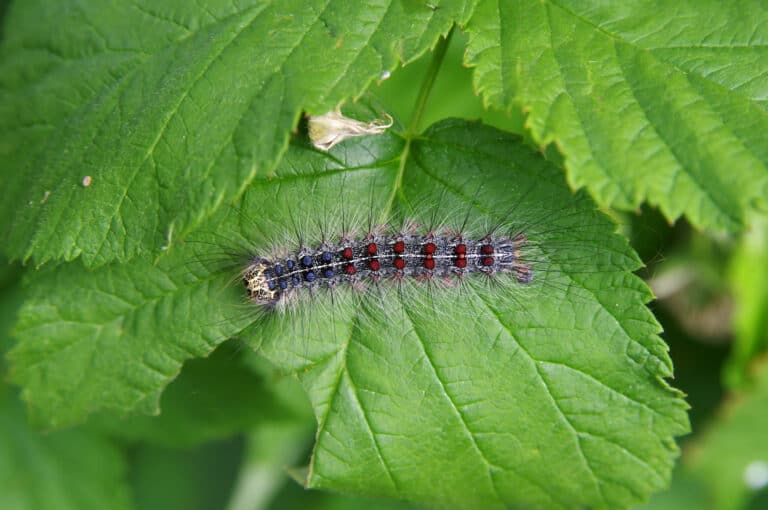
Over the course of their lives gypsy moths vary wildly in appearance. They look dark brown or black at birth and measure approximately 0.63 centimeters (0.25 inches) long. They feature long brown hairs and five pairs of blue dots followed by six pairs of red dots along the back. The head appears black and tan, and a thin yellow line runs the length of their body. By the time the caterpillars fully mature, they measure approximately 6.35 centimeters (2.5 inches) long. 
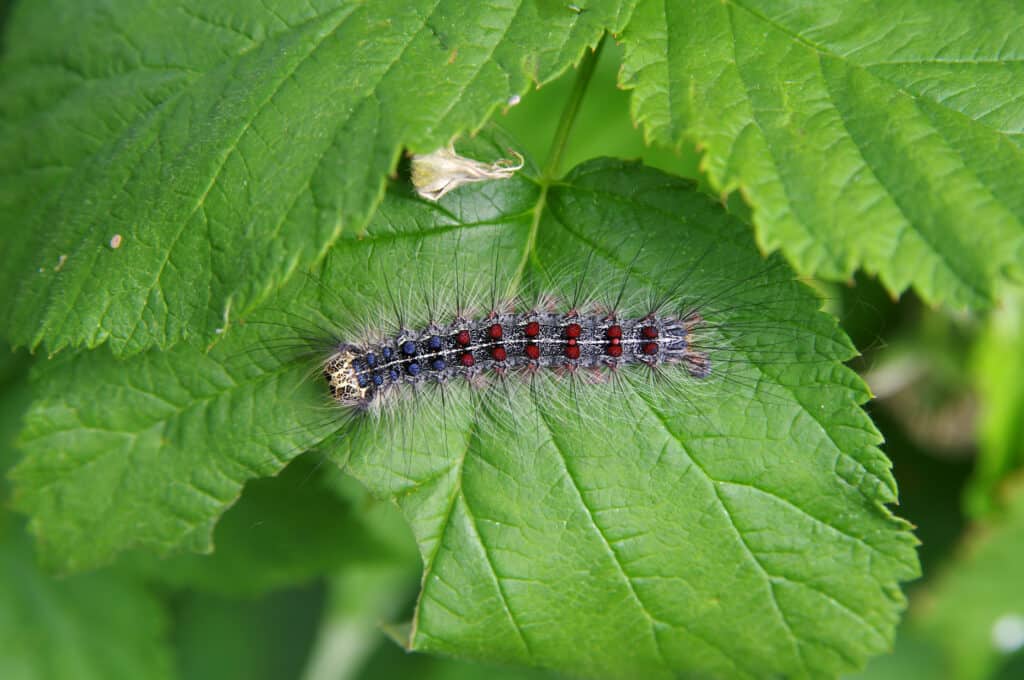
Gypsy moth caterpillar on a raspberry leaf.

Gypsy moth caterpillars feature long brown hairs and five pairs of blue dots followed by six pairs of red dots along the back

Next comes the pupal stage, which lasts approximately 10 to 14 days. Unlike some caterpillars, these moths do not spin a silk cocoon, although the pupae may attach themselves to a nearby substrate using several strands of silk. The pupae appear dark brown and shell-like and measure approximately five centimeters (two inches) long. On average, female pupae measure slightly larger than males.

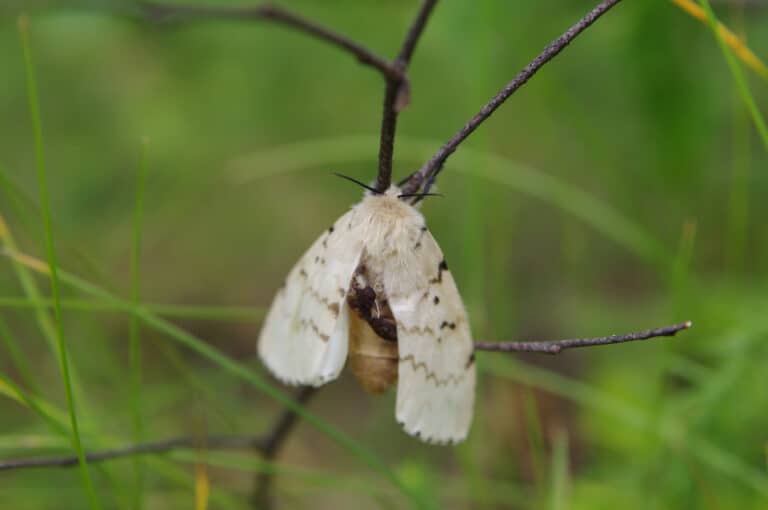
Male gypsy moths emerge before females. They look predominantly gray-brown and sport feathery antennae. The males measure slightly smaller than females, with an average wingspan of approximately 3.8 centimeters (1.5 inches). Females have a wingspan of approximately five centimeters (two inches) long and lack the feathery antennae of the males. They possess creamish-white colored wings and a tan body. Unlike the males, female cannot fly. Both males and females have an inverted V-shape on each wing pointing toward a dot. 

Habitat: Where to Find Gypsy Moths

The native range of gypsy moths varies depending on the subspecies. For example, L. d. dispar originally hails from temperate forests in western Europe as well as parts of Eurasia and North Africa. Meanwhile, L. d. asiatica is native to Eastern Asia, while L. d. japonica originates from the island of Japan. The spread to North America began in 1868 when a French scientist named Etienne Leopold Trouvelot imported some gypsy moths in the hopes of breeding them with native moths to make a hardier hybrid silk-spin caterpillar species. While mainly confined to the eastern United States, you can now find gypsy moths throughout much of North and South America.  Today, you can find gypsy moths on every continent except for Australia and Antarctica.

Female gypsy moths lay their egg masses on tree trunks or sturdy shrubs. They prefer to lay their eggs on hardwood trees but will take advantage of whatever they can find, including rocks, foliage, and buildings. Eggs overwinter in the egg masses until they hatch in the spring. The newly hatched caterpillars then disperse to nearby foliage. If they can’t find enough food for their development, they will balloon to new hosts. They can travel miles away from their original birth site until they find a suitable spot to settle down. 

Diet: What Do Gypsy Moths Eat?

Gypsy moths only eat during the larval (caterpillar) stage of their life cycle. Shortly after hatching, the caterpillars set out in search of foliage. If they cannot find enough suitable food, they will float on silk threads through the air in a method known as “ballooning” until they find food. Younger caterpillars tend to feed during the day, while older caterpillars typically feed at night. Nighttime feeding helps the caterpillars avoid the heat of the day and predators such as birds. However, older caterpillars may feed in high-density populations day and night. The caterpillars eat for 6 to 7 weeks, with their appetite gradually increasing as they age and grow. 

Gypsy moths feed on the foliage of over 500 known species of trees and shrubs. While they prefer hardwood trees such as oak, they will also readily eat the foliage of conifers. Plants commonly eaten by gypsy moths include aspen, alder, birch, poplar, hawthorn, cottonwood, pine, spruce, and willow.  

Prevention: How to Get Rid of Gypsy Moths

Over the years, numerous biological pest control measures have been deployed to curtail the spread of gypsy moths. One of the first methods entailed the introduction of parasitic and predatory insects such as deer mice, tachinid flies, and braconid wasps. While some of these species can help reduce gypsy moth populations, others play little role in managing population dynamics. Moreover, some species do more harm than good by decimating native moth populations while leaving gypsy moth populations relatively unchanged. At the beginning of the 19th century, people started to use powerful pesticides such as DDT (dichlorodiphenyltrichloroethane) to eliminate gypsy moths. Although they successfully eliminated the moths, some of these chemicals also negatively impacted local environments by harming honeybees, eagles, and other fauna. While DDT is now banned, chemical pesticides such as Foray, Orthene, and Sevin are widely available alternatives.

Today, commonly employed methods to remove these pests include targeted microbial pathogens, viruses, and funguses. For example, Lymantria dispar multicapsid nuclear polyhedrosis virus (LdmNPV) targets gypsy moth caterpillars and causes them to disintegrate. Similarly, the fungus Entomophaga maimaiga causes high levels of infection amongst gypsy moths, particularly those living in high-density populations. When used strategically, mating disruption can also effectively curtail infestations. Mating disruption involves the constant release of species sex pheromones. These pheromones trick the males into following false trails, thereby reducing the number of mating encounters between moths. Finally, the active removal of egg masses and the physical destruction of caterpillars also helps to reduce gypsy moth populations, although these methods are time-consuming and difficult to enact en masse. 

View all 261 animals that start with G

Sources

  1. psu.edu / Accessed November 2, 2022
  2. Illinois.edu / Accessed November 2, 2022
  3. in.gov / Accessed November 2, 2022
  4. aphis.usda / Accessed November 2, 2022
  5. si.edu / Accessed November 2, 2022
  6. canada.ca / Accessed November 2, 2022

Thank you for reading! Have some feedback for us?


Gypsy Moth FAQs (Frequently Asked Questions)

While gypsy moths are incredibly harmful to trees and plants, they pose no danger to humans.