

Quick Take
- Three frogs share the name 'green tree frog,' yet they are more different from one another than their shared name might suggest. Meet all three species →
- The Australian green tree frog's scientific name means 'blue,' and there's a wild biological reason why. Explore the name's origin →
- Australian green tree frogs may have a superpower that lets them survive where most amphibians can't. See their skin adaptations →
- A pet frog introduced to the U.S. now roams wild in one American state, and the story only gets stranger from there. Check U.S. population status →
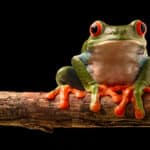
Among the more than 800 tree frog species in the world, three share the moniker “green tree frog.” The Australian green tree frog measures up to about 10 centimeters (around 4 inches) in length for the largest females, with males somewhat smaller, and its back is a bright jade green. The American green tree frog measures approximately 2.5 inches long, and its back is more olive green. Emerald tree frogs measure about 35–41 mm (roughly 1.4–1.6 inches) in length and live in Taiwan. All three species are popular terrarium inhabitants. In fact, Australian green tree frogs, first introduced as pets, can now be found in the wild throughout many parts of Florida — which makes these naming conventions all the more confusing.
American green tree frogs are the official state amphibian of Louisiana and Georgia.

5 Incredible Facts
- These frogs change color. Color changes are influenced by temperature, ambient lighting, and other environmental conditions.
- A group of frogs is called an “army.”
- These frogs exchange oxygen through their skin.
- Australian green tree frogs are thought to be able to control the amount of water that evaporates from their skin.
- Though fertilization occurs externally, mating green tree frogs engage in coitus-like behavior called “amplexus.”
Evolution
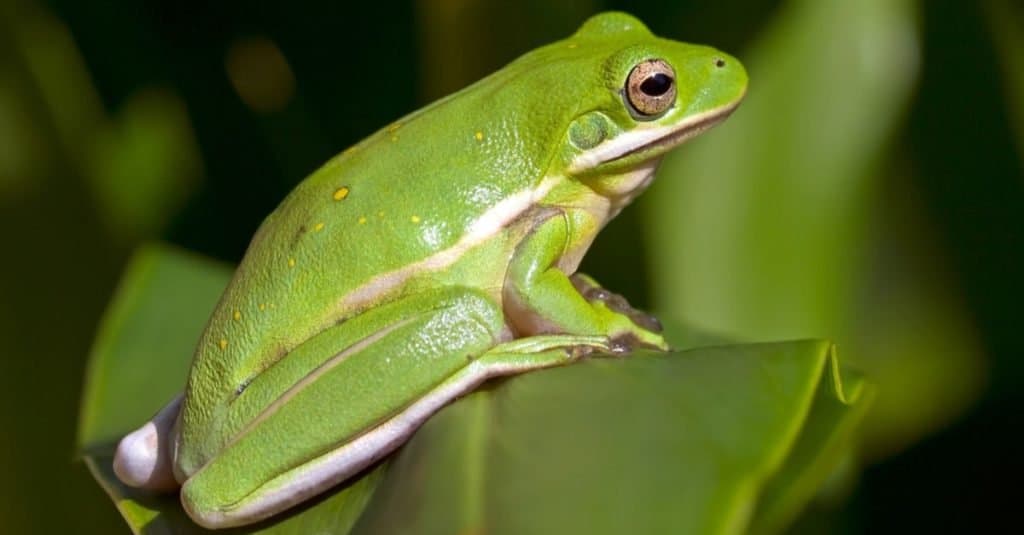
Green tree frogs are believed to have evolved 10 million years ago.
©LorraineHudgins/Shutterstock.com
We know something about the evolutionary history of the green tree frog. The species is believed to have evolved from a common ancestor in South America over 10 million years ago. This ancestor was likely a terrestrial animal that adapted to become an arboreal creature, which explains why modern-day green tree frogs are so adept at climbing and jumping from branch to branch. Over time, these animals spread out across Central America and into North America, where they could be found living in trees close to bodies of water. Today, this species inhabits parts of Mexico as well as Florida, Arizona, Texas, and Louisiana in the United States. It has also been introduced into New Zealand and Hawaii with varying levels of success.
Classification and Scientific Name
The Australian native’s scientific name is Litoria caerulea. “Litoria” is the name given to the genus of tree frogs native to Australia and nearby locations such as New Guinea, the Bismarck Archipelago, and the Solomon Islands. While species in this genus vary widely in appearance, they all share unpigmented eyelids and horizontal irises. “Caerulea” is Latin for “blue” and refers to the fact that this frog owes its striking emerald coloration to blue pigments that overlie a base coat of yellow.
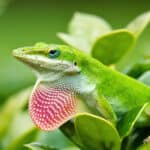
The American native’s scientific name is Hyla cinerea. “Hyla” is the name of a genus in the tree frog family “Hylidae” and was inspired by the mythological hero Hylas, a companion of Heracles; “cinerea,” which is Latin for gray, refers to the olive tinge of this amphibian’s skin.
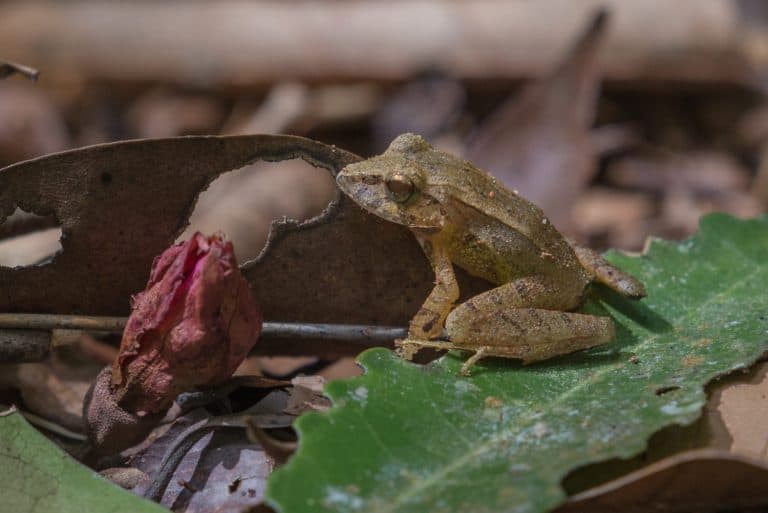
The green tree frog native to Taiwan has the scientific name Zhangixalus prasinatus. It belongs to the order Anura and the family Rhacophoridae. It is also called the tributary flying frog and the Taiwanese green tree frog.
Appearance
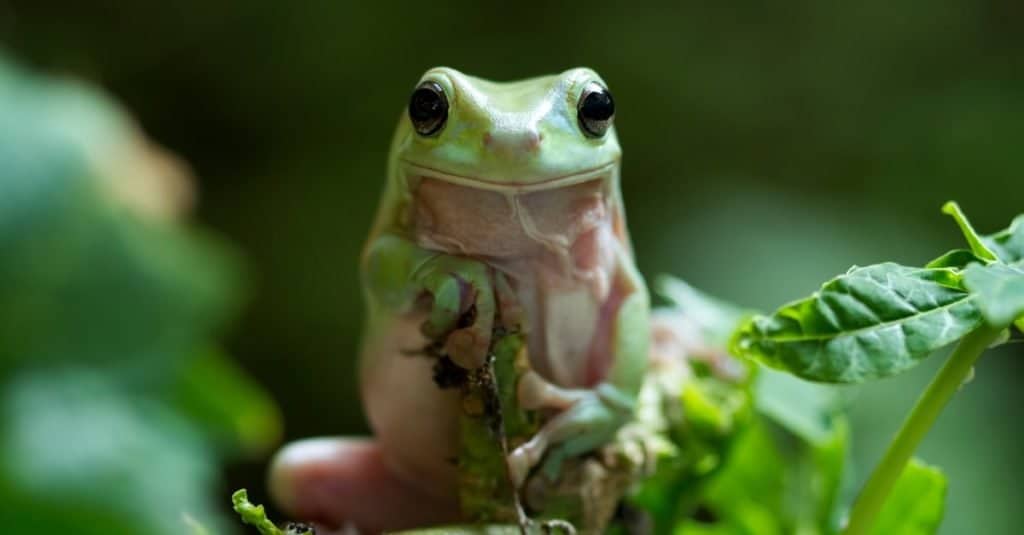
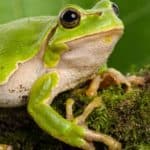
The Australian green tree frog is a bright jade green.
©Kurit afshen/Shutterstock.com
Each species has a chameleon-like ability to change color depending on temperature, lighting conditions, and the animals’ general surroundings. Much of the time, the Australian frog is a bright jade green, while the American frog is a less vivid, grayer green. These colors reflect the hues of the leaves and other vegetation where the frog typically lives.
The Australian frog is larger than its American counterpart. Its belly is white; its limbs are short and strong and end in digits that are specialized for sticking to surfaces like trees. During mating season, males grow a black pad on their proximal digit so that they can better grasp the female during amplexus. Beneath its throat, the Australian native has a large vocal sac that’s gray in males and white in females. When fully grown, females are slightly larger than males.
The limbs of the American green tree frog end in long, thin digits tipped with sticky spatulate pads. While the Australian native almost appears to grasp the branch it is clinging to, the American native merely sticks to it. The green tree frog found in the U.S. also has a white or cream-colored lateral stripe running from its jaw to its groin.
Behavior

Asian green tree frogs are social animals that live in groups.
©dwi putra stock/Shutterstock.com
Frogs are social animals that live in groups. A group of frogs is called either an army or a chorus. The latter designation reflects the fact that these little amphibians are enthusiastic vocalizers, especially after a rain shower. Their distinctive croaks play an important role in their mating rituals but also serve as a warning when a predator grows too near. Both of these frog species are largely nocturnal. During the day, they like to tunnel into cooler, moister, darker areas from which they emerge as the sun sets, ready to feed and croak.
Each of these frog species is a popular terrarium pet. While the Australian green tree frog is a bold little creature with relatively little fear of humans, its American counterpart is timid and does not tolerate frequent handling.
Habitat
Australian green tree frogs are found in a variety of habitats that range from relatively dry eucalyptus stands in the northwest parts of Australia to the more tropical forests of New Guinea. Though frogs have lungs, much of their oxygen exchange occurs through skin absorption, so their skin must remain moist. Some scientists speculate that the Australian species has a bioregulation mechanism that actually allows it to control the amount of water that evaporates through its skin. Thus, it is able to thrive in seasonally dry and wet habitats. Australian frogs also appear to have some kind of homing ability that allows them to return to the spot they were captured from, even if they were released a fair distance away.
American frogs are most frequently found in trees near lakes, marshes, and streams. Their geographic distribution ranges as far north as Delaware, as far south as the Florida Keys, and as far west as Texas. They are especially abundant in the Piedmont and coastal plains of North Carolina.
Taiwan green tree frogs live in bamboo forests and orchards in northern Taiwan that are between 1,200 and 1,800 feet high.
Diet
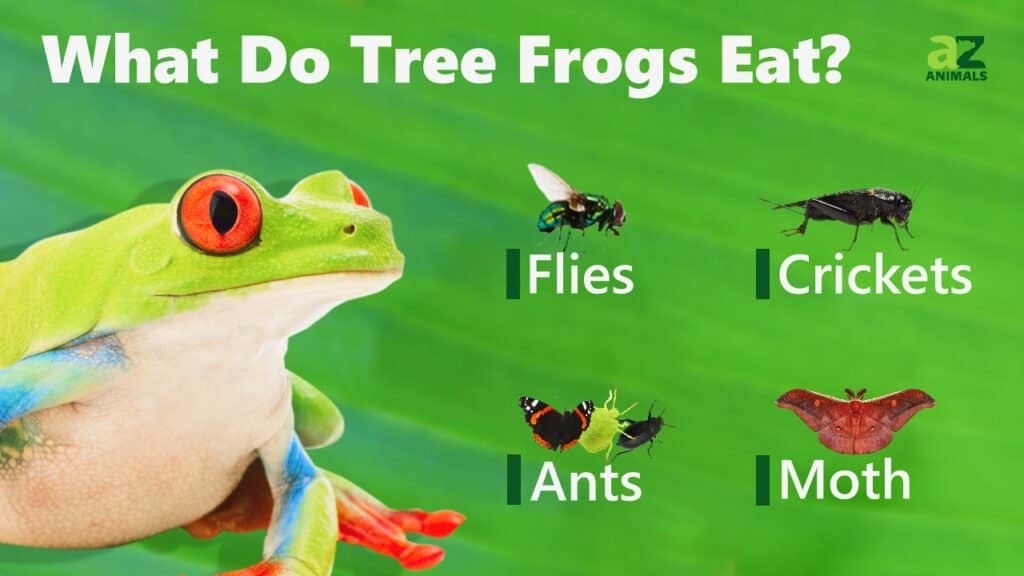
These green tree frog species are insectivores, feeding on flies, mosquitoes, crickets, locusts, moths, and other small insects. Frogs only have teeth on their upper jaws, and those teeth are designed not to masticate but to hold prey in place. Frogs’ tongues are very long, often one-third the length of their bodies. Typically, frogs extend their tongues as bait, and once prey is attracted, they retract their tongues and swallow the prey whole.
Australian frogs can grow fat from overeating. Hence, one of the species’ nicknames is “dumpy tree frog.”
Predators and Threats
Since the European settlement of Australia, dogs and cats have joined snakes and birds as frog predators. In general, though, these animals have few natural predators, which is reflected in the length of their lifespan: In captivity, it’s not uncommon for these animals to live more than 15 years.
Life is more perilous for the American frogs. Predators include snakes, birds, large fish, and even other species of frogs. These amphibians are among the only frog species that breed in bodies of water that are inhabited by predatory fish. As tadpoles, they can even become prey to aquatic insects such as waterbugs. Their lifespans are shorter than those of their counterparts in Australia; in captivity, they seldom live longer than five years.
Habitat destruction through drainage and wetland clearance is causing a decline in the size of these frogs’ populations in Australia, particularly throughout the Sydney bioregion. Its American counterpart continues to thrive throughout its geographic range, particularly in locales like Florida and North Carolina. However, amphibians are one of the animal groups on the planet that are at the highest risk of extinction from the activities of humans. Because part of their oxygen exchange takes place through their skin, green tree frogs (and other amphibians) are extremely sensitive to pollution and other environmental changes. Ecologists call species like this “indicator species”; their dwindling numbers may signal deteriorating environmental conditions.
What eats green tree frogs?
Snakes and birds eat adult green tree frogs. As tadpoles, these amphibians are eaten by birds, fish, insects, and other frogs.
What do green tree frogs eat?
Green tree frogs are insectivores. They feed on a diet of flies, mosquitoes, crickets, and other small insects.
Reproduction and Life Cycle
These frog species breed from the middle of March to September, most often following a rainstorm. Breeding cycles are influenced by temperature and precipitation in a manner that’s not fully understood, but breeding males tend to vocalize more as the temperature rises and the length of the day increases.
Mating takes place in water through amplexus: The male frog grasps the female tightly around the back so that their cloacal openings are in close proximity. Fertilization is external. The female then expels her eggs through the deposited sperm cloud, enabling external fertilization. American frogs lay approximately 400 eggs, while their Australian counterparts lay 150 to 300 eggs.
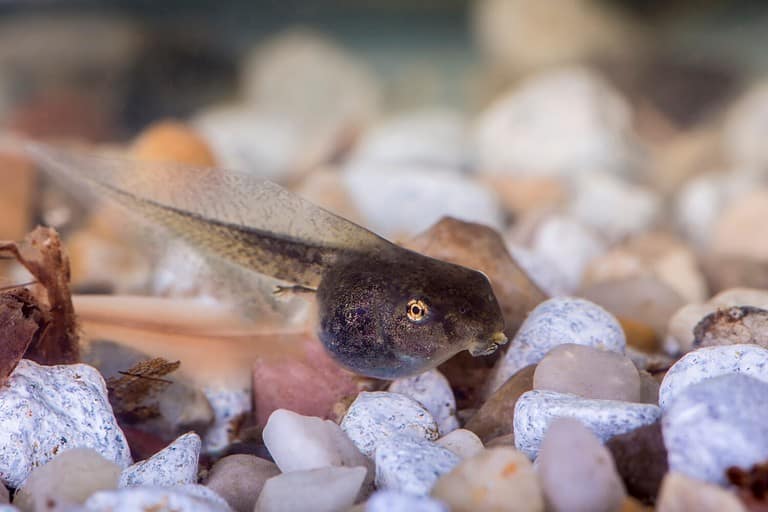
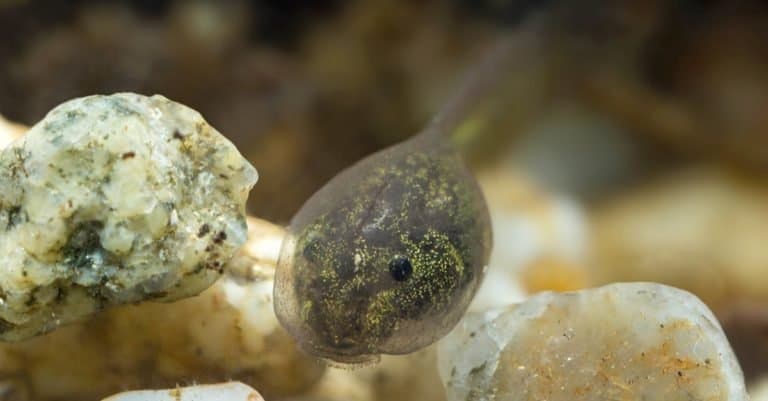
Australian green tree frog eggs take three days to hatch; American green tree frog eggs take two days longer. The resulting offspring are called tadpoles. For the first few weeks of their lives, tadpoles are water dwellers exclusively, and they look like primitive fish with tails, mouths, and rudimentary gill tracts. Then they begin to go through metamorphosis, which is an extraordinary series of physiological changes that prepare them for life on land. Frog populations in the U.S. typically complete metamorphosis within eight weeks, while Australian frogs take a more variable four to 12 weeks.
Neither of these frog species takes any interest in their offspring once the mating process is over.
Population
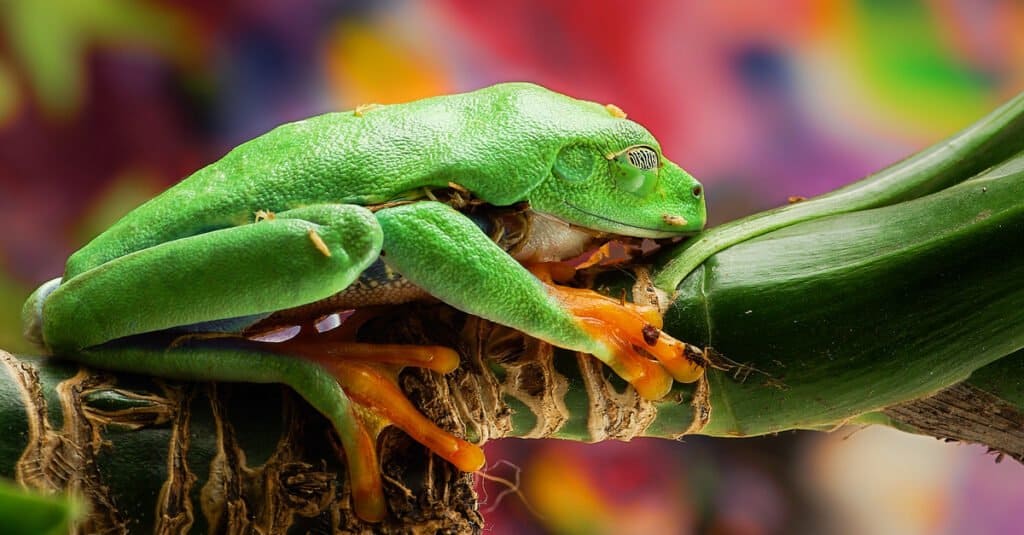
Green tree frogs are threatened by the loss of their wetland habitats.
©Irina Kozorog/Shutterstock.com
In the United States, these frogs are found in wetlands across the southeastern part of the country and as far west as central Texas. They are common in Florida and North Carolina. They have even been observed in Hawaii, although these animals most likely are descendants of terrarium escapees. Biologists do not have an estimate for the size of the American green tree frog population, but this animal is not on any endangered species list.
Australian green tree frogs are found throughout the northeast regions of the continent as well as in New Guinea. In suburban areas, these frogs are threatened by pollution and predator animals like dogs and cats introduced by European settlers. Outside these areas, their population numbers are stable. As native animals, Australian green tree frogs enjoy protected status under the stipulations of the federal Environment Protection and Biodiversity Conservation Act 1999.
Green tree frogs Pictures
View all of our Green tree frogs pictures in the gallery.

LorraineHudgins/Shutterstock.com
Sources
- Animal Diversity Web / Accessed February 22, 2021
- Animal Diversity Web / Accessed February 22, 2021
- Smithsonian Magazine / Accessed February 22, 2021
- Fauna of Australia / Accessed February 22, 2021
- Three Rivers Park District / Accessed February 22, 2021
- Britannica / Accessed February 22, 2021
- Richard Landcare / Accessed February 22, 2021
- ABC Science / Accessed February 22, 2021
- Naturalist Afield / Accessed February 22, 2021