P
Species Profile

Peacock Butterfly

Aglais io

Flash the eyespots-vanish the rest!
iStock.com/Binnerstam

Peacock Butterfly Distribution

Click a location to explore more animals from that region

Loading map...
Peacock Butterfly, Animal Body Part, Animal Wing, Backgrounds, Beauty

At a Glance

Wild Species
Also Known As Peacock, Peacock butterfly, European peacock, Paon du jour, Tagpfauenauge, Dagpauwoog
Diet Herbivore
Activity Diurnal+
Lifespan 9 years
Weight 0.00035 lbs
Status Least Concern
Did You Know?

Wingspan typically 50-55 mm (common field-guide range for Aglais io; e.g., Tolman & Lewington, 2008).

Scientific Classification

A medium-sized nymphalid butterfly native to the Palearctic, famous for its vivid red wings and large peacock-like eyespots that deter predators. Adults often overwinter and can be among the first butterflies seen in spring.

Kingdom
Animalia
Phylum
Arthropoda
Class
Insecta
Order
Lepidoptera
Family
Nymphalidae
Genus
Aglais
Species
io

Distinguishing Features

  • Deep reddish-brown wings with one large, iridescent eyespot on each wing
  • Dark (nearly black) wing margins with subtle blue/purple scaling
  • Underside of wings cryptic, dark, leaf-bark-like for camouflage when wings are closed
  • Adults frequently bask and may hibernate in sheds, tree hollows, or buildings

Physical Measurements

Weight
0 lbs (0 lbs – 0 lbs)
Top Speed
10 mph
flying

Appearance

Primary Colors
Secondary Colors
Skin Type Chitinous exoskeleton; wings densely covered in overlapping colored scales
Distinctive Features
  • Adult wingspan typically 5.0-5.5 cm (European field guides and Lepidoptera descriptions).
  • Four bold dorsal eyespots (one per wing) used in startle/anti-predator display against birds.
  • Underside very dark, mottled brown-black; resembles dead leaves or tree bark when wings closed.
  • Adults commonly overwinter (hibernate) in dark shelters (tree hollows, sheds, buildings) and reappear early spring.
  • Single main brood in much of Europe: fresh adults mid-late summer; after overwintering they fly again in spring.
  • Females lay eggs in large clusters on nettles (especially Urtica dioica and Urtica urens).
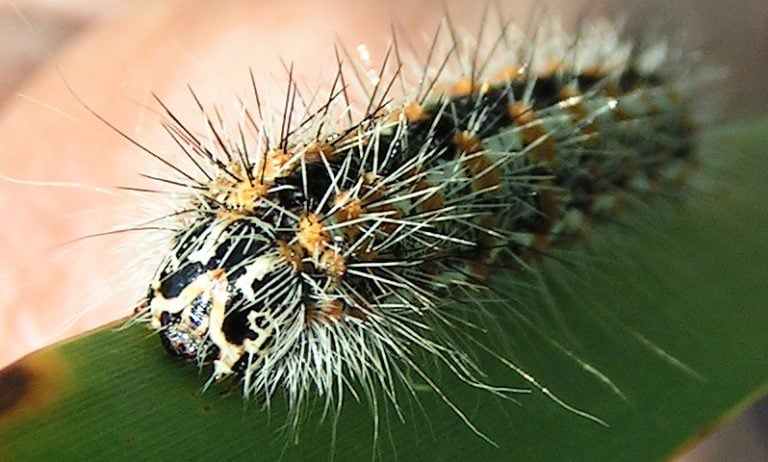
  • Larvae are gregarious early instars; caterpillars are dark with prominent spines (urticating appearance).
  • Range spans much of Europe and temperate Asia in the Palearctic; absent from North America as a native species.

Sexual Dimorphism

Sexual dimorphism is subtle: both sexes share the same red-and-eyespot pattern. Females average slightly larger with a broader abdomen for egg development; males tend to be slightly smaller and more slender.

♂
  • On average slightly smaller body size; slimmer abdomen.
  • Often more active in territorial/patrolling behavior around nectar and sunlit openings.
♀
  • On average slightly larger body size; broader abdomen when gravid.
  • Oviposition behavior: deposits egg clusters on nettle leaves and stems.

Did You Know?

Wingspan typically 50-55 mm (common field-guide range for Aglais io; e.g., Tolman & Lewington, 2008).

Unlike many butterflies, it overwinters as an adult (imago) and can live from late summer emergence to the following spring-up to ~9-10+ months in the wild depending on climate.

Caterpillars are "nettle specialists": larvae feed mainly on stinging nettles (Urtica dioica; also U. urens), often in conspicuous communal webs when young.

The underside of the wings is dark, bark-like camouflage; when the butterfly snaps its wings open, four bold eyespots create a sudden startle display against predators.

Adults commonly nectar on Buddleja ("butterfly bush"), thistles (Cirsium), and late-season flowers, then switch to tree sap and fallen fruit in autumn.

Its range spans much of the Palearctic: from western Europe across temperate Eurasia to the Russian Far East, and into East Asia (commonly reported to include Japan).

It is one of the earliest conspicuous garden butterflies in spring because hibernated adults fly on the first warm, sunny days.

Unique Adaptations

  • Four high-contrast eyespots (anti-predator pattern): positioned to resemble large vertebrate eyes, enhancing predator hesitation during a sudden wing-flick reveal.
  • Camouflage underside: closed wings present a dark, leaf/bark-like pattern that reduces detection while roosting on tree trunks or walls.
  • Sound-assisted defense: when handled or attacked, adults can produce an audible hiss/click via wing-body structures (stridulation), adding a startle cue alongside the eyespots (documented in behavioral studies on bird deterrence).
  • Overwintering physiology: adult diapause and cold hardiness allow survival through temperate winters, extending adult lifespan compared with species that overwinter only as eggs/larvae/pupae.
  • Host-plant specialization on nettles: larvae tolerate and exploit stinging nettles (Urtica spp.), gaining both food and a "spiny, stinging" plant refuge from many grazers and some predators.

Interesting Behaviors

  • Adult hibernation: enters diapause in autumn in cool, dark refuges (sheds, hollow trees, caves/crevices), then resumes flight in early spring on mild days.
  • Startle display: when disturbed, it rapidly reveals the dorsal wing surface; the sudden appearance of the four eyespots is timed to surprise birds and other visual predators.
  • Territorial perching: males often defend sunlit patches and "perch" to intercept passing females, chasing rivals in short aerial bouts.
  • Basking thermoregulation: frequently opens wings to absorb solar heat; this helps early-season activity when air temperatures are still low.
  • Seasonal feeding shift: uses nectar heavily in summer, then often turns to fermenting fruit and tree sap in autumn-useful fuel before overwintering.
  • Larval grouping: early instars feed gregariously on nettle leaves, forming visible silk webs; later instars disperse more widely before pupation.

Cultural Significance

Across Europe the European Peacock (Aglais io) is a garden icon and symbol of planting for butterflies: its caterpillars need nettles and the butterflies visit flower nectar. Its peacock-like eye spots make it common in art, guides, and citizen science as a sign of early spring.

Myths & Legends

Classical naming thread: the species epithet io is commonly linked to Io of Greek mythology; the butterfly's eye-like markings evoke the motif of watchful eyes in the Io-Argus story cycle (Argus Panoptes, the many-eyed guardian).

In Europe, folk names compare the European peacock butterfly (Aglais io) wing spots to tail 'eyes.' In tales, these watching eyes are seen as protective, keeping away harm by seeming to stare at danger.

In many European folk stories, butterflies are linked to human souls or spirits of the dead. The European Peacock Butterfly (Aglais io), bright and returning in spring, is used in this 'return' idea.

In parts of northern and western Europe, people see the European Peacock Butterfly (Aglais io) as a sign of spring; early butterflies after winter are taken to mean spring and fair weather.

Conservation Status

LC Least Concern

Widespread and abundant in the wild.

Population Stable

Life Cycle

Birth 300 caterpillars
Lifespan 9 years

Lifespan

In the Wild
2–12 years
In Captivity
1–12 years

Reproduction

Mating System Polygynandry
Social Structure Solitary
Breeding Pattern Transient
Fertilization Internal Fertilization
Birth Type Internal_fertilization

Behavior & Ecology

Social Aggregation Group: 200
Activity Diurnal, Matutinal, Vespertine
Diet Herbivore Larvae: Urtica dioica (stinging nettle) leaves; Adults: nectar from buddleia (Buddleja davidii) and late-season ivy (Hedera helix) where available
Seasonal Hibernates

Temperament

Adults mostly solitary; males commonly defend sunny perches via chase flights (territoriality varies with density and habitat openness).
Gregarious early-instar larvae; females lay eggs in large batches (typically about 200-400) on Urtica (nettles), producing large sibling cohorts.
Predator-avoidance is primarily defensive rather than aggressive; adults rely on crypsis when wings closed.
Startle/deflection behavior: sudden wing-opening exposes eyespots that reduce avian attack success (Vallin et al., 2005, Proceedings of the Royal Society B).
Adults can live ~10-11 months by overwintering as imago; social interactions minimal during diapause (univoltine in much of range, often bivoltine farther south; Tolman & Lewington, 2008).

Communication

Visual anti-predator display: rapid wing-opening reveals eyespots Vallin et al., 2005, Proc. R. Soc. B
Visual social signaling: territorial chase flights and sunlit perching/basking postures convey occupancy and vigor.
Chemical cues: mate-location and acceptance mediated by pheromones and antennal chemoreception General Lepidoptera/Nymphalidae mechanism
Tactile cues: antennation and close-contact assessment during courtship immediately before copulation.

Habitat

Biomes:
Temperate Forest Temperate Grassland Mediterranean Boreal Forest (Taiga) Wetland
Terrain:
Mountainous Hilly Plateau Plains Valley Coastal Island Riverine +2
Elevation: Up to 8202 ft 1 in

Ecological Role

Pollinating nectar-feeding adult butterfly; herbivorous leaf-feeding larva on nettles; common prey/host for higher trophic levels.

Pollination of a wide range of wildflowers and garden plants visited for nectar (notably late-season ivy and mid/late-summer composites such as thistles/knapweeds). Energy transfer in food webs: converts nettle leaf biomass (larvae) and floral/fruit sugars (adults) into biomass used by predators and parasitoids. Acts as a host for parasitoid insects, supporting parasitoid biodiversity and regulating lepidopteran populations locally.

Diet Details

Other Foods:
Nectar plants Fermenting fruit juices, tree sap and honeydew Stinging nettle

Human Interaction

Domestication Status

Wild

Aglais io (European Peacock) is a wild Palearctic butterfly with no domestication history. People help it by gardening for nectar and nettles (Urtica) and by short-term captive rearing for education or conservation (e.g., butterfly kits). Wingspan about 5.0–5.5 cm; females lay ~200–400 eggs; adults can live ~9–11 months.

Danger Level

Low
  • Adults are harmless (no sting/venom; do not bite).
  • Larvae have spines that can cause mild skin irritation if handled roughly (mechanical irritation rather than medically significant envenomation).
  • Rearing often involves Urtica (stinging nettles), which can cause contact urticaria in humans-this is a common practical risk during human interaction rather than a direct danger from the butterfly itself.
  • As with many insects, scales/frass/mold in poorly maintained rearing containers can aggravate allergies or respiratory irritation in sensitive individuals.

As a Pet

Not Suitable as Pet

Legality: In many places you can legally raise captive-bred Aglais io or eggs/larvae from private host plants, but rules vary. Wild collecting, moving, or releasing may be restricted in protected areas or nature reserves; follow local laws and biosecurity rules.

Care Level: Moderate

Purchase Cost: Up to $60
Lifetime Cost: $10 - $150

Economic Value

Uses:
Ecosystem services (pollination support) Education and outreach Citizen science / biodiversity monitoring Eco-tourism and gardening value Indicator value for habitat quality and climate/phenology studies
Products:
  • butterfly rearing kits (eggs/larvae/pupae supplied where available/allowed)
  • nature education programming (schools, museums, butterfly houses)
  • garden/nursery trade indirectly via demand for nectar plants and host-plant-friendly practices (nettles retained/managed in wildlife corners)

Relationships

Predators 10

Great Tit Parus major
Blue Tit
Blue Tit Cyanistes caeruleus
European Robin
European Robin Erithacus rubecula
European Pied Flycatcher Ficedula hypoleuca
European Paper Wasp Polistes dominula
Common Wasp Vespula vulgaris
Diadem Spider Araneus diadematus
Emperor Dragonfly Anax imperator
Common Pipistrelle Pipistrellus pipistrellus
Parasitoid wasp Pteromalus puparum

Related Species 7

Small Tortoiseshell Aglais urticae Shared Genus
Milbert's Tortoiseshell Aglais milberti Shared Genus
Kashmir Tortoiseshell Aglais kaschmirensis Shared Genus
Ladakh Tortoiseshell Aglais ladakensis Shared Genus
Mourning Cloak Nymphalis antiopa Shared Family
Red Admiral
Red Admiral Vanessa atalanta Shared Family
Comma Polygonia c-album Shared Family

Ecological Equivalents 5

Animals that fill a similar ecological role in their ecosystem

Small Tortoiseshell Aglais urticae There is a strong overlap in habitat and food: both are Palearctic nettle feeders (larvae on Urtica), use edge habitats such as hedgerows, woodland margins, and gardens, and often overwinter as adults. European Peacock wingspan about 5–5.5 cm.
Mourning Cloak Nymphalis antiopa Ecological analogue among nymphalids: overwinters as an adult and is often among the earliest butterflies seen in spring. Frequently uses tree sap, rotting fruit, and early-season nectar, and relies on crypsis plus startle/defensive displays to reduce bird predation.
Red Admiral
Red Admiral Vanessa atalanta Similar adult ecology: strong presence in gardens and habitat edges; frequent nectar use of Buddleja, thistles, and ivy; and use of fermenting fruit and sap. Although Red Admiral is more migratory across much of Europe, both species commonly utilize the same flowering resources and encounter similar predators in human-modified landscapes.
Painted Lady Vanessa cardui Shares adult feeding guild (nectar generalist in open habitats, gardens, and field margins) and is exposed to similar aerial predators (birds, dragonflies) and ambush predators (spiders), even though larval host plants differ markedly.
Meadow Brown Maniola jurtina Co-occurs broadly in temperate grassland–edge mosaics and shares predator communities, including insectivorous birds and spiders. Both rely on wing patterning for anti-predator defense, although peacock eyespots serve as a pronounced startle signal.

“A 2005 scientific experiment revealed that not all predators are scared away by this butterfly’s eyespots.”

When you look at a Peacock butterfly, it’s easy to tell how it got its name. The eyespot pattern on its wings is very similar to the pattern on a peacock’s feathers. These butterflies are found in woodlands, gardens, and pastures in Europe and Asia. They are medium-size butterflies with a wingspan of up to two and a half inches. The Peacock butterfly lives on a diet of nectar and sap.

4 Incredible Peacock Butterfly Facts!

  • One of the strangest facts about this butterfly is it can make a hissing noise by rubbing its wings together.
  • When it comes to identification, the female Peacock butterfly is a little larger than the male.
  • The caterpillar of the Peacock butterfly has black spikes all along its body.
  • These butterflies hibernate over the winter in the hollows of trees.

Peacock Butterfly Species, Types and Scientific Name

This insect’s common name is the Peacock butterfly. It’s sometimes called the European Peacock. Aglais io is its scientific name. This butterfly is a member of the Nymphalidae family and is categorized in the order of Lepidoptera. There are 6,125 butterflies in this family.

Three species in the Aglais genus:

  • Aglais io
  • Aglais urticae
  • Aglais ichnusa

Appearance: How to Identify a Peacock Butterfly

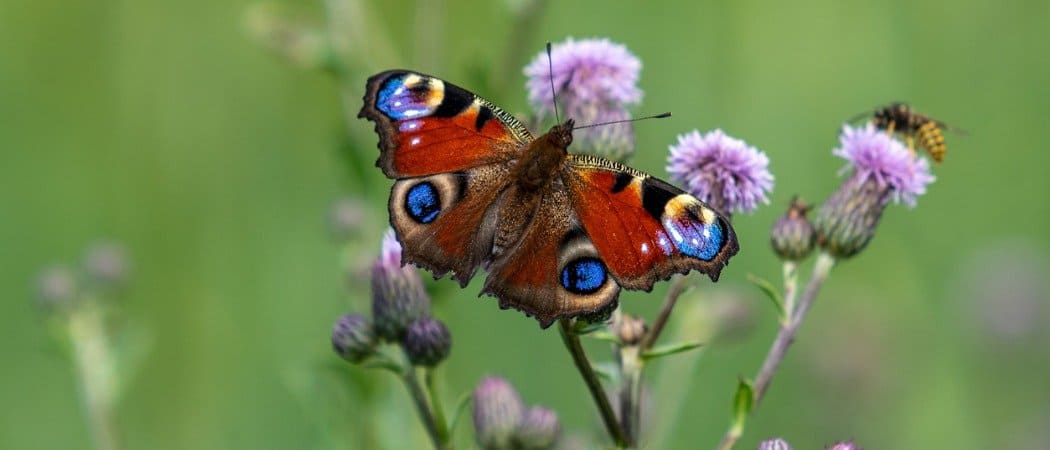
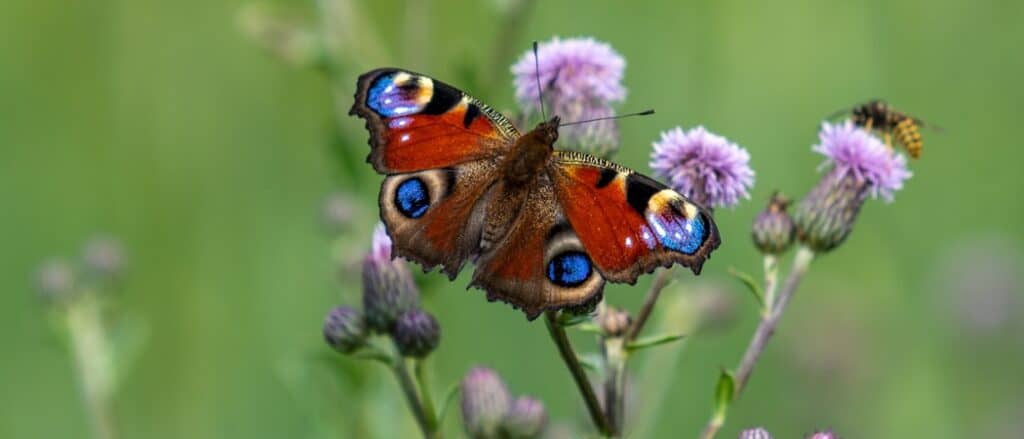
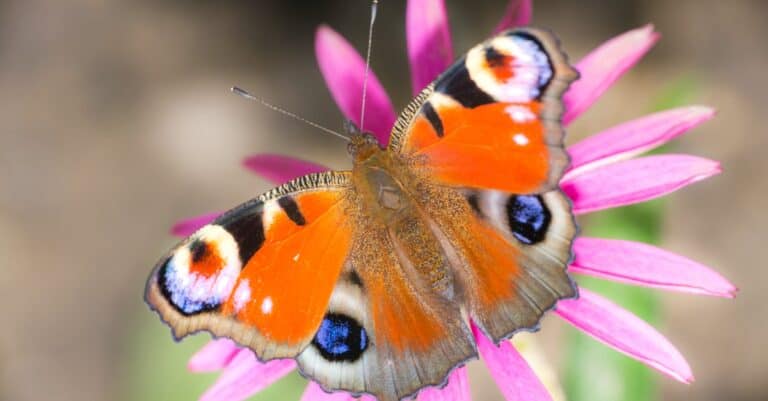
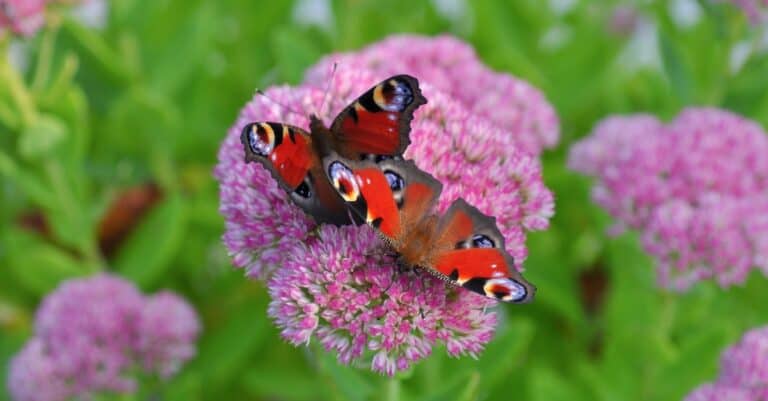
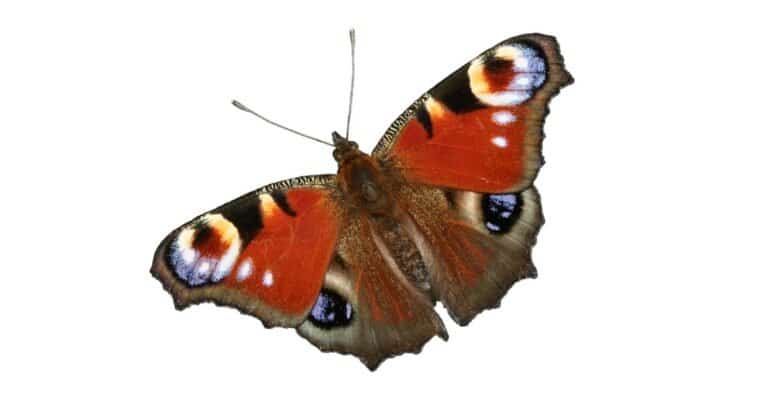
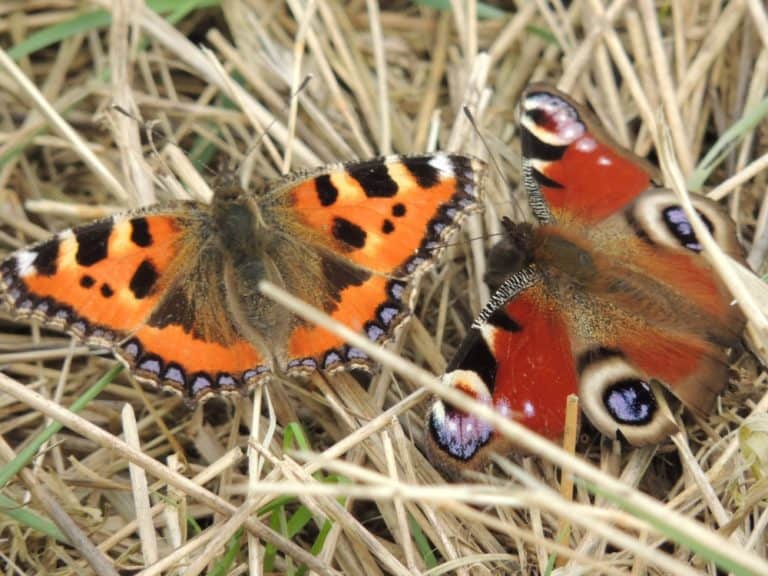
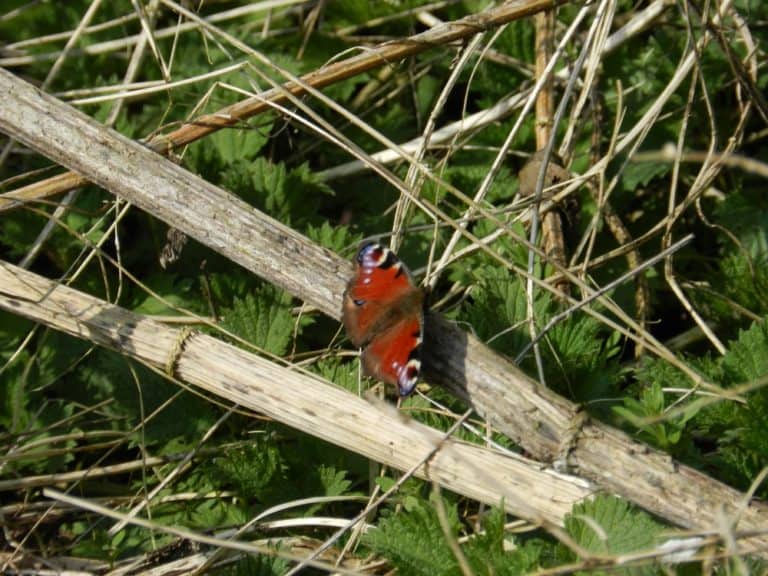
The bright colors of a Peacock butterfly make identification fairly easy. Its wings are a rusty red color with a black or gray border. This butterfly has an eyespot on each of its wings. Its eyespots are a mixture of the colors blue, white, black, and yellow. Its body is covered with brown bristly hairs and it has two thin antennae.

Interestingly, there are some Peacock butterflies without eyespots. They’re called blind specimens. However, a Peacock butterfly with no eyespots is a rare sight. This insect’s body is one to two inches long. The wingspan of this butterfly ranges from two to two and a half inches. The largest wingspan of the Peacock butterfly is 2.7 inches.

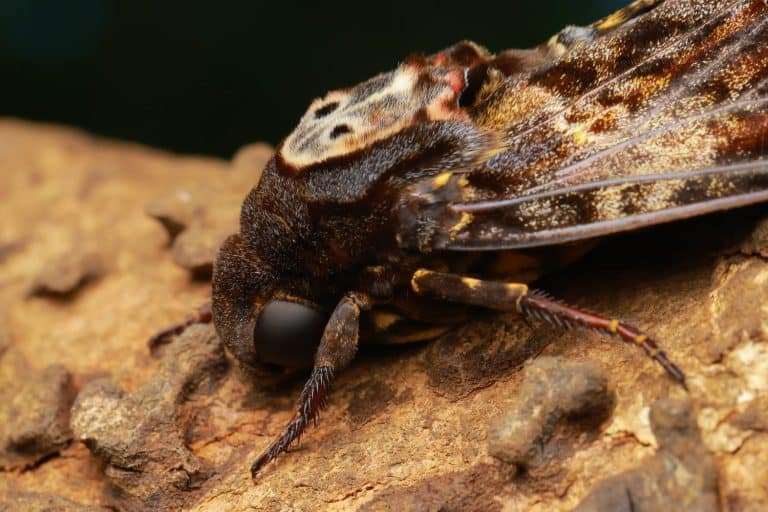
Compare this butterfly with the Io moth (Automeris io). This moth is bright yellow and has eyespots on its hindwings. Though they share the presence of eyespots, the Io moth’s wingspan is larger in size ranging from two and a half to three and a half inches.

The Peacock butterfly’s eyespots are used as a defense against predators. The butterfly sits quietly with its wings folded. But, when a predator such as a bird or a mouse approaches it, the butterfly quickly opens its wings revealing its eyespots. The predator is caught off guard and thinks it’s looking at the eyes of a larger animal!

If a Peacock butterfly wants to hide from a predator, it folds its wings. This covers its bright colors revealing the brown underside of its wings. This makes it easy to blend in with a tree trunk. A third method of self-protection is also one of the most interesting facts connected with this insect. It can make a hissing noise by rubbing its wings together. This sound is a deterrent to some predators.

Peacock butterflies are solitary unless its breeding season.
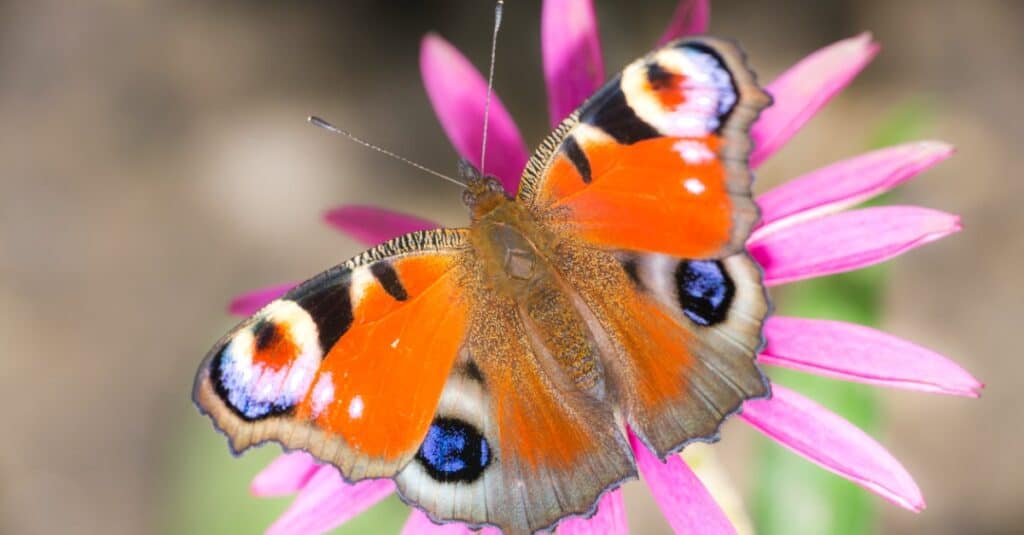
The eyespots on a Peacock butterfly’s wings are the most distinctive feature of the insect.

Habitat: Where to Find Peacock Butterflies

Peacock butterflies live in Europe and Asia. Woodlands, pastures, and meadows are all habitats of this butterfly. It’s common to see them moving from flower to flower in backyard gardens as well.

Diet: What Do Peacock Butterflies Eat?

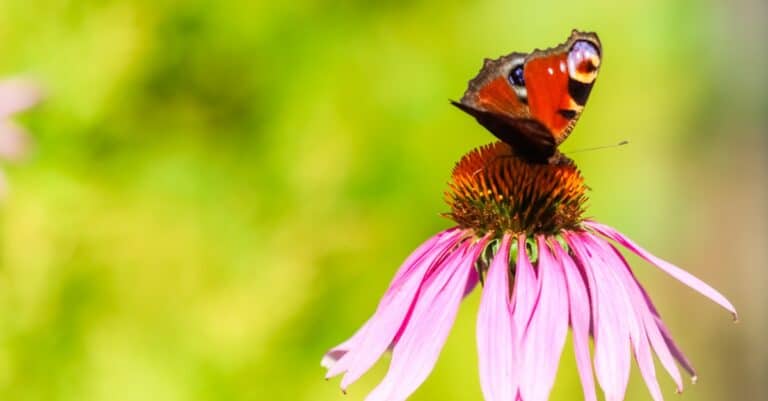
These flying insects are constantly looking or foraging for food. They land on dozens of flowers and shrubs each day. Peacock butterflies use the sensors in their feet to check a flower for appetizing nectar. Once it finds a supply of nectar, the butterfly uses its proboscis as a straw to draw the liquid up into its body.

What do Peacock butterflies eat?

The nectar of a Buddleia is a very popular food for Peacock butterflies. They also drink juice from fallen pieces of fruit.

What eats Peacock butterflies?

Its small size makes this butterfly easy prey for many predators including birds and mice.

How to Get Rid of Peacock Butterflies

Peacock butterflies are pollinators and won’t cause any harm to a backyard garden. But in another part of its life cycle, it takes the form of a caterpillar. It’s true some types of caterpillars can eat through the vegetables in a garden. But the Peacock butterfly caterpillar isn’t included in that group. This caterpillar eats nettles and leaves but tends to leave vegetables alone.

View all 246 animals that start with P

Sources

  1. Butterfly Conservation / Accessed October 13, 2021
  2. StNicks / Accessed October 13, 2021
  3. rspb / Accessed October 13, 2021
  4. Florida Wildflower Foundation / Accessed October 13, 2021
  5. Wikipedia / Accessed October 13, 2021
A-Z Animals Staff

About the Author

A-Z Animals Staff

AZ Animals is a growing team of animals experts, researchers, farmers, conservationists, writers, editors, and -- of course -- pet owners who have come together to help you better understand the animal kingdom and how we interact.
Connect:

Thank you for reading! Have some feedback for us?


Peacock Butterfly FAQs (Frequently Asked Questions)

The last part of this insect’s life cycle is the adult stage. The lifespan of an adult Peacock butterfly is about one year.