

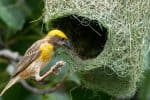
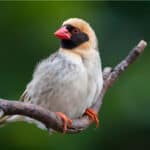
The weaver is a family of songbirds originating from Africa and Asia, celebrated for their extraordinary nest-building skills. While not all members of this family are technically called weavers, most of them do construct elaborate nests and breed together in sizable colonies. These intricately woven nests are some of the most amazing constructions in the entire avian world. Furthermore, weavers are also known for their dazzling plumage, fascinating behaviors, and significant role in ecosystems.
10 Fascinating Weaver Bird Facts
- Weavers are said to be very smart birds that can be trained to perform tricks and stunts.
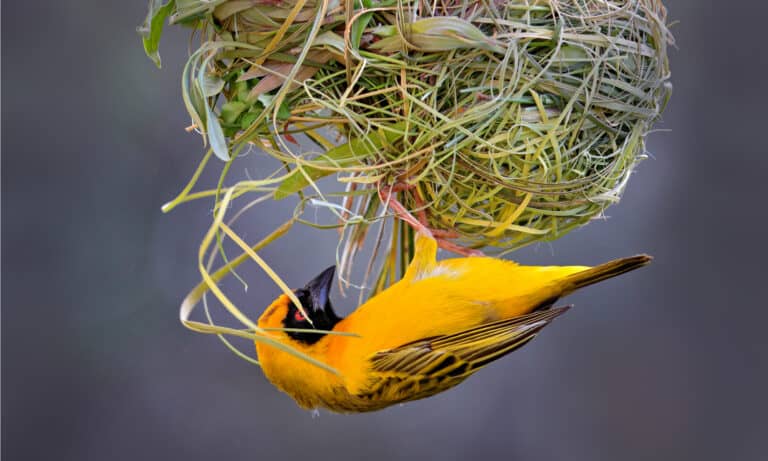
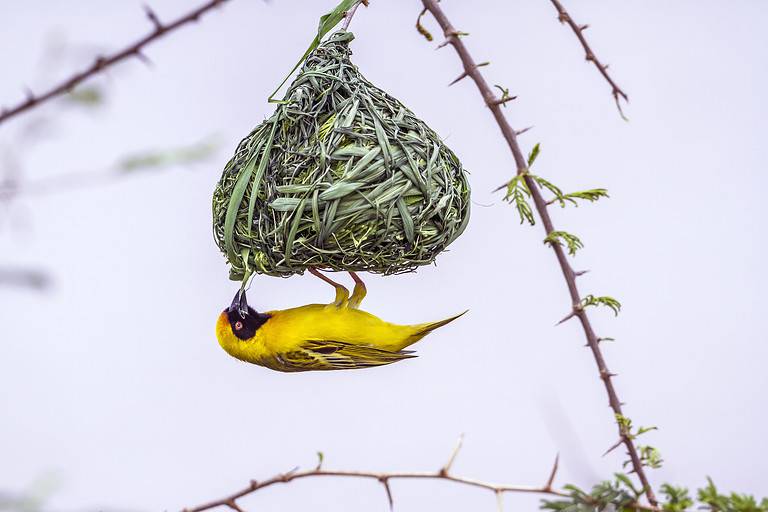
- Weavers can hang upside down from just about any surface or object they can cling to with their talons.
- Some birds, such as whydahs and indigobirds, are brood parasites that lay their eggs in the nests of weavers, tricking the weaver parents into raising their chicks.
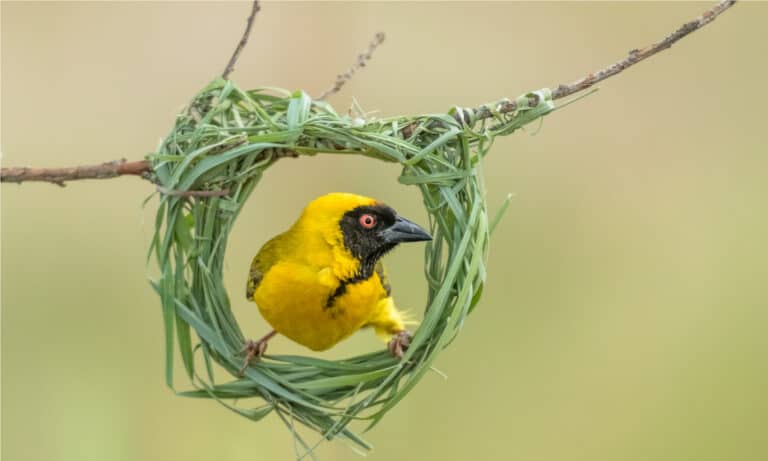
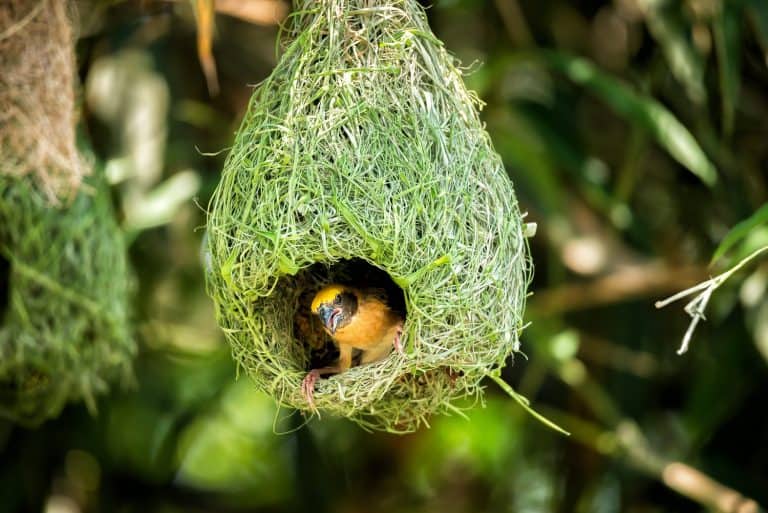
- Weaver birds are master nest-builders, weaving grass and plant fibers into intricate designs.
- Some species, like the Sociable Weaver, construct communal nests that last for decades and house hundreds of birds.
- Female weavers choose mates based on the quality of the nests they build.
- Certain species lay patterned eggs that help them detect and reject parasitic eggs.
- The Red-billed Quelea is the most numerous wild bird on Earth, with billions of individuals.
- Some weaver species are agricultural pests, raiding crops in large flocks.
- Male weavers may build up to 25 nests per season in attempts to attract mates.
Scientific Classification
Weaver birds are classified in the family Ploceidae and the order Passeriformes. The family name is derived from the ancient Greek word plokeus, meaning weaver. The family also includes bishops, widowbirds, and queleas, but weavers make up the bulk of the species. The genus Ploceus is the most populous, with some 60 or so species alone.
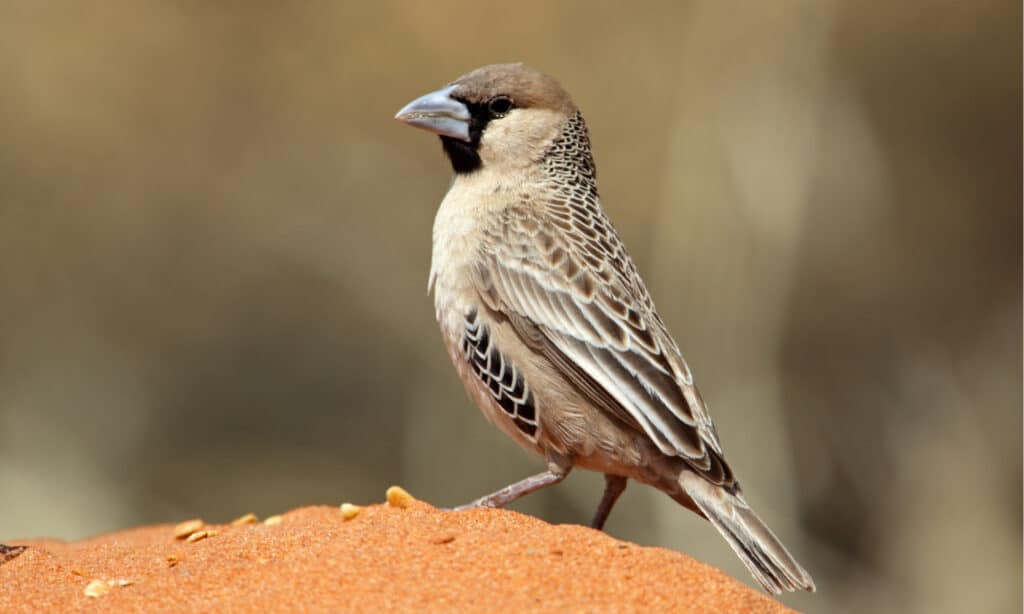
Weaver birds belong to a vast family of over 100 species, which derive their name from the ancient Greek word for weaver.
©Mogens Trolle/Shutterstock.com
Size, Appearance, and Behavior
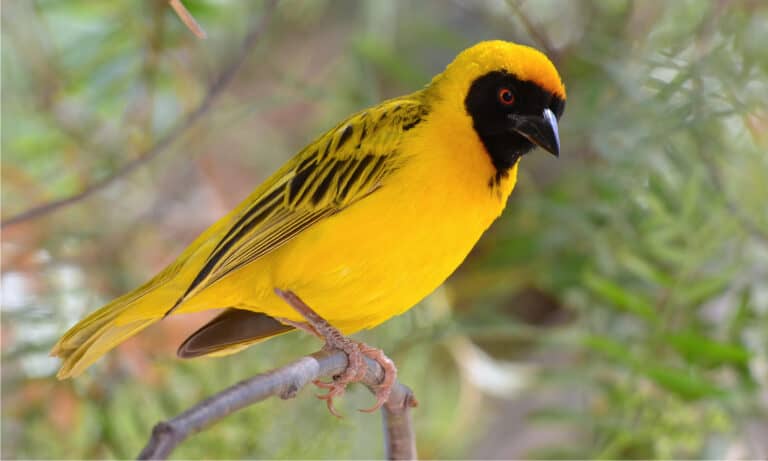
Weavers come in a remarkable variety of different shapes and colors. These are small songbirds, rarely measuring much more than 5 to 10 inches from their rounded head to square tail. The plumage is perhaps the most interesting and diverse characteristic. Bright red, yellow, black, gray, brown, and white, arranged in different patterns and shapes, are all very common plumage colors. The male weavers from the genus Ploceus are particularly notable for their ability to grow bright yellow plumage in the breeding season.
Weavers are among the most gregarious (meaning social) birds in the world. They often nest together in large colonies that consist of dozens of members at a time. The red-billed quelea is particularly extraordinary in this regard; it has been seen occupying massive colonies in which millions of birds are supposedly said to reside. Weaver birds do almost everything in close proximity to each other, including foraging, breeding, and preening. When they travel together, some species also fly in a tight formation. Their high-pitched chattering calls include mating songs, alarm calls, and the cries of chicks.
Habitat and Distribution
Weavers are endemic to grasslands, forests, and savannas throughout sub-Saharan Africa and South Asia. A few species have also been introduced outside of their original range. Weavers prefer to build nests near water, suspended from thorny trees to deter predators.
Nest-Building: Avian Engineering Feats
The one quality that unites all weavers is their ability to construct big nests from grass, leaves, and other plant fibers. These nests can range from simpler roofed shelters to complex cylindrical structures comprised of a single tube-shaped entrance and an internal chamber. Suspended from a thorny palm or acacia tree over a body of water, the nest is constructed by the male in the breeding season with only his feet and beak to work with. Weaver nests vary in both size and shape. The sociable weavers of southwestern Africa construct giant communal nests that can reach up to 20 feet in width and weigh over a ton. These nests last for generations. Females will inspect the nest to choose a mate.
Species Spotlights
There are about 120 species of weaver birds. The most common of them include:
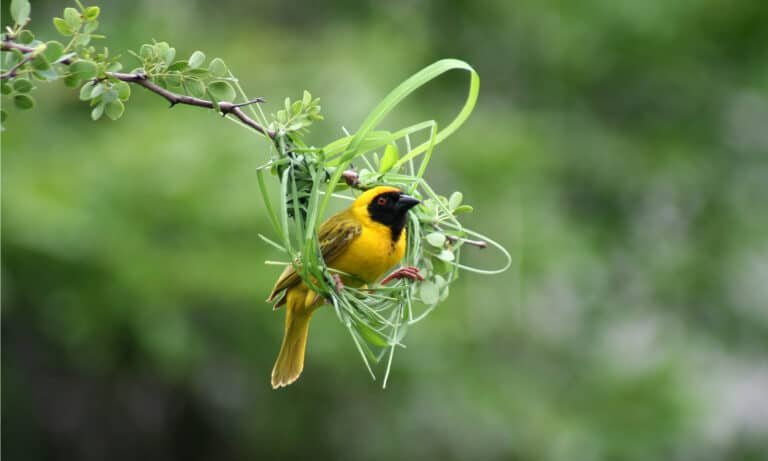
- The village weaver (Ploceus cucullatus): This gregarious species is generally found in Africa and is known for its males, which have a bright yellow plumage streaked with black and black head feathers. Females have feathers of a more muted yellow interspersed with pale brown. The species is at home in the woods and among humans, too.
- The cinnamon weaver: This avian is rather fond of trees with copious foliage and can be found in Sudan and South Sudan. It is found nowhere else.
- The white-headed buffalo weaver: This species is known for the dark bands around its eyes, dark wing and tail feathers, and white chest and head feathers. It is especially fond of buffalo since it gets to feed on the insects they disturb.
- The southern masked weaver (Ploceus velatus): This species is known for its prolific nest building (males build about 25 per season). It is also one species capable of outwitting the cuckoo due to its habit of laying different colored eggs. Strange eggs are jettisoned from the nest.
- The chestnut weaver: In a departure from the golden plumage of most weavers, male members of this species have a black mask and russet head and chest feathers. Chestnut weavers live in eastern and south-western Africa.
See the full list of 122 species at the bottom of this article.
Diet and Foraging
The weaver is an omnivorous bird that spends much of its day foraging on the ground and in trees. The diet of the weaver mostly consists of seeds, grains, insects, and other small animals. Their large beak enables them to crack open the thick shells on which they feed. Because of their habit of raiding farmlands and fields, some weavers — especially the Red-billed Quelea — are considered to be annoying agricultural pests.
Predators and Threats
Many weavers are preyed upon by snakes, lizards, crows, and larger birds of prey. The location of the nest, suspended from a thorny tree over a body of water, can protect against predators. Mobs of weavers may also work together to drive the predator away.
Habitat loss is a persistent threat to some species, but they can adapt fairly well to human presence. Other human threats include climate change and persecution as pests.
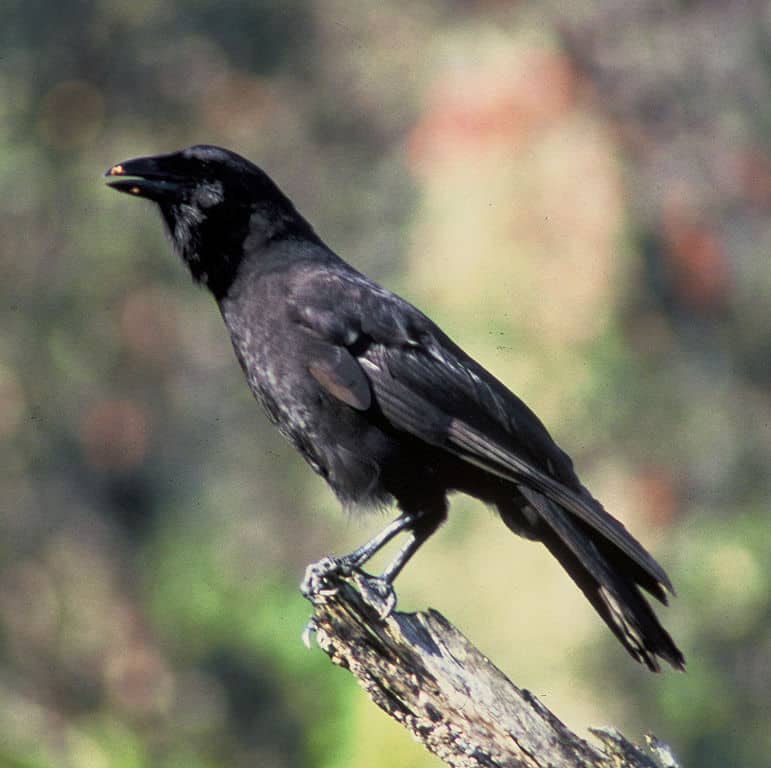
Crows, as well as larger birds of prey, are known to hunt weavers.
©U.S. Fish and Wildlife Service / Public Domain / Wikimedia Commons – Original / License
Reproduction and Lifecycle
The weaver bird has many different reproductive strategies. Many species gather together in large communal flocks to attract a mate. Males produce a chattering bird song while fluttering their wings. Females will judge the male by the quality of his nest, so not everyone will have immediate success. Many nests are abandoned without use in the breeding season because the female rejected them as subpar (although this may also be an anti-predator strategy).
Usually, 2 to 6 eggs are laid per clutch. After about 2 weeks of incubation inside the nest, the eggs will start to hatch. With rigorous feeding and care from the parents, the chicks will gain their flight feathers and start to leave the nest only a few weeks later.
‘Male weavers are generally polygynous, often mating with multiple females per breeding season, while females typically mate with one male per season. The lifespan varies, but many of these birds live some 10 to 20 years.
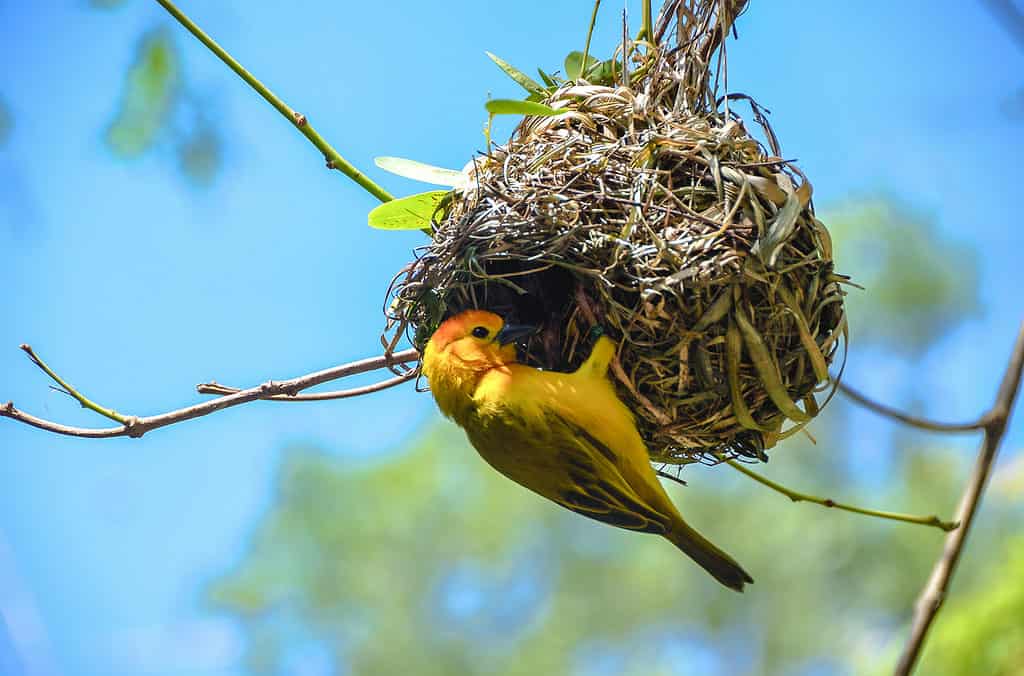
Female weaver birds assess the quality of potential mates’ nests as a means of deciding whether to accept their advances or not.
©iStock.com/thittaya itthithepphana
Migration Patterns
Weaver birds generally don’t migrate far, but many types of species do travel seasonally in response to changing weather and food availability. They generally migrate together as a large flock.
Evolutionary History
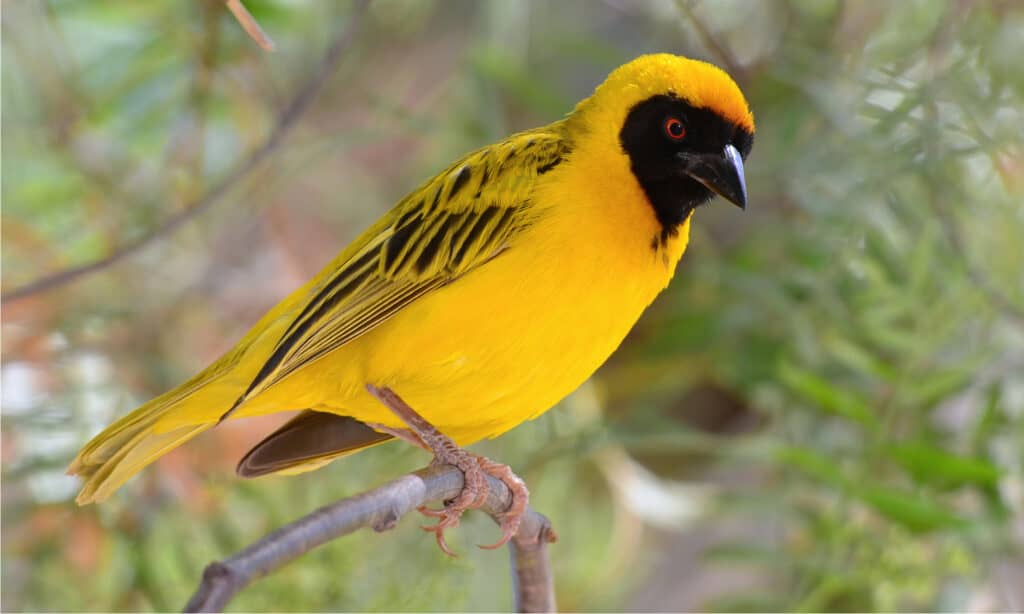
The earliest ancestor of weaver birds is believed to have emerged during the Miocene, about 18 million years ago.
©Karel Gallas/Shutterstock.com
The ancestor of the weaver bird is believed by paleontologists to have lived during the early part of the Miocene epoch (~18 million years ago). During this epoch, which occurred between 5.33 – 23 million years ago and also saw apes emerge on the evolutionary scene, the climate was warm, although cooling gradually.
The earlier version of the weaver bird was likely pretty similar to its descendants in appearance, with nest-building as a defining adaptation, since several animals and birds during the Miocene resembled their distant progeny.
Ecological Role
Weaver birds play important roles in ecosystems. They help control insect populations and disperse seeds and grains. Their abandoned nest are also used by other animals for shelter. Furthermore, they serve as prey for higher predators. Through their massive flocks and communal nesting habits, they also serve as important indicators of environmental health.
Cultural Significance
In African folklore, weavers often symbolize creativity, wisdom, and cooperation. The Baya Weaver in South Asia is celebrated for its artistry and admired in poetry and art. Birdwatchers and ecotourists are also attracted to their colonies.
Conservation Status
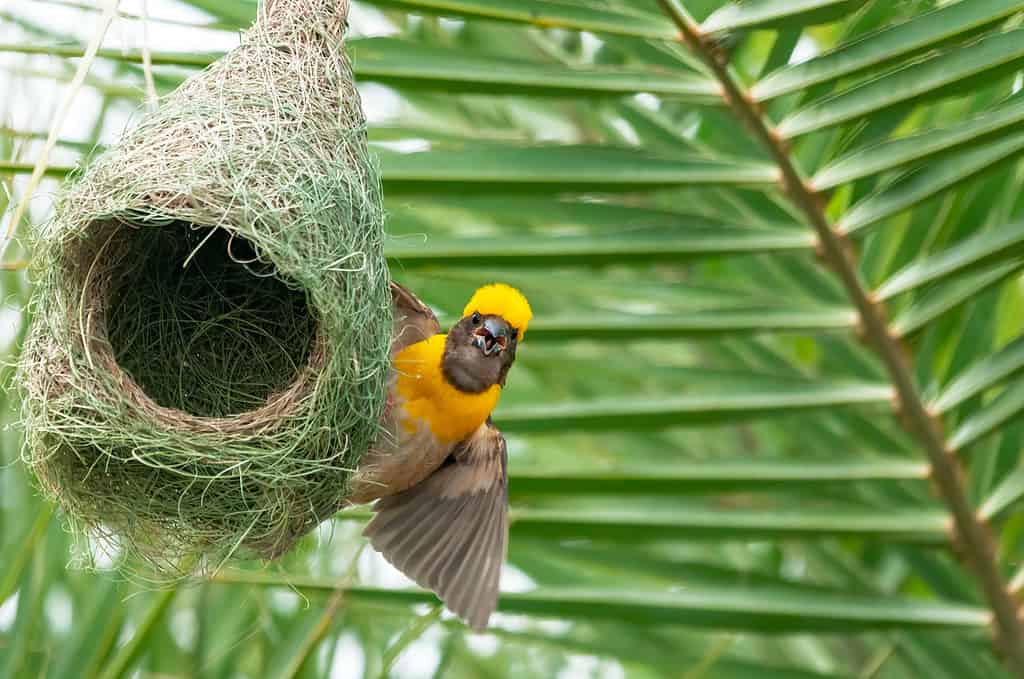
According to the IUCN, weavers are doing pretty well in general. However, a few species are endangered.
©iStock.com/Syed F Abbas
The weaver varies considerably in its conservation status. According to the IUCN Redlist, the majority of species are considered to be of least concern, meaning they require no specific conservation effort. A few of them are endangered too, including
- Finn’s Weaver (Ploceus megarhynchus) — fewer than 1,000 individuals
- Golden-naped Weaver (Ploceus aureonucha) — endangered
- Bannerman’s Weaver (Ploceus bannermani) — vulnerable (6,000 to 15,000 individuals)
Some of the challenges faced by weavers are habitat loss and agricultural conflict.
Population
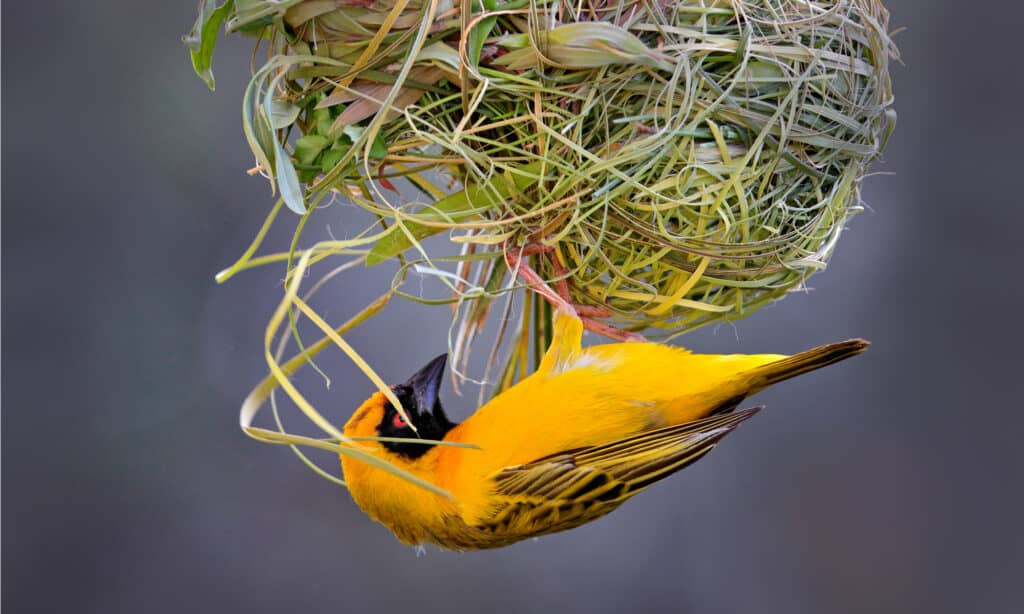
Reliable population estimates remain unavailable for several weaver species.
©Ondrej Prosicky/Shutterstock.com
Good population estimates are not available for the majority of species, but there are some exceptions. For instance, the Red-billed Quelea population numbers in the billions. In contrast, other species, like Finn’s Weaver, are endangered and have populations in the low thousands. This dramatic range highlights both the adaptability and fragility within the family.
Full Species List
Here are the 122 species of weaver birds:
- Aldabra fody
- Asian golden weaver
- Baglafecht weaver
- Bannerman’s weaver
- Bar-winged weaver
- Bates’s weaver
- Baya weaver
- Bertram’s weaver
- Black bishop
- Black-billed weaver
- Black-breasted weaver
- Black-capped social weaver
- Black-chinned weaver
- Black-headed weaver
- Black-necked weaver
- Black-winged red bishop
- Blue-billed malimbe
- Bob-tailed weaver
- Bocage’s weaver
- Brown-capped weaver
- Cape weaver
- Cardinal quelea
- Cassin’s malimbe
- Chestnut weaver
- Chestnut-and-black weaver
- Chestnut-backed sparrow-weaver
- Chestnut-crowned sparrow-weaver
- Cinnamon weaver
- Clarke’s weaver
- Comoros fody
- Compact weaver
- Crested malimbe
- Dark-backed weaver
- Donaldson Smith’s sparrow-weaver
- Eastern golden weaver
- Fan-tailed widowbird
- Finn’s weaver
- Fire-fronted bishop
- Forest fody
- Fox’s weaver
- Giant weaver
- Gola malimbe
- Golden palm weaver
- Golden-backed bishop
- Golden-backed weaver
- Golden-naped weaver
- Grey-capped social weaver
- Heuglin’s masked weaver
- Holub’s golden weaver
- Ibadan malimbe
- Jackson’s widowbird
- Juba weaver
- Katanga masked weaver
- Kilombero weaver
- Lesser masked weaver
- Little weaver
- Loango weaver
- Long-tailed widowbird
- Lufira masked weaver
- Marsh widowbird
- Mauritius fody
- Maxwell’s black weaver
- Montane widowbird
- Nelicourvi weaver
- Northern brown-throated weaver
- Northern masked weaver
- Northern red bishop
- Olive-headed weaver
- Olive-naped weaver
- Orange weaver
- Preuss’s weaver
- Principe weaver
- Rachel’s malimbe
- Red fody
- Red weaver
- Red-bellied malimbe
- Red-billed buffalo weaver
- Red-billed quelea
- Red-collared widowbird
- Red-cowled widowbird
- Red-crowned malimbe
- Red-headed malimbe
- Red-headed quelea
- Red-headed weaver
- Red-vented malimbe
- Rodrigues fody
- Rufous-tailed weaver
- Rüppell’s weaver
- Ruvu weaver
- Sakalava weaver
- Sao Tome weaver
- Scaly-feathered weaver
- Seychelles fody
- Slender-billed weaver
- Sociable weaver
- Southern brown-throated weaver
- Southern masked weaver
- Southern red bishop
- Speckle-fronted weaver
- Spectacled weaver
- Speke’s weaver
- Strange weaver
- Streaked weaver
- Tanzanian masked weaver
- Taveta weaver
- Thick-billed weaver
- Usambara weaver
- Vieillot’s black weaver
- Village weaver
- Vitelline masked weaver
- Weyns’s weaver
- White-billed buffalo weaver
- White-browed sparrow-weaver
- White-headed buffalo weaver
- White-winged widowbird
- Yellow bishop
- Yellow-capped weaver
- Yellow-crowned bishop
- Yellow-legged weaver
- Yellow-mantled weaver
- Yellow-mantled widowbird
- Zanzibar red bishop
Weaver Birds Pictures
View all of our Weaver Birds pictures in the gallery.

Ondrej Prosicky/Shutterstock.com
Sources
- Britannica / Accessed March 25, 2022
- 10000 Birds / Accessed March 25, 2022