
Quick Take
- Black widows have a notorious reputation, yet almost everything most people "know" about them is wrong. See surprising facts →
- Their silk is being studied for use in major infrastructure projects, and the reason why will surprise you. Discover silk strength →
- Female cannibalism after mating is one of the most famous things about black widows, but it is also one of the most misunderstood. Read about cannibalism myths →
- Only three animals on Earth regularly dare to prey on black widows, and at least one of them is deeply unexpected. Meet their rare predators →
Their reputations are fierce, but in reality, black widow spiders are calm, loner pacifists that only unleash venomous bites when they’ve exhausted all other defensive options. Roughly 32 to 35 species of the infamous arachnids populate the Earth on every continent except Antarctica, and the genus probably popped onto the world scene about 300 million years ago.
Female black widows carry large loads of venom, but males don’t. And though it’s widely believed that all females eat their mates after breeding, such behavior is rare and only happens in lab environments where there’s no escape.

Incredible Black Widow Spider Facts
- Black widows’ webs are stronger than steel. Scientists actively study the spider’s weaving silk in the hopes of replicating it for infrastructure projects, like bridges.
- At first glance, spiders in the genus Steatoda resemble widow spiders, which is how they got the nickname “false widow spiders.” Steatoda bites aren’t pleasant, but they’re not as destructive as black widow bites.
- Latrodectus tredecimguttatus is the most deadly of all 32 widow species.
- Black widow spiders don’t live long lives. Males typically expire within a few weeks after maturity, and while females usually survive for over a year, only a few lucky ones make it to three years old.
Evolution and Classification
Black widows are Araneomorphae, an infraorder of spiders known for having chelicerae that point diagonally forward and cross in a pinching action. Within that vast collective, they also belong to the subgroup Theridiidae, which are also referred to as tangle-web spiders. Tangle-web spiders are known for their habit of spinning adhesive webs for the capture of prey and a comb of serrated bristles on the tarsus of their fourth leg.
As members of the genus Latrodectus, they are known as true widows and are connected to their European and South American counterparts, brown widows, red widows, the Australian redback spider, and others
These arachnids also share the ability to produce latrotoxin, a notably potent neurotoxic venom that gives rise to latrodectism.
Scientific Name
Latrodectus is the scientific name for widow spiders. A portmanteau combining the New Latin word ‘latro,’ meaning ‘bandit,’ and the Ancient Greek word ‘dēktēs,’ meaning ‘biter,’ it was coined by French civil servant and scientist Baron Charles Athanase Walckenaer in 1805. Colloquially, it translates to “bandit who bites.”
Types
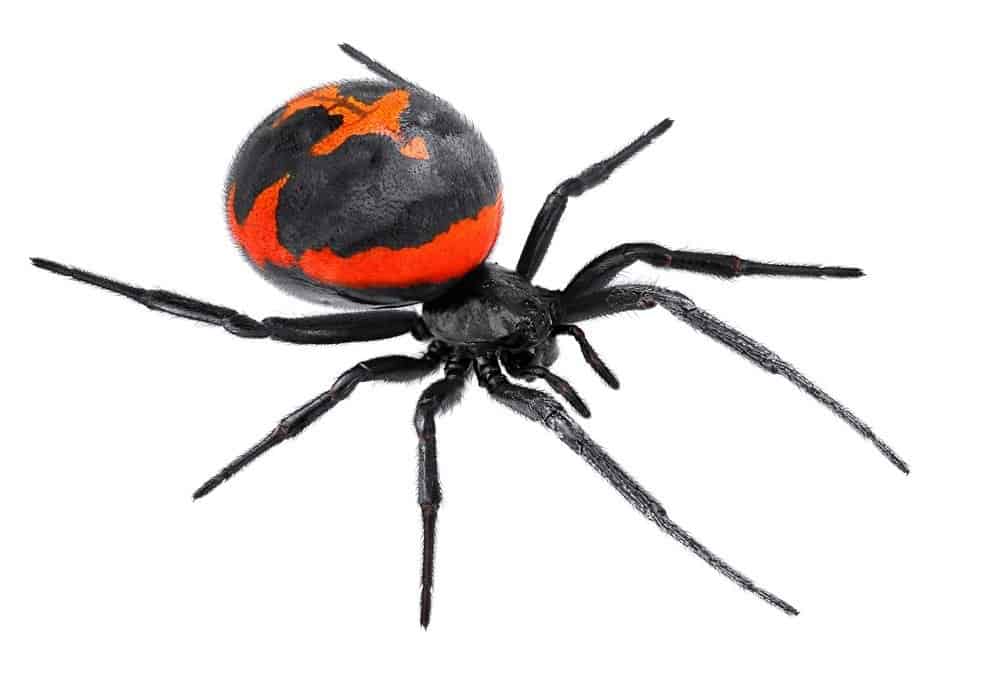
Members of the black widow genus can be found in Africa, the Americas, Asia, Australia, and Europe.
©Protasov AN/Shutterstock.com
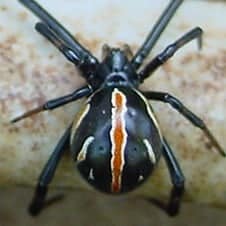
There are approximately 32 to 35 recognized species in the ‘true widow’ genus. In North America, three species — Latrodectus mactans, Latrodectus hesperus, and Latrodectus variolus — are informally known as southern black widows, western black widows, and northern black widows, respectively. Latrodectus tredecimguttatus is the European black widow; Latrodectus hasselti crawls throughout Australia and is known as the redback spider, or Australian black widow; in South America, two species — Latrodectus corallinus and Latrodectus curacaviensis — are commonly called South American black widow spiders.
| Scientific Name | Taxonomy Origin Date | Regions |
|---|---|---|
| Latrodectus antheratus | 1932 | Paraguay, Argentina |
| Latrodectus apicalis | 1877 | Galapagos Islands |
| Latrodectus bishopi | 1938 | USA |
| Latrodectus cinctus | 1865 | Cape Verde, Africa, Kuwait, Iran |
| Latrodectus corallinus | 1980 | Argentina |
| Latrodectus curacaviensis | 1776 | Lesser Antilles, South America |
| Latrodectus dahli | 1959 | Morocco to Central Asia |
| Latrodectus diaguita | 1960 | Argentina |
| Latrodectus elegans | 1898 | India, Myanmar, Thailand, China, Japan |
| Latrodectus erythromelas | 1991 | India, Sri Lanka |
| Latrodectus garbae | 2021 | Colombia |
| Latrodectus geometricus | 1841 | Africa, Introduced to North America and South America, Poland, Middle East, Pakistan, India, Thailand, Japan, Papua New Guinea, Australia, Hawaii |
| Latrodectus hasselti | 1870 | India, Southeast Asia to Australia, New Zealand |
| Latrodectus hesperus | 1935 | North America, Introduced to Israel, Korea |
| Latrodectus hurtadoi | 2021 | Colombia |
| Latrodectus hystrix | 1890 | Yemen |
| Latrodectus indistinctus | 1904 | Namibia, South Africa |
| Latrodectus karrooensis | 1944 | South Africa |
| Latrodectus katipo | 1871 | New Zealand |
| Latrodectus lilianae | 2000 | Spain, Algeria |
| Latrodectus mactans | 1775 | Probably native to North America only, introduced to South America, Asia |
| Latrodectus menavodi | 1863 | Madagascar, Comoros, Seychelles |
| Latrodectus mirabilis | 1876 | Argentina |
| Latrodectus obscurior | 1902 | Cape Verde, Madagascar |
| Latrodectus pallidus | 1872 | Cape Verde to Libya, Turkey, Kazakhstan, Iran, Central Asia |
| Latrodectus quartus | 1980 | Argentina |
| Latrodectus renivulvatus | 1902 | Africa, Yemen, Saudi Arabia, Iraq |
| Latrodectus revivensis | 1948 | Israel |
| Latrodectus rhodesiensis | 1972 | Southern Africa |
| Latrodectus thoracicus | 1849 | Chile |
| Latrodectus tredecimguttatus | 1790 | Mediterranean to China |
| Latrodectus umbukwane | 2019 | South Africa |
| Latrodectus variegatus | 1849 | Chile, Argentina |
| Latrodectus variolus | 1837 | USA, Canada |
Appearance and Behavior
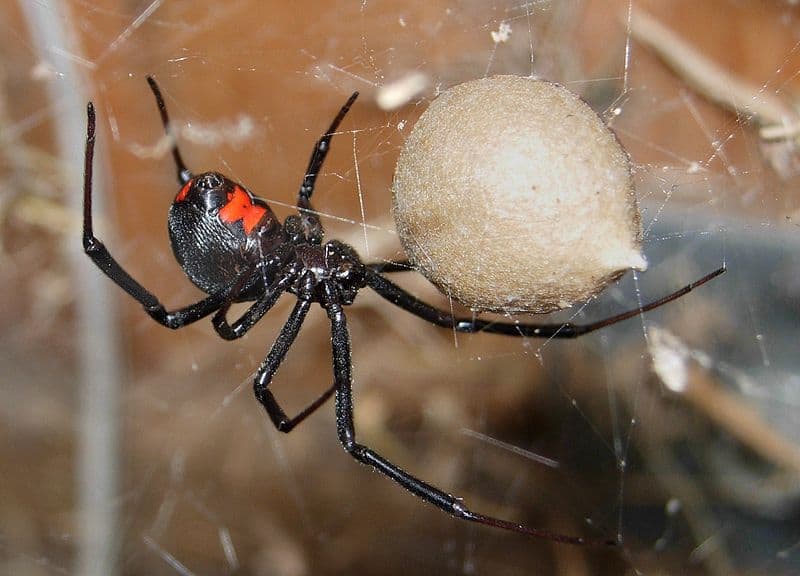
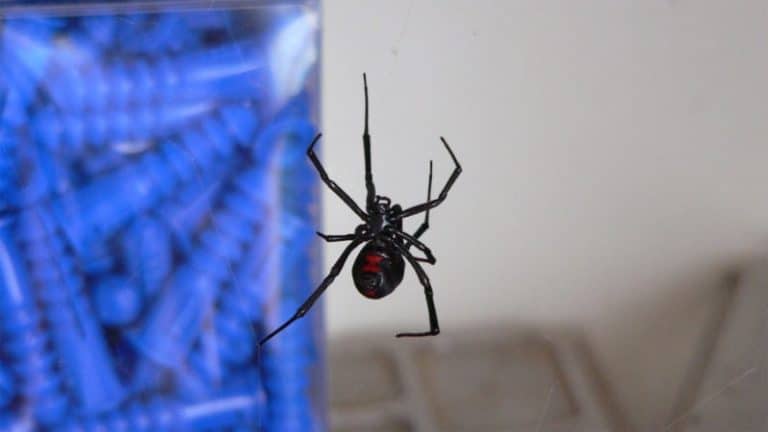
Despite their small sizes, black widows produce a potent neurotoxic venom.
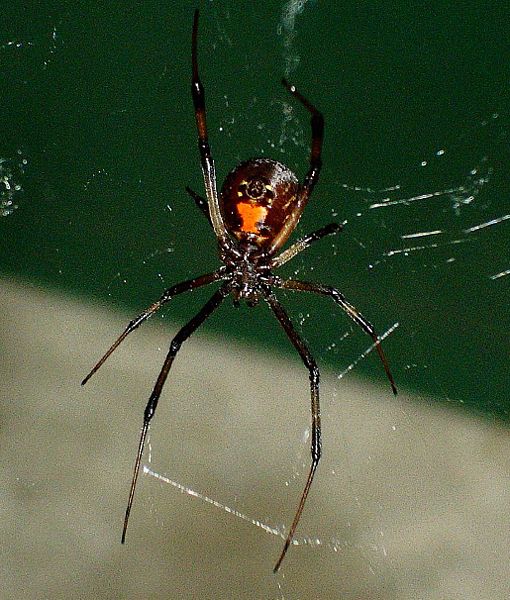
©Chuck Evans(mcevan)”./ CC BY 2.5, via Wikimedia Commons – Original / License
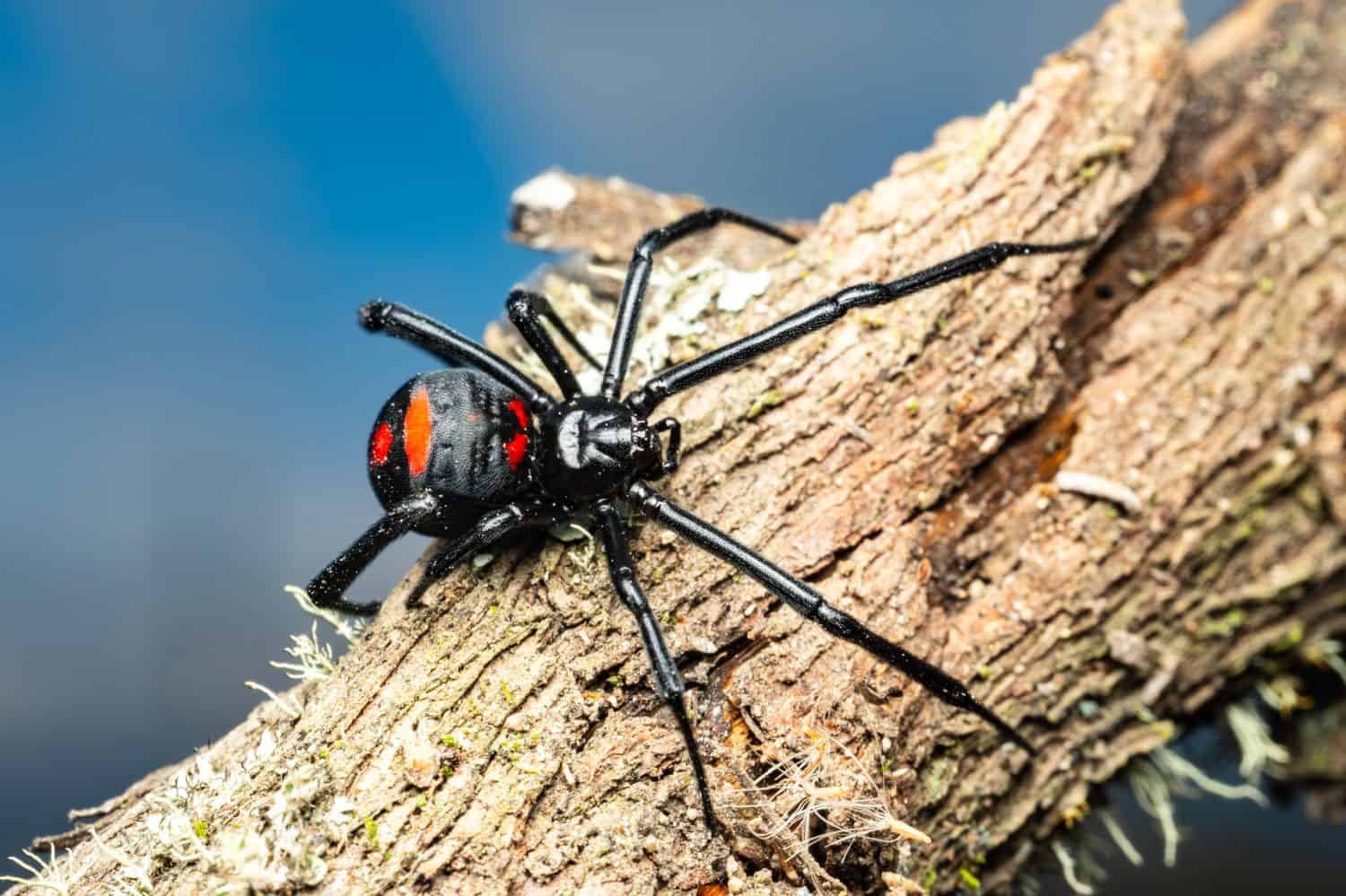
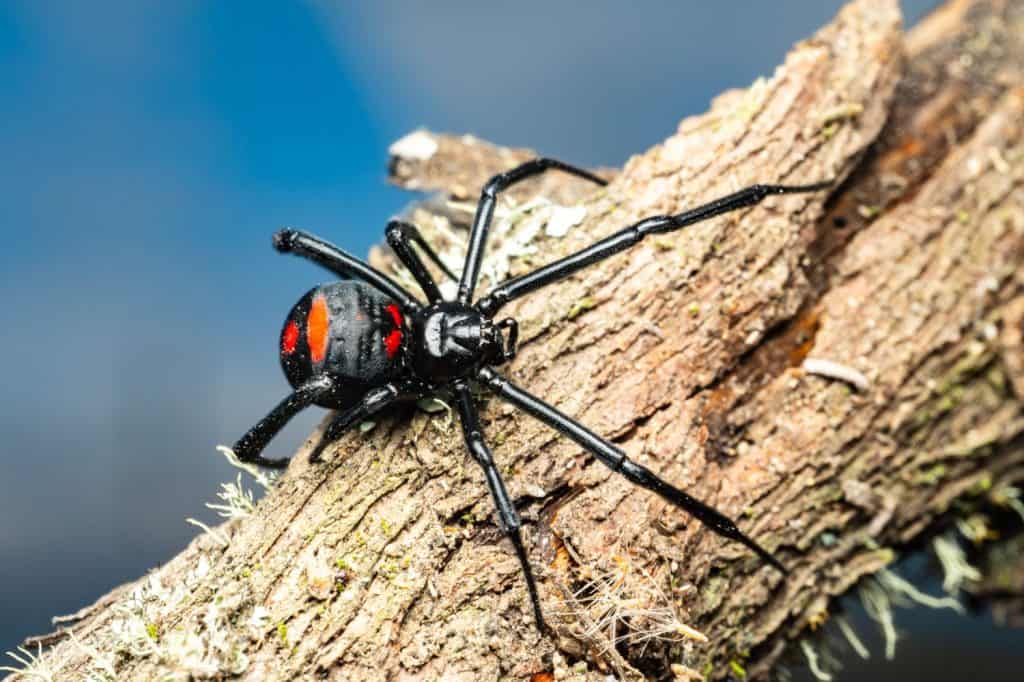
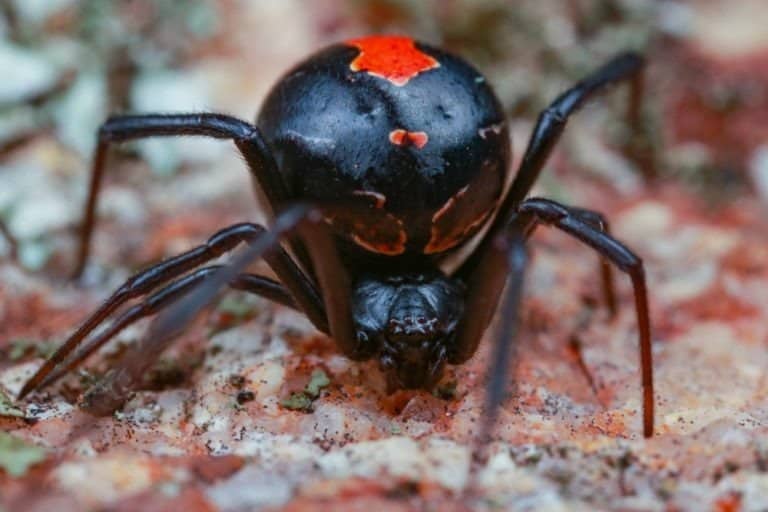
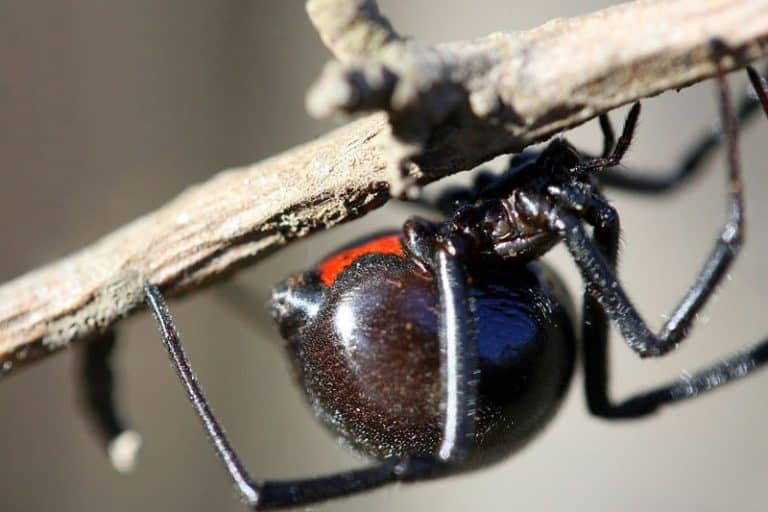
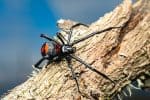
Nearly all black widow spiders are about 1.5 inches long, weigh approximately 0.035 ounces, and have dark-colored, hourglass-shaped bodies accented with white, brown, or red markings. Like most web-weaving spiders, widows have terrible eyesight and rely on vibrations to sense prey and danger.
Unlike the Goliath birdeater (Theraphosa blondi), the world’s largest spider, black widows are tiny — about the size of a paperclip. But don’t let their compact bodies fool you — widows pack a dangerous punch! Their bites release a neurotoxin called latrotoxin, which can cause extreme pain, muscle rigidity, vomiting, and heavy sweating. Acute symptoms in people bitten by black widow spiders typically resolve within 1 to 3 days, though residual effects such as muscle spasms, weakness, and pain can persist for weeks. But it’s false that widow bites routinely result in human fatalities. They do, however, kill cats and dogs.
Only females are harmful; males do not possess sufficient quantities of venom to cause significant damage.
Widow spiders are notorious for female sexual cannibalism — meaning the ladies eat males after mating. But what people may not understand is that it doesn’t happen all that often, and not all species engage in the practice.
So why do some Latrodectus ladies murder their mates? Nobody knows for sure, but a popular theory postulates that the act increases the odds of offspring survival. Additionally, thanks to special chemicals that emanate from webs after meals, males can sense when females are well-fed and tend to avoid hungry mates. In fact, most males who fall prey to their partners are trapped in a laboratory environment and can’t escape.
Habitat
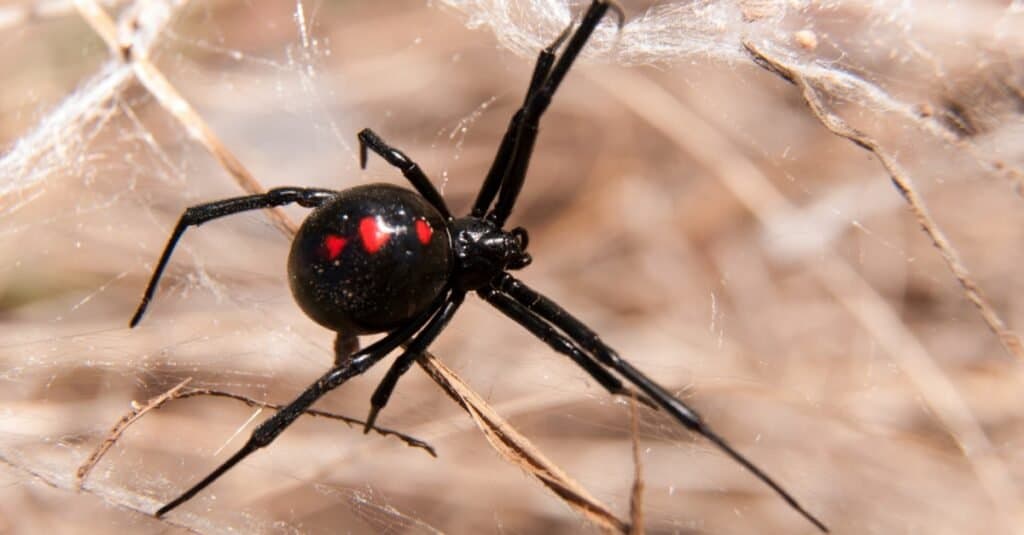
Black widows can be found in attics, basements, holes, or woodpiles.
©Sari ONeal/Shutterstock.com
Widow spiders crawl around every continent except Antarctica. They’re particularly abundant in North America, especially in Canada’s wine country, the Okanagan Valley in British Columbia.
Typically, black widow spiders spin webs near the ground or in dark, low places. Inside, you’ll most likely find them in dark corners under desks, basements, and attics. Outside, they hunker in holes and wood piles.
Diet
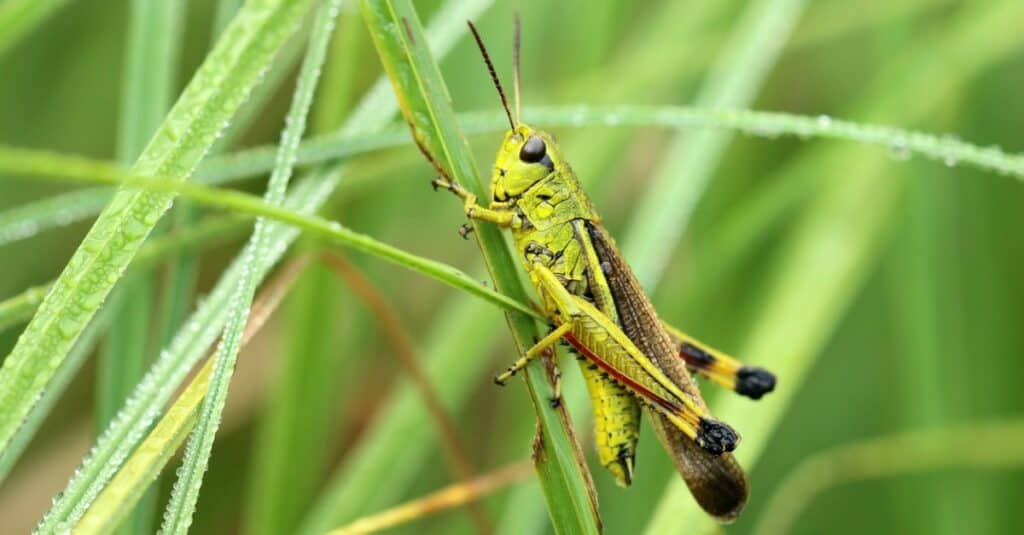
Grasshoppers are some of black widows’ favorite prey.
©iStock.com/Eileen Kumpf
What do black widow spiders eat? They prey on small insects like flies, mosquitoes, grasshoppers, beetles, and caterpillars. Within their environment, they are considered apex predators.
How do black widows catch food? Like most other spider species, black widows weave sticky webs of silken fibers. When waiting for food to stumble into their lairs, widow spiders hang upside down in the middle of their nets. When a victim crashes in, they’re incapacitated by the web’s stickiness. At that point, the spider moves in, paralyzes the prey with venom, and then wraps its meal in silk to prevent escape.
When a black widow is ready to dine, it covers its prey in digestive juices and consumes the liquefied remains. If a widow senses danger, it will quickly crawl down a loose web thread and scurry to safety.
Predators and Threats
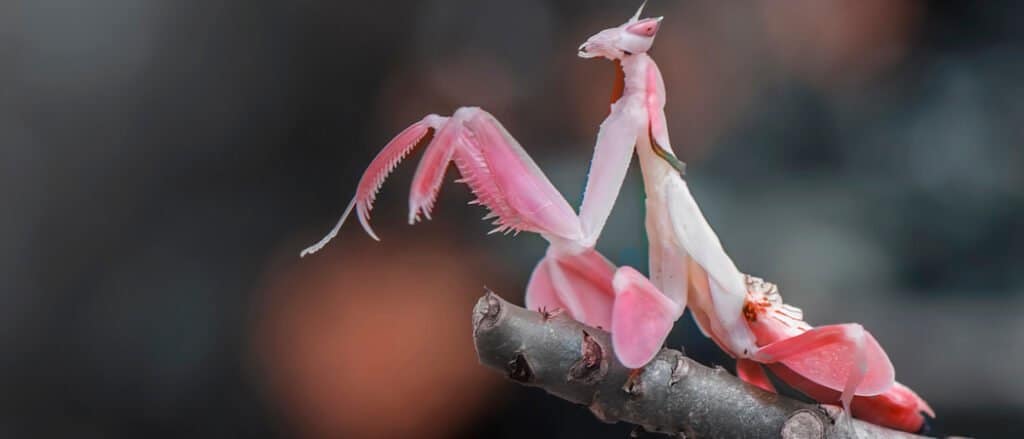
Praying mantises are an example of a predator that black widows have to look out for.
©Galuh M/Shutterstock.com
Few animals prey on black widow spiders because of the spider’s body shape and markings, which scientists believe send unpleasant signals that repel most animals.
But rules come with exceptions, and in this case, the three are praying mantises (Mantodea), alligator lizards (Anguidae), and blue mud wasps (Chalybion californicum), which use their stingers to paralyze before chowing down.
Humans also pose a threat to black widow spiders because we accidentally crush them and purposefully kill them when stumbling upon the species at home.
Reproduction, Babies, and Lifespan
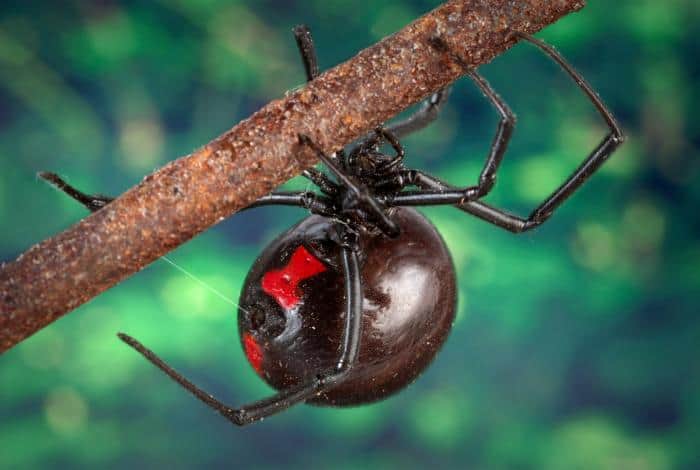
Black widow spiders generally get to live for three years.
Widow spiders are solitary animals that only come together in late spring for mating season. During the yearly ritual, males and females partner up, and the former injects the latter with sperm. The females then fertilize their eggs internally and lay silken egg sacs.
The sac incubates for about 30 days, at which point a brood of self-sufficient spiderlings hatches. The moment they’re born, baby spiders scurry away from the nest. The wind often helps them along, and most find themselves far away from home within hours of birth.
But a black widow’s life isn’t long. Many die before they reach a month old, and few — mostly females — make it to three years old.
Population
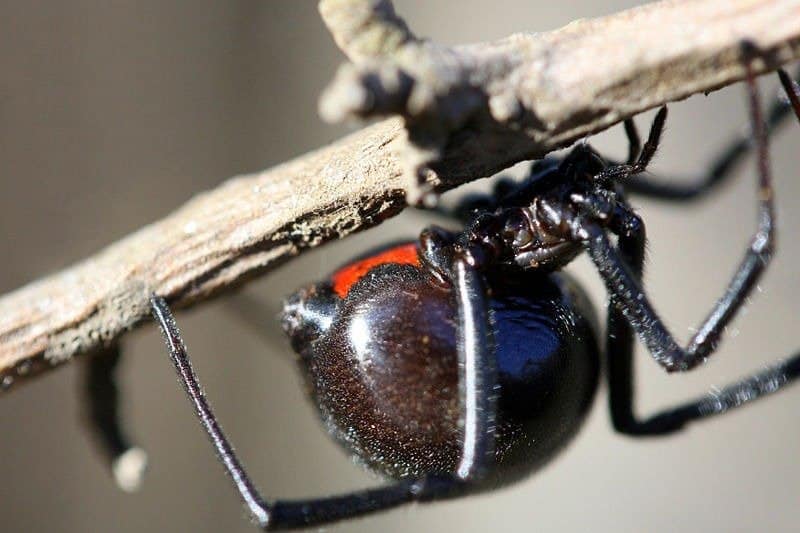
Black widow populations do not seem to be under any immediate threat.
Black widow spiders aren’t in danger currently. The International Union for the Conservation of Nature doesn’t even include the animal on its Red List. IUCN does list false widow spiders, but only under the Data Deficient section.
Availability in U.S. Zoos
Black widow spiders live in hundreds of exhibits and labs around the world. Here’s a partial list of U.S. zoos that care for individuals from the genus:
Black Widow Spider Pictures
View all of our Black Widow Spider pictures in the gallery.

Peter Yeeles/Shutterstock.com
How to say Black Widow Spider in ...
Sources
- David Burnie, Dorling Kindersley (2011) Animal, The Definitive Visual Guide To The World's Wildlife / Accessed December 21, 2009
- Tom Jackson, Lorenz Books (2007) The World Encyclopedia Of Animals / Accessed December 21, 2009
- David Burnie, Kingfisher (2011) The Kingfisher Animal Encyclopedia / Accessed December 21, 2009
- Richard Mackay, University of California Press (2009) The Atlas Of Endangered Species / Accessed December 21, 2009
- David Burnie, Dorling Kindersley (2008) Illustrated Encyclopedia Of Animals / Accessed December 21, 2009
- Dorling Kindersley (2006) Dorling Kindersley Encyclopedia Of Animals / Accessed December 21, 2009
- Welke, Klaas W.; Schneider, Jutta M. "Sexual cannibalism benefits offspring survival". Animal Behaviour. 83 (1): 201–207. / Accessed October 13, 2020
- Baruffaldi, Luciana; Andrade, Maydianne C.B. (2015) "Contact pheromones mediate male preference in black-widow spiders: avoidance of hungry sexual cannibals?". Animal Behaviour. 102: 25–32. / Accessed October 13, 2020
- Osborne, H. Black widow spider silk is so strong a lab version could be used to build bridges. / Accessed October 13, 2020
- Garwood, R. J., & Dunlop, J. Three-dimensional reconstruction and the phylogeny of extinct chelicerate orders. / Accessed October 13, 2020
- Harris, R. Predators of the Black Widow / Accessed October 13, 2020