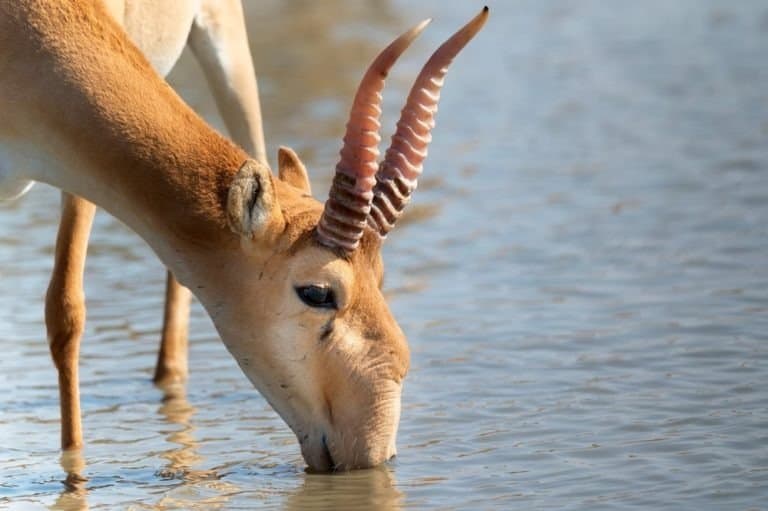
Saiga
Built for dust: the steppe's proboscis

Kalmykia’s wildlife is shaped by wide open land: wind-blown dry steppe that turns into semi-desert. Plants and animals cope with drought, salty soils, and big seasonal temperature changes. This area is part of the Pontic-Caspian grassland and supports wide-ranging herds and ground-nesting birds that need open country and careful grazing. Visitors can see "big sky" nature with migrations, nomadic grazing, and raptors patrolling. Main habitats are feather-grass and wormwood (Artemisia) steppes, saline flats (solonchaks), and reed-lined wetlands and channels of the Lower Volga-Manych-Caspian lowlands. These support saiga antelope, bustards, larks, eagles, harriers, and many waterbirds at lakes and wetlands. Compared to Volgograd and Astrakhan, Kalmykia is more arid, more open, with fewer forests. The wildlife feel is strongly steppe-centered: scanning for antelope and bustards, listening for songbirds, and watching raptors over treeless plains.
Kalmykia lies in Russia's Lower Volga-Caspian lowlands, where dry steppe transitions into semi-desert and saline lowlands. This flat, arid geography (with strong continental climate, wind, and limited surface water) concentrates wildlife around river valleys, salt lakes, and wetland depressions, while vast open grasslands support steppe-adapted species and long-distance movements typical of the Pontic-Caspian grassland ecosystem.
Approximately −30 m (Caspian Depression lowlands) to ~220 m (Ergeni Hills/uplands)
Caspian Sea coastline along the republic's eastern edge (northwestern Caspian littoral and adjacent coastal lowlands)
~5% of the republic's land area (approx., combining the federal reserve and a set of smaller regional protected areas)
Regional protection focused on steppe slopes, saline lake margins, and island/shorebird habitats; complements the federal Manych cluster by covering adjacent feeding and roosting areas.
A chain of shallow, often saline or brackish lakes important as drought refugia and migration stopovers; supports dense waterbird use during favorable hydrological years.
Protects upland steppe remnants, gullies, and ravines that act as biodiversity 'microrefugia' in an otherwise open and intensively used landscape; notable for raptors and steppe passerines.
Sanctuaries established and managed primarily to reduce disturbance and poaching risk and to keep key seasonal ranges and movement corridors open for saiga across steppe and semi-desert.
Seasonal and breeding-season protection for colonial waterbirds and steppe-edge nesting sites; especially valuable during migration peaks and dry years when suitable roosts concentrate birds.
Refuge network protecting shallow lakes and surrounding steppe used by nesting and migratory birds and by steppe mammals during dry seasons; helps maintain a distributed set of watering and foraging sites.
Kalmykia's wildlife is defined by wide, treeless dry steppe and semi-desert (the northwestern Caspian lowlands), with salt lakes, reedbeds, and seasonal wetlands that act as a major stopover and breeding area for steppe birds. The region is a key fragment of the Pontic-Caspian grassland ecosystem and is most famous for steppe-adapted mammals (especially saiga) and open-country birds (bustards, cranes, raptors). Biodiversity is shaped by aridity, grazing, drought cycles, and the strong influence of the Caspian basin's wetlands and riverine corridors.
Kalmykia is a rare open wildlife area in the Pontic-Caspian steppe: wide grasslands, salt lakes and semi-desert where wildlife is often seen at a distance. The flagship is the saiga antelope, with steppe foxes, hares, ground squirrels, raptors, larks, cranes and geese/ducks. Binoculars or a spotting scope help; base trips near protected areas and salt-lake shores.
Prime all-around season: warming temperatures bring high bird activity (courtship, song, raptor movement) and excellent visibility before summer haze. Salt lakes and wetlands can host migrating waterfowl and waders; steppe mammals are active in cooler hours. Expect changeable winds, cool mornings, and big skies-great for photography.
Heat and glare increase, so plan dawn and dusk outings. This is a good time for steppe-specialist birds (larks, wheatears, raptors) and mammal viewing if you work cooler windows. In wet years, some lake margins can still produce good birding; in dry years, focus on raptor perches, burrows, and shaded watering points. Bring sun protection and lots of water.
Another strong season: clearer air, cooler temperatures, and migration pulse. Look for moving flocks of geese/ducks and raptors along open steppe corridors and around lakes. Mammals can be more active as heat subsides. Expect crisp nights and windy days; road/trail conditions can vary after rain.
Austere but rewarding for hardy travelers: stark landscapes, long sightlines, and chances of wintering raptors and steppe species. Some lakes/shallows may freeze; birds concentrate where water remains open. Dress for wind-chill and plan shorter, targeted excursions with local support.
The Republic of Kalmykia lies in the dry Lower Volga–Caspian lowlands and is mostly open steppe that becomes semi‑desert (the 'Black Lands'). Continental climate, strong winds, salty soils, and grazing shape its habitats. Few forests exist, but grasslands, saline basins, steppe shrubs, Manych–Sarpa lakes and wetlands, and small Caspian coasts support wildlife.
The core biome: dry bunchgrass and forb steppes on plains and low rises, historically supporting large steppe herbivores and today extensive pastoral landscapes. Includes feather-grass (Stipa)-type communities and wormwood-grass mosaics.
Dominant across most of the republic; especially central and northern areas.
Semi-desert and desert-steppe conditions with sparse grasses, salt-tolerant plants, and wormwood (Artemisia) on sandy or saline soils; strong dust/wind processes and seasonal extremes.
Broad belt in the south and east (including the Black Lands) and on the driest saline/sandy sites.
Shallow lakes, channels, and intermittent/regulated waterways (notably in the Manych and Sarpa depression systems) that provide crucial stopover and breeding habitat for waterbirds in an otherwise arid matrix.
Patchy but regionally important; concentrated around major lake chains and depressions.
Reedbeds, wet meadows, and saline marshes fringing lakes and lowland depressions; water levels fluctuate strongly seasonally and interannually, driving high habitat turnover.
Localized around large lakes and low-lying basins (Manych-Gudilo and Sarpa lake complexes).
Caspian coastal and nearshore brackish habitats (functionally "marine" for classification), including shallow bays/lagoon-like areas and coastal shallows used by fish and migratory birds.
Limited to the republic's small Caspian Sea frontage in the southeast.
Dry feather-grass and mixed-grass steppe landscapes; key habitat for steppe-adapted fauna (including ground-nesting birds and burrowing mammals) and strongly influenced by grazing and fire regime changes.
Open grass-forb plains and pasturelands, often forming mosaics with saline patches; productivity varies sharply with precipitation.
Wormwood and salt-shrub (halophytic) communities on arid and saline soils; common transitional habitat between steppe and semi-desert.
Semi-desert plains with sparse vegetation on sandy/saline substrates (notably in the Black Lands), with high summer heat, cold winters, and wind erosion risk.
Large shallow lakes (e.g., Manych-Gudilo) and chains of saline/freshwater lakes (Sarpa system), critical for waterbirds and fisheries where conditions allow.
Lowland channels and riverine corridors associated with the Manych system and other steppe waterways; riparian strips are narrow and discontinuous.
Reedbeds and wet meadows along lake margins and in depressions; important for migratory staging and breeding waterfowl.
Seasonally flooded and saline marsh fringes around shallow lakes; salinity gradients create distinct plant zonation.
Caspian shoreline habitats (brackish shallows, coastal flats), used by migratory birds and supporting coastal fish spawning/feeding areas.
Caspian nearshore benthic habitats (soft-bottom shallows) that underpin local aquatic food webs.
Cropped fields and managed pastures interspersed with remnant steppe; land-use intensity and irrigation/drainage locally shape habitat quality.
Urban and industrial footprints (e.g., Elista and smaller towns) with fragmented green spaces and artificial water bodies.
The saiga's strange, oversized "trunk" isn't just for looks: its nasal passages act like a built-in air filter and climate-control system-warming icy winter air and filtering dust during dry, windy steppe summers.
The 'Black Lands' (Chernye Zemli) name is literal: in many winters snow cover is thin or short-lived, so winds and rapid melt expose the dark soil/vegetation while neighboring regions stay white-an oddity for a European landscape at this latitude.
Manych-Gudilo is a salt lake system in a grassland/semi-desert setting, so you can get an unexpectedly 'marine-like' bird scene-large waterbird gatherings in the middle of an arid steppe, driven by fluctuating salinity and water levels.
Kalmykia's open steppe makes predators and prey unusually visible compared with forest regions: species like the Corsac Fox (Vulpes corsac) often rely on old burrows (for shelter and pup-rearing) rather than dense cover-so their survival strategy is underground, not hidden-in-brush.
Greater Flamingos (Phoenicopterus roseus) are not "typical" for the Lower Volga steppe, but they are periodically recorded at the Manych lakes during favorable years-an eye-catching, out-of-place visitor that highlights how the area links Caspian and wider Eurasian flyways.
Kalmykia supports a wild, self-sustaining population of the saiga antelope (Saiga tatarica), one of the westernmost remaining wild saiga populations.
Lake Manych-Gudilo (within the 'Chernye Zemli'/Black Lands reserve complex) is the westernmost regular breeding area known for the Relict Gull (Ichthyaetus relictus), a globally rare species whose main colonies are far to the east in Central Asia.
The State Nature Biosphere Reserve "Chernye Zemli" was created primarily to protect saiga-making it Russia's only federal strict nature reserve (zapovednik) established first and foremost around conserving this single flagship steppe ungulate.
Kalmykia is one of the strongest remaining breeding areas in European Russia for Pontic-Caspian steppe raptors like the Steppe Eagle (Aquila nipalensis). They nest on vast treeless dry steppe and semi-desert.
1 species documented in our encyclopedia
Thank you for reading! Have some feedback for us?
We appreciate your help in improving our content.
Our editorial team will review your suggestions and make any necessary updates.
There was an error submitting your feedback. Please try again.