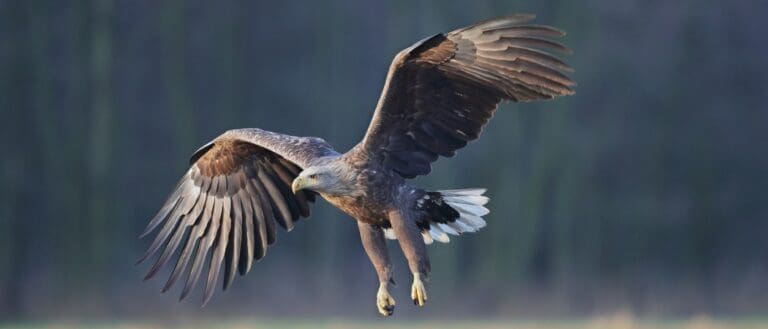
White-Tailed Eagle
Wedge-tailed ruler of northern waters

Kaluga Oblast sits where broadleaf and conifer forests meet a dense web of rivers, oxbows, and floodplain meadows. This temperate landscape supports classic Central Russian animals: large hoofed mammals (ungulates), beavers that shape waterways, and many woodland and wetland birds. River-valley habitats stay productive even among farms, creating a resilient patchwork that still feels wild. Key habitats are mixed spruce-pine stands, oak-lime broadleaf forests, birch and aspen regrowth, and the Oka basin floodplains with marshes, reedbeds, and wet meadows. Rivers act as highways, concentrating wildlife, giving breeding and feeding areas for waterbirds, and linking broken forest blocks. The farm mosaic adds edge habitat - field margins, hedgerows, and small woodlots - making many species easy to see, often at dawn and dusk.
Kaluga Oblast has a low, gentle temperate landscape of mixed conifer-broadleaf forests and Oka basin river valleys. Floodplains, oxbow lakes, and wet meadows along the Oka and its tributaries make important wetlands. A forest-agriculture mosaic supports edge-adapted species and woodland-interior animals. Varied soils (glacial and riverine deposits) make local habitat diversity.
Approximately 110-285 m above sea level (low-relief terrain; habitat variation driven mainly by river valleys, wetlands, and soil differences rather than altitude)
Kaluga Oblast's protected-area network centers on Ugra National Park (river valley, mixed forest) and Kaluzhskiye Zaseki State Nature Reserve (old-growth broadleaf forest). Regional reserves and nature monuments protect Oka-basin floodplains, mature spruce-broadleaf forests, raised bogs, and bird breeding and stopover sites. The network supports Central Russian wildlife and large mammals, including European bison in managed free-ranging groups, and wetland biodiversity.
~6-7% of the oblast (order-of-magnitude; varies by how regional micro-reserves/nature monuments are counted)
Large, scenic protection of the Ugra and Zhizdra river valleys and surrounding mixed forests-an important landscape for beaver and otter rivers, forest raptors, and wide-ranging ungulates. Also known for long, quiet river corridors that function as wildlife-viewing routes.
A large protected river-valley landscape (Ugra, Zhizdra, and Oka river basins) with extensive forests, floodplains, and wetlands that support diverse birdlife and mammals.
A strictly protected old-growth broadleaf forest area ("zaseki" forest belt) important for conserving forest biodiversity and native large mammals and birds.
A strictly protected nature reserve in Kaluga Oblast that preserves old-growth broadleaf and mixed forests and serves as a core refuge with very limited human impact.
Kaluga Oblast is in the mixed-forest belt of Central European Russia. It has broadleaf-conifer forests, river floodplains like the Oka-Ugra system, peatlands, and patches of farmland, creating many habitats. Wildlife is typical for the Central Russian forest zone: many ungulates and mesocarnivores live at forest–field edges. Beavers shape wetlands along rivers and streams. Birds include forest specialists such as grouse, owls, and woodpeckers, and floodplain and meadow species like cranes, storks, and harriers. Ugra National Park and Kaluzhskiye Zaseki reserve protect old-growth forests, floodplains, and rare breeding birds.
Kaluga Oblast, southwest of Moscow, has Central Russian landscapes: mixed spruce-pine-birch forests, old-growth broadleaf stands, Oka river valleys and floodplain meadows, wetlands and farmland. Best wildlife viewing is in protected areas like Ugra National Park and Kaluzhskie Zaseki Nature Reserve—quiet forest walks, river trips and dawn/dusk watching for elk, wild boar, fox, beaver, woodpeckers, owls, raptors, cranes and migrant birds.
Peak bird migration along rivers and floodplains; territorial singing in forests (thrushes, warblers), display flights of raptors over meadows, and fresh animal activity on muddy edges. Expect variable weather and high tick activity-bring repellent and do daily checks.
Long daylight for river-based viewing and forest hikes. Best for beaver at dusk, butterfly/dragonfly diversity near wetlands, and family groups of many mammals. Dense foliage can make large mammals harder to spot; plan early/late sessions and use edges (meadows, riverbanks).
Crisp visibility as leaves turn; strong chances for elk during rut (audible and sometimes visible at dawn), active wild boar on forest edges, and mixed bird flocks in forests. Excellent for photography and combining wildlife with mushroom/berry forays (follow local rules in protected areas).
Best season for reading wildlife via tracks on snow-elk, fox, hare, mustelids-and for quiet forest walks or ski routes. Look for owls and wintering woodland birds; rivers may retain open leads that attract waterbirds depending on freeze-up.
Kaluga Oblast, in the temperate continental East European Plain of western Russia, has mixed forests and large farmland crossed by Oka-basin rivers (Oka, Ugra, Zhizdra, Protva). Uplands hold broadleaf and mixed forests, poor sandy soils have conifers, and floodplains host wet meadows, oxbow lakes, marshes and local peat wetlands, supporting typical Central Russian plants and animals.
The dominant biome: mixed broadleaf-conifer forests and secondary woodlands, with oak, birch, aspen, lime, maple and scattered spruce/pine; much is managed or regrown after historical logging and agriculture.
Widespread across the oblast; forms the primary natural cover outside cultivated areas (largest continuous blocks away from major settlements and on less-arable soils).
Occurs mainly as anthropogenic grasslands (hay meadows, pasture), plus natural/semi-natural floodplain meadows along river valleys and forest glades.
Patchy; most extensive in river floodplains and around agricultural areas (a minority of total area).
Large lowland rivers (Oka basin) with tributaries, backwaters and oxbow lakes; supports riparian corridors, aquatic vegetation, and fish assemblages typical of central Russia.
Linear network throughout; ecologically concentrated along the Oka and major tributaries (Ugra, Zhizdra, Protva) and associated floodplain waters.
Floodplain marshes, wet meadows, alder/willow carrs, and localized peatlands in depressions; important for water filtration, breeding birds, and amphibians.
Localized but common along river valleys and in lowlands; generally a small percentage of area but high ecological importance.
Extensive mixed and secondary forests forming the core natural habitat matrix, including protected and managed forest blocks.
Broadleaf stands (oak, lime, maple, birch, aspen) on more fertile soils; strong spring understory flora in many areas.
Pine and spruce patches, often on sandier or poorer soils, and in plantations/managed stands; provides winter cover for many mammals.
Forest edges, regrowth and small copses around fields and villages creating high edge diversity and wildlife corridors.
Floodplain meadows, hayfields and pastures; many are maintained by mowing/grazing and host meadow plants and pollinators.
The Oka River system (Oka, Ugra, Zhizdra, Protva and others) with riparian belts, sandbars, cutbanks and seasonally inundated areas.
Mostly small natural lakes and floodplain oxbows rather than large lakes; often rich in aquatic vegetation.
Numerous man-made ponds and small impoundments (including fish ponds) adding still-water habitats within agricultural/settled landscapes.
Complex of wet meadows, riparian wetlands and peat-forming lowlands; frequently associated with river floodplains and forested depressions.
Floodplain marshes and reed/sedge communities in backwaters and low-lying areas, especially near slow-flowing river reaches.
Localized peatlands in poorly drained basins; sensitive to drainage and fire, important for carbon storage.
A dominant human land use outside forests: cropland and mixed farming creates a forest-field mosaic and extensive edge habitats.
Urban ecosystems in Kaluga city and other towns, including riverfronts, parks, and brownfields used by synanthropic species.
Dacha and peri-urban mosaics with gardens, small woodlots and hedgerows; often high in bird and small-mammal activity.
A medieval military project became a wildlife refuge. The defensive abatis forests that gave Kaluzhskiye Zaseki its name were protected by the Great Abatis Line, and cutting limits kept old-growth forest for sensitive species.
In Kaluga Oblast's Oka-basin rivers lives the Russian desman (Desmana moschata), a living fossil semi-aquatic mammal with a trunk-like snout and strong musk glands, now found only in a few European Russian rivers.
Black storks (Ciconia nigra) breed in the oblast's hidden forest and stream areas. Unlike village white storks, they are very shy and nest deep in old forests, so people often do not notice them.
Beavers in the Ugra and its tributaries don't just 'block streams': their dams can create chains of shallow ponds that boost local amphibian and duck breeding habitat, effectively re-shaping small-valley ecosystems within a few seasons.
The oblast's patchwork of forest, meadow, and floodplain can support large predators surprisingly close to densely populated areas: wolves and lynx persist in parts of Kaluga thanks to contiguous forest blocks and protected areas, despite the region's proximity to Moscow.
Kaluzhskiye Zaseki Nature Reserve is one of the places in Kaluga Oblast where European bison (Bison bonasus) live free-ranging again-Europe's heaviest wild land mammal (adult bulls can approach ~900 kg).
Along the Ugra-Zhizdra-Oka river system in Kaluga Oblast, you can find the Eurasian beaver (Castor fiber), the largest native rodent in Europe (often 20-30+ kg), leaving conspicuous dams, canals, and winter food caches.
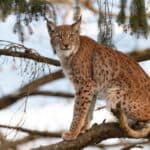
Kaluga's mixed forests support Eurasian lynx (Lynx lynx), the largest wild cat species in Europe-an apex predator that still occurs in western Russia's forest belt within a few hours of Moscow.
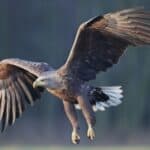
In the Oka basin wetlands and wide river valleys, bird watchers look for the white-tailed eagle (Haliaeetus albicilla), often called Europe’s largest eagle (wingspan about 2.4–2.5 m); the Oka corridor is ideal for sightings.
1 species documented in our encyclopedia
Thank you for reading! Have some feedback for us?
We appreciate your help in improving our content.
Our editorial team will review your suggestions and make any necessary updates.
There was an error submitting your feedback. Please try again.