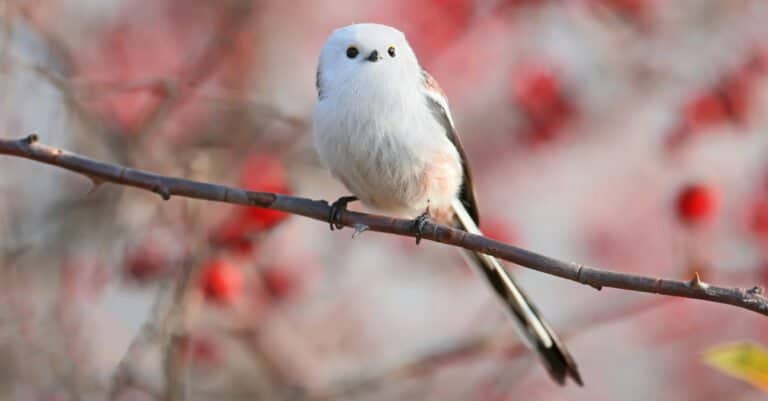
Long-Tailed Tit
Long tail, tight flock, big personality

Kurgan Oblast sits on the Russia–Kazakhstan border in the West Siberian plain. It is an ecotone of forest-steppe and steppe where northern woodland species mix with open-country animals and birds. The land is a patchwork of birch groves, pine islands, meadow-steppe, and reed-lined shores. Mammals like moose and roe deer share space with steppe predators and small game. Water is the region’s main driver. Many lakes, from fresh to mineralized or saline, plus the Tobol River and its tributaries, create wetlands, floodplain meadows, and reed beds. These are key breeding areas and stopovers for waterfowl and other wetland birds. Lakes support fish and many amphibians, while nearby grasslands and forest belts give cover, calving areas, and hunting routes for large mammals. The close mix of steppe, grove, and wetland makes birding and wildlife viewing easy, especially in spring and autumn when geese, ducks, swans, and cranes pass through.
Kurgan Oblast is on the low West Siberian Plain in the Tobol River basin, a flat area of forest-steppe and steppe. River floodplains, wetlands, and many fresh and salty lakes form habitats from dry grasslands to wet meadows, reedbeds, and river-edge woods. Rivers and lake lowlands are key for waterbirds; drier patches support grassland species.
~55-300 m above sea level (low-relief plains; habitat diversity driven more by moisture/soil and flood regimes than by altitude)
Landlocked; no ocean coastline. Wildlife-relevant shorelines occur around extensive lake systems (including saline/alkaline lakes) and along the Tobol-Iset riverbanks and floodplain wetlands.
Kurgan Oblast's protected areas are mostly regional sites—lakes, wetlands, steppe and forest-steppe—set up to protect waterfowl breeding and stopover areas, reedbeds and Tobol and Iset floodplains, and steppe patches near Kazakhstan. It lacks large federal national parks; protection comes from regional wildlife sanctuaries and natural monuments for lakes, rivers and pine/birch forests.
about 5.7%
A large saline lake system famous for its mineral-rich waters and muds, also important as a wetland stopover and staging area for migratory waterfowl and shorebirds in the forest-steppe lake district.
A representative salty steppe lake with reed margins and shallow flats that can concentrate ducks, geese, and waders during migration; notable for open vistas that support wildlife viewing from shorelines where access is permitted.
Floodplain meadows, oxbows, and reedbeds along the Tobol that provide breeding habitat for wetland birds and corridors for mammals; valuable for maintaining riparian biodiversity in an otherwise agricultural landscape.
Floodplain mosaic of oxbows, wet meadows, and willow thickets supporting nesting waterbirds and serving as a migration corridor; typically managed with seasonal restrictions to reduce disturbance during breeding.
Designed to protect breeding colonies and staging aggregations of ducks, geese, swans, and waders on chains of shallow lakes common in Kurgan's forest-steppe; particularly important in years with favorable water levels.
Protects remaining steppe/forest-steppe fragments, ground-nesting birds, and raptor foraging areas in a heavily cultivated landscape; can be good for viewing open-country wildlife from tracks and edges (where allowed).
Kurgan Oblast sits in the Trans-Ural forest-steppe/steppe belt and is strongly shaped by the Tobol River basin and a dense network of lakes, marshes, and floodplains. Wildlife is a mix of taiga-edge mammals (moose, lynx), open-country steppe species (bustards, steppe raptors), and exceptionally rich wetland birdlife during migration and breeding (geese, swans, cranes, ducks). The most "defining" experiences are waterbird spectacles on lakes and reedbeds, plus large ungulates and predators in forest-steppe mosaics.

Kurgan Oblast offers wildlife watching across wide forest-steppe and steppe, the Tobol River basin, and many freshwater lakes and reedbeds near the Kazakhstan border. Expect excellent birding in spring and autumn, wetland mammals like beaver, muskrat and fox, and classic steppe species. It is best for patient, quiet watching—sunrise lake hides, riverbank walks and long-distance scanning, not big-game crowds.
Peak migration and courtship displays on lakes and floodplains. Expect large mixed flocks of waterfowl and waders, loud breeding activity in reedbeds, and high day-to-day variety. River levels can be higher; muddy access on unpaved tracks is common. Bring optics and layers-wind can be sharp.
Breeding season in wetlands and forest-steppe: nesting waterbirds, active raptors, and abundant dragonflies/butterflies along lake edges. Mammal sightings improve at dawn/dusk near water (beaver, fox). Mosquitoes can be intense around reeds and flooded areas; midday heat reduces activity-plan early/late outings.
Second major migration window with staging waterfowl on larger lakes and rivers. Clear air and golden steppe light make for excellent photography. Rut activity for some mammals may increase movement. First frosts arrive; storms can move birds quickly-flexible plans pay off.
Quiet, atmospheric wildlife tracking: fresh snow reveals mammal trails along forest edges and river corridors. Look for wintering birds in sheltered areas and around open water where available. Days are short and cold; focus on half-day outings, tracking walks, and photography of winter landscapes.
Kurgan Oblast is on the southwest edge of the West Siberian Plain along the Tobol basin. It shifts from forest-steppe in the north to drier steppe near the Kazakhstan border. The land is mostly flat and farmed, but still has steppe/forest mosaics, river corridors, and many shallow, often salty or brackish, lakes and wetlands that support waterbirds and aquatic life.
Dominant steppe and forest-steppe landscapes: feather-grass and fescue grasslands, meadow-steppe patches, and shrub-steppe on drier sites; much is converted to cropland but natural and semi-natural fragments persist on less arable soils and around lake basins.
Widespread across the oblast; strongest in central and southern areas and as grassland components within the forest-steppe mosaic (largest share overall).
Forest-steppe woodlands and small forest patches, mainly birch and aspen with some pine on sandy terraces; forests appear as groves, shelterbelts, and larger blocks in the north and along wetter river and lake edges.
Patchy, mainly northern and north-central districts and along riparian corridors; smaller share than grassland due to steppe dominance and agriculture.
Tobol River system (with tributaries) plus numerous shallow lakes and ponds on the plain; includes floodplain waters, oxbows, and small streams with seasonally variable flow and extensive littoral vegetation.
Networked throughout; highest concentration in lake districts and along the Tobol valley; locally prominent though limited in areal extent relative to uplands.
Marshes, wet meadows, reedbeds, and peat-poor fens associated with floodplains and lake margins; includes saline wetland complexes around endorheic or weakly drained basins.
Scattered but frequent around lakes and in lowland depressions and floodplains; moderate local coverage in lake-rich areas.
Feather-grass/fescue steppe and meadow-steppe remnants on interfluves and gentle rises; many areas are fragmented by cultivation, with best remnants in less-plowed tracts and near lake basins.
Herb-rich meadows and grass-forb communities in the forest-steppe matrix and along river terraces; includes pastures and semi-natural hayfields.
Forest-steppe groves (often birch-aspen) forming a mosaic with grasslands; includes shelterbelt plantings that function as secondary habitat corridors.
Birch and aspen stands, especially in the north and in moister sites; understory often grassy with shrubs where grazing/fire regimes allow.
Pine stands on sandy soils and river terraces (where present), forming drier, more open forests compared with birch-aspen tracts.
Shrubby steppe and lake-margin thickets (e.g., willow and other shrubs) on ecotones between dry steppe and wetlands, plus degraded or recovering steppe patches.
Tobol River and tributaries with floodplain channels, oxbows, and riparian belts; important migration corridor and spawning/feeding habitat for aquatic fauna.
High density of shallow lakes, including freshwater to saline basins; extensive reedbeds and mudflats seasonally important for waterbirds.
Small natural ponds and man-made waterbodies (stock ponds, irrigation/settlement ponds) that add local aquatic habitat diversity.
Floodplain wetlands, wet meadows, and lake-edge reed/sedge zones; strong seasonal dynamics with spring inundation and late-summer drawdown.
Reed- and sedge-dominated marshes around shallow lakes and in river floodplains, often forming broad belts of emergent vegetation.
Limited occurrences; where present, typically small peat-forming patches in poorly drained depressions compared with more widespread marsh/fen-like wetlands.
Extensive croplands (grain and fodder crops) and managed hayfields dominating the human-modified matrix; major driver of habitat fragmentation.
Urban habitats concentrated in Kurgan and other towns, with river/lake edges, parks, and industrial zones creating localized novel ecosystems.
Some Kurgan Oblast lakes are naturally very salty, such as Lake Medvezhye. In warm months the water may turn red from Dunaliella algae. Fish are few, but birds feed on brine shrimp (Artemia).
Shallow steppe lakes in Kurgan Oblast can have "winterkill" when thick ice lowers oxygen and fish die. The nutrient boost then raises invertebrate numbers, making lakes attractive to spring and autumn waterbirds.
Kurgan lies on the Russia–Kazakhstan steppe edge, so you can see a surprising mix: steppe birds like larks and steppe raptors in open fields near forest birds like woodpeckers and owls in birch groves and riparian woods.
Beavers in the Tobol basin don't just live in deep forest rivers: they can colonize surprisingly small steppe streams and drainage channels, building dams that create new ponds-often increasing local amphibian and waterfowl breeding habitat in otherwise dry landscapes.
Kurgan Oblast's lakes act like a chain of rest stops: when weather changes, geese, ducks, and cranes move fast between lakes, so an empty site can fill with big mixed flocks.
Kurgan Oblast's Tobol floodplains and birch-aspen forest-steppe support the Eurasian elk (moose)-the world's largest living deer species (bulls can exceed 500 kg).
Wetlands and backwaters in the Tobol basin are home to the Eurasian beaver-Eurasia's largest rodent (adults commonly 20-30 kg), a true "ecosystem engineer" that can re-shape whole stretches of small rivers.
On the lake-dotted steppe/forest-steppe of Kurgan, the whooper swan is a regular breeder and migrant; it is among the heaviest flying birds on Earth (up to ~15 kg, wingspan ~2.4 m).
Large lakes and riverine forests in the oblast provide hunting and nesting habitat for the white-tailed eagle-one of Europe's largest eagles (wingspan up to ~2.45 m).
1 species documented in our encyclopedia
Thank you for reading! Have some feedback for us?
We appreciate your help in improving our content.
Our editorial team will review your suggestions and make any necessary updates.
There was an error submitting your feedback. Please try again.