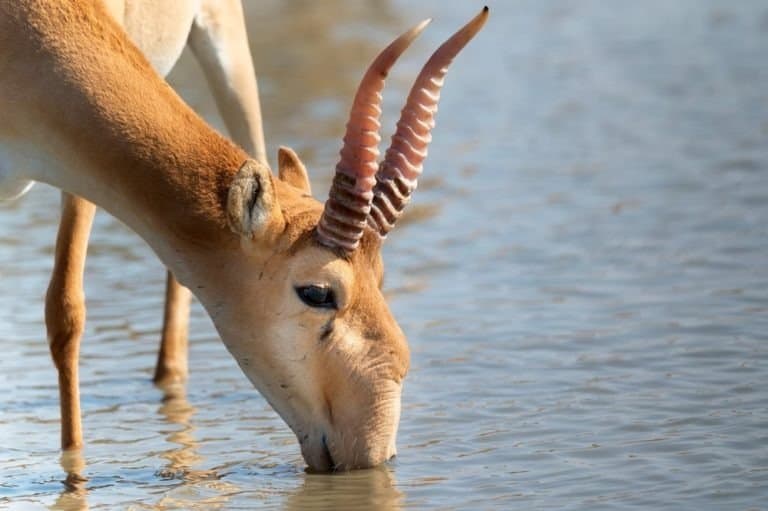
Saiga
Built for dust: the steppe's proboscis

Astrakhan Oblast is shaped by water and wind. The lower Volga spreads into the Volga Delta of channels, reedbeds, lotus-lined bays, and floodplain forests before it meets the Caspian Sea. This area is a major wildlife crossroads. Rich waters feed many birds, lots of fish, and both steppe and wetland mammals. The Volga-Caspian system has long supported important fisheries and a seasonal burst of life. Main habitats are the Volga Delta wetlands (spawning and nursery grounds for fish; nesting and stopover sites for millions of migratory birds), Caspian coastal lagoons and shallow waters (key feeding areas), and nearby semi-arid steppe and desert (salt flats, sandy places, and dry grasslands with reptiles, raptors, and small mammals). The wildlife here is "delta-forward": boat travel through maze-like waterways, huge flocks of waterbirds, and encounters with Caspian-linked species and sturgeons.
Astrakhan Oblast lies in the lower Volga–Caspian lowlands where the river delta meets the Caspian Sea. Flat, semi-dry land makes a patchwork of reedbeds, floodplain channels and shallow lagoons for many migratory birds, with steppe, semi-desert, salt flats and sand for drought-tolerant mammals and reptiles. Volga freshwater and the brackish Caspian feed fisheries, including sturgeon, and drive seasonal wildlife movements.
About −28 m (Caspian lowlands, below global sea level) to ~149 m (Mount Bolshoye Bogdo)
Caspian Sea coastline (including delta-front lagoons, wetlands, and brackish nearshore waters)
Astrakhan Oblast protects important wetland and semi-desert areas at the Volga-Caspian interface. It has federal nature reserves (Volga Delta, Lake Baskunchak, Mount Bolshoye Bogdo) and regional sanctuaries, monuments, and managed wetlands. These keep migratory bird stopovers, spawning and nursery sites for Caspian fish (including sturgeons), and steppe habitat. The Volga Delta reedbeds, floodplain lakes, and channels are a priority.
≈10-15% of the oblast's land area (commonly cited around ~12% when federal + regional protected areas are combined; boundaries and designations can change over time).
A core, highly protected portion of the Volga Delta's reedbeds and shallow lakes. Outstanding for colonial waterbirds, raptors, and dense migratory concentrations in spring/autumn; also key for maintaining wetland productivity that underpins regional fisheries.
Delta channels and floodplain lakes that are especially important for breeding herons/egrets and for staging waterfowl. The mix of open water, lotus/vegetated shallows, and reedbeds makes it one of the best zones for wildlife viewing (primarily by boat).
A protected delta sector valued for large mixed colonies of waterbirds and extensive undisturbed reed marsh. Important as a migration 'bottleneck' site on the African-Eurasian flyway, with high species diversity during peak passage.
Protects the striking Lake Baskunchak salt-lake system, salt flats, and the Mount Bolshoye Bogdo area-an arid-steppe to semi-desert landscape with specialized flora/fauna. Notable for steppe raptors, open-country birds, and drought-adapted mammals and reptiles; also important for conserving unique saline habitats.
Regional-level protection around the Baskunchak area that complements the strict reserve by buffering steppe and saline habitats used by raptors and steppe birds, and by reducing disturbance on key open landscapes.
A set of locally protected wetland/lotus areas that support breeding waterbirds and offer concentrated wildlife viewing in vegetated shallows; these sites help maintain habitat continuity beyond the federal reserve core.
Protects characteristic delta microrelief (Baer mounds), steppe patches, and floodplain lakes that create high habitat diversity-important for nesting birds, amphibians, and raptors, especially where grazing/vehicle pressure is managed.
A constellation of seasonal and year-round sanctuaries that protect key reedbeds, shallow lakes, and migration stopovers outside the strict nature reserve boundaries-often focused on minimizing disturbance during breeding/migration and maintaining wetland hydrology.
Sanctuaries aimed at conserving open semi-desert habitats, steppe bird breeding grounds, and raptor hunting territories; also important as low-disturbance corridors between more strictly protected areas.
Where implemented, these refuges reduce disturbance on coastal shallows, spits, and islands used for nesting and roosting seabirds and waders; especially valuable during migration and late-summer post-breeding aggregations.
Astrakhan Oblast sits at the mouth of the Volga River on the Caspian Sea. Its wildlife settings are the vast Volga Delta (reedbeds, floodplain forests, channels and shallow lagoons), semi-arid steppe and desert (saltmarsh, dunes, dry grasslands), and the Volga-Caspian nearshore zone. This mix makes it one of Russia’s main wetlands for migratory birds on the Caspian/Black Sea flyways and a key spawning and nursery area for Caspian fishes, especially sturgeons. Wildlife includes mass waterbird migrations and colonies (pelicans, herons, ibis, spoonbills), raptors, rich fisheries, and steppe species like saiga.
Astrakhan Oblast lies where the Volga River fans into a delta before the Caspian Sea. Reedbeds, shallow lakes, lotus channels, semi-arid steppe and salty areas make homes for many migratory birds, wetland specialists and fish linked to Caspian fisheries. Trips use boat tours, dawn and dusk birding and steppe drives for raptors, with seasonal changes in water and bird numbers.
Peak migration energy: large mixed flocks of waterfowl and waders moving through the delta; raptor passage over open steppe; active breeding displays begin in wetlands. Water levels can be high, making boat access excellent. Best for multi-species birding and photography with dramatic light and activity.
Breeding season in the delta; early mornings bring strong bird activity. The iconic Volga lotus blooms typically peak mid/late summer in lotus-rich channels. Weather is hot and insect levels can be high in reeds; plan dawn-and-dusk outings and midday rest. Excellent for boat trips, lotus scenery, and fish-focused experiences.
Another major migration window with concentrated birds feeding in wetlands before heading south; strong chances for large gatherings of ducks, geese, and waders. Cooler, clearer days suit long field sessions and steppe drives for raptors. Good time for combining delta birding with Caspian-coast nature stops.
A quieter, starkly beautiful season: steppe and semi-desert birding can be rewarding, and open-water pockets (where present) may hold wintering waterbirds. Conditions can be harsh and access depends on ice and weather; best for hardy travelers seeking solitude, winter landscapes, and targeted species searches with local guidance.
Astrakhan Oblast lies where the lower Volga meets the Caspian Sea, shifting from dry steppe and desert to a vast river-delta wetland. Changing water levels and salinity create reedbeds, flooded meadows, channels, oxbow lakes, and salt lowlands. The area is very important for migratory waterbirds and for Caspian fish spawning and nurseries.
Dry steppe landscapes dominate away from the delta: open grasslands on plains and low terraces, often with drought-tolerant grasses and salt-tolerant plants on solonchak/solonetz soils.
Widespread across much of the oblast outside the delta; dominant terrestrial biome in the north and west.
Semi-desert to desert conditions occur on sandy and saline substrates (including areas associated with the Caspian Lowland), with sparse xerophytic vegetation and mobile sands in places.
Extensive in the east/southeast and on sandy massifs; intergrades with steppe across large areas.
The Volga Delta forms a vast complex of reedbeds, marshes, floodplain lakes, and seasonally inundated meadows; brackish-to-fresh wetlands support major bird concentrations and fish nurseries.
Concentrated in the southern part of the oblast (Volga Delta and delta-front); locally dominant where present.
The lower Volga's mainstem, distributaries, channels, oxbow lakes, and floodplain waters provide large-scale riverine and deltaic freshwater habitats with strong seasonal flooding.
Major linear and areal presence centered on the Volga River and delta network.
Caspian Sea coastal and nearshore environments include brackish waters, shallow shelves, and delta-front mixing zones influencing productivity and fisheries.
Along the southern boundary on the Caspian coast; nearshore and delta-front areas most influential.
Open dry grasslands on the Caspian Lowland; frequently influenced by drought and soil salinity, with patches of wormwood/halophytic vegetation in drier or saltier sites.
Sandy semi-desert and desert patches with sparse shrubs and psammophytic plants; includes areas of shifting sands and salt-affected flats.
Arid and semi-arid shrub communities (often wormwood and other drought/salt-tolerant shrubs) forming transitions between steppe and desert.
Dry meadows and grassland openings, including floodplain meadows that are seasonally inundated near the delta margins and more xeric grasslands inland.
Extensive reedbeds and floodplain wetland mosaics in the Volga Delta, including seasonally flooded marshy meadows and shallow lagoons/ponded areas.
Large reed- and sedge-dominated marshes in deltaic backwaters and low-lying floodplain basins; critical breeding and stopover habitat for waterbirds.
Waterlogged delta and floodplain zones with persistent inundation and dense emergent vegetation (often reed swamps) along slow-flowing channels and backwaters.
The Volga main channel and distributaries form a complex branching network with strong seasonal flow variation, sediment deposition, and important fish migration routes.
Numerous shallow floodplain lakes and deltaic water bodies (including oxbows and backwater lakes), varying from fresh to brackish depending on connectivity and sea influence.
Small shallow water bodies and isolated pools across the delta and floodplain, often seasonal and important for amphibians and waterbirds.
Delta-front mixing zone where Volga waters meet the Caspian's brackish conditions, creating highly productive nursery and feeding areas.
Caspian shoreline habitats including low-lying coasts, spits, and shallow nearshore waters strongly influenced by river sediment and sea-level fluctuations.
Shallow Caspian shelf and bottom habitats near the delta-front that support benthic communities and fisheries productivity.
Irrigated and non-irrigated croplands and pastures, especially near settled areas and along water sources; land use can interact with salinization and water management.
Urban and industrial habitats centered on Astrakhan and other settlements, including ports and infrastructure linked to the Volga-Caspian corridor.
Despite being an inland sea, the North Caspian off Astrakhan has seals: the Caspian seal is the Caspian's only marine mammal, and it can give birth on winter ice floes in the northern Caspian when ice forms.
Astrakhan's wetlands host large wild stands of sacred lotus (Nelumbo nucifera) in the Volga Delta-an "Asian" plant many people don't expect to see growing naturally in Russia.
In one region you can encounter true desert-steppe fauna (like saiga and jerboas) and, a short distance away, dense reedbed "jungle" packed with herons, egrets, and pelicans-an unusually sharp habitat contrast for a single oblast.
Many iconic Caspian fish make dramatic migrations right in Astrakhan's backyard: they move from brackish or salty Caspian waters into fresh Volga channels to spawn, switching salinity regimes in a matter of days.
The Volga Delta sits on a major migratory crossroads: depending on water levels and season, huge numbers of birds funnel through the delta's narrow flyway corridor between the Caspian shoreline and the interior wetlands.
The Volga Delta in Astrakhan Oblast is the largest river delta in Europe-its maze of channels and reedbeds supports some of the continent's biggest concentrations of nesting and migratory wetland birds.
Astrakhan Oblast borders the Caspian Sea, the world's largest inland body of water; the shallow North Caspian next to Astrakhan is one of the sea's most productive nursery areas for fish, including major anadromous (sea-to-river) spawners.
The lower Volga near Astrakhan is known for the beluga sturgeon (Huso huso), the world's largest sturgeon and one of the biggest fish that move between sea and river, with past catches over 1,000 kg.
For much of the 20th century, the Caspian basin produced the vast majority of the world's wild sturgeon landings and caviar supply-Astrakhan was the best-known processing and trading hub tied directly to these fisheries.
Astrakhan's semi-desert and steppe hold one of Europe's last wild saiga antelope groups (west of Central Asia), making it one of the few places this steppe antelope still lives in European Russia.
1 species documented in our encyclopedia
Thank you for reading! Have some feedback for us?
We appreciate your help in improving our content.
Our editorial team will review your suggestions and make any necessary updates.
There was an error submitting your feedback. Please try again.