


S
Species Profile

Stonechats

Saxicola

Perch, pounce, and chatter
Piotr Krzeslak/Shutterstock.com

Stonechats Distribution

Click a location to explore more animals from that region

Loading map...

Found in 100 countries

stonechat

At a Glance

Genus Overview This page covers the Stonechats genus as a group. Stats below are general traits shared across the genus.
Also Known As Old World stonechats, Saxicola chats, stonechats (Saxicola), African stonechat complex, European stonechat group
Activity Diurnal+
Weight 0.023 lbs
Status Not Evaluated
Did You Know?

Across the genus, adults are small: roughly 11-15 cm long, with wingspans about 18-23 cm.

Scientific Classification

Genus Overview "Stonechats" is not a single species but represents an entire genus containing multiple species.

Stonechats (genus Saxicola) are small insectivorous passerines in the Old World flycatcher family, typically found in open habitats. They often perch conspicuously on shrubs or fence posts, making short sallies to catch insects, and many show strong sexual dimorphism.

Kingdom
Animalia
Phylum
Chordata
Class
Aves
Order
Passeriformes
Family
Muscicapidae
Genus
Saxicola

Distinguishing Features

  • Often perches upright on exposed stems
  • Insect-catching sallies from low perches
  • Frequent tail-flicking behavior
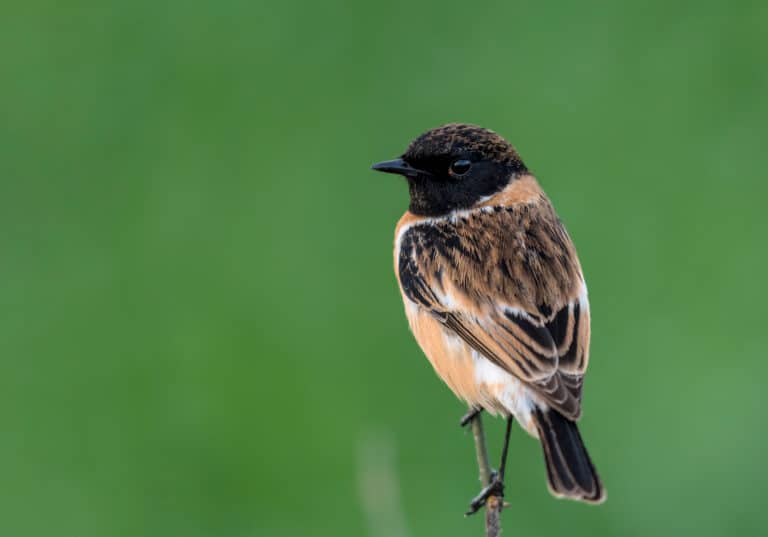
  • Many males: dark head with pale neck patches
  • Warm orange/rufous breast common

Physical Measurements

Males and females differ in size

Length
5 in (4 in – 6 in)
5 in (4 in – 6 in)
Weight
0 lbs (0 lbs – 0 lbs)
Tail Length
2 in (2 in – 3 in)
2 in (2 in – 3 in)
Top Speed
31 mph
flying

Appearance

Primary Colors
Secondary Colors
Skin Type Feathers
Distinctive Features
  • Small passerines; body length roughly 10-15 cm across the genus.
  • Lightweight build; typical mass roughly ~8-30 g, species-dependent.
  • Short, straight insect-catching bill; width and length vary by species.
  • Often shows white neck-sides or wing patches, but extent varies widely.
  • Underparts commonly buff to orange-rufous; intensity varies by sex and season.
  • Tail usually dark; frequent tail-flicking and wing-flicking during perching.
  • Upright stance on shrubs, rocks, fence posts in open-country habitats.
  • Juveniles typically browner with pale spotting or scaly-looking feather edges.
  • Seasonal plumage change in many taxa; breeding males become higher-contrast.
  • Island endemics may show subtly different proportions and plumage tones.

Sexual Dimorphism

Many Saxicola are strongly sexually dimorphic: males tend to be darker and higher-contrast with more vivid underparts, while females are browner and more cryptic. Strength of dimorphism varies by species, region, and season.

  • Blacker head and upperparts in many breeding males.
  • Brighter orange-rufous breast in numerous species.
  • Sharper white neck-sides or wing patches, often more extensive.
  • Higher-contrast facial patterning, depending on species.
  • Overall browner, more camouflaged plumage in many taxa.
  • Buffier underparts with reduced or absent bright rufous.
  • Less distinct white patches; pattern edges appear softer.
  • Juvenile-like mottling more common outside breeding season.

Did You Know?

Across the genus, adults are small: roughly 11-15 cm long, with wingspans about 18-23 cm.

Most stonechats feed mainly on insects, but many also take berries and small fruits seasonally.

Migration varies widely: some species are year-round residents, others are short- to long-distance migrants.

Many species show strong sex differences: males often have bold contrasts, females tend to be browner and more cryptic.

Several Saxicola are island endemics with naturally restricted ranges, making habitat change a major risk.

The English name "stonechat" refers to a call likened to two stones being tapped together.

Typical clutches are about 3-7 eggs, usually laid in well-hidden nests low in vegetation.

Unique Adaptations

  • Perch-and-sally hunting fits open habitats, reducing energy costs compared with continuous searching.
  • Cryptic female/juvenile plumage in many species helps conceal birds near ground-level nests.
  • Plumage diversity across the genus (from bold to subdued) supports different signaling needs in varied landscapes.
  • Compact bodies and broad foraging niches aid survival in windy coasts, montane grasslands, and arid scrub.
  • Behavioral plasticity in migration-resident, partial migrant, and long-distance migrant strategies occur within Saxicola.

Interesting Behaviors

  • Conspicuous "sentinel" perching on shrubs, reeds, or fence posts to scan for prey and rivals.
  • Short aerial sallies to snatch insects, often returning to the same lookout perch repeatedly.
  • Tail and wing flicking that can signal alertness or help flush insects from vegetation.
  • Territoriality is common in breeding season, but strength of defense varies by species and habitat.
  • Seasonal movements differ: some form loose winter groups, while others remain strongly site-faithful.
  • Feeding flexibility: insect-heavy diets in warm seasons, with more fruit taken when insects decline.

Cultural Significance

In European countryside tradition, stonechats are familiar "gorse and heath" birds; their call inspired the name "stonechat." In Japan, the migrating "nobitaki" (Saxicola) appears in seasonal nature writing and birding culture.

Myths & Legends

British and Irish bird-naming tradition says "stonechat" imitates its call, like two stones clicked together in the hedgerow.

The scientific name is traditional Latin: "Saxicola" ('rock-dweller'), reflecting early naturalists' habit-based naming lore.

In Japanese seasonal poetry and nature essays, "nobitaki" (Saxicola stonechats) is treated as an autumn passage bird, marking seasonal change.

Older European rural birdlore groups stonechats as 'chats' of gorse and heath, a landscape identity echoed in regional names and writings.

Conservation Status

NE Not Evaluated (genus-level; IUCN assesses species. Across Saxicola, most species are LC, with some higher-risk taxa such as White-throated Bush Chat Saxicola insignis listed as VU).

Has not yet been evaluated against the criteria.

Population Unknown

Protected Under

  • EU Birds Directive
  • National wildlife laws

You might be looking for:

European Stonechat

20%

Saxicola rubicola

Widespread western Palearctic stonechat; often the default "stonechat" in Europe; open-country passerine with male black head and orange breast.

View Profile

Siberian Stonechat

15%

Saxicola maurus

Eastern Palearctic stonechat species complex; resembles European Stonechat but differs in plumage details and range across Siberia and East Asia.

View Profile

African Stonechat

15%

Saxicola torquatus

Afrotropical stonechat; part of a complex historically lumped with other stonechats; common in open habitats across parts of sub-Saharan Africa.

View Profile

Reunion Stonechat

10%

Saxicola tectes

Island endemic from Réunion; this is the taxon directly returned by ITIS for the English common name ‘Stonechat’.

View Profile

Canary Islands Stonechat

10%

Saxicola dacotiae

Restricted-range island endemic (Fuerteventura); notable conservation interest due to limited distribution and specialized arid habitat.

View Profile

Life Cycle

Birth 5 chicks

Lifespan

In the Wild
0 years
In Captivity
3–14 years

Reproduction

Mating System Monogamy
Social Structure Socially Monogamous
Breeding Season Spring-summer temperate; rainy season in tropics
Breeding Pattern Seasonal
Fertilization Internal Fertilization
Birth Type Internal_fertilization

Across Saxicola, pairs defend breeding territories and usually form social monogamous bonds for a season, with biparental nesting care. Extra-pair copulations and occasional polygyny occur in some species/populations; cooperative helping is not typical.

Behavior & Ecology

Social Flock Group: 2
Activity Diurnal, Crepuscular
Diet Insectivore insects
Seasonal Migratory 3,728 mi

Temperament

Territorial
Bold
Alert
Curious
Aggressive

Communication

chat-like calls
short contact calls
alarm calls
territorial song
begging calls
visual display postures
tail flicking
wing-flicking displays
perch-based signaling
chasing and threat flights

Habitat

Biomes:
Savanna Tropical Dry Forest Temperate Grassland Mediterranean Temperate Forest Boreal Forest (Taiga) Alpine Wetland +2
Terrain:
Plains Hilly Plateau Valley Mountainous Coastal Island +1
Elevation: Up to 13779 ft 6 in

Ecological Role

Open-habitat insect predator; occasional frugivore in winter

pest control seed dispersal food web support

Diet Details

Other Foods:
Berries Elderberries Other small wild fruits Small seeds

Human Interaction

Domestication Status

Wild

Stonechats (Saxicola) are not domesticated; across the genus they remain wild insectivorous passerines of open habitats in the Old World. Human interaction is mainly indirect (farmland edges, hedgerows) plus birdwatching, ringing, and ecological research rather than purposeful domestication.

Danger Level

Low
  • Minor pecks or scratches
  • Zoonotic disease exposure (rare)
  • Ectoparasites/mites handling risk

As a Pet

Not Suitable as Pet

Legality: Usually restricted/permit-only; often illegal to keep wild birds.

Care Level: Expert Only

Purchase Cost: Up to $500
Lifetime Cost: $1,500 - $12,000

Economic Value

Uses:
Tourism Research Agriculture

Relationships

Related Species 5

Wheatears Oenanthe Shared Family
Redstarts
Redstarts Phoenicurus Shared Family
Flycatchers Ficedula Shared Family
European robins and allies Erithacus Shared Family
Nightjars? (not a close relative) Caprimulgus europaeus Shared Class

Ecological Equivalents 4

Animals that fill a similar ecological role in their ecosystem

Northern Wheatear Oenanthe oenanthe Open habitats; ground/low-perch insect hunter with sallies.
Common Redstart
Common Redstart Phoenicurus phoenicurus Perch-and-sally insectivore; similar territorial song displays.
Zitting Cisticola Cisticola juncidis Grassland/shrubland passerine; small-insect foraging in open cover.
European Stone-curlew Burhinus oedicnemus Shares open dry habitats; different feeding but overlapping landscapes.

Quick Take

  • The stonechat's name is no accident. Its song has a quality that sets it apart from nearly every other songbird. Hear about their song →
  • Stonechats are monogamous each breeding season, but that loyalty has a limit, and where it ends affects how their chicks are raised. Explore their breeding behavior →
  • One stonechat species faces a shrinking future while the rest thrive, a situation that comes down to a very specific geography. See the threatened species →
  • The Latin name for the stonechat genus hides a clue about where these birds actually spend their time that contradicts their typical habitat description. Unpack the Latin name →

Stonechats are small passerine birds with an enormous range spanning three continents. Most species are nonmigratory or short-distance migrants and prefer to live in their habitats year-round. They predominantly inhabit grassland and scrublands, placing their nests in low vegetation.

A detailed wildlife infographic about the Stonechat bird, displaying its global range, diet of insects, and a life cycle diagram ranging from incubation to adulthood.
It sounds like two stones striking together and spans three continents, yet this master of the grasslands is facing a silent crisis. © A-Z Animals

5 Amazing Stonechat Facts

  • Stonechats have an extensive range, covering over 100 countries across three continents.
  • Their songs are harsh and sound like two rocks hitting together.
  • Grasshoppers and dragonflies are their favorite food.
  • The Fuerteventura stonechat is “near threatened” due to habitat loss.
  • Stonechats are monogamous during the breeding season, but don’t typically mate for life.

Where to Find the Stonechat

The stonechat lives in over 100 countries across three continents, including Russia, France, Ethiopia, China, Greece, and many more. You can find it throughout Europe, Asia, and Northern, Central, and Southern coastal areas of Africa (from Morocco to Angola to South Africa). Stonechats in Europe inhabit shrubland, coastal dunes, and rough grasslands. You can find them in open grasslands, shrublands, swamp edges, and cultivated land in Africa. Some populations inhabit mountainous areas in Southwest Arabia and Madagascar. 

Nests

Females build their nests in dense vegetation close to the ground. They construct a loose cup of dried grass and line it with animal hair and feathers. Occasionally, stonechats will place their nest in rock crevices or holes in the ground.

Classification and Scientific Name

The stonechat (Saxicola) is in the Muscicapidae family, which includes small passerine birds restricted to the Old World. The family encompasses over 300 species of small arboreal insectivores. The genus, Saxicola, is Latin for “rock-dwelling” and contains 15 species of “chats.”

The 15 species accepted in the Saxicola genus:

  • Whinchat
  • White-browed bush chat
  • White-throated bush chat
  • Canary Islands stonechat
  • European stonechat
  • Siberian stonechat
  • Amur stonechat
  • African stonechat
  • Madagascar stonechat
  • Reunion stonechat
  • White-tailed stonechat
  • Pied bush chat
  • Jerdon’s bush chat
  • Grey bush chat
  • White-bellied bush chat

Size, Appearance, & Behavior
stonechat

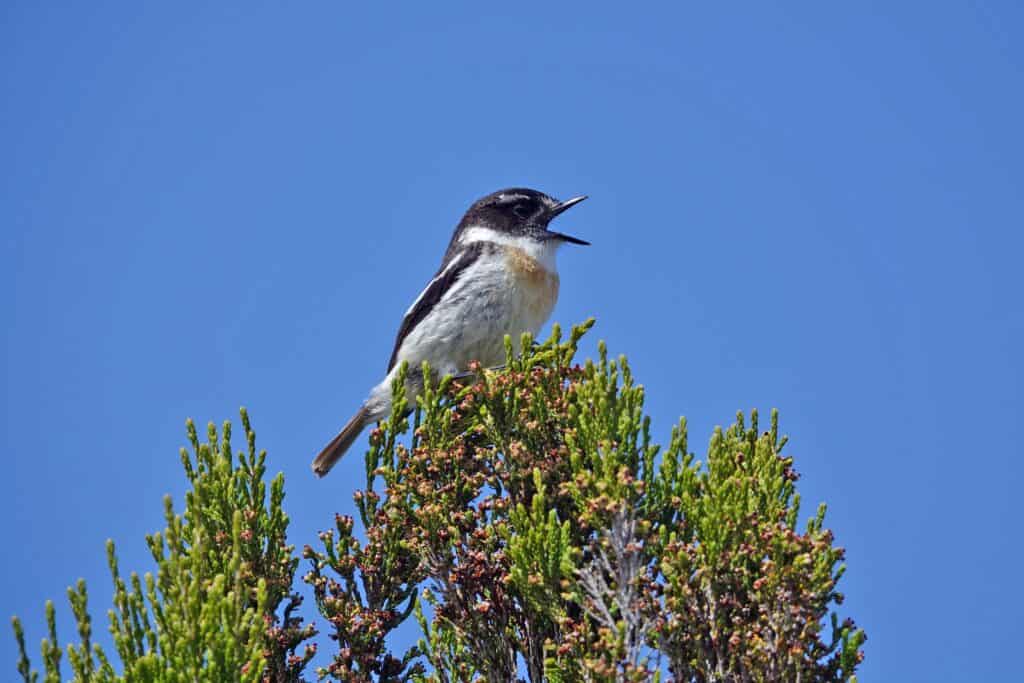
Their songs are harsh and sound like two rocks hitting together.

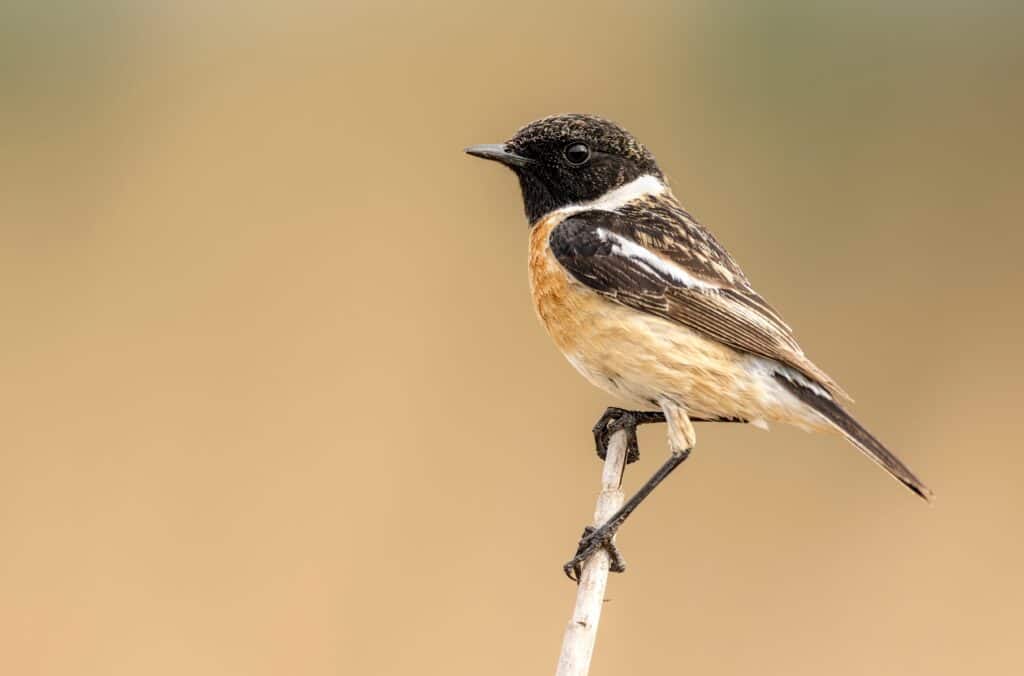
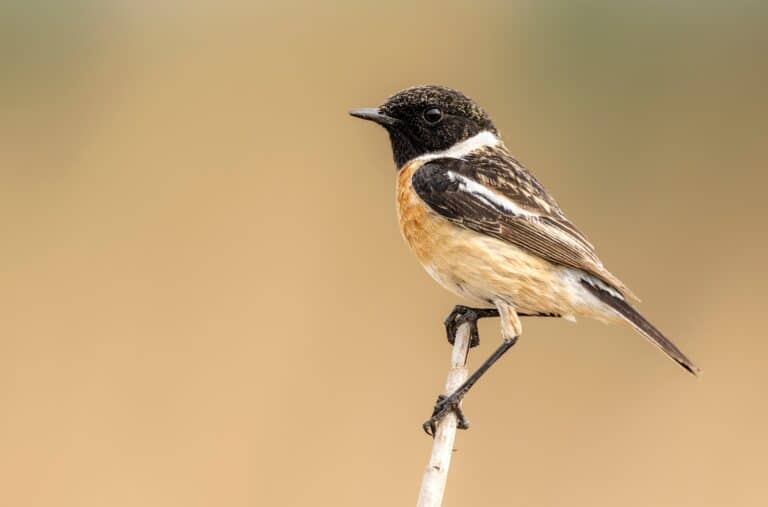
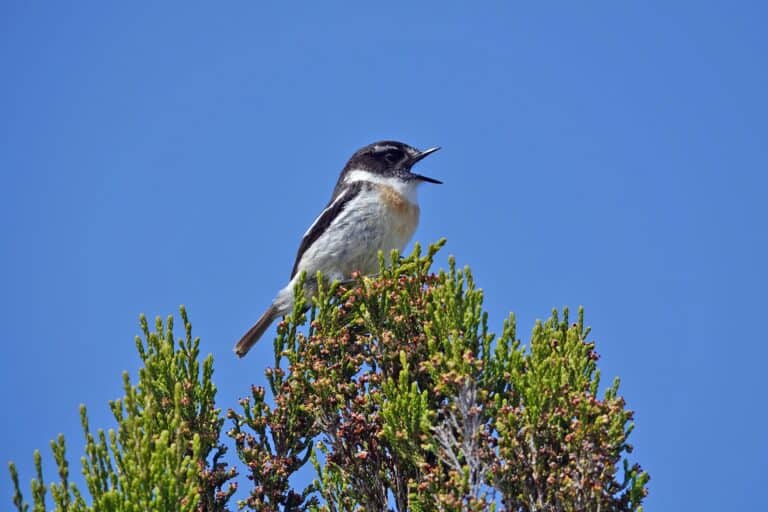
Stonechats are small passerine birds, measuring between four and five inches long and weighing 0.46 to 0.60 ounces, with a seven-to-nine-inch wingspan. They have stout bodies, large heads, and thick necks. Males have black heads, wings, and throats, with white patches on the sides of their necks. Their breasts and flanks are orange, transitioning to a grayish-white on their undersides. Females are a mottled brown color. They also feature short, pointed bills, rounded wings, and short tails. Their songs are harsh and sound like two rocks hitting together, and their calls are quick and squeaky.

Migration Pattern and Timing

Most stonechats are nonmigratory, meaning they are residents in their environments. Some species are partial migrants who may move slightly south for winter. For instance, the common stonechat stays year-round in particular habitats. It’s a resident in Central and Southern Africa (Angola, South Africa, etc.), Madagascar, and parts of Europe (Spain, France, and Italy). In places like China, Russia, Hungary, and Ukraine, stonechats will stay for the breeding season and then move south for winter in areas like Germany, Austria, Morocco, and Algeria.

Diet

Stonechats are insectivores that supplement their diet with seeds and berries.

What Does the Stonechat Eat?

The stonechat eats a wide variety of insects, including worms, slugs, and snails. It primarily eats grasshoppers and dragonflies, but it will also eat invertebrates like spiders. It will eat berries, seeds, and nuts from bushes and trees during winter. And occasionally, it will eat small frogs and lizards. It forages for food on the ground and in low vegetation like shrubs and hedges.

Predators, Threats, and Conservation Status

The IUCN lists most stonechat species as LC or “least concern.” Due to their extensive range and large, stable population, they do not qualify for “threatened” status. The Fuerteventura Stonechat (Saxicola dacotiae) is the only exception and has an NT or “near threatened” status. This species has a small range in the Canary Islands and is experiencing habitat loss from urbanization and the agricultural industry. Studies also indicate tropical stonechats are less likely to lay a second brood due to nest predation and a limited food supply.

What Eats the Stonechat?

Little is known about the stonechat’s predators, but they and their chicks may fall victim to foxes, birds of prey, crows, ravens, and snakes. Males and females defend their nests by producing alarm and defense calls.

Reproduction, Young, and Molting

Stonechats start breeding at around one year old. While they are monogamous during the breeding season, they don’t typically mate for life. Females lay four to six pale blue-green eggs early in the morning during daily intervals. She incubates them by herself for 13 to 14 days, but both parents care for and feed the chicks. Nestlings fledge the nest 12 to 16 days after hatching, and both parents continue to tend to them for four to five days afterward. Males take over feedings for another 5 to 10 days, while the female begins making another nest for her second brood. Stonechats raise two to three broods in one season. These birds have an average lifespan of four to five years.

Population

The exact global population of the stonechat is unknown, but most species appear stable. The Fuerteventura Stonechat is the only stonechat with decreasing numbers. However, insufficient research exists to accurately estimate the magnitude of the decline. Researchers believe they are declining due to ongoing habitat loss and degradation.

View all 390 animals that start with S

Sources

  1. Red List / Accessed October 12, 2022
  2. JSTOR / Proceedings: Biological Sciences / Alexander Scheuerlein, Thomas J. Van't Hof and Eberhard Gwinner / Accessed October 12, 2022
  3. Elsevier / Animal Behaviour / P.W.Greig-Smith / Accessed October 12, 2022
Niccoy Walker

About the Author

Niccoy Walker

Niccoy is a professional writer for A-Z Animals, and her primary focus is on birds, travel, and interesting facts of all kinds. Niccoy has been writing and researching about travel, nature, wildlife, and business for several years and holds a business degree from Metropolitan State University in Denver. A resident of Florida, Niccoy enjoys hiking, cooking, reading, and spending time at the beach.
Connect:

Thank you for reading! Have some feedback for us?


Stonechats FAQs (Frequently Asked Questions)

Their calls sound like two stones knocking together.