








G
Species Profile

Great Egret

Ardea alba

Big white hunter of the wetlands
iStock.com/CreativeNature_nl

Great Egret Distribution

Click a location to explore more animals from that region

Loading map...

Found in 161 locations

Size Comparison

Human 5'8"
Great Egret 3 ft 1 in

Great Egret stands at 55% of average human height.

Great white egret

At a Glance

Wild Species
Also Known As Great White Egret, Great White Heron, White Heron, Common Egret, Large Egret, Kōtuku
Diet Carnivore
Activity Diurnal+
Lifespan 15 years
Weight 1.5 lbs
Status Least Concern
Did You Know?

Size: 80-102 cm long; wingspan 131-170 cm (Birds of the World/Cornell Lab).

Scientific Classification

The Great Egret is a large, all-white wading bird in the heron family, widespread across much of the world in wetlands, coasts, and flooded fields. It is noted for its tall stature, long neck, dagger-like yellow bill (often darkening in breeding condition), and elegant breeding plumes.

Kingdom
Animalia
Phylum
Chordata
Class
Aves
Order
Pelecaniformes
Family
Ardeidae
Genus
Ardea
Species
alba

Distinguishing Features

  • Large, tall white egret with long S-curved neck
  • Usually yellow bill; may become darker/blackish in breeding season in some populations
  • Black legs and feet (no consistently bright yellow feet as in Snowy Egret)
  • Slow, deliberate stalking behavior while foraging
  • Long, lacy breeding plumes (aigrettes) on back during breeding season

Physical Measurements

Height
3 ft 1 in (2 ft 9 in – 3 ft 4 in)
Length
3 ft 1 in (2 ft 7 in – 3 ft 5 in)
Weight
2 lbs (2 lbs – 3 lbs)
Top Speed
25 mph
No confirmed top speed

Appearance

Primary Colors
Secondary Colors
Skin Type Feathered body; long loose ornamental breeding plumes; bare facial skin at lores; legs/feet covered in scaly skin.
Distinctive Features
  • Large white heron/egret with long S-curved neck and dagger-like bill; typically stands very tall relative to other sympatric egrets.
  • Size (adults): total length about 94-104 cm; wingspan about 131-145 cm; mass about 1.0 kg. Source: Cornell Lab of Ornithology, All About Birds (Great Egret overview).
  • Long black legs and black feet (helps separate from Snowy Egret, which typically shows yellow feet).
  • Bill usually yellow outside breeding; breeding season can show darkened bill and vivid green lores (seasonal soft-part color change used in display).
  • Breeding plumage: long filamentous scapular plumes ("aigrettes") used in courtship displays; plumes historically targeted for millinery trade.
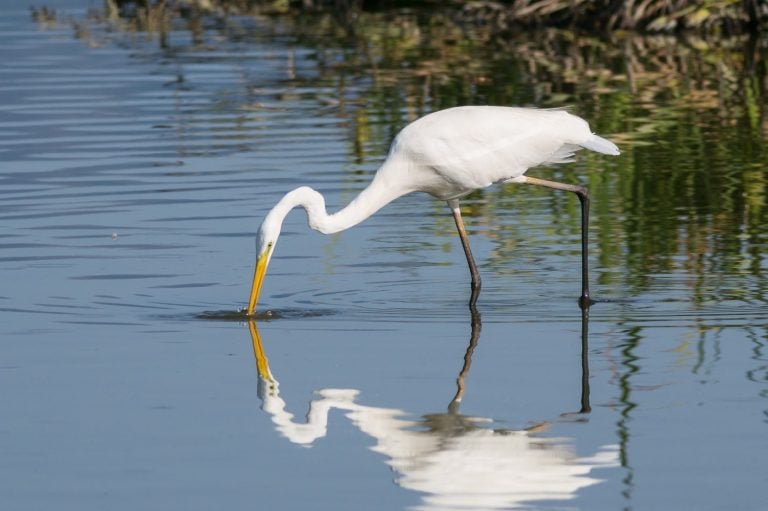
  • Great Egret (Ardea alba) looks for food by slow, careful wading in shallow water; often stands still, then spears fish, frogs, and aquatic bugs with a rapid neck thrust.
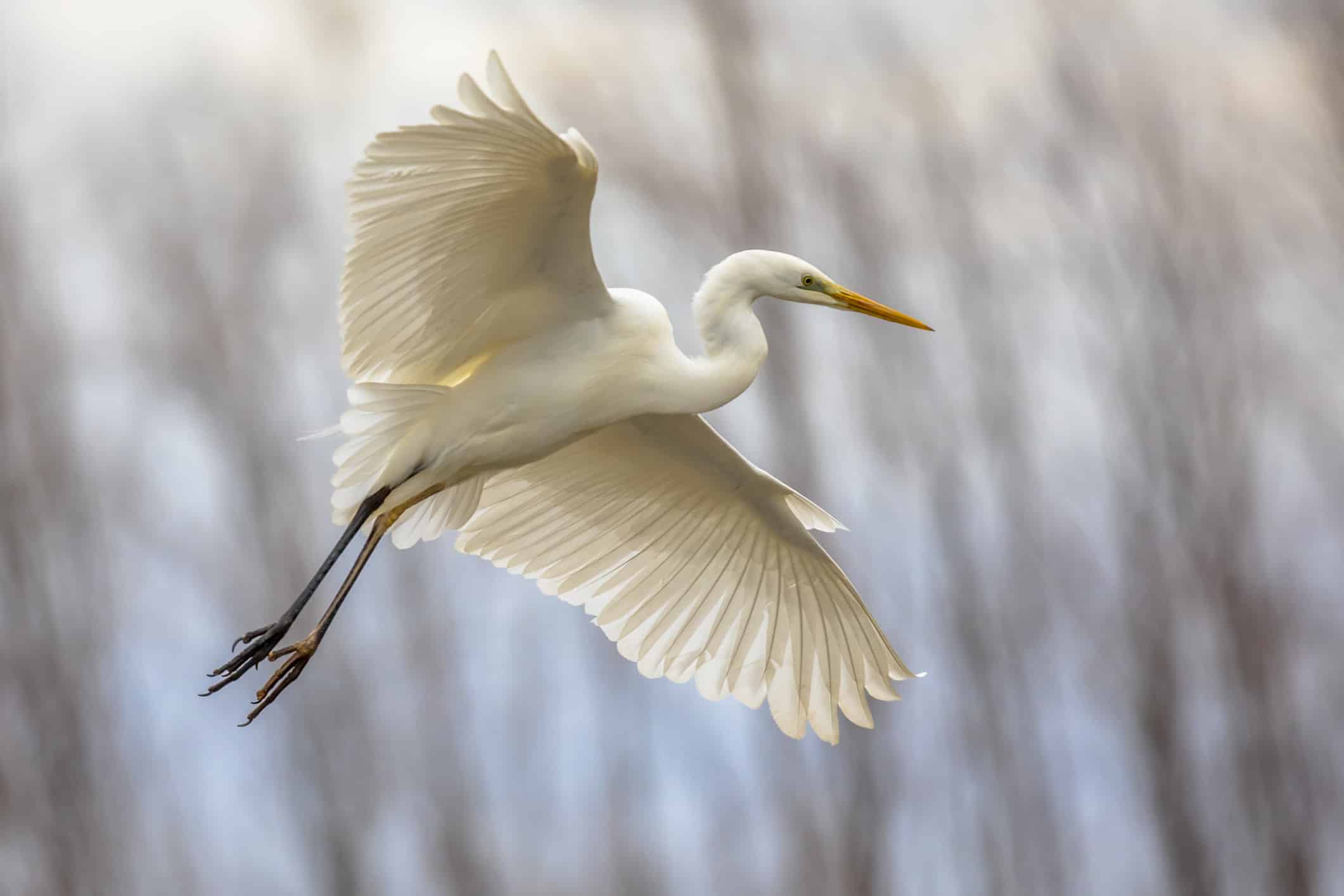
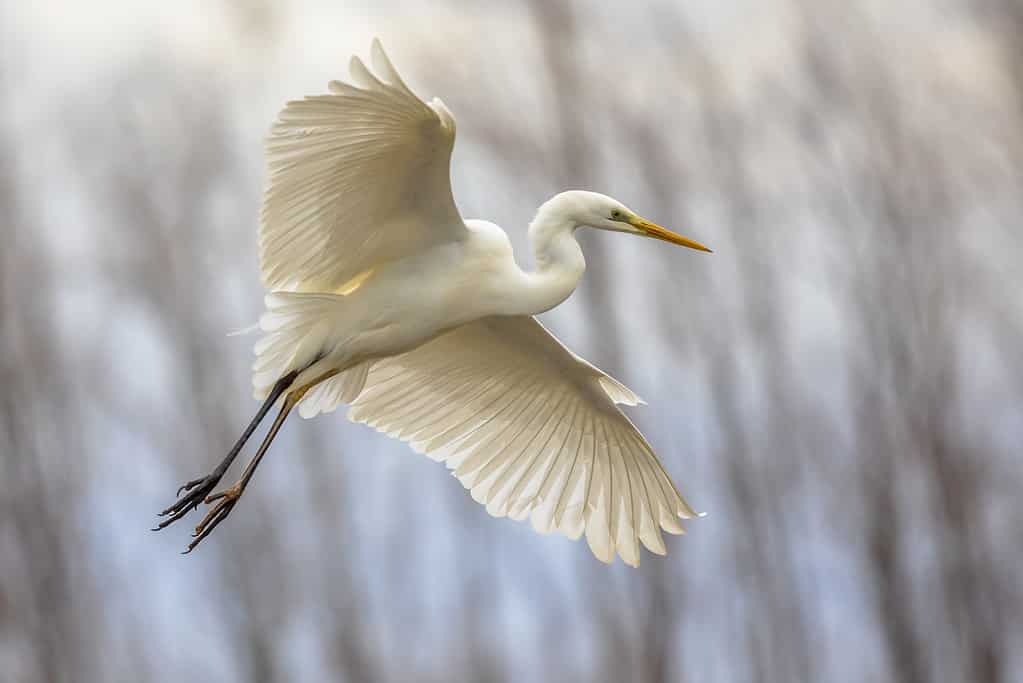
  • Typical flight silhouette: neck retracted in an 'S' curve, long legs trailing beyond tail (heron-like flight posture).
  • Longevity: documented wild individuals can exceed 15 years; banding records have reported maximum longevity >20 years (e.g., ~22 years). Source: USGS Bird Banding Laboratory longevity records (species-level reports).

Sexual Dimorphism

Sexes are very similar in plumage; differences are mostly in average size and breeding ornamentation intensity rather than color pattern.

  • On average slightly larger/heavier than females (overlapping ranges).
  • May show longer/more developed breeding plumes during peak display (variable and overlapping).
  • Slightly smaller on average (overlapping ranges).
  • Breeding plumes present as in males; typically not as elongated on average (variable).

Did You Know?

Size: 80-102 cm long; wingspan 131-170 cm (Birds of the World/Cornell Lab).

Field mark combo: yellow bill + black legs/feet; in breeding season the lores turn vivid green and the bill may darken.

Breeding plumes (long back plumes) can reach about 30-50 cm, once prized in fashion-driving early bird-protection laws.

Typical clutch is 3-4 pale blue-green eggs (range ~1-6); incubation about 23-26 days (Birds of the World).

Often hunts by "stand-and-wait" ambush, striking prey with a rapid bill jab powered by its spring-loaded S-neck.

Global footprint: occurs on every continent except Antarctica, using marshes, mangroves, lake edges, rice fields, and tidal flats.

Longevity: commonly reaches 15+ years; banding records include individuals over 22 years (USGS Bird Banding Laboratory longevity records).

Unique Adaptations

  • S-shaped neck as a strike mechanism: specialized vertebrae and muscles store elastic energy for rapid spearing strikes.
  • Pectinate (comb-like) claw on the middle toe: helps groom feathers and remove parasites-common in herons and egrets.
  • Powder-down patches: produce fine, talc-like keratin dust used to clean slime and oils from fish and feathers.
  • Long legs and widely splayed toes: stable wading and weight distribution on soft mud and floating vegetation.
  • Dagger-like bill: optimized for seizing and impaling slippery prey in shallow water.
  • Breeding color signals: bright green lores and enhanced plume display function as close-range cues in dense colonies.

Interesting Behaviors

  • Stand-and-wait foraging: statuesque stillness followed by a lightning-fast stab at fish, frogs, or crustaceans.
  • Slow stalking: deliberate steps with the neck partly coiled, then a sudden lunge when prey moves.
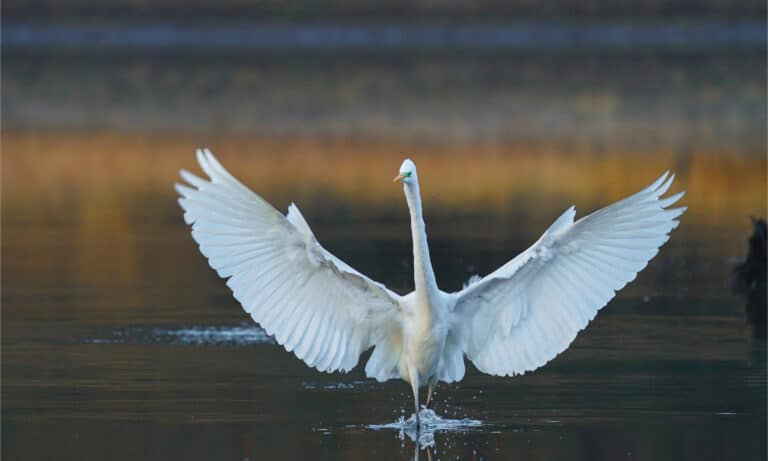
  • Wing-spread shading: sometimes opens wings to reduce glare and flush prey in shallow water.
  • Colonial nesting: breeds in "heronries," often mixed with other herons/egrets; adults may steal sticks from neighbors to build nests.
  • Courtship signaling: plume-raising, head-and-neck stretching, bill-pointing, and ritualized snapping/clattering near the nest site.
  • Chick rivalry: asynchronous hatching can create size differences; aggressive competition among nestlings is common in herons/egrets.
  • Seasonal movement: many temperate populations migrate or disperse after breeding, while tropical/subtropical birds may be resident.

Cultural Significance

The Great Egret (Ardea alba) became a symbol of bird conservation after its long feathers were hunted for hats, sparking laws and public action. The Audubon Society uses it as a symbol. Egrets and herons appear in art as signs of grace, patience, and healthy wetlands.

Myths & Legends

In Japan hot spring legends, a white heron or egret (Great Egret, Ardea alba) with a hurt leg bathes in a hot spring, comes out healed, and people follow it to find the spring.

Japan (Heron Maiden): a classic Japanese dance drama features a heron spirit taking the form of a woman, blending beauty with an uncanny, otherworldly stillness-echoing the bird's poised hunting stance.

China & East Asia (symbolic lore in painting): herons/egrets are traditional auspicious motifs; paired with lotus or reeds they can symbolize harmony, purity, and wishes for advancement (visual wordplay and rebus symbolism in classical art).

In South Asian epics, stories make a heron or crane—like the Great Egret (Ardea alba)—a calm, watchful bird that stands for secret plans, an image that keeps appearing in moral and literary tales.

Conservation Status

LC Least Concern

Widespread and abundant in the wild.

Population Increasing

Protected Under

  • United States: Migratory Bird Treaty Act (MBTA)
  • European Union: Birds Directive (Directive 2009/147/EC)
  • Agreement on the Conservation of African-Eurasian Migratory Waterbirds (AEWA)
  • Many range states: protected under national wildlife legislation; wetland sites often protected/managed via Ramsar-designated wetlands and protected-area networks

Life Cycle

Birth 3 chicks
Lifespan 15 years

Lifespan

In the Wild
1–22.83 years
In Captivity
2–25 years

Reproduction

Mating System Monogamy
Social Structure Socially Monogamous
Breeding Pattern Seasonal
Fertilization Internal Fertilization
Birth Type Internal_fertilization

Great Egret (Ardea alba) is seasonally monogamous, forming one male–female pair per nesting attempt in dense colonies (heronries). Males show and defend nest sites. Pairs share nest building, incubation, and feeding; clutch 3–4 eggs; no helpers.

Behavior & Ecology

Social Colony Group: 100
Activity Diurnal, Crepuscular
Diet Carnivore small fish
Seasonal Migratory 1,243 mi

Temperament

Generally wary and vigilant in open wetlands; flushes readily from disturbance, especially outside colonies (Birds of the World).
Territorial/agonistic at close range: defends nest site and may aggressively displace conspecifics at profitable feeding spots; threat displays include bill jabs, wing spreading, and posture escalation (Kushlan & Hancock 2005).
Socially tolerant at broader scales: nests in dense colonies and uses communal roosts, with aggression typically confined to nest perimeter or immediate feeding position (Hancock & Kushlan 1984; Birds of the World).
Seasonally variable: increased aggression and display intensity during courtship/breeding; more gregarious flocking/roosting tendencies often outside breeding season where conditions favor aggregation (Birds of the World).

Communication

Harsh croaks/squawks used in alarm, disturbance, and aggressive interactions at nests/roosts Commonly described as a rough 'kraak' or grating croak in field and species accounts
Short greeting/contact calls between mates and at nest exchanges; louder, more frequent calling during courtship and nest defense Birds of the World, Great Egret
Chick begging calls increase in rate/intensity with hunger and parental arrival General Ardeidae pattern; described for Great Egret in Birds of the World
Visual displays are primary at close range: bill pointing, neck stretching, wing spreading, plume erection, and head/neck shaking during courtship and territorial interactions Kushlan & Hancock 2005; Birds of the World
Bill snapping/clappering and strike postures as close-range threat signals Ardeidae social behavior described in Hancock & Kushlan 1984; applied in Great Egret accounts
Body orientation and spacing Approach/retreat, maintaining inter-individual distance) regulate feeding-site interactions; nest-boundary defense is communicated largely through posture before escalation to contact aggression (Kushlan & Hancock 2005

Habitat

Biomes:
Wetland Freshwater Marine Temperate Forest Temperate Grassland Mediterranean Savanna Tropical Dry Forest Tropical Rainforest +3
Terrain:
Coastal Riverine Plains Valley Island Muddy Sandy +1
Elevation: Up to 6561 ft 8 in

Ecological Role

Wetland mesopredator/top predator (site-dependent) linking aquatic prey production to terrestrial roosting/nesting sites.

Controls/redistributes populations of small fish, amphibians, and aquatic invertebrates through predation (can influence community structure in shallow wetlands). Transfers aquatic-derived nutrients to terrestrial habitats via guano at roosts/colonies, locally fertilizing soils and affecting plant productivity. Acts as a bioindicator of wetland condition (prey availability and contaminant burdens can be reflected in foraging success and colony performance).

Diet Details

Main Prey:
Small fish Amphibians Crustaceans Aquatic and terrestrial insects and invertebrates Reptiles Small mammals Earthworm +1

Human Interaction

Domestication Status

Wild

Great Egret (Ardea alba) is a wild, not domesticated waterbird. In the late 1800s and early 1900s it was hunted for long breeding plumes for hats, causing drops in numbers and led to bird-protection laws and Audubon groups. After legal protection and wetland conservation, numbers recovered. Today people manage habitat, protect colonies, and allow limited care, research, or display.

Danger Level

Low
  • Physical injury if handled/approached closely: defensive stabbing with the bill can cause puncture wounds and serious eye injury risk (notably during capture/rehabilitation or when cornered).
  • Zoonotic/health exposure typical of wild birds: potential carriage of enteric bacteria (e.g., Salmonella spp.), ectoparasites, and pathogens of concern in surveillance contexts (e.g., avian influenza viruses); risk is mainly to handlers without protective hygiene/PPE.
  • Colony nuisance in urban-adjacent rookeries: noise, odor, and fecal accumulation on vegetation/structures; can create localized sanitation/cleanup concerns but rarely direct danger.

As a Pet

Not Suitable as Pet

Legality: Generally illegal to keep as a pet in many places. In the United States, Ardea alba (Great Egret) is protected by the Migratory Bird Treaty Act; permits are needed for rehab, science, or zoos. Check local laws.

Care Level: Expert Only

Purchase Cost:
Lifetime Cost: $15,000 - $60,000

Economic Value

Uses:
Ecotourism and wildlife viewing (rookeries, wetlands, birding) Ecosystem services (predation on aquatic prey; wetland indicator species) Education and conservation flagship value Historical commercial value (aigrette plume trade; now illegal in most places) Herons and egrets can have a mix of positive value (birding/ecosystem indicators) and negative externalities (noise and fecal accumulation at nesting colonies, fish-farm depredation complaints in some regions).
Products:
  • No legal contemporary commercial products from Great Egrets in most jurisdictions
  • Historically: ornamental breeding plumes used in hats and clothing (late 19th-early 20th century trade)

Relationships

Related Species 12

Great Blue Heron
Great Blue Heron Ardea herodias Shared Genus
Grey Heron
Grey Heron Ardea cinerea Shared Genus
Purple Heron Ardea purpurea Shared Genus
Cocoi Heron Ardea cocoi Shared Genus
Goliath Heron Ardea goliath Shared Genus
Black-headed Heron Ardea melanocephala Shared Genus
Intermediate Egret Ardea intermedia Shared Genus
Snowy Egret Egretta thula Shared Family
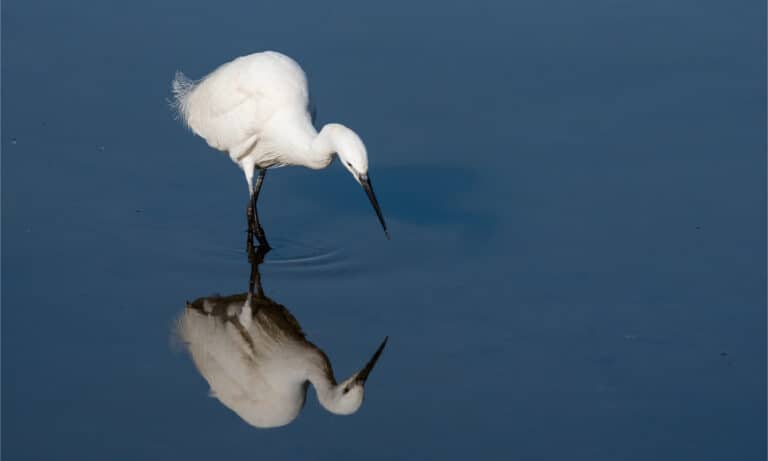
Little Egret Egretta garzetta Shared Family
Cattle Egret Bubulcus ibis Shared Family
Black-crowned Night-Heron
Black-crowned Night-Heron Nycticorax nycticorax Shared Family
American Bittern Botaurus lentiginosus Shared Family

Ecological Equivalents 6

Animals that fill a similar ecological role in their ecosystem

Snowy Egret Egretta thula Both Great Egret and Snowy Egret feed in the same shallow wetlands and estuaries and hunt by sight, using slow stalking and quick bill strikes to catch small fish and crustaceans. The Great Egret tends to stand and wait, while the Snowy Egret often stirs its feet.
Little Egret Egretta garzetta Ecological analogue across much of Eurasia and Africa: both exploit similar prey and microhabitats (mudflats, marsh edges, rice fields) and often mix in feeding flocks where prey is concentrated; wetland foraging guild overlap is reported in ardeid ecology literature (Birds of the World).
Great Blue Heron
Great Blue Heron Ardea herodias Both species hunt by slow stalking in shallow water followed by a rapid spear strike. They partition habitat and prey by water depth and prey size: the Great Blue Heron typically forages in deeper water and takes larger prey.
Black-crowned Night-Heron Nycticorax nycticorax Shares a wetland prey base (fish, amphibians, crustaceans) and frequently nests in mixed ardeid colonies; differs mainly by being primarily crepuscular/nocturnal, but strongly overlaps in habitat use and trophic role. Colony ecology and diet breadth are summarized in Birds of the World.
White Stork Ciconia ciconia Large wetland wader that uses flooded fields and marshes. Eats fish, frogs, and large aquatic invertebrates like crabs. Overlaps with storks, but storks forage more on land and eat more insects and small vertebrates.
Glossy Ibis Plegadis falcinellus Co-occurs in marshes and impoundments and both exploit shallow-water prey. The ibis uses tactile probing while the Great Egret uses visual spearing—distinct foraging methods that occupy the same prey-rich wetlands and contribute to a shared wading-bird guild structure (wader guild ecology literature).

Great egrets spend all their lives near wetlands and swamps. The legs help them wade easily through the shallow water in search of food. While they live in colonies, great egrets sometimes compete with each other for mates. This article will cover some interesting facts about the physical characteristics, behavior, and migration patterns of the great egret.

3 Great Egret Amazing Facts

  • The great egret will retract its long, curved neck when in flight. The retractable neck is a common characteristic of herons, but not storks and cranes.
  • When the breeding season arrives, soft, delicate ornamental feathers sprout from the back. The long, sinewy feathers help to attract a mate.
  • The great egret is a symbol of the National Audubon Society.

Where to Find the Great Egret

The great egret can be found all over the world near warm or tropical lakes, swamps, marshes, ponds, or wetlands, preferably with extensive reed beds and trees. Among the four subspecies, one is found primarily in Europe, another is located in the Americas, a third is in Africa, and the eastern great egret is found in Asia and Oceania. The eastern great egret is almost distinct enough to be classified as its own separate species, but for now, it remains a subspecies of the great egret.
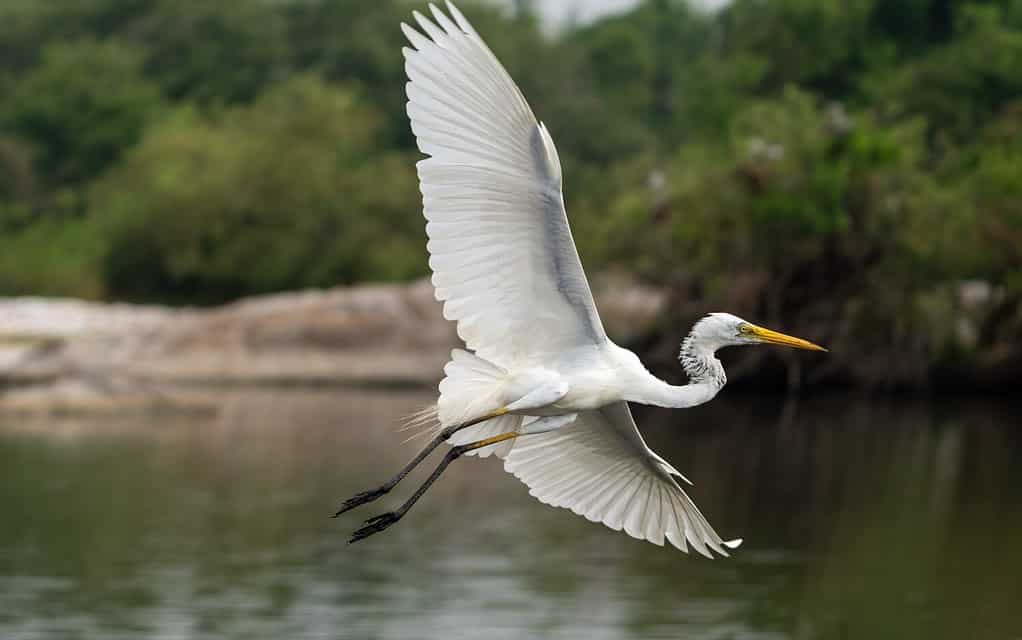
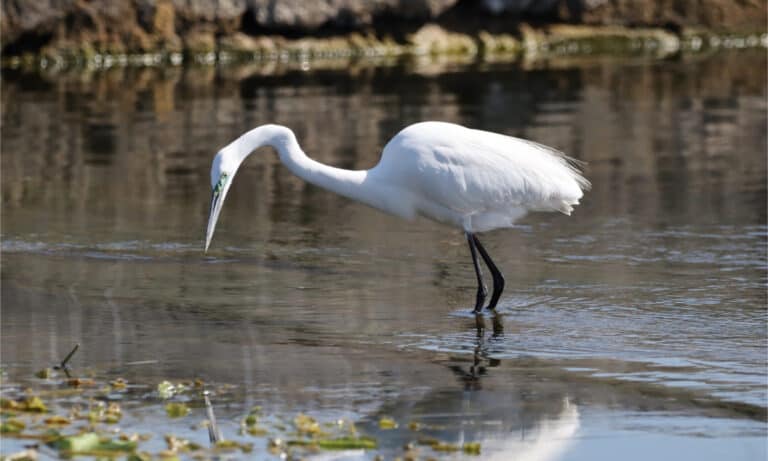
Great egret (Ardea alba) also known as the common egret

The great egret has a remarkably long neck and spear-like bills to catch aquatic prey.

Great Egret Nests

The great egret nest is composed of sticks, twigs, and stems located in a colony close to the water. The nest can measure up to 3 feet long.

Great Egret Scientific Name

The scientific name of the great egret is Ardea alba. Ardea means heron in Latin, whereas alba means white. It is closely related to the gray heron, great blue heron, Pacific heron, and other species within the same genus. There isn’t much of an evolutionary difference between the egret and the heron. For instance, several herons are classified in the genus Egretta, and several egrets are classified in the genus Ardea. The main difference between these two genera comes down to size. Members of Ardea tend to be larger than members of Egretta.

Great Egret Size, Appearance, and Behavior

The great egret is characterized by extremely long, slender black legs, a big white body, a long yellow dagger-like bill, and a long neck that forms an S shape when retracted back toward the body. They measure more than 3 feet in height with an average wingspan of 5 feet. Males tend to be slightly larger than females, but otherwise, they are difficult to tell apart from each other.

Great egrets mostly live and breed in communal roosting sites near the shore. They spend most of their day feeding in shallow water and then gather in the nest around dusk. Great egrets are fairly aggressive about defending their territories, especially in the breeding season. They may leap at or jab an intruder while squawking loudly to chase it away.

Great Egret Migration and Timing

In warm climates, the great egret is mostly sedentary for the entire year, but northern populations do undertake a long migration south for the winter in response to changing temperatures. American birds may travel all the way down to the southern United States or Central America, while populations from central and eastern Asia may travel to South Asia and the Pacific island part of their range.

Great Egret Diet

The great egret is a carnivorous bird. They stand near the shore in shallow water and pick up food with their long beak. The competition with other wading birds is often quite fierce, but because of their enormous height and imposing size, great egrets have an advantage; they will sometimes steal food directly from the mouths of smaller birds.

What does the great egret eat?

The great egret has a very diverse diet that consists largely of fish, mice, frogs, snakes, crayfish, and insects. Their bill strikes are extremely fast and accurate.

Great Egret Predators, Threats, and Conservation Status

According to the IUCN Red List, the great egret is considered to be a species of least concern. At one point in the 19th century, large numbers of egrets were killed to make clothing from their plumage. While they are currently protected from hunting by the US Migratory Bird Treaty Act, great egrets still suffer from the loss of wetland habitats. Water pollution also poisons birds and thins out their shells.

What eats the great egret?

The adult egrets have very few, if any, predators in the wild, but eggs and juveniles are particularly vulnerable to jays, crows, vultures, and raccoons.
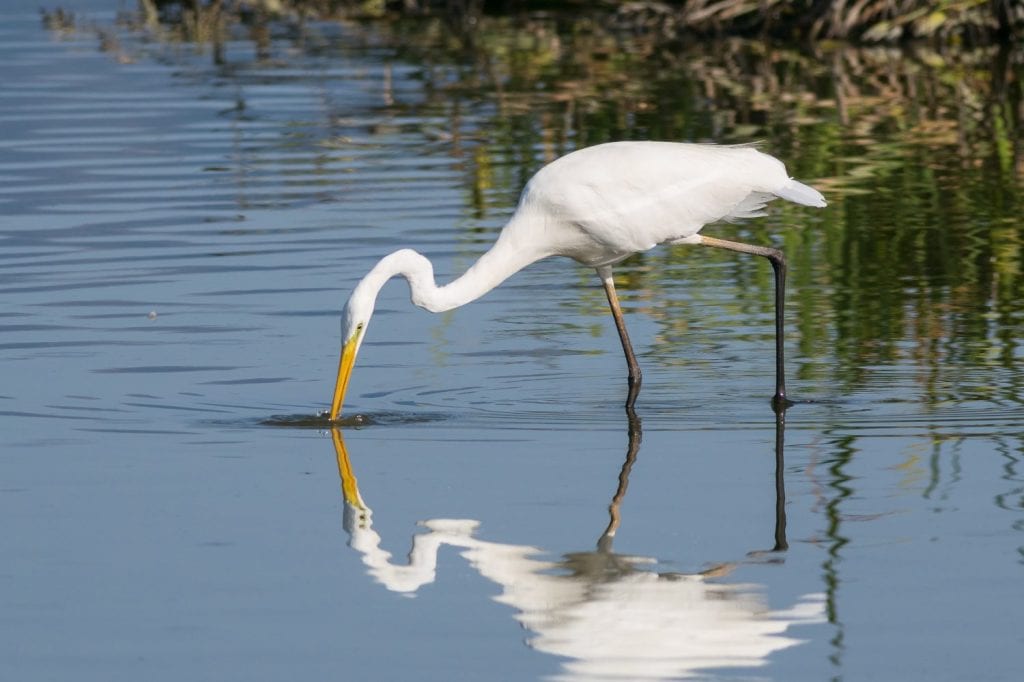
The Great Egret (Ardea alba), also known as common egret, large egret or great white heron , is a large, widely distributed egret. Distributed across most of the tropical and warmer temperate regions.

The Great Egret (Ardea alba), also known as the common egret, large egret, or great white heron, is a large, widely distributed egret.

Great Egret Reproduction, Young, and Molting

The breeding season begins once a year in the middle of April when the male selects a territory and attempts to attract a suitable mate with his ritualized display, which includes mating calls, circular flight displays, and pointing his bill skyward with wings outstretched. Once a mate is selected, the pair will remain monogamous for the remainder of the breeding season. Together, they will produce an average of three to four eggs in the nest, although sometimes up to six. If one egg is damaged, then the female can replace it quickly with another.

The chicks will hatch from the eggs after an incubation period lasting 23 to 24 days. They are covered in white down feathers and are completely dependent on both parents for food and protection. Parents regurgitate the food directly into the mouth of the juvenile to feed them. It takes about two or three weeks for the juveniles to start growing their flight feathers and around six or seven weeks to leave the nest. The average age for sexual maturity is about two years of age. If the juvenile reaches adulthood, then the typical lifespan is 15 years in the wild and almost 23 years in captivity.

Great Egret Population

The great egret has an estimated population of 590,000 to 2.2 million mature individuals in the wild. Populations declined precipitously by the turn of the 20th century, but thanks to a ban on hunting, their numbers have greatly increased since then. Their range has now spread as far as the United Kingdom, where the first breeding pair was established in 2012.

View all 261 animals that start with G

Sources

  1. Animal Diversity Web / Accessed March 11, 2022
  2. Audubon / Accessed March 11, 2022
Austin S.

About the Author

Austin S.

Growing up in rural New England on a small scale farm gave me a lifelong passion for animals. I love learning about new wild animal species, habitats, animal evolutions, dogs, cats, and more. I've always been surrounded by pets and believe the best dog and best cat products are important to keeping our animals happy and healthy. It's my mission to help you learn more about wild animals, and how to care for your pets better with carefully reviewed products.
Connect:

Thank you for reading! Have some feedback for us?


Great Egret FAQs (Frequently Asked Questions)

Northern populations migrate south for the winter.